Same Hall, Two Rulebooks: Who Gets Paid While Singapore’s Local AI Buyers Wait for a US Licence
From 19 November, advanced US AI chips going to Singapore need a licence unless the buyer is headquartered in the US. Two firms in one building can now face two rulebooks. Singtel’s next 2 MW of AI servers waits; Singapore is asking for “trusted access”.

Two companies can rent space in the same Singapore data hall, buy the same Nvidia chip, and from 19 November face two different rulebooks. If the buyer’s headquarters are in the US, its supplier sends Washington a monthly report and the chips keep coming. If the buyer is a Singapore company, it needs a US licence first. Singtel’s next 2 MW of AI servers sits on the wrong side of that line. Singapore has asked for “trusted access”, and on 18 November said both sides will follow up. The stuck step is the licence.
SINGAPORE PULSE · AI DATA CENTRES · EXPORT CONTROLS · GPU CLOUDS · Data as at 18 Nov 2026 (rule released 16 Nov; Singapore follow-up 18 Nov) · Next update: when the rule is published and takes effect, expected 19 Nov 2026
Affects: AI Data Centers · Neoclouds · Hyperscalers — Markets: Singapore · Malaysia · China · US
Education only, not advice to buy or sell any security. All money figures are Singapore dollars (S$) or US dollars ($) as marked. A megawatt (MW) is a measure of how much electricity a data hall can deliver to its servers; it is the usual way to size a data centre. A “GPU cloud” rents out AI chips over the internet instead of selling them (GPU cloud providers explained). Yesterday our China desk covered what this rule means for Chinese AI labs that used chips abroad (offshore chips need a licence). This note is about something different: what it does to companies based in Singapore itself.
The numbers that matter this week
Rule starts
19 Nov
Effective on publication · released 16 Nov
NewUS-headquartered buyers
Report
Monthly reports instead of a licence
PaidSingapore-headquartered buyers
Licence
Case-by-case US review
WaitsSingtel RE:AI
4 of 6 MW
Installed · 2 MW contracted, due from Jan–Mar 2027
WaitsSingapore and US
Follow-up
Teo and Kessler agree to work on “trusted access”
NewThe gate
The licence
No approvals yet · US industry briefings planned
Stuck stepUS interim final rule (public inspection copy, filed 16 Nov 2026); MDDI–METI statement 16 Nov; CNA 18 Nov; Singtel via The Straits Times and The Business Times, 17 Nov 2026. Status chips are Second Order’s read.
On this page: Why it matters · What the rule asks · What Singapore did · How stocks read it · What operators said · Our math · Who gets paid · What is stuck? · Dates next · FAQ
Why does a headquarters test matter inside a Singapore data hall?
Picture a block of flats with one loading bay. Two neighbours order the same new oven from the same shop. For the first neighbour, the shop just writes the delivery in a monthly logbook and drops it off. For the second, the shop must first send a form overseas and wait for a stamp. Same building, same oven, same lift. The only difference is where each neighbour’s family home is. The second neighbour can still get the oven. It just cannot plan the kitchen until the stamp comes back.
That is close to what the new US rule does in Singapore. The building does not matter. The chip does not matter, as long as it is one of the advanced AI chips the rule covers. What matters is where the buyer, or its ultimate parent company, is headquartered. A US cloud company is the first neighbour. A Singapore telco, a Singapore AI start-up or a Singapore research cloud is the second.
Professor Ramkishen Rajan of the Lee Kuan Yew School of Public Policy put it in one line to The Business Times: two companies in the same building in Singapore could face quite different rules, simply because of where their headquarters are. For a country that has built its data centre industry on being neutral ground for everyone, that is a new kind of cost. It is not a ban. It is a queue, and only some people have to stand in it.
Singapore is not a small player here. It has more than 70 cloud, enterprise and shared data centres with a combined capacity above 1.6 gigawatts, according to Lianhe Zaobao. New capacity is rationed, mainly by power, and handed out through government tenders; the last round gave 50 MW each to four operators (how Singapore rations data centre power, the green-fuel condition). So the question of who can fill those scarce megawatts with the newest chips, and how fast, goes straight to who earns money from them.
What does the rule ask of Singapore?
The US Commerce Department released an interim final rule called Addressing Remote Access to Advanced Semiconductors on Monday 16 November. An interim final rule takes effect first and collects comments afterwards. The public inspection copy says it takes effect on the day it appears in the Federal Register, and the Federal Register lists that day as 19 November. These are the parts that touch Singapore:
- A new country licence. A licence is needed to export, re-export or transfer within the country advanced AI chips going to Indonesia, Malaysia, Singapore, Thailand or Brazil. The rule calls these countries a higher-than-normal risk of chips being moved on to places they should not go.
- Transfers inside Singapore count. A chip that is already in Singapore and is passed from one company to another inside the country is also covered.
- A US-headquarters exception. The licence is not needed if the buyer, or its ultimate parent, is headquartered in the US, provided the exporter files a monthly report. The report lists the buyer and its parent, the destination, the product, its computing score, the quantity and the date.
- Case-by-case review. Everyone else applies, and each application is looked at on its own. The rule does not publish a deadline for decisions.
- A separate data centre test. Anywhere in the world, a licence is needed to send advanced chips to a data centre that gives more than 12 million units of computing power, measured in a score called TPP, to companies headquartered in China, Macau or other countries of concern. By our China desk’s arithmetic that is roughly 333 of Nvidia’s B200 chips. Halls that already serve such customers get 90 days to win a licence.
- Clocks. Shipments already on their way may finish within 30 days. Comments are due 60 days after publication.
- Warnings to countries. The rule says the US will watch for countries that tolerate evasion and may answer with import limits, new licence needs, a lower status in US export rules, or blacklisting of people involved.
Notice what the country licence does not say. It does not ask whether the Singapore buyer has Chinese customers. Singtel’s AI cloud, which says it serves Singapore only, falls under it just as much as an operator renting to overseas AI labs. The test is the headquarters of the buyer, full stop. That is why companies with no China business at all are now filling in forms.
What has Singapore said and done since Monday?
The government answered the same day. In a joint statement on 16 November, the Ministry of Digital Development and Information and the Ministry of Energy, Trade and Industry said they were studying the measure, talking to affected companies, and engaging US authorities on its scope and how it will be applied, as well as exploring how to facilitate trusted access for Singapore companies. The statement added that Singapore does not condone companies using their link with Singapore to get around other countries’ laws, including export controls.
Then it moved from studying to talking. On Tuesday 17 November, Minister Josephine Teo spoke with Jeffrey Kessler, the US Under Secretary of Commerce who runs export controls. In a statement on Wednesday reported by CNA, her ministry said the two discussed a shared interest in consistent and clear rules for legitimate business, and agreed to follow up on practical arrangements so that Singapore users keep trusted access to advanced American technology. Mrs Teo welcomed a US plan to hold industry briefings to explain what the rules require. Speaking at a conference in the US, she noted that about 6,000 US companies operate in Singapore and said there is positive momentum she would like to keep going.
That is real movement, but it is not yet a result. “Agreed to follow up” is a door left open, not a licence granted. No list of trusted companies, no blanket approval and no date have been announced. For a business planning a hall, the words that matter are still “case by case”.
Why Singapore and not, say, Japan? Part of the answer is money flows. CNBC reported that the share of Nvidia’s revenue billed to Singapore rose to 22% in the quarter to July 2025, while Singapore’s trade ministry estimated that chips physically delivered there were less than 1% of the company’s revenue. Singapore is where many regional deals are invoiced, not where most chips end up. That makes it look, from Washington, like a crossroads worth watching.
The other part is one company. On 17 November the US Justice and Commerce departments published a joint statement on Megaspeed, a Singapore-based company that rents out computing power. They said Commerce opened an export-control investigation in 2024, that Nvidia placed Megaspeed on its no-sell list in June 2025, and that US officials carried out a check at the company that month together with Singapore law enforcement. The Justice Department now leads a criminal investigation. No court has found that Megaspeed broke any law, and the company has denied wrongdoing. Singapore’s police say their own investigation into the company and six other people is still open. Whatever the outcome, the case is part of why Singapore landed on the list of five.
How did Singapore stocks read it on 17 November?
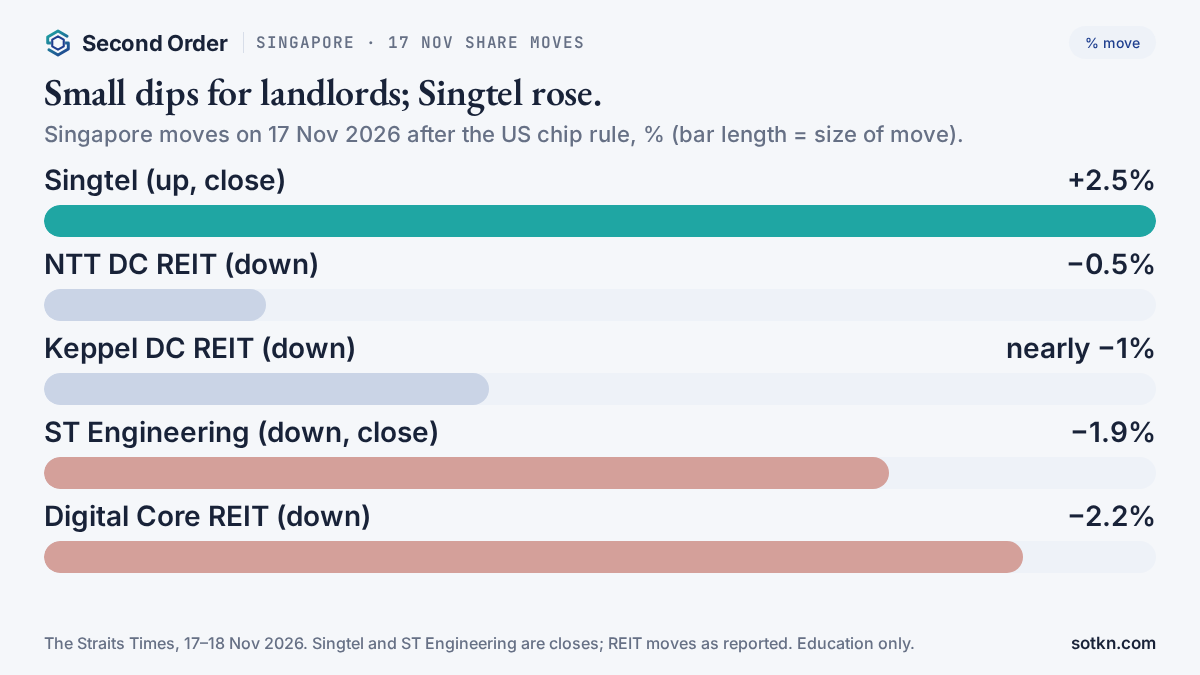
Singapore’s market answered on Tuesday, and it did not treat every data centre name the same.
- Singtel rose. Its shares were up 1.8% in the afternoon and closed 2.5% higher at S$4.10.
- ST Engineering, which designs and builds data centres among much else, fell 2.3% during the day and closed 1.9% lower at S$8.86.
- Digital Core REIT, which owns data centres sponsored by the US company Digital Realty, fell 2.2%.
- Keppel DC REIT fell by nearly 1%.
- NTT DC REIT, which trades in US dollars, fell 0.5%.
Two things stand out. First, the falls were small next to the near-20% drops in some Malaysian data centre builders the same day, which our China desk covered yesterday. Second, the one company with a direct licence problem, Singtel, went up. That is less strange than it looks. Singtel had raised its profit guidance on 13 November, the AI cloud is a small part of a very large group, and its data centre arm said its exposure is tiny. Investors seem to have read the licence as a nuisance for Singtel, not a threat.
Analysts mostly said the same. OCBC’s Andy Wong said the direct impact on Singapore-listed data centre names is likely contained, because they mainly act as landlords and infrastructure providers, and noted that Keppel DC REIT has most of its power capacity already contracted. CMC Markets’ Eric Xiao made the landlord point plainly: the main tenants, US tech giants such as Amazon and Google, bring their own AI servers and are exempt from the new licences. Saxo’s Charu Chanana said the sector faces no demand collapse but a more complicated next phase, with the biggest risk for operators that depend on Chinese AI customers. Phillip Securities’ Ben Chong warned against treating the rule as a uniform cut in demand.
The one warning worth keeping came from OCBC: second-order effects, if customers delay or cancel expansion plans and that slows leasing and new projects in the region. That is the part that would show up later, in leasing numbers, not in a single day’s prices.
What did the operators say about their own halls?
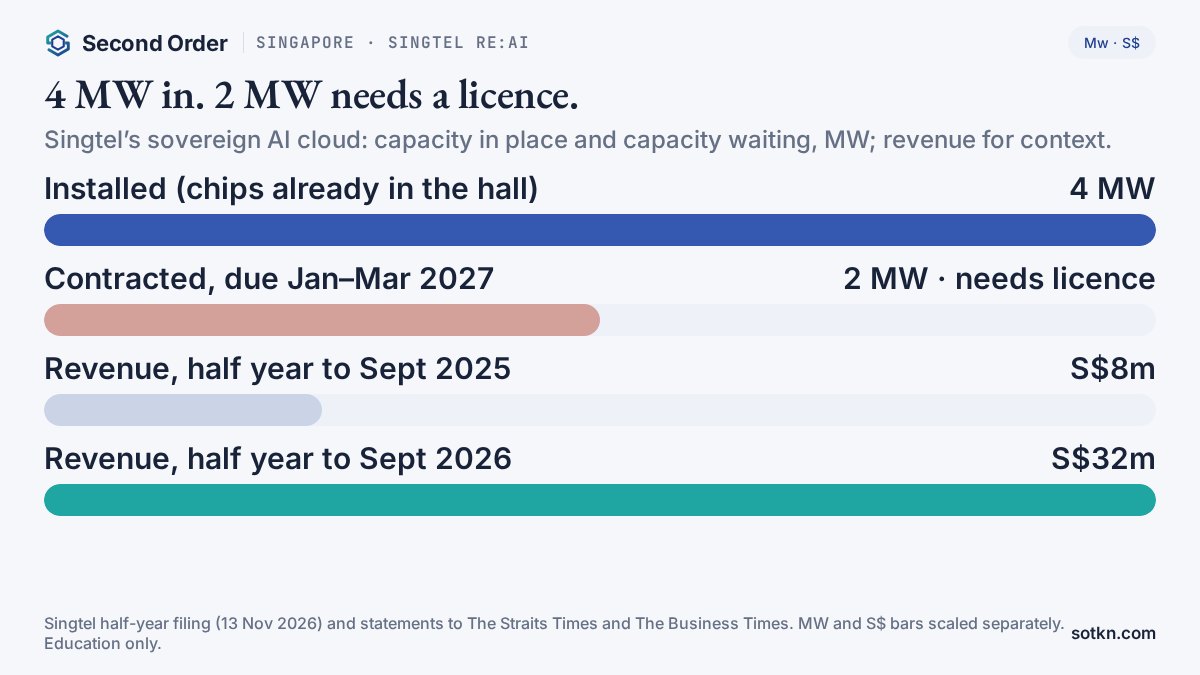
Singtel is the clearest case, because it buys Nvidia chips for its own AI cloud, RE:AI, rather than only renting out space. It told The Straits Times and The Business Times that RE:AI is a sovereign AI platform that serves Singapore only, mostly public sector and research agencies, and that no chips are being re-exported. Of RE:AI’s 6 MW, 4 MW is already installed, which its Digital InfraCo chief Bill Chang said means those chips are already in the data centre. The other 2 MW is contracted and due to be deployed from the fourth quarter of Singtel’s financial year, which is January to March 2027. Singtel said it expects minimal impact but will work with the government to obtain the necessary clearance and licences (what Nxera does).
So the licence does not touch what Singtel already has. It touches what Singtel is about to add. In the half year to September, RE:AI’s revenue rose to S$32 million from S$8 million, and its earnings before interest, tax, depreciation and amortisation rose to S$18 million from S$2 million, according to Singtel’s filing. A business that quadrupled in a year now has its next third of capacity behind a US form.
For its Nxera data centres, Singtel said only an insignificant amount of capacity is contracted to neoclouds, the newer AI-only cloud companies, and that it is not a material part of contracted revenue. It added a line worth noting: it will execute later pipelines in a disciplined and gated manner. In plain terms, Singtel will be choosier about who it signs.
Keppel said it does not expect a significant impact on its Singapore data centre business, because most of its Singapore halls, including the floating data centre under construction, are predominantly committed to US-based hyperscalers, the largest cloud companies (what Keppel DC REIT does, Keppel DC REIT’s quarter). ST Engineering said its existing operations are not affected.
The US operators sounded different, and that is the point. Serene Nah, Digital Realty’s Asia-Pacific head, said that as a US-based operator the company might have a better operating advantage, depending on how the rules are applied. She also said it will have to be even more selective about the customers it picks for SIN13, its 50 MW Jurong Island data centre due by 2029, even though many US-headquartered customers have shown interest (what Digital Realty does, Digital Core REIT’s SIN12 lease). Equinix said it is reviewing the rule and noted that, as a provider of space, power and connections, it does not directly provide access to computing such as GPUs (what Equinix does, Equinix SG6).
Put the answers side by side and a pattern appears. Landlords whose halls are filled by US clouds bringing their own chips are, for now, mostly outside the problem. US-headquartered operators gain a selling point. The companies with the most paperwork are the local ones that buy chips themselves, and anyone whose customers have a Chinese parent.
What does the arithmetic say?
Everything below is our arithmetic from published figures, not a forecast by any company or government. The dates after 19 November assume the rule is published that day, as listed.
Singtel RE:AI capacity
Singtel RE:AI money, half year to Sept
How big is the waiting slice?
The clocks, if published 19 Nov
Billing hub, not delivery hub
Singtel half-year filing (13 Nov 2026) and statements to The Straits Times and The Business Times; Lianhe Zaobao; CNBC; rule text. The S$16m line assumes the next 2 MW earns what the first 4 MW did in the half; it could be off either way, because capacity grew during the half and prices may differ.
Read the table this way. In megawatts, the slice that needs a licence today is tiny next to Singapore’s whole industry. In money, it is the fastest-growing slice: a cloud that quadrupled its revenue in a year, with its next third of capacity waiting. And the 90-day clock is aimed at a different group, halls serving companies with Chinese parents, which Singtel and Keppel say they barely have. The country licence is the clock that matters for local buyers, and it has no published end date.
Who gets paid, and who waits?
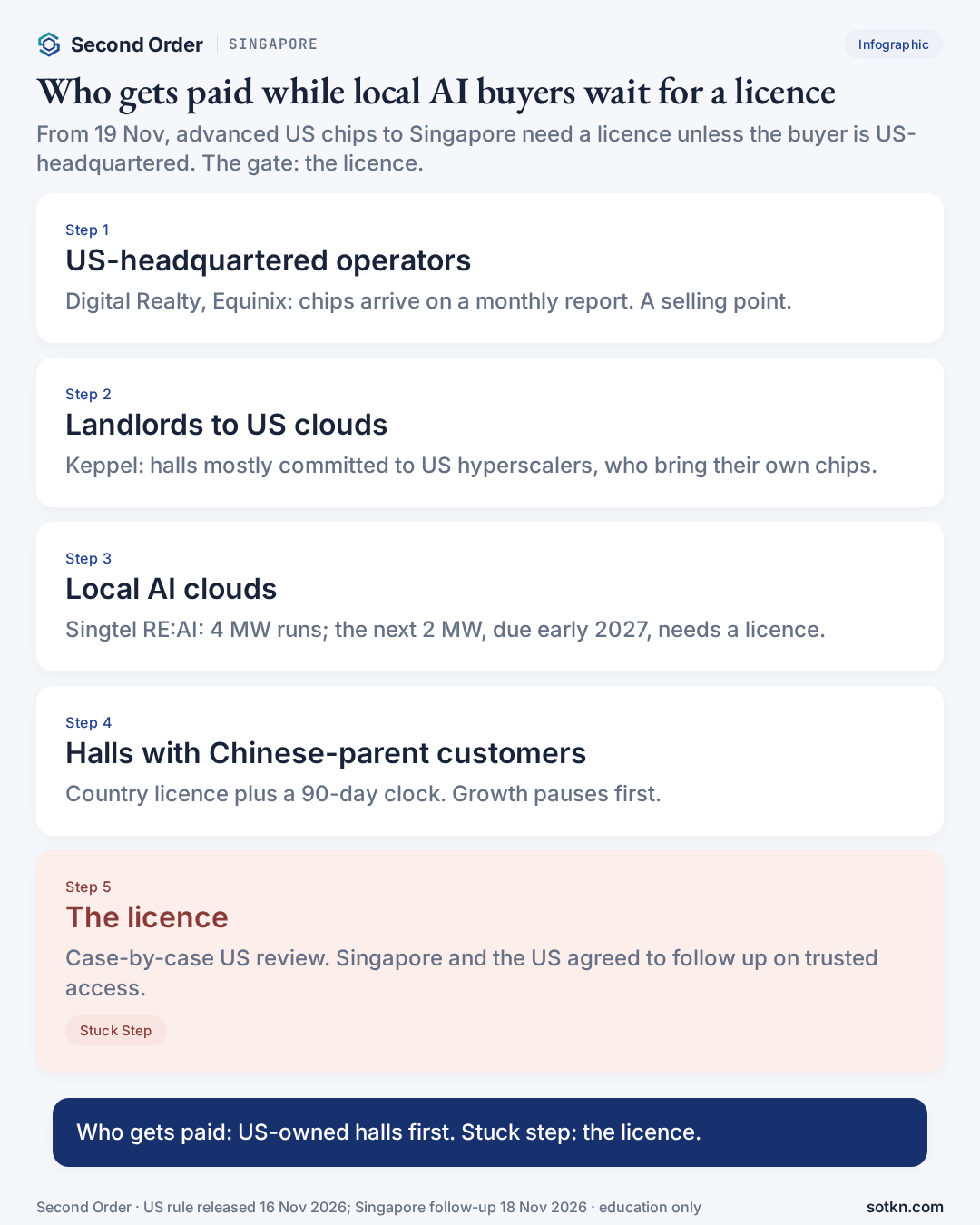
1 · US-headquartered operators
Who: Digital Realty, Equinix and other US-owned halls
Paid: Simpler path for chips; a selling point to tenants
2 · Landlords to US clouds
Who: Keppel, Keppel DC REIT and halls leased to US hyperscalers
Paid: Tenants bring their own chips and only report
3 · Compliance and checks
Who: Customer checks, records, licence filings, monthly reports
Paid: Work for lawyers, auditors and compliance teams
4 · Local AI clouds
Who: Singtel RE:AI and other Singapore-based GPU clouds
Paid: What is installed runs; the next chips need a licence
5 · Halls with Chinese-parent customers
Who: Operators serving firms whose parents are in China
Paid: 90 days to win a licence; growth paused
6 · The licence
Who: Case-by-case US review; trusted-access talks under way
Paid: Sets the timing for everyone in rows 4 and 5
First paid, the US-headquartered operators. Digital Realty said it outright: being a US company may be a better operating advantage. When a tenant chooses between two halls with similar power and price, the one where new chips arrive on a monthly report rather than a licence is easier to plan around. That matters most for the scarce new capacity, such as the four 50 MW tender wins, which are still to be filled (who the neoclouds are).
Second, the landlords whose halls are leased to US clouds. Their tenants bring their own servers and are exempt if their suppliers report. Keppel says its Singapore halls are predominantly committed to US hyperscalers. For these landlords the rule changes little today, which is why their prices moved little. The risk sits further out, if the rule slows regional demand from other customers.
Third, everyone in the compliance chain. Sellers must now know who the ultimate parent of each buyer is, and exporters to US-headquartered buyers in Singapore must file monthly reports listing products, quantities and dates. Digital Realty said it already runs strict customer checks and will now be more selective. That is steady paid work for lawyers, auditors and the compliance teams at chip distributors and server makers. It is not a large pool of money, but it is paid first.
Fourth, and waiting, the local AI clouds. Singtel’s RE:AI is the named example: what is installed keeps running, and the next 2 MW needs a licence before the chips can arrive. Smaller Singapore-based GPU clouds and AI start-ups that planned to buy their own servers face the same form, without a telco’s scale or government ties to help.
Fifth, and waiting longest, any hall that serves companies with a Chinese parent. They fall under both the country licence and the separate data centre test, with its 90-day clock. Singapore-based operators that have said little so far may be the ones to watch here; our earlier note on DayOne’s Singapore hall shows how fast these projects can change shape (DayOne’s Singapore hall).
What is stuck, exactly?
The stuck step is the licence for buyers that are not headquartered in the US. It is not demand: operators and analysts agree AI and cloud demand in Singapore is strong. It is not power, for once: the tender megawatts are allocated. It is not money: Singtel can pay for its next 2 MW. It is US permission to deliver new advanced chips to a Singapore company, reviewed one case at a time.
The clock has three parts. First, publication, listed for 19 November, which starts the rule and every timer in it. Second, the talks: Singapore and the US agreed to follow up on practical arrangements for trusted access, and the US plans industry briefings. Third, the reviews themselves, which have no published deadline. Singtel’s own timetable, with the next 2 MW due from January to March 2027, is the first real-world test of how long that third part takes.
There are honest reasons for caution. First, this is an interim rule, open for comment for 60 days, and it can change. Second, “trusted access” could turn into something concrete, such as a faster path for vetted Singapore companies; nobody has said what form it would take. Third, case by case can mean approval, and Singtel’s customers are Singapore public bodies, which may be an easy case. Fourth, the rule covers advanced US chips only. Fifth, share moves on one day carry plenty of other news. The pattern our Analysis desk keeps returning to still applies: the slow step sets the timing, and money gathers around whoever is not stuck behind it (where the stuck step moves).
Which dates test the read?
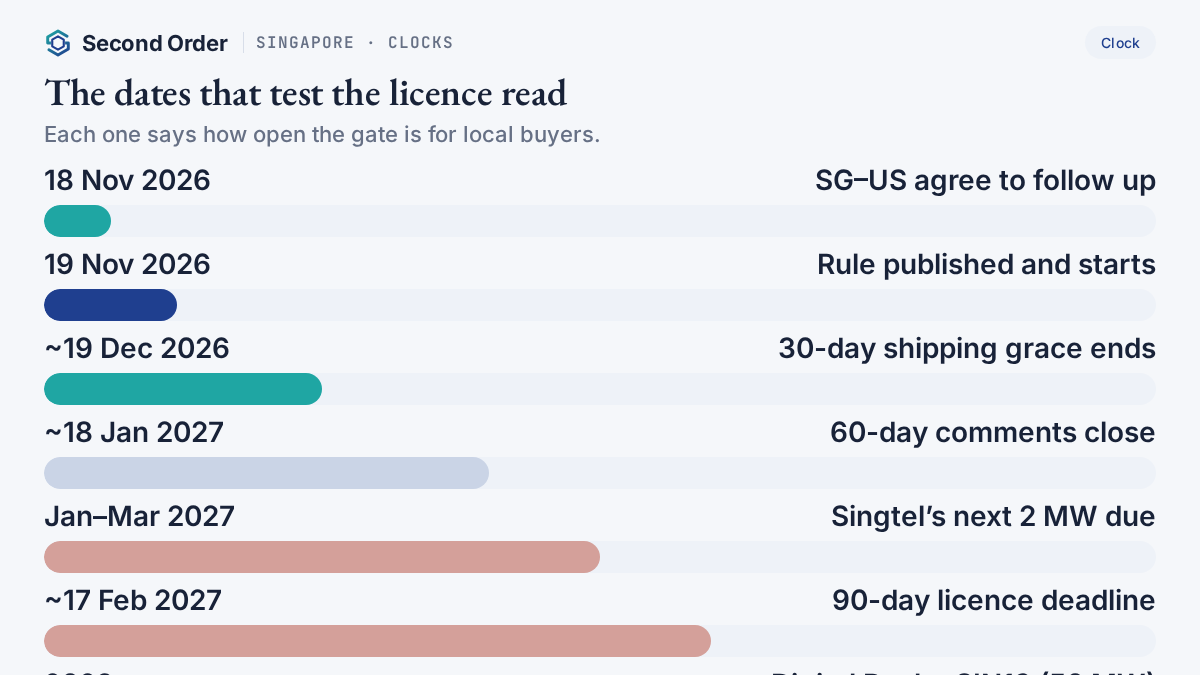
- 16 November 2026 — the rule is released; Singapore’s ministries say they are studying it and seeking trusted access.
- 17 November 2026 — Singapore data centre names mostly dip and Singtel rises; Minister Teo speaks with Under Secretary Kessler; the US publishes its Megaspeed statement.
- 18 November 2026 — Singapore says both sides will follow up on practical arrangements; the US plans industry briefings (no date given).
- 19 November 2026 — listed publication in the Federal Register and the start date.
- About 19 December 2026 — 30 days on: shipments already moving under the old rules must be complete (our arithmetic).
- January to March 2027 — Singtel’s next 2 MW of RE:AI capacity is due. Has the licence come through?
- About 18 January 2027 — 60 days on: public comments close (our arithmetic). Watch for changes to the five countries or the US-headquarters exception.
- About 17 February 2027 — 90 days on: halls already serving companies with Chinese parents need a licence (our arithmetic).
- 2029 — Digital Realty’s 50 MW SIN13 on Jurong Island is due; who signs for it shows whether US ownership became a selling point.
Dates from the rule’s public inspection copy and its listed publication date, Singtel via The Business Times, Digital Realty via The Business Times, and CNA. Dates after 19 Nov are Second Order arithmetic and assume publication that day.
How does this look from Malaysia, China, the US and Australia?
From Malaysia, it is the same licence with a bigger exposure: more halls were built quickly in Johor for overseas AI tenants, and the builders fell much harder on Tuesday (Malaysia Markets, Malaysia’s chip pass-through). From China, it is one more door narrowing for AI labs that used chips abroad, which we traced yesterday (China Markets).
From the US, the rule hands American operators and clouds a home advantage abroad, and asks chip sellers to file more paperwork (US Markets). From Australia, which is not on the list, the question is whether some regional AI demand that wanted a simpler path now looks south (Australia Markets). For all of our Singapore notes, see Singapore Markets.
How we check this. The rule’s terms come from the public inspection copy of the US interim final rule filed on 16 November 2026, read alongside a section-by-section summary of the same document. Singapore’s response comes from the joint statement of its two ministries and from CNA’s report of the 18 November follow-up statement. Company comments come from The Straits Times and The Business Times, which put questions to Singtel, Keppel, ST Engineering, Digital Realty and Equinix. Singtel’s revenue, profit and capacity figures come from its own half-year filing on SGX. Share moves are the ones The Straits Times reported for 17 November; some are closes and some are moves during the day, as labelled. Every sum we worked out, including the dates after 19 November and the revenue-per-megawatt sum, is labelled “our arithmetic”. We do not guess which customers sit in which hall when no company has said so, and we do not repeat allegations as facts. Price targets and ratings are left out on purpose. The references we used are listed at the end. Our editorial standards →
FAQ
What changes for Singapore on 19 November?
A US rule released on 16 November and due to take effect when it is published on 19 November says a licence is needed to export, re-export or transfer advanced US AI chips to or within Singapore, Malaysia, Indonesia, Thailand and Brazil. Buyers headquartered in the US, or whose ultimate parent is, are left out if the exporter files monthly reports. Everyone else applies, and each case is reviewed on its own.
Why does the article say same hall, two rulebooks?
Because the test is where the buyer’s headquarters are, not where the building is. A US cloud and a Singapore company renting space in the same data centre can face different paperwork for the same chip: the first is reported, the second waits for a licence. A Singapore professor quoted by The Business Times made the same point.
What is stuck?
The licence for buyers that are not headquartered in the US. Singtel’s sovereign AI cloud, RE:AI, has 4 MW of its 6 MW installed; the other 2 MW is contracted and due from January to March 2027, and Singtel says it will apply for licences with the government’s help. Singapore has asked the US for “trusted access”, and the two sides agreed on 17 November to follow up on practical arrangements. Nothing has been granted yet.
Who gets paid first?
Operators and tenants with US headquarters, such as Digital Realty, Equinix and the big US clouds, keep a simpler path, and Digital Realty’s regional head said it may give them a better operating advantage. Landlords whose halls are leased to US clouds, such as Keppel, said they expect little impact. Compliance work and customer checks get paid by everyone.
Is this investment advice?
No. Education only. It maps who gets paid and which step is stuck. It is not a recommendation to buy or sell any security, and we leave out price targets and ratings on purpose.
References
Outbound links below are nofollow. We list only the sources actually used. Internal sotkn.com links in the body are separate.
- US Bureau of Industry and Security, Addressing Remote Access to Advanced Semiconductors (interim final rule, Federal Register public inspection copy, FR Doc. 2026-23529), filed 16 Nov 2026. federalregister.gov — the rule’s own summary: the five-country licence, the US-headquarters exclusion with reporting, the data centre test, effect on publication, and the 60-day comment window.
- Drawback AI, BIS remote-access rule for advanced SI semiconductors, Nov 2026. drawbackai.com — section-by-section reading of the rule: the 12 million TPP test, monthly reports and their contents, the 30-day and 90-day clocks, and the 19 November publication date.
- Ministry of Digital Development and Information and Ministry of Energy, Trade and Industry, joint media statement on the US interim final rule, 16 Nov 2026. mddi.gov.sg — Singapore’s official response, including “trusted access for Singapore companies”.
- CNA, Singapore and US agree to follow up on arrangements to facilitate continued trusted access to advanced American technologies, 18 Nov 2026. channelnewsasia.com — the call between Minister Josephine Teo and Under Secretary Jeffrey Kessler, the planned US industry briefings, and the agreed follow-up.
- The Straits Times, Data centre REITs, related stocks slide as US imposes new rules on AI chip exports, 17–18 Nov 2026. straitstimes.com — Singapore share moves on 17 November, and the statements from Singtel, Keppel and ST Engineering and analysts at OCBC, Saxo, Phillip and CMC.
- The Business Times, US chip curbs could give American data centre operators an edge in Singapore, 17 Nov 2026. businesstimes.com.sg — Singtel’s RE:AI timing, Digital Realty’s and Equinix’s responses, the SIN13 timeline, and Professor Ramkishen Rajan’s comments.
- Singtel, Management discussion and analysis for the half year ended 30 September 2026 (SGX filing), 13 Nov 2026. links.sgx.com — Digital InfraCo, Nxera and RE:AI revenue and profit, Nxera capacity and utilisation, and STT GDC capacity.
- US Department of Justice, Joint statement from the Department of Commerce and the Department of Justice on the Megaspeed investigation, 17 Nov 2026. justice.gov — the timeline of the US investigation into Singapore-based Megaspeed.
- CNBC, Why Singapore keeps surfacing in Nvidia chips and China controversy, 13 Nov 2026. cnbc.com — Singapore’s share of Nvidia’s billed revenue versus chips physically delivered, and the server fraud case.
- Lianhe Zaobao, Singapore data centre operators keep close watch as US tightens chip export controls, 17 Nov 2026. zaobao.com.sg — the count and combined capacity of Singapore’s data centres.
Not investment advice. Do your own research. Education only. Map of who gets paid and which step is stuck — not a buy list.
More on this desk: Singapore Markets · AI Data Centers · GPU cloud providers explained · the China view of this rule · all Markets.