GPU Cloud Providers
GPU cloud providers are the roles along the Neoclouds bind — fleet owners, hour sellers, offtake buyers, and power+hall suppliers. Roles only. No tip sheet.
EXPLAINED · Players · Last reviewed: 30 Sep 2026 · Next review: after next major neocloud offtake or power-capacity print
GPU cloud providers are the firms and counterparties that put AI accelerators into billed hours: who owns and operates the GPU fleet, who sells reserved or on-demand hours, who buys multi-year offtake, and who supplies the power and halls that make those hours possible.
In short. GPU cloud providers are a roles map on the Neoclouds layer: fleet owners operate GPU clusters; hour sellers clear reserved or on-demand hours; offtake buyers commit multi-year dedicated capacity; power and hall suppliers deliver megawatts and shells. The stuck step sits where offtake and power bind before billed hours clear — not a tip sheet.
For investors on the Neoclouds layer, the useful question is which role gets paid when offtake and power bind — not which ticker “wins.” Mechanism siblings: GPU as a Service and take-or-pay GPU contracts. Versus: neocloud vs hyperscaler.
What are GPU cloud providers?
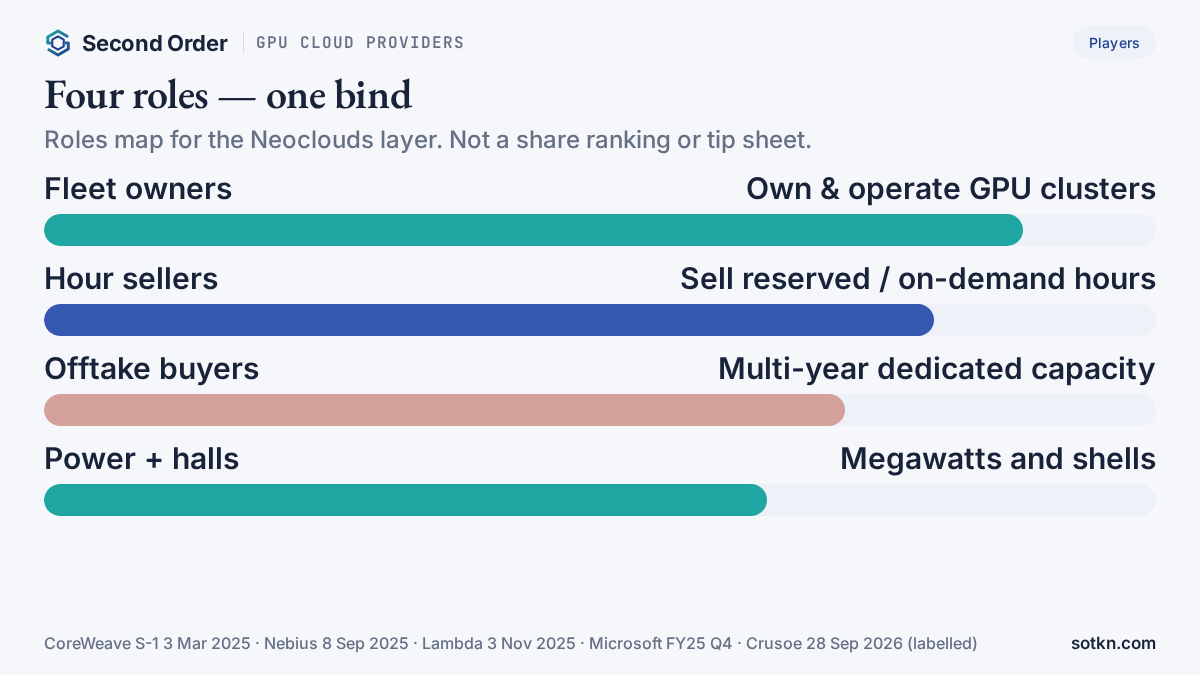
GPU cloud providers split into four roles along one bind. Fleet owners operate the accelerators. Hour sellers clear reserved or on-demand hours. Offtake buyers commit multi-year dedicated capacity. Power and hall suppliers deliver the megawatts and shells. Missing any one role leaves CapEx waiting — even when backlog looks full.
| Role | Job | Dated example (labelled) |
|---|---|---|
| Fleet owners / operators | Design, buy, and run GPU clusters in purpose-built halls | CoreWeave Form S-1 (filed 3 Mar 2025): as of 31 Dec 2024 — 32 active data centers; >250,000 GPUs; >360 MW active power; ~1.3 GW contracted power |
| Hour sellers (GaaS) | Sell reserved or on-demand billed GPU hours | Same operators often sell hours on their fleets; cash clears when delivered hours are used — see GPU as a Service Explained |
| Offtake buyers | Commit multi-year dedicated capacity (hyperscalers / AI labs) | Nebius → Microsoft multi-billion AI infra from Vineland NJ (8 Sep 2025, Ex. 99.1); Lambda → Microsoft multibillion GPU deal incl. GB300 NVL72 (3 Nov 2025) |
| Power + hall suppliers | Provide megawatts, shells, energy-first campuses | CoreWeave S-1: Core Scientific agreement >500 MW (as of 31 Dec 2024); Crusoe developing Google Armstrong County TX campus (announced 28 Sep 2026; broke ground Jun 2025) |
Who owns the GPU fleet?
Fleet owners design, buy, and run GPU clusters. CoreWeave’s Form S-1, filed 3 March 2025, reported that as of 31 December 2024 its 32 active data centers were running more than 250,000 GPUs with more than 360 MW of active power, and about 1.3 GW of total contracted power. That is one labelled fleet print — company-reported scale, not a ranking. For the layer map, see what a neocloud is.
Other specialist operators sit in the same fleet role when they own or control accelerator clusters sold as cloud. Names change with each CapEx cycle; the job stays ownership and operation of the metal.
Who sells the billed hours?
Hour sellers turn fleet capacity into GPU as a Service — reserved blocks and on-demand instances. Cash clears when delivered hours are used and paid, not when a rack looks full. Many neoclouds hold both fleet-owner and hour-seller roles; keep the jobs separate when you read an IR slide. See GPU as a Service Explained.
Who buys offtake?
Offtake buyers are usually hyperscalers and AI labs. On 8 September 2025, Nebius announced a multi-billion agreement to deliver AI infrastructure to Microsoft from its Vineland, New Jersey data center (Nebius Ex. 99.1 / SEC). On 3 November 2025, Lambda announced a multibillion multi-year Microsoft agreement to deploy tens of thousands of NVIDIA GPUs, including GB300 NVL72 systems (Lambda). Those dates show the offtake-buyer role — committed capacity — beside hyperscalers who also own their own fleets.
Microsoft’s FY25 Q4 remarks (30 July 2025) put numbers on the buyer side of the same bind: capital expenditures of $24.2 billion in the quarter (including $6.5 billion of finance leases), more than two gigawatts of new capacity stood up over the prior twelve months, and Azure demand still higher than supply. For how committed capacity shows up in revenue, see take-or-pay GPU contracts and remaining performance obligation.
Who supplies power and halls?
Power and hall suppliers gate every fleet. CoreWeave’s S-1 cites an agreement with Core Scientific for more than 500 MW of capacity as of 31 December 2024 — a labelled landlord/power print, not a share table. Crusoe announced on 28 September 2026 that it is developing Google’s data center campus in Armstrong County, Texas, with construction broken ground in June 2025 — an energy-first hall developer role beside the offtake buyer.
Wire that uses GPU-cloud / neocloud offtake in anger: Crusoe building Google’s Armstrong County campus.
Dated ranges — power, fleets, CapEx
These are labelled company prints, not industry “estimates.” Use them as ranges for roles — not as a league table.
| Value | As-of / date | Source | |
|---|---|---|---|
| Active power (example fleet) | >360 MW | 31 Dec 2024 | CoreWeave S-1 (filed 3 Mar 2025) |
| Contracted power runway | ~1.3 GW | 31 Dec 2024 | CoreWeave S-1 |
| Active data centers / GPUs | 32 DCs; >250k GPUs | 31 Dec 2024 | CoreWeave S-1 |
| Landlord power example | Core Scientific >500 MW agreement | 31 Dec 2024 | CoreWeave S-1 |
| Hyperscaler new capacity | >2 GW stood up in 12 months | FY25 to 30 Jun 2025 | Microsoft FY25 Q4 (30 Jul 2025) |
| Hyperscaler CapEx (quarter) | $24.2B (incl. $6.5B finance leases) | Q4 FY25 | Microsoft FY25 Q4 |
Who gets paid — and where is the stuck step?
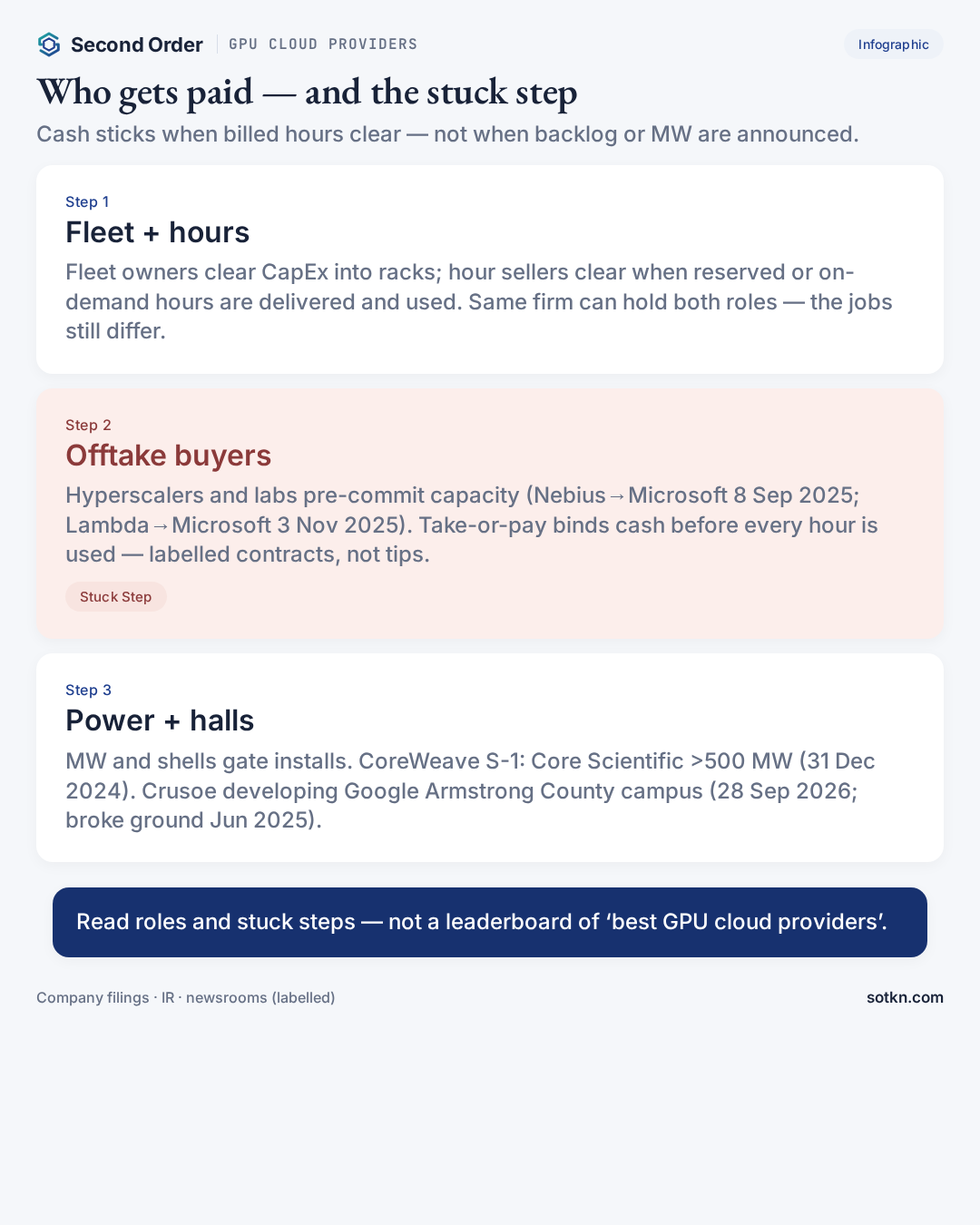
On the Neoclouds layer, who gets paid tracks which role clears first. Fleet owners clear when CapEx becomes live clusters. Hour sellers clear when reserved or on-demand hours are delivered and paid. Offtake buyers bind cash early through multi-year commitments. Power and hall suppliers clear when megawatts and shells are contracted and energised. The stuck step is usually offtake-plus-power before billed hours — backlog and filled racks are not the same as paid hours.
Common misconceptions
- People assume “GPU cloud providers” means one tip sheet of best clouds. Actually four roles share the bind: fleet owners, hour sellers, offtake buyers, and power+hall suppliers. Ranking tickers skips the stuck step.
- People assume backlog or contracted megawatts equal cash. Actually cash clears when a customer uses a working GPU and pays for that hour. Contract prints and power runways are labelled commitments — not revenue.
- People assume hyperscalers and neoclouds are the same role. Actually hyperscalers often buy offtake and own fleets; specialist GPU cloud providers concentrate on accelerator clusters. Versus page: neocloud vs hyperscaler.
- People treat a market-share table as investment advice. Actually this page maps roles and stuck steps. Share or capacity prints from filings and press are labelled and are not buy/sell calls.
FAQ
What are GPU cloud providers?
GPU cloud providers are the roles that turn GPUs into billed cloud hours: fleet owners who operate accelerators, hour sellers who price reserved or on-demand access, offtake buyers who commit multi-year capacity, and power+hall suppliers who deliver megawatts and shells. This is a roles map, not a ranking of “best” clouds.
Who owns the GPU fleet?
Fleet owners design, buy, and run GPU clusters in purpose-built halls. CoreWeave’s Form S-1 (filed 3 Mar 2025) reported 32 active data centers running more than 250,000 GPUs with more than 360 MW of active power as of 31 December 2024 — company-reported scale for one labelled fleet operator, not a share ranking.
Who sells GPU cloud hours?
Hour sellers monetise the fleet as GPU as a Service — reserved blocks and on-demand instances that customers pay for when capacity is delivered and used. The same firm often owns the fleet and sells the hours; the roles still split: ownership of metal versus clearing billed hours. See GPU as a Service Explained.
Who buys GPU offtake?
Offtake buyers are hyperscalers and AI labs that commit multi-year dedicated capacity. Nebius announced a multi-billion agreement to deliver AI infrastructure to Microsoft from Vineland, New Jersey on 8 September 2025 (Nebius Ex. 99.1). Lambda announced a multibillion multi-year Microsoft agreement covering tens of thousands of NVIDIA GPUs, including GB300 NVL72 systems, on 3 November 2025 (Lambda). Those are dated offtake examples — not tips.
Who supplies power and halls for GPU clouds?
Power and hall suppliers provide megawatts, shells, and energy-first campuses. CoreWeave’s S-1 cites an agreement with Core Scientific for more than 500 MW of capacity as of 31 December 2024. Crusoe announced on 28 September 2026 that it is developing Google’s Armstrong County, Texas data center campus (broke ground June 2025) — a labelled hall/power developer role beside offtake buyers.
How do GPU cloud providers differ from hyperscalers?
Hyperscalers run broad cloud platforms and are often the largest offtake buyers as well as fleet owners. Specialist GPU cloud providers (neoclouds) concentrate on accelerator clusters and committed capacity. See Neocloud vs Hyperscaler and What Is a Hyperscaler.
Is this a list of the best GPU cloud providers or stocks?
No. Second Order Players pages map roles and stuck steps. They do not rank providers, give buy/sell calls, or treat market-share tables as investment advice.
Related terms
- Neocloud — what a specialist GPU cloud operator is.
- GPU as a Service — how billed accelerator hours clear.
- Neocloud vs hyperscaler — specialist fleets versus broad cloud platforms.
- Take-or-pay GPU contracts — offtake that binds idle hours.
- Hyperscaler — who sets AI CapEx and often buys offtake.
Markets and stack doors
Layer: Neoclouds. Buyer layer: Hyperscalers.
Further reading
Wire: Crusoe — Google Armstrong County campus. Mechanism: take-or-pay GPU contracts.
Get the Wire — short notes when offtake, power, or fleet clocks move.
How we check this
Figures come from company filings and government releases, each dated in the list below. Capacity and timing from press reports are labelled as reported, not guided. Where we work something out ourselves, the arithmetic is shown in full.
Last reviewed: 30 Sep 2026 · Next review: after next major neocloud offtake or power-capacity print
Spot an error? Tell us and we will correct it and note the change here.
Sources
- CoreWeave Form S-1 — 32 active data centers; >250,000 GPUs; >360 MW active power; ~1.3 GW contracted power; Core Scientific >500 MW (as of 31 Dec 2024; filed 3 Mar 2025)
- Nebius Group Ex. 99.1 — multi-billion Microsoft AI infrastructure agreement from Vineland, NJ data center (8 Sep 2025)
- Lambda — multibillion multi-year Microsoft agreement; tens of thousands of NVIDIA GPUs incl. GB300 NVL72 (3 Nov 2025)
- Microsoft FY25 Q4 earnings — CapEx $24.2B (incl. $6.5B finance leases); >2 GW new capacity over prior 12 months; Azure demand higher than supply (30 Jul 2025)
- Crusoe newsroom — developer of Google Armstrong County, TX data center campus; broke ground June 2025 (28 Sep 2026)
- Crusoe via GlobeNewswire — Armstrong County campus announcement mirror (28 Sep 2026)