
8 MW Open, 12 MW to Go: Who Gets Paid as Singapore’s First Tender-Won Data Centre Fills
Equinix opened SG6 on 6 November 2026, the first Singapore data centre to open under the government's capacity tender. It starts at 8 MW of a planned 20 MW, about 40 months after the award. Builders and the running halls are paid first; the stuck step is the fit-out.

Singapore's first data centre built under its government capacity tender is open, and only part of it is switched on. Equinix opened SG6 on 6 November 2026 with 8 MW and about 1,550 cabinets, out of a planned 20 MW, for an initial investment of about US$290 million. The award behind it was announced in July 2023, so the first megawatts took about 40 months to arrive, and 12 MW of the building is still to be fitted out. The builders and Equinix's older, fuller halls are paid first. The stuck step is the fit-out: turning allocated megawatts into installed, billed cabinets.
SINGAPORE · AI DATA CENTERS · Equinix SG6 opening, 6 Nov 2026 · Next update: Equinix Q4 results and SG6 fill, early 2027
Affects: AI Data Centers · Hyperscalers · Neoclouds — Markets: Singapore · Malaysia · Australia · US
Education only, not advice to buy or sell any security. Figures are as published by the companies and agencies named, unless labelled as our arithmetic.
The numbers that matter this week
SG6 open now, phase one
8 MW
About 1,550 cabinets · opened 6 Nov 2026
OpenSG6 at full build-out
20 MW
12 MW still to fit out (our arithmetic) · no date given
PlannedSG6 initial investment
US$290m
About US$36m per open MW (our arithmetic)
SpentAward to opening
~40 months
14 Jul 2023 award → 6 Nov 2026 opening (our arithmetic)
ClockNamed in two tenders since 2023
~280 MW
About 80 MW in 2023 + 200 MW in Aug 2026 (our arithmetic)
AllocatedThe fit-out
The bind
Allocated megawatts reach customers one phase at a time
Stuck stepFigures from Equinix (6 Nov 2026), MDDI (6 Nov 2026) and EDB and IMDA (14 Jul 2023 and 21 Aug 2026). Status chips are Second Order’s read.
On this page: Why it matters · What opened · The tender · The clock · The money · Jurong Island · Our math · Who gets paid · What is stuck? · Dates next · Elsewhere · What would change this · FAQ
Why does SG6 matter for Singapore's data centres?
Because it is the first time Singapore's rationed megawatts have turned into a working building. Singapore paused new data centre capacity in 2019, and since then new halls have been allowed only through a government tender, the Data Centre Call for Application. Operators compete on efficiency, connectivity and what they bring to the economy, and the winners get a provisional allocation of megawatts. Until last week, none of those allocations had become a facility that customers could move into.
At the opening on 6 November, Senior Minister of State Tan Kiat How said SG6 is the first facility to open under that framework. That gives the market something it did not have before: a real clock from award to opening, and a real first phase to set against the headline megawatts.
The question this piece follows is simple. Singapore has now named about 280 MW of new capacity across two tenders. How fast does that become computing that earns, and who is paid while it is being built and filled?
For what makes an AI hall different from an ordinary one, see our explainer on what an AI data center is. For how a retail colocation operator like Equinix differs from a hall built for one cloud tenant, see hyperscale versus colocation data centers, and for Equinix's role on our map, what Equinix does.
1 · Builders and suppliers
Who: Construction, electrical and mechanical work for SG6
Paid: Paid out of about US$290m already invested
2 · Power and renewable sellers
Who: Grid supply and renewable coverage for Equinix Singapore
Paid: 100% renewable coverage since 2020, per Equinix
3 · Equinix's running halls
Who: Colocation and interconnection fees across Asia-Pacific
Paid: Q3 2026 Asia-Pacific revenue: US$545m
4 · SG6's last 12 MW
Who: Capacity in the building that is not yet fitted out
Paid: No date given for full build-out
What exactly opened on 6 November?
Equinix announced the opening of SG6, its sixth International Business Exchange data centre in Singapore, and gave four numbers that matter. The initial investment is about US$290 million. The first phase provides 8 MW of capacity, delivering about 1,550 cabinets. At full build-out the facility will offer up to 20 MW of IT capacity. And it is designed to reach a power usage effectiveness of 1.20, while targeting Green Mark Platinum certification.
- Built for dense computing. Equinix said SG6 is designed for AI, high-performance computing and data-heavy workloads, with proprietary cooling systems and liquid cooling capability for power-hungry GPU equipment.
- Built on renewables coverage. Equinix said its Singapore data centres have kept 100% renewable energy coverage since 2020. SG6 adds rooftop and facade solar panels, rainwater harvesting and lower-carbon building materials.
- Built around connections. Equinix has grown from one Singapore data centre in 2002 to six, and said its Singapore operations connect to more than 17 subsea cable systems.
- A research floor from 2027. Equinix plans to open a Co-Innovation Facility at SG6 with the National University of Singapore in 2027, to test cooling, digital twins and battery storage in a working data centre.
Power usage effectiveness is total facility power divided by the power that reaches the computers, so a design PUE of 1.20 means about 9.6 MW from the grid for 8 MW of IT load running flat out (our arithmetic). For how the ratio works and why it is a design target rather than a measured result, see PUE, explained.
What Equinix did not say: when the remaining 12 MW will be fitted out, how many of the 1,550 cabinets are already sold, or which customers have moved in. Those are the numbers that decide how quickly SG6 earns.
How does Singapore hand out data centre megawatts?
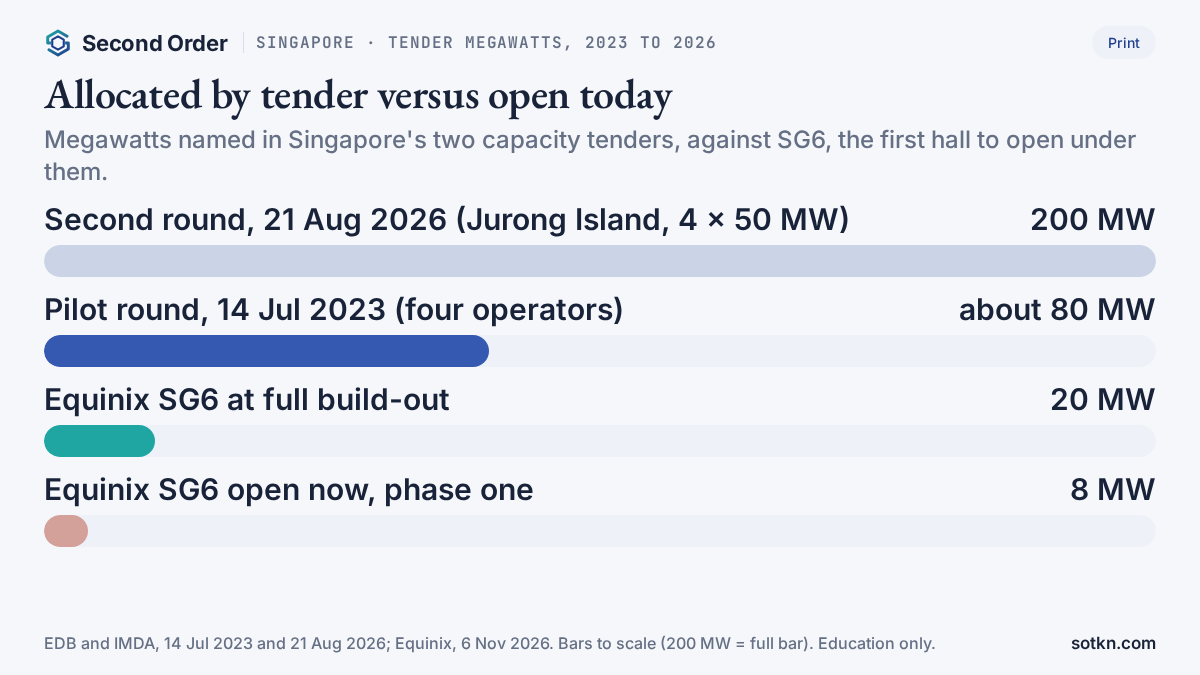
By tender, in rounds. Each round is run by the Economic Development Board and the Infocomm Media Development Authority, and each one has drawn more than 20 proposals.
- 14 July 2023 — the pilot round. About 80 MW provisionally awarded to four operators: an AirTrunk-ByteDance consortium, Equinix, GDS and Microsoft. The agencies highlighted liquid cooling, more subsea cable capacity, AI and high-performance computing, and economic commitments beyond the buildings.
- 30 May 2024 — the roadmap. The Green Data Centre Roadmap said at least 300 MW would be added in the next few years, with another 200 MW for operators using green energy, on top of 1.4 GW in more than 70 data centres.
- 21 August 2026 — the second round. 200 MW provisionally allocated, 50 MW each to Digital Realty, Equinix, Keppel Data Centres and ST Telemedia Global Data Centres. All four will build on Jurong Island, where JTC is developing a low-carbon data centre park, and each must power more than half of its capacity from green energy. The agencies said they would review the need for another round in 18 to 24 months.
- October 2026 — the licence law. Parliament passed the Digital Infrastructure Act. At the SG6 opening the minister said that where operators make material commitments to secure scarce capacity, those commitments should remain meaningful.
We covered the licence law and what the 200 MW round handed out in our Singapore data centre licence Pulse, and the green-fuel conditions on the Jurong Island halls in our Singapore power plan Pulse. SG6 is the other end of the same process: not an allocation on paper, but one that has become a building.
Equinix is the only operator named in both rounds. Its SG6 release said the building is among the first developed under the framework, and its 50 MW from the second round is a separate Jurong Island project. Neither Equinix nor the agencies have said exactly how much of the 2023 round's roughly 80 MW went to Equinix, so we do not split it.
Why did it take about 40 months, and why only 8 MW?
From the award announced on 14 July 2023 to the opening on 6 November 2026 is 1,211 days, about 40 months (our arithmetic). That is not unusual for a new multi-storey data centre on a small, crowded island: a site has to be designed, approved and built, and the power connection and cooling plant have to be ready before the first customer moves in. Equinix has not given a breakdown of where the time went, and we do not guess.
The 8 MW is the more telling number. Data centre operators often build the shell and core systems for the whole building, then fit out the halls in phases as customers sign up. That keeps spending close to demand, but it means a building's headline capacity reaches customers in steps. SG6 has opened at 40% of its planned 20 MW (our arithmetic). The other 12 MW exists as space in a finished building, not as halls a customer can use today.
The cabinet count shows how the first phase is laid out. About 1,550 cabinets on 8 MW works out to about 5.2 kW per cabinet on average (our arithmetic). On its Q3 2026 earnings call, Equinix said new customers were coming in at an average of 7 kW per cabinet, against 5 kW for customers leaving, because of AI workloads. If SG6's customers draw more power per cabinet than the average layout assumes, the 8 MW fills before every cabinet does: at 7 kW each, 8 MW would serve about 1,140 cabinets (our arithmetic). In that case power, not floor space, sets the pace for the next phase.
For how long each step of a build takes, see how long it takes to build an AI data center, and for what a booked megawatt is and is not, contracted power, explained.
What does Equinix already earn in Asia-Pacific?
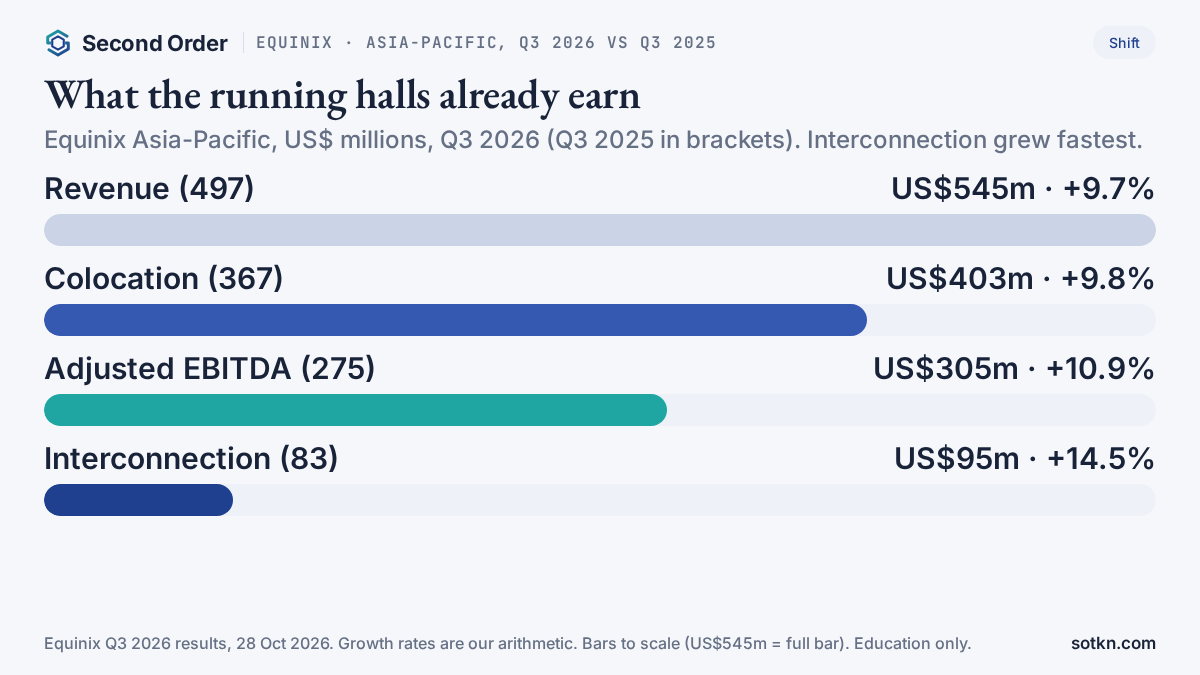
SG6 is new, but Equinix's Singapore business is not. Equinix does not break out Singapore in its results, so the closest view is its Asia-Pacific region. In Q3 2026 Asia-Pacific revenue was US$545 million, against US$497 million a year earlier, up about 9.7% (our arithmetic). Colocation, the rent for space and power, was US$403 million, against US$367 million. Interconnection, the fees for cross-connects between customers in the same building, was US$95 million, against US$83 million, up about 14.5% (our arithmetic).
Asia-Pacific adjusted EBITDA was US$305 million, against US$275 million, a margin of about 56% on the quarter's revenue (our arithmetic). The region was about 21% of Equinix's worldwide Q3 revenue of US$2.571 billion (our arithmetic).
Two figures from the earnings call explain why a new building is worth less on day one than a full one. Equinix said its 193 stabilised assets, its mature, mostly full sites, were 83% utilised and produced a 27% cash-on-cash yield, with interconnection revenue in that pool growing 10% a year against 7% for colocation. A new building starts at the bottom of that curve. Its value comes as cabinets fill and customers connect to each other inside it, and Equinix's pitch for SG6 is exactly that: a dense exchange in one of the region's most connected cities.
For the global side of Equinix's quarter, including its record bookings and the cabinets it plans to deliver in Q4, see our US Equinix Q3 Pulse. For how a data centre lease turns into revenue, see data center leases, explained.
What comes after SG6?
The 200 MW second round on Jurong Island is the next, much larger block. Its four winners each have 50 MW, and only one has published a cost. Keppel said on 21 August that its share will support Keppel Data Centre Singapore 11, an AI-ready data centre on Jurong Island with an expected investment of more than S$1 billion, developed by Keppel and funded by Keppel Data Centre Fund III and its co-investors. That is more than S$20 million per MW (our arithmetic). Keppel is targeting a PUE under 1.2 and pointed to its 1,900 MW of power generation on Jurong Island at the Keppel Merlimau and Keppel Sakra cogeneration plants.
Comparing the two costs needs care. SG6's US$290 million is an initial investment that delivers 8 MW now in a building sized for 20 MW: about US$36 million per open MW, or about US$14.5 million per MW of full build (our arithmetic). Keppel's figure is an expected total for 50 MW in Singapore dollars. Neither is a like-for-like cost per MW, and we do not convert currencies to force one.
What the two do share is the order of payment. Money is committed and spent on buildings, plant and connections years before the last megawatt earns. For Singapore-listed ways into the region's halls, see what Keppel DC REIT does, what Digital Core REIT does and what Digital Realty does. For the other 2023 winners, see what GDS does. For what a hall costs before it earns, see how much it costs to build an AI data center.
Our math: what do the numbers say?
SG6, as announced
Singapore's tenders, as announced
- 14 July 2023 to 6 November 2026 is 1,211 days, about 40 months from award to opening (our arithmetic).
- 8 MW of 20 MW is 40% of SG6's planned capacity open today; 12 MW is still to be fitted out (our arithmetic).
- About US$290 million over 8 MW is about US$36 million per open MW; over the full 20 MW it is about US$14.5 million per MW. This is the initial investment only, not the full cost of the building (our arithmetic).
- 8 MW over about 1,550 cabinets is about 5.2 kW per cabinet on average (our arithmetic).
- At Equinix's 7 kW average for incoming customers, 8 MW would serve about 1,140 cabinets (our arithmetic; illustration only).
- If the full 20 MW were laid out like phase one, it would hold about 3,875 cabinets (our arithmetic; illustration only, Equinix has not said).
- At a design PUE of 1.20, 8 MW of IT load draws about 9.6 MW from the grid at full load, and 20 MW about 24 MW (our arithmetic).
- About 80 MW plus 200 MW is about 280 MW named in two tenders since 2023 (our arithmetic).
- 8 MW open is about 3% of that 280 MW (our arithmetic).
- 280 MW is about 20% of the 1.4 GW base the government gave in May 2024 (our arithmetic).
- Equinix's tender pipeline is up to 20 MW at SG6 plus 50 MW on Jurong Island, up to 70 MW; 8 MW is about 11% of it (our arithmetic).
- More than S$1 billion over 50 MW is more than S$20 million per MW for Keppel DC SGP 11 (our arithmetic).
- Equinix Asia-Pacific revenue rose from US$497 million to US$545 million, about 9.7%; interconnection from US$83 million to US$95 million, about 14.5%; colocation from US$367 million to US$403 million, about 9.8% (our arithmetic).
- Asia-Pacific adjusted EBITDA of US$305 million on US$545 million of revenue is a margin of about 56%; the region is about 21% of worldwide revenue of US$2.571 billion (our arithmetic).
- 18 to 24 months after 21 August 2026 puts the review of a third round between about February and August 2028 (our arithmetic).
Who gets paid first?
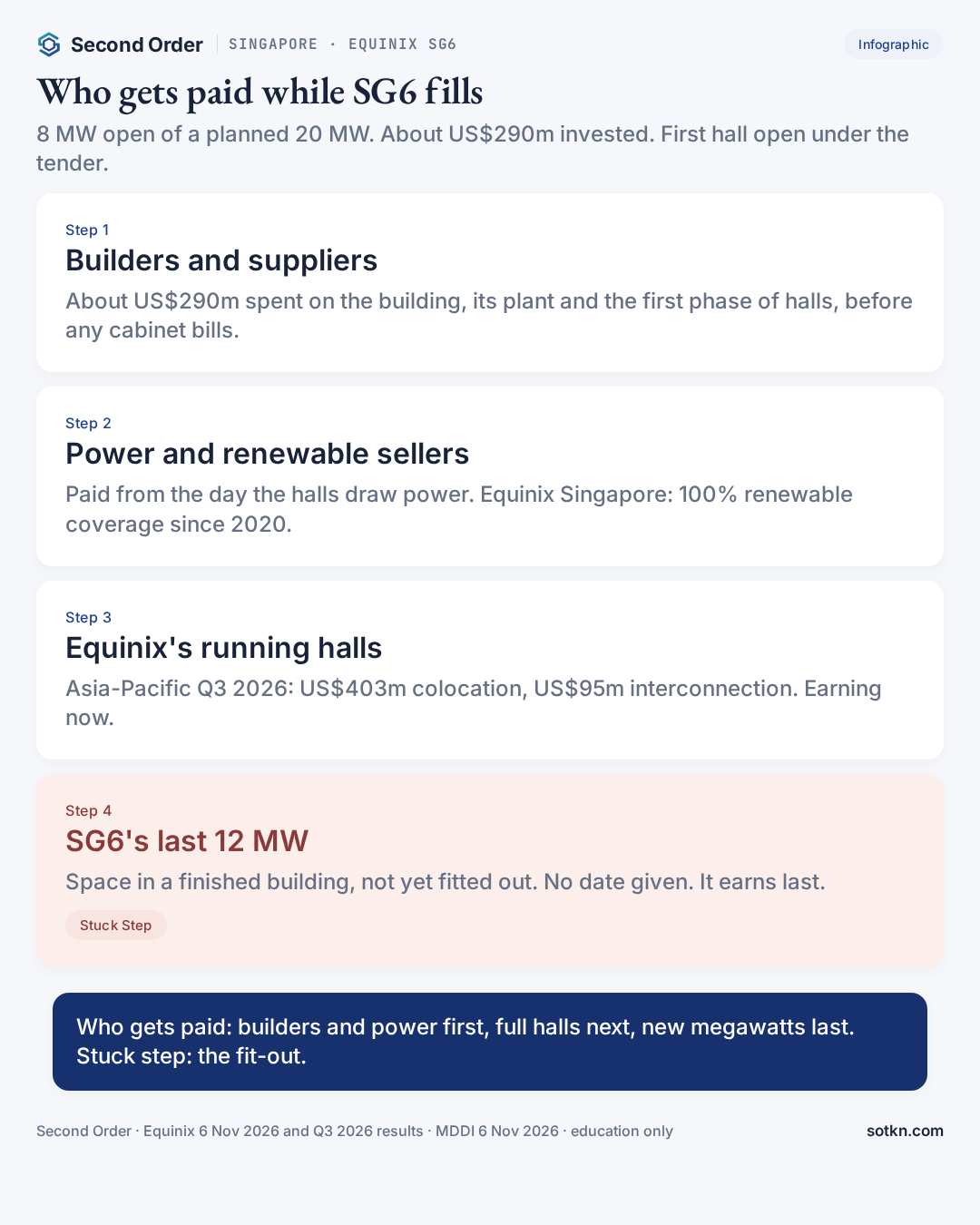
First, the builders and equipment suppliers. The roughly US$290 million Equinix has invested in SG6 is money spent on building and equipping it: the structure, the electrical and mechanical plant, the cooling and the first phase of halls. Equinix did not name its contractors, so we do not either. That money is paid before any cabinet bills. For who does this kind of work, see who builds AI data centers, and for who makes the electrical gear, who makes data center power equipment.
Second, the power and renewable-energy sellers. A data centre pays for electricity from the day it runs, and Equinix says its Singapore sites have had 100% renewable coverage since 2020, which means someone is paid for that coverage every month the halls draw power. For how much a large hall draws, see how much power an AI data center uses.
Third, Equinix's existing halls. They are already earning: US$403 million of colocation and US$95 million of interconnection fees in Asia-Pacific in Q3 2026 alone. SG6 adds to that platform, and much of its appeal to customers is the chance to connect to the companies already in Equinix's other Singapore buildings.
Fourth, SG6's own capacity — in steps. The 8 MW first phase earns as customers sign, install and switch on their equipment. The remaining 12 MW earns only after it is fitted out and sold. Further out, the 200 MW on Jurong Island follows the same order, starting with the builders and the plants that supply it.
One-line rule: in Singapore this week, the builders, the power sellers and the halls already running are paid before the newly allocated megawatts earn. The stuck step is the fit-out.
So what is the stuck step?
The fit-out: turning megawatts that Singapore has allocated into halls that are built, powered and filled with customers' equipment. It is not demand: the second round drew more than 20 proposals for 200 MW, and Equinix said new deals came in at higher prices globally. It is not the permission to build, at least for SG6: the allocation exists and the building is up. Three things keep the step tight:
- The building opens in phases. SG6 has 8 MW of 20 MW in use. The rest of the building's capacity reaches customers only as each phase is fitted out, and Equinix has given no date for the next one.
- The first round is only starting to open. The minister said SG6 is the first facility to open under the framework, so none of the other 2023 winners' halls had opened before it. Most of the roughly 80 MW from that round is not yet open.
- The next block waits on a new park and new fuel. The 200 MW on Jurong Island depends on JTC's low-carbon data centre park and on each operator meeting more than half its needs from green energy, such as biomethane, low-carbon ammonia or hydrogen, and building-integrated solar.
So-what: in Singapore the scarce thing is no longer just the allocation. It is the time and capital it takes to turn an allocation into running, billed capacity. Builders and power sellers are paid while that happens, and the operators with full, connected halls keep earning in the meantime.
Which dates test this read next?
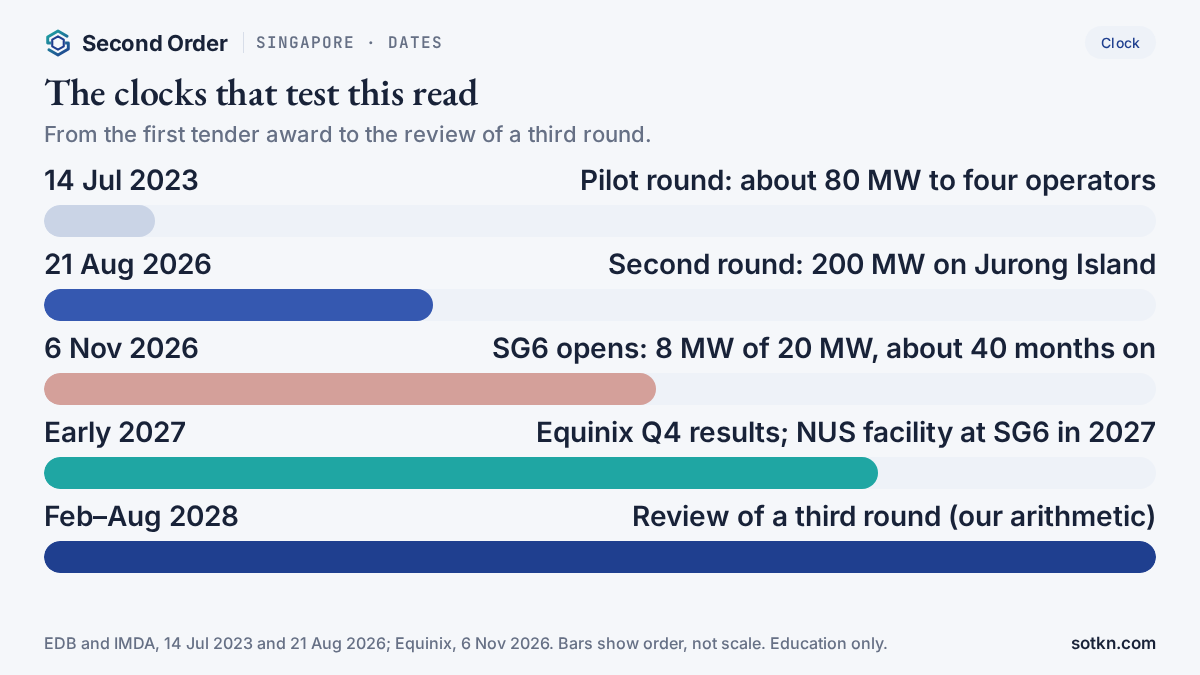
- 6 November 2026 — SG6 opens at 8 MW of 20 MW. The baseline for this read.
- Early 2027 — Equinix's Q4 2026 results. The test: whether Asia-Pacific colocation and interconnection keep growing as SG6 adds capacity, and whether Equinix says how much of SG6 is sold.
- 2027 — the Co-Innovation Facility with NUS opens at SG6. The test: whether it comes with any news on the next phase of the building.
- Digital Infrastructure Act start date, not yet announced — the test: how the licence conditions treat commitments made to win tender capacity.
- About February to August 2028 — the window in which EDB and IMDA said they would review the need for a third round (our arithmetic). The test: whether Singapore releases more megawatts before the first two rounds are built.
How does this compare with Malaysia, Australia and the US?
Malaysia is building at a far larger scale, with power as the long pole. Our Google Malaysia Pulse followed a US$15 billion plan whose new clean generation has no sites or dates yet. Singapore's halls are smaller and come only through a tender that fixes the megawatts in advance. For how the two fit together, the minister's own framing at SG6 was that Singapore aims to connect compute to power across the region, not to compete for every megawatt.
In Singapore itself, the same scarcity is showing up in other ways. Our DayOne SG1 Pulse covered a 20 MW hall studying how to earn from flexible power, our Digital Core REIT Pulse followed the land lease behind its SIN12 site, and our Keppel DC REIT 3Q Pulse followed renewals and interest costs at its existing halls. For where the world's AI campuses are being built and why, see where AI data centers are located.
In the US, Equinix's problem is the same one at a bigger scale: it has sold more capacity than it has installed. Our US Equinix Q3 Pulse covered a record sold-not-installed backlog and more than 13,000 cabinets due in Q4. Singapore's version is earlier in the chain, because the megawatts themselves are rationed.
What would change this view?
- Equinix says SG6's first phase is largely sold and gives a date for the next phase — the fit-out would bind less.
- The other 2023 winners open their Singapore halls within months — the 40-month clock would look like a first-mover delay, not the norm.
- Jurong Island's park or its green-fuel supply slips — the stuck step would move from the fit-out to power and fuel.
- Singapore opens a third round early, or the licence law tightens conditions on unbuilt allocations — the gate itself would become the question again.
Practical takeaways
- Equinix SG6 opened on 6 November 2026: 8 MW and about 1,550 cabinets for about US$290 million, up to 20 MW at full build
- The government says it is the first facility to open under the Data Centre Call for Application
- About 40 months from the 2023 award to opening, and 40% of the building's capacity open (our arithmetic)
- About 280 MW named in two tenders since 2023; about 8 MW of it open today (our arithmetic)
- Next block: 200 MW on Jurong Island for Digital Realty, Equinix, Keppel and STT GDC, more than half green
- Equinix Asia-Pacific Q3 2026: revenue US$545 million, interconnection US$95 million, both growing
- Builders, power sellers and full halls are paid first; new megawatts last. Stuck step: the fit-out
FAQ
What is Equinix SG6?
SG6 is Equinix's sixth data centre in Singapore, opened on 6 November 2026. Equinix said its first phase provides 8 MW of capacity and about 1,550 cabinets for an initial investment of about $290 million, rising to up to 20 MW of IT capacity at full build-out. It is designed for AI and high-performance computing, with liquid cooling capability and a design power usage effectiveness of 1.20.
Why does it matter that SG6 was built under the Data Centre Call for Application?
Because Singapore releases new data centre capacity only through these government tenders. Senior Minister of State Tan Kiat How said at the opening that SG6 is the first facility to open under that framework, which began after the 2019 pause on new capacity. The first round, announced on 14 July 2023, awarded about 80 MW to AirTrunk-ByteDance, Equinix, GDS and Microsoft. SG6 is the first of those megawatts to become a working hall.
How long did it take from award to opening?
About 40 months, on our arithmetic, from the award announced on 14 July 2023 to the opening on 6 November 2026. And the opening is partial: 8 MW of a planned 20 MW, so about 40% of the building's full capacity is fitted out today.
How much new capacity has Singapore allocated since 2023?
About 280 MW across two tenders, on our arithmetic: about 80 MW in the July 2023 pilot round and 200 MW in the second round of 21 August 2026, which gave 50 MW each to Digital Realty, Equinix, Keppel Data Centres and ST Telemedia Global Data Centres, all on Jurong Island. In May 2024 the government put Singapore's existing base at 1.4 GW in more than 70 data centres.
Who gets paid first while SG6 fills?
On our map: the builders and equipment suppliers, paid out of the roughly $290 million already spent; the power and renewable-energy sellers that serve Equinix's Singapore sites; and Equinix's existing, fuller halls, whose colocation and interconnection fees show up in its Asia-Pacific revenue of $545 million in Q3 2026. SG6's own cabinets earn as customers move in, and the last 12 MW earns only after it is fitted out.
Is this investment advice?
No. Education only. It maps who gets paid and which step is stuck. It is not a recommendation to buy or sell any security, and we leave out share prices, valuations, broker ratings and price targets on purpose.
Keep reading on the map
- Singapore Markets hub — country page
- Singapore data centre licence Pulse · Singapore power plan Pulse · DayOne SG1 Pulse
- Digital Core REIT SIN12 Pulse · Keppel DC REIT 3Q Pulse · US Equinix Q3 Pulse
- AI Data Centers on the Stack — Equinix · Digital Realty · Keppel DC REIT · Digital Core REIT · Nxera · GDS
- What is an AI data center? · Hyperscale vs colocation · PUE, explained · How long a build takes
- All Markets doors — Taiwan, Korea, US, China, Singapore, Australia, Malaysia
How we check this. The SG6 investment, megawatts, cabinets, design efficiency and renewable coverage come from Equinix's release of 6 November 2026. That SG6 is the first facility to open under the Data Centre Call for Application comes from the Senior Minister of State's speech the same day, published by the Ministry of Digital Development and Information. The tender awards come from the Economic Development Board and IMDA releases of 14 July 2023 and 21 August 2026, the 2024 capacity base from EDB's roadmap note of 30 May 2024, and Keppel DC SGP 11 from Keppel's release of 21 August 2026. Equinix's Asia-Pacific figures come from its Q3 2026 results of 28 October 2026 and the density and utilisation figures from that day's earnings call. Anything we worked out ourselves is labelled “our arithmetic”. Share prices, valuations, broker ratings and price targets are left out on purpose. The references we used are listed at the end. Our editorial standards →
Not investment advice. Do your own research.
References
- Equinix, Equinix Opens SG6 in Singapore, Expanding AI-Ready Capacity in One of Asia-Pacific's Most Connected Markets (press release), 6 Nov 2026. newsroom.equinix.com — SG6 opening, about $290 million initial investment, 8 MW and about 1,550 cabinets in phase one, up to 20 MW at full build, PUE 1.20 design, 100% renewable coverage in Singapore since 2020, NUS Co-Innovation Facility in 2027, six Singapore sites since 2002.
- Ministry of Digital Development and Information, Keynote Address by SMS Tan Kiat How at the Launch of Equinix's Data Centre SG6, 6 Nov 2026. mddi.gov.sg — SG6 is the first facility to open under the Data Centre Call for Application; the 2019 pause; Digital Infrastructure Act passed last month; commitments made to secure scarce capacity; data centres about one-fifth of ASEAN electricity demand growth 2025 to 2030.
- Singapore Economic Development Board and IMDA, Four data centre proposals selected as part of pilot Data Centre-Call for Application, 14 Jul 2023. edb.gov.sg — about 80 MW provisionally awarded to AirTrunk-ByteDance, Equinix, GDS and Microsoft; more than 20 proposals.
- Singapore Economic Development Board, Singapore to expand data centre capacity by at least one-third, pushes for green energy use, 30 May 2024. edb.gov.sg — Green Data Centre Roadmap: at least 300 MW more in the next few years plus 200 MW for green-energy operators, on top of 1.4 GW in more than 70 data centres.
- Singapore Economic Development Board and IMDA, Fact sheet: Four data centre proposals selected as part of second Data Centre - Call for Application (DC-CFA2), 21 Aug 2026. edb.gov.sg — 200 MW provisionally allocated, 50 MW each to Digital Realty, Equinix, Keppel Data Centres and STT GDC, on Jurong Island, more than 50% green energy, review of another call in 18 to 24 months.
- Keppel, Keppel awarded 50 MW new data centre capacity under Singapore's second Data Centre Call for Application, 21 Aug 2026. keppel.com — Keppel DC SGP 11 on Jurong Island, expected investment of more than S$1 billion, funded by Keppel Data Centre Fund III and co-investors, PUE under 1.2, 1,900 MW of Keppel generation on Jurong Island.
- Equinix, Equinix Reports Third-Quarter Results and Raises 2026 Guidance (press release), 28 Oct 2026. investor.equinix.com — Q3 2026 revenue $2.571 billion; Asia-Pacific revenue $545 million, colocation $403 million, interconnection $95 million, adjusted EBITDA $305 million, with year-earlier comparisons.
- Equinix Q3 2026 earnings call transcript (The Motley Fool), 28 Oct 2026. fool.com — 7 kW per cabinet for incoming customers versus 5 kW for churning ones; 193 stabilized assets 83% utilized with a 27% cash-on-cash yield; record sold-not-installed backlog.