
US$15 Billion Pledged, 1 GW Still to Build: Who Gets Paid While Google’s Malaysia Power Catches Up
Google will invest US$15 billion in Malaysia in 2027 and 2028 and bring more than 1 GW of new clean power to the grid through TNB. Banks lent PDG US$1.3 billion for Johor the same day. Builders and lenders are paid first; the stuck step is the new power plant.
Google will spend US$15 billion on data centres in Malaysia in 2027 and 2028, and the part of the plan that takes longest is the power. On 4 November it said it will bring more than 1 GW of new clean energy capacity to Malaysia's national grid with Tenaga Nasional Berhad, pay for all the electricity its campuses use, and pay the direct cost of connecting them. The same day, six banks lent Princeton Digital Group about US$1.3 billion for its Johor campus, and a day earlier TNB signed a 500 MWac solar venture to feed another data centre operator. The money is ready before the megawatts. The stuck step is the new power plant.
MALAYSIA · AI DATA CENTERS · Google investment announcement, 4 Nov 2026 · Next update: CRESS project awards and Google site details, 2027
Affects: AI Data Centers · Hyperscalers · Neoclouds — Markets: Malaysia · Singapore · Australia · US
Education only, not advice to buy or sell any security. Figures are as published by the companies named, unless labelled as our arithmetic.
The numbers that matter this week
Google investment, 2027–2028
US$15bn
Selangor and Negeri Sembilan campuses · about US$7.5bn a year (our arithmetic)
PledgedNew clean energy for the grid
1 GW+
With TNB under CRESS · no sites or dates given yet
PlannedPDG Johor green loan
US$1.3bn
Six banks · 200 MW JH1 campus, Sedenak
SignedBahau solar for DayOne
500 MWac
Plus 250 MW / 1,000 MWh battery · TNB Renewables 70%
JV signedGoogle water plant, Port Dickson
65 MLD
US$160m · built by Gamuda · owned by the state
FundedThe new power plant
The bind
Money and land move faster than generation and wires
Stuck stepFigures from Google (2 and 4 Nov 2026), Princeton Digital Group (4 Nov 2026) and IOI Corporation (4 Nov 2026). MLD is million litres a day. Status chips are Second Order’s read.
On this page: Why it matters · What changed · The money · The power · The solar · The water · Elsewhere · Our math · Who gets paid · What is stuck? · Dates next · What would change this · FAQ
Why does Google's US$15 billion matter for Malaysia's data centres?
Because it is a large, dated commitment from a cloud company, and it comes with a promise about power rather than just buildings. Google did not only say how much it will spend. It said who pays for the electricity, who pays for the grid connection, and that it intends to add new generation to the national grid on top of what its campuses draw. That is the part of the plan Malaysia's regulators and utility have been asking data centre owners to carry.
Our recent Malaysia coverage has followed the rules tightening around exactly this. Our 17 October Pulse covered charges on power that operators book but do not use. Our 18 October Pulse followed the grid charge on green power sold straight to data centres. Our 1 November Pulse followed 24 applications put on hold until water is checked. Google's announcement is the first big plan from a cloud company since then that is built around those conditions: it pays for its own power and wires, and it funds its own water.
The question this piece follows is simple. The capital is committed and the banks are lending. What decides how fast new computing capacity in Malaysia earns is how fast new generation is built, connected and switched on to match it.
For what makes an AI hall different from an ordinary one, see our explainer on what an AI data center is, and for how Google fits in the cloud layer, what Google does. For how much electricity a large campus draws, see how much power an AI data center uses.
1 · Builders and suppliers
Who: Gamuda on the water plant, 80-plus Malaysian suppliers
Paid: US$160m water plant · US$1.1bn a year to GDP in construction
2 · Banks
Who: Lenders to campus owners
Paid: PDG JH1: about US$1.3bn from six banks
3 · TNB and landowners
Who: Grid connection, CRESS plants, land leases
Paid: Google pays 100% of direct connection costs · Bahau: 1,300 acres leased
4 · The new power plant
Who: More than 1 GW of clean generation still to be built
Paid: No sites, split or dates given yet
What changed between 2 and 4 November?
Three announcements in three days filled in the money, the water and the power for Malaysia's next round of data centre building.
- Google's plan got a size and a date. On 4 November, at an event attended by Prime Minister Anwar Ibrahim, Google said it will invest US$15 billion over 2027 and 2028. Its first Malaysian campus, at Elmina Business Park in Selangor, is now operational. New campuses are planned in Selangor and Negeri Sembilan, and its Selangor capacity will support an upcoming Google Cloud region in Malaysia.
- Power terms were spelled out. Google said it will pay for 100% of the power its campuses use and the direct infrastructure costs to connect them to the grid. Anchored by its collaboration with TNB, it plans to enable new clean generation under the Corporate Renewable Energy Supply Scheme, bringing more than 1 GW of new clean capacity to the national grid, and to explore round-the-clock clean energy projects to cover solar's gaps.
- Water was funded first. On 2 November Google said it is providing US$160 million for an off-river reservoir and treatment plant on the Linggi River, built by Gamuda, to serve its planned campus at Springhill Industrial Park in Port Dickson and the public.
- The banks and the solar builders moved too. On 4 November PDG said six banks underwrote about US$1.3 billion of green financing for its 200 MW JH1 campus in Johor. IOI said its subsidiary signed a joint venture on 3 November with TNB Renewables and a group of small firms for a 500 MWac solar project with a battery, backed by TNB's long-term offtake deal with DayOne.
What did not change: Google gave no megawatt figure for its new campuses, no site or size for the new clean energy, and no date for when that generation will switch on. The plan is a two-year spending window with the power to follow.
How much money moved this week, and where does it go?
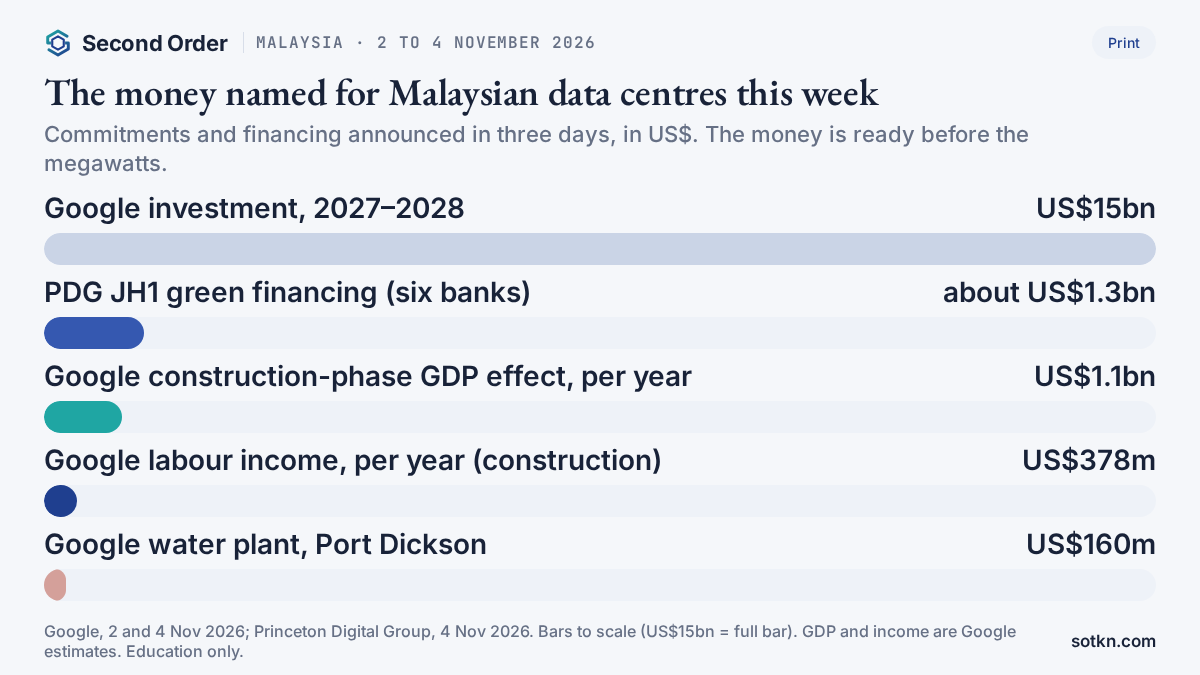
Google's US$15 billion is the headline, but the company itself split out only part of how it flows through Malaysia. It said the construction phase of its new campuses, 2027 to 2028, is expected to add an annual average of US$1.1 billion to Malaysia's GDP and support more than 37,000 local jobs a year, with US$378 million a year in labour income. About 6,000 of those jobs are in construction. Once operating, the campuses are projected to sustain more than 9,000 local jobs a year at wages averaging 45% above the national median.
Google said it works with a domestic supply chain of more than 80 Malaysian entities to build and run its campuses, spanning construction and civil engineering, network infrastructure, power and cooling system components, and services such as logistics, legal, catering and waste. That is where construction money lands first: in contracts let before a single server is installed.
The PDG loan shows the other half of Malaysia's build: independent operators funding halls for cloud tenants. The about US$1.3 billion, roughly RM5.1 billion, was underwritten by Affin Bank, HSBC, Maybank, OCBC, Standard Chartered and UOB. It builds on loans first arranged with three banks in April 2024 and enlarged with four banks in October 2025, and it will fund the continued build of JH1, a 200 MW campus at Sedenak Tech Park designed for high-density AI and cloud work. PDG said the deal is part of a plan announced in March 2026 to raise up to US$5 billion of debt to deliver contracted capacity across Asia Pacific, and that its total portfolio is more than 1.8 GW across eight countries.
We first flagged this loan as it was being arranged, in our Wire on PDG's Johor loan. For what a hall costs before it earns, see how much it costs to build an AI data center, and for how capex shows up in the cloud companies' own numbers, hyperscaler capex lines to watch.
What exactly did Google promise on power?
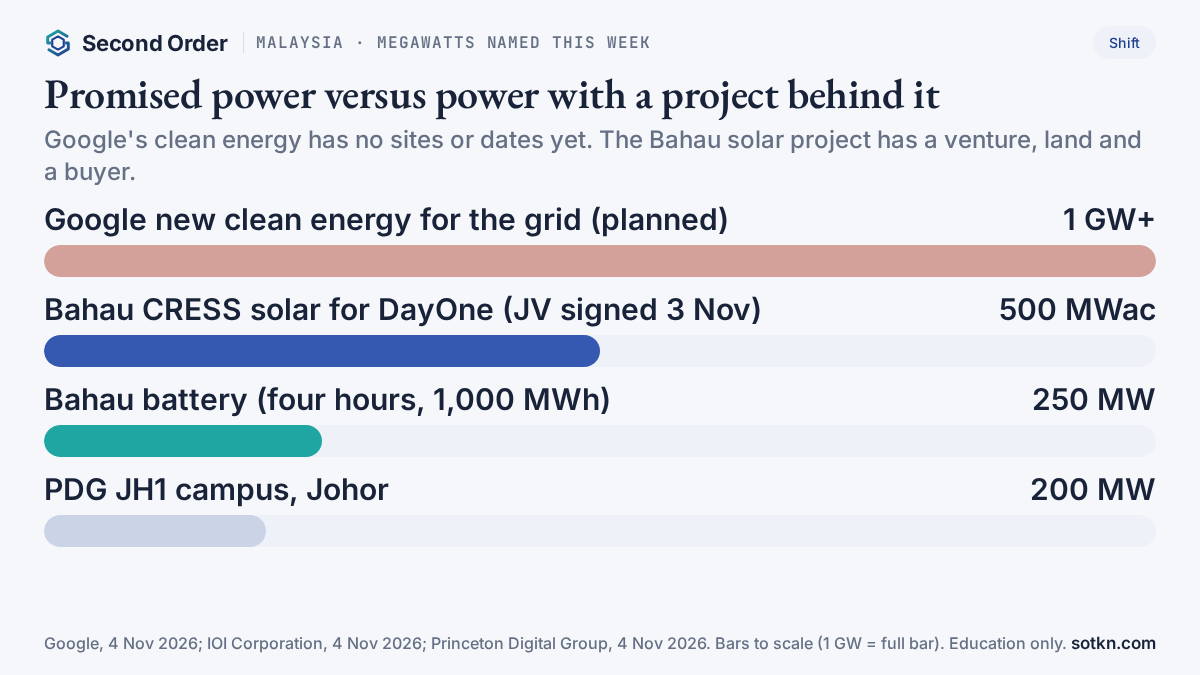
Three separate things, and it helps to keep them apart. First, Google will pay for 100% of the electricity its Malaysian campuses use. Second, it will pay the direct infrastructure costs required to connect those campuses to the grid, while complying with local rules. Third, it plans to bring more than 1 GW of new clean energy capacity to the national grid, so that the system gains supply as Google's demand grows.
The third promise is the one that sets the pace. Google said it will enable new clean generation facilities under the Corporate Renewable Energy Supply Scheme, anchored by its collaboration with TNB, and that the two will also explore round-the-clock clean energy projects to account for the intermittency of sources such as solar. That comes on top of its existing power purchase agreements with consortiums led by Shizen Energy-Solarvest and TotalEnergies, which Google described on 2 November as giving developers the guaranteed future revenue they need to finance new solar farms.
The words to notice are “plans to”. Google gave no project names, sites, megawatt split between solar and other sources, or switch-on dates for the new capacity.
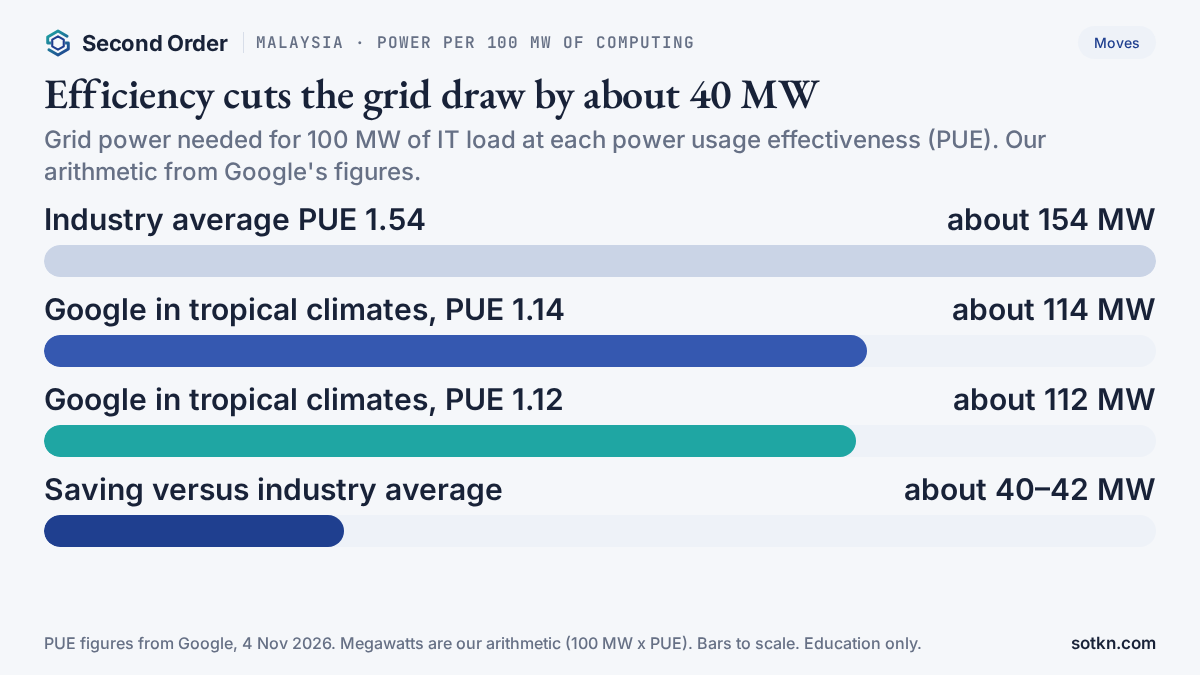
Efficiency is the other lever. Google said its campuses run at a power usage effectiveness of 1.12 to 1.14 in tropical climates like Malaysia's, against an industry average of 1.54, and that it will publish quarterly figures for each site once fully operational. PUE is total facility power divided by the power reaching the computers, so a lower number means less grid power for the same computing. For how the biggest buyers secure electricity, see how hyperscalers buy power, and for what a booked megawatt means, contracted power, explained.
What does a CRESS solar project look like in practice?
The best guide to what Google's gigawatt will involve is the CRESS deal signed the day before. On 3 November, IOI Corporation's wholly owned Luminous Aspect signed a joint venture and shareholders' agreement with TNB Renewables, a wholly owned TNB subsidiary, and CSP 500MW Sdn Bhd, a consortium of small firms, to develop a 500 MWac solar photovoltaic project with a 250 MW, 1,000 MWh battery energy storage system. IOI said it is its first large-scale project under CRESS.
TNB Renewables holds 70% of the project company, Bahau Energy Ventures. Luminous holds 25% and the small-firm consortium 5%. The project company also signed a long-term lease with IOI on about 1,300 acres of land in Bahau, Negeri Sembilan. The buyer is a data centre operator: the project is backed by TNB's long-term renewable offtake agreement with DayOne Data Centres, under which DayOne is expected to buy up to 500 MWac of renewable power over 21 years for its Malaysian operations, as the parties announced on 11 June 2025.
Two things stand out. The battery is sized at four hours, which is how a solar plant is made useful after dark. And the offtake came first: the power buyer signed in June 2025, and the joint venture that will build the plant was signed in November 2026, about 17 months later (our arithmetic). The plant itself still has to be built. That gap, between a buyer committing and generation switching on, is the gap Google's gigawatt now has to cross too.
IOI said it expects stable long-term income both as a shareholder in the project and as lessor of the land. That is a useful description of who is paid while a data centre waits for green power. For the grid charge that applies to this kind of power, see our 18 October Pulse, and for DayOne's own Johor build and its lenders, our DayOne financing Pulse.
Why did Google fund water before it named its power plants?
Because in Malaysia, water is now checked first. On 2 November Google said it is providing US$160 million for shared water infrastructure in Negeri Sembilan, coordinated with the state government and the state water operator, Syarikat Air Negeri Sembilan. Google appointed Gamuda to build an off-river storage reservoir and a water treatment plant along the Linggi River. On completion, the facilities will be owned by Menteri Besar Negeri Sembilan (Incorporated), the state body that manages state assets.
The plant will be able to deliver 65 million litres of drinking water a day, serving Google's planned campus at Springhill Industrial Park in Port Dickson and adding to the state's public supply. The reservoir captures excess river flow and rainfall in wet seasons, which helps with flooding, and the plant can draw on it in dry spells without disturbing the river's natural flow. Google said its water risk assessments in Selangor and Negeri Sembilan found local supplies were not at high risk of scarcity, which is why it chose water cooling there; it said water cooling can cut a data centre's energy use by about 10% compared with air cooling.
That order, water secured and paid for before the campus, matches what the government set out in late October, when it said developers must confirm water with the state first and power with TNB second. Our 1 November Pulse covered that rule and the 24 applications held behind it. Google has cleared the first gate with its own money. The second gate, new generation, is the longer job.
How does this compare with Johor and Singapore?
Johor's build is further along on halls and more exposed on the grid. Our 28 October Pulse followed the substations and connections Johor's campuses are waiting on, and our Malaysia power use Pulse set out how fast data centre demand has grown. PDG's JH1 sits in that cluster at Sedenak. Google's new campuses are in Selangor and Negeri Sembilan, which spreads Malaysia's next wave of demand across more of the grid rather than piling it onto one corridor.
Singapore is the contrast. It releases new data centre capacity only by government tender and sets efficiency and low-carbon conditions on each award, which is part of why demand has moved across the causeway. For two Singapore-listed ways into the region's halls, see what Keppel DC REIT does and what Nxera does. For where the world's AI campuses are being built and why, see where AI data centers are located.
In the US, Alphabet's balance sheet already carries the cost of this kind of build in another form; our Alphabet backstops Wire covered US$48.0 billion of signed backstops on other firms' data centre leases at 30 September. Malaysia's version is earlier in the chain: the money and the rules are in place, and the generation is the next step.
Our math: what do the numbers say?
The commitments, as announced
The local effects, as estimated by Google
- US$15 billion over two years is about US$7.5 billion a year (our arithmetic).
- US$1.1 billion a year of GDP over two construction years is about US$2.2 billion, about 15% of the US$15 billion headline (our arithmetic; GDP effect is not the same as spending, and Google gives no split of its spend).
- US$378 million of labour income across 37,000 jobs is about US$10,200 per job per year (our arithmetic).
- About 6,000 construction jobs out of 37,000 is about 16% (our arithmetic).
- US$160 million for 65 million litres a day is about US$2.5 million per million litres a day of capacity (our arithmetic).
- 65 million litres a day is about 23.7 billion litres a year at full output (our arithmetic).
- PDG's about US$1.3 billion against a 200 MW campus is about US$6.5 million of this financing per MW (our arithmetic; earlier loans and equity also fund JH1, so this is not the cost per MW).
- US$1.3 billion is about 26% of PDG's plan to raise up to US$5 billion of debt (our arithmetic).
- JH1's 200 MW is about 11% of PDG's more than 1.8 GW portfolio (our arithmetic).
- Bahau's 1,000 MWh battery over 250 MW is four hours of storage (our arithmetic).
- About 1,300 acres for 500 MWac is about 2.6 acres per MWac of solar (our arithmetic).
- TNB Renewables' 70% of a 500 MWac project is equivalent to about 350 MWac (our arithmetic).
- More than 1 GW of new clean capacity is at least twice the Bahau project's 500 MWac (our arithmetic).
- From DayOne's offtake announcement on 11 June 2025 to the Bahau joint venture on 3 November 2026 is about 17 months (our arithmetic).
- Illustration only: for every 100 MW of computing load, a PUE of 1.54 needs about 154 MW from the grid; a PUE of 1.12 to 1.14 needs about 112 to 114 MW, about 40 MW less (our arithmetic).
Who gets paid first?
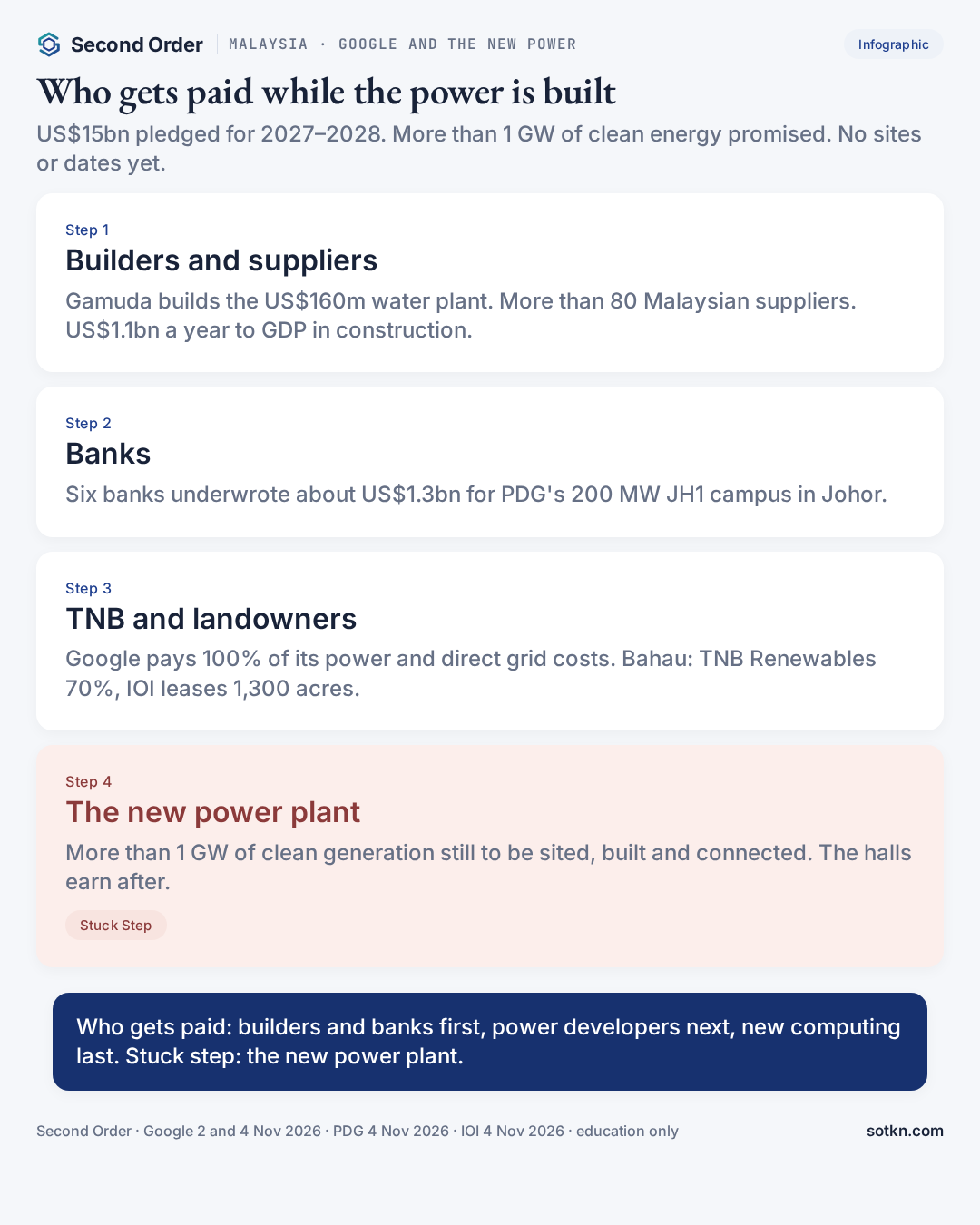
First, the builders and suppliers. Gamuda has been appointed to build Google's US$160 million reservoir and treatment plant, and Google says more than 80 Malaysian entities supply its build and operations, from civil works to power and cooling components. Construction money is spent before any campus earns. For who does this work, see who builds AI data centers, and for who makes the electrical kit, who makes data center power equipment.
Second, the banks. Affin Bank, HSBC, Maybank, OCBC, Standard Chartered and UOB underwrote PDG's about US$1.3 billion, on top of the earlier JH1 loans. Lenders earn fees at signing and interest as the money is drawn, while the halls are still being built and filled.
Third, TNB and the owners of land and plants behind new clean power. Google pays the direct cost of connecting its campuses to the grid and pays for all the power it uses. Under CRESS, TNB Renewables owns 70% of the Bahau project, and IOI earns as both shareholder and landlord on about 1,300 acres. Google's gigawatt will need more projects like it, and each one pays the developer, the landowner and the grid owner as it is built and then over a long offtake.
Fourth, the new computing capacity itself — last. Google's new Selangor and Negeri Sembilan campuses, and the Google Cloud region the Selangor capacity will support, earn only once halls are finished and power is flowing. The same order holds for PDG's cloud tenants at JH1. For how long a hall takes from permit to power, see how long it takes to build an AI data center.
One-line rule: in Malaysia this week, the builders, the banks and the power developers are paid before the new computing capacity earns. The stuck step is the new power plant.
So what is the stuck step?
The new power plant: getting more than a gigawatt of clean generation sited, built, connected and switched on so that new data centre demand adds supply instead of only drawing it down. Not money: Google has committed US$15 billion and banks lent PDG about US$1.3 billion in a single deal. Not water, at least at Port Dickson: Google has funded its own plant. Not willingness to pay: Google pays all of its power bill and its direct connection costs. Three things keep the generation step tight:
- No projects named yet. Google gave no sites, sizes or dates for its more than 1 GW. Until projects are awarded under CRESS, the gigawatt is a plan, not a pipeline.
- Solar needs storage to match a data centre. A data centre runs around the clock. Google itself said it will explore round-the-clock clean projects because of solar's intermittency, and the Bahau model pairs 500 MWac of panels with a four-hour battery.
- Offtake comes long before switch-on. The DayOne power deal was announced in June 2025; the venture to build the plant behind it was signed in November 2026. Land, panels, batteries and a grid connection still sit between signing and power.
So-what: in Malaysia, the scarce thing is no longer capital or a buyer for green power. It is generation that is built and connected. Builders, lenders and power developers are paid while it is built, and the pace of new plants decides how fast US$15 billion of buildings turns into computing that earns.
Which dates test this read next?
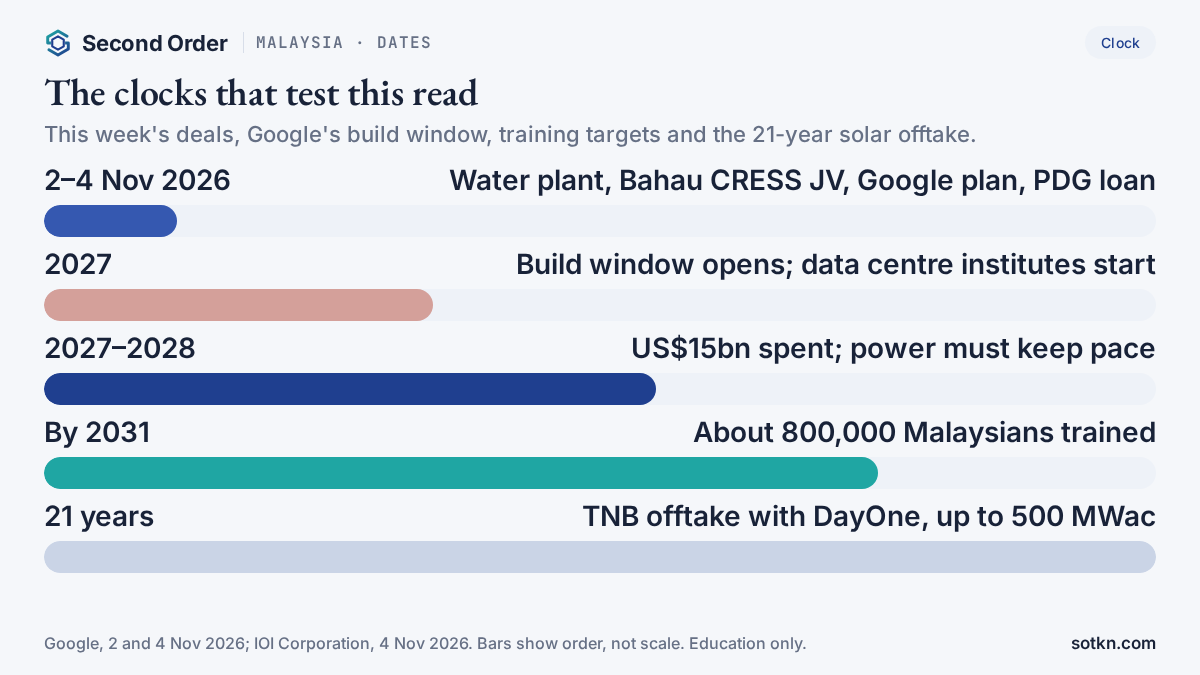
- 2 to 4 November 2026 — water plant funded, Bahau CRESS venture signed, Google plan and PDG loan announced. The baseline for this read.
- 2027 — Google's construction window opens, its Data Center Institutes start training technicians in Selangor and Negeri Sembilan polytechnics, and it plans community programmes to cut household power bills in its host states. The test: whether CRESS projects for Google are named with sites and megawatts.
- 2027 to 2028 — the US$15 billion build window. The test: whether the new campuses' power arrives on the same timetable as the halls.
- By 2031 — Google's target to train about 800,000 Malaysians. The test is less about power, but it shows how long Google expects the build to run.
- 21 years — TNB's offtake with DayOne for up to 500 MWac. The test: when Bahau switches on, and whether Google's projects follow the same template.
What would change this view?
- Google and TNB name CRESS projects with sites, megawatts and switch-on dates that line up with the 2027 to 2028 build — the generation step would bind less.
- Grid connections, not generation, turn out to be the delay for the new campuses — the stuck step would move to substations and lines.
- Water approvals for the Selangor campus slow the build — the stuck step would move back to the water check.
- Google trims or delays the US$15 billion — demand, not supply, would become the question.
Practical takeaways
- Google: US$15bn in Malaysia over 2027–2028; Elmina campus operating, new Selangor and Negeri Sembilan campuses planned
- More than 1 GW of new clean energy for the grid with TNB under CRESS; no sites or dates yet
- Google pays 100% of its campuses' power and direct grid connection costs
- US$160m water plant at Port Dickson, 65 million litres a day, built by Gamuda, owned by the state
- PDG: about US$1.3bn from six banks for its 200 MW JH1 campus in Johor
- Bahau: 500 MWac solar plus a four-hour battery for DayOne, TNB Renewables 70%, IOI as landlord
- Builders, banks and power developers are paid first; new computing capacity last. Stuck step: the new power plant
FAQ
What did Google announce in Malaysia on 4 November 2026?
Google said it will invest US$15 billion in Malaysia over two years, 2027 and 2028. The plan covers data centre campuses in Selangor and Negeri Sembilan, including its first campus at Elmina Business Park in Selangor, which is now operational. It also plans to bring more than 1 GW of new clean energy capacity to Malaysia's national grid with Tenaga Nasional Berhad, fund water projects, and train about 800,000 Malaysians by 2031.
Who pays for the power Google's Malaysian data centres use?
Google says it will pay for 100% of the power its data centre campuses use and the direct infrastructure costs of connecting them to the grid. Separately, it plans to enable new clean generation under Malaysia's Corporate Renewable Energy Supply Scheme, anchored by its collaboration with TNB.
What is CRESS?
The Corporate Renewable Energy Supply Scheme is Malaysia's route for a company to buy renewable power from a specific new plant, delivered over TNB's grid. On 3 November 2026 TNB Renewables, IOI and a group of small firms signed a joint venture for a 500 MWac solar project with a 250 MW, 1,000 MWh battery in Bahau, Negeri Sembilan, backed by TNB's 21-year offtake deal with the data centre operator DayOne.
What is the Google water deal in Negeri Sembilan?
On 2 November 2026 Google said it is funding US$160 million of shared water infrastructure: an off-river storage reservoir on the Linggi River and a treatment plant built by Gamuda, able to deliver 65 million litres of drinking water a day to Google's planned Port Dickson campus and the public. The state body MBINS will own the facilities on completion.
Who gets paid first while the new power is built?
On our map: the builders, starting with Gamuda on the water plant and more than 80 Malaysian suppliers; the banks lending to campus owners, such as the six that underwrote PDG's US$1.3 billion; and TNB and the owners of the land and plants behind new CRESS generation. Google's new computing capacity earns last, once the power and the halls are both ready.
Is this investment advice?
No. Education only. It maps who gets paid and which step is stuck. It is not a recommendation to buy or sell any security, and we leave out share prices, valuations, broker ratings and price targets on purpose.
Keep reading on the map
- Malaysia Markets hub — country page
- Water check Pulse · Johor grid connection Pulse · Green power grid charge Pulse
- Unused power charge Pulse · DayOne financing Pulse · PDG Johor loan Wire
- AI Data Centers on the stack · What Google does · What Keppel DC REIT does
- What is an AI data center? · Contracted power, explained · Who makes data center power equipment
- Where AI data centers are located · How long it takes to build an AI data center · How hyperscalers buy power
- All Markets doors — Taiwan, Korea, US, China, Singapore, Australia, Malaysia
How we check this. The US$15 billion plan, the campuses, the clean energy and grid terms, the supplier count, the jobs and GDP estimates and the PUE figures come from Google's announcement of 4 November 2026. The water plant comes from Google's Negeri Sembilan announcement of 2 November 2026. The Johor loan comes from Princeton Digital Group's release of 4 November 2026, and the Bahau solar project from IOI Corporation's release of 4 November 2026 on its 3 November agreement. Anything we worked out ourselves is labelled “our arithmetic”. Share prices, valuations, broker ratings and price targets are left out on purpose. The references we used are listed at the end. Our editorial standards →
Not investment advice. Do your own research.
References
- Google, Google Announces Digital Infrastructure Expansion, Local Jobs, Water Replenishment, and Clean Energy Initiatives with US$15 Billion Malaysia Investment (Google Malaysia blog), 4 Nov 2026. blog.google — US$15bn over 2027-2028, Elmina campus operational, new Selangor and Negeri Sembilan campuses, more than 1 GW of clean energy with TNB under CRESS, 100% of power and direct grid connection costs, 80-plus local suppliers, US$1.1bn a year to GDP, 37,000 jobs and US$378m labour income a year during construction, 9,000 jobs once operating, PUE 1.12 to 1.14 against 1.54.
- Google, Google Funds US$160 Million in Shared Water Infrastructure Alongside Digital Infrastructure Development in Negeri Sembilan (Google Malaysia blog), 2 Nov 2026. malaysia.googleblog.com — US$160m off-river reservoir and treatment plant on the Linggi River built by Gamuda, owned by MBINS on completion, 65 million litres a day, Springhill Industrial Park campus in Port Dickson, PPAs with Shizen Energy-Solarvest and TotalEnergies consortiums.
- Princeton Digital Group, PDG Secures ~USD 1.3 Billion for JH1 Campus in Johor (press release), 4 Nov 2026. princetondg.com — about US$1.3bn (about RM5.1bn) green financing from Affin Bank, HSBC, Maybank, OCBC, Standard Chartered and UOB for the 200 MW JH1 campus at Sedenak Tech Park, part of a plan to raise up to US$5bn of debt, portfolio above 1.8 GW.
- IOI Corporation, IOI Inks Renewable Energy Partnership With TNB For 500 MWac Large-Scale CRESS Project (press release), 4 Nov 2026. markets.businessinsider.com — joint venture of 3 Nov 2026 with TNB Renewables (70%), IOI's Luminous Aspect (25%) and an SME consortium (5%) for a 500 MWac solar project with a 250 MW / 1,000 MWh battery on about 1,300 acres in Bahau, supported by TNB's 21-year offtake of up to 500 MWac with DayOne.