20 MW Hall, Batteries Still Unproven: Who Gets Paid While DayOne's Singapore VPP Waits on FEED
DayOne signed a non-binding deal on 30 October to study a virtual power plant that would link batteries at its 20-megawatt SG1 hall with other sites. Banks and the power seller are already in the money. The batteries wait on a design study and the grid's market rules.
DayOne, a Singapore-headquartered data centre platform, signed a non-binding deal on 30 October to study a virtual power plant that would link batteries at its upcoming 20-megawatt SG1 hall with batteries at other commercial and industrial sites. The first work is a front-end engineering design study. Banks have already lent S$530 million against the hall, and a ten-year power contract is already signed. The batteries, and any money they might earn from the grid, wait on that design study and on the market rules for cutting demand when the system is tight. The stuck step is the FEED.
SINGAPORE PULSE · AI DATA CENTRES · POWER · Data as at 6 Nov 2026 (DayOne–Blue Whale MOU 30 Oct) · Next update: FEED outcome or SG1 ready-for-service
Affects: AI Data Centers · Power use · Virtual power plants — Markets: Singapore · Malaysia · Australia
Education only, not advice to buy or sell any security. Dollar figures are Singapore dollars unless we say US. A megawatt is a thousand kilowatts, roughly the continuous draw of a large suburban shopping mall. Our own sums are labelled. This piece is about the new virtual power plant study; it does not re-tell the October Digital Core SIN12 land-lease Pulse.
The numbers that matter this week
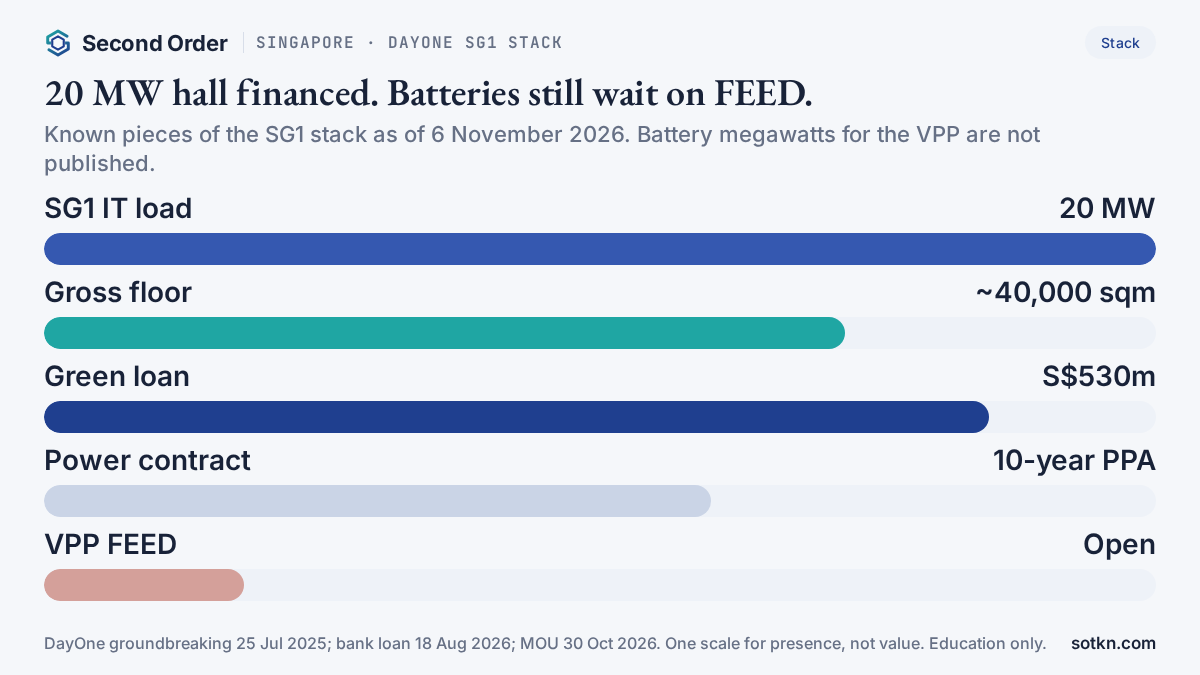
SG1 IT load
20 MW
About 40,000 sqm gross floor · west Singapore
HallGreen loan
S$530m
4 years · DBS, OCBC, UOB · 18 Aug 2026
PaidPower contract
10 years
Sembcorp PPA + renewable certificates
PaidMOU date
30 Oct
DayOne + Blue Whale Energy · non-binding
NewDR / IL floor
0.1 MW
EMA minimum offer into either programme
RuleThe FEED
Open
Design + market rules before batteries earn
Stuck stepDayOne MOU 30 Oct 2026; DayOne groundbreaking 25 Jul 2025; UOB/DBS/OCBC loan release 18 Aug 2026; EMA DR/IL factsheet. Status chips are Second Order’s read.
On this page: Why it matters · What changed · What is a VPP? · The SG1 hall · Who is already paid · Market rules · Our math · Who gets paid · What is stuck? · Dates next · FAQ
Why does a virtual power plant study matter for AI halls?
Think of a neighbourhood where every big house has a spare water tank. Alone, each tank is too small to help the city when a dry spell hits. Linked together and controlled from one place, the tanks can ease the pressure on the main pipes at the hottest hour. Nobody builds a new reservoir. They just coordinate the tanks that already exist, or that are about to be installed.
A virtual power plant is the electricity version of that. It is not a new power station. It is software and contracts that tell many small batteries, generators or flexible loads when to charge, discharge or cut back, so that together they behave like one controllable plant for the grid. Hyperscalers are already buying this kind of peak relief in tight US markets; Google’s deal with Voltus in PJM is the clearest recent example.
Singapore’s problem is different in shape but the same in kind. New data centre capacity is rationed. The second Call for Application provisionally allocated 200 megawatts across four operators in August, and halls still wait on green fuel and grid paths we mapped in October (Singapore’s power plan; the licence and 200 MW ration). A data hall that can prove it will ease the peak, not just add to it, has a stronger case the next time capacity is allocated. That is why a FEED study at a 20-megawatt hall is a Markets story, not just a press release.
If you need the basics of what these halls are and how much power they draw, start with the Explained layer (what is an AI data center; how much power an AI data center uses; contracted power).
What did DayOne and Blue Whale actually sign?
On 30 October 2026 DayOne Data Centers and Blue Whale Energy announced a Memorandum of Understanding. It is non-binding. It does not name a megawatt target for the batteries, a dollar value for the study, a completion date for the FEED, or a price for future flexibility. What it does name is the shape of the work.
The collaboration would explore an intelligent real-time solution to coordinate a distributed battery energy storage network that links storage at DayOne’s upcoming SG1 data centre with suitable third-party commercial and industrial sites, allowing them to act together as a single flexible resource for the grid. The stated aim is to adjust electricity drawn from the grid at key moments, make better use of existing power infrastructure, and reduce the need for costly grid upgrades to deal with peak demand.
The initial work is expected to include a joint front-end engineering design study covering storage configuration, safety, metering and telemetry, controls, operational safeguards, and potential arrangements with participating commercial and industrial facilities. The parties also intend to engage relevant authorities and market stakeholders, and to assess the requirements for potential participation in Singapore’s Demand Response and Interruptible Load programmes, subject to applicable market rules and regulatory approvals.
Jamie Khoo, DayOne’s chief executive, said data centres should play an active role in strengthening the broader power ecosystem they rely on. Gabriel Lim, Blue Whale Energy’s founder and chief executive, said the MOU would assess the technical, operational and commercial arrangements required for a Distributed VPP, starting in Singapore. Those are statements of intent. The money still sits behind the FEED.
What is a Distributed VPP in plain English?
“Distributed” means the batteries are not all in one yard. Some would sit at SG1. Others would sit at factories, warehouses or office campuses that agree to join. Software would tell the pool when to charge from the grid, when to discharge, and when to cut the hall’s draw so the grid sees less demand at the stressed hour.
That is different from a single on-site battery that only backs up one hall. A single battery protects the customer inside the fence. A virtual power plant sells a service outside the fence: peak relief, contingency reserve, or both, depending on which market programme it joins. The aggregator, here Blue Whale Energy, is the company that stitches the sites together and bids them into the market.
We covered a much larger version of the same idea in the US mid-Atlantic grid in October, when Google and Voltus took a virtual power plant to about 1.17 gigawatts in PJM (Google–Voltus 1 GW VPP). Singapore’s version, if it ever clears FEED and registration, would be smaller and earlier. The useful comparison is the stuck step: in PJM the scarce thing was peak-hour capacity on a short grid; here the scarce thing is a completed design and a clear path into the local programmes.
It is also different from buying a gas turbine slot years ahead. Turbine makers get cash deposits today for machines that ship years later (GE Vernova’s turbine queue). A virtual power plant gets paid when it can actually deliver a verified cut or a verified standby. Until the FEED says the controls, meters and contracts work, there is nothing to bid.
What is already built into SG1?
SG1 is DayOne’s first Singapore data centre. DayOne broke ground on 25 July 2025. The hall is sized at 20 megawatts of IT load across about 40,000 square metres of gross floor area in the west of Singapore. It was awarded capacity under the pilot Data Centre Call for Application run by IMDA and EDB, and DayOne frames it as the Singapore anchor of a Singapore–Johor–Riau Islands regional strategy.
On the same groundbreaking day DayOne signed a ten-year Power Purchase Agreement with Sembcorp Power. The energy is to be backed by bundled renewable energy certificates, sourced locally or imported via grid-to-grid connection, so that operations are covered with renewable energy on a certificate basis. That is a long contracted power relationship: the hall pays for energy under the PPA whether or not a virtual power plant ever earns a dollar.
The same release said SG1 would support high-density air-cooled GPU loads with hybrid air and liquid cooling, and that it was expected to be Singapore’s first data centre with on-site Solid Oxide Fuel Cell power generation as a proof of concept for hydrogen-based energy. An earlier 2023 collaboration with SK ecoplant and Bloom Energy described a trial that would start on natural gas and move toward hydrogen once infrastructure and rules allow. DayOne also partnered with the National University of Singapore on tropical data centre research under STDCT 2.0.
Financing caught up in August. On 18 August 2026 DayOne secured a four-year S$530 million green loan from DBS, OCBC and UOB, structured under Green Loan Principles, with the three banks as joint mandated lead arrangers, book runners and green loan coordinators. DBS is also facility and security agent. The bank release said the facility is expected to become operational by the first quarter of 2027, that it will feature vertical building-integrated photovoltaics and hybrid air and liquid cooling, and that in December 2025 it achieved BCA Green Mark Platinum (Provisional) under the Green Mark for Data Centres scheme.
Put plainly: the hall, the green loan, the power contract, the fuel-cell trial and the green-mark path are already on the calendar. The virtual power plant is a new layer on top. DayOne has also been raising and connecting capacity on the Johor side of the SIJORI triangle; that is a separate Markets story (DayOne in Malaysia).
Who is already in the money?
Before any battery earns a Demand Response payment, several parties are already paid or contracted on their own clocks. That is the useful split this week.
1 · The lenders
Who: S$530m four-year green loan from DBS, OCBC and UOB
Paid: Interest paid on the loan schedule
2 · The power seller
Who: Ten-year Sembcorp PPA with renewable certificates
Paid: Energy billed as the hall draws
3 · The hall
Who: 20 MW SG1 under construction; ops targeted Q1 2027
Paid: Customer contracts start when racks go live
4 · The FEED
Who: Design, meters, controls, DR/IL rules, third-party contracts
Paid: No flexibility revenue until this clears
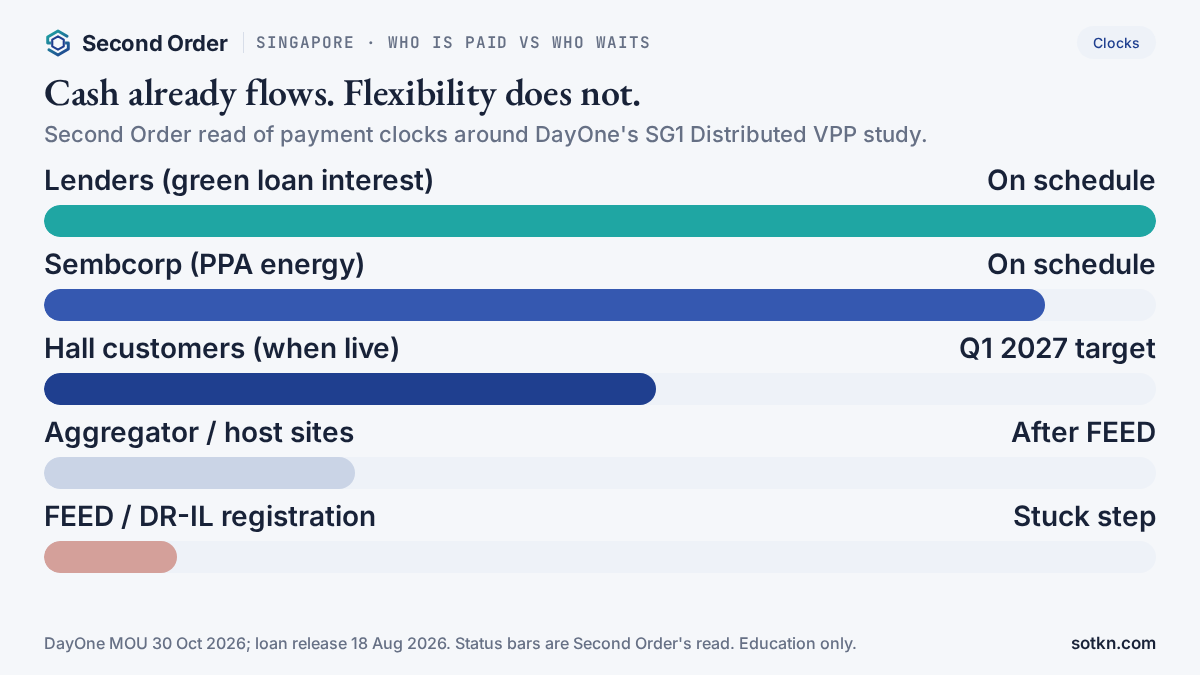
The lenders are first. A four-year green loan of S$530 million against a 20-megawatt hall is about S$26.5 million of loan per megawatt of IT load (our arithmetic). Interest accrues whether or not the virtual power plant ships. The power seller is second. Sembcorp’s ten-year PPA bills energy as the hall draws it; renewable certificates travel with that energy on the terms of the contract. Neither payment depends on Blue Whale clearing a FEED.
The hall’s own customers come third. Colocation or cloud tenants pay when racks are live and power is delivered to IT load. That clock starts around the first-quarter 2027 operations target the banks published. The virtual power plant, if it works, is a fourth cash stream: payments for verified demand cuts or for standing by as contingency reserve. That stream does not start at groundbreaking. It starts after design, registration and a cleared bid.
This is the same shape we keep seeing across AI infrastructure: the party that clears the stuck step late still pays the parties that cleared earlier steps on time (where the stuck step moves; purchase commitments).
What do Singapore’s Demand Response and Interruptible Load rules require?
DayOne and Blue Whale said they will assess requirements for potential participation in Singapore’s Demand Response and Interruptible Load programmes. Those programmes already exist. The Energy Market Authority’s factsheet sets out the floor rules that any FEED has to design against.
Demand Response lets contestable consumers reduce electricity demand voluntarily when wholesale prices are high, in exchange for a share of the system-wide savings. Participants can join through a retailer or a Demand Response aggregator, or directly if they can offer at least 0.1 megawatt of reduction. They submit demand bids at different price points. When activated, the provider receives one-third of the savings from the price reduction, with the incentive capped at S$4,500 per megawatt-hour, which is the ceiling for wholesale electricity prices. Typical flexible loads the Authority lists include production equipment, high-voltage air conditioning, chillers and pumps, and on-site backup generation.
Interruptible Load pays contestable consumers to be on standby. In exchange, they must cut demand when the system needs the reduction for reliability. The same 0.1-megawatt floor applies, again through a retailer, an aggregator, or direct participation. Participants bid into the reserves market. They are paid the clearing price for contingency reserves every period they are on standby; there is no extra payment when they are actually activated.
A 20-megawatt hall is far above the 0.1-megawatt floor. Size is not the bind. The bind is proving that batteries inside a data hall, plus batteries at third-party sites, can be metered, controlled and contracted so that a cut offered into Demand Response or a standby offered into Interruptible Load is real when the system calls. That is exactly what the FEED lists: storage configuration, safety, metering, telemetry, controls, safeguards and arrangements with participating facilities.
Singapore is also tightening the licence floor under the Digital Infrastructure framework we covered in October. Halls above set megawatt thresholds will need IMDA licences for sustainability and, for the larger ones, for security and resilience (Singapore’s data centre licence). A virtual power plant does not replace that licence. It sits beside it: another way a hall shows it can be a grid citizen, not only a grid load.
What do the numbers say about scale?
None of the primary releases names a battery megawatt target for the Distributed VPP, so we cannot invent one. What we can do is put the known hall next to the known programmes and label the arithmetic.
SG1 is 20 megawatts of IT load. The Demand Response and Interruptible Load floor is 0.1 megawatt. On paper, a hall that could flex even 5% of IT load for a short window would offer 1 megawatt, ten times the minimum (our arithmetic). Flexing 10% would offer 2 megawatts. Those are illustrations of scale, not DayOne’s plan; the MOU does not say how many megawatts of batteries will sit at SG1 or at third-party sites.
The green loan is S$530 million against 20 megawatts, or about S$26.5 million per megawatt (our arithmetic). That is the capital already committed to the hall itself. A virtual power plant’s capital sits on top: battery containers, inverters, meters, controls and the aggregator’s platform. Until the FEED sizes those, any comparison of loan-per-megawatt to battery-per-megawatt would be made up, so we stop.
The Demand Response incentive is one-third of system savings, capped at S$4,500 per megawatt-hour. That is a ceiling on the payment rate when a cut lands in a high-price period, not a forecast of annual revenue. Interruptible Load pays the contingency-reserve clearing price for being on standby. Neither figure becomes a cash forecast without hours of activation, megawatts delivered and a cleared registration. The FEED is what turns those programme rules into a site-specific cash model.
For context on how long halls take and what they cost before any flexibility revenue, see the Explained layer (how long it takes to build an AI data center; how much it costs; where they are located).
Who gets paid while the FEED is open?
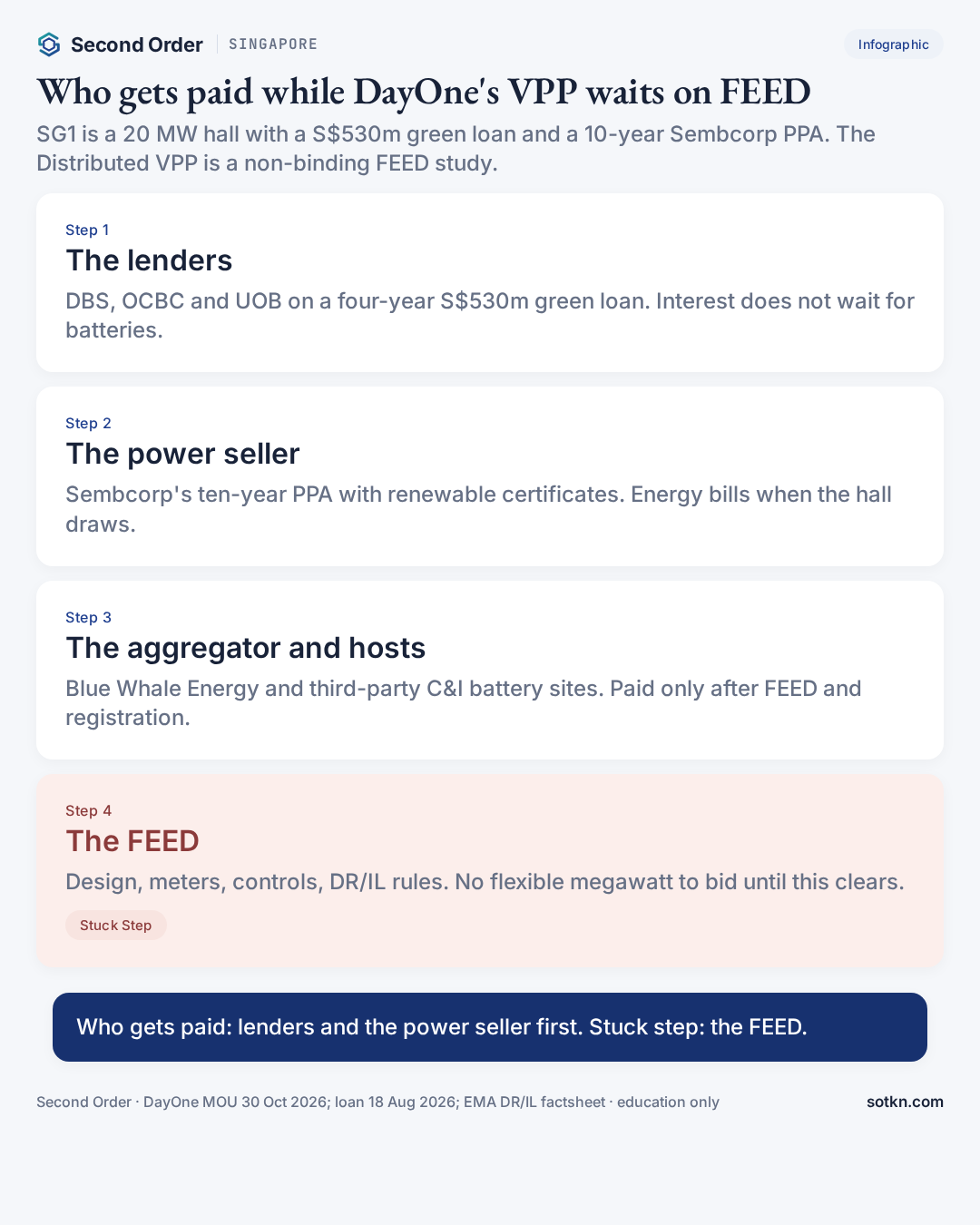
First, the banks. DBS, OCBC and UOB earn interest and fees on the S$530 million green loan on the loan’s own schedule. That cash does not wait for a virtual power plant.
Second, Sembcorp. Under the ten-year PPA it sells energy, backed by renewable certificates, as SG1 draws power. When the hall opens, that meter runs every hour the racks are on.
Third, DayOne’s construction and equipment chain: builders, cooling suppliers, fuel-cell partners, photovoltaic suppliers. They are paid against the build, not against Demand Response.
Fourth, if and when the FEED clears and the pool registers, Blue Whale Energy as aggregator and the third-party commercial and industrial sites that host batteries. Aggregators typically earn a share of programme payments; host sites earn for the flexibility they deliver. Neither cheque exists while the study is open.
Fifth, the grid and other consumers, in theory: a working Distributed VPP that cuts peaks can defer some reinforcement and shave wholesale spikes. That benefit is real only after megawatts are registered and delivered. It is not a payment to DayOne today.
Who waits. Tenants who wanted cheaper power from on-site flexibility before the hall opens. Battery suppliers waiting for a sized order. Any future Call for Application scoring that might reward proven grid services — that score cannot be claimed on a memorandum alone. Across the causeway, Malaysia is checking water before power on new applications; in Australia the permit binds the pipeline. Singapore’s new twist is that even an awarded, financed hall still has a flexibility clock that starts only after FEED (Malaysia’s water check; Australia’s permit).
What is stuck, exactly?
The stuck step is the FEED: the front-end engineering design study that has to prove storage configuration, safety, metering, telemetry, controls, operational safeguards and contracts with third-party sites, and then map those onto Demand Response and Interruptible Load rules. Until that work finishes, there is no registered flexible megawatt to bid, and no programme payment to share.
It is not the land. SG1 already broke ground under a pilot Call for Application award. It is not the senior debt: S$530 million is committed. It is not the energy supply: Sembcorp’s ten-year PPA is signed. It is not the basic licence story we told in October. Those steps have moved. The new step that has not moved is the flexibility layer.
That is why the overlay on this Pulse is words, not a fake battery megawatt number. The MOU does not publish a battery size. Shipping a made-up megawatt on the cover would teach the wrong thing. The teach is the gate: FEED first, then the grid can pay (the stuck-step map).
Elsewhere on the Singapore desk this autumn, Digital Core’s SIN12 stake was gated by a land lease, Keppel DC REIT was printing renewals and interest costs, and a data centre REIT listing stayed on hold. Those are different clocks (SIN12 land lease; Keppel DC REIT’s quarter; the REIT IPO delay). Today’s clock is the design study behind a virtual power plant.
Which dates test the read?
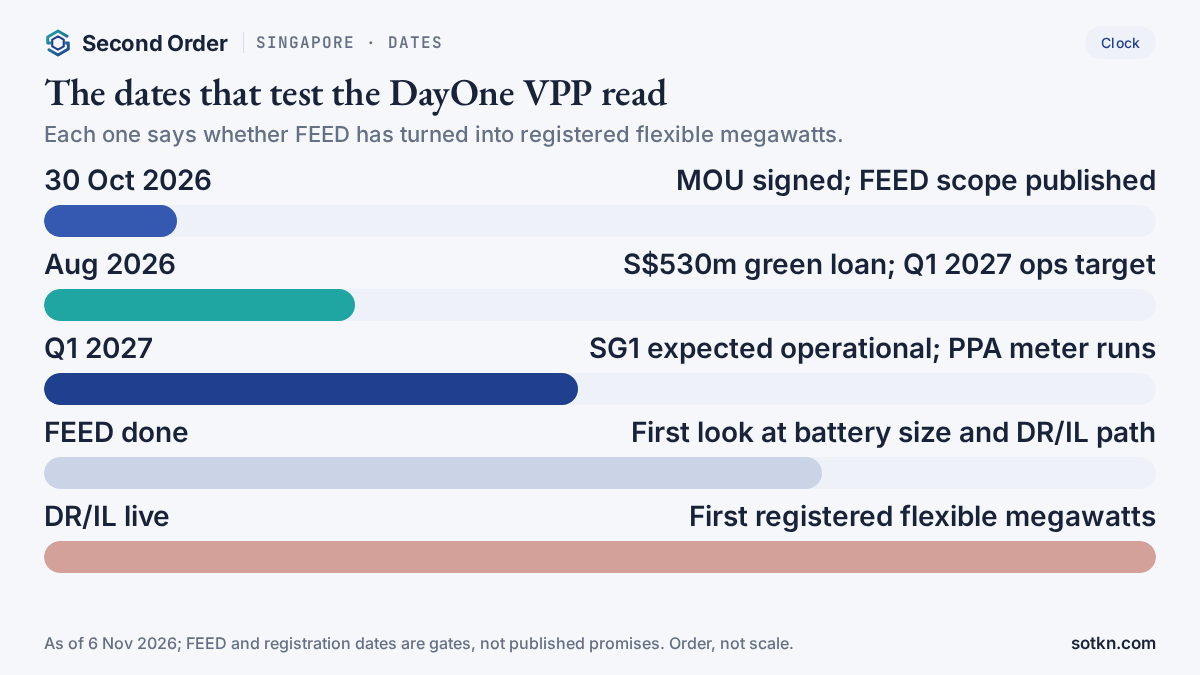
Dates from DayOne MOU 30 Oct 2026, bank loan release 18 Aug 2026 and EDB/IMDA DC-CFA2 note 21 Aug 2026. FEED and registration dates are not published; listed as gates, not promises.
How we check this. The virtual power plant memorandum, the FEED scope and the plan to assess Demand Response and Interruptible Load come from DayOne’s 30 October 2026 release, with secondary confirmation from Data Center Dynamics the same day and ASEAN Coverage on 2 November. SG1’s size, groundbreaking, Sembcorp power purchase agreement and fuel-cell plan come from DayOne’s 25 July 2025 groundbreaking release. The S$530 million green loan, Q1 2027 operations target and Green Mark Platinum Provisional certification come from the 18 August 2026 bank release. Demand Response and Interruptible Load rules come from the Energy Market Authority factsheet. Every sum we worked out is labelled “our arithmetic”. Price targets and ratings are left out on purpose. The references we used are listed at the end. Our editorial standards →
FAQ
What did DayOne announce on 30 October?
DayOne and Blue Whale Energy signed a non-binding memorandum of understanding to study a Distributed Virtual Power Plant in Singapore. The idea is to coordinate battery storage at DayOne's upcoming SG1 data centre with batteries at suitable commercial and industrial sites so they can act as one flexible resource for the grid. The first work is a joint front-end engineering design study covering storage configuration, safety, metering, telemetry, controls, safeguards and arrangements with participating sites.
What is SG1?
SG1 is DayOne's first Singapore data centre: about 20 megawatts of IT load across roughly 40,000 square metres of gross floor area in the west of the island. It broke ground on 25 July 2025 under a pilot Data Centre Call for Application award, signed a ten-year renewable power purchase agreement with Sembcorp, is piloting solid oxide fuel cells, and raised a S$530 million four-year green loan from DBS, OCBC and UOB in August 2026. The banks say it is expected to become operational by the first quarter of 2027.
What is the stuck step?
The FEED study, and behind it the market rules for Demand Response and Interruptible Load. Until the design clears and the partners know how batteries at a data hall and at third-party sites can bid into Singapore's programmes, the flexibility revenue does not start. Banks and the power seller are already paid on their own clocks; the batteries wait.
Is this investment advice?
No. Education only. It maps who gets paid and which step is stuck. It is not a recommendation to buy or sell any security, and we leave out price targets and ratings on purpose.
References
Outbound links below are nofollow. We list only the sources actually used. Internal sotkn.com links in the body are separate.
- DayOne, DayOne and Blue Whale Energy to Explore Distributed Virtual Power Plant in Singapore, 30 Oct 2026. dayonedc.com — the non-binding MOU, the Distributed VPP concept, the joint FEED scope and the plan to assess Demand Response and Interruptible Load participation.
- Data Center Dynamics, DayOne inks MoU with Blue Whale Energy to explore feasibility of a distributed virtual power plant in Singapore, 30 Oct 2026. datacenterdynamics.com — SG1 size, cooling mix, fuel-cell claim, Sembcorp PPA and commercial-operations timing as reported.
- DayOne, Singapore's DayOne breaks ground on first data center in Singapore, 25 Jul 2025. dayonedc.com — the 20 MW / 40,000 sqm SG1 groundbreaking, DC-CFA pilot award, Sembcorp 10-year PPA with RECs, SOFC plan and NUS partnership.
- UOB / DBS / OCBC, DayOne secures S$530 million green loan from DBS, OCBC and UOB for its first Singapore data centre, 18 Aug 2026. uobgroup.com — the four-year S$530 million green loan, Q1 2027 operations target, BIPV, hybrid cooling and BCA Green Mark Platinum Provisional certification.
- DayOne, DayOne Data Centers and SK ecoplant Collaborate on Fuel Cell Technology Trial to Power Data Centers in Singapore, 4 Sep 2023. dayonedc.com — the SOFC trial with SK ecoplant and Bloom Energy, starting on natural gas with a path to hydrogen.
- Energy Market Authority, Enhancing the Demand Response (DR) and Interruptible Load (IL) Programmes with a Demand Side Management Sandbox, 3 Nov 2022. ema.gov.sg — DR and IL eligibility at 0.1 MW, DR incentive of one-third of system savings up to $4,500/MWh, and IL standby payments.
- EDB / IMDA, Four data centre proposals selected as part of second data centre - call for application (DC-CFA2), 21 Aug 2026. edb.gov.sg — the 200 MW provisional allocation under DC-CFA2 and the Jurong Island low-carbon park context.
- ASEAN Coverage, DayOne and Blue Whale Energy plan Singapore virtual power plant study, 2 Nov 2026. tech.aseancoverage.com — secondary confirmation of the FEED scope and authority-engagement plan.
Not investment advice. Education only. Map of who gets paid and which step is stuck — not a buy list.
More on this desk: Singapore Markets · AI Data Centers · all Markets · Equinix · Digital Realty · hyperscale vs colocation · today’s Wire.