16.6 GW Ordered, 5.3 GW Shipped: Who Gets Paid While GE Vernova’s Turbine Slots Run to 2032
America’s biggest gas turbine maker booked three times more turbines than it shipped last quarter, and customers handed it billions in deposits to hold a place in line. Demand is not the problem. How many turbines one factory can finish each quarter is.
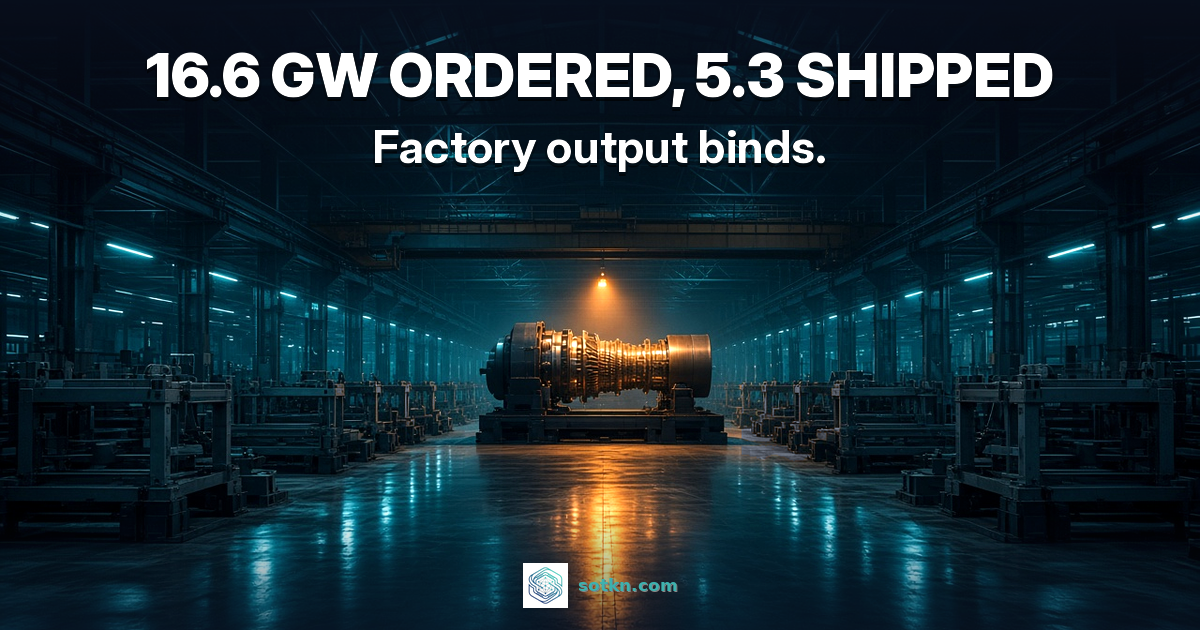
GE Vernova, America’s biggest maker of gas turbines, took orders for 16.6 gigawatts of turbines in the third quarter and shipped 5.3 gigawatts. It now has 122 gigawatts of firm orders and paid reservations waiting, and it said it sold slots for delivery in 2032. Customers are paying billions up front just to hold a place in line. The money is flowing to the turbine maker today. The power plants, and the AI data centres that need them, wait for a factory that finishes about 5 gigawatts a quarter. The stuck step is the factory’s output.
US PULSE · POWER · Data as at 4 Nov 2026 (GE Vernova Q3, Amazon Q3) · Next update: GE Vernova fourth-quarter results, late January 2027
Affects: AI Data Centers · Amazon · Power equipment makers — Markets: US · Korea · Taiwan
Education only, not advice to buy or sell any security. Growth rates are against the third quarter of 2025 unless we say otherwise. Dollar figures are US dollars. A gigawatt is a thousand megawatts, roughly the power a large city district or one very big AI campus draws. Our own sums are labelled.
The numbers that matter this week
Gas turbines ordered in Q3
16.6 GW
112 units · up from 7.4 GW a year ago
HotGas turbines shipped in Q3
5.3 GW
32 units · up from 4.0 GW
SlowerUnder contract
122 GW
64 GW orders + 58 GW paid slots · 130 GW by year-end
QueueCustomer cash held at Power
$33.2bn
Was $16.5bn at end-2025
PaidOrder price per kilowatt
~+50%
2026 orders vs 2025 orders
PriceThe factory’s output
~5 GW
A quarter · slots now sold for 2032
Stuck stepGE Vernova Q3 release, 10-Q and call, 28 Oct 2026. Status chips are Second Order’s read.
On this page: Why it matters · The quarter · The queue · Cash first · Price · Data centres · Parts · Our math · Who gets paid · What is stuck? · Dates next · FAQ
Why does a turbine queue matter for AI data centres?
Think of a famous bicycle workshop that builds every frame by hand. One year, everyone wants one. The workshop can only finish so many frames a week, so it starts a waiting list. Then it asks for a deposit to join the list. Then the list gets so long that it starts taking deposits for bikes it will build six years from now. The workshop’s bank account fills up long before any extra bikes reach the road.
That is what the gas turbine business looks like right now. A gas turbine is the big spinning engine at the heart of a gas power plant. Burn gas, spin the turbine, turn a generator, make electricity. Only a few companies in the world build the large ones, and GE Vernova is the biggest. When utilities and data centre builders want new power plants quickly, they all end up in the same few queues.
AI data centres need a lot of steady power, day and night (how much power does an AI data center use?). Much of the new supply being planned in the US is gas, either plants on the grid or plants built next to a campus. So a turbine that cannot be delivered until 2030 or later is not just GE Vernova’s problem. It sets the earliest date some data centres can switch on. The chain looks like this.
1 · The demand
Who: Utilities and data centre builders need new power plants
Paid: Big buyers reserve years ahead
2 · The slot
Who: A buyer pays a deposit to hold a production slot, then a full order
Paid: Turbine maker paid in cash first
3 · The factory’s output
Who: How many turbines the factory can finish each quarter
Paid: Decides when the queue moves
4 · The power
Who: Turbine ships, plant is built, power flows to the grid or the campus
Paid: Plant owners and data centres paid last
What did GE Vernova report?
On 28 October, GE Vernova reported its results for the three months to 30 September. The company has three parts: Power, which makes gas turbines and services nuclear and other plants; Electrification, which makes grid gear like transformers, switchgear and high-voltage links; and Wind. Across the whole company, orders were US$29.3 billion, up 96% on an organic basis, and revenue was US$12.6 billion, up 27%. Its total backlog, the value of work customers have signed for but not yet received, rose by about US$20 billion in three months to US$197 billion.
The gas turbine figures are the heart of it. The 10-Q, the quarterly filing, gives orders and sales in units. In the quarter GE Vernova took orders for 112 gas turbines with 16.6 gigawatts of capacity, against 29 turbines and 7.4 gigawatts a year earlier. Of the 112, 55 were heavy-duty units, the big machines for full-size power plants, including 21 of its largest HA class. The other 57 were aeroderivatives, smaller turbines based on jet engine designs that start quickly and are popular for sites that need power fast.
On the other side, it sold 32 gas turbines with 5.3 gigawatts, against 20 turbines and 4.0 gigawatts a year earlier. Sold here means shipped and counted as revenue. Only 7 of the 32 were HA units. So in one quarter the company booked about three times as much capacity as it shipped, and three times as many HA units as it shipped (our arithmetic). For the first nine months of 2026, orders were 36.7 gigawatts and sales 12.8 gigawatts, close to the same three-to-one ratio.
Management was clear that the factory is running harder, not slower. The chief financial officer said the plant had ramped to about 5 gigawatts a quarter as new capacity came on, and that hitting that rate “always is a big move for the factory”. Units shipped rose 60% from a year earlier. Output is going up. It is just going up far more slowly than orders.
How long is the turbine queue?
GE Vernova counts two kinds of commitment. A firm order is a signed contract for a turbine. A slot reservation agreement is a paid place in the production queue: the buyer puts down money to hold a slot before it signs the full order. Added together, the company calls them gigawatts under contract.
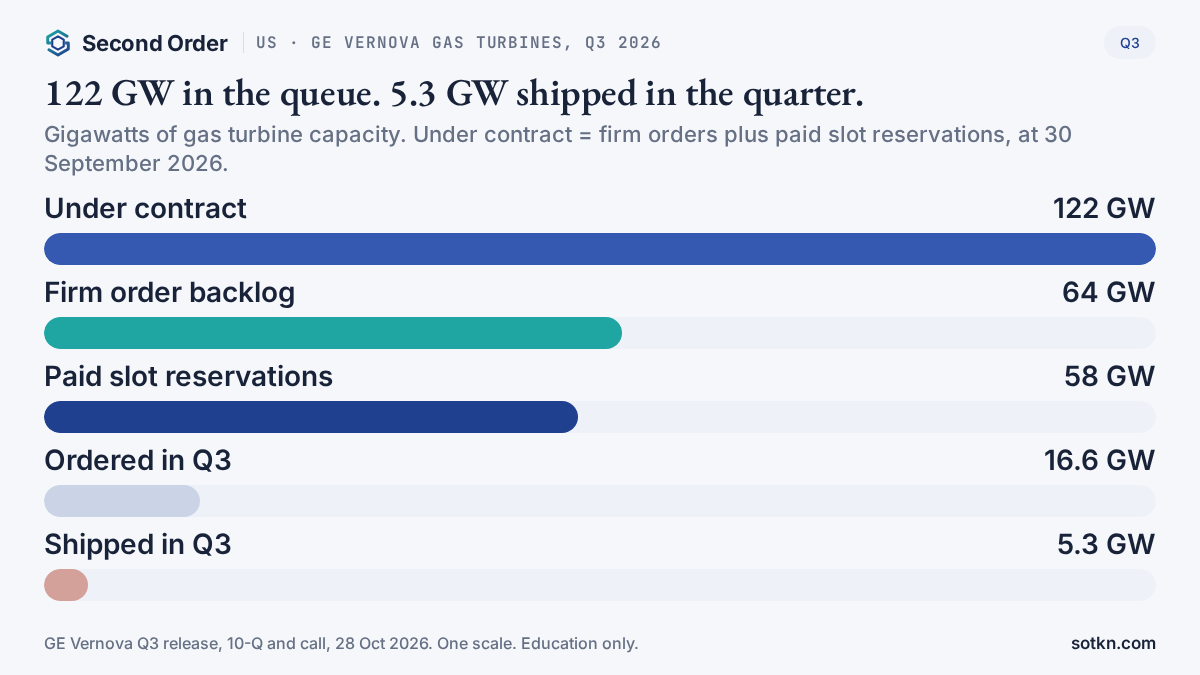
In the third quarter the firm backlog rose from 53 to 64 gigawatts, and reservations fell from 63 to 58 gigawatts. The arithmetic is simple. Thirteen gigawatts of reservations turned into firm orders. The company signed 8 gigawatts of new reservations and 3 gigawatts of new firm orders. And it shipped 5 gigawatts. Firm backlog: 53 plus 13 plus 3, minus 5, is 64. Reservations: 63 plus 8, minus 13, is 58. Together, 122 gigawatts, up from 116.
The chief executive called this an inflection point, because the firm backlog is now bigger than the reservations. In plain words: more of the queue has turned from a deposit into a signed contract, so more of it is very likely to be built. He also said the company now expects at least 130 gigawatts under contract by the end of 2026, which means about 13 gigawatts or more of new agreements in the fourth quarter. It started the year at 83 gigawatts.
How long is that queue in time? At the current pace of about 5.3 gigawatts a quarter, 122 gigawatts is about 23 quarters, or a little under six years of output (our arithmetic). That lines up with what management said: this quarter it “sold multiple slots for ’32 delivery”. A buyer signing today for a big new turbine is booking a machine for the next decade. Even the firm backlog alone, 64 gigawatts, is about three years of output at today’s rate (our arithmetic).
This sum has limits. The factory is still ramping, so the pace should rise. Some of the queue is outside the US. And aeroderivatives move faster than the biggest units. But even a much faster factory leaves years of work on the books. Our Analysis from late October looked at the same queue across the three big makers and asked where cash sticks if turbines stay booked into 2030 (if gas turbines stay booked into 2030). This quarter’s numbers move the far end of that queue out to 2032.
Who pays before the turbine ships?
Here is the part that shows who gets paid first. When a customer pays a deposit or a down payment before the turbine is built, the company holds that cash as a contract liability, an amount it owes back in the form of a future machine. At the end of September, GE Vernova’s Power business held US$33.2 billion of these. At the end of 2025 it held US$16.5 billion. That is roughly twice as much customer cash in nine months (our arithmetic).
The cash flow statement says the same thing. GE Vernova’s free cash flow, the cash left after running the business and paying for new plant, was US$5.4 billion in the quarter. The company said a US$5.3 billion boost from working capital came mainly from down payments on orders and slot reservations at Power, plus down payments at Electrification. Over nine months, the rise in this kind of customer cash added US$19.5 billion. Put simply, customers are funding the factory’s order book before the turbines exist.
Is anyone getting cold feet? An analyst asked whether any customers were struggling to pay, asking to leave their reservations or slowing the switch from reservation to order. The chief executive’s answer was “no”. He said the company had not had to change its cash terms, and that its customers have very strong balance sheets. When buyers will pay this much this early, the queue is not soft.
We have seen this pattern elsewhere on the map. Vertiv’s customers prepaid billions for data centre power and cooling gear to secure a place in its line (Vertiv’s customers prepay), and our Analysis on that line asked what the price assumes (Vertiv’s prepaid gear line). GE Vernova is the same idea at power-plant scale.
What does a slot cost now?
A long queue gives the seller pricing power, and the numbers show it. Management said third-quarter gas equipment orders were priced more than 20% above orders from the last quarter of 2025, helped by a mix with more aeroderivatives. For the whole of 2026, it expects gas orders to be priced about 50% higher per kilowatt than 2025 orders. The fourth quarter should be a bit lower per kilowatt, because of mix, not because demand is softer.
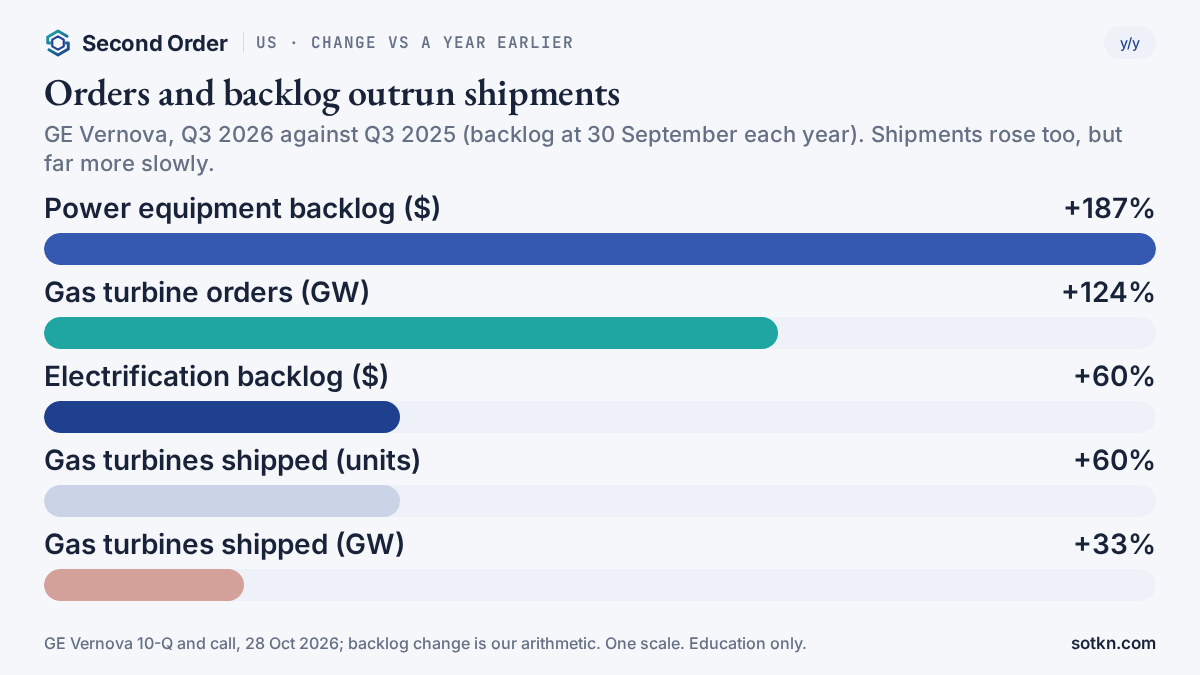
The higher prices are only now reaching the profit line. Turbines ordered in late 2024 and after are the first to ship at the better prices, and the third quarter was the first full quarter of those shipments. The Power business’s profit margin before interest, tax and depreciation rose 8.3 points to 21.4%. The value of Power equipment still to be delivered was US$54.4 billion at the end of September, against US$24.7 billion at the end of 2025 and US$19.0 billion a year earlier (10-Q).
There is a second payday after the turbine ships. Big turbines need servicing for decades. Management said every gigawatt of HA turbines should bring in about US$0.5 billion of service revenue over its first 20 years, and that the HA fleet running or on contract will be at least 400 units by the end of 2027. So every slot sold today is also a long service contract later.
Where do data centres fit in the queue?
On the call, the chief executive said demand comes from about 100 customers in 25 countries, and that about 80% is from traditional customers, mainly utilities, and about 20% is for data centres. So most of the turbine queue is not AI. But a fifth of a queue this long is a lot of power, and data centre buyers are competing for the same slots as utilities that also need plants for their own growing demand.
The data centre pull is clearer in Electrification. Its equipment backlog was US$42.2 billion, up 60% from a year earlier. Data centre orders in that business were about US$1.4 billion in the quarter and more than US$6 billion so far this year. The company also signed its first order from a hyperscaler, one of the giant cloud companies, for a medium-voltage backup power system, and was told it had won a hyperscaler award for a 6-megawatt outdoor solid-state transformer, with the contract to follow in the fourth quarter.
The buyers’ side of the queue showed up a day later. On 29 October, Amazon said its cash capital spending was US$75.9 billion in the quarter, mostly for AWS and AI, and that it still expects about US$220 billion for 2026 and “meaningfully more” in 2027. Asked about AWS growth, Amazon’s chief executive said the big chunks of capacity customers take, “the hundreds of megawatts or sometimes up to a gigawatt”, are reserved well in advance, and that Amazon has very good visibility into 2027 and 2028 and some of 2029. We covered the AWS sold-out comment in the Wire (AWS sold out into 2028).
Put the two calls together. The cloud company books its customers’ gigawatt blocks years ahead. The turbine maker sells slots six years ahead. For a new campus that needs its own gas plant, the turbine date can be the date that matters. Some projects already show this in their deals: an AI lab prepaying for 1.2 gigawatts of power (an AI lab prepays for 1.2 GW) and a hyperscaler backstopping 1,200 megawatts of gas turbines (a hyperscaler backstop for gas turbines). Our explainer on contracted power shows how these deals work (contracted power explained).
Why buy a bushing maker for $9 billion?
The same call announced a deal that tells you where the company thinks the next pinch is. GE Vernova agreed to buy Trench Group, a maker of high-voltage parts, for US$9 billion, about 13 times Trench’s expected 2028 earnings before interest, tax, depreciation and amortisation. It expects the deal to close in late 2027.
Trench’s biggest product is the bushing. Every large transformer has bushings: insulated parts that let a live conductor pass safely through the transformer’s metal tank. Management said bushings are 5% to 8% of the bill of materials of a transformer, and that GE Vernova buys most of its bushings from outside suppliers today. Trench also makes instrument transformers, which measure voltage in substations, and coils. It has 11 factories, about US$5 billion of backlog and framework agreements, and a newly opened plant in North Carolina that it says will be the first US maker of high-voltage bushings up to 765 kilovolts.
Why pay so much for a small part? Because when a product is sold out for years, a small part you cannot get can hold up the whole machine. The chief executive said owning Trench would give the company “a lot more control over the critical technology in the supply chain”. In other words, GE Vernova is buying a place in its own suppliers’ queue. We traced the same transformer bind in Korea yesterday, where the biggest transformer maker said it turned orders away because its slots were full (Korea’s factory slots), and our Analysis follows the cash if big transformers stay sold out (if big transformers stay sold out).
What does our arithmetic say?
A few simple sums make the numbers concrete. Every one is our own arithmetic on the published figures, and each has limits.
The queue
The cash
Ordered against shipped. In the quarter, the company booked about three gigawatts for every one it shipped, and the same was true over nine months. As long as that ratio stays well above one, the queue gets longer even while the factory gets faster.
Years of work. At 5.3 gigawatts a quarter, the full 122 gigawatts is about 23 quarters of output, which is why 2032 slots are on sale. The factory pace will rise and some slots will be smaller, faster units, so treat this as a rough clock, not a schedule.
Cash before goods. The Power business holds about twice as much customer cash as it did at the end of last year. Nearly all of the quarter’s free cash flow came from customers paying ahead. That is good for the maker. It also means the cash will turn into revenue only as fast as the factory ships.
Scale of the buyers. Amazon spent about six times GE Vernova’s whole quarterly revenue on capital projects in the same three months. Not all of that needs new power plants, and Amazon buys power from utilities rather than turbines directly. But it shows how much money is waiting on the far side of a factory that adds about 5 gigawatts a quarter. Equipment backlog timing tells the same story: of US$104.1 billion of equipment still to deliver across the company, GE Vernova expects about 33% to turn into revenue within a year and 60% within two (10-Q).
Who gets paid while the turbine slots run to 2032?
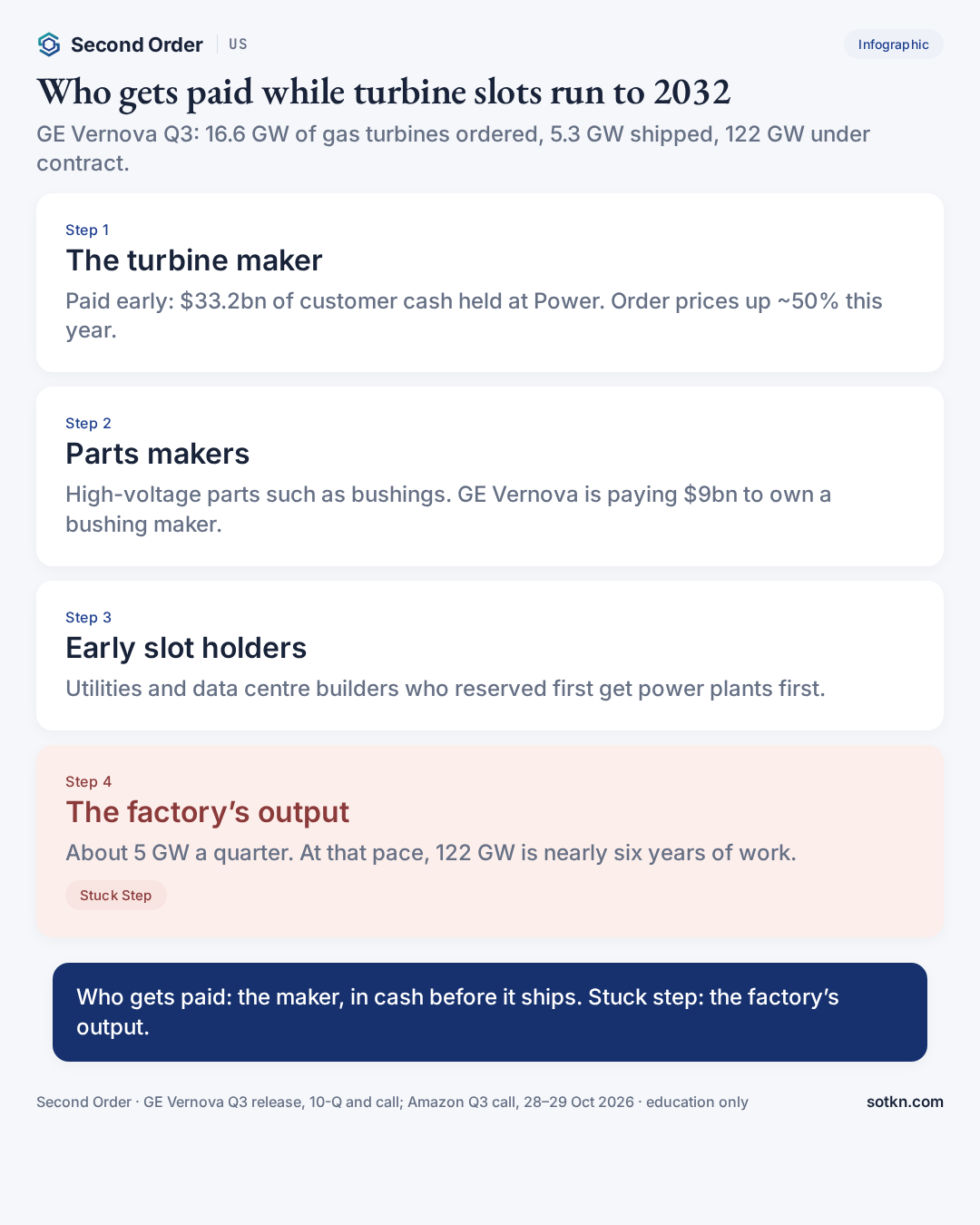
First, the turbine maker, paid in cash before it ships. GE Vernova holds US$33.2 billion of customer cash at Power, is pricing this year’s orders about 50% higher per kilowatt, and is only now shipping the first of those better-priced turbines. Our explainer covers who else makes this kind of gear (who makes data center power equipment?).
Second, the parts makers, paid on scarcity. When the end product is sold out, the companies that make critical parts, such as bushings, gain bargaining power, and big buyers try to own them. GE Vernova’s US$9 billion for Trench is the clearest sign this quarter.
Third, the early slot holders, paid in time. Utilities and data centre builders who reserved slots in 2024 and 2025 get their turbines years before anyone signing today, and at lower prices. A slot booked early is worth more as the queue grows. Some utilities are already lining up gas plants for big data centre customers (Black Hills and Google in Cheyenne).
Fourth, the service business, paid later and for longer. Each big turbine that ships starts decades of maintenance and parts work, about US$0.5 billion per gigawatt of HA turbines over 20 years, by management’s estimate.
Waiting: anyone who needs a new gas plant and has not yet reserved a slot; AI campuses whose switch-on date depends on a power plant that is not yet built; and electricity customers on grids that need new plants to keep up. Hyperscalers are paying for buildings and chips that still need power before they earn, which we have tracked at Microsoft (Microsoft’s GPU handover) and Digital Realty (signed, not yet billed).
One-line rule: when power plants are sold out for years, the maker and the early slot holders get paid first, and everyone who needs a new plant waits for the factory.
So what is the stuck step?
The factory’s output: how many big turbines one company can build, test and ship each quarter. Not demand, which pushed orders to three times shipments. Not money, with customers paying billions up front. Four things make it stick:
- Orders outrun shipments. 16.6 gigawatts ordered against 5.3 gigawatts shipped in the quarter.
- The queue reaches 2032. 122 gigawatts under contract is a little under six years at today’s pace.
- Output rises slowly. Gigawatts shipped rose 33% from a year earlier while gigawatts ordered rose 124%.
- Parts are tight too. The maker is spending US$9 billion to secure high-voltage parts like bushings.
This is the move our stuck-step Analysis describes: when one input gets scarce, the bind shifts to whoever controls the slowest thing. For many AI campuses the slowest thing used to be the grid connection. For those building their own power, it is now the turbine factory. Amazon’s own bind on new sites is permission to build, which we covered in a separate Analysis (Amazon’s site permission), and PJM’s grid has its own backstop plan for data centre growth (PJM’s power backstop).
Which dates test this read next?
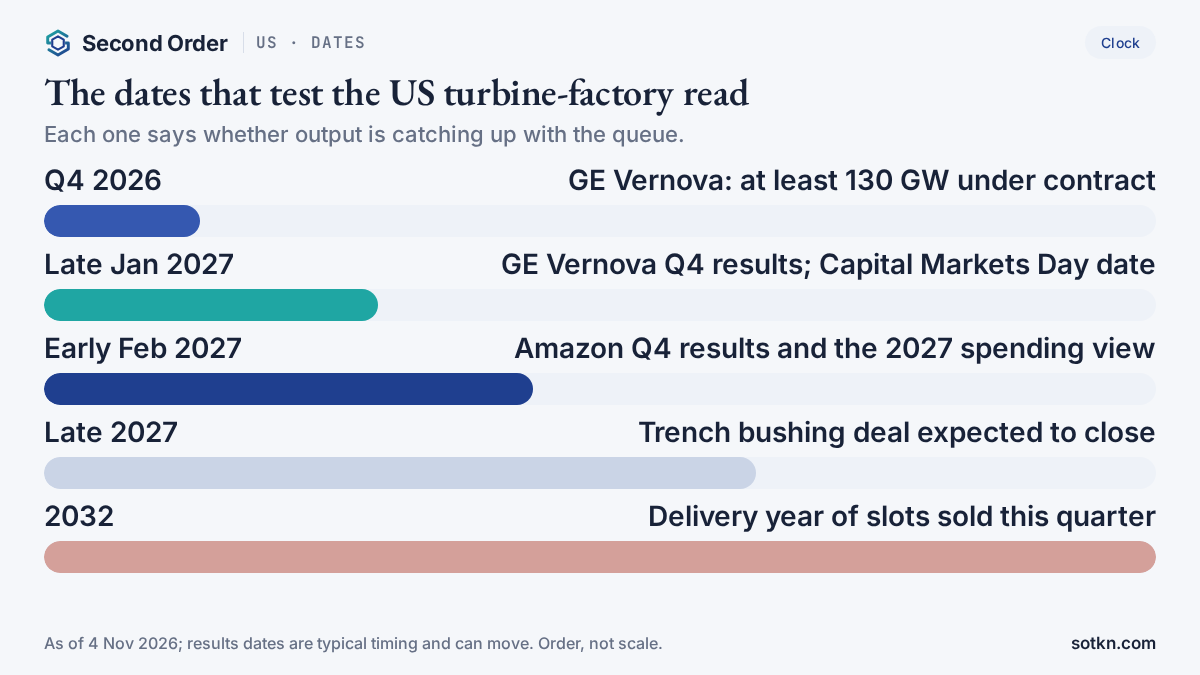
- Fourth quarter 2026 — GE Vernova expects at least 130 gigawatts under contract by year-end, which needs about 13 gigawatts or more of new agreements.
- Late January 2027 — GE Vernova’s fourth-quarter results (typical timing), with the year-end queue, the change in backlog margin and the date of its next Capital Markets Day.
- Early February 2027 — Amazon’s fourth-quarter results (typical timing), where the size of “meaningfully more” 2027 spending may become clearer.
- Late 2027 — The Trench deal is expected to close, bringing a bushing maker inside the turbine and transformer maker.
- 2032 — Delivery year of some slots sold this quarter, the far end of today’s queue.
What would change this view?
- Output jumps. If quarterly shipments rise well above 5 gigawatts and stay there, the factory is less stuck and the queue starts to shorten.
- Orders slow. If new agreements fall short of the 130-gigawatt year-end target, demand may be meeting its own limits.
- Customers walk. If reservations stop converting to orders or buyers ask to leave the queue, the deposits were softer than they look.
- Other makers add room. If rival turbine makers add a lot of capacity, buyers get more choice and the price per kilowatt eases.
Practical takeaways
- GE Vernova ordered 16.6 gigawatts of gas turbines in the third quarter and shipped 5.3 gigawatts, about three to one
- Firm orders plus paid slots reached 122 gigawatts, heading for at least 130 by year-end, with slots sold for 2032
- Customers hold US$33.2 billion of cash with the Power business, about double the end-2025 level
- Orders are priced about 50% higher per kilowatt this year; about a fifth of gas demand is for data centres
- Stuck step: the factory’s output, about 5 gigawatts a quarter
FAQ
What did GE Vernova report for gas turbines?
In the three months to 30 September, GE Vernova took orders for 112 gas turbines with 16.6 gigawatts of capacity, up from 29 turbines and 7.4 gigawatts a year earlier. It sold, meaning shipped and booked as revenue, 32 turbines with 5.3 gigawatts. Firm orders plus paid slot reservations reached 122 gigawatts, up from 116 in June, and the company expects at least 130 gigawatts by the end of 2026. It said it sold some slots for delivery in 2032.
What is a slot reservation?
A slot reservation is a paid place in the factory’s queue. The buyer puts down money to hold a production slot for a turbine before it signs a full order. Later it converts that slot into a firm order. In the third quarter, 13 gigawatts of reservations turned into orders and 8 gigawatts of new reservations were signed.
Why does this matter for AI data centres?
Data centres need large amounts of steady power, and many new US projects plan to use gas plants, either on the grid or on site. GE Vernova said about a fifth of its gas demand now comes from data centres. Amazon said big blocks of capacity, hundreds of megawatts or up to a gigawatt, are reserved well in advance, with visibility into 2029. If the turbine for a plant cannot arrive until 2030 or later, the data centre waits too.
Is this investment advice?
No. Education only. It maps who gets paid and which step is stuck. It is not a recommendation to buy or sell any security, and we leave out price targets and ratings on purpose.
Keep reading on the map
- US Markets hub — country page
- Digital Realty: signed, not yet billed · Microsoft’s GPU handover · Equinix’s cabinets · Meta’s Q3 capex
- Korea’s factory slots · Korea’s power gear booked ahead — other markets
- What does Amazon do? · Who are the hyperscalers? · Amazon’s unstarted leases
- Who makes data center power equipment? · How much power does an AI data center use? · Contracted power explained · Data center power distribution · Capex vs depreciation
- If gas turbines stay booked into 2030 · If big transformers stay sold out · Where does the stuck step move?
- AI Data Centers on the stack · Hyperscalers layer · All Markets doors — Taiwan, Korea, US, China, Singapore, Australia, Malaysia
How we check this. GE Vernova’s orders, backlog, gigawatts under contract, revenue and cash figures come from its third-quarter release of 28 October 2026. Turbine orders and sales in units and gigawatts, the Power equipment backlog, customer down payments and the timing of the equipment backlog come from its 10-Q filed the same day. Management’s comments on slot reservations, 2032 slots, the data centre share and pricing come from the earnings call transcript. Amazon’s spending figures come from its 29 October release and call. Every sum we worked out is labelled “our arithmetic”. Price targets and ratings are left out on purpose. The references we used are listed at the end. Our editorial standards →
Not investment advice. Do your own research.
References
- GE Vernova, GE Vernova reports strong third quarter 2026 financial performance, raises 2026 guidance, and increases share repurchase authorization, 28 Oct 2026. gevernova.com — headline orders, backlog, gigawatts under contract, revenue, cash flow and the year-end target.
- GE Vernova, Form 10-Q for the quarter ended 30 September 2026, 28 Oct 2026. gevernova.com — gas turbine orders and sales in units and gigawatts, Power equipment backlog, customer down payments held as contract liabilities and the timing of equipment backlog.
- The Motley Fool, GE Vernova (GEV) Q3 2026 Earnings Call Transcript, 28 Oct 2026. fool.com — management’s comments on slot reservations, 2032 delivery slots, the data centre share, pricing, the 5 GW quarterly rate, Electrification data centre orders and the Trench deal.
- Amazon, Amazon.com Announces Third Quarter Results, 29 Oct 2026. ir.aboutamazon.com — AWS sales and the full-year cash capital spending outlook.
- Stock Analysis, Amazon (AMZN) Q3 2026 Earnings Call Transcript, 29 Oct 2026. stockanalysis.com — third-quarter cash capital spending, the 2027 spending comment and how far ahead big blocks of capacity are reserved.