
$1.8 Billion Signed, Not Yet Billed: Who Gets Paid While Digital Realty’s Halls Get Built
Digital Realty signed a record $627 million of yearly contracts in the third quarter, and its pile of signed contracts that have not started reached $1.85 billion. New deals now take 17 months to start paying, and fewer leases started than planned. The stuck step is the handover date.
Digital Realty, one of the biggest data centre owners in the world, just signed more new business in three months than ever before. On 29 October it said customers had signed contracts worth $627 million a year to it. But a signature is not a payment. New deals now take 17 months on average to start paying, almost twice as long as deals signed in the spring, and fewer contracts started in the quarter than the company had planned. Demand is not the problem. Money is not the problem. The stuck step is the handover date.
US PULSE · AI DATA CENTERS · Data as at 29 Oct 2026 · Next update: Digital Realty fourth-quarter results, early 2027
Affects: AI Data Centers · Hyperscalers — Markets: US · Singapore · Korea
Education only, not advice to buy or sell any security. Figures are as published by Digital Realty in its 29 October release and financial supplement, at its own share, or as said on its call, unless another source is named. Our own sums are labelled.
The numbers that matter this week
New yearly contracts signed, Q3
$627m
Record · $855m at 100% share · 185 MW
RecordSigned, not yet paying (30 Sep)
$1.85bn
Up from $1.43bn in June · ~40% of current revenue
Piling upSigning to first payment
17 months
Q3 deals · 9 months for Q2 deals
LongerContracts that started, Q3
$207m
Flat on the last three quarters
FlatInterest booked into unfinished halls
$71m
Up from $37m in Q2
RisingDue to start, Q4 2026
$371m
Nearly double the Q3 pace
Stuck stepFigures from Digital Realty’s Q3 2026 release, supplement and call (29 Oct), at Digital Realty’s share unless stated. Start timing from the results slides. y/y = from a year earlier; q/q = from the quarter before. Status chips are Second Order’s read.
On this page: Why it matters · The quarter · Signed, not paying · 17 months · Starts fell short · What is being built · Who pays for the wait · Our math · Who gets paid · What is stuck? · Dates next · What would change this · FAQ
Why does Digital Realty’s quarter matter to who gets paid?
Because it is one of the few places where you can see the AI building boom from the landlord’s side. Cloud companies and AI labs do not build every data centre they use. Many of them sign long contracts for space, power and cooling in buildings owned by companies such as Digital Realty and Equinix (what Digital Realty does; what Equinix does). The customer brings the computers. The owner provides the building, the power supply, the cooling and the network links.
That makes Digital Realty a good place to measure one simple thing: how long it takes from the moment a customer says yes to the moment a finished hall is handed over and the customer starts paying. The 29 October numbers answer that question clearly, and the answer is getting longer.
The picture that comes out is this. Builders, power and cooling gear makers, landowners and lenders are paid first, while the halls are going up. Digital Realty is paid now on the buildings it already has, at higher prices. Customers sign early, at record prices, and then wait. And the step that decides when the new contracts turn into cash is the handover of a finished, powered hall.
1 · Builders and gear makers
Who: Shells, power gear, cooling, generators, fit-out
Paid: Paid on progress, deposits and delivery
2 · Lenders and landowners
Who: Bond buyers, banks, sellers of powered land
Paid: Paid now · interest and land prices
3 · The handover date
Who: A finished hall with power on, ready for the customer
Paid: Signed contracts only pay from this day
4 · Customers
Who: Cloud companies, AI labs, large firms
Paid: Sign early at record prices, then wait about 17 months
What did Digital Realty report on 29 October?
Digital Realty owns 311 data centres, 88 of them through joint ventures, with about 3.2 gigawatts of computing power capacity in use or ready and another 9.8 gigawatts it could build on land it holds or is developing. It sells space in two main ways. Large blocks of more than one megawatt go mostly to cloud companies and AI labs. Smaller pieces of up to one megawatt, plus the cables that link customers to each other (interconnection), go to a wider mix of firms.
Revenue in the third quarter was $1.9 billion, up 21% from a year earlier and up 10% from the second quarter once a one-off $201 million gain in the second quarter is taken out. Core FFO, the cash earnings measure property companies use, was $2.10 a share, up 11% from $1.89 a year earlier. The company raised its 2026 Core FFO outlook to $8.30 to $8.35 a share, which it said means growth of almost 13% this year.
The buildings it already runs did well. Occupancy across the portfolio rose to 91.1% from 90.2% in June, and to 93.4% in its stable, long-held buildings. Customers leaving were a record low 0.7% of revenue. When contracts came up for renewal, prices rose 11.8% on a cash basis, and 26.3% for the big blocks over one megawatt, led by renewals with cloud companies in Northern Virginia.
New signings were the headline. Customers signed contracts worth $855 million a year at 100% share, a record and about 20% above the previous high, covering 267 megawatts. At Digital Realty’s own share, after partners in joint ventures, that was $627 million for 185 megawatts. The big blocks brought $474 million of it. The smaller deals and interconnection brought a record $152 million, up 40% from the second quarter, and the company said 44% of the small deals were linked to AI.
The deals were spread around the world. Asia Pacific was the largest region at $283 million, with large signings in Seoul, Chennai and Sydney, which the company said beat its previous Asia record by more than 600%. The Americas brought $243 million, including two large cloud deals in Northern Virginia signed in early July. Europe, the Middle East and Africa brought $78 million, mostly in smaller deals.
How much is signed but not yet paying?
This is the number that matters most. Digital Realty reports a “backlog”: contracts customers have signed for space that is not ready yet, so they are not paying. At the end of September it stood at $2.5 billion a year at 100% share, or $1.85 billion at Digital Realty’s share. At the end of June it was $1.43 billion at its share.
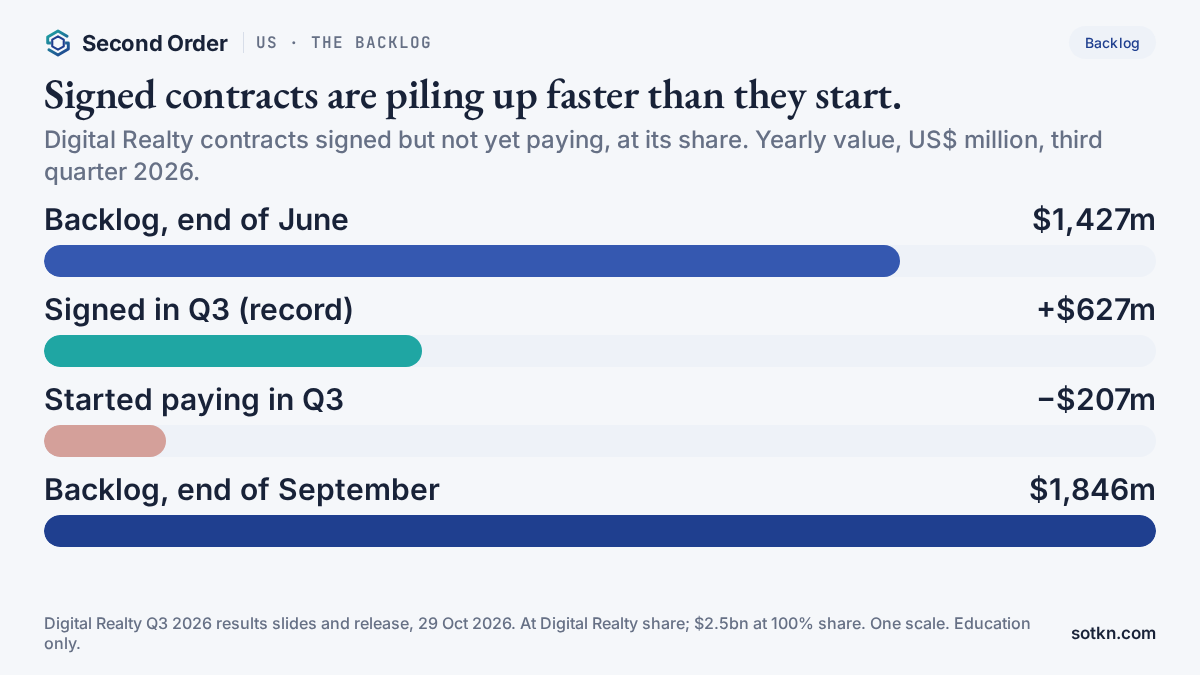
The roll-forward in the company’s slides shows how it moved. Start with $1.43 billion in June. Add $627 million of new signings. Take away $207 million of contracts that started paying. That leaves about $1.85 billion (our arithmetic matches the company’s $1,846 million). Of that, $1.23 billion sits in buildings Digital Realty owns outright and $617 million in joint ventures.
Put another way, the signed-but-not-paying pile is now almost 40% of what Digital Realty earns today from its data centres, against about 30% at the end of June, the company said. That is a lot of future revenue already locked in. It is also a lot of revenue that depends on buildings being finished on time.
The backlog rose by about $420 million in one quarter, or roughly 29% (our arithmetic). Signings ran about three times faster than starts. Unless starts speed up, the pile keeps growing, which is good news for future revenue and a warning about how much has to go right on building sites.
Why does a new deal now take 17 months to pay?
Digital Realty reports the average gap between signing a new contract and the date it is due to start, weighted by size. For deals signed in the third quarter it was 17 months. For deals signed in the second quarter it was nine months. The gap almost doubled in a quarter.
Part of the reason is the mix. The third quarter had several very large deals, and the company said its three biggest signings were each for more than 60 megawatts. Large blocks are usually signed before the building exists, so they naturally take longer to start. The results slides note that big cloud signings typically take 18 to 24 months from signature to the customer moving in.
But the mix is itself the point. The customers with the most money are signing for space that does not exist yet, because the space that does exist is nearly full. Digital Realty said pricing was strong “reflecting robust and sustained demand and growing constraints around the development of new capacity”, and that its big-block pricing hit a new high. Customers are not waiting because they want to. They are waiting because that is the earliest a finished, powered hall can be handed to them.
The weighted average length of the new contracts was 16 years, the company said. A customer that signs for 16 years and waits 17 months is paying for certainty, not speed.
Did contracts start on time?
Not quite. In July, on its second-quarter call, Digital Realty said $635 million of yearly contracts were scheduled to start in the second half of 2026, with 45% of that in the third quarter and 55% in the fourth. Forty-five per cent of $635 million is about $286 million (our arithmetic).
On 29 October it said $207 million started in the third quarter, “consistent with the prior three quarters”. That is about $79 million, or roughly 28%, below the July schedule for the quarter (our arithmetic). The company did not call it a delay, and start dates can move for many reasons, including customers asking for changes. But the money did not arrive when it was expected to.
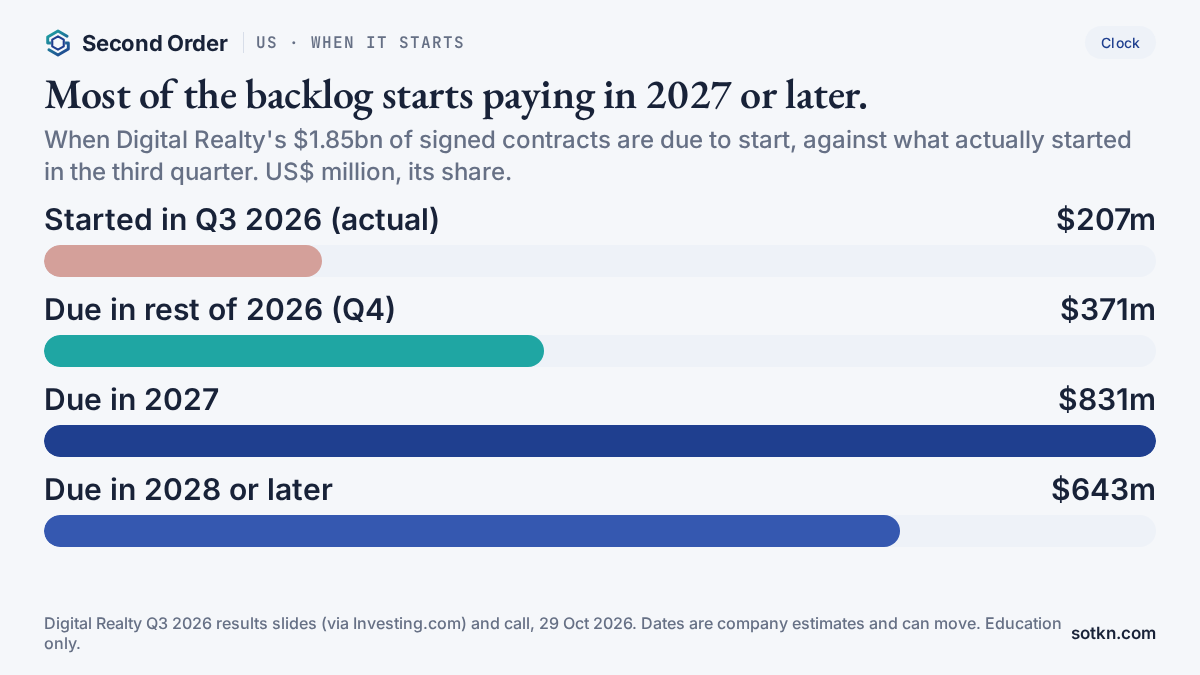
The new schedule in the slides says $371 million of the backlog should start in what is left of 2026, $831 million in 2027, and $643 million in 2028 or later. Add the $207 million that started in the third quarter to the $371 million due in the fourth, and the second half of 2026 now comes to about $578 million, against $635 million in the July plan (our arithmetic). That is about $57 million less, even though some of the new small deals signed in the quarter start quickly and should have pushed the 2026 figure up, not down.
The fourth quarter is now the test. $371 million of starts would be almost 1.8 times the $207 million pace of the last four quarters (our arithmetic). The company said starts should speed up over the next two quarters, helped by new small deals and “over 250 MW of upcoming pre-lease deliveries”, meaning halls already signed for that are about to be finished.
We saw the same pattern from the other side this week. Microsoft said on 28 October that outside GPU capacity it had agreed to rent arrived late (the Microsoft GPU handover Pulse). At Digital Realty the contracts are signed and the customers are ready; the handover is what sets the pace.
What is actually being built?
Digital Realty has about 1,464 megawatts under construction, roughly 1.5 gigawatts, with a total expected cost of $22.0 billion at 100% share. About 63% of it is already signed for, at an expected average yield of 11.6% on cost once full. Of the $22.0 billion, $6.4 billion has been spent so far and $15.6 billion is still to spend (our split of the supplement’s table). The company said its development pipeline has more than doubled from about $10 billion at the start of the year.
Northern Virginia
Charlotte
Atlanta
All projects
Digital Realty Q3 2026 financial supplement, development lifecycle table (100% share). Completion dates are the company’s averages for each market and can move.
The table tells you where the backlog lives. The Northern Virginia and Charlotte projects are almost fully signed but will not be complete until late 2027 and mid-2028. Those dates line up with the $831 million due to start in 2027 and the $643 million due in 2028 or later.
In the quarter itself, the company finished 50 megawatts of new capacity, 95% of it already signed for, and started work on another 112 megawatts, including projects in five countries in Asia Pacific. When asked about the cloud capacity it will have ready in 2027 and 2028, it said those blocks total just under the 1.5 gigawatts now under construction, and that it is in many talks with customers about them.
It is also buying land for the next round. In the quarter it spent $742 million on land, including a site near Indianapolis for more than one gigawatt, two sites near Chicago for 360 megawatts, a site near Charlotte for up to 600 megawatts, and land next to its Fort Gillem campus near Atlanta. Earlier this month we covered its Kansas site (the De Soto Wire). On the call, the company said Indiana is drawing big projects partly because of long power queues in Ohio and limits on new data centres in some other states.
Asked by an analyst whether it was seeing the building delays reported across the industry, the company said its spread of sites and supply chains gives it “swing capacity” for parts, and that it had largely kept its record intact, adding: “Yes, there’s always here and there a delay.” For a wider view of who builds these sites, see who builds AI data centers.
Who pays for the wait?
While a hall is being built, money goes out and nothing comes in from that hall. Digital Realty spent $1.15 billion on development in the third quarter, by the supplement’s count, up from $747 million in the second quarter and $533 million a year earlier. On the call, it said its own share of development spending was $1.5 billion in the quarter and $3.3 billion so far this year, with full-year capital spending still expected at $4.25 billion to $4.75 billion after partners’ shares.
The clearest sign of the waiting cost is a line most readers skip. When a company borrows to build, accounting rules let it add the interest on the money tied up in unfinished buildings to the cost of the building, instead of counting it as an expense straight away. Digital Realty added $71.0 million of interest this way in the third quarter, up from $37.1 million in the second quarter and $32.9 million a year earlier. It nearly doubled in three months.
At the same time, the interest expense shown in its income statement fell to $93.3 million from $113.9 million. Add the two together and total interest rose to about $164 million from about $151 million (our arithmetic). More of the interest bill is now attached to buildings that are not finished yet. The lenders are paid either way. The building has to earn it back after handover.
The company is raising money from every direction to fund the build. It sold about $450 million of new shares in the quarter and $2.9 billion so far this year. In October it sold €1 billion of euro bonds due 2036 at a 5.125% coupon and Swiss franc bonds worth about $611 million, about $1.7 billion of debt at a blended coupon of about 4%, it said. It also closed $1.4 billion of first commitments to a new long-term fund that will buy finished, fully let cloud data centres in North America, and says it has more than $20 billion of capital available in total. Debt was 5.2 times a year of earnings before interest, tax and depreciation, or 4.9 times counting three fully let Northern Virginia projects about to finish (capex vs depreciation; free cash flow explained).
The same squeeze shows up in Singapore. Keppel DC REIT’s finance costs grew faster than its income in its 23 October update (the Keppel DC REIT Pulse). The difference at Digital Realty is scale: it is paying to build more than a gigawatt before most of it pays back.
Our math, in plain sums
- Backlog roll-forward: $1,427 million in June + $627 million signed − $207 million started = about $1,847 million, matching the reported $1,846 million (our arithmetic).
- Backlog growth: $1,846 million ÷ $1,427 million is about 1.29, so up about 29% in one quarter (our arithmetic).
- Signed vs started: $627 million signed against $207 million started is about three to one (our arithmetic).
- July schedule for Q3: 45% of $635 million is about $286 million; actual $207 million is about $79 million, or 28%, short (our arithmetic).
- Second half 2026: $207 million started + $371 million due in Q4 = about $578 million, against $635 million planned in July, about $57 million less (our arithmetic).
- Q4 test: $371 million due ÷ $207 million recent pace is about 1.8 times (our arithmetic).
- Interest: $71.0 million capitalised + $93.3 million expensed = about $164 million, against about $151 million in Q2 (our arithmetic).
- Build left to pay: $22.0 billion total cost − $6.4 billion spent = about $15.6 billion still to spend at 100% share (our arithmetic from the supplement).
- Backlog by year: $371 million (rest of 2026) + $831 million (2027) + $643 million (2028 and later) = $1,845 million; about 80% starts in 2027 or later (our arithmetic).
What this tells you: Digital Realty has more customers than finished halls, it is charging more for the halls it has, and it can raise the money to build. The revenue it has signed for is real. But how fast that revenue arrives depends on handover dates, and the third quarter showed those dates can slip even at a large, experienced builder.
Who gets paid first?
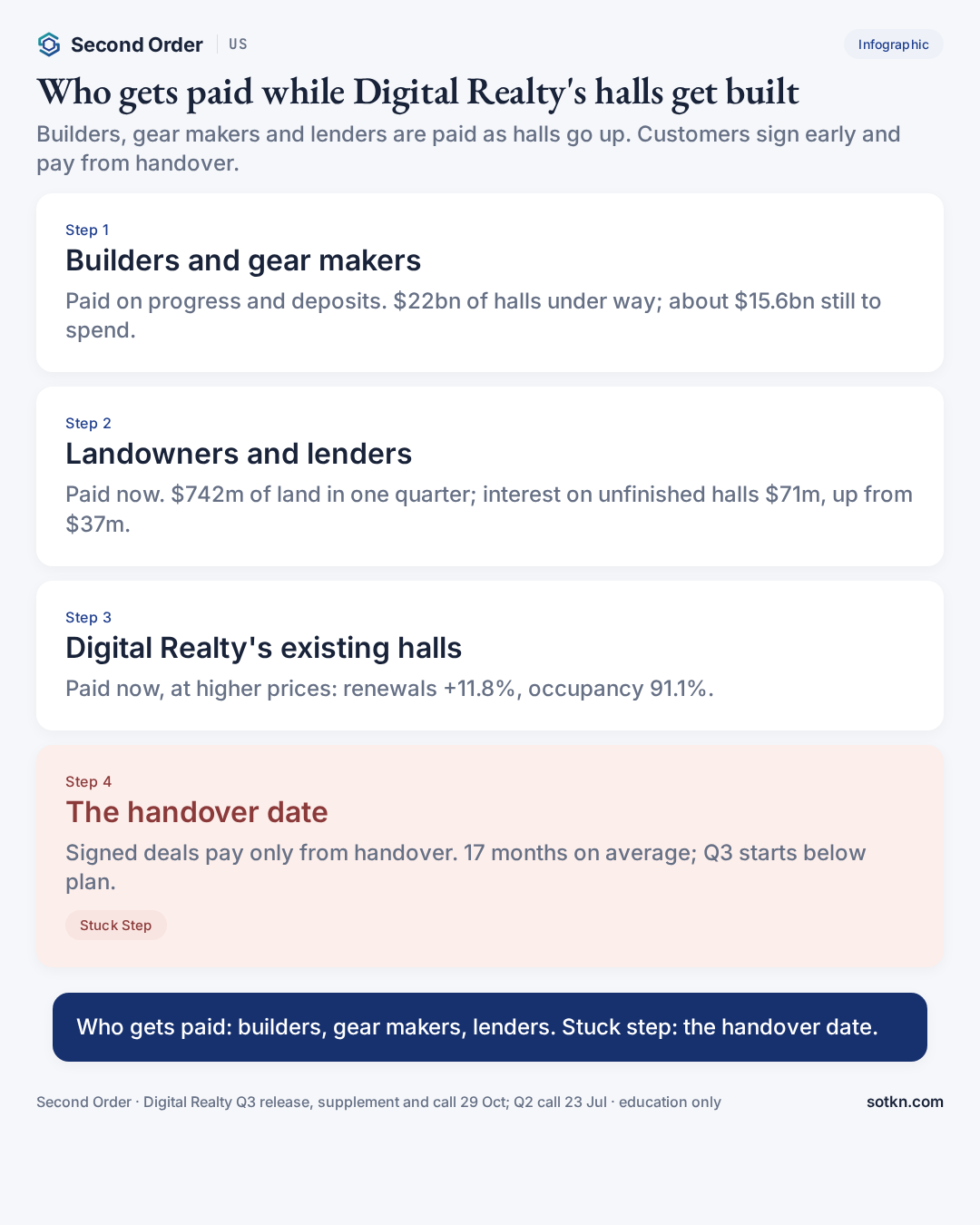
First, the builders and gear makers — on progress. Construction firms and the makers of transformers, switchgear, backup generators and cooling systems are paid as each hall goes up, often with deposits up front. Vertiv said this month that customers are prepaying for power gear (the Vertiv prepay Catalyst), and big transformers are booked years ahead (if big transformers stay sold out).
Second, landowners and lenders — now. Digital Realty paid $742 million for land in one quarter. Bond buyers and banks earn interest from the day the money is lent, and more of that interest is now tied to unfinished halls.
Third, Digital Realty — now on its existing halls, later on the new ones. Its full, older buildings are earning more as contracts renew at higher prices and empty space fills. The new contracts pay only from the handover date.
Fourth, its fund partners — on fees and finished buildings. Private investors in its joint ventures and the new long-term fund put money in to own finished, fully let halls, and Digital Realty earns fees for managing them.
Last, the customers — who pay more and wait. Cloud companies and AI labs sign 16-year contracts at record prices for space they will not use for well over a year (the hyperscalers). Until handover, their computers sit somewhere else, or are not switched on.
One-line rule: at Digital Realty, builders, gear makers, landowners and lenders are paid while the halls go up; Digital Realty is paid now on the halls it already has; customers pay more and wait. The stuck step is the handover date.
So what is the stuck step?
The handover date: the day a finished hall, with power connected and cooling working, is handed to the customer and the contract starts to pay. Not demand, which set a record. Not price, which also set a record. Not money, which the company is raising easily. Four things make it stick:
- Big deals are signed before the building exists. The new mix of large blocks pushed the average wait to 17 months, and big cloud deals usually take 18 to 24 months.
- Starts can slip. Third-quarter starts came in about $79 million below the July schedule (our arithmetic), and the second-half total is now lower than planned.
- Power and parts come first. A hall cannot be handed over until its power supply and gear are in. The company points to long power queues in some states as a reason it is buying land elsewhere.
- Waiting costs money. Interest tied to unfinished halls nearly doubled in a quarter, so every month of delay adds to the cost the finished hall must earn back.
This is the bind our stuck-step Analysis describes: once money and orders are in place, the bind moves to the slowest physical step. At Digital Realty that step is turning a signed hall into a handed-over hall. We saw a sharper version in Australia, where a power delay at one Melbourne site put a data centre owner’s guidance under review (the NEXTDC Pulse).
Which dates test this read next?
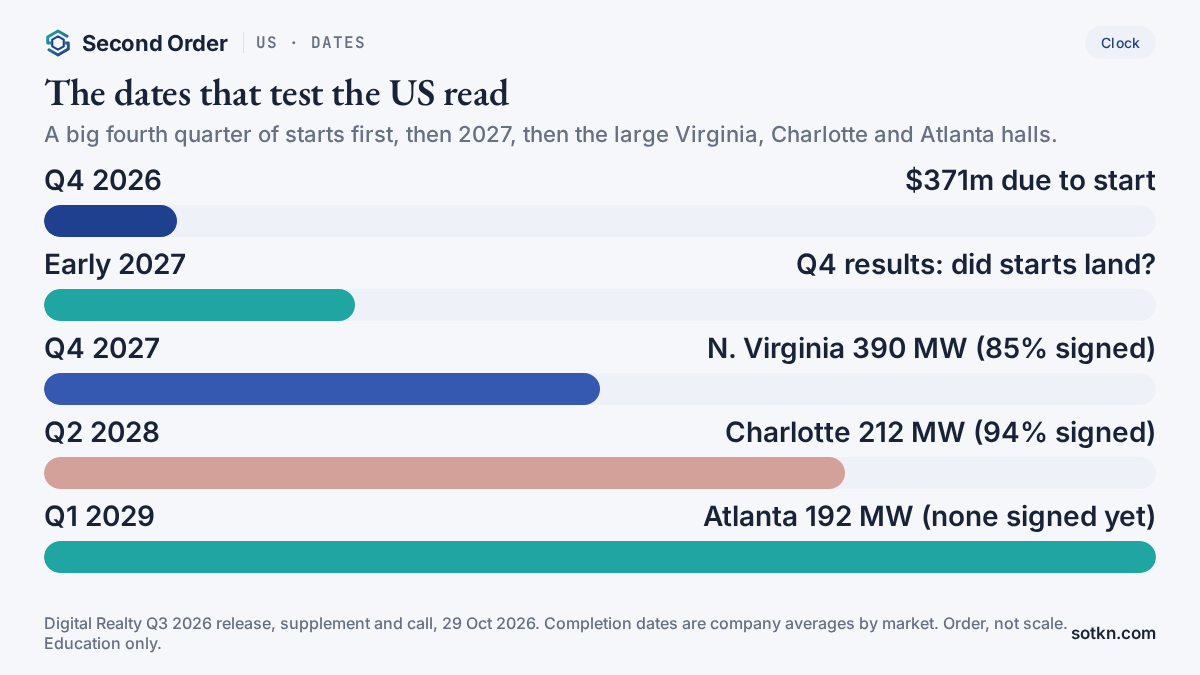
- Fourth quarter 2026 — $371 million of contracts due to start, almost 1.8 times the recent pace, with more than 250 MW of signed halls due for delivery over two quarters.
- Early 2027 — Fourth-quarter results: did starts reach the schedule, and did the signing-to-start gap shrink or grow?
- 2027 — $831 million of the backlog is due to start, the largest single year. Northern Virginia’s 390 MW, 85% signed, is due by the end of the year.
- Mid-2028 — Charlotte’s 212 MW, 94% signed, is due to finish; part of the $643 million due in 2028 or later.
- Early 2029 — Atlanta’s 192 MW is due, with no share shown as signed yet. A test of whether demand still runs ahead of halls by then.
What would change this view?
- Starts catch up. If the fourth quarter delivers close to $371 million of starts, the third-quarter gap was timing, and the handover bind is loosening.
- The wait shrinks. If deals signed in the fourth quarter start well under 17 months later, the long gap was about one quarter’s mix of big deals, not a lasting delay.
- Starts slip again. If more of the 2026 schedule moves into 2027, handover dates are binding harder, and interest on unfinished halls keeps climbing.
- Demand cools. If cloud companies and AI labs cut 2027 budgets, new signings would slow and the Atlanta block, unsigned today, would be the first place to show it.
Practical takeaways
- Digital Realty signed a record $627 million of new yearly contracts at its share in the third quarter, $855 million counting partners
- Its signed-but-not-paying backlog rose to $1.85 billion from $1.43 billion, about 40% of what it earns today
- New deals now take 17 months on average to start paying, against nine months for second-quarter deals
- Only $207 million started in the quarter, below the July schedule; $371 million is due in the fourth quarter
- Builders, gear makers, landowners and lenders are paid now; customers pay more and wait; stuck step: the handover date
FAQ
What did Digital Realty report on 29 October 2026?
Digital Realty reported third-quarter 2026 revenue of $1.9 billion, up 21% from a year earlier, and Core FFO of $2.10 a share, up 11%. It signed a record $855 million of new yearly contracts at 100% share, or $627 million at its own share, and raised its 2026 Core FFO outlook to $8.30 to $8.35 a share.
What does “signed but not yet commenced” mean?
It is money a customer has signed up to pay but is not yet paying, because the space is not handed over. At the end of September Digital Realty had $1.85 billion a year of contracts like this at its share, up from $1.43 billion in June. New leases signed in the quarter start on average 17 months after signing.
What is the stuck step?
The handover date: the day a finished, powered hall is ready for the customer and payments start. Only $207 million of contracts started in the third quarter, below the pace the company set out in July, while $371 million is due to start in the fourth quarter. Most of the backlog is due in 2027 and later.
Is this investment advice?
No. Education only. It maps who gets paid and which step is stuck. It is not a recommendation to buy or sell any security, and we leave out share prices, broker ratings and price targets on purpose.
Keep reading on the map
- US Markets hub — country page
- Microsoft’s GPU handover · Meta’s Q3 capex · Virginia’s 3 GW first power · PJM’s capacity shortfall · US data centre construction
- Keppel DC REIT’s renewals · NEXTDC’s power delay · Samsung’s clean rooms · ASE’s new floors — other markets
- What does Digital Realty do? · What does Equinix do? · What does Digital Core REIT do? · AI Data Centers on the stack
- Digital Realty’s De Soto site · Microsoft’s rented GPUs arrive late · AWS sold out into 2028 · Vertiv customers prepay
- Who builds AI data centers? · The biggest AI data center · Finance vs operating lease · Capex vs depreciation
- Digital Core REIT’s powered hall · If big transformers stay sold out · Where does the stuck step move?
- All Markets doors — Taiwan, Korea, US, China, Singapore, Australia, Malaysia
How we check this. Revenue, Core FFO, bookings, the signing-to-start lag, the backlog, renewals, occupancy, the development pipeline, capital spending, capitalised interest and funding come from Digital Realty’s own third-quarter 2026 results release and financial supplement of 29 October 2026, in US dollars and at Digital Realty’s share unless we say 100% share. Commencements, upcoming deliveries, pricing and the delay answer are as said on the 29 October call, checked against a transcript. When the backlog is due to start comes from the company’s results slides as summarised by Investing.com. The July schedule comes from the second-quarter release and call. Every sum we worked out is labelled “our arithmetic”. Share prices, broker ratings and price targets are left out on purpose. The references we used are listed at the end. Our editorial standards →
Not investment advice. Do your own research.
References
- Digital Realty, Digital Realty reports third quarter 2026 results, 29 Oct 2026. investor.digitalrealty.com — revenue, Core FFO, bookings, the 17-month lag, the backlog, renewals, land buys, funding and the raised outlook.
- Digital Realty, third quarter 2026 financial supplement (SEC Form 8-K, Exhibit 99.1), 29 Oct 2026. sec.gov — bookings by region, occupancy, the development pipeline by market, capital spending and capitalised interest.
- Stock Analysis, Digital Realty Q3 2026 earnings call transcript, 29 Oct 2026. stockanalysis.com — commencements in the quarter, upcoming pre-leased deliveries, pricing, delays and the hyperscale capacity left to sell.
- Investing.com, Digital Realty Q3 2026 slides: record bookings fuel double-digit growth, 29 Oct 2026. investing.com — the backlog roll-forward and when the backlog is due to start, from the company’s results slides.
- Digital Realty, Digital Realty reports second quarter 2026 results, 23 Jul 2026. investor.digitalrealty.com — the June backlog and the nine-month lag for second-quarter signings.
- Stock Analysis, Digital Realty Q2 2026 earnings call transcript, 23 Jul 2026. stockanalysis.com — the July schedule of $635 million of contracts due to start in the second half of 2026.