Microsoft capex misses $50B as rented GPU capacity runs late
Microsoft’s capex and finance leases came to $45.2 billion in the quarter to September, about $5 billion under its guide, because some third-party GPU-as-a-service deliveries slipped to January-June 2027. It still guides over $50 billion this quarter.

WIRE · HYPERSCALERS · US · Data as at 28 Oct 2026 (US)
Microsoft spent $45.2 billion on capital expenditure and finance leases in the three months to September, about $5 billion short of the roughly $50 billion it had pointed to. The plan did not change. Finance chief Amy Hood said some third-party capacity deliveries expected in the quarter were delayed: GPU-as-a-service contracts with outside providers that now land in the first half of 2027. Demand still exceeds supply, she said. On the Hyperscalers layer, that is the gap between ready and paid. The buyer wants the capacity and the contract is signed, but nobody books the money until the racks are handed over.
What happened
The quarter
Revenue $92.3 billion, up 19%. Azure $33.2 billion, up 48%
Fiscal first quarter to 30 September, released 28 October. The first time Microsoft has given Azure revenue in dollars
The spend
Capex including finance leases $45.2 billion, against about $50 billion guided
Up about 30% from $34.9 billion a year earlier. Finance leases were $7.4 billion and cash paid for property and equipment was $39.4 billion
The delay
Some third-party GPU-as-a-service contracts slipped to January to June 2027
Microsoft books the full principal of a finance lease as capex only when the lease starts, so late deliveries mean lower capex now
The outlook
Over $50 billion of capex this quarter, about $170 billion for the calendar year
Azure growth guided at 49% to 50% in constant currency. Spending to accelerate in the first half of 2027 as the delayed capacity arrives
Why cash cares
The late deliveries flattered Microsoft's cash. Operating cash flow was $58.0 billion and cash paid for property and equipment was $39.4 billion, which leaves $18.6 billion of free cash flow. Analysts had expected about $10 billion less. Alphabet, reporting the same evening, burned $9.1 billion of free cash on $51.4 billion of capex. Meta burned $2.1 billion a week earlier.
So part of Microsoft's advantage this quarter is timing, not thrift. Cash spent on property and equipment still roughly doubled from $19.4 billion a year earlier. What did not happen is the capacity that outside providers were due to hand over.
Here is our own arithmetic, not a company figure. Against the roughly $50 billion guide, the quarter came in about $4.8 billion light. Microsoft has now spent about $118.1 billion on capex in the first nine months of calendar 2026. Hood's figure of about $170 billion for the calendar year therefore implies about $51.9 billion for October to December. Hitting the $175 billion that Microsoft pointed to in July would have needed about $56.9 billion. The difference, about $5 billion, is roughly the size of the September miss. That is spending moved into 2027, not cancelled.
The order book says the demand is there. Commercial remaining performance obligation, the contracted revenue not yet recognised, rose 73% to $677 billion. Microsoft says roughly 30% of that will turn into revenue in the next 12 months, which is about $203 billion on our arithmetic.
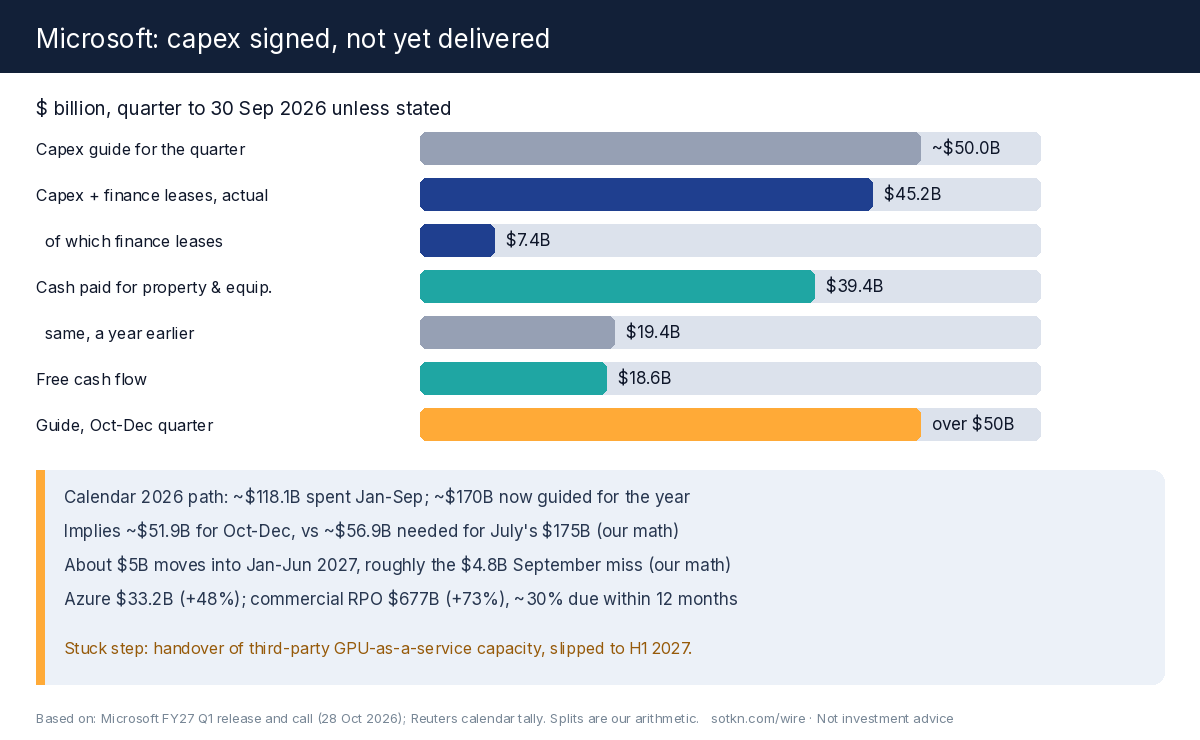
Figure: Signed, not delivered. Microsoft's September-quarter capex against its guide, the cash it paid for property and equipment, and the calendar 2026 path after third-party GPU deliveries slipped. The $4.8 billion shortfall, the $51.9 billion fourth-quarter figure, the $5 billion shift and the $203 billion next-12-month backlog are our arithmetic on Microsoft's 28 October release and call.
The step that is still open
Handover of rented GPU capacity. Microsoft buys some of its AI compute from neoclouds, specialist providers that build or lease the halls, install the GPUs and rent them out under multi-year contracts. Hood said some of those GPU-as-a-service contracts have been delayed to the second half of Microsoft's fiscal year, which runs January to June 2027. She did not name the providers or say how much capacity is late.
Microsoft is covering the gap with what it already has. It said engineering work found and sold underused capacity, that it added 24 new data centres across five continents in the quarter, and that it cut the time to bring new Nvidia GB300 racks online by about 20% from the previous quarter in its biggest regions. About three quarters of the quarter's capex went on short-lived assets, mainly CPUs and GPUs, including higher memory and storage costs.
The second-order read
Who gets paid. Microsoft shareholders, now: $18.6 billion of free cash flow and $10.2 billion returned in dividends and buybacks. Chip and memory suppliers, next: Hood said the 2027 spending rise will come mainly from CPUs, GPUs and higher memory and storage costs, as well as the delayed third-party deliveries.
Who waits. The third-party GPU providers whose contracts slipped. Under a finance lease, the rent clock starts at handover, so a late hall is a late invoice, and their lenders wait with them.
Who pays. Microsoft, later. The spending comes back in the first half of 2027, and the company already guides other expense of about minus $300 million this quarter, partly because of interest on data centre finance leases.
Stuck step. Delivery of third-party GPU capacity into working halls. The contracts are signed. The cash starts when the racks go live.
Three cautions
The calendar year behind the $170 billion is not spelled out. CNBC reported it as calendar 2027. Hood's wording on the call and Reuters' nine-month tally both fit calendar 2026, which is how we read it. Check Microsoft's outlook slides before leaning on either.
The $5 billion is not a disclosed figure. Microsoft gave no dollar size for the delayed contracts and named no providers. Our number is the gap against its own guide.
Lower capex is not lower building. Because finance leases enter capex only when they start, a delivery delay cuts reported capex while the cash Microsoft spends on its own sites keeps rising.
What to watch
- 29 October US time (30 October, 05:00 SGT): Amazon's third-quarter results, the last of the four big US cloud buyers this season.
- November: neocloud third-quarter reports, and whether any provider points to a delayed hyperscaler handover.
- Late January 2027: Microsoft's December-quarter results, and whether capex clears the $50 billion it guided.
- Alphabet's next results call: the 2027 capex figure, which Alphabet says will rise significantly.
Read: what does Microsoft do, which hyperscaler capex lines to watch, data center leases explained and SpaceX takes a $40B Apollo lease on GPUs due in 2027
Get the Wire. A free brief every day, here and in your inbox. Subscribe free →
Not investment advice. Do your own research. The $4.8 billion shortfall, the $51.9 billion October-to-December figure, the $56.9 billion and $5 billion comparisons, the doubling in cash capex and the $203 billion next-12-month backlog are our arithmetic.
References
- Microsoft, "Microsoft Announces First Quarter Results", 28 Oct 2026. Revenue, Azure, remaining performance obligation, cash flow statement.
- Benzinga, "Microsoft Q1 2027 Earnings Call Transcript", 28 Oct 2026. Hood on delayed third-party deliveries, finance leases and capex outlook.
- CNBC, "Microsoft stock jumps as cloud growth drives earnings and revenue beat", 28 Oct 2026. Capex against consensus, GPU-as-a-service delays.
- Reuters via CNA, "Microsoft's cloud growth, cash flow offer respite from AI spending fears", 29 Oct 2026. Year-ago capex, calendar 2026 tally, July forecast, free cash flow against estimates.
- Alphabet, third-quarter 2026 results (SEC exhibit 99.1), 28 Oct 2026. Capex and cash flow.
- Meta, "Meta Reports Third Quarter 2026 Results", 21 Oct 2026. Free cash flow.