$5,137 Million Paid, No Data-Center Row: Who Gets Paid While Qualcomm's Ramp Stays a Target
Qualcomm was paid on handsets, cars, IoT and licenses in the September quarter. The $5 billion data-center target is not a row in that table.
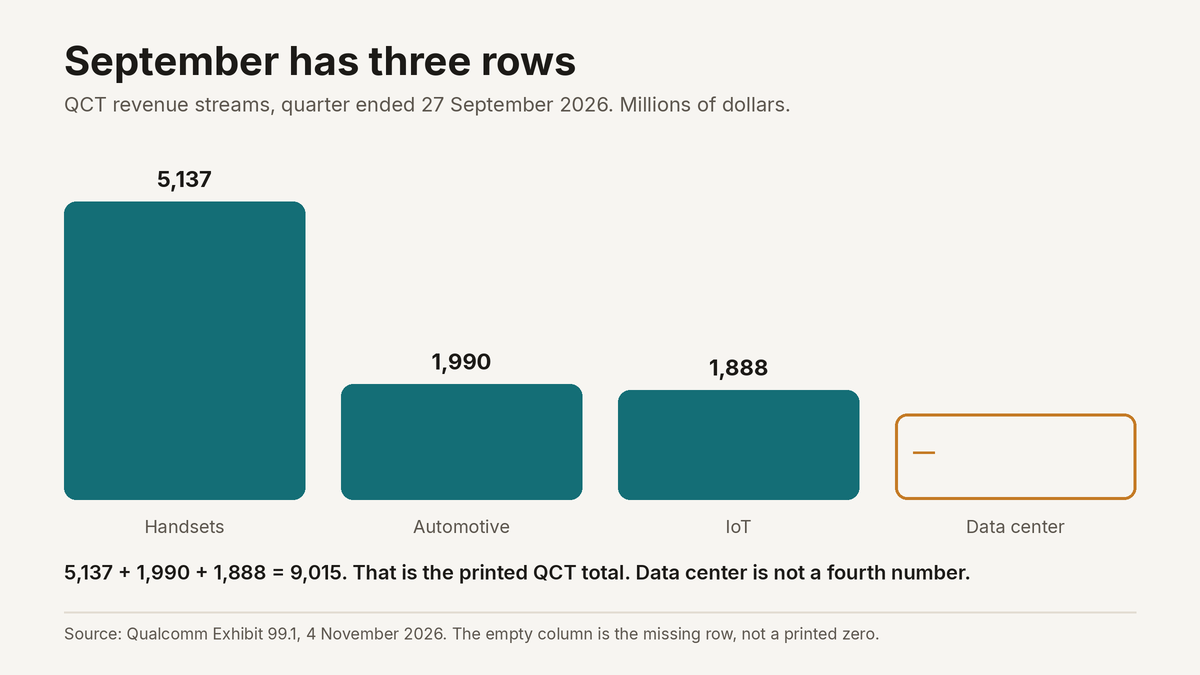
Qualcomm got paid on the chips that left in the quarter ended 27 September: handsets of $5,137 million, automotive of $1,990 million, IoT of $1,888 million, and QTL of $1,304 million. The stuck step is the data-center row. The September table does not have one. The $5 billion figure is a target for a year that has not been reported.
US PULSE · Data as at 5 Nov 2026 · Next update: when a closed quarter prints a data-center row
Affects: Semiconductors — Markets: US · Korea · Taiwan
Education only, not advice to buy or sell any security. Figures are from Qualcomm's Exhibit 99.1 furnished with the 4 November 2026 Form 8-K, and from the call the same day where a line is marked as the call. Lines marked our arithmetic are worked on this page.
The numbers that matter this month
The trigger is Exhibit 99.1, filed 4 November, for the quarter and year ended 27 September 2026. The data-center dollar missing from that exhibit is from the call the same afternoon, and the table marks it as the call.
| Line | Figure | What it is |
|---|---|---|
| Quarter ended | 27 September 2026 | The books this release reports |
| GAAP revenue, quarter | $10,322 million | Down 8%. Year-ago $11,270 million |
| Non-GAAP revenue, quarter | $10,442 million | $120 million customer payment in the gap |
| GAAP operating income, quarter | $1,356 million | Year-ago $2,918 million |
| Non-GAAP diluted EPS, quarter | $2.17 | GAAP diluted EPS $1.17 |
| QCT revenue, quarter | $9,015 million | EBT $2,142 million. Margin printed 24% |
| Handsets | $5,137 million | Down 26%. Year-ago $6,961 million |
| Automotive | $1,990 million | Up 89%. Headline says the first $2 billion quarter |
| IoT | $1,888 million | Up 4% as printed |
| QTL revenue, quarter | $1,304 million | Margin printed 70%. Apple, Huawei, Transsion renewed |
| Data-center row, September | not in the table | Three streams sum to QCT |
| Fiscal 2027 data-center target | $5 billion | Reiterated. Forward-looking |
| December data-center guide | more than $650 million | The call. Not in the exhibit |
| Q1 fiscal 2027 revenue guide | $10.4–$11.2 billion | QCT $9.0–$9.6 billion, inclusive of Data Center |
| Inventories | $8,640 million | Was $6,526 million. Mix not named |
| Fiscal 2026 GAAP diluted EPS | $12.70 | Includes a $5.7 billion tax benefit |
| Fiscal 2026 non-GAAP diluted EPS | $10.54 | Down 12% |
| Returned to stockholders, year | $11,671 million | Buybacks $7,817 million. Dividends $3,854 million |
Source: Exhibit 99.1 to the 4 November 2026 Form 8-K. The December guide is the call the same day. The $5 billion target is forward-looking. The statements are unaudited.
Why does the US matter now?
Because a large US chip designer closed a year in which the phone still wrote the cheque, and set a data-center target beside it with no row.
Qualcomm is paid when a chip ships, and again when a licensed phone ships. Handsets, automotive and IoT add to QCT's $9,015 million. A data-center line cannot hide in that addition. AMD's quarter, the day before, already printed a data-center segment. Qualcomm's headline names an Amazon collaboration. The dollar in the release is the $5 billion target.
Handset revenue fell while the car chip had its largest quarter. The release says input costs are up across wafers, assembly, test, packaging, memory and other materials, and that the full benefit of price increases lands in the second half of fiscal 2027. The call names memory as the pressure on handset volumes. The job Qualcomm is bidding for is custom AI silicon. September shows what has already been paid.
What changed
The filing closed the year. The call put the first dollar on a ramp the filing does not split out.
Handsets fell from $6,961 million to $5,137 million. Automotive rose from $1,053 million to $1,990 million. IoT rose from $1,807 million to $1,888 million. The headline calls automotive the first $2 billion quarter. The table prints $1,990 million. For the year the same three names recur: handsets $24,072 million, automotive $6,004 million, IoT $7,132 million. The same absence recurs with them.
Long-term QTL agreements were renewed with Apple, Huawei and Transsion. Quarterly QTL revenue was $1,304 million, against $1,409 million. For the year the change column is a dash, $5,556 million against $5,582 million, and the call said the run rate is unchanged.
The data-center sentences are not a revenue row. The chief executive says fiscal 2027 starts the non-handset inflection, "including the ramp of our Data Center business," that non-handset revenue is projected to grow by more than 60%, and that the $5 billion fiscal 2027 target is reiterated. The outlook footnote says first-quarter fiscal 2027 guidance is inclusive of Data Center. Inclusive means the $9.0–$9.6 billion QCT range contains it. The range is not a split.
The call supplies the split. Data-center revenue in the December quarter is expected to exceed $650 million, from the start of shipments to custom-silicon customers. Custom accelerators began shipping in October, which is after 27 September, so those shipments are outside the quarter this release reports. The call also said the exit is about a $7 billion run rate, that most of the $5 billion is two hyperscalers, one of them Amazon, and that a potential with Amazon is up to $60 billion over ten years. "Up to" and "potential" are not a receivable. Neither figure is in Exhibit 99.1.
GAAP net income for the year was $13,628 million, up 146%, including a $5.7 billion tax benefit the reconciliation places in the second quarter, not this one. Stockholders were paid on another pipe: $1,011 million of buybacks and a $987 million dividend in the quarter. A buyback pays the seller. A dividend pays the holder.
Our math
These lines are our arithmetic. A total that matches a printed total is the company's. A ratio of a target to a paid quarter is ours.
The stream identity closes. $5,137 million plus $1,990 million plus $1,888 million is $9,015 million. For the year, $24,072 million plus $6,004 million plus $7,132 million is $37,208 million. The data-center target fits in neither addition.
The headline and the table disagree by $10 million on the car quarter. We use $1,990 million. Automotive growth on the two lines is 89.0%, printed as +89%. IoT growth is 4.5%, printed as +4%. Combined automotive and IoT rose from $2,860 million to $3,878 million, which is 35.6%. The release says 36%. We divide to 35.6% and quote 36%.
Handsets were 57.0% of quarterly QCT revenue. Automotive and IoT were 43.0%. For the year, handsets were 64.7% of QCT. The call's milestone, non-handset revenue above half of QCT in fiscal 2027, has not printed.
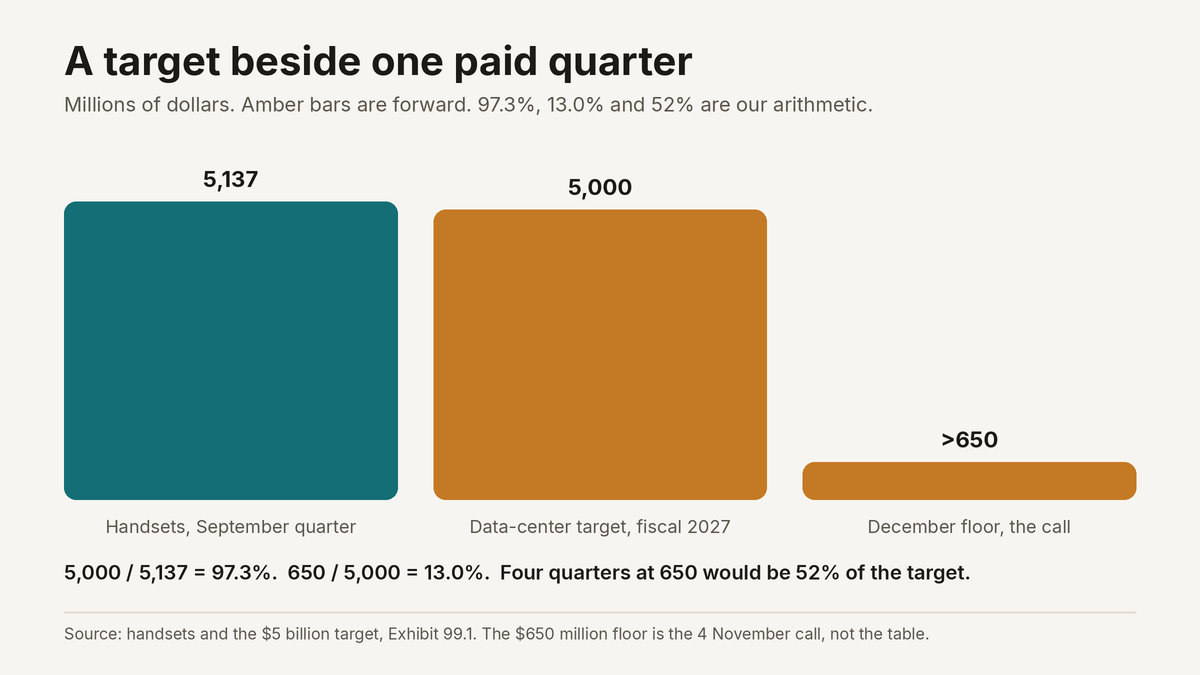
$5,000 million is 97.3% of the September handset quarter. A year of the target is a little smaller than three months of phone chips. The numbers share a unit, not a period. More than $650 million is 13.0% of $5,000 million if the floor and the target are both hit exactly. The other three quarters would then carry $4,350 million, 6.7 times the floor. Four quarters at $650 million would be $2,600 million, 52% of the target. The call says the line ramps and exits at about a $7 billion run rate. A run rate is not a quarter, and this page does not divide $7 billion by four.
Automotive plus IoT in fiscal 2026 was $13,136 million, the non-handset base the table can give. Sixty percent of it is $7,881.6 million, so the line you clear is $21,017.6 million. The quote says more than 60%. If the $5,000 million target sits inside that line and is met exactly, $16,017.6 million is left, 21.9% above this year's automotive and IoT. That 21.9% is the exact case of two forward figures. It is not a car-and-IoT guide.
The earnings bridge closes. GAAP diluted EPS of $1.03 plus $0.99 and $0.13 is $2.15. At the top, $1.23 plus the same two amounts is $2.35. The revenue bridge has a wedge. QCT of $9.0–$9.6 billion plus QTL of $1.3–$1.5 billion is $10.3–$11.1 billion, against a company range of $10.4–$11.2 billion. The gap is $0.1 billion at both ends, and the release does not name it. For the year, QCT plus QTL is $42,764 million against revenue of $43,120 million. The $356 million is unnamed, and it sits outside the three chip rows.
At the top of the QCT range, with automotive and IoT held at $3,878 million and data center at the $650 million floor, $5,072 million is left for handsets. That is $65 million, or 1.3%, under September. It is a boundary, the most room the range gives the phone line. We do not turn the call's "mid-single-digit" into a percent.
Gross margin is not printed. Cost of revenue of $5,084 million on GAAP revenue of $10,322 million is 50.7%, against 55.3% a year earlier. QCT's printed EBT margin is 24%; the two lines divide to 23.8%. The call guides 20–22% and names 3 points for adding Data Center. The midpoint is 21, and 24 minus 21 is 3.
The $120 million between non-GAAP and GAAP revenue is a payment to a customer from a legal settlement. Adding it back is not more silicon. The full-year gap is the same $120 million. Walk the GAAP EPS of $12.70 through the reconciliation and it lands a penny from the printed non-GAAP $10.54. The release allows the rounding. The $5.7 billion tax benefit is a second-quarter item. Quarterly operating income fell from $2,918 million to $1,356 million.
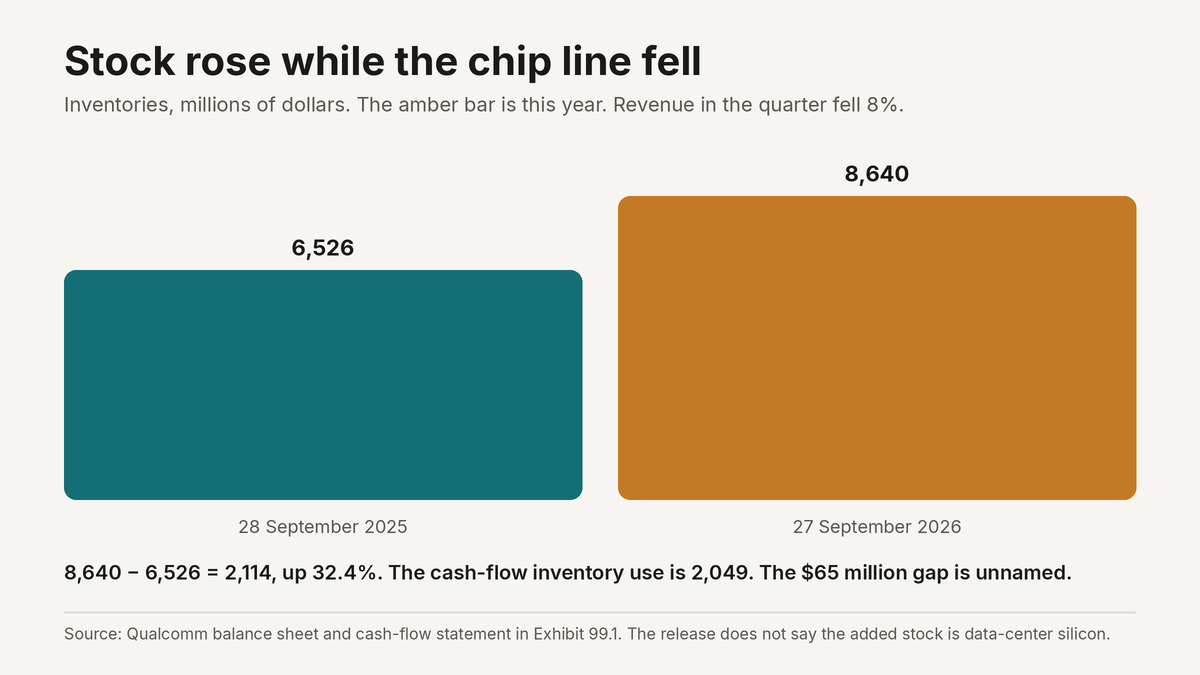
Inventories rose from $6,526 million to $8,640 million, up $2,114 million, or 32.4%. The cash-flow use is $2,049 million. The $65 million between them is unnamed. Cash equivalents fell by $884 million and restricted cash by $2,323 million. Those drops sum to the printed $3,207 million decrease. Operating cash flow was $11,145 million against stockholder returns of $11,671 million, 104.7% of operating cash. Capital spending was $2,494 million, up 109.2% from $1,192 million.
This is not a price call.
Where does the money stick?
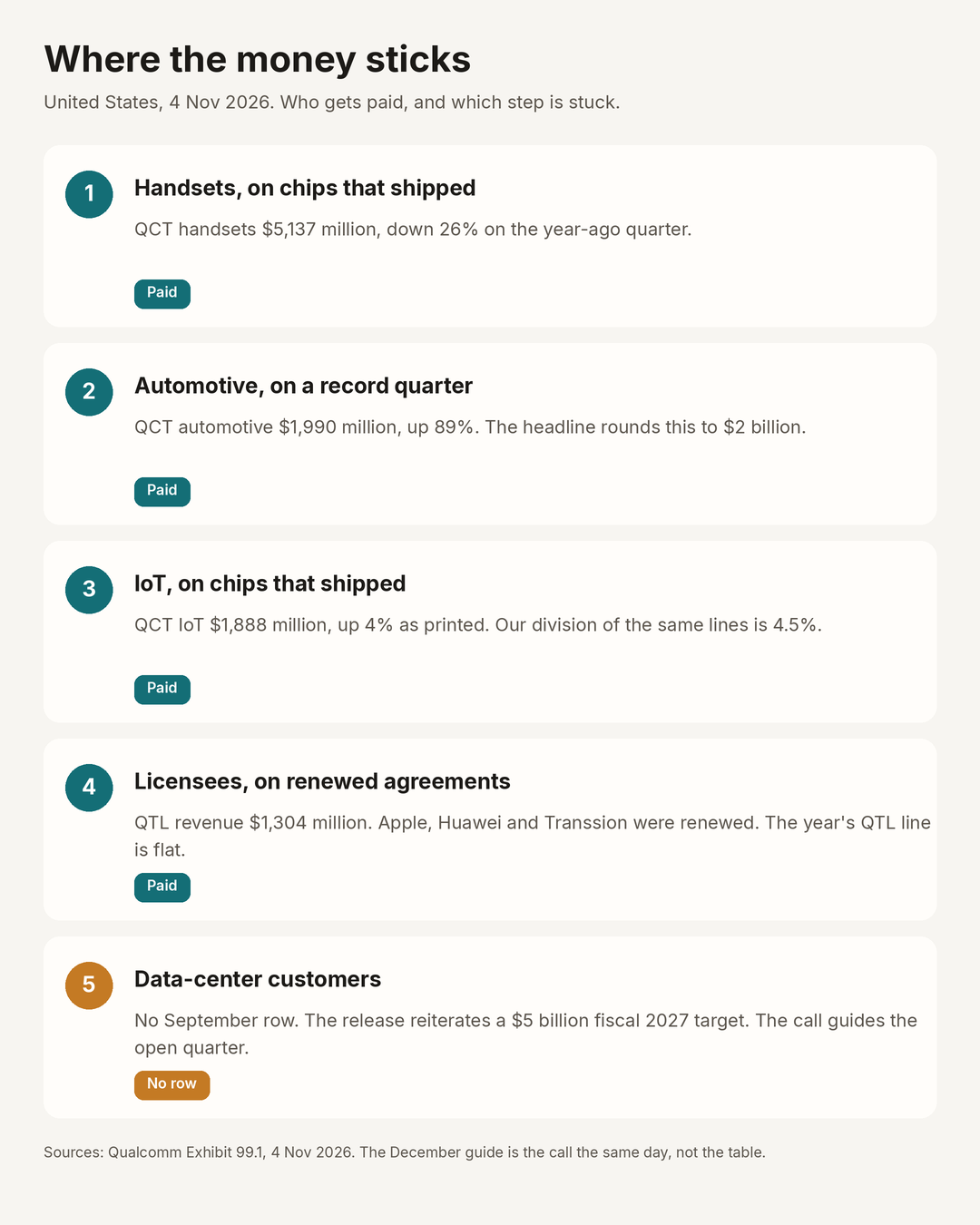
At five seats. Four of them were paid in the quarter the filing closes. One of them is the stuck step.
- Handset customers, on chips that shipped. $5,137 million, down from $6,961 million. The call adds memory as the pressure, and a plan that assumes global handset units flat to down in calendar 2027. A volume clock, not the missing row.
- Car customers, on a record quarter. $1,990 million, from $1,053 million. The cheque cleared. The call's exit run rate is not a row in the September table.
- IoT customers, on chips that shipped. $1,888 million, from $1,807 million. The printed change is +4%. Our division is 4.5%. The line is a receipt.
- Licensees, on agreements that were renewed. QTL revenue $1,304 million in the quarter and $5,556 million in the year, against $5,582 million. The year's change column is a dash. Stockholders were paid on a separate pipe: $1,998 million in the quarter.
- Data-center customers. This is the stuck step. No September row. A $5 billion target in the release. A call floor above $650 million, an October start, and an "up to $60 billion" potential over ten years. None of those is revenue for a quarter that has closed.
Phones, cars, IoT and licenses have cleared at the dollars in the table. The data-center shipment has been described and, on the call, begun in October. It has not been reported.
Is the data-center row still missing?
Yes, in every closed period this filing prints. The quarter and the year each have three QCT streams. The first quarter of fiscal 2027 has not closed. A guide for an open quarter is not a row for a closed one.
The call says custom accelerators began shipping in October, after the books closed. The company did not print an October dollar. The dollar it did give is a floor for the whole December quarter, said on the call. A start is not a reported line.
Two figures look like the row. The $5 billion is a target, with the release's forward-looking caution on it. The $8,640 million of inventory has no composition. The unnamed $356 million between total revenue and the two segments sits outside the three chip rows. None of the three is labeled Data Center. Price increases are a margin clock, timed in the release to the second half of fiscal 2027. The call says custom silicon is dilutive to gross margin and accretive to operating margin, and that supply would cap upside past the $5 billion. Those sentences describe the ramp. They leave the cell empty.
What dates matter
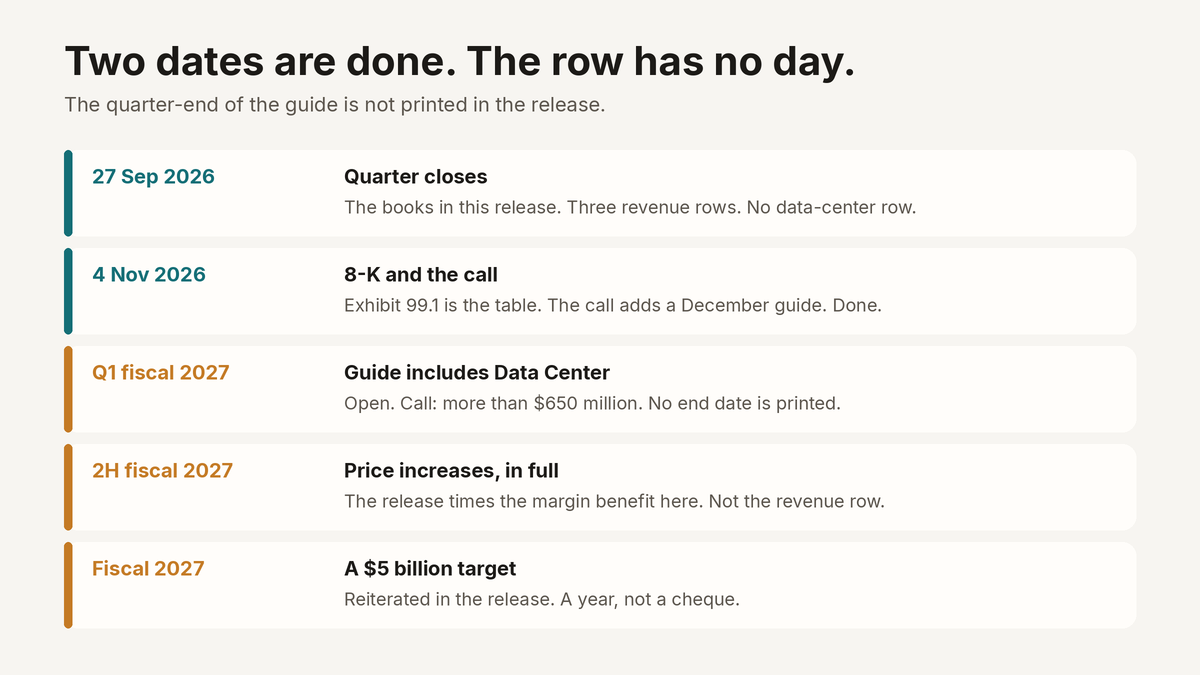
Five markers. Two have a day. The test of this view does not.
| When | What | What would count |
|---|---|---|
| 27 Sep 2026 | Quarter and year-end. | Done. The books. No data-center row. |
| 4 Nov 2026 | Form 8-K, Exhibit 99.1, and the call. | Done. This pulse. |
| First quarter of fiscal 2027 | The first guide that includes Data Center. Call: more than $650 million. | The row test. The release does not print the quarter's end date. |
| Second half of fiscal 2027 | Full benefit of price increases, in the release. | A margin date. Not the revenue row. |
| Fiscal 2027 | The reiterated $5 billion target. Call: about a $7 billion exit run rate. | A year. Not a day, and not a cheque. |
The next quarter is the one the footnote pulls Data Center into. The release does not print the day it ends.
How is this different from the Microsoft handover?
The 29 October pulse was a buyer that had signed for GPUs and had not taken delivery. This print is the seller's table. Qualcomm has been paid for the phones, the cars and the licenses. The scarce object is a product line with no cell.
Yesterday's GE Vernova pulse had an order book and a shipped gigawatt, both printed. Qualcomm's data center has a target and a footnote, and neither an order book nor a shipment inside the revenue table. The Digital Realty pulse was a lease signed and not yet billed. Here the Amazon collaboration is named, and the September invoice is not. AMD's quarter, the day before, printed a data-center segment. This filing does not.
What would change this view?
Who gets paid today is Qualcomm, on handsets, cars, IoT and licenses that the September books record. The stuck step is the data-center row. It moves if any of these print.
- A closed quarter puts a data-center dollar in a revenue table. The call's floor, more than $650 million, is the first number that could become that row.
- The December quarter closes below that floor, or with no commencement. The ramp the target assumes would have missed its first step.
- The $5 billion target is cut. The scale on this page is that target against one handset quarter.
- Inventory is split, and the $2,114 million increase is either data-center silicon or it is not. The blank would close.
- The unnamed $0.1 billion in the guide, or the unnamed $356 million in the year, is later labeled Data Center. That would be a naming. The three September streams would still sum to QCT.
- Audit moves an unaudited line by enough to change the addition. The exhibit marks the statements unaudited, and the forward-looking lines are not a promise.
Practical takeaways
- Four seats were paid: handsets $5,137 million, automotive $1,990 million, IoT $1,888 million, QTL $1,304 million. The three chip rows sum to QCT.
- The $5 billion target is 97.3% of one handset quarter, on our arithmetic. It is a target, not September revenue.
- More than $650 million is the call, for an open quarter. It is 13.0% of the target if both are hit exactly. Four flat quarters at that floor would be 52% of the target.
- GAAP EPS of $12.70 includes a second-quarter tax benefit of $5.7 billion. Non-GAAP EPS of $10.54 fell. The next row is the first closed quarter whose guide includes Data Center. No end date is printed.
FAQ
Who gets paid on Qualcomm's 4 November print?
Qualcomm, on handsets, cars and IoT chips that shipped in the quarter ended 27 September, and on licenses it renewed. Handsets were $5,137 million. Automotive was $1,990 million. IoT was $1,888 million. QTL was $1,304 million. The data-center customer is not in that table.
What did the 4 November release print for data center?
A target, not a row. The chief executive reiterated a fiscal 2027 data-center revenue target of $5 billion, and said non-handset revenue is projected to grow by more than 60%. The September revenue-stream table has handsets, automotive and IoT only. A footnote says first-quarter fiscal 2027 guidance is inclusive of Data Center. The release does not print a September data-center dollar.
Where does the greater-than-$650 million figure come from?
The 4 November call, not Exhibit 99.1. The company said data-center revenue in the December quarter should exceed $650 million, from the start of shipments to custom-silicon customers, and that custom accelerators began shipping in October. October is after 27 September. The figure is a guide for an open quarter.
Why is $1,990 million called a $2 billion quarter?
The release headline says the first $2 billion automotive quarter. The table prints $1,990 million. The gap is $10 million. We use the table.
Is the data-center row still missing?
Yes, in every closed period this release prints. Shipments the call placed in October sit in a quarter that has not closed. A target, a footnote and a guide are not a row.
What date matters next?
The close of the first quarter of fiscal 2027, which is the first quarter whose guidance includes Data Center. The release does not print that quarter's end date. The test is a revenue row, not the guide.
Keep reading on the map
- Markets: US: Microsoft's GPU handover · US: GE Vernova, orders and shipments · US: Digital Realty, signed and not billed · United States
- Explained: Who makes custom AI chips
- The Stack: Semiconductors
How we check this
The quarter, the year, the three revenue streams, the license renewals, the $5 billion target, the "more than 60%" line, the tax benefit, the inventory and the cash-flow lines are from Exhibit 99.1, furnished with the 4 November 2026 Form 8-K. The greater-than-$650 million guide, the October shipment sentence, the $7 billion exit run rate, the 3-point margin note and the "up to $60 billion" potential are from the 4 November call, not from that exhibit. Subtraction and division are marked our arithmetic.
Last reviewed: 5 Nov 2026 · Next review: when a closed quarter prints a data-center revenue row