What Does Galaxy Digital Do? The Helios AI Data Center Builder
Galaxy Digital is two businesses: a digital-asset trading and asset-management firm, and a data-center builder at Helios in West Texas. CoreWeave has leased 526 MW of critical IT there; 133 MW is live and the next 260 MW waits on 2027.
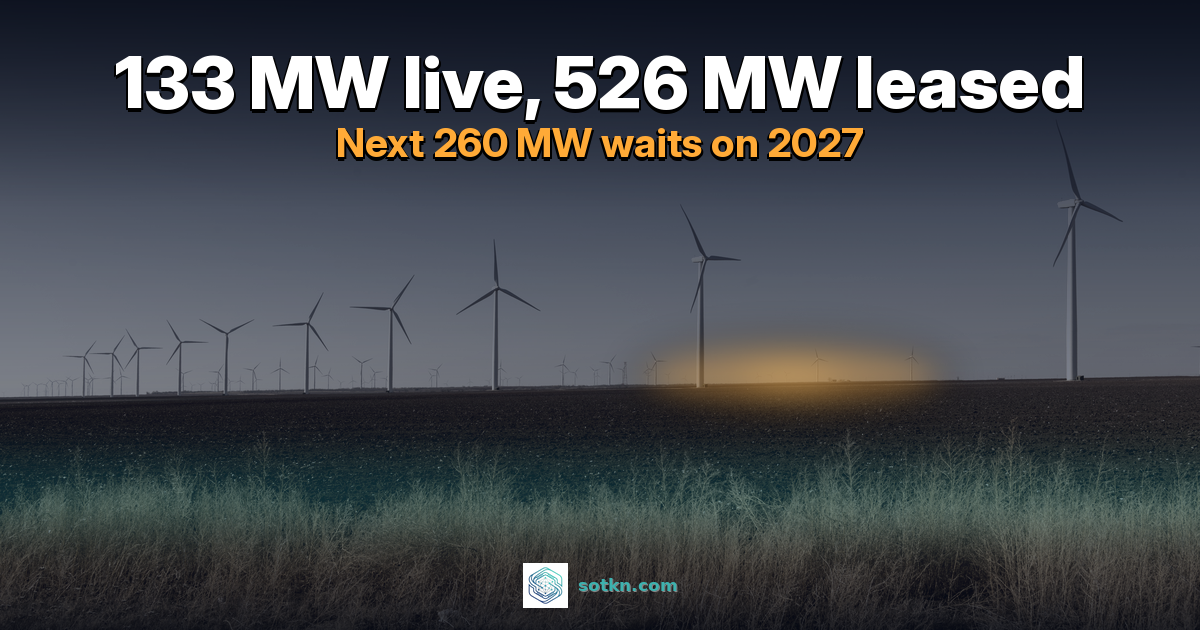
Galaxy Digital Inc. (Nasdaq: GLXY) is best known as a crypto firm. It trades and lends digital assets, runs funds and ETFs, and stakes tokens for clients. Since 2025 it has also been building one of the largest AI data-center campuses in North America. The campus is called Helios. It sits on more than 2,200 acres in Dickens County, West Texas, about 60 miles from Lubbock, on a site Galaxy bought as a bitcoin mine from Argo Blockchain in December 2022. Galaxy stopped mining there at the end of the first quarter of 2025 and signed a 15-year lease with CoreWeave in April 2025. By 30 September 2026 CoreWeave had leased 526 MW of critical IT load at Helios across three phases. The first 133 MW was handed over by the end of the second quarter of 2026. The next 260 MW is scheduled to start reaching CoreWeave in the second quarter of 2027, and the last 133 MW in 2028.
AI DATA CENTERS · Data as at 30 Sep 2026 · Next update: after Galaxy's fourth-quarter 2026 results (date not announced at 17 Nov 2026)
Affects: AI Data Centers · US · Texas power
Galaxy sits on the AI Data Centers layer next to other former bitcoin miners that turned their power sites into halls for AI tenants, such as Core Scientific, IREN, Cipher Mining, TeraWulf and Hut 8. The difference is what sits beside the data centers. Galaxy also owns a large digital-asset business and a treasury of crypto and venture investments, and at 30 September 2026 it put about 48% of its $3.0 billion of equity capital into data centers. This page covers the data-center half: what Galaxy builds, who pays for it, how it is funded, and where it is stuck. For the tenant side of the same deal, read What Does CoreWeave Do?.
In short: Galaxy makes money at Helios by building powered, liquid-cooled data halls and leasing them to CoreWeave for 15 years, with two optional five-year extensions. Phase I, 133 MW of critical IT, is live and carries $315 million of annual base revenue by Galaxy's figure; Phase II, 260 MW, carries $675 million and Phase III, 133 MW, follows in 2028. Galaxy says the three phases together should bring in more than $1 billion a year on average. The stuck step is timing: Phase II is paid for with $3.5 billion of 9.875% notes whose interest runs now, while its rent does not start until the second quarter of 2027. A further 830 MW of approved power at Helios has no tenant yet.
Education only, not advice to buy or sell any security. Figures are from Galaxy Digital Inc.'s filings with the US Securities and Exchange Commission: its quarterly report on Form 10-Q for the period to 30 September 2026, filed 9 November 2026; its third-quarter 2026 results release and investor presentation, filed on Form 8-K on 27 October 2026; its July 2026 notes announcements; and its annual report on Form 10-K for 2025. Galaxy reports in US dollars under US GAAP. Adjusted EBITDA and adjusted gross profit are Galaxy's own non-GAAP measures.
Numbers that matter
Critical IT leased to CoreWeave
526 MW
Three phases on about 800 MW of gross power at Helios · 30 Sep 2026
Contracted
Critical IT delivered
133 MW
Phase I, handed over by end of Q2 2026 · 30 Sep 2026
Live
Next delivery
260 MW
Phase II, data halls from Q2 2027; Phase III, 133 MW, in 2028
Bind
Approved power at Helios
1,630 MW
830 MW of it not yet leased · 30 Sep 2026
Unlet
Q3 2026 data center lease revenue
$79.1M
First full quarter of Phase I rent · three months to 30 Sep 2026
New
Data Centers adjusted EBITDA
$68.7M
Up from $11.5M in Q2 2026 · three months to 30 Sep 2026
Ramping
Phase II notes
$3.5bn at 9.875%
Senior secured, due 2031, issued 28 Jul 2026
Costly
Helios construction still committed
$3.16bn
$2.63bn of it due within a year · 30 Sep 2026
Spending
Status chips are Second Order's read. Leased and delivered capacity, approved power, lease revenue, segment adjusted EBITDA, the notes and construction commitments are Galaxy's own figures from its 10-Q and third-quarter release and presentation. Adjusted EBITDA is Galaxy's non-GAAP measure.
What does Galaxy Digital actually do?
Two businesses under one listing. One trades, lends and manages digital assets. The other buys land with grid power in Texas, builds AI data halls on it and leases them out for 15 years.
From a bitcoin mine to a 1.6 GW AI campus in West Texas.
- It runs a digital-asset business. Galaxy's Digital Assets segment trades, lends and brokers crypto for institutions, runs an investment bank, manages about $5.9 billion of assets including ETFs and alternative funds, and had about $4.6 billion of assets staked to its validators at 30 September 2026. A Treasury & Corporate segment holds Galaxy's own bitcoin, ether, solana and venture investments. Galaxy listed in Toronto in 2018 and on Nasdaq in May 2025, and is based in New York.
- It turned a bitcoin mine into an AI campus. Galaxy bought the Helios mining site and its operations from Argo Blockchain in December 2022, according to its 2025 annual report. It stopped mining there at the end of the first quarter of 2025 and began converting the site for AI and high-performance computing. The 10-Q warns that the conversion brought impairment charges on the old mining equipment and negative adjusted EBITDA in earlier periods.
- It owns the power path, not just the buildings. Helios has its own 345 kV substation, connected to the Texas grid, with up to 900 MW of transformer capacity across phases, according to the September 2026 campus update in Galaxy's investor presentation. The grid operator ERCOT has approved more than 1.6 GW of gross power capacity at the campus. The site also has chiller yards for direct-to-chip liquid cooling, electrical yards with backup generators, and its own groundwater and water-treatment facilities.
- It builds for one tenant in phases. Phase I gave CoreWeave 133 MW of critical IT load, the power available to servers, using about 200 MW of gross power. Phases II and III add 393 MW of critical IT on about 600 MW of gross power. Phase II is two buildings with eight data halls, 260 MW of critical IT and 400 MW of utility capacity on a site of about 260 acres. Galaxy's presentation puts the cost of Phase I at $1.8 billion and estimates Phase II at $4.0 billion.
| Helios phase | Critical IT (MW) | Gross power (MW) | Rent starts | Annual base revenue | Construction cost |
|---|---|---|---|---|---|
| Phase I | 133 | ~200 | Delivered by Q2 2026 | $315M | $1.8bn |
| Phase II | 260 | ~400 | From Q2 2027 | $675M | $4.0bn (estimate) |
| Phase III | 133 | ~200 | 2028 | Not given separately | Not given |
| Helios II (unleased) | Not given | 830 | No tenant yet | — | — |
The phase figures are from Galaxy's third-quarter 2026 investor presentation; annual base revenue is the company's anticipated revenue at full turnover, including annual escalators, and the Phase II cost is its internal estimate. The gross power figures are described as approximate. Galaxy does not give Phase III revenue or cost on its own, so we leave those blank instead of estimating.
Dividing cost by capacity, Phase I cost about $13.5 million per megawatt of critical IT and Phase II is estimated at about $15.4 million per megawatt (our arithmetic: $1.8 billion ÷ 133 MW; $4.0 billion ÷ 260 MW). Dividing base revenue by capacity, Phase I earns about $2.4 million per megawatt a year and Phase II about $2.6 million (our arithmetic: $315 million ÷ 133 MW; $675 million ÷ 260 MW). Phase I's base rent is about 17.5% of its cost each year and Phase II's about 16.9% (our arithmetic). These are rent-to-cost ratios before operating costs, interest and tax, not returns.
Beyond the leased 800 MW, Galaxy says it has submitted a 1 GW load request at Helios that is still in ERCOT's process, sees another 1 GW of possible expansion there, and bought two more Texas sites, Caspian and Selene, with potential capacity of about 700 MW and 900 MW. It also agreed to buy about 500 acres in McGregor, Texas, for a campus called Merlin with about 74 MW in its first phase. Galaxy counts all of this as a potential pipeline of more than 5.7 GW, assuming full approval. Only the 1,630 MW at Helios is approved today.
How does Galaxy Digital make money from data centers?
Rent on long leases, paid as each data hall is handed over. The tenant passes through operating costs. Galaxy keeps the margin and carries the debt.
- Base rent from CoreWeave. Galaxy recognised $79.1 million of data center lease revenue in the third quarter of 2026 and $97.9 million in the first nine months, all from the Phase I lease, according to the 10-Q. Each data hall is leased through the end of a 15-year base term that starts when the final hall is turned over, and revenue starts hall by hall as they are delivered.
- Escalators and extensions. The lease has annual rent escalators and two five-year extension options. Galaxy puts the total potential contract value at more than $30 billion over a potential 25-year term, a figure that assumes CoreWeave exercises both extensions.
- High lease margins, by Galaxy's measure. Galaxy expects an average lease-level adjusted EBITDA margin above 90% across the 15-year base term for the three phases. The 10-Q shows $9.9 million of data center operator cost in the third quarter, described as pass-through operating costs under the CoreWeave lease.
- The rest of Galaxy. In the third quarter Digital Assets earned $71.3 million of adjusted gross profit and Treasury & Corporate $418.9 million, mostly from gains on its investments, against $79.1 million for Data Centers. Group net income was $323 million. Those other segments swing with crypto prices; Galaxy says it expects the data-center business to become a source of long-term, predictable revenue uncorrelated to digital-asset prices.
Multiplying the third quarter by four gives about $316 million a year of lease revenue (our arithmetic: $79.1 million × 4), close to the $315 million of Phase I annual base revenue in Galaxy's presentation. That suggests Phase I was billing at roughly its full base rent through the quarter.
The segment's own numbers show where the money goes. Data Centers reported $89.0 million of revenues and gains and $9.9 million of transaction expenses, giving $79.1 million of adjusted gross profit and $68.7 million of adjusted EBITDA. Below that line came $75.4 million of notes interest and other expense and $17.3 million of depreciation, and the segment's net result was a loss of $0.4 million. Interest was larger than adjusted EBITDA in the quarter (our arithmetic: $75.4 million against $68.7 million).
That gap comes from timing. Interest on the Phase I term loan stopped being capitalised once Phase I was in service, and the Phase II notes started charging interest in July 2026, well before Phase II earns rent. Of $62.0 million of interest incurred on the notes in the quarter, $20.7 million was capitalised into construction and the rest expensed, according to the 10-Q.
What limits it?
One tenant. Expensive money. And a grid queue that Texas has put under audit.
- One customer pays for everything. The 10-Q says the data-center business is highly dependent on a single customer, CoreWeave, and may stay that way for the foreseeable future. All 526 MW of leased critical IT at Helios is CoreWeave's. If CoreWeave failed to pay, cut back or renegotiate, the segment's revenue and the security behind its debt would be at risk. Read What Does CoreWeave Do? for the tenant's own position.
- The Phase II debt is costly and runs ahead of rent. Galaxy Helios Data Centers II LLC issued $3.5 billion of 9.875% senior secured notes due August 2031 on 28 July 2026, at 99.5% of face. At that coupon the notes cost about $346 million a year in interest (our arithmetic: $3.507 billion × 9.875%), about 51% of Phase II's $675 million of annual base revenue (our arithmetic). Interest is paid every six months from 1 February 2027; Phase II rent starts from the second quarter of 2027. The notes begin to amortise at 4% a year once the project is complete.
- The Phase I loan floats and has covenants. Galaxy Helios I borrowed $1.3 billion of a $1.4 billion Deutsche Bank term loan by 30 September 2026, at SOFR plus 4.75% with a 2.5% floor, maturing in August 2028. The loan requires a debt service coverage ratio of at least 1.40 after stabilisation and a loan-to-cost ratio of no more than 80% until then. Galaxy uses interest-rate caps to limit the floating-rate exposure. The filings we read do not say how the loan will be refinanced before 2028.
- Construction is still mostly ahead. At 30 September 2026 Galaxy had $3.16 billion of outstanding commitments for Helios construction, up from $530 million at the end of 2025, with $2.63 billion due within a year. Data Centers capital spending was $757 million in the third quarter alone. Galaxy's parent partnership has given completion guarantees on both the Phase I loan and the Phase II notes, so a cost overrun or delay lands back on the group.
- The next power waits on a Texas audit. In August 2026 the Governor of Texas directed the Public Utility Commission of Texas and ERCOT to verify and audit every data center in ERCOT's interconnection process, and the 10-Q says that audit must finish before any data center project moves forward. Galaxy warns it may affect approval timelines for some of its sites. The 1 GW load request at Helios and the Caspian and Selene sites sit behind it. For how Texas is handling big loads, read Texas's Large-Load Rule.
- 830 MW of approved power has no tenant. Galaxy says it is in discussions with prospective tenants for the 830 MW of approved capacity at Helios II and calls market conditions increasingly favourable, but at 30 September 2026 nothing had been signed. Approved power earns nothing until a lease is signed and halls are built.
Where the filings are silent we say so. Galaxy does not give Phase III revenue or cost on its own, a construction budget for Helios II, the names of the tenants it is talking to, a timetable for ERCOT's audit, a refinancing plan for the Phase I loan, or the date of its fourth-quarter results. We do not estimate any of those.
Who else does this?
Roles, not a league table.
| Company | What it does | What makes it different |
|---|---|---|
| Galaxy Digital | Helios AI campus in West Texas plus a digital-asset finance business | 526 MW of critical IT leased to CoreWeave, 133 MW live; about 48% of group equity in data centers |
| Core Scientific | Former bitcoin miner hosting CoreWeave | Several sites converted for one big AI tenant |
| Applied Digital | North Dakota AI campuses for CoreWeave and others | Also funds builds with project debt against long leases |
| IREN / Cipher Mining / TeraWulf / Hut 8 | Miners moving into AI halls | Same playbook of turning power sites into leased capacity |
| Equinix / Digital Realty | Global data-center landlords | Many tenants and cities, investment-grade funding |
What separates Galaxy is the mix. Its data-center half looks like the other converted miners: one large AI tenant, one power-rich campus, project debt secured on the lease. Its other half is a crypto finance firm with $4.9 billion of cash, stablecoins and US Treasuries at 30 September 2026, which gives it a cushion the pure miners lack but also ties the group's results to digital-asset prices. Its campus is also unusually large for one approved site, with 1,630 MW approved at Helios against 800 MW leased.
What would change this view?
The read on the model weakens if:
- Galaxy signs a tenant for some of the 830 MW of approved but unleased power at Helios II, especially a tenant other than CoreWeave.
- Phase II data halls slip past the second quarter of 2027, or the $4.0 billion estimate rises, pushing rent further behind the 9.875% notes' interest.
- CoreWeave's finances weaken enough to put its lease payments in doubt.
- ERCOT's audit delays or cuts the 1 GW Helios load request or the Caspian and Selene sites.
- Galaxy refinances the floating-rate Phase I loan before its August 2028 maturity on better or worse terms.
The read holds while Phase I keeps billing at full base rent, Phase II reaches CoreWeave from the second quarter of 2027 on budget, and Galaxy can keep funding construction without relying on crypto gains.
Practical takeaways
- Galaxy Digital is a Nasdaq-listed crypto finance firm that is also building the Helios AI data-center campus in Dickens County, West Texas.
- CoreWeave has leased 526 MW of critical IT at Helios for 15 years plus two optional five-year extensions; 133 MW was live by the end of the second quarter of 2026.
- Phase I brings $315 million of annual base revenue by Galaxy's figure; third-quarter lease revenue was $79.1 million.
- The stuck step is Phase II: 260 MW, an estimated $4.0 billion, funded by $3.5 billion of 9.875% notes, with rent starting from the second quarter of 2027.
- ERCOT has approved 1,630 MW at Helios; 830 MW has no tenant, and new power requests wait on a Texas audit.
- In the third quarter, interest on the data-center debt was larger than the segment's adjusted EBITDA (our arithmetic).
FAQ
What does Galaxy Digital do?
Galaxy Digital Inc. runs two businesses. Its digital-asset business trades, lends and brokers crypto, runs an investment bank, manages funds and ETFs, and stakes tokens for clients. Its data-center business is building the Helios campus in West Texas and leasing it to CoreWeave for AI computing. A third segment holds Galaxy's own crypto and venture investments.
What is the Galaxy Helios data center?
Helios is Galaxy's data-center campus on more than 2,200 acres in Dickens County, West Texas, about 60 miles from Lubbock. It was a bitcoin mine bought from Argo Blockchain in December 2022. ERCOT has approved more than 1.6 GW of gross power there, and Galaxy has its own 345 kV substation on site.
How much has CoreWeave leased from Galaxy?
CoreWeave has leased 526 MW of critical IT load at Helios in three phases: 133 MW in Phase I, delivered by the end of the second quarter of 2026; 260 MW in Phase II, from the second quarter of 2027; and 133 MW in Phase III, in 2028. The lease runs 15 years with two optional five-year extensions.
How much revenue does Galaxy make from Helios?
Galaxy recognised $79.1 million of data center lease revenue in the third quarter of 2026. It puts Phase I's annual base revenue at $315 million and Phase II's at $675 million, and expects more than $1 billion a year on average across the three phases once all are delivered.
How is Helios being paid for?
Phase I uses a Deutsche Bank term loan of up to $1.4 billion, $1.3 billion drawn at 30 September 2026, at SOFR plus 4.75%. Phase II is funded mainly by $3.5 billion of 9.875% senior secured notes due 2031, issued in July 2026, plus Galaxy's own equity.
Is Galaxy's data center business profitable?
Not yet after interest. In the third quarter of 2026 the Data Centers segment reported $68.7 million of adjusted EBITDA but $75.4 million of notes interest and other expense, and a net loss of $0.4 million, because the Phase II notes charge interest before Phase II earns rent.
Keep reading on the map
- The layers: AI Data Centers · Neoclouds · Hyperscalers
- The terms: What Is an AI Data Center? · Data Center Leases Explained · Data Center Financing Explained · How Much Power Does an AI Data Center Use? · PUE Explained
- Other miners turned AI landlords: What Does Core Scientific Do? · What Does IREN Do? · What Does Cipher Mining Do? · What Does TeraWulf Do? · What Does Hut 8 Do? · What Does Applied Digital Do?
- The tenant and the market: What Does CoreWeave Do? · US Markets · Texas's Large-Load Rule
For how builders borrow against a signed lease, read Data Center Financing Explained. This page stays the free Stack read of Galaxy's data-center model.
Sean
Writes Second Order by TKN — a plain-English map of AI infrastructure. Who gets paid, where money sticks, which step is stuck. Not investment advice.
Author page → · Editorial standards →
How we check this
Figures come from Galaxy Digital Inc.'s SEC filings listed below: its Form 10-Q for the quarter to 30 September 2026 (filed 9 November 2026), its third-quarter 2026 results release and investor presentation (Form 8-K, 27 October 2026), its 23 July 2026 notes pricing release, its 28 July 2026 notes closing filing, and its Form 10-K for 2025. Adjusted EBITDA and adjusted gross profit are Galaxy's non-GAAP measures; phase revenue, the Phase II cost and the 90% lease margin are the company's own estimates. Where we work something out ourselves, the arithmetic is shown and labelled. Galaxy does not give Phase III revenue or cost on its own, a Helios II budget, the names of prospective tenants, an ERCOT audit timetable or its next results date, so we do not estimate those. Social media posts and press reports are not used.
Last reviewed: 17 Nov 2026 · Next review: after Galaxy's fourth-quarter 2026 results (date not announced at 17 Nov 2026)
Spot an error? Tell us and we will correct it and note the change here.
Our editorial standards →
References
- Galaxy Digital Inc., Form 10-Q for the quarter ended September 30, 2026 (company, SEC filing), 9 Nov 2026 — Helios capacity and ERCOT approval, CoreWeave dependence, lease revenue, operator cost, interest, Deutsche Bank loan terms, notes terms, construction commitments, balance sheet, ERCOT audit, Texas pipeline
- Galaxy Digital Inc., Galaxy Announces Third Quarter 2026 Financial Results (Exhibit 99.1) (company, results release), 27 Oct 2026 — Segment adjusted gross profit and EBITDA, Data Centers assets, liabilities and capital spending, equity allocation, net income, cash and Treasuries
- Galaxy Digital Inc., Q3 2026 Investor Presentation (Exhibit 99.2) (company, investor presentation), 27 Oct 2026 — Helios acreage and power, CoreWeave lease by phase, annual base revenue, construction costs, lease margin, contract value, campus update, 5.7 GW pipeline, assets under management
- Galaxy Digital Inc., Galaxy Digital Inc. Announces Pricing of $3.507 Billion of Senior Secured Notes (Exhibit 99.1) (company, press release), 23 Jul 2026 — Phase II project scope, 9.875% coupon, 2031 maturity, interest dates, amortisation and security
- Galaxy Digital Inc., Form 8-K, closing of 9.875% Senior Secured Notes due 2031 (company, SEC filing), 28 Jul 2026 — Issue of the notes and the indenture with The Bank of New York Mellon
- Galaxy Digital Inc., Form 10-K for the year ended December 31, 2025 (company, annual report), 26 Feb 2026 — Acquisition of Helios from Argo Blockchain in December 2022 and the Deutsche Bank loan drawn at year-end