What Is a Cloud Region? Why Power Decides Where the Cloud Grows
A cloud region is a group of data centres in one area that a cloud provider runs as one location, split into availability zones. New AWS regions have taken about 12 to 33 months from announcement. Power near the metro, not money, sets how far a region can grow.
EXPLAINED · Mechanism · Last reviewed: 3 Nov 2026 · Next review: after the AWS Saudi Arabia Region launch (due December 2026)
A cloud region is a group of data centres in one geographic area that a cloud provider runs and sells as a single location. Each region is split into availability zones: separate sites with their own power, cooling and network, linked by fast fibre.
In short. A cloud region is a cluster of data centres in one area, sold as one location and split into at least three availability zones. AWS lists 39 regions and 124 zones as of 3 November 2026. Recent AWS regions took about 12 to 33 months from announcement to opening. Our read: new countries make the headlines, but most of the money thickens regions that already exist. What binds is power and land close to the zones, so the landlords and utilities that hold powered sites get paid before the cloud does.
Why an investor cares: a region is where a cloud provider’s capital spending actually lands. Where regions can grow, and how fast, decides who gets paid first from the AI build. Our guide to hyperscalers covers the companies; this page covers the map they build on.
What is a cloud region?
It is the place you choose when you buy cloud computing. When a customer starts a server or stores a file on Amazon Web Services, Microsoft Azure or Google Cloud, it picks a region, such as Singapore, Northern Virginia or Frankfurt. The provider promises the data stays there unless the customer moves it.
Behind the name sits a cluster of data centres in one metro area. Each region is its own location: a region in Singapore and a region in Sydney share software, not buildings.
The other big clouds use the same idea under similar names. The details differ, but the design is the same: a region is the area, and the zones inside it are the separate sites.
What is an availability zone?
It is one of the separate sites inside a region. AWS describes each zone as having independent power, cooling and physical security, connected to the other zones by redundant, ultra-low-latency fibre. Every AWS region has at least three.
The design rule is a balance. Zones must be far enough apart that a fire, flood or power cut at one does not take down the others, but close enough that data can be copied between them almost instantly. That is what lets a bank run the same system in three zones and survive losing one.
Zones are not all the same size. AWS’s documentation lists six zones in Northern Virginia, its oldest and largest region, with a Maryland zone coming in 2026, and three in Singapore. Our arithmetic: 124 zones across 39 regions is about 3.2 per region, so most regions sit near the minimum.
Why do cloud providers build new regions?
Two reasons: data residency and latency. Banks, governments and hospitals are often required, or prefer, to keep data inside the country. Users also get faster responses from servers that are nearby. A local region lets a provider sell to customers who could not use one abroad.
That is why new regions are announced like trade deals, with a prime minister quoted and an investment figure attached. Taiwan’s premier welcomed the Taipei region in both 2024 and 2025. Our guide to sovereign AI covers the political side of the same demand.
How long does a new cloud region take?
Recent AWS regions took about one to three years from public announcement to opening. The table uses Amazon’s own dates.
| AWS region | Announced | Opened or due | Months (our arithmetic) | Planned investment |
|---|---|---|---|---|
| Asia Pacific (Malaysia) | March 2023 | 21 August 2024 | About 18 | Not used here |
| Asia Pacific (Taipei) | 11 June 2024, for “early 2025” | 5 June 2025 | About 12 | More than $5 billion |
| Saudi Arabia | March 2024 | Due December 2026 | About 33, if on time | More than $5.3 billion |
Dates and investment figures from Amazon and AWS announcements dated 11 June 2024 to 31 August 2026. Months are Second Order arithmetic. Each region opened with three zones. The clock starts at the public announcement; site, power and permit work usually starts earlier, so the real build is longer than the table shows.
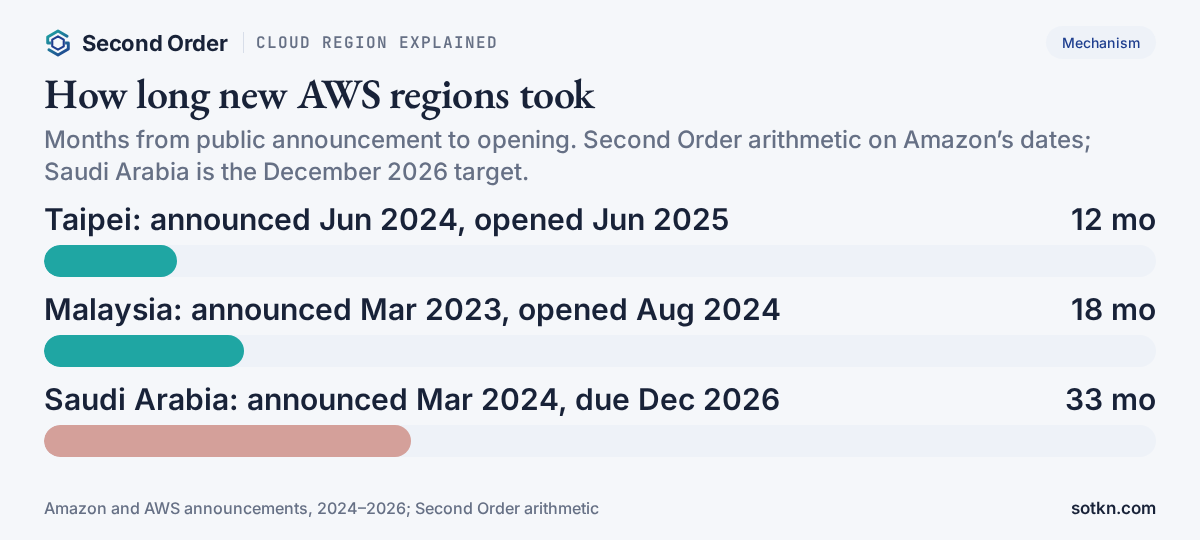
The announcement is not the start. Taiwan already had an AWS Local Zone in Taipei from 2022, and the Taipei region still slipped from “early 2025” to June. Saudi Arabia, announced in March 2024 for “2026”, was confirmed for December in August 2026. Read the clock as a floor.
How fast is AWS adding regions?
Steadily, a few a year. The counts AWS publishes in each announcement show the pace.
| Date | AWS regions | Availability zones | What changed |
|---|---|---|---|
| June 2024 | 33 | 105 | Taipei announced |
| August 2024 | 34 | 108 | Malaysia opens |
| June 2025 | 37 | 117 | Taipei opens |
| November 2026 | 39 | 124 | Saudi Arabia and Chile still to come (7 more zones) |
Counts as published by AWS on each date. Our arithmetic: from June 2024 to November 2026 AWS added 6 regions and 19 zones, and now averages about 3.2 zones per region. A count of regions says nothing about how much capacity sits inside each one.
The count understates the build. A new region opens with three zones, but the money keeps going into the old ones. Northern Virginia gaining a seventh zone in Maryland is one example: more capacity in a region that already exists, not a new pin on the map.
Where does the money go?
Mostly into regions that already exist. Amazon spent $75.9 billion on property and equipment, net of proceeds and incentives, in the third quarter of 2026, and still guides about $220 billion of cash capital expenditure for the year. AWS sales rose 39% to $46.0 billion in the quarter, with $17.8 billion of operating income.
Our arithmetic puts the region pledges in scale. $220 billion a year is about $603 million a day. Saudi Arabia’s whole planned investment of more than $5.3 billion is about nine days of Amazon’s 2026 spending, and the third quarter alone was about 14 times that pledge. Even spread across three zones, the pledge is about $1.8 billion a zone, and it covers years of construction and operation.
So the country launches are the small part. The big money thickens existing regions with more halls, more racks and more power. Our Wire on AWS’s $220 billion capex plan and guide to AI capex follow that spending.
It has a cost. Amazon’s trailing free cash flow turned to an outflow of $42.4 billion by 30 September 2026, against an inflow of $14.8 billion a year earlier, as purchases of property and equipment rose; Amazon says the increase primarily reflects investment in artificial intelligence.
Who gets paid when a region grows?
Our read: whoever holds powered land near the zones is paid first, the builders next, and the cloud provider last, when capacity is live and sold.
- Landlords with powered sites. Cloud providers build some halls and lease others. In a tight market the landlord that already holds land and a grid allocation sets the terms. Singapore’s latest allocation went to four operators: Digital Realty, Equinix, Keppel Data Centres and ST Telemedia Global Data Centres.
- Utilities and grid builders. Every zone needs its own supply, and a region needs several in one metro. The utility, the substation and the transmission line come before any server.
- Builders and equipment makers. Shells, cooling, switchgear and the fibre between zones are paid during construction, before the region earns anything.
- The host country. AWS estimated its Malaysia region would add about $12.1 billion to the country’s economy through 2038. Governments trade land and power for jobs, tax and local data centres.
- The cloud provider, last. AWS earns only when customers use the capacity. Its 38.7% operating margin in the third quarter is the reward for filling regions, not for announcing them.
Our comparison of hyperscale and colocation data centres covers the build-or-lease choice, and our guide to data centre leases covers the contracts.
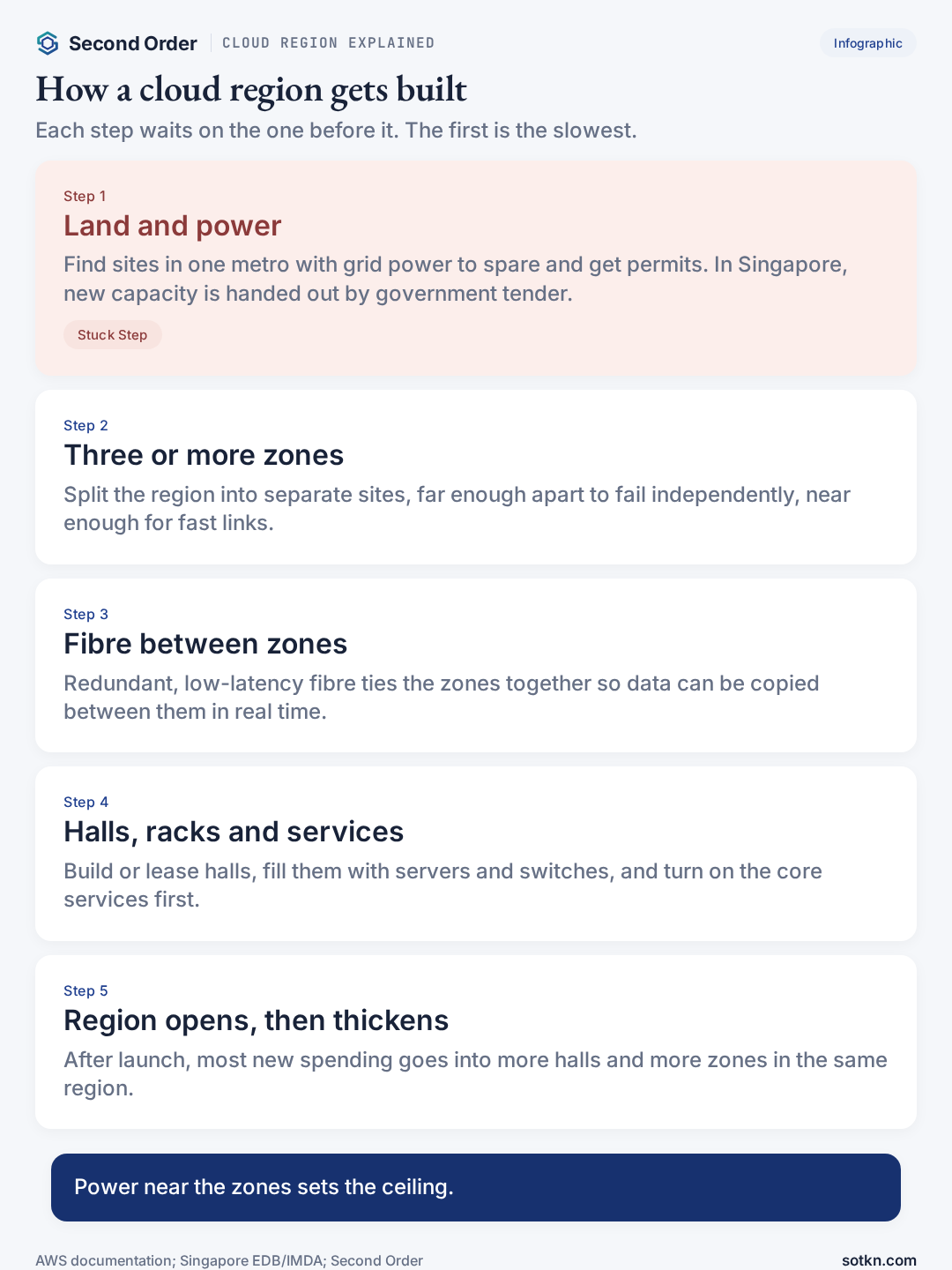
Where is the stuck step?
Our read: power and land close to the existing zones. Money is not the constraint for the largest clouds; sites are. Because zones must sit within a short fibre run of each other, a region cannot simply move its next zone to wherever power is cheap. It has to find power in the same metro.
AWS says as much in its own documentation. As zones grow, its ability to expand them can become constrained. When that happens it may stop customers creating new resources in that zone, and may drop it from the list offered to new accounts. A constrained zone is a region that has run out of room in one place.
Singapore shows the clock when power is scarce. The government hands out new data centre capacity by tender. The second call opened on 1 December 2025 and allocated 200 MW on 21 August 2026, 50 MW each to four operators, about nine months by our arithmetic. The sites are on Jurong Island, and the agencies will review the need for another call in 18 to 24 months. Our Stack page on how hyperscalers buy power and guide to contracted power cover how that power is secured.
Why does this matter for Singapore, Malaysia and Taiwan?
Because Southeast Asia is where the trade-off is sharpest. Singapore has had an AWS region for years, with three zones, but new capacity comes only through tenders. Malaysia got its own AWS region in August 2024, three zones of its own next door. Our Markets note on Singapore’s power plan for data centres and Markets note on Johor grid connections track both sides of the Causeway.
Taiwan is the other case. AWS opened its Taipei region in June 2025 with plans to invest more than $5 billion. Its customer list in Taiwan includes TSMC. Our Taiwan Markets door follows the supply side.
What would change the view?
- Regions open faster. If Saudi Arabia opens on time and the next regions take well under a year from announcement, sites and power are less tight than this page assumes.
- Zones stop growing. If spending shifts from adding halls in existing regions to many new small regions, the money spreads to new countries and new landlords.
- Power frees up. If Singapore, Northern Virginia or other tight metros add grid capacity quickly, the landlord’s advantage narrows and the stuck step moves to chips or equipment.
Common misconceptions
- People assume a region is one data centre. Actually it is several sites, at least three zones on AWS, each of which can hold more than one building.
- People assume more regions means more capacity. Actually most capacity is added inside existing regions. A region count says nothing about how big each one is.
- People assume the cloud can go wherever power is cheap. Actually zones must sit close together for fast links, so growth is tied to power in one metro.
- People assume the investment figure is spent on day one. Actually Amazon’s pledges cover construction, connection, operation and maintenance over many years.
FAQ
What is a cloud region?
A cloud region is a group of data centres in one geographic area that a cloud provider sells as one location, such as Singapore or Northern Virginia. Customers pick a region when they start a server or store data, and the data stays there unless they move it.
What is the difference between a region and an availability zone?
A region is the area; an availability zone is one of the separate sites inside it. Each zone has its own power, cooling and security, and zones are linked by low-latency fibre. AWS says every region has at least three zones, so an app can survive one site going down.
How many regions does AWS have?
As of 3 November 2026, AWS lists 39 regions with 124 availability zones, and plans for two more regions, in Saudi Arabia and Chile. That works out to just over three zones per region on average.
How long does it take to build a cloud region?
From public announcement to opening, recent AWS regions took about 12 months in Taiwan and about 18 months in Malaysia. Saudi Arabia, announced in March 2024, is due in December 2026, about 33 months. Site and power work usually starts before the announcement.
Why do cloud providers build regions in more countries?
Mainly for data residency and latency. Banks, governments and hospitals often must keep data in the country, and users get faster responses from nearby servers. A local region lets a provider sell to customers who could not use a foreign one.
What limits how big a cloud region can get?
Mostly power and land near the existing zones. Zones must sit close enough together for fast links, so a region cannot simply move to wherever power is cheap. AWS says zones can become constrained as they grow and may stop taking new resources.
Is this a list of stocks to buy or sell?
No. This page explains cloud regions and where they bind. It does not rank companies or give buy or sell calls. Not investment advice. Do your own research.
Related: who the hyperscalers are; AWS vs Azure vs Google Cloud; what Amazon does.
Stack doors
Layer: Hyperscalers. Markets: Singapore, Malaysia, US.
Get the Wire — short daily notes when regions, power and cloud capex move.
Not investment advice. Do your own research.
How we check this
Region and zone counts, the zone design and the constrained-zone rule come from AWS’s global infrastructure page and its availability zone documentation, read on 3 November 2026. Announcement and opening dates and investment plans come from Amazon and AWS releases on Malaysia (21 August 2024), Taiwan (11 June 2024 and 5 June 2025) and Saudi Arabia (31 August 2026). Amazon’s sales, AWS profit, capital spending guide and free cash flow come from its third-quarter results of 29 October 2026. Singapore’s data centre allocation comes from the EDB and IMDA fact sheet of 21 August 2026. The build times, zone averages, footprint changes, investment per zone and capital spending per day are our arithmetic, checked in code and labelled as ours on the page. The order of who gets paid and the stuck step are our read. The featured photograph is credited in its caption. This page explains cloud regions. It does not rank companies or give buy or sell calls. Not investment advice. Do your own research.
Last reviewed: 3 Nov 2026 · Next review: after the AWS Saudi Arabia Region launch (due December 2026)
Spot an error? Tell us and we will correct it and note the change here.
References
- Amazon Web Services — AWS Global Infrastructure page (accessed 3 Nov 2026) — 124 Availability Zones in 39 Regions; plans for 7 more zones and 2 more Regions in Saudi Arabia and Chile; three zones per Region
- Amazon Web Services — AWS Availability Zones documentation (accessed 3 Nov 2026) — every Region has at least three zones; US East (Northern Virginia) lists six zones plus a Maryland zone coming in 2026; Singapore lists three; zones can become constrained as they grow
- AWS News Blog — Now open: AWS Asia Pacific (Malaysia) Region (21 Aug 2024) — Malaysia Region open with three zones, announced in March 2023; AWS at 108 zones in 34 Regions; estimated $12.1 billion GDP contribution through 2038
- Amazon — AWS to launch an infrastructure Region in Taiwan (11 Jun 2024) — Taipei Region announced for early 2025 with three zones; AWS then at 105 zones in 33 Regions; zones far enough apart for continuity, near enough for low latency, each with independent power and cooling
- Amazon — Amazon launches infrastructure Region in Taiwan (5 Jun 2025) — Taipei Region open with three zones; more than $5 billion planned for construction, connection, operation and maintenance; AWS at 117 zones in 37 Regions
- Amazon — AWS to launch first cloud Region in Saudi Arabia by December 2026 (31 Aug 2026) — Saudi Region on track for December 2026, first announced March 2024; more than $5.3 billion planned; would take AWS to 40 Regions
- Amazon — third-quarter 2026 results (29 Oct 2026) — AWS sales $46.0 billion, up 39%; AWS operating income $17.8 billion; 2026 cash capital expenditure guide about $220 billion; trailing free cash flow outflow of $42.4 billion
- Singapore EDB and IMDA — DC-CFA2 fact sheet (21 Aug 2026) — 200 MW provisionally allocated, 50 MW each to Digital Realty, Equinix, Keppel Data Centres and ST Telemedia Global Data Centres; launched 1 Dec 2025; sites on Jurong Island; next call reviewed in 18 to 24 months