45.5% Premium, Power Still Paused: Who Gets Paid While NEXTDC's Capex Verdict Waits for 20 November
Goodman and Digital Realty bought close to 8% of NEXTDC at A$9.50 a share, two weeks after a paused power line cut its earnings guidance. Sellers, raiders and advisers are already paid. The answer on what NEXTDC still builds waits for its 20 November meeting.

Goodman Group and Digital Realty paid A$9.50 a share for close to 8% of NEXTDC on 4 November, a 45.5% premium, two weeks after a paused power line in Melbourne cut its earnings guidance. Sellers, the raiders and the advisers are already paid. The power line cannot restart before February. The stuck step is the 20 November verdict on what NEXTDC still builds.
AUSTRALIA PULSE · AI DATA CENTRES · CAPITAL · Data as at 8 Nov 2026 (raid 4 Nov; closes 5–6 Nov) · Next update: NEXTDC AGM, 20 Nov 2026
Affects: AI Data Centers · NEXTDC · Digital Realty — Markets: Australia · Singapore · US
Education only, not advice to buy or sell any security. Dollar figures are Australian dollars unless we say US. A megawatt is a thousand kilowatts, roughly the continuous draw of a large suburban shopping centre. Our own sums are labelled. This piece is about the share raid and the 20 November verdict; it does not re-tell the October M3 delay or guidance cut (the M3 line stall; the A$140 million guidance cut) or the 1 November permit pipeline Pulse.
The numbers that matter this week
Raid price
A$9.50
45.5% over the A$6.53 close · 4 Nov
PaidStake sought
9.9%
Ackland Investments No.1 · Goodman 50 / Digital Realty 50
NewReported filled
57.25m sh
About 7.5% via JPMorgan (AFR) · notice not yet seen
OpenFriday close
A$10.40
After A$9.85 on Thursday · ~A$7.9bn value
MarketJemena restart
Feb 2027+
66kV works for M3 suspended since September
WaitThe verdict
20 Nov
Capex review outcome + M3 update at the AGM
Stuck stepNEXTDC ASX releases 21 Oct, 5 Nov and 6 Nov 2026; Mingtiandi 5 Nov; IBTimes Australia 6 Nov. Status chips are Second Order’s read.
On this page: Why it matters · What happened · The price path · Why 9.9%? · What the raiders own · What NEXTDC owes · Our math · Who gets paid · What is stuck? · Dates next · FAQ
Why does a share raid matter for AI data centres?
Picture a half-built shopping centre whose owner has just told the bank that the power company cannot finish the connection until next year. The shop leases are signed. The tenants are waiting. The owner’s shares fall by almost half. Then two rival developers walk in after hours and buy a large slice of the owner’s shares from big funds, at a price well above where the market closed, without asking the owner first.
That is roughly what happened to NEXTDC this week. The rivals did not buy any land, any halls or any power. They bought a claim on a company whose most important new campus is waiting on someone else’s poles and wires. The price they paid is a public number for what two of the most experienced data centre builders think that waiting company is worth to them.
For anyone mapping AI infrastructure, that matters for three reasons. It puts a market price on stranded-but-contracted capacity. It shows who has spare balance sheet when a rival stumbles. And it moves the next real decision — what NEXTDC funds and what it parks or sells — onto a fixed date. If you need the basics on these companies first, start with the Stack pages (what NEXTDC does; what Digital Realty does; hyperscale vs colocation).
And if you want the plain-English version of why power is the scarce input in the first place, the Explained layer has it (what is an AI data center; how much power an AI data center uses; why location follows the substation).
What exactly did Goodman and Digital Realty do?
On Thursday 5 November, before the market opened, NEXTDC told the ASX that Ackland Investments No.1 Pty Limited, as trustee for the Ackland Investments No.1 Trust, had conducted an aftermarket book build on 4 November. Ackland is owned in equal shares by Goodman Group, the ASX-listed industrial and data centre developer, and Digital Realty, the New York-listed data centre landlord. The book build sought NEXTDC shares at A$9.50 each, up to a maximum holding of 9.9% of the ordinary shares.
An aftermarket book build is a fast, after-hours process. A broker calls large institutions overnight and offers to buy their shares at a fixed price. Only institutions are in the room. Retail shareholders are not offered the price. NEXTDC’s board made exactly that point: the raid was made through a book build open only to institutional investors.
NEXTDC said it did not know the outcome. It noted the statement Goodman and Digital Realty made to investors through their broker during the book build: that they have “no intention of submitting a control proposal or making a takeover bid for the Company at this time, but reserve their right to do so”. The board said it considered the move opportunistic, that it came two weeks after the 21 October announcement of the M3 Melbourne power delay and revised FY27 guidance, that it was not in possession of any takeover proposal, and that any bona fide approach would be considered on its merits. Shareholders were told they did not need to take any action.
NEXTDC appointed Barrenjoey Advisory and UBS Securities Australia as joint lead financial advisers, Cadence Advisory as independent financial adviser, and Mallesons as legal adviser. That is a full defence team, hired within hours.
How much did the raiders actually get? Press reports differ in the detail and no Ackland substantial holder notice was on NEXTDC’s announcements list as of Friday. The Australian Financial Review, as reported by Mingtiandi, said JPMorgan arranged the purchase of 57.25 million NEXTDC shares for the joint vehicle, equal to about 7.5% of the company. A term sheet seen by Reuters valued a full 9.9% at about A$715 million. Until the notice lands, the honest statement is: close to 8% confirmed in reporting, up to 9.9% sought.
What does the price path tell us?
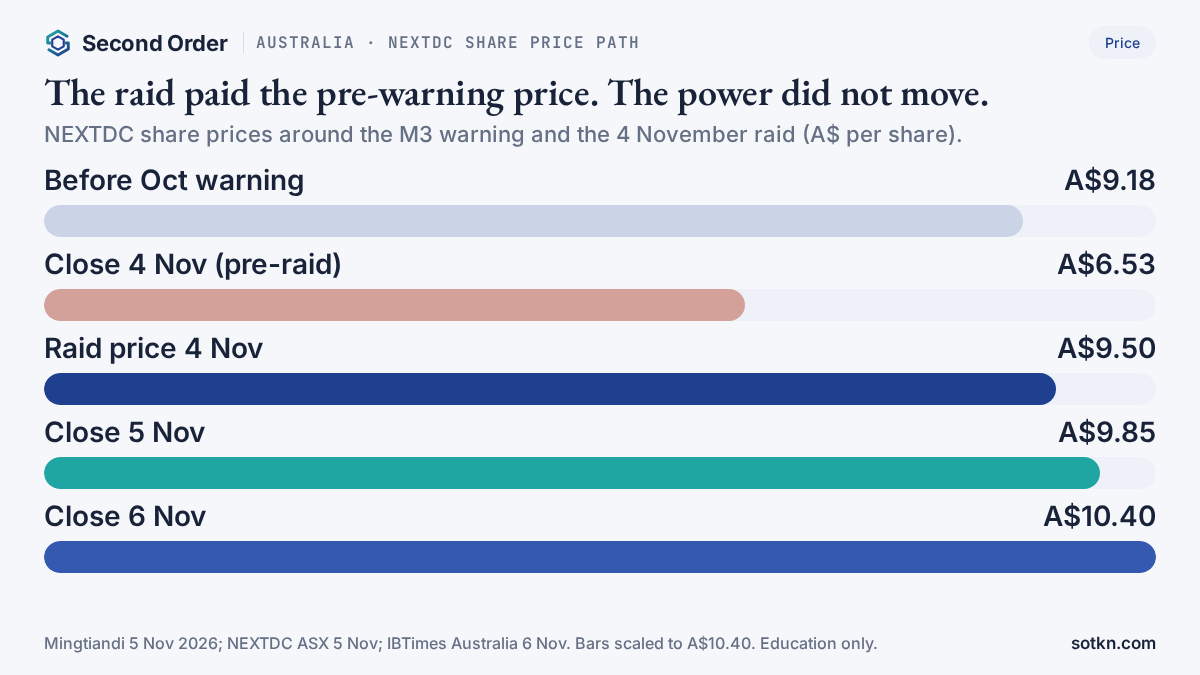
Start with four prices. A$9.18 is where NEXTDC last traded before its October profit warning, according to Mingtiandi. A$6.53 is where it closed on Wednesday 4 November, after losing almost half its value in October. A$9.50 is what the raiders paid. A$9.85 is where it closed on Thursday, up 50.8% in a day, and A$10.40 is where it closed on Friday, up another 55 cents on about 18.8 million shares traded.
The raid price was only about 3.5% above the pre-warning price (our arithmetic). In plain terms, the institutions that sold into the book got back roughly what the stock was worth before anyone outside the company knew Jemena had stopped work. The raiders, in turn, paid for the company as if the M3 delay had cost almost nothing in value — while the company itself had just taken about A$140 million of contracted revenue and EBITDA out of its FY27 guidance.
The market then went further than the raiders. By Friday’s close the stock was about 9.5% above A$9.50 (our arithmetic). That gap is the market pricing a chance of something more — a control proposal, a rival bidder, or a deal for assets — on top of the raid. None of those has been announced.
We asked in October what NEXTDC’s share price assumed about contracts that were signed but not yet billing (NEXTDC’s signed-not-billing stuck step). This week answered part of it from the outside: two builders were willing to pay a pre-warning price for a company whose billing date had slipped. They did not say why. The price is the only statement.
Why stop at 9.9%?
Three Australian lines sit near that number. The first is the substantial holder line at 5%: anyone who crosses it must lodge a notice within two business days, and again for every one-point move. That notice is how the market will learn the real fill. Two other 5% notices did land this week — JPMorgan from 3 November and Citigroup from 4 November — but both are dominated by securities lending positions, not by a new strategic owner.
The second is the foreign investment line. Under Australia’s rules a foreign person generally has to notify the Treasurer before acquiring a direct interest, usually 10% or more, in a business that counts as a national security business. The Foreign Investment Review Board’s own guidance says that can include a data centre that stores or processes business-critical data for governments. Digital Realty is a foreign company and owns half of Ackland. Analysts at Marcus Today read the 9.9% cap as a deliberate stop below that line. Neither Goodman nor Digital Realty has said so.
The third is the takeover line at 20%. Below it, a holder can buy shares without making a formal bid or a scheme. There is also a rule that matters for the next four months: if the same buyers launch a takeover bid within four months of buying shares, the bid has to be at least the highest price they paid. On Marcus Today’s reading, that makes A$9.50 the floor for any bid by this group until about early March 2027.
So the 9.9% buys a seat, a price floor and time, without triggering a foreign investment filing or a bid. It does not buy a board seat, a vote on the capex plan, or a single extra megawatt in Melbourne.
What do the raiders already own?
The raid landed on the same day Goodman published its first-quarter FY27 operational update. That document is the cleanest public picture of what one half of Ackland brings to the table.
Goodman said its global power bank had increased to 6.6 gigawatts, with 3.6 gigawatts of secured power. It had 0.5 gigawatts of data centre projects in work in progress at 30 September 2026, all with secured power connections and planning approvals, staged for delivery between early 2027 and 2030, with 1.3 gigawatts of potential expansion on the same campuses. Total development work in progress was A$19.7 billion across 51 projects, and data centres under construction were 79% of it. Yield on cost was 8.3%. Only 31% of work in progress was pre-committed, because, in Goodman’s words, the data centre workbook is primarily commenced before customer contracts are executed.
In Australia, the project in Goodman’s data centre table is SYD01, a 90-megawatt fully fitted data centre in the Macquarie Park availability zone in Sydney, with customer discussions expected to accelerate in early 2027 as construction moves toward first-phase ready-for-service. About 90% of Goodman’s data centre projects under construction are held in data centre or development partnerships, not on its own balance sheet.
Goodman’s chief executive framed the quarter as barriers to entry rising: strategic city sites are scarce, power is constrained, planning is complex, and funding needs are large. Read next to NEXTDC’s M3 problem, that is not an abstract claim. Goodman is saying its projects already have the power connection and the planning approval. NEXTDC’s Melbourne expansion has neither the next power step nor, for Stages 6 and 7, the planning permit.
Digital Realty is the other half. We covered its third quarter in October: record bookings, a backlog of signed leases waiting to start, and a 17-month gap between signing and billing (Digital Realty’s signed-not-billed backlog). Its Australian footprint is modest next to NEXTDC’s national network. A share in NEXTDC is a cheap way to sit closer to that network without building it. We looked at what Goodman’s own share price assumes about its power bank in October as well (Goodman’s power bank).
What has NEXTDC promised to say by 20 November?
On 21 October NEXTDC cut FY27 net revenue guidance to A$475–500 million from A$615–640 million, and underlying EBITDA guidance to A$245–265 million from A$385–410 million, by taking the affected M3 contracts out until it can reliably estimate them. It cut FY27 capex guidance to A$4.5–5.0 billion from A$5.25–5.75 billion. It put all new development projects and land acquisitions on hold for the foreseeable future.
It also made two promises with a date. The board committed to announcing the outcome of a detailed review of the capital expenditure program by the annual general meeting on 20 November 2026. And NEXTDC said it would provide further updates on M3, including at that meeting. Separately, the board said it would evaluate capital recycling opportunities, including the potential sale of selected development sites not required in the near term.
On 6 November NEXTDC moved the meeting from its own Artarmon offices to the Hilton in central Sydney, at the same time of 11:00am AEDT on 20 November, citing the level of interest. Visitors are asked to pre-register by 18 November. Two resolutions had already been withdrawn on 26 October.
That is the verdict the raid now hangs on. It will say which projects keep their funding, which are deferred, whether any sites are put up for sale, and what NEXTDC can say about the M3 customer. On that last point, the 21 October release was blunt: the M3 contracts provide for service level credits when capacity is late or not fully powered, and in some circumstances give the customer rights to terminate. NEXTDC is considering whether force majeure relief is available.
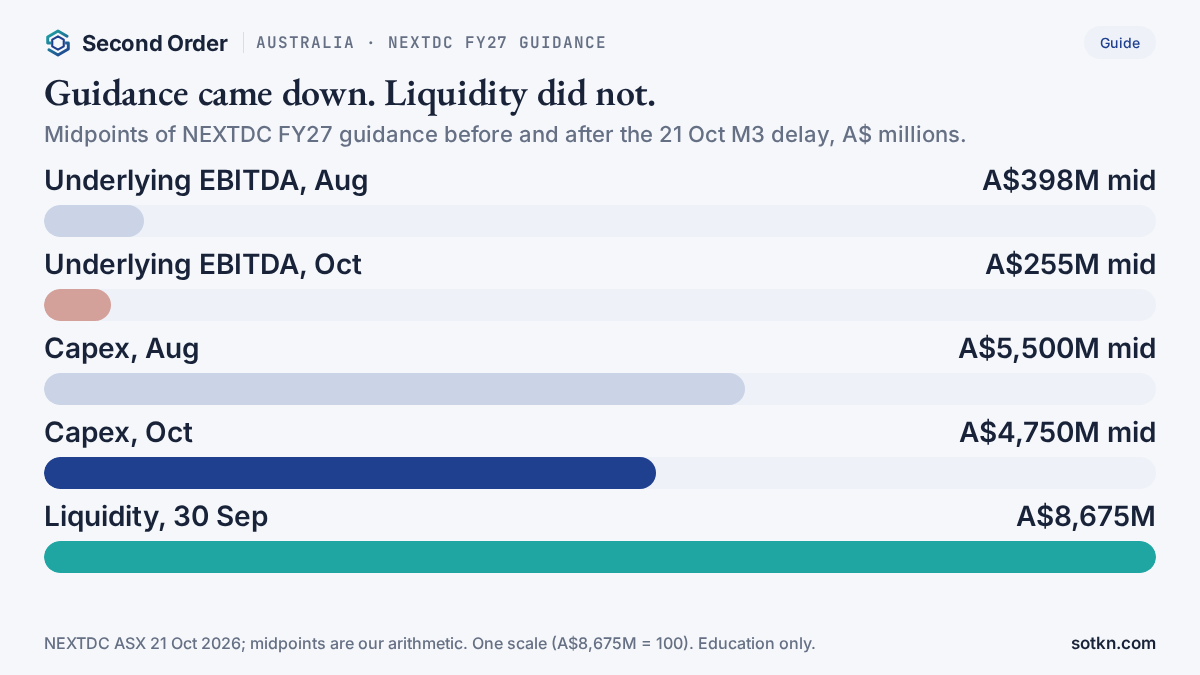
NEXTDC FY27 guidance, revised 21 Oct 2026
NEXTDC ASX release 21 Oct 2026. Ranges as published.
What do the numbers say?
Share count first. Citigroup’s notice put 38,061,439 shares at 5.0040% of the vote, which implies about 760.6 million NEXTDC shares on issue (our arithmetic). On that count, a full 9.9% is about 75.3 million shares, or about A$715 million at A$9.50, which matches the term-sheet figure. The 57.25 million shares reported by the AFR are about 7.5% of the company and about A$544 million of cash. If Ackland stopped there, about 18 million shares, roughly A$171 million, separate the reported fill from the cap (all our arithmetic).
Market value next. At A$6.53 the company was worth about A$5.0 billion; at A$10.40 about A$7.9 billion. Two trading sessions added about A$2.9 billion of market value (our arithmetic). That is more than five times what the raiders are reported to have spent.
Paper gain. On 57.25 million shares, the 90-cent move from A$9.50 to Friday’s A$10.40 is worth about A$51.5 million to Ackland, split evenly between Goodman and Digital Realty (our arithmetic). The same sum is what the selling institutions left on the table by Friday.
Earnings multiple. At A$7.9 billion of market value and the A$255 million midpoint of revised FY27 underlying EBITDA, the shares trade at about 31 times this year’s guided EBITDA on equity value alone, before any debt (our arithmetic). That multiple does not price FY27. It prices the contracted capacity that arrives after the power does, plus a takeover option.
Liquidity against the raid. NEXTDC had A$8,675 million of liquidity at 30 September. A full 9.9% stake at A$715 million is about 8% of that figure (our arithmetic). The raid did not touch NEXTDC’s cash at all — the money went to the selling institutions — which is exactly why the board can call it opportunistic: the company got a new strategic shareholder and not a dollar of capital.
Goodman’s scale. Data centres under construction at 79% of A$19.7 billion is about A$15.6 billion of end value across 0.5 gigawatts, or roughly A$31 million of end value per megawatt under construction (our arithmetic; Goodman values work in progress at estimated end value). Goodman’s half of a A$544 million stake is about A$272 million, under 2% of that data centre work in progress (our arithmetic). For Goodman, this is a small cheque for a seat at the table.
For context on how long these halls take and what they cost before a single rack bills, see the Explained layer (how long it takes to build an AI data center; how much it costs; why contracted power is not revenue yet).
Who gets paid while the verdict waits?
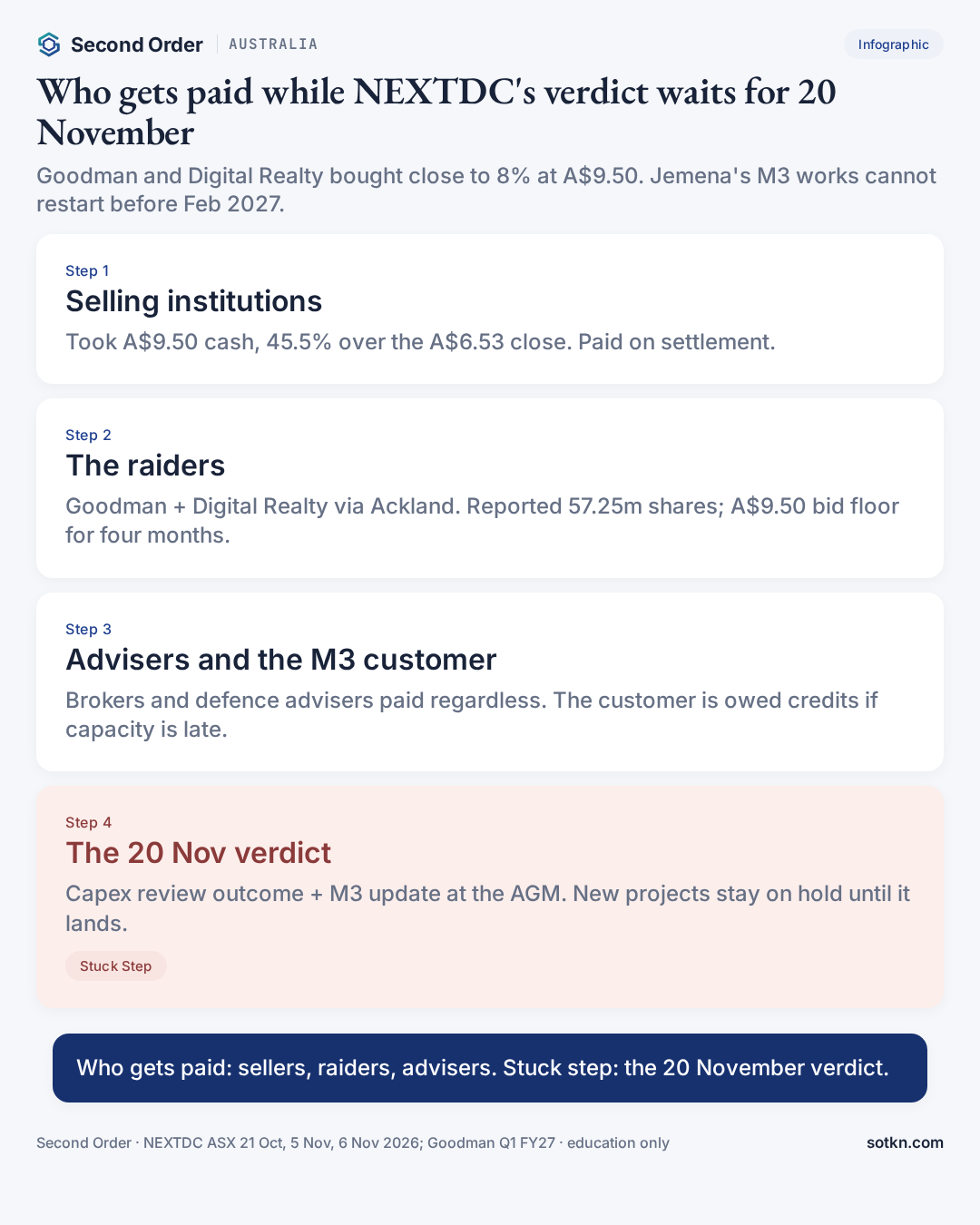
1 · Selling institutions
Who: Sold into the book at A$9.50, 45.5% over the close
Paid: Cash on settlement
2 · The raiders
Who: Close to 8% reported; A$9.50 bid floor for four months
Paid: ~A$51.5m paper gain by Friday (our arithmetic)
3 · The advisers
Who: JPMorgan for the buyers; Barrenjoey, UBS, Cadence, Mallesons for the board
Paid: Fees not disclosed
4 · The M3 customer
Who: Service level credits when capacity is late; some termination rights
Paid: Owed by NEXTDC, not yet quantified
5 · The verdict
Who: Capex review outcome + M3 update at the 20 Nov AGM
Paid: New projects stay on hold until it lands
First, the selling institutions. They took A$9.50 in cash for shares that had closed at A$6.53. They are the clearest winners of the week — even though, by Friday, the market price had run past them.
Second, the raiders. Ackland holds a reported stake of close to 8%, worth more on Friday than it paid, and a four-month window in which any bid from the same group cannot go below A$9.50. As holders they can vote on whatever resolutions remain at the AGM. They also get optionality on the sites NEXTDC has said it might sell. Nobody has said Ackland will bid for those sites; it is the obvious buyer if they come to market.
Third, the advisers. JPMorgan ran the book for the buyers; Barrenjoey, UBS, Cadence Advisory and Mallesons are on NEXTDC’s side. No fees are disclosed. They are paid whether or not anything else happens.
Fourth, potentially, the M3 customer. NEXTDC has said the M3 contracts provide for service level credits when capacity is delivered late or not fully powered. Those credits flow from NEXTDC to the customer and could take underlying EBITDA below the revised guidance. The customer also has termination rights in some circumstances. NEXTDC has not quantified any of it.
Fifth, potentially, lawyers. The Age reported on 6 November that Gordon Legal is examining claims for shareholders who bought between 31 August and 21 October, and that Shine Lawyers has opened a separate class-action investigation. These are investigations, not filed claims. NEXTDC declined to comment on them.
Who waits. Retail shareholders, who were not offered A$9.50. The M3 customer’s contracted capacity, waiting on Jemena. Every uncontracted NEXTDC project and land deal, now on hold. Contractors and equipment suppliers who were lined up for those projects. And Melbourne as a market: the Stages 6 and 7 permit is not expected until 2027. Across Australia, the same power-first pattern runs through our October Pulses (NSW’s power condition; who pays for the wires at Kurri Kurri; AirTrunk’s loan waiting on power-on).
What is stuck, exactly?
The stuck step is the 20 November verdict. Until NEXTDC announces the outcome of its capex review and updates the market on M3, nobody — not the raiders, not the remaining shareholders, not the customer — knows which projects keep their funding, which sites might be sold, and how the M3 contracts are being handled.
Behind the verdict sits the physical bind. Jemena suspended parts of the 66kV line augmentation works for M3 in September 2026 and has formally told NEXTDC it does not expect to restart them before February 2027. NEXTDC now expects the next increase in grid supply at M3 during FY28. Later increases depend on new transformers at the Brooklyn Terminal Station, which NEXTDC now expects later than planned. The planning decision on M3 Stages 6 and 7 waits for the 28 November Victorian election and is now expected in 2027.
It is not the money. NEXTDC had A$8.7 billion of liquidity at 30 September and said it was in compliance with its covenants. It is not the halls: construction of the M3 data halls is continuing inside the existing buildings. It is not demand: the capacity remains under contract, subject to the customer’s rights. And it is not the raid itself, which settled overnight. The step that has not moved is the decision about what to build while the line is paused.
One more detail tightens the clock. NEXTDC’s interest cover covenant lets it count the annualised EBITDA of new customer contracts expected to start billing within 24 months of each test date. The next test date is 31 December 2026. On our read, an M3 power step that stays inside FY28 still sits inside that window; a further slip would start to press on it. NEXTDC itself said a material change to billing profiles could affect its ability to draw senior debt.
This is the same shape we keep seeing across AI infrastructure: the party that owns the slow step does not get paid on time, while the parties around it are paid on their own clocks (where the stuck step moves; capex vs depreciation; free cash flow).
Which dates test the read?
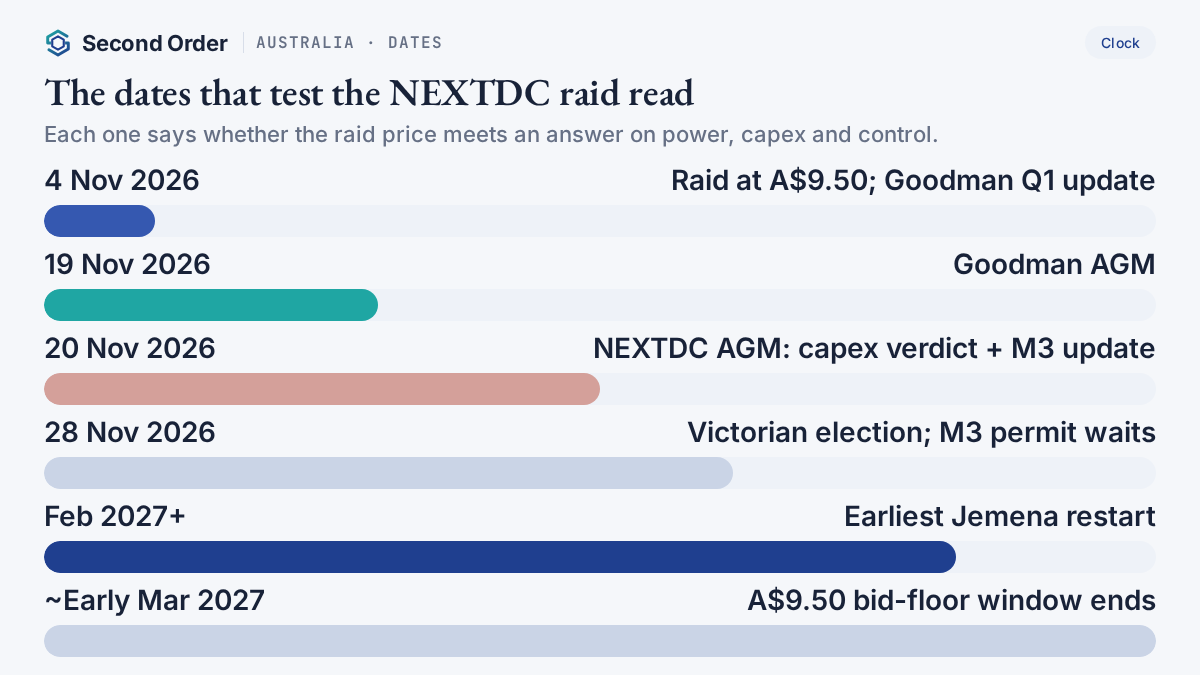
Dates from NEXTDC ASX releases 21 Oct and 6 Nov 2026, Goodman notice of meeting 19 Oct 2026, and the four-month rule as read by Marcus Today. The half-year result month is our expectation, not a published date.
How does this compare with Singapore and Malaysia?
Singapore’s recent stories are about financed halls waiting on a design study or a land lease, not on a power line that residents blocked (DayOne’s VPP waits on FEED; Digital Core’s SIN12 land lease). Malaysia’s is about checking water before power on new applications (Malaysia’s water check). Australia’s twist this week is that the market found a price for a power-delayed operator before the operator found its own answer.
Inside Australia, the October map still holds: Sydney power sold out and leased in long blocks, funding getting dearer, and permits sorting the pipeline (Sydney’s 71 MW lease; AI data centre money gets dearer; permits sort the pipeline). Macquarie Technology, the other listed Australian operator, is a useful comparison for sovereign and government workloads (what Macquarie Technology does).
How we check this. The raid terms, the buyers’ statement and the board’s response come from NEXTDC’s 5 November ASX release. The M3 power delay, the revised FY27 guidance, liquidity, covenants and the promise of a capex verdict by the 20 November AGM come from NEXTDC’s 21 October ASX release. The AGM date and venue come from NEXTDC’s 6 November release. Goodman’s power bank, work in progress and AGM date come from its 4 November quarterly update and its notice of meeting. Share prices and the reported 57.25 million shares come from Mingtiandi and IBTimes Australia; the class-action investigations from The Age. Every sum we worked out is labelled “our arithmetic”. Price targets and ratings are left out on purpose. The references we used are listed at the end. Our editorial standards →
FAQ
What happened to NEXTDC on 4 and 5 November?
After the market closed on Wednesday 4 November, Ackland Investments No.1, a trust owned in equal shares by Goodman Group and Digital Realty, ran an aftermarket book build to buy NEXTDC shares at A$9.50, up to a maximum holding of 9.9%. That price was 45.5% above Wednesday's A$6.53 close. NEXTDC told the market on Thursday that it did not know the outcome, that its board saw the move as opportunistic, and that it held no takeover proposal. The shares closed Thursday at A$9.85 and Friday at A$10.40.
Did Goodman and Digital Realty make a takeover bid?
No. Through their broker they told investors they had no intention of submitting a control proposal or making a takeover bid at this time, but reserved the right to do so. NEXTDC said any bona fide approach would be judged on its merits.
Why does 20 November matter?
NEXTDC's board committed on 21 October to announce the outcome of a detailed review of its capital expenditure program by its annual general meeting on 20 November 2026, and to give further updates on the Melbourne M3 power delay there. Goodman's own AGM is the day before. That is the first scheduled point where the market can see what NEXTDC keeps building while Jemena's power works stay suspended.
What is the stuck step?
The 20 November verdict. Jemena does not expect to restart the suspended 66kV works before February 2027, so the M3 power step sits in FY28. Until NEXTDC says which projects keep funding, which sites it might sell, and how the M3 customer contracts are being handled, the raid price is a bet on an answer that has not been given.
Is this investment advice?
No. Education only. It maps who gets paid and which step is stuck. It is not a recommendation to buy or sell any security, and we leave out price targets and ratings on purpose.
References
Outbound links below are nofollow. We list only the sources actually used. Internal sotkn.com links in the body are separate.
- NEXTDC, Response to Share Raid by Goodman Group and Digital Realty (ASX release), 5 Nov 2026. announcements.asx.com.au — Ackland Investments No.1 ownership, the 4 November book build at A$9.50 up to 9.9%, the buyers' no-bid-at-this-time statement, the board's 'opportunistic' view and the defence advisers.
- NEXTDC, M3 Melbourne Power Delay and Revised FY27 Guidance (ASX release), 21 Oct 2026. announcements.asx.com.au — Jemena's suspended 66kV works, the FY28 power step, revised FY27 revenue, EBITDA and capex, liquidity, covenants, service level credits and the capex review due by the 20 November AGM.
- NEXTDC ASX announcements: Change of Venue – FY26 Annual General Meeting, and Citigroup Form 603 notice of initial substantial holder, 6 Nov 2026. asx.com.au — the 20 November 11:00am AEDT AGM, the move to a larger Sydney venue and visitor pre-registration; and Citigroup's 38,061,439 shares equal to 5.0040% voting power, used for our share-count arithmetic.
- Goodman Group, Q1 FY27 Operational Update (ASX release), 4 Nov 2026. goodman.com — the 6.6 GW power bank with 3.6 GW secured, A$19.7 billion WIP with data centres at 79%, 0.5 GW of data centre projects in WIP, 31% pre-commitment and SYD01's 90 MW.
- Goodman Group, Notice of Annual General Meetings, 19 Oct 2026. asx.com.au — the 19 November 2026 10:00am Sydney AGM date.
- Foreign Investment Review Board, Guidance Note 8: National security, 2026. foreigninvestment.gov.au — mandatory notification for a foreign person acquiring a direct interest in a data centre that stores or processes business-critical government data.
- Mingtiandi, NextDC Shares Jump 51% as Goodman, Digital Realty Buy Stake, 5 Nov 2026. mingtiandi.com — the A$6.53 prior close, the A$715 million term-sheet value, the A$9.85 close, the 57.25 million shares reported by the AFR and the disclosed substantial holders.
- IBTimes Australia, NextDC Shares Extend Rally Above A$10, 6 Nov 2026. ibtimes.com.au — the Friday close of A$10.40, the session range and the roughly A$7.9 billion market value.
- The Age, Data centre behemoth NextDC facing two class actions – and a potential takeover, 6 Nov 2026. theage.com.au — the Gordon Legal and Shine Lawyers class-action investigations, the 31 August to 21 October window and the Yarraville pole works.
- Marcus Today, A NEXTDC takeover, or just a raid?, 6 Nov 2026. marcustoday.com.au — the reading of the 9.9% cap against the 10% foreign investment line and the four-month minimum bid price rule.
Not investment advice. Do your own research. Education only. Map of who gets paid and which step is stuck — not a buy list.
More on this desk: Australia Markets · AI Data Centers · all Markets · Equinix · Malaysia Markets · today’s Wire.