
550 MW at an Old Smelter: Who Gets Paid as NSW Makes Data Centres Pay for the Wires
AirTrunk wants 550.5 MW on the old Kurri Kurri smelter site. On 23 October NSW's law letting the state charge data centres for grid upgrades got assent. Builders and the grid get paid first; the connection contract is the step that is stuck.

Who pays for the wires at Kurri Kurri is now a question with a law behind it. AirTrunk's 550.5 MW data centre on the old Hunter smelter site went on public exhibition on 14 October, and on 23 October the NSW law that lets the state charge data centres for grid upgrades received assent. Builders, equipment makers and the grid get paid first. The tenant waits. The stuck step is the connection contract, which is being written before the rules that will price it are final.
AUSTRALIA · AI DATA CENTERS · Exhibition 14 Oct to 11 Nov 2026 · Act assented 23 Oct 2026 · Next update: submissions close 11 November 2026
Affects: AI Data Centers · Hyperscalers · Neoclouds — Markets: Australia · Singapore · Malaysia · US
Education only, not advice to buy or sell any security. Figures are as filed in the planning application or published by the NSW Government unless labelled as our arithmetic. Proposed fees are proposals until the regulation is made.
The numbers that matter this week
Total power consumption
550.5 MW
Maximum demand · 352.4 MW of it IT load
FiledEstimated development cost
A$3.7B
A$3,775,341,634 in the council offer
FiledFlexible load offered
150 MW
Cut or shifted for 2 hours · 28% of forecast load
FiledPublic exhibition
To 11 Nov
Opened 14 Oct · council objection voted 21 Oct
DatedProposed upgrade fee
A$100k–200k/MW
Default rates in the August paper · not yet law
ProposedThe connection contract
The bind
Being finalised as the Act's rules are written
Stuck stepFigures from the Kurri Kurri Data Centre environmental impact statement and AirTrunk's draft planning agreement offer (SSD-128819490), the NSW energy department's August 2026 consultation paper and the NSW Parliament bill page. Status chips are Second Order’s read.
On this page: Why it matters · What changed · The site · The rules · The money · The scale · The council · Elsewhere · Our math · Who gets paid · What is stuck? · Dates next · What would change this · FAQ
Why does one Hunter data centre matter for Australia's AI power map?
Because it is the first big test of a new deal in New South Wales: data centres can build, but they pay for the grid they need. Sydney has run out of easy power. The state's energy department says more than 90% of the NSW data centre pipeline wants to connect in the Sydney, Newcastle and Wollongong region, and that in July 2026 Transgrid told developers there will be no transmission capacity for new connections in Western Sydney until Sydney Ring South, a project it now places in 2033/34.
So the megawatts are starting to move out of the city. Kurri Kurri is the clearest example on the planning portal right now. It is a single 550.5 MW application on an industrial site in the Lower Hunter, next to a 750 MW gas power station and under an existing 132 kV line. If a project this size can get approved and connected under the new rules, it shows other developers the route. If it stalls, it shows them the price.
The timing makes it sharper. The application was prepared against the NSW Data Centre Guidelines issued in August, and its exhibition overlapped with the law that turns part of those guidelines into enforceable rules. The Electricity Infrastructure Investment Amendment Bill 2026 passed Parliament on 14 October and received assent on 23 October as Act No. 41 of 2026. The regulation that sets the actual charges is still to be made.
This piece is distinct from our recent Australia coverage. Our 10 October Pulse followed two approved Sydney halls that cannot switch on until their power is matched with new renewable supply. Our 17 October Pulse covered Sydney selling out of new grid connections, and our 20 October and 22 October pieces followed NEXTDC's Melbourne power delay. This one is about the bill for the wire. For what makes an AI hall different, see what an AI data center is, and for why sites follow the grid, where AI data centers are located.
1 · The builders
Who: Contractors, electrical and mechanical trades, equipment makers
Paid: 14-month fit-out · peak workforce 1,210 · 308 power train units
2 · The network
Who: Ausgrid, and the state's grid fund under the new Act
Paid: Connection works funded by the developer · proposed bond and upgrade fee
3 · New generation
Who: Wind, solar and storage projects in NSW not yet at final investment decision
Paid: Ten-year power purchase and firming deals · at least 40% wind
4 · The connection contract
Who: AirTrunk and the network, under rules still being written
Paid: Fee, bond and minimum charges decide the price of the wire
What changed between August and 26 October?
Read in order, the documents take NSW from a policy promise to a law, and Kurri Kurri from a request for assessment requirements to a public fight.
- 16 June and 14 July — the request. The project asked the planning department for its environmental assessment requirements on 16 June. They were issued on 14 July 2026.
- 17 August — the framework. The NSW Government announced its Data Centre Policy Framework. Projects that meet the new guidelines get a promise of assessment within 75 days in state hands. The second pillar: regulatory changes so that data centres pay for the network upgrades they need. The release counted 19 data centre projects worth A$50.3 billion in the state significant development pipeline.
- August — the price list, proposed. The energy department's consultation paper set out ten proposals, among them a A$30,000 per MW entry bond, guaranteed minimum network charges, and a Major Network Upgrade Fee with default rates of A$200,000 per MW in Sydney, Newcastle and Wollongong and A$100,000 per MW elsewhere. Submissions closed on 14 September.
- 31 August — the requirements, amended. The planning department amended Kurri Kurri's requirements so the application had to address the new guidelines.
- 14 October — exhibition opens, and the Bill passes. The impact statement went on public exhibition, with submissions closing on 11 November. The same day the Legislative Assembly agreed to the upper house amendment, and the Bill passed Parliament.
- 21 October — the council objects. Cessnock City Council voted unanimously to lodge an objection, and asked for a national pause on data centre approvals until federal rules are in place.
- 23 October — assent. The Electricity Infrastructure Investment Amendment Act 2026 received assent. The rules now need a regulation to bite.
None of this is a decision on Kurri Kurri. The project is at the exhibition stage, with response to submissions, assessment, recommendation and determination still ahead. What changed is the frame around it: the price of connecting a big data centre in NSW is moving from a private negotiation to a public rule.
What exactly is AirTrunk asking for at Kurri Kurri?

The application is narrower than the headline number suggests. The two-storey building shell, with a gross floor area of 47,143 square metres, was approved separately under a complying development certificate. The state significant application asks for permission to fit it out and run it as a data centre, with 32,297 square metres of technical data hall space. The planning application names a Hunter planning consultancy, ADW Johnson, as proponent. AirTrunk is the company behind it: the draft planning agreement offer in the same file comes from AirTrunk Operating Pty Ltd.
The power numbers are set out in one table. The maximum instantaneous demand is 550.5 MW: 352.4 MW of IT load, 165.6 MW for the cooling system and 32.5 MW for supporting infrastructure and losses. That is a worst case, with everything running flat out at once. The annualised design power usage effectiveness is modelled at 1.299. The building is designed for high-density compute, including AI training, with servers installed progressively by a tenant who is not named.
The grid design is the part that matters for this story. Ausgrid's planning study advised that the connection will be made at 132 kV, through a sub-transmission switching station built on the site to Ausgrid's requirements. New overhead feeders will tie into the existing 132 kV Ausgrid line that already crosses the south-western corner of the site, the former Hydro Aluminium smelter that ran there from 1969 until 2012. The site is fed by four 300 MVA supplies, any two of which can run it. The impact statement says no augmentation of the transmission network is proposed.
Backup is deliberately thin. Short-duration batteries carry the IT load for six minutes, and only six 2 MW diesel generators back up the core network, because AI training loads are less uptime-critical than a conventional colocation hall. The cooling is dry, using air-cooled chillers, so the site needs no water for cooling, which removes one of the fights that has slowed data centres elsewhere (our explainer on AI data center water use has the detail).
So the site has the line, the land and a gas plant next door. What it does not yet have is a signed connection contract.
What do NSW's new rules ask of a data centre like this?
There are two layers. The first is the guidelines, which are a planning test. The second is the new Act, which lets the state turn the energy parts of that test into network rules with money attached.
The guidelines have 17 performance measures under six principles, among them no net cost to consumers and communities, and funding additional supply of water and energy. Three measures matter most for the wire. Measure 9 asks a data centre to show it can cut grid-supplied demand by 25% of its forecast average load for up to two hours, without using diesel generators. Measure 10 asks for commercial arrangements with the energy utility that protect other customers if assets built for the data centre end up stranded, through prepayments, take-or-pay terms, upfront capital or guarantees. Measure 13 asks for power purchase and firming agreements with new NSW renewable projects: at least 40% wind, storage of at least 25% of generation capacity for four hours, terms of at least ten years, projects not yet at final investment decision, and contracted supply equal to annual average demand from the fourth year of operation.
Kurri Kurri's own scorecard is candid. Of the 17 measures, the impact statement says 12 are achieved, four can be met subject to commercial and procurement arrangements being finalised, including measure 10 on stranded assets and measure 13 on renewable power, and one needs forecast energy and water data to be provided on a commercial-in-confidence basis. On flexibility it goes beyond the floor: the Ausgrid connection arrangement includes a 150 MW flexible load component, which the statement puts at 28% of the site's total forecast load, against the 25% required.
The money layer comes from the energy department's August paper. It proposed that the regulation cover data centres with a connection of 15 MW or more. Applicants would post an entry bond of A$30,000 per MW of requested capacity, to discourage speculative and duplicate applications. Network businesses would require guarantees that data centres pay for the capacity made available to them whether they use it or not, for example minimum network charges for ten years. And a Major Network Upgrade Fee would be paid into the state's Electricity Infrastructure Fund just before a connection agreement is signed, charged on rated capacity less any flexible capacity. The default rate would be A$200,000 per MW in the Sydney, Newcastle and Wollongong region and A$100,000 per MW elsewhere, until the state's Consumer Trustee sets the final rate.
Two details favour a site like Kurri Kurri. The guidelines say data centres outside the Sydney Ring should expect smaller contribution obligations, because many regional locations have more grid capacity. And the upgrade fee rewards flexibility directly, because flexible megawatts are taken off the charge. The impact statement places Kurri Kurri in the Hunter, outside the Sydney Ring. The consultation paper we read does not spell out whether the Lower Hunter counts as part of the higher-rate region, so we show both rates below.
What could the wire cost?
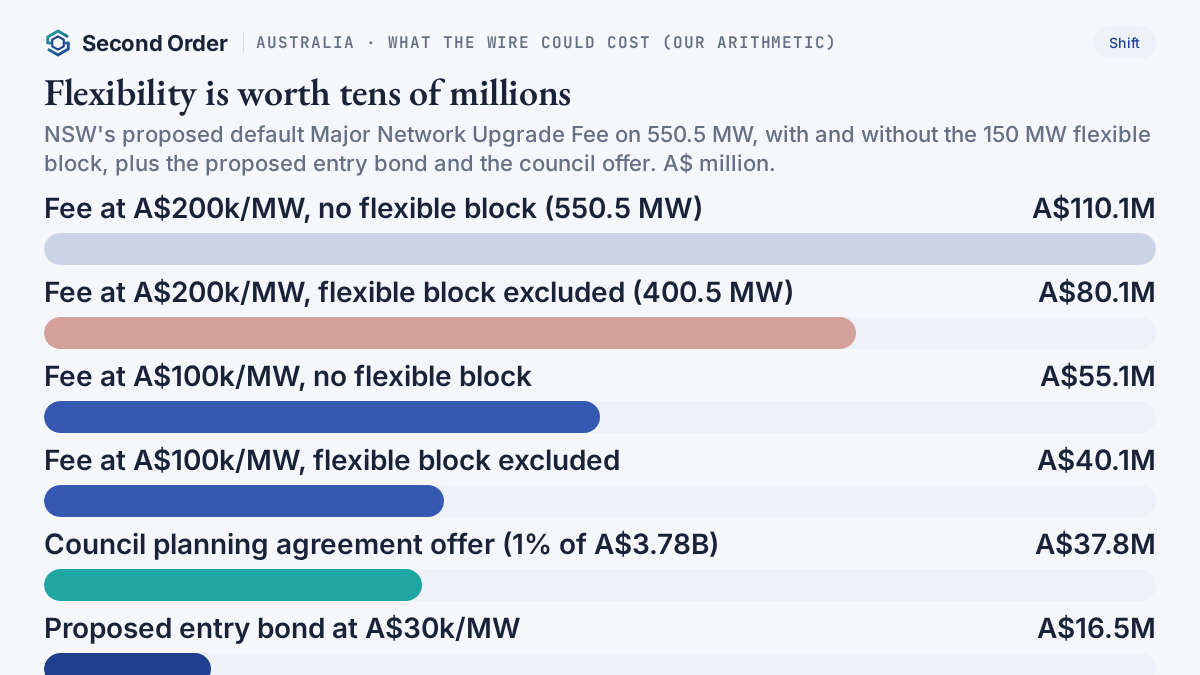
These are illustrations on proposed rates, not a bill. With that caveat, the arithmetic is simple. At A$200,000 per MW on the full 550.5 MW, the upgrade fee would be about A$110.1 million. Take the 150 MW flexible block off, as the proposal allows, and the charge falls to about A$80.1 million on 400.5 MW. At the A$100,000 per MW rate for the rest of the state, the same two cases come to about A$55.1 million and A$40.1 million. All of that is our arithmetic.
Two more numbers sit beside it. An entry bond at A$30,000 per MW on 550.5 MW would be about A$16.5 million, if the bond were to apply to this application at all; the impact statement says the connection contracts are already being finalised, and the transition rules are not set out in the paper. And AirTrunk's draft offer to Cessnock council is 1% of an estimated development cost of A$3,775,341,634, about A$37.8 million on our arithmetic, for district sporting and community facilities in Loxford.
Set against the project, none of these is large. The highest fee case is about 3% of the A$3.7 billion development cost, and the flexible block alone is worth about A$30 million at the higher rate or A$15 million at the lower one, on our arithmetic. The point is not that the fee could sink the project. It is that the fee, the bond and the minimum charges all land at one moment: the signing of the connection contract. That is where the money for the wire is fixed.
For how a hall's cost stacks up before any tenant pays rent, see how much it costs to build an AI data center and who lends before the rent.
How big is 550 MW in New South Wales?

Big for one site, small against the queue. The energy department says average daily electricity demand in NSW typically runs between 7.5 GW and 10 GW. Kurri Kurri's maximum demand of 550.5 MW is about 5.5% to 7.3% of that range on our arithmetic, and about three-quarters of the 750 MW gas peaking plant immediately to its north. That plant, run by Snowy Hydro, was approved in December 2021 and is expected to be fully commercially operational by late 2026, according to the project's economic assessment.
The queue is the real comparison. As of July 2026, data centres were seeking NSW network connections with a total capacity of up to 28 GW, and about 13 GW of that was in advanced discussions. Transgrid has signed agreements to connect around 1.5 GW of data centre demand to its network, with another 8 GW in advanced discussions. At the same time, about 7 GW of coal-fired generation is expected to leave the system by 2033, starting with Eraring in 2029. Kurri Kurri is one 550 MW slice of that 28 GW, about 2% on our arithmetic.
What does the council objection change?
Less than the headlines suggest, but not nothing. Cessnock City Council is not the consent authority: as a state significant development, Kurri Kurri is decided by the NSW planning system. The council's motion, passed unanimously on 21 October, directs its general manager to lodge an objection through the planning portal before 11 November. As reported, it cites 24-hour noise including low-frequency noise from air-cooled plant, heavy demand on the grid and local power infrastructure, and traffic during construction. An amendment asks the federal government for a national pause on data centre approvals until federal rules are adopted.
In practice, the objection feeds into the response-to-submissions stage, which comes before assessment, the stage where the state's 75-day promise applies. The more issues raised, the more the proponent has to answer. The council also sits on the other side of the planning agreement: AirTrunk's offer of about A$37.8 million is addressed to it, and is made subject to approval on acceptable terms and the start of the data centre development.
How does this compare with Malaysia, Texas and Singapore?
NSW is not alone in making data centres pay for capacity. In Malaysia, our 17 October Pulse followed the minister's line that data centres pay for booked but unused power. In the US, our Texas Pulse covered a large-load rule that shifts connection costs onto big users, and the NSW guidelines themselves cite Texas Senate Bill 6. In Singapore, our Pulse earlier today followed a different bind: new halls that must run on green fuel that is not yet flowing.
The pattern is the same in each place. The scarce thing is no longer land or demand. It is a grid connection with a known price and a known date, and governments are now deciding who carries the risk between the request and the first bill.
Our math: what do the numbers say?
Kurri Kurri, as filed
NSW proposals (August 2026, not yet law)
- IT share: 352.4 MW of 550.5 MW is about 64%; cooling about 30%; other about 6% (our arithmetic).
- Upgrade fee: 550.5 MW at A$200,000 is about A$110.1 million; 400.5 MW after the flexible block about A$80.1 million (our arithmetic).
- Upgrade fee at the lower rate: about A$55.1 million on 550.5 MW, about A$40.1 million on 400.5 MW (our arithmetic).
- The flexible block's value under the fee: about A$30 million at the higher rate, A$15 million at the lower (our arithmetic).
- Entry bond: 550.5 MW at A$30,000 is about A$16.5 million, if it applied (our arithmetic).
- Council offer: 1% of A$3,775,341,634 is about A$37.8 million (our arithmetic).
- Biggest fee case against cost: A$110.1 million is about 3% of A$3.7 billion (our arithmetic).
- Cost per MW: A$3.7 billion over 550.5 MW is about A$6.7 million per MW of total power, or about A$10.5 million per MW of IT load (our arithmetic).
- Scale: 550.5 MW is about 5.5% to 7.3% of NSW's 7.5 to 10 GW average daily demand, and about 2% of the 28 GW queue (our arithmetic).
- Pipeline share: A$3.7 billion is about 7% of the A$50.3 billion in the state significant data centre pipeline counted in August (our arithmetic).
Who gets paid first?

First, the builders and equipment makers — once there is consent. The plan calls for 308 power train units, 308 transformers, two on-site 132/33 kV substations and a switching station, all inside a 14-month programme with a peak of 1,210 workers and about 470 a day on average. The economic assessment puts direct construction activity at A$1,847.9 million of output in NSW. This is money spent before any tenant pays rent.
Second, the network — before the power flows. The connection is to Ausgrid's 132 kV line, and the switching station is designed to Ausgrid's requirements. AirTrunk has said it will pay for its own grid connection. Under the new Act, the state's Electricity Infrastructure Fund would also collect the proposed bond and upgrade fee, and network businesses would hold guarantees of minimum charges. All of this is paid or pledged before a megawatt of AI load is billed.
Third, new generation — by contract. The project commits to 100% renewable energy matching by 2030 through long-term power purchase and firming agreements with new NSW projects, at least 40% wind, with four-hour storage at not less than 25% of generation capacity and terms of at least ten years. The impact statement says the developer is talking to renewable developers in the Hunter and across NSW. Those deals are not signed yet; they are one of the four measures still subject to procurement.
Fourth, the community — on conditions. The council offer of about A$37.8 million is payable only after approval on acceptable terms and once the data centre development starts. The operating jobs, 254 full-time equivalent, start when the halls run.
Fifth, the landlord and its tenant — last. The tenant installs servers progressively, and rent on a hall like this usually starts when the power does, as our data center lease explainer sets out. Australian peers such as NEXTDC and Macquarie Technology, and global landlords like Digital Realty, face the same order: capital out first, rent once the grid delivers.
One-line rule: at Kurri Kurri, the builders and the grid are paid before the tenant. The new Act adds a line to the network's side of the ledger. The stuck step is the contract that fixes it.
So what is the stuck step?
The connection contract: the agreement with the network that fixes when Kurri Kurri gets its power, what it pays for the wire and what it guarantees in return. Not land: the site is zoned, remediated and already has a building approval. Not the line: a 132 kV line already crosses the site. Not demand: the application is built for AI training. Three things make the contract stick:
- The rules are law but not yet priced. The Act received assent on 23 October. The bond, minimum charges and upgrade fee exist only as August proposals until the regulation is made, which the department intended for 2026. A contract signed before then has to guess, or wait.
- The guideline scorecard is not finished. Four of 17 measures, including the stranded-asset protections and the renewable deals, depend on commercial arrangements still being finalised. The 75-day assessment promise applies to projects that meet the measures.
- The planning clock has not started. Exhibition runs to 11 November, the council will object, and the proponent must respond to submissions before assessment begins. Construction is anticipated from early 2027, which puts a full 14-month programme into 2028 at the earliest, on our arithmetic.
So-what: in NSW the scarce thing for a regional AI data centre is not power on the line. It is a signed, priced right to use it. Kurri Kurri has the line, the land and a flexible design that the new rules reward. What it needs is the contract, and the contract now runs through a regulation that is not yet written.
Which dates test this read next?
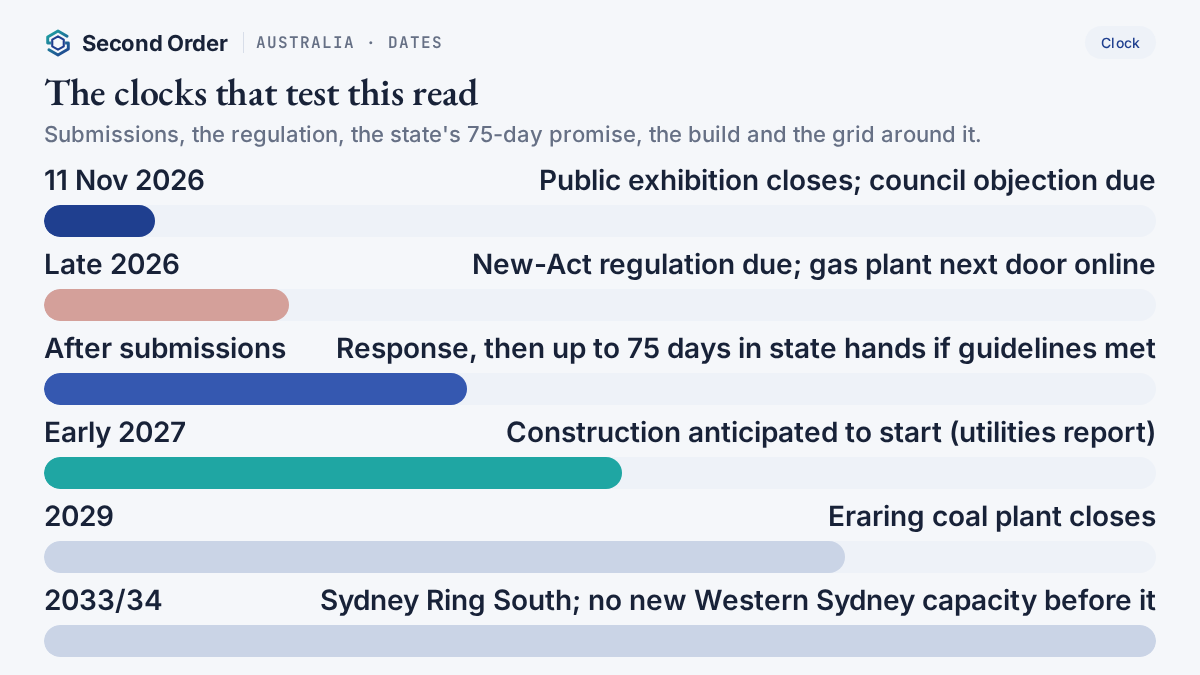
- 11 November 2026 — public exhibition closes and Cessnock council's objection is due. The test: how many issues the proponent has to answer, and whether power is among the main ones.
- Late 2026 — the regulation under the new Act, which the energy department intended to make in 2026, and the gas peaking plant next door reaching full commercial operation. The test: the final bond, minimum-charge and fee terms, and which rate applies to the Lower Hunter.
- After the response to submissions — assessment, with a promise of up to 75 days in state hands for projects that meet the guidelines. The test: whether Kurri Kurri gets the fast lane or the normal one.
- Early 2027 — construction anticipated to start, per the utilities report. The test: whether the connection contract and the renewable deals are signed by then.
- 2029 — Eraring, the next coal plant due to leave the market, closes. The test: whether new generation and the Hunter Transmission Project keep pace with new large loads.
- 2033/34 — Sydney Ring South, the date Transgrid gives for new Western Sydney capacity. The test: whether regional sites like Kurri Kurri win the AI load that Sydney cannot connect before then.
What would change this view?
- The connection contract is signed and disclosed before the regulation — the contract would have bound less than it looks.
- The final regulation drops or sharply cuts the upgrade fee or the minimum charges — the price of the wire would matter less.
- The planning department refuses the project or adds heavy conditions on noise or power — consent, not the contract, would be the main bind.
- A named tenant pulls out, or the halls fit out far below 550.5 MW — demand, not the wire, would become the question.
Practical takeaways
- AirTrunk's Kurri Kurri Data Centre asks for 550.5 MW, 352.4 MW of it IT load, at about A$3.7 billion
- Exhibition runs 14 October to 11 November 2026; Cessnock council voted on 21 October to object
- It connects to an existing 132 kV Ausgrid line and offers a 150 MW flexible block
- 23 Oct: NSW's Electricity Infrastructure Investment Amendment Act 2026 received assent
- Proposed: A$30,000/MW bond, minimum charges, A$100,000–200,000/MW upgrade fee less flexible MW
- On our arithmetic the fee could run from about A$40 million to A$110 million, about 1% to 3% of cost
- Builders and the grid are paid first; the tenant last. Stuck step: the connection contract
FAQ
What is the Kurri Kurri Data Centre?
It is a proposed data centre on the former Hydro Aluminium smelter site at Hart Road, Loxford, in the Hunter region of New South Wales. The application, SSD-128819490, seeks to fit out an approved two-storey building as a data centre with a total power consumption of 550.5 MW, including 352.4 MW of IT load. The estimated development cost is about A$3.7 billion. AirTrunk is the company behind it, and the impact statement describes the intended use as mainly AI training. The tenant is not named.
Who pays for the grid connection at Kurri Kurri?
The impact statement says the site will connect by a dual overhead line to an existing 132 kV Ausgrid line, with no upgrade of the transmission network proposed, and that the developer will enter commercial arrangements protecting other customers from stranded-asset risk. Those connection contracts were still being finalised. AirTrunk has said it will pay for its own grid connection.
What did NSW change on 23 October 2026?
The Electricity Infrastructure Investment Amendment Bill 2026 received assent on 23 October as Act No. 41 of 2026, after passing Parliament on 14 October. It lets the state make regulations for large loads such as data centres. The government's August consultation paper proposed what those rules could include: a A$30,000 per MW entry bond, guaranteed minimum network charges, and a Major Network Upgrade Fee with default rates of A$200,000 per MW in Sydney, Newcastle and Wollongong and A$100,000 per MW elsewhere. The final regulation has not been made.
How much could the new fee cost a 550 MW data centre?
On our arithmetic, at the proposed default rates, 550.5 MW would cost about A$110.1 million at A$200,000 per MW or A$55.1 million at A$100,000 per MW. The proposal charges the fee on rated capacity less flexible capacity, so excluding Kurri Kurri's 150 MW flexible block would cut that to about A$80.1 million or A$40.1 million. These are illustrations on proposed rates, not a bill. Which rate would apply and the final numbers depend on the regulation.
Why did Cessnock council object?
On 21 October the council voted unanimously to lodge an objection before submissions close on 11 November, citing round-the-clock noise, demand on the grid and local power infrastructure, and construction traffic, and asked for a national pause on data centre approvals until federal rules exist. The council is not the consent authority. The NSW planning department decides.
Is this investment advice?
No. Education only. It maps who gets paid and which step is stuck. It is not a recommendation to buy or sell any security, and we leave out share prices, valuations, broker ratings and price targets on purpose.
Keep reading on the map
- Australia Markets hub — country page
- NSW renewable-matching condition Pulse · Sydney sold-out power Pulse
- NEXTDC Melbourne power delay · NEXTDC FY27 guidance cut · Australia AI data centre funding
- Malaysia unused-power charge Pulse · Texas large-load rule Pulse · Singapore power plan Pulse
- AI Data Centers on the stack · What NEXTDC does · What Macquarie Technology does
- Where AI data centers are located · How long it takes to build an AI data center · How hyperscalers buy power
- All Markets doors — Taiwan, Korea, US, China, Singapore, Australia, Malaysia
How we check this. The project figures (550.5 MW, the power breakdown, the 132 kV connection, the 150 MW flexible block, the guideline scorecard, cost, jobs and build time) come from the environmental impact statement and its appendices for SSD-128819490, downloaded from the NSW Planning Portal during the exhibition that runs from 14 October to 11 November 2026. The council offer comes from AirTrunk's draft planning agreement letter of 30 September 2026 in the same file. The rules come from the NSW Data Centre Guidelines and the energy department's consultation paper, both August 2026, and the Act's status from the NSW Parliament's bill page. Proposed fees and bonds are proposals, not law, until the regulation is made. The council vote is as reported by the Newcastle Herald. Anything we worked out ourselves is labelled “our arithmetic”. Share prices, valuations, broker ratings and price targets are left out on purpose. The references we used are listed at the end. Our editorial standards →
Not investment advice. Do your own research.
References
- NSW Planning Portal, Kurri Kurri Data Centre, SSD-128819490 (project page), exhibition 14 Oct to 11 Nov 2026. planningportal.nsw.gov.au — application number, 550.5 MW description, assessment stage and exhibition dates.
- Willowtree Planning for ADW Johnson, Environmental Impact Statement, Kurri Kurri Data Centre, SSD-128819490, Oct 2026. majorprojects.planningportal.nsw.gov.au — power breakdown, 132 kV Ausgrid connection, 150 MW flexible load, guideline measures, renewable procurement, A$3.7 billion cost, jobs and build time, SEARs dates, neighbouring gas plant.
- Kurri Kurri Data Centre, Appendix 23, Utilities Infrastructure Report, Sep 2026. majorprojects.planningportal.nsw.gov.au — Ausgrid planning study, switching station, construction anticipated from early 2027.
- Kurri Kurri Data Centre, Appendix 35, Economic Impact Assessment, Oct 2026. majorprojects.planningportal.nsw.gov.au — construction and operating output estimates, Kurri Kurri Power Station status.
- AirTrunk, Draft Planning Agreement Offer to Cessnock City Council, 30 Sep 2026. majorprojects.planningportal.nsw.gov.au — 1% of an estimated development cost of A$3,775,341,634 offered for district infrastructure.
- NSW Government, Nation-leading framework to harness NSW data centre investment (ministerial release), 17 Aug 2026. nsw.gov.au — six principles, 75-day assessment commitment, 19 data centre projects worth A$50.3 billion in the pipeline.
- NSW Government, NSW Data Centre Guidelines, Aug 2026. infrastructure.nsw.gov.au — performance measures 9, 10 and 13, the 75-day assessment promise, lower contributions outside the Sydney Ring.
- NSW Department of Climate Change, Energy, the Environment and Water, Reforming electricity network connection and cost recovery arrangements for data centres in NSW (consultation paper), Aug 2026. energy.nsw.gov.au — 28 GW queue, entry bond, minimum charges, Major Network Upgrade Fee default rates, Sydney Ring South timing.
- Parliament of NSW, Electricity Infrastructure Investment Amendment Bill 2026 (bill details), assented 23 Oct 2026. parliament.nsw.gov.au — passed 14 October, assented 23 October, Act No. 41 of 2026.
- Newcastle Herald, Cessnock City Council objects to $3.7b AirTrunk data centre at Loxford, Kurri Kurri, 23 Oct 2026 (updated 26 Oct). newcastleherald.com.au — the council's unanimous objection motion and its call for a national pause.