
A$4.25 Billion From 32 Lenders: Who Gets Paid While Australia's Data Centre Loans Wait on Power-On
AirTrunk has A$4.25 billion of new debt for SYD3 in Western Sydney. A week after NEXTDC's power delay, banks are still lending to halls with a feed and a customer. Builders and banks are paid now. Owners are paid at power-on. That date is the stuck step.
A week after NEXTDC showed what a late power line does to a data centre owner, AirTrunk showed that banks will still lend to one. On 27 October it said 32 lenders had put up an A$4.25 billion green loan to keep building SYD3, its campus of more than 400 MW in Western Sydney, due to be finished by mid-2028. The money is there. What decides when the owner is paid is the day power reaches each new hall and the tenant starts paying. The stuck step is the power-on date.
AUSTRALIA PULSE · AI DATA CENTERS · Data as at 27 Oct 2026 · Next update: NEXTDC AGM, 20 Nov
Affects: AI Data Centers · Hyperscalers — Markets: Australia · Singapore · Malaysia · US
Education only, not advice to buy or sell any security. Figures are as published by AirTrunk, NEXTDC and Infratil, or as reported by ARN, The Fast Mode, Capital Brief, Forbes Australia, RenewEconomy and Energy-Storage.News, unless another source is named. Our own sums are labelled.
The numbers that matter this week
New SYD3 green loan
A$4.25bn
AirTrunk, 27 Oct · 32 lenders, 14 lead banks
SignedSYD3 planned capacity
400+ MW
132 kV feed · 42 data halls · design PUE 1.15
BuildingAirTrunk committed debt
~A$38.4bn
>A$19.8bn for Australian projects
RisingAirTrunk ten-year plan in Australia
A$75bn
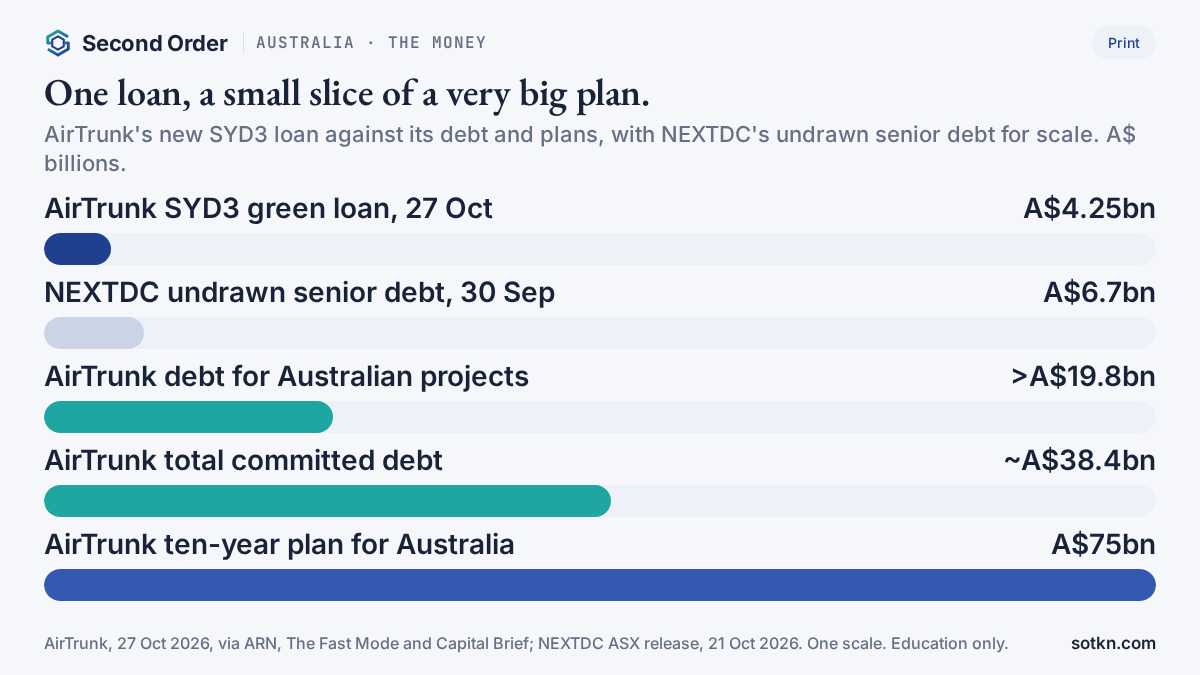
This loan ≈ 5.7% of it (our arithmetic)
EarlyNEXTDC undrawn senior debt
A$6.7bn
Draws depend on billing within 24 months · 21 Oct
WatchSYD3 completion target
Mid-2028
About 20 months away · our read
Stuck stepFigures from AirTrunk (27 Oct 2026, as reported by ARN, The Fast Mode and Capital Brief), AirTrunk’s SYD3 page and NEXTDC’s ASX release of 21 Oct 2026. Percentages and the month count are our arithmetic. Status chips are Second Order’s read.
On this page: Why it matters · What AirTrunk announced · What SYD3 is · Who lent · The NEXTDC side · What lenders count · The grid behind it · Who pays if power is late · Our math · Who gets paid · What is stuck? · Dates next · What would change this · FAQ
Why does one loan matter to who gets paid in Australian data centres?
Because most of a data centre is built with borrowed money, and the last two weeks tested whether that money would keep coming. On 13 October we wrote that money was setting the pace for Australia’s AI build, as rates rose and a float was pulled (the funding Pulse). Then a power delay at one of NEXTDC’s Melbourne halls cut its expected income and raised questions about how much of its own debt it can draw (the guidance Pulse).
AirTrunk’s loan is the first big answer since then. Thirty-two lenders agreed to put A$4.25 billion into one Sydney campus. That tells you the money is still there for a hall with a power feed and a customer. It does not tell you when those halls will be earning, and that is the date every party in the chain is really waiting for.
This Pulse follows the money in order: who is paid when the loan is signed, who is paid while the halls go up, and who has to wait for power. It also looks at the other side of the same week, where NEXTDC’s published debt terms show how a power date turns into a borrowing limit.
1 · The lenders
Who: 32 banks and lenders, 14 lead banks, three coordinators
Paid: Paid on signing and drawing · fees and interest
2 · The build
Who: The head builder, trades and equipment suppliers
Paid: Paid on progress · to mid-2028
3 · Power-on
Who: The network brings power to each new hall and the tenant starts paying
Paid: Hall by hall · no dates published
4 · The owner
Who: AirTrunk and its owner Blackstone earn rent on powered halls
Paid: Paid on billing
What did AirTrunk announce on 27 October?
AirTrunk said it had secured an A$4.25 billion green loan to fund the continued development of SYD3, its campus in Western Sydney. A green loan is a normal bank loan whose money must go to projects that meet agreed environmental tests. This one has margin adjustments: the interest rate can move if those tests are met. AirTrunk said any savings from the lower margin will go to its social impact programme, which funds local charities.
The lending group is large. Thirty-two local and international financial institutions backed the loan, which AirTrunk called one of the largest lending groups put together for a data centre in Australia. Fourteen lead banks underwrote it: Banco Santander, BNP Paribas, Crédit Agricole, DBS, Deutsche Bank, ING, Mizuho, MUFG, National Australia Bank, Royal Bank of Canada, Société Générale, Sumitomo Mitsui Banking Corporation, HSBC and United Overseas Bank. SMBC, HSBC and UOB coordinated the green side of the loan. Mallesons acted for AirTrunk, Gilbert + Tobin for the lenders.
Including this deal, AirTrunk says its total committed debt is now about A$38.4 billion around the world, more than A$19.8 billion of it for projects in Australia. In Australia it has five campuses with more than 1.2 GW of capacity, has invested more than A$12 billion so far, and plans to invest a further A$75 billion over the next decade. AirTrunk has been owned by Blackstone since 2024.
What the statement left out matters as much. It gave no tenor, no interest rate, no drawing schedule and no financial tests. It did not name SYD3’s tenants or say how much of the expansion is already leased. It did not say when each new hall will be powered. Those are the facts that decide when the loan starts to be repaid from rent rather than from new borrowing.
What is SYD3, and why is it the one that got funded?
SYD3 is a hyperscale campus, built for a few very large cloud and AI customers rather than many small ones (hyperscale vs colocation). AirTrunk’s own page lists more than 400 MW of total capacity on 8.3 hectares, with 70,000 square metres of technical floor across 42 data halls. It is fed by a diverse 132 kV high-voltage supply, which means more than one incoming path at the voltage used for big industrial loads. The design power usage effectiveness is 1.15: for every 1 MW of computing, about 0.15 MW more goes on cooling and other overheads (PUE explained).
The campus was first announced in 2021 at more than 320 MW and later enlarged by about 80 MW, Forbes Australia noted. It estimated that 400 MW is about a quarter of the roughly 1.6 GW of data centre capacity operating in Australia today. AirTrunk calls SYD3 the largest hyperscale data centre in Asia Pacific by megawatts.
The build is under way. A W Edwards leads construction of the expanded campus, and AirTrunk expects it to be finished by mid-2028. To keep heavy equipment moving, it uses a 25,000 square metre buffer zone in Western Sydney to store, stage and pre-test critical gear before it goes on site, and has chartered its own ships to bring equipment into Port Botany and Port Kembla. It says the project will support more than 10,000 jobs across construction, trades, engineering, logistics and safety. Building measures include lower-carbon steel and concrete and a target to keep at least 90% of non-hazardous construction waste out of landfill.
Why this campus got A$4.25 billion when the mood around Australian data centres has soured is the point of the story. It already has a large power feed in a part of Sydney where new connections are now very hard to get (Sydney’s power is sold out). Lenders can see the wire. What they are lending against is the date that wire carries a paying load.
Who lent, and what do they get?
A loan of this size is spread so that no single bank carries too much of one borrower. With 32 lenders, the average share is about A$133 million each (our arithmetic), though lead banks usually hold more than the rest. The lead group is worth a look: one Australian major (NAB), three Japanese megabanks, two Singapore banks (DBS and UOB), HSBC, and large French, Spanish, German, Dutch and Canadian lenders.
Banks are paid in three ways on a deal like this: arrangement and underwriting fees when it is signed, commitment fees on money promised but not yet drawn, and interest on what is drawn. All three start long before any new hall earns rent. That is why lenders are first in our chain. They are paid for taking the risk that the power-on date slips, and they price that risk into the margin.
Two other Asian-Pacific deals this month show the same pattern. Princeton Digital Group raised a loan for a Johor campus (the Johor loan Wire), and DayOne doubled its Johor borrowing (the DayOne Pulse). Bank money is flowing to halls with power and customers. Public equity has been harder: AirTrunk’s own Singapore REIT listing was pushed to 2027 earlier this month (the REIT delay Pulse).
What did NEXTDC say the same week?
We are not re-telling the M3 Melbourne delay here; our M3 Pulse and guidance Pulse cover the power line and the income cut. Two newer pieces of NEXTDC news matter for this story.
First, on 26 October NEXTDC renewed its board. Chairman Douglas Flynn said he will retire once a new chair is in place. A search firm will also find a new independent director, ideally with data centre, energy, infrastructure or capital management experience, with both appointments expected in the first quarter of 2027. Directors cut their own fees by 10%, a proposal to raise the directors’ fee pool was withdrawn, and chief executive Craig Scroggie agreed to give up his short- and long-term incentives for the 2027 financial year. The annual meeting is on 20 November. The board said its two priorities are working with the customer and the electricity distributor to limit the impact of the delay, and earning back investor confidence.
Second, its 21 October release spelled out how its lenders count. That is the part that connects to AirTrunk’s loan, and to every other data centre loan in Australia.
What do lenders actually count?
At 30 September NEXTDC had A$8,675 million of liquidity: A$1,275 million of cash, A$6,700 million of undrawn senior debt and a A$700 million hybrid securities series it can draw until 15 April 2027. It said it was in compliance with its financial covenants at the last test date, 30 June 2026, and expects to comply at the next one, 31 December 2026.
The tests are simple. Senior debt, net of cash, must stay at or below 60% of the Australian group’s assets at book value. And earnings must cover net interest at least 1.5 times. The second test has a clause that explains the whole industry: when NEXTDC works out its earnings for the test, it may add the yearly earnings of new customer contracts that are expected to start billing within 24 months.
That clause is how a data centre company borrows to build: the bank lets it count tomorrow’s rent today, as long as tomorrow is close enough. NEXTDC said its ability to draw all A$6,700 million while staying inside its tests will depend on when it draws and on the expected billing of its new contracts at that time. If expected billing changes a lot, its ability to draw senior debt may suffer, and it named a delay to grid supply at M3 as such a change.
AirTrunk has not published its loan’s tests, and they may well be different. But the logic is the same for any lender to a hall that is not yet earning: the loan is sized and drawn against rent that starts on a date. SYD3 is due to be finished by mid-2028, about 20 months from now (our arithmetic). The money arrived. The date it is waiting for is the day power reaches each new hall.
This is also why a delayed power date hurts more than a delayed building. A late building pushes back costs and income together. A late power date leaves a finished hall, with its interest bill running, and no rent (capex vs depreciation; data center financing explained).
What does the grid behind these loans look like?
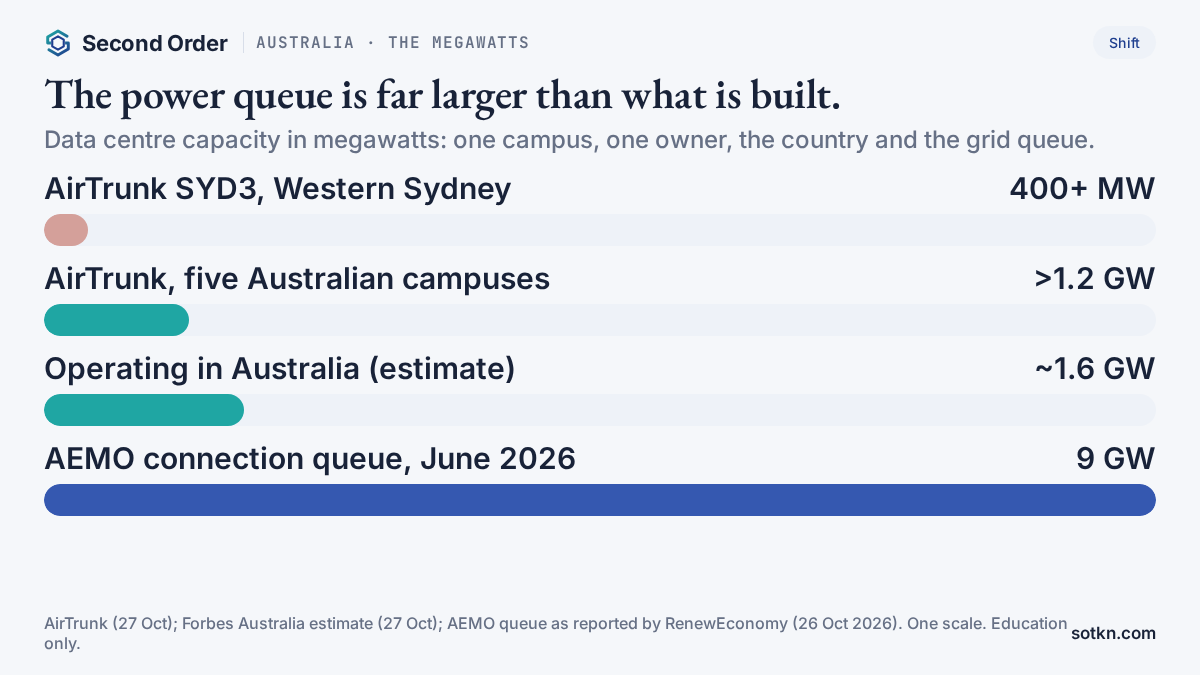
The queue for power is much longer than the build. At the end of June, the Australian Energy Market Operator had 17 data centre projects in its connection queue, with 9 GW of capacity, RenewEconomy reported; five of them, 1.4 GW, were being put in place. That is about 16% of the queue moving (our arithmetic). Against roughly 1.6 GW operating today, the queue is more than five times the built base.
Not all of it is stuck. Infratil, a part-owner of CDC Data Centres, said on 21 October that it had received investor questions about power timelines and that CDC had confirmed its power delivery and construction timelines for sites under construction are tracking as expected, with CDC-related guidance unchanged.
In New South Wales the rules are changing too. A new law lets the state charge large loads for grid upgrades, which we covered with AirTrunk’s Kurri Kurri proposal on 26 October (the Kurri Kurri Pulse); the earlier state condition on powered sites is in our NSW power condition Pulse. SYD3 already has its feed, so those rules matter more for the next campus than for this one.
At the far end of the map, one developer is skipping the grid entirely. On 26 October Energy-Storage.News reported that Gingerah Energy, a joint venture that includes the Karajarri traditional owners and Fugro’s Australian arm, has referred a 1 GW data centre near Broome under federal environment law. It would run on its own microgrid: about 5,200 MW of solar, 1,500 MW of wind and a 5,000 MWh battery, built in stages of 48, 120, 240, 620 and 1,000 MW. A referral is an early step, not an approval, and no cost or supplier was named. It shows the other answer to the power-on problem: build your own power, at a scale of about 6.7 MW of wind and solar for each megawatt of computing (our arithmetic).
Who pays if the power arrives late?
On 26 October the Smart Energy Council published a study of what happens if 5 GW of data centres connect to the east coast grid before new generation is built for them. It found wholesale prices would rise by about A$40 billion across Queensland, New South Wales, Victoria and South Australia between 2029 and 2035, with about A$37 billion of that paid by other customers. That is about 92% (our arithmetic). The council wants the data centre, not households, to carry the cost of any lag.
The same day, industry minister Tim Ayres told a Senate Estimates hearing that the government will introduce its data centre legislation “shortly”. He said it will use national rules so these investments do not push up power prices, and will make sure data centres procure new renewable generation, firming and demand flexibility.
For lenders, that debate changes the power-on date from an engineering question into a policy one. A campus that already has its feed, like SYD3, mostly faces the build and the network. A campus still waiting for a connection may face new obligations before it can switch on. Either way, the date the hall starts billing is what the loan depends on (how hyperscalers buy power).
Our math: what do the numbers say?
- Loan per megawatt: A$4.25 billion over about 400 MW is about A$10.6 million of debt per megawatt. Some of SYD3 is already built, so the loan may fund fewer megawatts at a higher cost each; treat this as a floor, not a price (our arithmetic).
- Lenders: A$4.25 billion over 32 lenders is about A$133 million each on average (our arithmetic).
- The plan: A$4.25 billion is about 5.7% of AirTrunk’s A$75 billion ten-year plan for Australia. Australia is about 52% of its A$38.4 billion of committed debt (A$19.8 billion) (our arithmetic).
- Scale: 400 MW is about a third of AirTrunk’s more than 1.2 GW in Australia and about a quarter of the roughly 1.6 GW operating nationally (our arithmetic on reported figures).
- The clock: from late October 2026 to mid-2028 is about 20 months, inside the 24-month window NEXTDC’s lenders use to count new contracts (our arithmetic; AirTrunk’s own tests were not published).
- NEXTDC liquidity: A$1,275 million cash plus A$6,700 million undrawn senior debt plus A$700 million of hybrids is A$8,675 million (our check of its sum).
- Queue: 1.4 GW of 9 GW is about 16% of queued data centre capacity being put in place; 9 GW is more than five times the roughly 1.6 GW operating (our arithmetic).
- Who pays: A$37 billion of A$40 billion is about 92% borne by other customers in the Smart Energy Council’s 5 GW case (our arithmetic).
What this tells you: money is not short for an Australian data centre that has a power feed and a customer. Banks lined up 32 deep for one Sydney campus in the same week the sector’s best-known listed name lost its chairman over a power line. The difference between the two is not access to money. It is how sure the lender can be of the date the power comes on.
Who gets paid first?
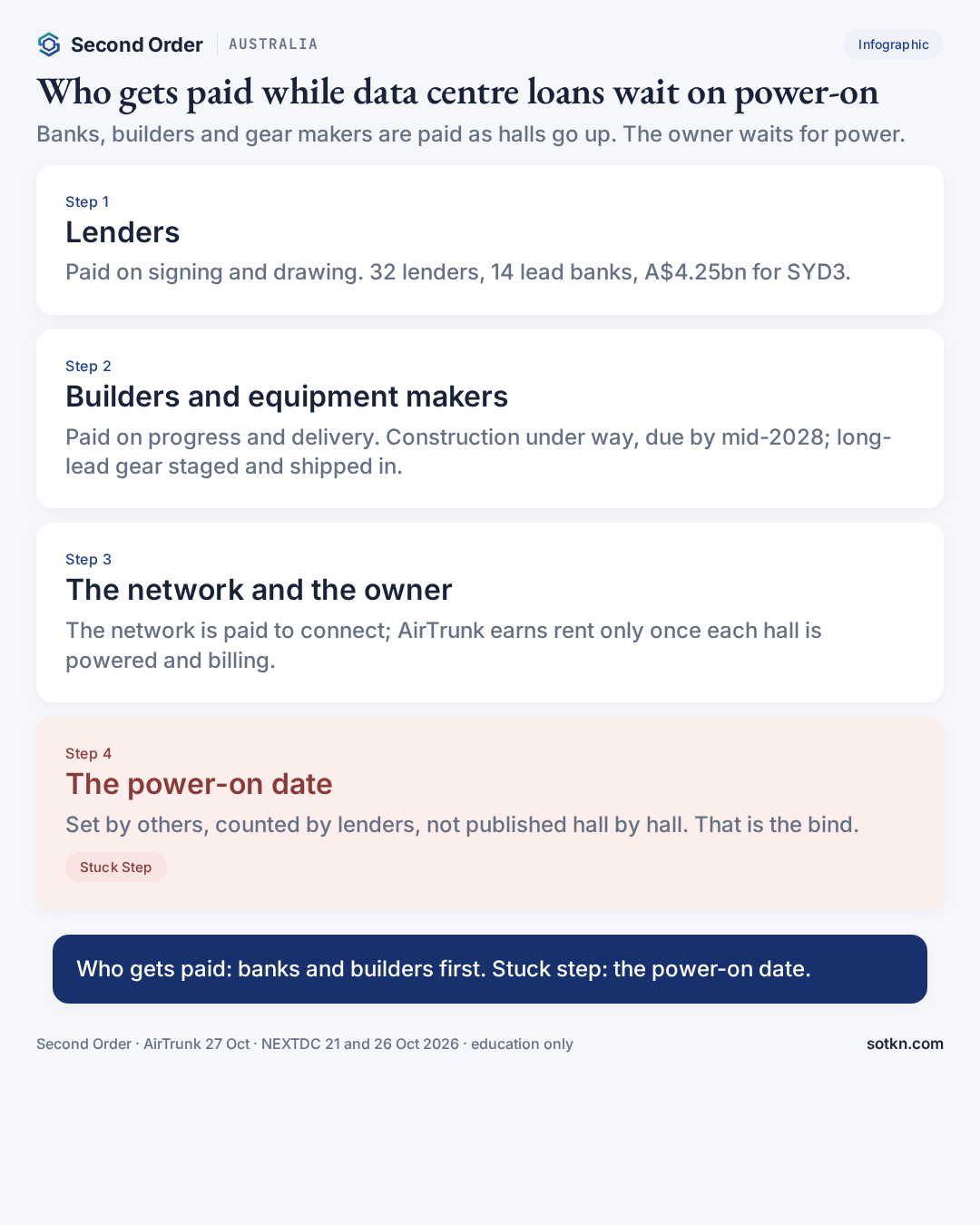
First, the lenders — on signing. Fees are earned when the loan is arranged and when money is committed; interest runs on every dollar drawn. Thirty-two institutions share in that, led by 14 underwriting banks.
Second, the builders and trades — on progress. A W Edwards and the trades behind it are paid as SYD3 goes up between now and mid-2028. Builders across Sydney have been winning data centre work this month; DigiCo’s SYD1 expansion went to a head contractor on a fixed-price contract, for example (the SYD1 Pulse).
Third, the equipment and logistics chain — on delivery. Transformers, switchgear, generators, chillers and cabling are bought and shipped ahead of time. AirTrunk’s buffer zone and chartered ships exist because these items are long-lead. Their makers are paid when the gear lands, not when the hall bills.
Fourth, the network — on connection. Whoever builds and owns the last part of the supply to each hall is paid for that work as it is done, and earns on it for decades after.
Last, the owner — on billing. AirTrunk and Blackstone earn rent only once a hall is powered and the tenant starts paying. Until then, the interest on the loan is a cost. NEXTDC shows what this looks like when the power date moves: the halls are there, the income is not, and the board changes (where cash sticks when debt is dear).
One-line rule: in Australia’s data centre build, banks, builders and equipment makers are paid as the halls go up; the owner is paid only from the day the power comes on. The stuck step is the power-on date.
So what is the stuck step?
The power-on date: the day electricity reaches a finished hall and the tenant starts paying. Not the money, which 32 lenders just showed is available. Not the building, which has a builder, a site and a supply chain. Four things make it stick:
- It is set by someone else. The owner can fund and build a hall, but the last stretch of supply is built by a network business on its own timetable, and in NEXTDC’s case that timetable moved.
- The loan counts it. Lenders let owners count rent that starts within a window. A late power date can push rent outside the window and shrink what the owner can borrow, as NEXTDC’s terms show.
- It is not published. AirTrunk gave a completion date for the campus, not a power date for each new hall. Outsiders cannot see how much margin sits between them.
- The rules are moving. National data centre legislation is due “shortly”, and New South Wales can now charge large loads for grid upgrades. New obligations can land between the loan and the switch-on.
This is the kind of bind our stuck-step Analysis describes: once money and buildings are in place, the bind moves to the input nobody in the deal controls. In Australia’s data centres, that input is the date the power arrives.
Which dates test this read next?
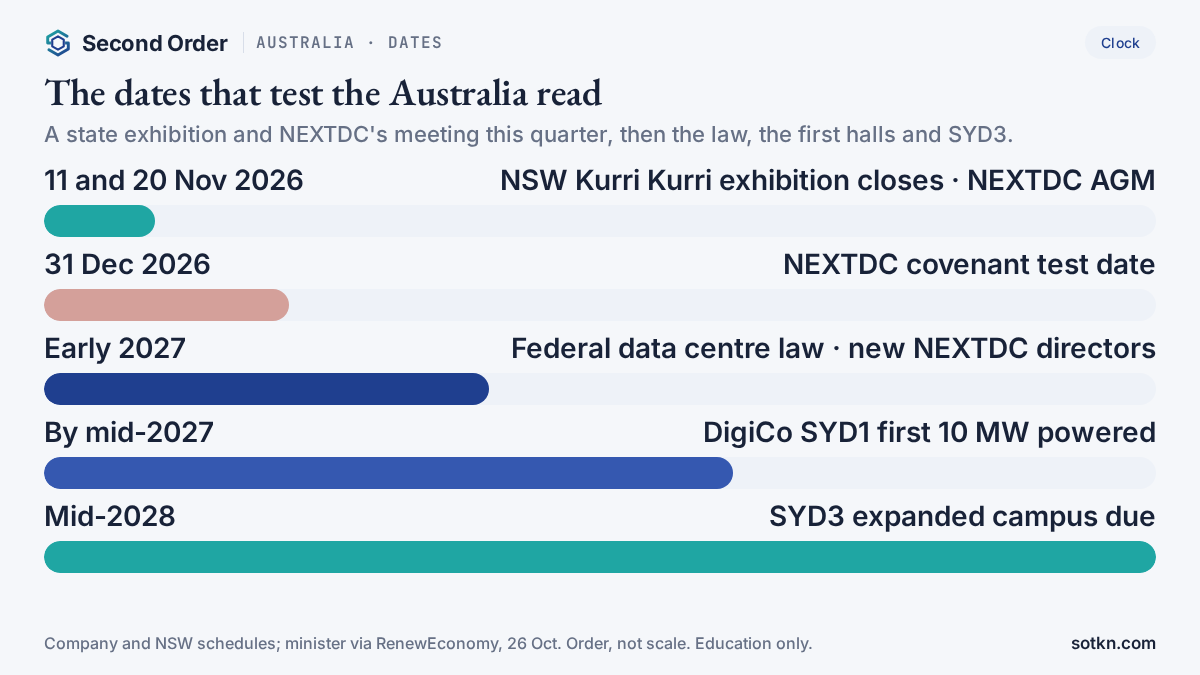
- 11 November 2026 — Public exhibition closes for AirTrunk’s Kurri Kurri proposal in New South Wales, the first test of how the new grid-upgrade charge is applied.
- 20 November 2026 — NEXTDC annual general meeting. Listen for any update on M3, on drawing its senior debt and on the board search.
- 31 December 2026 — NEXTDC’s next covenant test date. It said it expects to comply.
- Early 2027 — Federal data centre legislation, targeted for early 2027; the industry minister said on 26 October it would be introduced shortly. NEXTDC’s new directors are expected in the first quarter.
- By mid-2027 — DigiCo’s first 10 MW of the SYD1 expansion due to be powered and earning (late in its 2027 financial year).
- Mid-2028 — SYD3’s expanded campus due to be finished. The real test of this loan.
What would change this view?
- Power dates published. If AirTrunk or its tenants give hall-by-hall power dates, and they hold, the stuck step loosens for SYD3.
- A failed raise. If a large Australian data centre loan is pulled or priced much wider after NEXTDC, money becomes the bind again, as it was in our 13 October read.
- Faster networks. If network businesses clear the 9 GW queue faster, or more campuses build their own power, the power-on date stops being the scarce step.
- Heavy new rules. If the federal law or state charges make connection much costlier, the bind moves from the date to the price of power.
Practical takeaways
- AirTrunk has an A$4.25 billion green loan from 32 lenders for SYD3, a 400+ MW Western Sydney campus due by mid-2028
- Its committed debt is about A$38.4 billion, more than A$19.8 billion in Australia, against a A$75 billion ten-year plan
- NEXTDC’s published terms show lenders count new contracts only if billing is expected within 24 months
- 9 GW of data centres sat in the grid connection queue in June, against about 1.6 GW operating
- Banks, builders and equipment makers are paid now; owners are paid at power-on; stuck step: the power-on date
FAQ
What did AirTrunk announce on 27 October 2026?
AirTrunk said it had secured an A$4.25 billion green loan to keep building SYD3, its campus of more than 400 MW in Western Sydney. Thirty-two banks and other lenders joined, with 14 lead banks underwriting it, and the expanded campus is due to be finished by mid-2028. AirTrunk's total committed debt is now about A$38.4 billion, more than A$19.8 billion of it for Australian projects.
Why is the power-on date the stuck step if the money is there?
Lenders and builders are paid as a hall is built, but the owner only earns when power reaches the hall and the tenant starts paying. NEXTDC's own debt terms, published on 21 October, count new contracts only if they are expected to start billing within 24 months, so a late power date can limit how much it can draw. Money follows a credible power-on date; it cannot bring that date forward.
Is this investment advice?
No. Education only. It maps who gets paid and which step is stuck. It is not a recommendation to buy or sell any security, and we leave out share prices, broker ratings and price targets on purpose.
Keep reading on the map
- Australia Markets hub — country page
- Kurri Kurri and the NSW grid fee · NEXTDC billing date · NEXTDC Melbourne line — recent Australia Pulses
- Sydney power sold out · Australia’s AI money gets dearer · NSW power condition
- Data centre REIT listing on hold · Singapore power plan · DayOne Johor financing · Princeton Digital Johor loan
- Data center financing explained · What an AI data center costs · Capex vs depreciation
- Hyperscale vs colocation · PUE explained · Where AI data centers are located · How hyperscalers buy power
- If neocloud debt stays near 1,000 bp · Where does the stuck step move?
- AI Data Centers on the stack · All Markets doors — Taiwan, Korea, US, China, Singapore, Australia, Malaysia
How we check this. The loan figures come from AirTrunk’s statement of 27 October 2026 as carried the same day by ARN, The Fast Mode, Capital Brief and Forbes Australia; where they differ in wording we use the plainest figure they share. Campus size, power feed and design PUE come from AirTrunk’s own SYD3 page. NEXTDC’s liquidity and covenant terms are quoted from its ASX release of 21 October, and its board and pay changes from its ASX release of 26 October. CDC’s timelines come from Infratil’s 21 October update. The connection queue, the Smart Energy Council study and the minister’s remarks are as reported by RenewEconomy on 26 October; the Kimberley proposal is as reported by Energy-Storage.News the same day. AirTrunk did not publish the loan’s tenor, pricing or tests, and we do not guess them. Every sum we worked out is labelled “our arithmetic”. Share prices, broker ratings and price targets are left out on purpose. The references we used are listed at the end. Our editorial standards →
Not investment advice. Do your own research.
References
- ARN, AirTrunk locks in $4.25B green loan for SYD3 campus, 27 Oct 2026. arnnet.com.au — the loan, the 32 lenders, the lead banks and coordinators.
- The Fast Mode, AirTrunk Secures A$4.25 Billion Green Loan for SYD3 Expansion, 27 Oct 2026. thefastmode.com — the builder, the buffer zone, shipping and the mid-2028 date.
- Capital Brief, AirTrunk secures $4.25b green loan for Western Sydney data centre, 27 Oct 2026. capitalbrief.com — AirTrunk's Australian portfolio and spending plan.
- Forbes Australia, AirTrunk secures $4.25 billion loan amid $75 billion splurge, 27 Oct 2026. forbes.com.au — how SYD3 grew and its share of national capacity.
- AirTrunk, SYD3 Sydney West campus page, accessed 27 Oct 2026. airtrunk.com — the campus size, power feed and design PUE.
- NEXTDC, ASX release: M3 Melbourne power delay and revised FY27 guidance, 21 Oct 2026. announcements.asx.com.au — liquidity and how its debt covenants count new contracts.
- NEXTDC, ASX release: Board renewal and AGM voting items, 26 Oct 2026. announcements.asx.com.au — the board and pay changes.
- Infratil, Australian data centre update, 21 Oct 2026. infratil.com — CDC's power and build timelines.
- RenewEconomy, Letting data centres build first, catch up on renewables later could add $40 billion to power bills, 26 Oct 2026. reneweconomy.com.au — the Smart Energy Council study, the connection queue and the minister's remarks.
- Energy-Storage.News, 1GW data centre with 5,000MWh battery storage system submitted to Australia's EPBC Act for approval, 26 Oct 2026. energy-storage.news — the off-grid Kimberley proposal.