HBM3E vs HBM4: What Changes and Who Gets Paid
HBM4 doubles the interface width and channels of HBM3E. In October 2026 SK hynix said HBM4 would pass HBM3E in Q4, Samsung put HBM4 at about 60% of its HBM sales, and Micron said HBM3E was still most of its shipments. The stuck step is good stacks.
EXPLAINED · Versus · Last reviewed: 21 Nov 2026 · Next review: when Micron reports its fiscal first quarter of 2027 and SK hynix and Samsung report fourth-quarter 2026 results
HBM3E and HBM4 are two generations of high-bandwidth memory, the stacked DRAM that sits beside an AI chip; HBM4 is the newer one and uses a wider interface and more channels than HBM3E.
In short. What is the difference between HBM3E and HBM4? HBM4 is the newer high-bandwidth memory. It doubles the interface to 2,048 bits and the channels per stack to 32, and allows up to 2 TB/s a stack. In October 2026, SK hynix said HBM4 would pass HBM3E in the fourth quarter, Samsung said HBM4 was about 60% of its HBM sales, and Micron said HBM3E was still most of its fiscal 2026 shipments. Our read: the swap is under way and demand is not the problem. The stuck step is good stacks: wafers, cleanroom space and yield. Makers with qualified HBM4 and signed long contracts get paid first; buyers without contracts wait.
Why an investor cares: AI chips are only as fast as the memory next to them, and that memory is made by three companies. Which generation they ship, and how many good stacks they can finish, decides whose revenue shows up first. This page sits in our Semiconductors layer. Our HBM explained page covers what the stack is. This page compares the two newest generations.
What is the difference between HBM3E and HBM4? The short answer
High-bandwidth memory, or HBM, is a tower of thin DRAM chips stacked on a base chip and placed right beside an AI processor. The stack gives the processor a very wide road to its data. HBM3E and HBM4 are two generations of that tower.
The big change is the width of the road. JEDEC, the body that sets memory standards, published HBM4 in April 2025. It uses a 2,048-bit interface and 32 independent channels per stack. HBM3 had 16 channels, and its published speed and bandwidth imply a 1,024-bit interface. So HBM4 doubles both, by JEDEC’s figures and our arithmetic.
HBM3E is the extended version of HBM3. It keeps the narrower interface and pushes the speed up. Micron says its 12-high HBM3E runs above 9.2 gigabits a second a pin and gives more than 1.2 terabytes a second a stack. SK hynix says it has raised the speed of its HBM3E to 9.6 gigabits a second.
HBM3E vs HBM4 side by side
| Line | HBM3E | HBM4 | Source |
|---|---|---|---|
| Interface width | 1,024 bits (our arithmetic from HBM3: 819 GB/s at 6.4 Gb/s per pin) | 2,048 bits | JEDEC, Jan 2022 and Apr 2025 |
| Independent channels per stack | 16 (HBM3) | 32 | JEDEC |
| Pin speed | 9.2 Gb/s and above (Micron); 9.6 Gb/s (SK hynix) | Up to 8 Gb/s in the standard | Micron, SK hynix, JEDEC |
| Bandwidth per stack | More than 1.2 TB/s (Micron, 12-high); about 1.23 TB/s at 9.6 Gb/s (our arithmetic) | Up to 2 TB/s | Micron, SK hynix, JEDEC |
| Layers | 8-high 24GB; 12-high 36GB | 4-, 8-, 12- and 16-high allowed; 12-high 36GB and 16-high 48GB shown by Micron | SK hynix, Micron, JEDEC |
| Largest stack in the standard | 36GB (12-high, as shipped) | 64GB (32 Gb dies, 16-high) | SK hynix, JEDEC |
| Who was selling it in Oct 2026 | Micron: the majority of fiscal 2026 HBM shipments | SK hynix: shipments began in earnest in Q3; Samsung: about 60% of HBM sales; Micron: volume production begun | Company releases and 10-K |
| Controller | — | Backwards compatible with HBM3 controllers, by JEDEC | JEDEC |
HBM3E has no separate JEDEC document in the sources we read, so its numbers come from the HBM3 standard and from the makers. The bandwidth rows mix ceilings from standards with vendor claims. They are not a like-for-like test.
How much faster is HBM4?
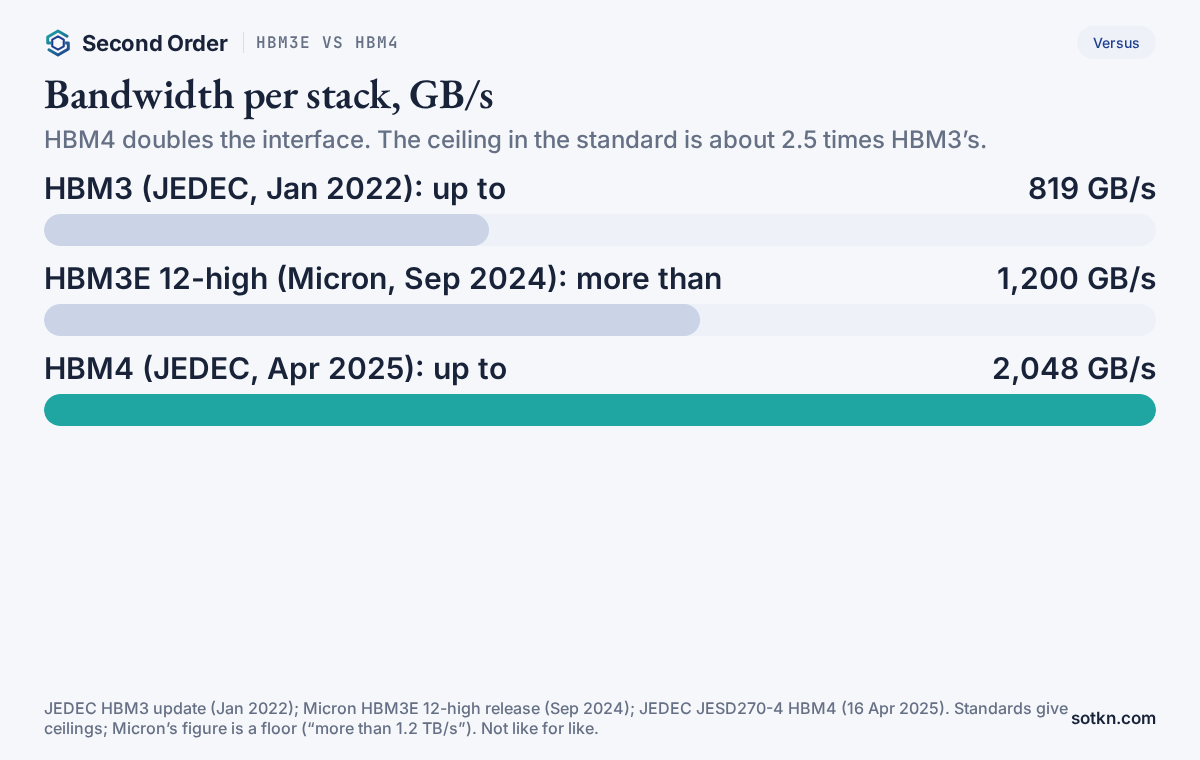
On paper, a lot. Our arithmetic from JEDEC’s two documents: HBM3 at 6.4 gigabits a second over 1,024 lines is about 819 gigabytes a second, and HBM4 at 8 gigabits a second over 2,048 lines is about 2,048 gigabytes a second. That is 2.5 times the HBM3 figure.
The fairer comparison is with HBM3E, because HBM3E is what ships today. SK hynix’s 9.6 gigabits a second over 1,024 lines is about 1,229 gigabytes a second. The HBM4 ceiling is about 1.7 times that. Treat this as rough. One number is a standard’s ceiling and the other is a maker’s product claim. We have not seen a filed HBM4 speed from any of the three makers.
Why does the road width matter more than the speed? Pushing every line faster costs power and heat. Adding lines costs room on the chip. HBM4 takes the second route, and its standard also allows lower voltages. JEDEC lists VDDQ from 0.7 to 0.9 volts and VDDC at 1.0 or 1.05 volts, set by the maker.
What else changes inside the stack?
Capacity. SK hynix says the largest HBM3E before its 12-layer part was 24GB, from eight stacked 3GB chips. Its 12-layer part reaches 36GB. By simple division, each chip holds 3GB. Micron’s HBM4 follows the same pattern: 36GB at 12 layers in volume production, and 48GB at 16 layers sent out as samples to several key customers. JEDEC’s standard goes higher, to 64GB with 32-gigabit chips at 16 layers.
Height is the hard part. Each extra layer is another chip that must work, be thinned, bonded and tested. Micron’s 10-K names the problem directly. It lists acceptable yields and quality for HBM products with their many chip layers as a technical barrier, along with limits on stacking more layers and advanced packaging.
The base chip changes role too. Micron says its HBM4 uses advanced CMOS and metal processes on the base logic die and the DRAM chips, both designed and made in-house. Samsung’s foundry unit said its earnings rose on HBM base-die sales. In plain words: the chip at the foot of the stack is becoming a made-to-order logic part, not a simple connector. Our HBM base die page covers what it does.
Is HBM4 replacing HBM3E now?
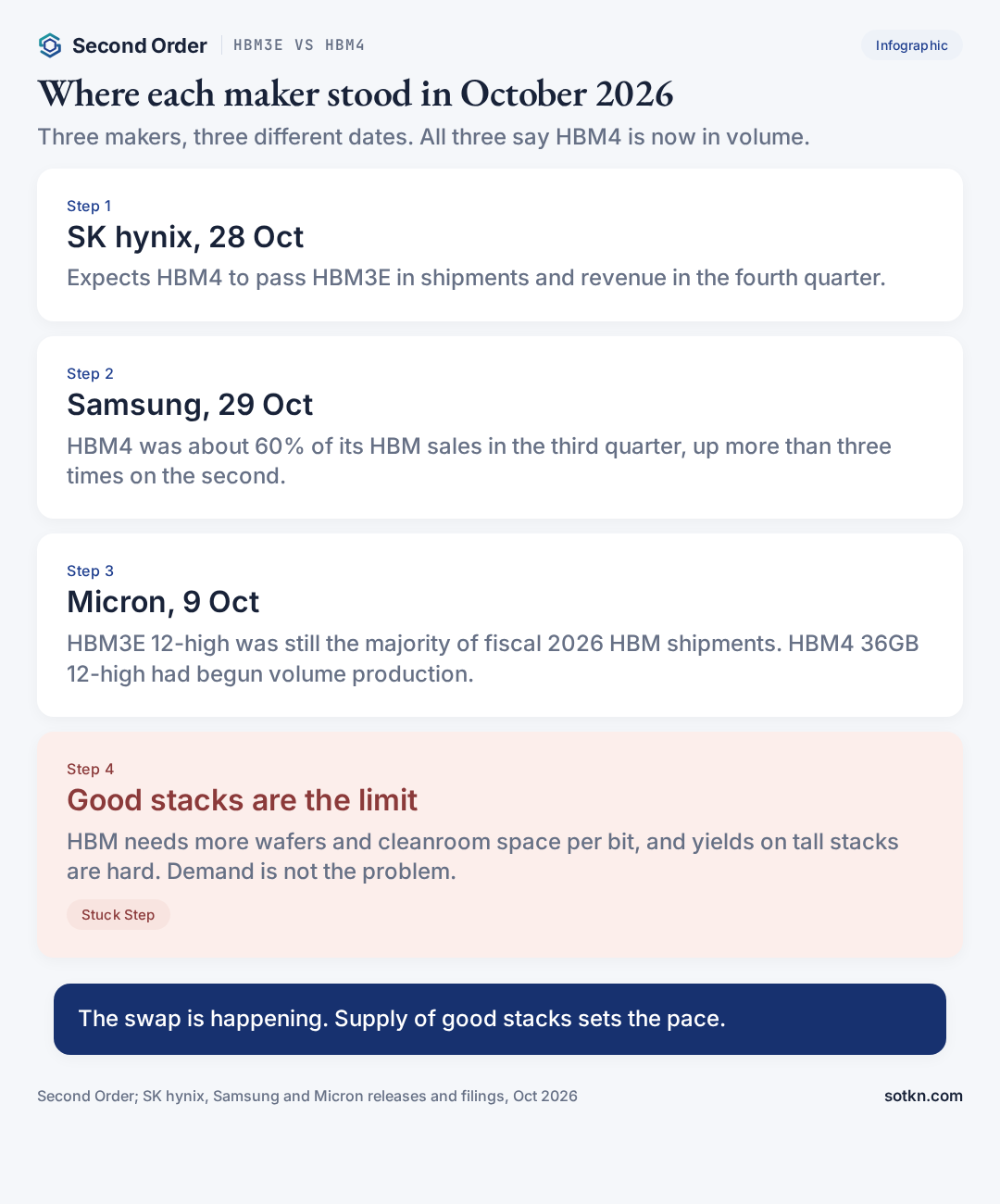
It is starting to. The three makers gave three different answers in October 2026, and the dates matter.
| Maker | Latest filing or release | What it said about HBM | Money line |
|---|---|---|---|
| SK hynix | 3Q26 results, 28 Oct 2026 | HBM4 shipments began in earnest; expects HBM4 to pass HBM3E in the fourth quarter; ramping M15X to maximum by year end | Revenue 104.6 trillion won; operating profit 83.3 trillion won (79.7%, our arithmetic) |
| Samsung | 3Q26 results, 29 Oct 2026 | HBM4 sales more than tripled from Q2 and were about 60% of HBM sales; 2027 HBM supply sold out (call remarks) | Device Solutions revenue 147.1 trillion won; operating profit 106.5 trillion won (72.4%, our arithmetic; includes foundry and logic) |
| Micron | 10-K, fiscal year to 3 Sep 2026, filed 9 Oct 2026 | HBM3E 12-high the majority of HBM shipments; HBM4 36GB 12-high in volume production; 16-high 48GB samples out; HBM4E volume in calendar 2027 | Cloud Memory unit revenue US$43.09bn; operating income US$31.2bn (72.5%, our arithmetic) |
The three margins are not like for like. Samsung’s figure covers its whole chip division. Micron’s covers one business unit in its own fiscal year. SK hynix’s covers the whole company.
SK hynix said on 28 October 2026 that HBM4 shipments began in earnest in the third quarter, and that it expects HBM4 to pass HBM3E in both shipments and revenue in the fourth quarter. It is raising its M15X fab to maximum output by the end of the year to make more HBM4.
Samsung said on its 29 October call that HBM4 sales more than tripled from the second quarter and made up about 60% of its HBM sales. It also said it reached its goal of an HBM market share on par with its overall DRAM share in the third quarter, ahead of plan. Those are call remarks. The report we read said independent third-quarter share figures had yet to confirm it.
Micron is on a different clock. Its fiscal year ended on 3 September 2026. In that year, HBM3E 12-high was still the majority of its HBM shipments. HBM4 36GB 12-high began volume production during the year. So Micron’s 10-K describes the start of the swap, and the other two describe the middle of it.
Who makes HBM3E and HBM4?
The same three companies make both. One secondary figure shows how the shares have moved. Aju Press, citing Counterpoint Research, reports that SK hynix had 50% of global HBM revenue in the second quarter of 2026, down from 64% a year earlier. Samsung had 33%, up from 15%. Micron had about 18%. Those add to 101% because of rounding in the source. Our who makes HBM page has the full cast, and our who makes DRAM page covers the wider market.
Each maker has its own page in our stack: SK hynix, Samsung and Micron.
Do HBM3E and HBM4 sell at different prices?
We do not know, and we will not guess. No filing we read gives an HBM3E or HBM4 price. What the filings do show is how the money is locked in.
SK hynix says it has long-term agreements with 14 major customers, including large cloud companies. They cover more than half of its 2027 and 2028 production capacity. The terms usually run five years, and a mechanism moves price with the market inside an agreed range. Samsung said its 2027 HBM supply was negotiated at its target price and is sold out.
Micron describes the same shape. Its strategic customer agreements are take-or-pay, with binding volumes over several years, and most have a minimum and maximum price. Our take-or-pay vs purchase commitment page explains why that matters, and our purchase commitment page covers the basics.
For a buyer, the point is simple. If supply is sold out through 2027 and prices sit in bands, the generation you want matters less than whether you have a contract.
Why can’t makers just switch everything to HBM4?
Because HBM eats capacity. Micron’s 10-K says HBM needs more wafers and more cleanroom space to make the same number of bits as ordinary DRAM on the same node. A maker that shifts a wafer to HBM gives up other DRAM it could have sold. It also says that if HBM demand weakened and makers moved capacity back, ordinary DRAM supply could jump, and prices could fall.
So the makers are building. Micron says it expects capital spending of about US$11.5 billion in its fiscal first quarter of 2027 and about US$25 billion in the first six months. It broke ground in January 2025 on an HBM advanced packaging plant in Singapore, to add packaging capacity from early calendar 2027. It also broke ground in July 2026 on a cleanroom project at Hiroshima, with first output expected in late calendar 2028. SK hynix says investment will rise sharply next year as its first Yongin fab reaches full operation. Our clean room explained page covers why the space is the scarce part, and our fab utilization page covers how full these plants run.
Packaging is the other end of the chain. Stacks only earn money once they sit beside a chip. Our who makes advanced packaging and CoWoS explained pages cover that step.
Who gets paid?
Our read: makers with qualified HBM4 and signed contracts are paid first. Everyone else is paid by how close they sit to that point.
- Memory makers with good HBM4 stacks first. SK hynix reported an operating margin of about 80% in the third quarter, by our arithmetic from its release. Samsung’s chip division was about 72%, and Micron’s Cloud Memory unit about 72.5% for its fiscal year. These are not like for like, but all three are paid well while supply is short.
- Buyers with long contracts. They hold volume and, inside the price bands, a known cost. SK hynix says contracts cover more than half of its 2027 and 2028 capacity.
- Foundry and packaging owners. The base die and the packaging step are now paid parts of the chain. Samsung’s foundry unit cited HBM base-die sales, and Micron is building packaging in Singapore.
- Waiting: buyers without contracts and designers on later generations. If the supply is sold out for 2027, a new buyer waits or pays what the bands allow.
Where is the stuck step?
Our read: good HBM4 stacks, meaning wafers, cleanroom space and yield on tall stacks. Demand is not the problem. SK hynix expects demand to exceed supply through 2030. Samsung says demand will far exceed industry supply in 2027.
The standard is finished. JEDEC published it in April 2025. The makers have parts in volume. What is slow is the plant: cleanrooms that take years to build, stacks that must pass test, and packaging that comes online in 2027 and later. That is why a new generation arrives as a swap over several quarters, not as a switch.
The clocks
- Fourth quarter of 2026. SK hynix expects HBM4 to pass HBM3E in shipments and revenue. Its results for the quarter come in January 2027.
- Early December 2026. Micron’s fiscal first quarter of 2027 ends, and results follow. It guided capital spending of about US$11.5 billion for the quarter.
- Calendar 2027. Micron expects HBM4E volume. Samsung says it shipped HBM4E samples in May 2026.
- Early calendar 2027. Micron’s Singapore HBM packaging plant is due to add capacity.
- 2027 and 2028. SK hynix’s long-term agreements cover more than half of capacity in these two years.
What would change the view?
- Supply catches up. If new cleanrooms and packaging arrive faster than demand, the sold-out status ends and contract bands start to matter.
- Yield trouble. A maker that cannot get tall stacks through test would fall behind, whatever its plan says.
- A filed price. A maker that files an HBM4 price, or a clear premium over HBM3E, would replace our silence on price with a number.
- Independent share data. Third-quarter share figures from Counterpoint or another tracker would test Samsung’s claim that its HBM share caught up with its DRAM share.
- Demand weakens. Micron’s own 10-K warns that if HBM demand fell and capacity moved back to ordinary DRAM, prices could drop.
Common misconceptions
- People assume HBM4 has already replaced HBM3E. Actually, Micron’s fiscal 2026 shipments were mostly HBM3E, and SK hynix only expects HBM4 to pass it in the fourth quarter.
- People assume HBM4 is just HBM3E at higher speed. Actually, the standard’s top pin speed is lower, 8 gigabits a second against 9.6 for SK hynix’s HBM3E. The gain comes from doubling the interface width.
- People assume the winner is whoever has the fastest part. Actually, with supply sold out, the ranking depends on how many good stacks each maker can ship and on contracts already signed.
- People assume HBM prices are public. Actually, they sit in private contracts. We found none in the filings.
FAQ
What is the difference between HBM3E and HBM4?
HBM4 is the newer generation. By JEDEC’s April 2025 standard it has a 2,048-bit interface, twice the width of the 1,024 bits implied by HBM3, and 32 channels per stack instead of 16. It allows up to 2 TB/s per stack and up to 16 layers. HBM3E is an upgrade of HBM3 and runs on the narrower interface at higher speed.
Is HBM4 faster than HBM3E?
On paper, yes. JEDEC allows HBM4 up to about 2 TB/s a stack. Micron says its 12-high HBM3E gives more than 1.2 TB/s, and SK hynix’s 9.6 Gbps HBM3E works out to about 1.23 TB/s by our arithmetic. Actual HBM4 speeds sold to customers are not published in the filings we read.
Has HBM4 replaced HBM3E yet?
Not fully. SK hynix said on 28 October 2026 that it expects HBM4 to pass HBM3E in both shipments and revenue in the fourth quarter. Samsung said HBM4 was about 60% of its HBM sales in the third quarter. Micron said HBM3E 12-high was still the majority of its HBM shipments in its fiscal year to 3 September 2026.
Who makes HBM4?
SK hynix, Samsung and Micron all say they ship it. SK hynix said HBM4 shipments began in earnest in the third quarter, Samsung said its HBM4 sales more than tripled from the second quarter, and Micron said it began volume production of HBM4 36GB 12-high in fiscal 2026.
Does HBM4 cost more than HBM3E?
No filing we read gives an HBM4 price, and SK hynix gave no HBM price on its 28 October 2026 results. Samsung said only that its 2027 HBM supply was negotiated at its target price level. Treat any single price you see as a talking point until a company files one.
Is HBM4 backward compatible with HBM3E?
Partly. JEDEC says the HBM4 interface definition is backwards compatible with existing HBM3 controllers, so one controller can work with both. That is about the controller. The stacks themselves are different parts, and a chip must be built for the one it uses.
What comes after HBM4?
HBM4E. Micron says its HBM4E will use its 1-gamma DRAM node and ramp volume in calendar 2027. Samsung said on its 29 October 2026 call that it shipped the first HBM4E samples in May.
Why is HBM harder to make than ordinary DRAM?
Micron’s 10-K says HBM needs more wafers and more cleanroom space to make the same number of bits as ordinary DRAM on the same node, and that getting acceptable yields and quality from many stacked layers is a technical barrier. It lists those as barriers to supply.
Related: HBM explained; HBM vs DDR5; HBM vs GDDR; memory process tools for HBM; interposer explained; who makes HBM.
Stack doors
Layer: Semiconductors. Memory: HBM. Players: Micron and SK hynix. Earlier: Micron’s 10-K and Idaho and Samsung’s clean rooms.
Get the Wire — short daily notes on where AI computing gets built and who pays for it.
Not investment advice. Do your own research.
How we check this
Micron’s product, shipment, unit revenue, contract and capital figures come from its Form 10-K for the fiscal year ended 3 September 2026, filed 9 October 2026. SK hynix’s results, HBM4 timing, long-term agreements and M15X plan come from its 3Q26 results release of 28 October 2026, and its revenue and profit match its Form 6-K of the same day. Samsung’s division figures come from its third-quarter 2026 results release of 29 October 2026. What Samsung said about HBM4 sales, its HBM share goal, its 2027 supply and its HBM4E samples comes from its 29 October earnings call, which we read in a news report and quote as call remarks, not as filed figures. The Counterpoint Research share figures come from an Aju Press report and are labelled as secondary. Interface width, channels, speeds and capacities come from JEDEC’s published HBM3 and HBM4 releases and from Micron’s and SK hynix’s product releases. JEDEC’s HBM3 document does not state the interface width, so we derive 1,024 bits from its two figures, 6.4 Gb/s and 819 GB/s, and label it as our arithmetic. Shares, ratios, margins and growth rates are our arithmetic, checked in code and labelled on the page. Who gets paid and the stuck step are our read. We found no filing with an HBM3E or HBM4 price, so we give none. The featured image is a CC0 photograph of an older HBM2 die, graded by us; it is not an HBM4 part. This page explains a difference. It does not rate companies as investments or give buy or sell calls. Not investment advice. Do your own research.
Last reviewed: 21 Nov 2026 · Next review: when Micron reports its fiscal first quarter of 2027 and SK hynix and Samsung report fourth-quarter 2026 results
Spot an error? Tell us and we will correct it and note the change here.
References
- Micron Technology — Form 10-K for the fiscal year ended 3 September 2026 (filed 9 Oct 2026) — HBM3E 12-high the majority of 2026 HBM shipments; HBM4 36GB 12-high in volume production; HBM4 48GB 16-high samples; base logic die and DRAM core dies made in-house; HBM4E volume in calendar 2027; HBM needs more wafers and cleanroom space per bit; Cloud Memory unit revenue US$43.09bn and operating income US$31.2bn; strategic customer agreements are take-or-pay with price bands; Singapore HBM packaging plant; capex outlook
- SK hynix Newsroom — SK hynix Announces 3Q26 Financial Results (28 Oct 2026) — Revenue 104.6155 trillion won, operating profit 83.3338 trillion won; HBM4 expected to pass HBM3E in shipments and revenue in the fourth quarter; M15X ramp; long-term agreements with 14 customers covering more than half of 2027–2028 capacity
- Samsung Global Newsroom — Samsung Electronics Announces Third Quarter 2026 Results (29 Oct 2026) — Device Solutions revenue 147.1 trillion won and operating profit 106.5 trillion won; Memory scaled up HBM4 sales; Foundry gained from HBM base-die sales
- The Asia Business Daily — Samsung Electronics Q3 conference call report (29 Oct 2026) — Call remarks: HBM4 sales more than tripled from the second quarter and were about 60% of HBM sales; 2027 HBM supply negotiated and sold out; first HBM4E samples shipped in May
- Aju Press — Samsung's HBM strides intensify AI memory race (29 Oct 2026) — Secondary report citing Counterpoint Research: second-quarter 2026 HBM revenue share SK hynix 50%, Samsung 33%, Micron about 18%
- JEDEC — JESD270-4 HBM4 standard press release (16 Apr 2025) — 2,048-bit interface, up to 8 Gb/s, up to 2 TB/s; 32 channels versus 16; 4-, 8-, 12- and 16-high stacks; 24 Gb or 32 Gb dies; up to 64GB per stack
- JEDEC — HBM3 update to the High Bandwidth Memory standard (Jan 2022) — Up to 6.4 Gb/s per pin, equivalent to 819 GB/s per device; 16 independent channels; 4-, 8- and 12-high stacks
- Micron — HBM3E 12-high 36GB announcement (Sep 2024) — Pin speed above 9.2 Gb/s and more than 1.2 TB/s of bandwidth for a 36GB 12-high HBM3E stack
- SK hynix Newsroom — SK hynix begins volume production of the world’s first 12-layer HBM3E (26 Sep 2024) — 36GB 12-layer HBM3E (eight-layer maximum had been 24GB from 3GB dies); memory speed of 9.6 Gbps