What Is a Sale-Leaseback? How Big Tech Sells Data Centers and Chips, Then Rents Them Back
A sale-leaseback turns an asset into cash today and rent tomorrow. Meta has used a version of it for two AI campuses and now guarantees up to US$41.5 billion of their value; Amazon has discussed one for Nvidia chips. The rent starts only when the campus is handed over.
EXPLAINED · Mechanism · Last reviewed: 15 Nov 2026 · Next review: after Meta’s 2026 annual report and any closed Amazon chip leaseback
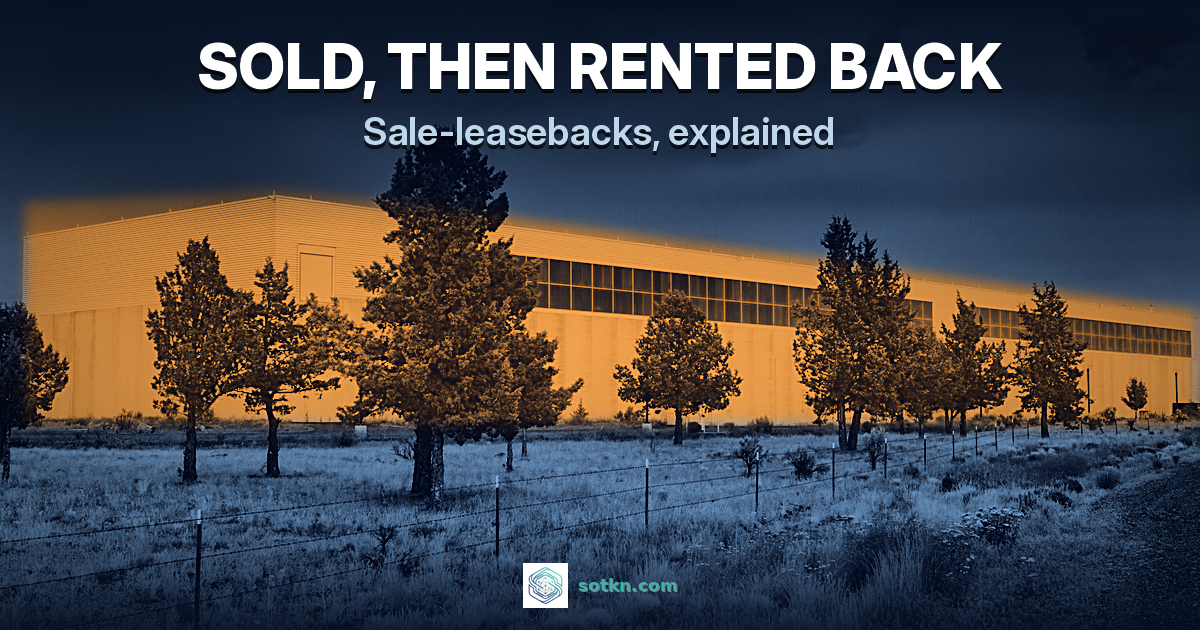
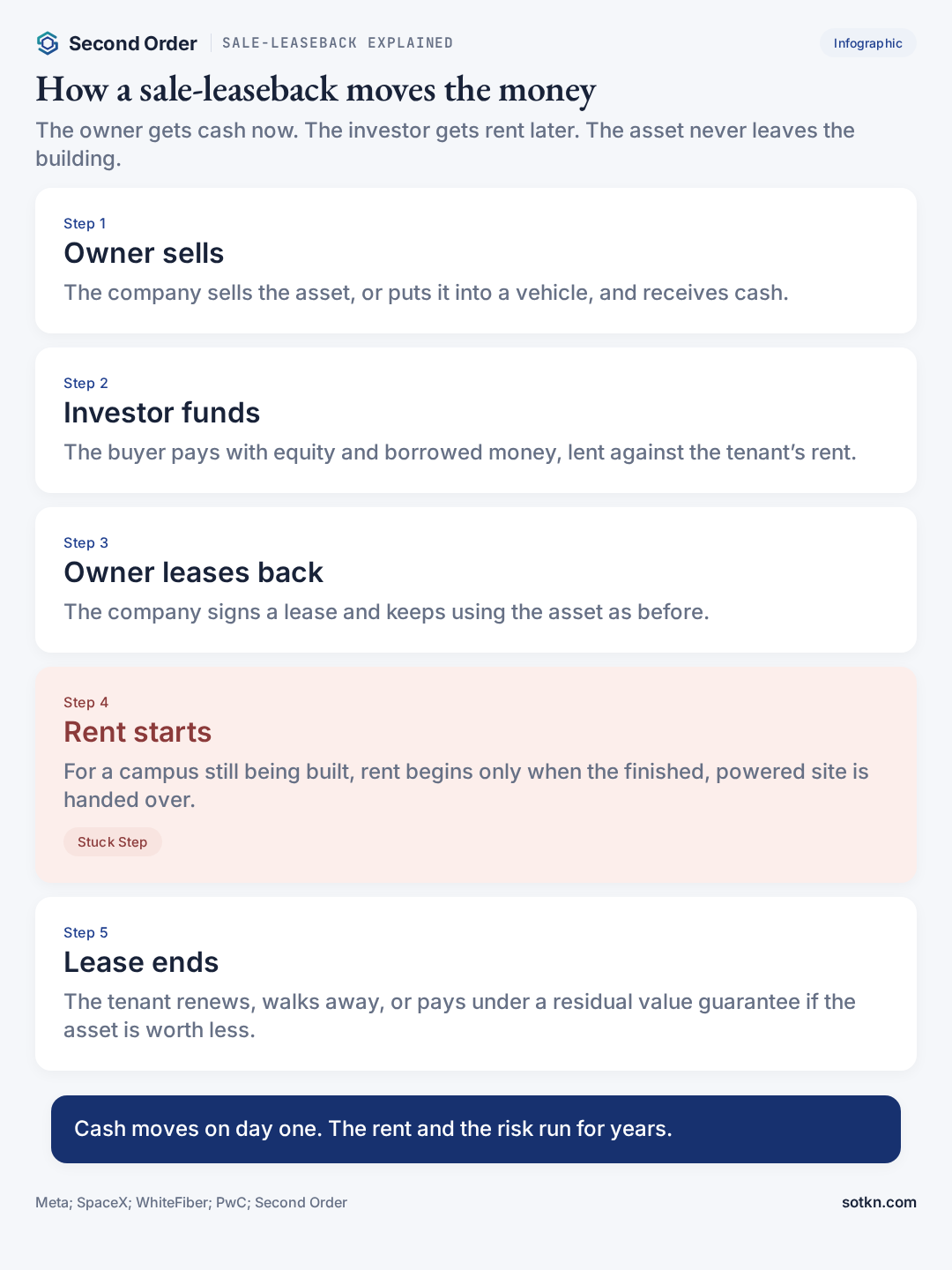
A sale-leaseback is a deal in which the owner of an asset sells it to an investor and immediately leases it back. The seller keeps using the asset, gets cash now and pays rent over time; the buyer owns the asset and collects the rent.
In short. A sale-leaseback swaps an asset for cash today and rent tomorrow. Hyperscalers are using versions of it to pay for AI capacity: Meta has moved two campuses, in Louisiana and Texas, into ventures it owns 20% of and will lease them back, and Amazon has discussed doing the same with about US$8 billion of Nvidia chips. The deal does not make the obligation disappear. Meta’s maximum exposure to the two ventures was US$68.4 billion at 30 September 2026, most of it a guarantee on what the campuses will be worth. Our read: the stuck step is lease commencement. The investor’s money is spent on day one; the rent that pays it back starts only when a finished, powered campus is handed over, in 2028 and 2029.
Why an investor cares: the largest buyers of AI capacity are spending faster than their cash flow, and selling assets they will keep using is one way to close the gap. The structure decides who owns the building or the chips, whose balance sheet carries the debt, who collects the rent, and who loses money if the asset is worth less in a few years’ time. This page sits under our Hyperscalers layer.
What is a sale-leaseback?
It is two contracts signed together. In the first, the owner sells an asset. In the second, the buyer leases the same asset back to the seller. Nothing moves physically. The building stays where it is, the servers stay in their racks, and the seller’s staff keep running them. What changes is who owns the asset and which way the cash flows.
The seller, called the seller-lessee, gets the sale price now and pays rent for as long as the lease runs. The buyer, called the buyer-lessor, pays the price now and is repaid through rent and, at the end, whatever the asset is still worth. Retailers have long done this with stores, airlines with aircraft and manufacturers with factories. The AI build-out has brought it to data centres and, more recently, to the chips inside them.
How does a sale-leaseback work?
The mechanism has four moving parts: the price, the rent, the term and the end-of-lease value.
- The price. The buyer pays for the asset, usually with a mix of its own equity and borrowed money. For a large data centre, most of the money is debt, sold to bond investors who are really lending against the tenant’s promise to pay rent.
- The rent. The seller agrees to pay rent that covers the buyer’s interest and a return on its equity. The stronger the tenant’s credit, the cheaper the money. That is why a deal with a highly rated hyperscaler as tenant can raise billions.
- The term. Leases can be long or short. A short first term with renewal options gives the tenant flexibility, but leaves the investor exposed if the tenant walks away early.
- The end-of-lease value. When the lease ends, the buyer owns an asset it has to re-let or sell. If the tenant wants a short lease, the investor usually asks for protection on that value, in the form of a residual value guarantee.
How is a sale-leaseback accounted for?
Under US rules, the first question is whether a sale has happened at all. The table sets out the tests. Our finance lease vs operating lease page explains the lease classification that decides most of them.
| Question the auditor asks | If yes | What the seller’s books show |
|---|---|---|
| Did control of the asset really pass to the buyer? | It can be a sale | Asset removed, sale price recorded, then a lease liability and right-of-use asset for the leaseback. |
| Would the leaseback be a finance lease? | No sale | Asset stays on the books and keeps being depreciated; the cash received is a financial liability, i.e. debt. |
| Can the seller buy it back at a fixed price? | Usually no sale | Same as above, unless the option is at fair value and similar assets are readily available. |
| Is the asset inside a venture the seller part-owns? | Consolidation test | If the seller directs what matters most, it consolidates the venture; if not, it shows an equity investment and discloses its maximum exposure. |
A simplified guide to US accounting rules (ASC 842-40 for sale-leasebacks). Each company’s notes give the exact treatment.
The finance lease test is the one that catches most AI deals. A finance lease is, in substance, a purchase: the tenant uses the asset for most of its life or ends up owning it. If the leaseback would be a finance lease, the accounting rules say control never really passed to the buyer, so there is no sale. The seller keeps the asset on its books, keeps depreciating it, and records the cash it received as a financial liability. That is called a failed sale-leaseback, and in the accounts it looks like a secured loan.
If the deal does pass as a sale, the asset leaves the seller’s balance sheet, but the lease does not disappear. Under current US lease rules, an operating lease also puts a lease liability and a matching right-of-use asset on the books. The difference is smaller than it used to be. A sale-leaseback that passes still swaps a building or a chip for a promise to pay rent.
Why are hyperscalers doing sale-leasebacks now?
Because the bill for AI capacity has outgrown even very large cash flows. Meta spent US$83.1 billion on property and equipment in the first nine months of 2026, about 72% more than a year earlier, by our arithmetic. Its notes outstanding rose to US$84.0 billion at 30 September from US$59.0 billion at the end of 2025, about 42% more. In November it sold another US$15.0 billion of dollar notes and €9.0 billion of euro notes, according to two Form 8-K filings.
Selling and leasing back is a way to bring in money from investors who want long-dated, rent-backed assets, such as infrastructure funds, insurers and private credit, without all of it showing up as the company’s own bonds. Five examples show the range.
| Seller-lessee | What moved | Who bought or funded it | Cash back to the seller | What the seller still owes |
|---|---|---|---|---|
| Meta (Louisiana, Hyperion) | Land and construction-in-progress for a campus costing about US$27bn | Funds managed by Blue Owl Capital (80%), partly with debt sold to PIMCO and other bond investors | About US$3bn one-time distribution | Operating leases from 2029, four-year first term; residual value guarantee for the first 16 years |
| Meta (Texas, El Paso) | Land and construction-in-progress valued at about US$2.3bn for a 1 GW campus costing about US$14bn | Funds managed by BlackRock (80%), with a US$12.5bn debt financing | About US$1bn one-time distribution | Leases from 2028, four-year first term, up to 20 years; guarantee threshold of about US$13bn that falls over time |
| SpaceX | AI (“Super Intelligence”) infrastructure hardware | Lessors including Valor Equity Partners, whose founder sits on SpaceX’s board | Recorded as US$12.9bn of debt at 30 Sept 2026 | Lease payments; booked as a financing because the leasebacks would have been finance leases |
| WhiteFiber | 96 AI servers (768 GPUs) | A third-party buyer | Not disclosed | Three years of lease payments |
| Amazon (reported, not closed) | About US$8bn of installed Nvidia chips | A special purpose vehicle funded by outside investors | Not reported | A lease on the same chips, if the deal goes ahead |
From each company’s filings and releases, and a press report for Amazon, listed under References. Not a ranking of investments.
- Meta and Blue Owl, Louisiana. In October 2025 Meta put land and construction-in-progress for its Hyperion campus, about US$27 billion of total development costs, into a venture 80% owned by funds managed by Blue Owl Capital. Blue Owl’s funds put in about US$7 billion of cash and Meta took about US$3 billion out as a one-time distribution, roughly 43% of the cash coming in, by our arithmetic. Meta signed operating leases for the whole campus with a four-year first term. Our Wire on the Hyperion bond shows how the debt behind it has traded.
- Meta and BlackRock, Texas. In July 2026 Meta did it again for a 1 GW campus in El Paso, costing about US$14 billion. Meta contributed land and part-built assets valued at about US$2.3 billion and received about US$1 billion back; its 10-Q puts the figures at US$2.26 billion and US$1.04 billion, so Meta took out about 46% of what it put in, by our arithmetic. The lease starts in 2028.
- SpaceX. Its subsidiary CTC Property has sold AI infrastructure hardware and leased it back in three transactions. Because the leasebacks would have been finance leases, the sales failed, and SpaceX recorded US$12,897 million of debt at 30 September 2026, about 2.9 times the US$4,507 million at the end of 2025, by our arithmetic. See what does SpaceX do.
- WhiteFiber. The smaller GPU cloud provider financed its first big customer contract by selling 96 AI servers, equivalent to 768 GPUs, to a third party and leasing them back for three years. It later agreed a second sale-leaseback of 128 servers, or 1,024 GPUs, though that order was postponed when the customer looked at newer chips. See what does WhiteFiber do.
- Amazon. In October 2026 the Financial Times reported, as relayed by Investopedia, that Amazon was considering moving about US$8 billion of Nvidia chips already installed in data centres across five states into a special purpose vehicle and leasing them back. That is a plan under discussion, not a closed deal. Our Wire on the Amazon talks has the detail.
How much is Meta on the hook for?
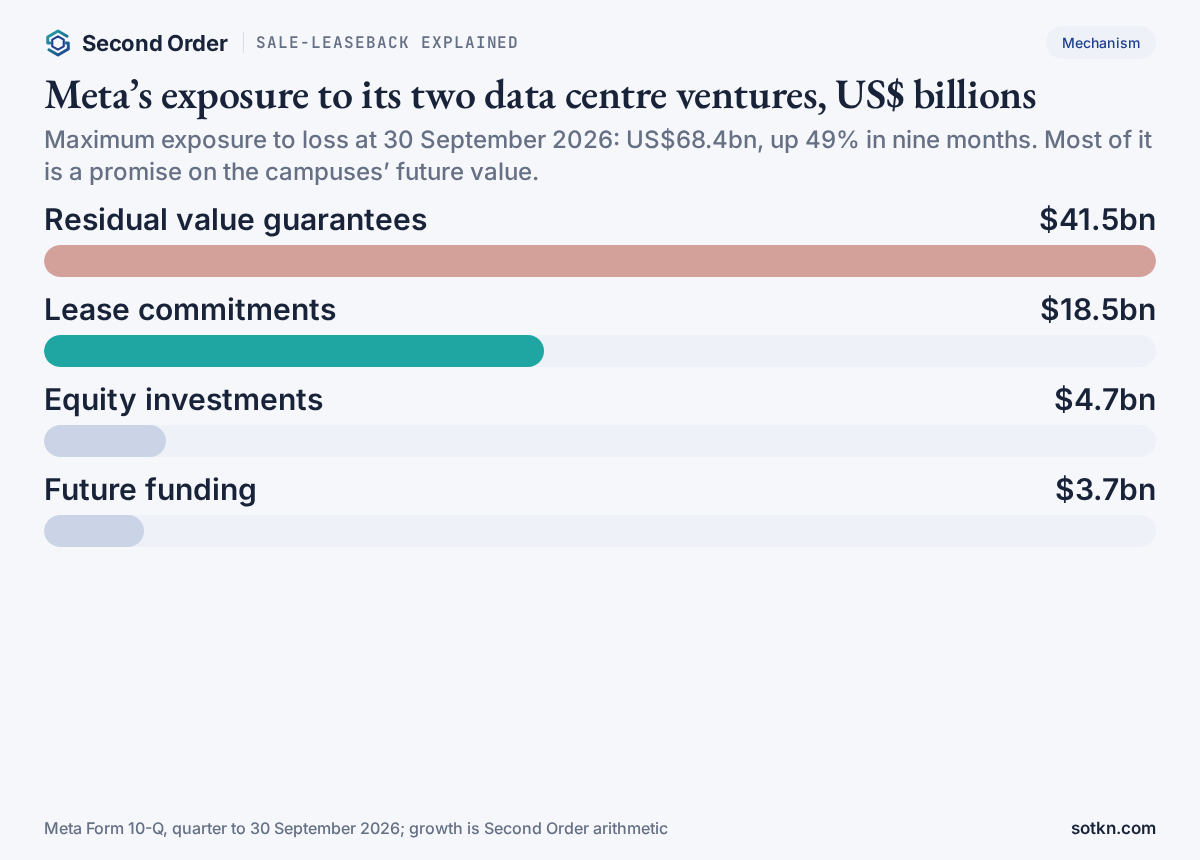
Meta’s 10-Q puts its maximum exposure to loss in the two ventures at US$68,404 million at 30 September 2026, up from US$45,952 million at the end of 2025, about 49% more in nine months, by our arithmetic. The total has four parts: US$4,732 million of equity investments, US$18,476 million of lease commitments, US$3,703 million of future funding commitments and US$41,493 million of maximum residual value guarantees.
The guarantees are about 61% of the total, by our arithmetic, and they are roughly equal to the two campuses’ combined development costs of about US$41 billion. In plain terms: if Meta stopped renewing both leases and the campuses turned out to be worth far less than the agreed thresholds, Meta could owe the ventures a large share of what they cost to build. Meta says the guarantee payments are not probable, so it has recorded no liability for them.
The ventures matter, but they are a small part of Meta’s total lease pipeline. The 10-Q also lists about US$355.73 billion of operating and finance leases that had not yet commenced at 30 September, covering data centres, energy infrastructure, colocation and network capacity, starting between the rest of 2026 and 2036. The US$18,476 million of lease commitments to the two ventures is about 5% of that, by our arithmetic.
Why does Meta not consolidate the ventures?
This is the accounting question at the heart of the structure. Each venture is a variable interest entity, which means control is decided by who directs the activities that matter most to its economics, not just by who holds most of the shares. Meta’s 10-Q says that after its analysis, the decisions that matter most are about remarketing the campus, such as negotiating with future tenants and selling individual properties. Because Meta does not have the power to direct those, it is not the primary beneficiary and does not consolidate the ventures.
The result is that the campuses and the venture debt do not sit on Meta’s balance sheet. Meta shows its 20% stakes as equity investments, discloses the lease and guarantee commitments, and records lease costs once the leases start. Meta’s 20% share of the two campuses’ roughly US$41 billion of development costs would be about US$8.2 billion; its equity investments plus remaining funding commitments come to US$8,435 million, by our arithmetic, which is close.
Who gets paid?
Our read: the seller gets cash first, the builders get paid out of the investor’s money, and the investor gets long-dated rent protected by the tenant’s guarantee. The tenant keeps the asset and the long-term risk.
- The seller, up front. Meta received about US$3 billion from Hyperion and about US$1 billion from El Paso. A closed Amazon chip deal would turn installed chips back into cash. That money funds the next round of building.
- Builders and suppliers, from the investor’s money. The ventures fund their share of construction, so contractors, electrical gear makers and other suppliers are paid from capital the investors raised, not only from the hyperscaler’s own cash. Our data centre financing Explained covers how that money is layered.
- Investors and lenders, over decades. Blue Owl’s and BlackRock’s funds own 80% of each venture, and bond investors such as PIMCO lend against the rent. They are paid by a highly rated tenant, with a residual value guarantee behind the building.
- Banks and advisers, on closing. Each deal pays arrangers, underwriters and lawyers. Meta’s Hyperion release names Morgan Stanley as its financial adviser and sole bookrunner on the private bond.
Where is the stuck step?
Our read: lease commencement. In a sale-leaseback of a finished building, rent starts on day one. In the AI version, the asset being sold is often a construction site. The investor’s money goes in at once, but the rent that services the debt starts only when the campus is finished, powered and handed over. Meta’s leases with the Texas and Louisiana ventures start in 2028 and 2029.
Until then the investors are carrying a part-built campus, and the tenant’s promise to pay rent depends on the site being delivered. The longer clock is the first renewal date. Both leases have four-year first terms. If Meta renews, the residual value guarantee stays in the background. If it does not, the guarantee decides who absorbs any fall in value. Our data centre lease Explained covers how commencement is defined.
For chips, the clock is shorter. A data centre hall can be re-let for decades; a GPU generation is overtaken in a few years. An investor buying installed chips is taking a view on what they will be worth when the lease ends. Our GPU depreciation Explained covers that question.
Sale-leaseback vs other ways to fund AI capacity
A sale-leaseback sits between borrowing and renting. A straight bond keeps the asset and the debt on the company’s books. A plain lease from a developer means the company never owned the asset in the first place. A sale-leaseback starts with ownership and converts it into a lease. A failed sale-leaseback ends up looking like a secured loan. Our GPU financing Explained, who finances GPU clusters and capex vs depreciation pages show where each one lands in the accounts.
What would change the view?
- Leases start on time. If the Texas and Louisiana campuses are handed over in 2028 and 2029 as planned, rent begins and the structure looks like cheap, long-dated money for Meta.
- A renewal is skipped. If Meta lets a four-year lease lapse, the residual value guarantee becomes real money, and the off-balance-sheet structure turns out to have carried most of the risk all along.
- The Amazon deal closes, or does not. A closed chip leaseback would show investors will fund short-lived hardware against hyperscaler rent. A quiet end to the talks would suggest the price was too high.
- Auditors or rule-setters look harder. If more AI leasebacks are judged to be finance leases, more of them will be recorded as debt, as SpaceX’s already are.
The clocks: Meta’s annual report for 2026, which will update the guarantee and lease figures; the Texas lease start in 2028 and the Louisiana lease start in 2029; the first renewal dates four years after each; and any announcement that Amazon’s chip vehicle has closed.
Common misconceptions
- People assume a sale-leaseback takes the asset off the books for good. Actually the lease still goes on the balance sheet, and if the deal fails as a sale, the asset and the debt both stay.
- People assume the seller has handed over the risk. Actually a residual value guarantee can bring most of it back. Meta’s guarantees on two campuses total up to US$41.5 billion.
- People assume a reported plan is a done deal. Actually the Amazon chip leaseback was a discussion reported by the press, not an announced transaction.
- People assume sale-leasebacks are only for buildings. Actually SpaceX and WhiteFiber have done them on AI hardware, and WhiteFiber has also been on the other side, buying property and leasing part of it back to the seller.
FAQ
What is a sale-leaseback?
A deal in which an owner sells an asset, such as a building or equipment, and leases it straight back. The seller keeps using the asset and receives cash now; the buyer owns it and collects rent.
Why would a company sell an asset and rent it back?
To turn money tied up in the asset into cash for something else, while keeping the use of it. For hyperscalers building AI capacity, that cash goes back into data centres and chips. The price is years of rent and, often, a promise about what the asset will be worth later.
Is a sale-leaseback off-balance-sheet?
Not entirely, in most cases. Under US rules the seller still records the lease as a liability. If the leaseback is a finance lease, or the seller can buy the asset back at a fixed price, the deal fails as a sale and the whole amount is treated as borrowing.
What is a failed sale-leaseback?
A sale-leaseback that does not qualify as a sale under accounting rules. The seller keeps the asset on its books, keeps depreciating it, and records the cash it received as debt. SpaceX recorded about US$12.9 billion of such debt at 30 September 2026.
What is a residual value guarantee?
A promise by the tenant to cover some of the shortfall if the asset is worth less than an agreed amount when the lease ends or is not renewed. Meta has given these guarantees on its Louisiana and Texas data centre ventures, with a maximum of US$41.5 billion at 30 September 2026.
Is Meta’s Hyperion deal a sale-leaseback?
It is a close cousin. Meta put land and a part-built campus into a venture it owns 20% of, took about US$3 billion out, and agreed to lease the finished campus. Meta does not consolidate the venture, so the campus does not sit on its balance sheet as property.
Did Amazon sell its Nvidia chips and lease them back?
Not as far as public reports show. In October 2026 the Financial Times reported that Amazon was considering moving about US$8 billion of installed Nvidia chips into a special purpose vehicle and leasing them back. No closed deal had been announced when this page was reviewed.
Is this advice to buy or sell any company?
No. This page explains how sale-leasebacks work and who they pay. It does not rank companies as investments or give buy or sell calls. Not investment advice. Do your own research.
Related: finance lease vs operating lease; data centre lease; data centre financing; GPU financing; AI capex; free cash flow; Meta’s leases not yet started.
Stack doors
Layer: Hyperscalers. Players: Meta and Amazon. Start with what a hyperscaler is.
Get the Wire — short daily notes on where AI computing gets built and who pays for it.
Not investment advice. Do your own research.
How we check this
Meta’s data centre ventures, lease terms, residual value guarantees, maximum exposure to loss, leases not yet commenced, capital spending and notes outstanding come from its Form 10-Q for the quarter to 30 September 2026, filed on 22 October 2026. Deal terms for Hyperion and El Paso come from Meta’s releases of 21 October 2025 and 28 July 2026. Meta’s November 2026 bond sales come from its Form 8-K filings for offerings completed on 5 and 12 November 2026. SpaceX’s failed sale-leaseback debt and interest come from its Form 10-Q filed on 22 October 2026. WhiteFiber’s server sale-leasebacks and Yadkinville purchase come from its Form 10-Q filed on 10 November 2026. The Amazon chip discussion comes from Investopedia’s report of a Financial Times story on 2 October 2026; it is a reported plan, not a closed deal. Accounting descriptions follow PwC’s public leases guide on ASC 842-40. Accounting descriptions are a simplified guide, not a replacement for each company’s notes. Company statements about plans and timing are their own outlooks, not facts about the future. Percentages, sums and multiples are our arithmetic, checked in code and labelled as ours on the page. We do not convert currencies. Who gets paid and the stuck step are our read. The featured photograph is credited in its caption. This page explains a mechanism and who it pays. It does not rank companies as investments or give buy or sell calls. Not investment advice. Do your own research.
Last reviewed: 15 Nov 2026 · Next review: after Meta’s 2026 annual report and any closed Amazon chip leaseback
Spot an error? Tell us and we will correct it and note the change here.
References
- Meta Platforms — Quarterly report on Form 10-Q for the quarter ended 30 September 2026 (filed 22 Oct 2026) — Louisiana and Texas data center ventures: 20% interests, development costs, lease start dates and terms, residual value guarantees, maximum exposure to loss; leases not yet commenced; capital spending; notes outstanding
- Meta — Meta announces joint venture with funds managed by Blue Owl Capital to develop Hyperion data center (21 Oct 2025) — 80/20 ownership, about US$27 billion of development costs, contribution of held-for-sale land and construction-in-progress, about US$7 billion of cash in and about US$3 billion distributed to Meta, operating leases, residual value guarantee
- Meta — Meta announces new strategic venture with BlackRock to develop data center in El Paso (28 Jul 2026) — 1 GW campus, about US$14 billion of development costs, Meta contribution of about US$2.3 billion and distribution of about US$1 billion, US$12.5 billion debt financing, four-year initial lease, residual value guarantee threshold of about US$13 billion
- Meta Platforms — Current report on Form 8-K, US dollar notes offering (completed 5 Nov 2026) — US$15.0 billion of senior notes in five tranches due 2031 to 2056
- Meta Platforms — Current report on Form 8-K, euro notes offering (completed 12 Nov 2026) — €9.0 billion of senior notes in six tranches due 2031 to 2065
- Space Exploration Technologies — Quarterly report on Form 10-Q for the quarter ended 30 September 2026 (filed 22 Oct 2026) — Sale-leasebacks of Super Intelligence infrastructure assets recorded as failed sale-leasebacks: debt of US$2,181 million current and US$10,716 million non-current; Valor transactions and interest expense
- WhiteFiber — Quarterly report on Form 10-Q for the quarter ended 30 September 2026 (filed 10 Nov 2026) — Sale-leaseback of 96 AI servers (768 GPUs) for three years; agreement for 128 servers (1,024 GPUs); Yadkinville property purchase with partial leaseback to the seller
- Investopedia — Amazon looks to offload $8B of Nvidia AI chips from its balance sheet (2 Oct 2026) — Report of Financial Times story: Amazon considering moving about US$8 billion of installed Nvidia chips into a special purpose vehicle and leasing them back
- PwC Viewpoint — Leases guide 6.3, Sale and leaseback: determining whether a sale has occurred — A leaseback classified as a finance lease means no sale has occurred; repurchase options generally preclude sale accounting
- PwC Viewpoint — Leases guide 6.5, Failed sale and leaseback transaction — ASC 842-40-25-5: a failed sale is accounted for as a financing; the seller keeps and depreciates the asset and records a financial liability