If $1.1 Trillion of Signed Leases Waits on Handover, Where Does Cash Stick?
Microsoft, Oracle, Meta, Amazon and Alphabet have signed about $1.1 trillion of data centre leases that start only at handover, 3.3 times a year ago. Who gets paid first, who waits, three scenarios with the arithmetic shown.
ANALYSIS · MEMBERS CONTINUE · 5 min free / 14 min full · Data as at 22 Oct 2026
Five of the biggest buyers of AI computing have now signed about US$1.1 trillion of data centre leases that have not started. A year ago the same footnotes added up to about US$338 billion. None of it sits on a balance sheet yet. It is paid only when each hall is handed over, powered and ready to use. If that pile keeps waiting on handover, where does the cash stick?
In short
- The question: big tech has signed a trillion dollars of halls it pays for later. Who is paid before handover, and who waits?
- The answer: Scenario B. The handover, not the signature, is the stuck step. Cash sticks first with chip and component sellers, who are now asking for money in advance; then with builders and the lenders who fund the shells, protected by big tech's guarantees; then with utilities. Landlords are paid only from handover. Big tech's shareholders carry the bill from that day, and developers on sites without a firm power date wait longest
- Why: leases signed but not yet started reached US$329.1 billion at Microsoft, US$288 billion at Oracle, US$278.99 billion at Meta, US$137.2 billion at Amazon and US$85.2 billion at Alphabet in the latest filings. Together that is about US$1.12 trillion, 3.3 times a year earlier (our sum)
- The squeeze: Meta's free cash turned negative, minus US$2.12 billion, in the quarter it reported on 21 October; Alphabet's in the first half was about US$4.3 billion; Amazon's over the past year about minus US$7.6 billion; Oracle's capital spending beat its operating cash by US$5.4 billion last quarter, even with US$11.4 billion of customer prepayments (our arithmetic from the filings)
- What would break it: halls slipping in bulk as power dates move, as in Essex this week (A), or revenue growing into the bill (C). Nothing here is a recommendation
What's in this piece: the numbers that matter · why the handover became the clock · what the map assumes in one line · members from here · who gets paid, in order · three scenarios, arithmetic shown · our read · what would change the view, with dates · practical takeaways · FAQ · references
The numbers that matter
| What | Figure | Date | What it tells us |
|---|---|---|---|
| Microsoft leases signed, not started | US$329.1B, from US$196.6B three months earlier and US$92.7B a year earlier | Form 10-K, 30 Jun 2026 | Up US$132.5B in one quarter (ours); "some arrangements subject to certain contractual conditions" |
| Oracle | US$288B, from US$99.8B a year earlier | Form 10-Q, 31 Aug 2026 | Start between late 2026 and fiscal 2029; terms of 15 to 19 years |
| Meta | US$278.99B, from US$52.56B a year earlier; plus about US$68B signed in July | Form 10-Q, 30 Jun 2026 | Start from 2026 to 2036; the September-quarter footnote comes with the 10-Q |
| Meta's latest quarter | Operating cash US$32.79B; free cash minus US$2.12B; 2026 capital spending guided to US$135–145B | Results, 21 Oct 2026 | Its own building now uses all of its operating cash |
| Amazon | US$137.2B, from US$68.9B a year earlier | Form 10-Q, 30 Jun 2026 | 68% of the payments fall after 2030 (ours) |
| Alphabet | US$85.2B, from US$23.9B a year earlier; plus a US$5.8B short-term lease | Form 10-Q, 30 Jun 2026 | Start between 2026 and 2031; terms of up to 26 years |
| The five together | About US$1.12T, from about US$338B (ours) | Latest filings | 3.3 times in a year; about 1.5 years of combined operating cash (ours) |
| Alphabet's backstops | US$43.8B of guarantees on other parties' data centre payments, from US$16.9B at end-2025 | Form 10-Q, 30 Jun 2026 | Alphabet's credit now stands behind other people's halls |
| Meta's Louisiana campus | About US$27B to build; leases start 2029; residual value guarantee about US$28B | Form 10-Q, 30 Jun 2026 | Meta's maximum loss on the venture: US$46.03B |
| Cloud spending | Nine biggest cloud buyers: US$957B in 2026, more than US$1.5T in 2027 | TrendForce, 14 Oct 2026 | Some component suppliers now ask for payment in advance |
| A tenant walks | Microsoft reportedly left a 23,000-GPU Essex site after the grid date moved to the 2030s | Reported 18 Oct 2026 | A tenant can step back before handover |
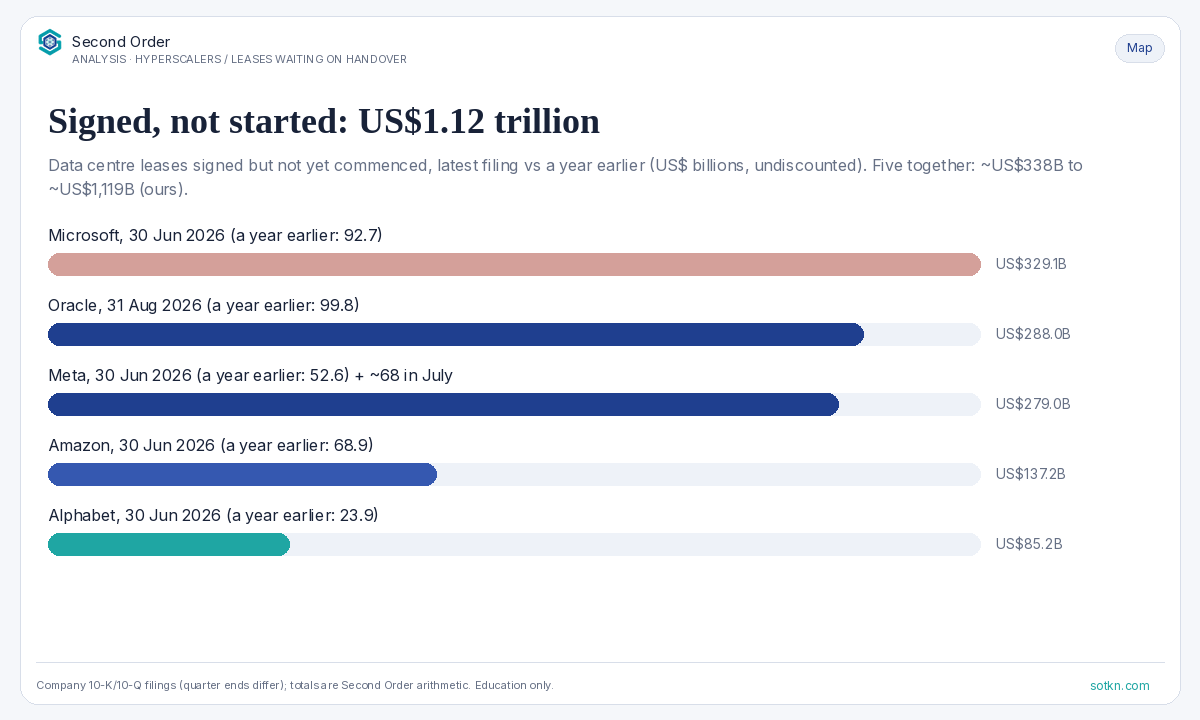
Chart 1 — Data centre leases signed but not yet started, latest filing against a year earlier. Company filings; totals are Second Order arithmetic. Education only.
Why did the handover become the clock?
A big cloud company builds some halls itself, which shows up as capital spending, and leases the rest from developers and landlords. The pile sits in the leases. Our Data Center Leases Explained page covers the mechanics, and the Hyperscalers layer shows where the buyers sit in the chain.
A lease starts on the day the hall is handed over: built, connected to power, ready to use. Until then the tenant records nothing on its balance sheet and, in most cases, pays nothing. Someone else pays to pour the concrete, buy the transformers and wait for the grid.
Those footnotes have tripled in a year. Microsoft added a net US$132.5 billion in a single quarter; Meta signed about US$68 billion more in July alone. The cash these companies spend directly has climbed too. TrendForce raised its forecast on 14 October and now expects the nine largest cloud buyers to spend US$957 billion this year and more than US$1.5 trillion in 2027, partly because some component suppliers want to be paid before they ship.
So big tech is paying for chips earlier and for halls later, and on 21 October Meta showed what that does: its own spending used all of its quarter's operating cash before a dollar of the new leases fell due. The gap between the two is the whole map. The question is no longer whether demand is real; the signed leases say it is. It is who carries a trillion dollars of halls between the signature and the handover, and what happens when the handover slips. That happened this week in Essex, where Microsoft reportedly walked away from a 23,000-GPU site after the grid operator said full power would not come until the 2030s. Our Loughton Catalyst has the detail.
What does the map already assume?
Three answers compete:
- The handover slips. Power dates move, tenants use their conditions to leave, and developers carry finished or half-finished shells longer than planned. Big tech's bill arrives later and smaller
- The handover lands, in stages. Most halls arrive roughly inside the start windows the filings give. Developers' lenders fund the build, landlords are paid from handover, and big tech's lease bill becomes a large new fixed cost
- The bind eases. Halls arrive early, power is found, and AI revenue grows fast enough that the lease bill barely dents free cash
Our read, in one line: the map already assumes Scenario B. The handover, not the signature, is the stuck step. Cash sticks first with chip and component sellers paid in advance, then with builders and the lenders who fund the shells against big tech's guarantees, then with utilities. Landlords are paid only from handover; big tech's shareholders carry the bill from that day; developers on sites without a firm power date wait longest. The scenarios and the arithmetic are below.
The free preview ends here.
—— Still to read · ~9 of 14 minutes ——
MEMBERS CONTINUE HERE
- Who gets paid, in order, and who waits
- What the pile adds up to in years of cash
- Three scenarios with the arithmetic
- The guarantees standing behind the shells
- Five practical takeaways
- Members' FAQ