EUV vs DUV: Two Kinds of Chip Lithography and Who Gets Paid
EUV and DUV are the two kinds of light used to print chips. EUV prints the finest layers in one pass and costs about €231 million a machine; DUV prints most layers for about €83 million. The stuck step is the EUV box, not the DUV one.

EXPLAINED · Versus · Last reviewed: 11 Oct 2026 · Next review: after ASML’s Q3 2026 results (14 Oct 2026)
EUV and DUV are the two kinds of light chipmakers use to print circuits on silicon. EUV uses 13.5-nanometre light for the finest layers; DUV uses longer 193- or 248-nanometre light for most of the rest.
In short. EUV and DUV both print chip patterns with light. EUV prints the finest layers in one pass; DUV prints most layers and needs several passes for fine ones. In the first half of 2026 ASML sold 32 EUV machines for €7.9 billion and 138 DUV machines for €4.6 billion. One Low-NA EUV machine averaged about €231 million, nearly three times an immersion DUV machine. The stuck step is the EUV box: about 65 this year, and 2027 already close to fully ordered.
Why an investor cares: the two machines carry very different cheques. EUV is where the money per machine is, and it decides how many leading-edge AI chips and advanced memory wafers can be printed. DUV is where most of the units are, and most of ASML’s China business. For how EUV works on its own, see EUV lithography explained.
What is the difference between EUV and DUV?
EUV uses much shorter light, so it can print a finer line in one exposure. DUV uses longer light, so for the finest lines a chipmaker has to print the same layer several times and stitch the result together. That is called multi-patterning.
| EUV vs DUV at a glance |
|---|
| Light: EUV uses 13.5-nanometre light. DUV uses 193 nm (ArF, dry or immersion) or 248 nm (KrF); ASML also sells older 365 nm i-line tools in the same range. |
| Finest line in one pass: 13 nm on ASML’s NXE:3800E EUV machine; 38 nm on its NXT:2100i immersion DUV machine (listed as 38 nm or less). |
| Speed: at least 220 wafers an hour for the NXE:3800E; 295 for the NXT:2100i. |
| Price per machine: about €231 million for Low-NA EUV and €396 million for High-NA, against €83 million for immersion DUV and €12 million for KrF (first half of 2026, sales ÷ units, our arithmetic). |
| Who makes it: EUV, ASML only. DUV, ASML, Canon and Nikon. |
| Export rules: EUV sales need a licence. ASML’s advanced immersion DUV models (NXT:1970i and newer) also need a Dutch licence. |
From ASML’s product pages (read 11 Oct 2026), its 2025 annual report and its first-half 2026 interim report. Prices are Second Order arithmetic.
ASML’s 2025 annual report puts it simply: DUV machines are the workhorses of the industry and print the majority of layers in microchips. EUV is used for the most intricate, critical layers on the most advanced chips. The two run side by side in the same fab, and ASML describes its newest EUV machine as complementary to its immersion DUV machines.
What is DUV lithography?
DUV means deep ultraviolet. Most DUV machines use an argon fluoride laser at 193 nanometres. The most advanced kind, immersion DUV, puts a thin layer of ultrapure water between the lens and the wafer, which lets the lens print finer lines. Dry DUV skips the water. Older KrF machines use 248-nanometre light for less critical layers.
DUV is not old news. ASML expects to ship about 130 immersion machines in 2026, similar to 2025, and plans 30% more immersion capacity for 2027.
Is EUV better than DUV?
For the finest layers, yes. ASML’s annual report says moving from multi-patterning on DUV to a single EUV exposure cuts the number of masks and process steps and improves yield. That is why memory makers are switching: ASML told investors on 15 July 2026 that its memory-related system sales should grow more than 75% this year, driven partly by DRAM makers replacing multi-patterning with what it called more cost-effective single-exposure EUV.
For everything else, DUV wins on cost and speed. An NXT:2100i immersion machine runs 295 wafers an hour against at least 220 for the NXE:3800E EUV machine. Per wafer-hour of capacity, the EUV machine costs about €1.05 million and the immersion machine about €0.28 million, roughly 3.7 times less (€231 million ÷ 220 and €83 million ÷ 295, our arithmetic; tool price only, before power, masks and yield). So EUV only pays where it replaces several DUV passes.
How much does an EUV machine cost compared with DUV?
ASML does not publish list prices, but its first-half 2026 interim report gives units and sales for each type. Dividing one by the other gives the average price.
| What ASML sold in the first half of 2026 |
|---|
| High-NA EUV (EXE): 3 systems, €1,189 million, about €396 million each. |
| Low-NA EUV (NXE): 29 systems, €6,709 million, about €231 million each (24 systems a year earlier). |
| DUV immersion (ArFi): 40 systems, €3,332 million, about €83 million each (56 systems a year earlier). |
| DUV dry ArF: 13 systems, €367 million, about €28 million each. |
| DUV KrF: 65 systems, €773 million, about €12 million each. |
| i-line: 20 systems, €113 million, about €5.7 million each. |
| All lithography and inspection: 274 systems, €12,844 million. |
ASML interim report, 15 Jul 2026. “Each” is sales divided by units, Second Order arithmetic; ASML does not publish list prices.
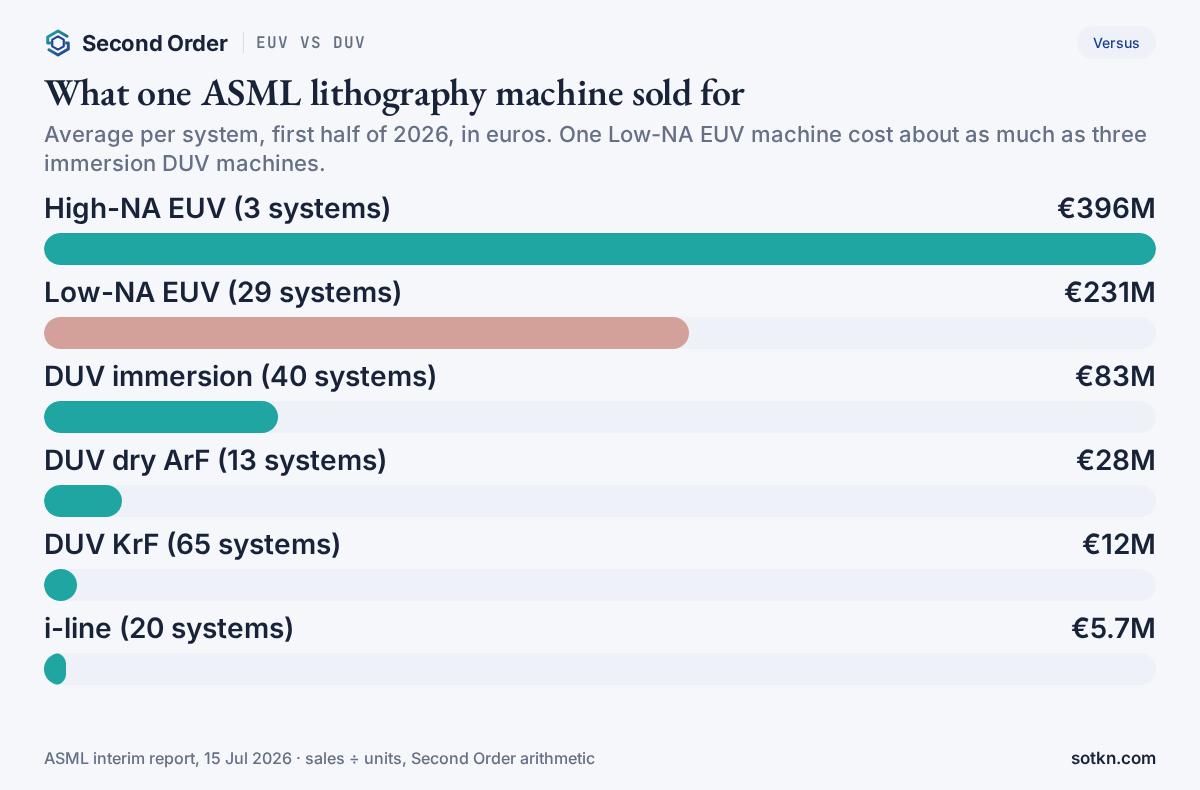
The split is lopsided. EUV was 32 of the 274 systems ASML sold, about 12%, but €7.9 billion of €12.8 billion of system sales, about 61%. DUV was 138 systems, about half the units, and €4.6 billion, about 36% (our arithmetic).
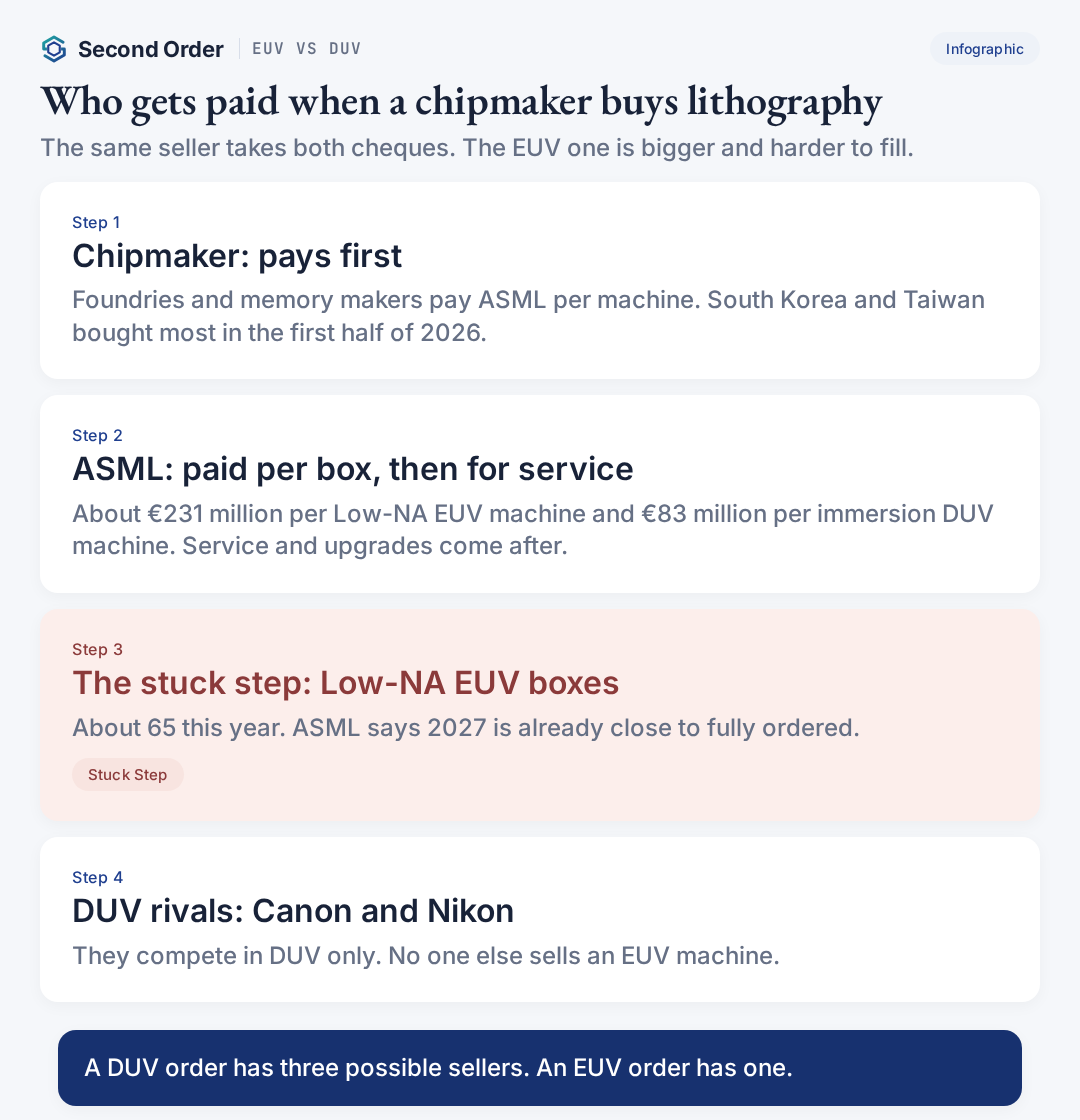
Who gets paid: EUV vs DUV
The money moves in a set order, and the same seller takes both cheques.
- 1. The chipmaker pays first. Foundries and memory makers buy the machines long before the chips sell. In the first half of 2026 ASML’s sales went mostly to South Korea (€7.1 billion) and Taiwan (€5.1 billion), then China (€2.9 billion), the US (€1.9 billion), Japan (€0.4 billion) and Singapore (€0.2 billion). See how Korea allocates DRAM wafers to HBM and TSMC’s capex split.
- 2. ASML is paid per box, then for service. Each Low-NA EUV box brings in nearly three times an immersion DUV box. Service and upgrades on machines already in fabs brought in another €2.8 billion in the second quarter. How that model works: what ASML does.
- 3. The suppliers inside the box. Carl Zeiss SMT is ASML’s only supplier of lenses, mirrors and other optics, and ASML says Zeiss capacity limits how many machines it can build. More in who makes EUV machines.
- 4. The DUV rivals. Canon and Nikon sell DUV machines and compete directly with ASML there. Neither sells an EUV machine. The wider tool map is in who makes wafer fab equipment.
Where is the stuck step?
The EUV box. ASML expects to ship about 65 Low-NA EUV machines in 2026 and said on 15 July that 2027 is already close to fully covered with orders. It is adding about 30% capacity for 2027, to roughly 85 machines (65 × 1.3, our arithmetic), and is only investigating another 30% for 2028. It recognised 29 Low-NA machines in the first half, so the second half has to be bigger (shipments and recognised sales are not the same count).
DUV has room the EUV queue does not. Immersion shipments of about 130 are similar to last year, and Canon and Nikon offer other places to buy. A chip that needs an EUV layer has one queue, so AI chips on 3- and 2-nanometre processes and the newest DRAM behind HBM wait on the same box. After printing, the die still needs a packaging slot, a separate clock covered in CoWoS explained.
China is the DUV side of the story. ASML expects China-related business to be around 20% of 2026 sales, mainly mainstream logic, which runs mostly on DUV (our read). China’s share fell to about 16% of ASML’s sales in the first half of 2026 from 24% a year earlier (our arithmetic). Without EUV, Chinese foundries print fine layers with DUV multi-patterning, which uses more tool time per wafer (our read). Our China note on SMIC’s margin guide shows that bind.
What would prove this wrong?
- EUV shipments slip for lack of buyers. If ASML’s Q3 or Q4 shows Low-NA shipments behind the ~65 plan because customers delay, not because of supply, the box stops binding and chip demand becomes the limit.
- High-NA takes over layers quickly. If High-NA machines replace several Low-NA steps sooner than expected, the stuck step moves to the €396 million box.
- DRAM makers slow the switch. If memory makers keep multi-patterning on DUV, immersion orders rise and EUV demand eases.
What to check next
ASML reports third-quarter results on Wednesday 14 October 2026, at 07:00 Amsterdam time (13:00 in Singapore). Look for EUV units against the ~65 plan, whether 2027 is now fully ordered, any decision on the extra 30% for 2028, and the China share against ~20%. Our Wire on TSMC’s September sales shows the buyer side.
Common misconceptions
- People assume DUV is obsolete. Actually DUV prints the majority of chip layers, and ASML plans about 130 immersion machines in 2026 plus 30% more capacity in 2027.
- People assume an EUV layer costs about the same as a DUV layer. Actually the EUV machine costs about 3.7 times more per wafer-hour; it pays only where it replaces several DUV passes.
- People assume China’s ASML purchases include EUV. Actually ASML ties its China sales to mainstream logic, and its 2025 report says non-EUV sales were driven mainly by that China business. EUV sales need a licence.
FAQ
What is the difference between EUV and DUV?
EUV uses 13.5-nanometre light and prints the finest chip layers in one pass. DUV uses 193- or 248-nanometre light and prints most other layers; for fine ones it has to expose the same layer several times.
Is EUV better than DUV?
For the finest layers on leading chips, yes, because one EUV pass replaces several DUV passes. But a DUV machine is faster per hour and far cheaper, so most layers still run on DUV.
How much does an EUV machine cost compared with DUV?
ASML does not publish list prices. In the first half of 2026 it booked about €231 million per Low-NA EUV system, €396 million per High-NA system and €83 million per immersion DUV system (sales divided by units, our arithmetic).
Who makes DUV and EUV machines?
ASML is the only maker of EUV machines. In DUV it competes with Canon and Nikon.
Can China buy EUV machines?
EUV sales need an export licence. ASML ties its China sales to mainstream logic, which runs mostly on DUV, and its most advanced DUV immersion models also need a Dutch licence.
Is this a list of stocks to buy or sell?
No. Second Order Explained pages explain how the money moves. They do not give buy or sell calls.
Related terms: EUV lithography; who makes EUV machines; HBM vs DDR5; hybrid bonding.
Stack doors
Layer: Semiconductors. Also: Hyperscalers, Neoclouds, AI Data Centers. Markets: Taiwan, Korea, China.
Get the Wire — short daily notes when chip tools, memory and capacity move.
How we check this
Machine counts, sales and plans come from ASML’s own filings, investor call and product pages, listed under References. Each was re-checked on 11 Oct 2026. Where we work something out ourselves, such as the price per machine, the arithmetic is shown and labelled “our arithmetic”. This page explains how the money moves. It does not give buy or sell calls.
Last reviewed: 11 Oct 2026 · Next review: after ASML’s Q3 2026 results (14 Oct 2026)
Spot an error? Tell us and we will correct it and note the change here.
References
- ASML — Statutory Interim Report 2026, first half (SEC Form 6-K, 15 Jul 2026) — system sales and units by technology and by region
- ASML — 2026 second-quarter results press release (SEC Form 6-K, 15 Jul 2026) — EUV and immersion capacity plans for 2027 and 2028
- ASML — Q2 2026 investor call transcript (15 Jul 2026) — shipment plans, memory and China commentary, 2027 order cover
- ASML — Annual Report 2025 on Form 20-F (filed 25 Feb 2026) — only EUV maker, DUV rivals, wavelengths, single vs multi-patterning
- ASML — TWINSCAN NXE:3800E product page (read 11 Oct 2026) — EUV wavelength, resolution and wafers per hour
- ASML — TWINSCAN NXT:2100i product page (read 11 Oct 2026) — DUV immersion wavelength, resolution and wafers per hour
- ASML — Statement on the Dutch government’s updated export licence requirement (6 Sep 2024) — licences for advanced DUV immersion and EUV
- ASML — Quarterly results page with Q3 2026 results date (read 11 Oct 2026) — Q3 results on 14 Oct 2026