What Is a Modular Data Center? Who Builds It, Who Gets Paid
A modular data center is built as tested modules in a factory, then shipped and lifted into place. It can halve the build and moves the money from the site to the factory: Vertiv, Eaton, Brightray, DXN. It does not bring the grid connection forward, so power still sets the date.
EXPLAINED · Mechanism · Last reviewed: 12 Nov 2026 · Next review: after Vertiv’s fourth-quarter 2026 results and first 2027 guidance (February 2027) and DXN’s half-year report
A modular data center is one whose power, cooling and computer rooms are built and tested as large modules in a factory, then shipped to the site and lifted onto a prepared slab, instead of being assembled piece by piece on site. That can roughly halve the build and moves the work, and the money, from the building site to the factory floor, but it does not bring the grid connection any closer, so power still sets the opening date.
In short. A modular data center is built in a factory, in blocks, and assembled on site. The makers say that turns an 18 to 36 month build into six to nine months for a full prefabricated block, or cuts deployment time by up to half for factory-built power and cooling. Who gets paid: the factory owner, earlier and per module (Vertiv, Eaton through Fibrebond, Brightray in Johor, DXN in Australia), while site crews do less of the work. The stuck step does not move: a finished module still waits for the substation and grid connection, and the factories themselves are becoming a queue.
Why an investor cares: the AI build-out is short of time more than it is short of money, and modular building is the industry’s main answer to the part of the delay it can control. When the work moves into a factory, so does the revenue, and the companies that own those factories get paid sooner and on a more predictable schedule than a building site. This page builds on what an AI data center is and how long one takes to build, and answers one question: what is a modular data center, and who gets paid when data centers are built in factories?
What is a modular data center?
It is a way of building, not a kind of computing. A modular data center does the same job as any other: it holds servers, feeds them power, takes the heat away and keeps them running. The difference is where it is made. In a conventional, or stick-built, data center, crews assemble the electrical rooms, the cooling plant, the cable trays and the pipework inside the building, in sequence. In a modular one, those pieces arrive finished, tested and ready to connect.
“Modular” covers four quite different things, and headlines rarely say which one they mean.
- Containerised units. A complete small data center in a box the size of a shipping container, or a few of them. They suit edge sites, remote locations and pilots. DXN’s first AI contract, a 1.36 MW modular data center for a US-listed neocloud, is at this scale.
- Factory-built power rooms. Switchgear, transformers and backup power equipment installed and wired inside a steel enclosure, often called an e-house, then trucked to site. This is what Fibrebond makes, and why Eaton bought it. Our page on who makes data center power equipment covers the gear that goes inside.
- Factory-built fit-out. The overhead layer above the racks, with busbar power, liquid-cooling pipework, hot-aisle containment and network trays, built as one prefabricated unit and lifted in. Vertiv’s SmartRun is the clearest example; Vertiv says it installs up to 85% faster on site than stick-built work.
- Full prefabricated buildings. The whole hall, shell included, made as blocks in a factory and assembled on a slab. Vertiv’s OneCore comes in 5 to 50 MW blocks; Brightray says more than 90% of its full-prefab facilities is built, integrated and tested in its factory.
Most big AI projects mix the four: a conventional or factory-made shell, factory-built power rooms outside it, and a prefabricated fit-out inside. The building owner, often a developer or landlord, decides how much to buy finished; our page on who builds AI data centers explains those roles.
How does a modular build work?
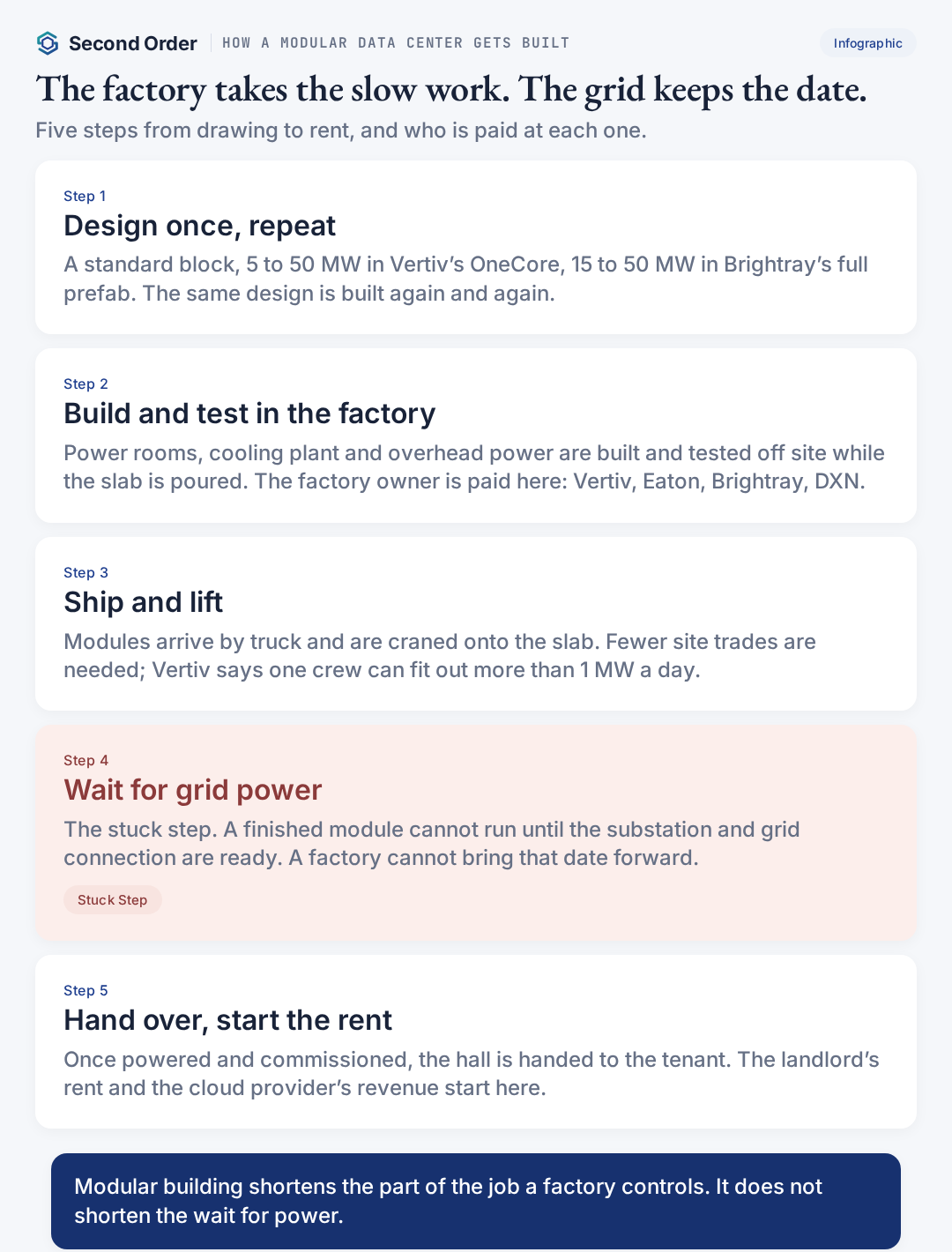
The trick is doing two jobs at once. In a stick-built project, most of the electrical and mechanical work can only start once the building is up. In a modular one, the factory builds the power and cooling modules while the site is graded, the foundations are poured and the utility works begin. Vertiv’s chief executive put it plainly on 28 October 2026: factory-built, modularly deployed infrastructure “happens in parallel with site preparation” and “cuts deployment time by up to half.”
- 1. Design a standard block. The same module design is reused across sites, so engineering is done once rather than for each hall.
- 2. Build and test in the factory. Modules are assembled on a production line and tested before they leave, which moves quality checks off the building site.
- 3. Ship and lift. Trucks deliver the modules and cranes set them on the slab. Vertiv says one crew can install more than 1 MW of SmartRun a day.
- 4. Connect to power. The modules are joined to the site’s substation and the grid. Our power distribution explainer walks through that path from grid to chip.
- 5. Commission and hand over. The hall is tested as a whole, then handed to the tenant, which is when rent starts.
How much faster is a modular data center?
The makers’ claims are large. Brightray, now 60% owned by Nasdaq-listed BUUU Group, says its full-prefab blocks of 15 to 50 MW take six to nine months against 18 to 36 months for a conventional build, and its factory-built interiors about 7 to 14 months. At its Sedenak Tech Park campus in Johor, it says the first 20 MW was built in eight months. Vertiv says up to half for its modular approach, and up to 85% faster on site for the SmartRun overhead layer alone.
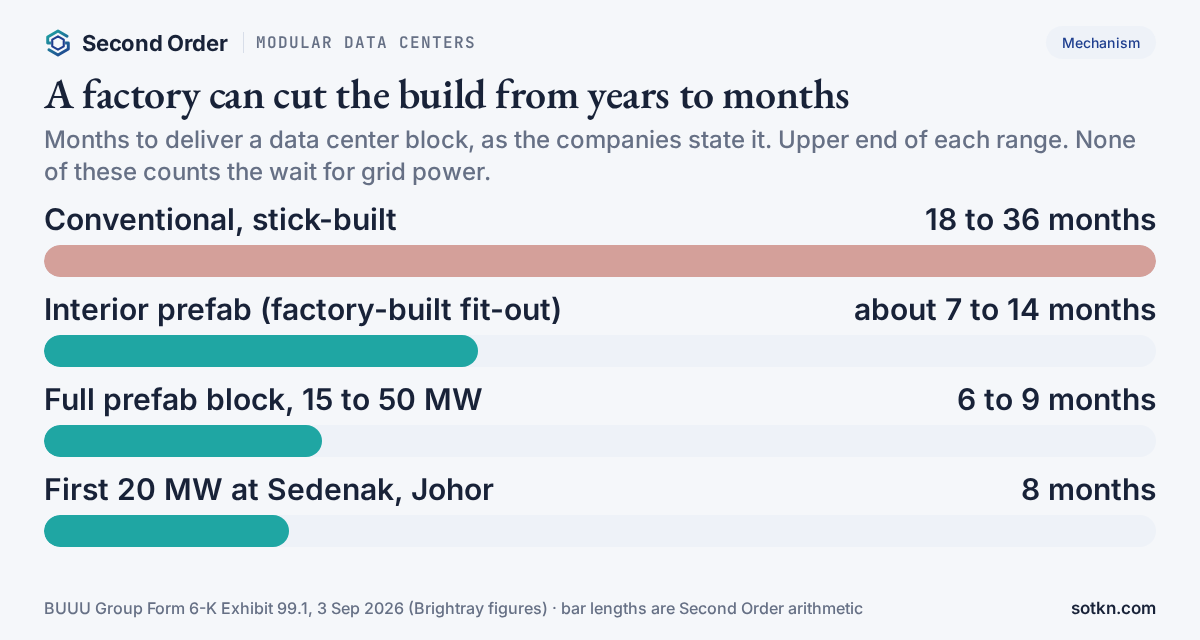
Three things to keep in mind when reading those numbers. They are sales claims from the companies that sell modules. They measure different things: a whole block, an interior, or one layer of the fit-out. And none of them starts the clock on the day the owner asked the utility for power. BUUU’s own pitch puts the value of the time saved at about $14.2 million for each month of delay on a 60 MW facility, a figure it attributes to outside research; that is the reason buyers pay for speed, but it only counts if the power is there to use.
Our view: modular building is a real speed-up for the part of the job that happens inside the fence. For the full timeline, including the grid, see how long it takes to build an AI data center.
Who makes modular data centers?
Two groups. The large electrical and thermal equipment makers are folding modules into what they already sell, and specialist integrators, several of them in Asia, build whole facilities in factories.
| Company | What it builds | Size or scale it states | What it has disclosed |
|---|---|---|---|
| Vertiv (US) | OneCore: a whole prefabricated data center in a Vertiv steel shell. SmartRun: factory-built power, pipework and containment above the racks | OneCore 5 to 50 MW per block, 96 to 944 racks; SmartRun more than 1 MW a day per crew | Q3 2026 sales $4,313 million, up 61%; APAC up 50%; says factory-built modules cut deployment time by up to half |
| Eaton / Fibrebond (US) | Pre-integrated modular power enclosures: switchgear and UPS rooms built and wired in a factory | Fibrebond revenue about $378 million in the 12 months to February 2025 | Eaton paid $1.4 billion in April 2025, about 12.7 times Fibrebond’s estimated 2025 adjusted EBITDA (our arithmetic) |
| Brightray / BUUU Group (Johor; BUUU moving to Singapore) | Full prefabricated buildings, factory-built interiors, and containerised units | 15 to 50 MW blocks; 300 MW a year of factory capacity | 120 MW Sedenak Tech Park campus in Johor, 70 MW running, first 20 MW in eight months; about 2 GW pipeline |
| DXN (Australia, ASX) | Modular data centers and edge units; Johor factory opening | First AI contract: 1.36 MW | Backlog $40.9 million at 30 August 2026; about 45% to turn into revenue in the six months to December 2026 |
| TECO (Taiwan; Malaysia base) | Modular data centers built from five core modules: IT, cooling, power, generator and energy management | Ongoing 10 MW modular project | Showed its modules at Data Centre World Singapore in September 2026; regional base in Malaysia |
DXN reports in Australian dollars. Figures are the companies’ own statements, dated April 2025 to October 2026. Full list under References.
What does a modular data center cost?
There is no list price, because scope varies so much: a power room, a fit-out and a whole building are different purchases. Two disclosed numbers give a rough range.
- BUUU Group’s pipeline. BUUU says Brightray’s pipeline is expected to reach about 2 GW, worth about $9 billion of potential contract value. That is about $4.5 million per megawatt (our arithmetic), for a mostly full-prefab scope, subject to final agreements.
- DXN’s first AI contract. About $8.8 million, in Australian dollars, for a 1.36 MW AI modular data center, signed in June 2026. That is about $6.5 million per megawatt (our arithmetic). Small units cost more per megawatt than big blocks.
Neither document lists exactly what is included, and neither figure covers the chips and servers, which are bought separately and cost far more. Our page on what an AI data center costs splits the full bill.
Who gets paid, and when?
Follow where the work goes. In a stick-built project, a large share of the money goes to the general contractor and the local trades, and it is paid in stages as the site progresses over two or three years. In a modular project, more of it goes to whoever owns the factory, and it is paid as modules are built and shipped.
- Factory owners, first and faster. DXN shows the effect at small scale. Its FY26 revenue was $10.1 million. It expects about 45% of its $40.9 million backlog to turn into revenue in the six months to December 2026, about $18.4 million, or roughly 1.8 times last year’s full revenue in half a year (our arithmetic). Factory output, not site progress, sets the pace of billing.
- Equipment makers, buying in. Eaton paid $1.4 billion for Fibrebond in April 2025, about 12.7 times its estimated 2025 adjusted EBITDA and about 3.7 times its trailing revenue (our arithmetic). Eaton’s quarterly report shows $541 million of that as goodwill and $410 million as customer relationships, which tells you it was paying for access to data center buyers. Vertiv, the biggest name in the space, grew third-quarter 2026 sales 61% to $4,313 million and says customers still place orders about 12 to 18 months ahead. See our Analysis on Vertiv’s prepaid gear line and Catalyst on Vertiv’s customer prepayments.
- Site contractors, less. Modules need slabs, cranes and connections, but fewer electricians and pipefitters on site. Vertiv markets SmartRun as reducing labour needs. In markets short of skilled trades, that is the point; for local contractors it means a smaller share of each project.
- Landlords and tenants, sooner, if the power is ready. A lease starts paying when the hall is handed over. Building faster brings that date forward only when the grid connection is already in hand. Our data center lease explainer shows how rent starts.
Where is the stuck step?
In two places, and neither is the building.
The grid. A module finished in eight months still needs a substation, a high-voltage connection and enough power from the utility. If that is two years away, the module waits, finished, for two years. Modular building shortens the part of the timeline a factory controls; it does nothing for the part a utility controls. Our Malaysia Pulse on Johor’s grid connections shows what that wait looks like in practice.
The factory slot. As more buyers go modular, the factories become the queue. Brightray says it has 300 MW a year of factory capacity and targets about 1 GW of deliveries over three fiscal years, about 333 MW a year, which is more than its stated capacity (our arithmetic). DXN raised $7.0 million to add factory capacity and is opening plants in Johor and New South Wales. Vertiv says customers order 12 to 18 months ahead. A buyer who did not reserve a slot does not get the speed.
There is also proof risk at the newer suppliers. DXN’s indicative follow-on of more than US$200 million depends on its 1.36 MW proof-of-concept module working as promised; until it is delivered and commissioned, that follow-on is a possibility, not a contract.
Our view: modular building moves the stuck step but does not remove it. It turns a construction problem into a manufacturing problem, which is easier to scale, and leaves the power problem exactly where it was. The question to ask about any modular data center headline is: is the power already there?
Modular data centers in Singapore, Malaysia and Australia
Malaysia. Johor, which BUUU, citing Cushman & Wakefield, calls Asia Pacific’s largest data center market, has also become the region’s modular factory floor. Brightray’s flagship is the 120 MW Sedenak Tech Park campus, where 70 MW runs for internet and cloud customers and 50 MW more is scheduled. DXN’s first factory outside Australia is in Johor, with production expected to start in the quarter to December 2026. TECO says Malaysia is its Southeast Asian base for modular prefabrication, backed by a busway plant in Penang and its purchases of the Malaysian firms NCL Energy and Dynaciate Engineering. See our Malaysia door and Wire on Princeton Digital’s Johor loan.
Singapore. Singapore is where the buyers and the capital sit rather than where the modules are made. BUUU is moving its headquarters there to be close to the region’s customers and capital markets, and TECO chose Data Centre World Singapore in September 2026 to show its modular range, including a 10 MW project. In Singapore itself, land and power are rationed by government allocation, so speed of building matters less than winning the allocation; see what Keppel DC REIT does, what Digital Core REIT does and our Singapore door.
Australia. DXN is the listed pure play: a modular data center maker that sold its Hobart colocation site in June 2026 for up to A$520,000 to focus on factory work, and plans a second Australian plant in New South Wales. The larger Australian operators still build mostly conventional campuses; see what NEXTDC does and our Australia door.
What would change this view?
- Faster grid connections. If utilities in Texas, Johor or Sydney cut connection times sharply, the building becomes the slow step again, and modular speed is worth much more.
- Factory capacity catching up. If Vertiv, Eaton and the integrators add capacity faster than orders grow, the factory slot stops being a queue and module prices come under pressure.
- A failed proof. A high-profile modular AI hall that runs late, overheats or needs rework on site would slow adoption, especially for the smaller suppliers.
- Chip generations outrunning the module. Each new GPU generation pushes rack power higher. A factory design that cannot take the next generation’s power and cooling loses its advantage.
How to read a modular data center claim
- Which kind of modular? A power room, a fit-out and a whole building are different products with different savings.
- Faster than what, from when? Check whether the months start at design, at groundbreaking or at the grid request.
- Is the power already contracted? Without a grid date, a modular build date means little. Our contracted power explainer shows what to look for.
- Capacity, pipeline or contract? BUUU’s 2 GW is a pipeline, DXN’s US$200 million is indicative, and a signed order is something else again.
- Which currency? DXN reports in Australian dollars; BUUU and Vertiv in US dollars.
FAQ
What is a modular data center?
A data center whose main parts, such as power rooms, cooling plant, the overhead power and pipework above the racks, or even whole building blocks, are built and tested in a factory, shipped to site and lifted into place. The opposite is a stick-built data center, assembled piece by piece on site. Most large modular projects today are hybrids: a factory-built power and cooling package inside, or next to, a conventional or factory-made shell.
How is a modular data center different from a traditional one?
The work moves off site. In a traditional build, electricians, pipefitters and steel crews assemble everything in place, in sequence. In a modular build, the factory makes the modules while the site is graded and the slab is poured, so the two jobs run at the same time. Vertiv says that can cut deployment time by up to half.
How long does it take to build a modular data center?
Brightray, which BUUU Group bought 60% of in September 2026, says a fully prefabricated 15 to 50 MW block takes six to nine months against 18 to 36 months for a conventional build, and that the first 20 MW at its Johor campus took eight months. Those are company claims, and they count from the start of building, not from the day the grid connection was requested.
How much does a modular data center cost?
There is no list price. Two disclosed figures give a range: BUUU’s pipeline of about 2 GW and $9 billion of potential contract value works out at about $4.5 million per megawatt, and DXN’s contract of about $8.8 million (Australian dollars) for a 1.36 MW AI module at about $6.5 million per megawatt (both our arithmetic). Neither document spells out exactly what is included, so treat them as rough guides.
Who makes modular data centers?
The big electrical and thermal equipment makers, such as Vertiv (OneCore and SmartRun) and Eaton (which paid $1.4 billion for the modular power enclosure maker Fibrebond in 2025), plus specialist integrators such as Brightray in Johor, DXN in Australia and TECO in Taiwan and Malaysia.
Are modular data centers used for AI?
Yes, increasingly. Vertiv’s OneCore blocks run from 5 to 50 MW, Brightray quotes liquid-cooled racks of 132 to 144 kW, and DXN’s first AI contract, signed in June 2026, is a 1.36 MW modular data center for a US-listed neocloud.
Does a modular data center solve the power problem?
No. A module can be finished in a factory in months, but it still needs a substation, a grid connection and enough power at the site. If the power is two years away, a modular hall simply waits, finished, for two years. That is why power, not the building, usually sets the opening date.
Where are modular data centers built in Asia?
Johor in Malaysia has become a factory hub: Brightray’s 120 MW Sedenak Tech Park campus is there, DXN is opening a factory there, and TECO uses Malaysia as its regional base. BUUU is moving its headquarters to Singapore, and TECO showed its modules at Data Centre World Singapore in September 2026.
Is this a list of stocks to buy or sell?
No. Second Order Explained pages explain how the money and the constraints move. They do not give buy or sell calls. Not investment advice. Do your own research.
Related: what is an AI data center; hyperscale vs colocation data centers; data center tiers; where AI data centers are located; data center financing; what a neocloud is; the Stargate data center project.
Stack doors
Layer: AI Data Centers. Also: Hyperscalers, Neoclouds, Semiconductors. Markets: US, Malaysia, Singapore, Australia.
Get the Wire — short daily notes when a data center hall is delivered, a factory adds capacity or a grid connection slips.
How we check this
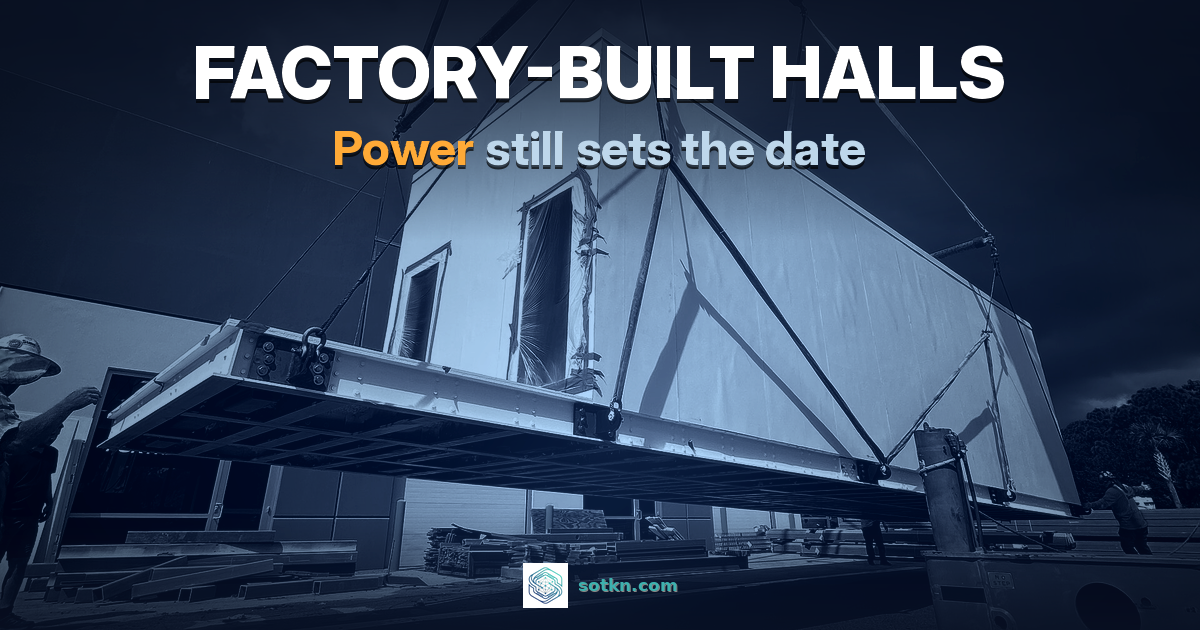
Figures come from Vertiv’s third-quarter 2026 results filed with the SEC (28 October 2026) and its earnings call that day, Vertiv’s OneCore (August 2025) and SmartRun (January 2026) product releases, Eaton’s Fibrebond completion release (1 April 2025) and its quarterly report for the three months to 31 March 2026, BUUU Group’s two Form 6-K filings on Brightray (3 and 15 September 2026), DXN’s FY26 results on the ASX (31 August 2026) and TECO’s release of 30 September 2026. Build times and speed-ups are the companies’ own claims and are measured from different starting points; none includes the wait for a grid connection. DXN reports in Australian dollars. Every per-megawatt figure, multiple or ratio we derived is labelled “our arithmetic”. The featured photo is a prefabricated data center module being lifted by crane, from Wikimedia Commons (Tsgrayson, CC0), graded by Second Order. This page explains how the money and the constraints move. It does not give buy or sell calls. Not investment advice. Do your own research.
Last reviewed: 12 Nov 2026 · Next review: after Vertiv’s fourth-quarter 2026 results and first 2027 guidance (February 2027) and DXN’s half-year report
Spot an error? Tell us and we will correct it and note the change here.
References
- Vertiv — Third quarter 2026 results, Form 8-K Exhibit 99.1 (28 Oct 2026) — net sales $4,313 million, up 61% (55% organic); Americas up 75%, APAC up 50%, EMEA up 23%; full-year 2026 net sales guidance $14,650 million at the midpoint, raised by $650 million
- Vertiv — Q3 2026 earnings call transcript, via The Motley Fool (28 Oct 2026) — factory-built, modularly deployed infrastructure runs in parallel with site preparation and cuts deployment time by up to half; orders more than 100% up organically; customers still order about 12 to 18 months ahead; Vertiv will not disclose orders
- Vertiv — Vertiv OneCore launch (5 Aug 2025) — factory-assembled prefabricated data center in a Vertiv-provided steel shell, slab-up and turnkey under a single point of contact; 5 to 50 MW per block; 96 to 944 racks
- Vertiv — Vertiv SmartRun global launch, Osaka (27 Jan 2026) — prefabricated overhead system combining busbar power, liquid-cooling pipework, hot-aisle containment and network trays; up to 85% faster on site than stick-built; more than 1 MW a day with a single crew; reduces labour needs
- Eaton — Eaton completes acquisition of Fibrebond (1 Apr 2025) — $1.4 billion paid for a builder of pre-integrated modular power enclosures; about $110 million estimated 2025 adjusted EBITDA; about $378 million revenue in the 12 months to 28 Feb 2025; aimed at multi-tenant and hyperscale data center customers
- Eaton — Form 10-Q for the quarter ended 31 Mar 2026, note on acquisitions — Fibrebond acquired 1 April 2025 for $1,435 million net of cash; goodwill $541 million; customer relationships $410 million; backlog intangible $60 million; $240 million of retention awards vesting over six years
- BUUU Group — Agreement to acquire 60% of Brightray Science, Form 6-K Exhibit 99.1 (3 Sep 2026) — more than 90% of a facility built and tested in the factory; delivery cut from 18–36 months to six to nine; full prefab 15–50 MW blocks, interior prefab about 7–14 months, containerised option; 300 MW a year factory capacity; 120 MW Sedenak Tech Park campus in Johor, 70 MW running, first 20 MW in eight months, 50 MW scheduled; about 1 GW of deliveries targeted over three fiscal years; pipeline about 2 GW and about $9 billion of potential contract value; headquarters moving to Singapore
- BUUU Group — Closing of Brightray acquisition, Form 6-K (15 Sep 2026) — 60% of Brightray acquired on 15 September 2026 for 2,000,000 new shares at $20 and a $200 million promissory note payable in shares against Brightray’s net profit for fiscal 2027 to 2029; call option on the other 40%
- DXN Limited — FY26 results, ASX announcement (31 Aug 2026) — about $8.8 million contract (June 2026) with a US-listed neocloud for a 1.36 MW AI modular data center, with a follow-on indicatively over US$200 million contingent on the proof-of-concept; second AI contract about $12.2 million; FY26 revenue $10.1 million; backlog $40.9 million at 30 Aug 2026, about 45% to convert in 1H FY27; Johor factory and a proposed NSW factory targeted for Q2 FY27; $7.0 million raised for factory capacity
- TECO Electric & Machinery — Modular data centre showcase at Data Centre World Singapore (30 Sep 2026) — five core modules (IT, cooling, power, generator, energy management); an ongoing 10 MW modular data centre project; Malaysia as its Southeast Asia base for modular prefabrication; Penang busway plant; acquisitions of Malaysia-based NCL Energy and Dynaciate Engineering