Stargate Data Center Explained: Who Builds It, Who Gets Paid
Stargate is OpenAI’s programme for buying AI data center capacity through partners: developers build the halls, Oracle or SB Energy leases or runs them, NVIDIA supplies chips, and OpenAI pays as capacity goes live. More than 10 GW is secured; delivery is the slow step.
EXPLAINED · Mechanism · Last reviewed: 9 Nov 2026 · Next review: after Oracle’s second-quarter fiscal 2027 results in December 2026 and OpenAI’s next Stargate site update
Stargate is OpenAI’s programme for getting the AI data center capacity it needs without owning most of it: developers such as Crusoe, Vantage and SoftBank’s SB Energy build and power the campuses, Oracle or SB Energy leases or runs them, NVIDIA supplies the chips, and OpenAI pays as the capacity goes live. OpenAI said in April 2026 that it had already secured more than the 10 GW it promised in January 2025, but at the flagship campus in Abilene, Texas, Oracle said in September 2026 that 618 MW had been delivered, so the gap between signed and live is the part to watch.
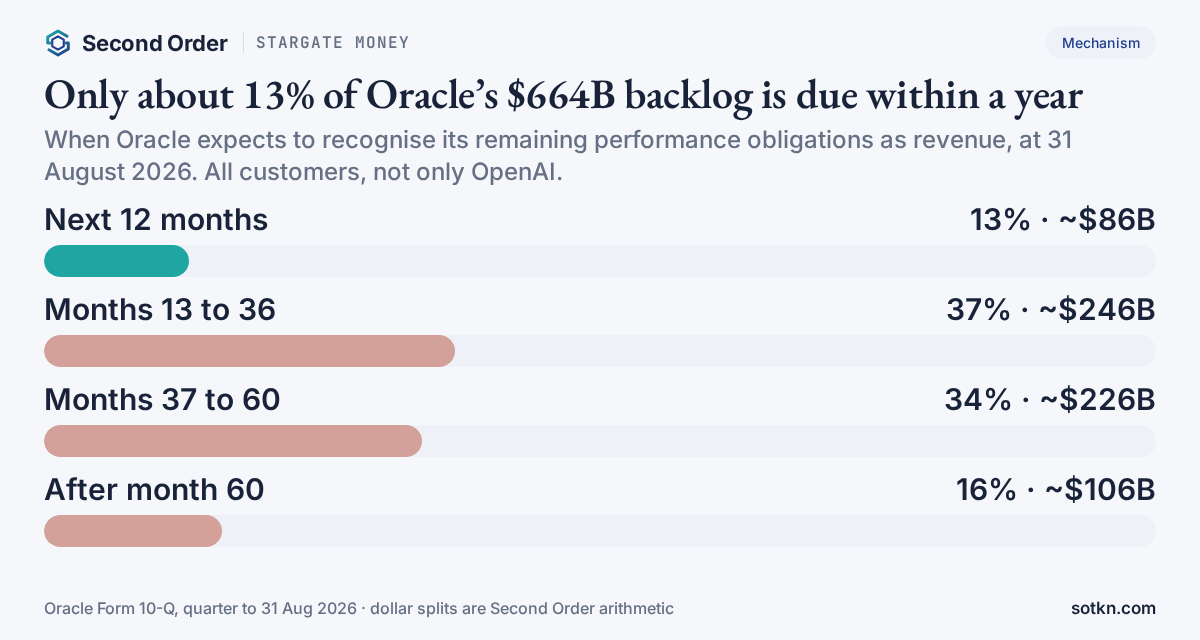
In short. Stargate is not one data center. It is a chain of contracts in which OpenAI is the customer and partners build, power, equip and run the campuses. OpenAI says it has secured more than 10 GW in the US. The flagship in Abilene, Texas had 618 MW delivered by September 2026, about 6% of that headline (our arithmetic, and the two figures are not measured the same way). Who gets paid: chip and gear makers first, developers when each lease starts, Oracle as it delivers capacity, and OpenAI pays last, as halls go live. The stuck step is delivery. Oracle alone had $288 billion of data center leases signed but not yet started at 31 August 2026, and only about 13% of its $664 billion backlog is due as revenue within a year.
Why an investor cares: Stargate is the biggest single source of new demand for AI data centers, and it runs through other companies’ balance sheets. Whether a landlord, a cloud provider or a chip maker gets paid on time depends less on the headline gigawatts than on when each hall is handed over. This page builds on what an AI data center is and which AI data centers are the biggest, and answers one question: what is Stargate, and who actually gets paid?
What is Stargate?
Stargate started as a company. On 21 January 2025, OpenAI announced The Stargate Project, a new company that intended to invest $500 billion over the next four years building AI infrastructure for OpenAI in the United States, with $100 billion to be deployed immediately. The equity funders were SoftBank, OpenAI, Oracle and MGX. SoftBank took financial responsibility and OpenAI operational responsibility, with Masayoshi Son as chairman. Arm, Microsoft, NVIDIA and Oracle were named as technology partners.
It has since become a label for a programme. By September 2025, OpenAI was calling Stargate its “overarching AI infrastructure platform”, and the sites it added were deals with partners rather than buildings owned by the Stargate company. In April 2026 OpenAI described Stargate as its long-term effort to build the compute it needs, said it had already passed the 10 GW US goal, and noted that “the financing models and partnership structures may evolve”.
So the useful definition is functional. Stargate is the set of contracts through which OpenAI gets computing capacity that someone else builds, powers and often owns. That makes it closer to a very large tenant than to a landlord, which is why it matters so much to the companies in our AI Data Centers layer.
How does Stargate work?
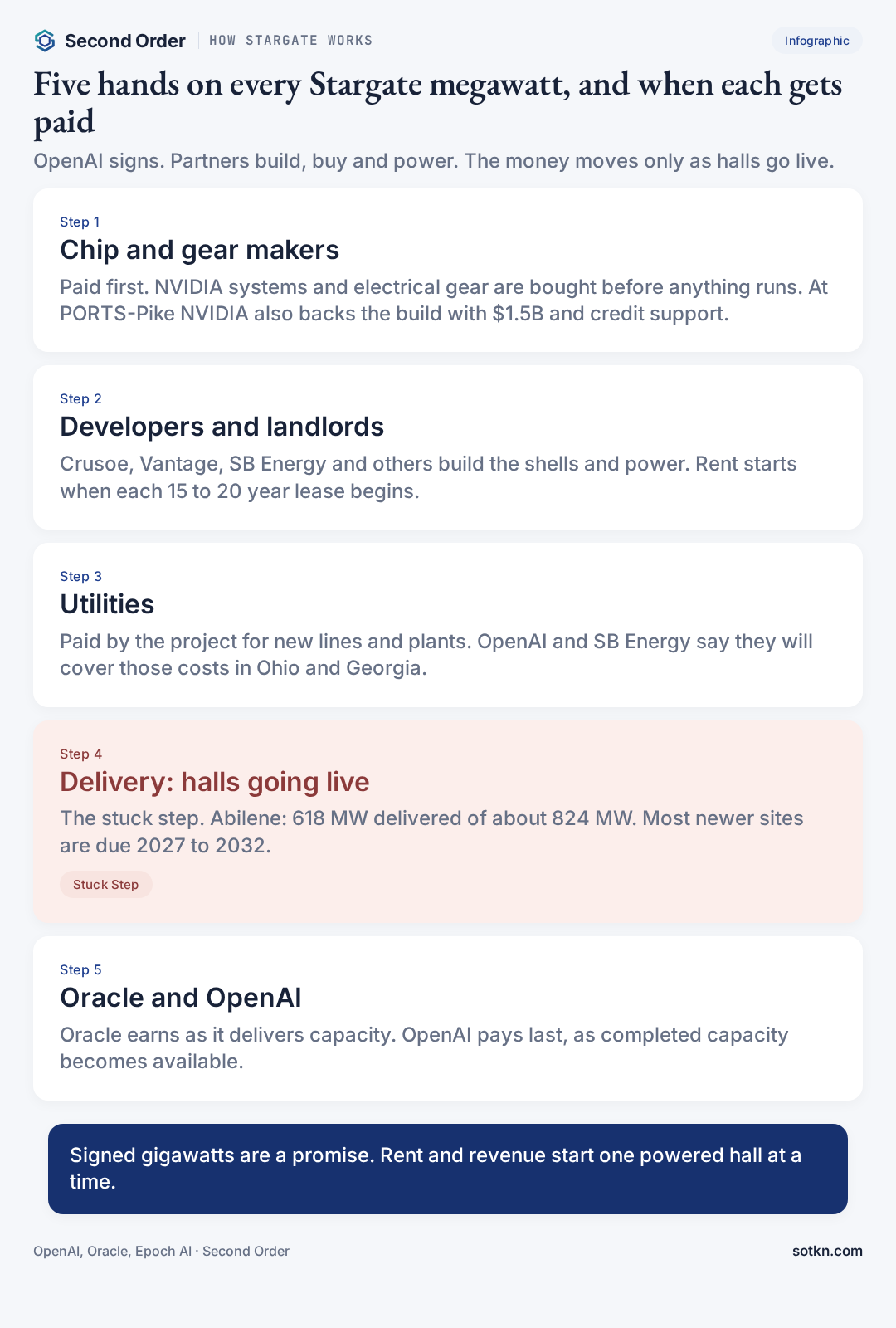
Each Stargate campus is a stack of separate deals. The names change from site to site, but the roles repeat.
- OpenAI is the customer. It signs for capacity it expects to need for training and for running its products. At PORTS-Pike in Ohio, OpenAI says it “will begin paying only as completed capacity becomes available for lease”, funded by revenue and money raised from investors.
- A cloud operator or landlord sits in the middle. At the Oracle sites, Oracle leases the campus, buys and owns the chips, and sells the computing to OpenAI through Oracle Cloud Infrastructure. At PORTS-Pike there is no cloud layer: SB Energy builds, owns and operates the data center and leases it to OpenAI for 20 years. Our Oracle Stack page covers that business model.
- A developer builds and powers the shell. Crusoe developed Abilene, Vantage is Oracle’s partner in Wisconsin, and SB Energy provides “powered infrastructure” in Milam County, Texas. See what Crusoe does and who builds AI data centers.
- NVIDIA supplies the chips and, increasingly, the credit. Abilene runs NVIDIA GB200 systems. At PORTS-Pike, NVIDIA will be the only compute supplier, will invest $1.5 billion in SB Energy and will give credit support for the land, power and shell behind the first 4.25 GW-IT.
- A utility connects it. Project Camellia in Georgia has contracted 3.2 GW from Georgia Power, delivered in phases from 2028 to 2032, and OpenAI says it will pay the full cost of the infrastructure needed to serve it. Our contracted power explainer shows how those agreements work.
Stargate sites and partners
Here is what OpenAI and its partners have said about each campus, with who builds it, who uses it and where it stands.
| Campus | Who builds or owns it | Who runs it, who uses it | Size as the companies state it | Where it stands |
|---|---|---|---|---|
| Abilene, Texas (flagship) | Crusoe developed the campus; Oracle owns the chips | Oracle Cloud Infrastructure, for OpenAI | Eight buildings; 618 MW was 75% of the total, so about 824 MW (our arithmetic) | Six of eight buildings delivered by 10 Sep 2026 |
| Shackelford County, Texas; Doña Ana County, New Mexico; Wisconsin | Oracle-developed sites; Vantage in Wisconsin | Oracle, for OpenAI | Over 5.5 GW together, including a possible 600 MW near Abilene | Announced Sep 2025; OpenAI gave no opening dates |
| Lordstown, Ohio; Milam County, Texas | SoftBank; SB Energy in Milam County | SoftBank and OpenAI partnership | Up to 1.5 GW within 18 months of Sep 2025 | Announced Sep 2025 |
| PORTS-Pike, Ohio | SB Energy builds, owns and operates; NVIDIA backs it with $1.5B and credit support | OpenAI, on a 20-year lease | About 8 GW-IT | First 800 MW expected in 2028; build-out to 2032 |
| Project Camellia, Georgia | OpenAI designs and develops it | OpenAI | 3.2 GW contracted from Georgia Power | Power delivered in phases, 2028 to 2032 |
| S7, Sydney | NEXTDC | OpenAI as initial offtaker (memorandum of understanding) | Not stated in the memorandum | First phase expected 2H 2027, subject to approvals |
| Two Firmus sites, Malaysia | Firmus | OpenAI as anchor customer | Not disclosed | Firmus targets ready-for-service within 24 months for its sites under development |
Sizes mix grid power, IT power and utility contracts, so they should not be added up. Status lines are from OpenAI, Oracle, Epoch AI, NEXTDC and Firmus documents dated January 2025 to September 2026. Full list under References.
Two numbers in OpenAI’s own announcements give a rough price. Its January 2025 plan was $500 billion for 10 GW, about $50 billion per gigawatt (our arithmetic). Its September 2025 update was over $400 billion for nearly 7 GW, about $57 billion per gigawatt (our arithmetic). Those totals bundle chips, buildings and power. Our page on what an AI data center costs to build splits the bill.
Who gets paid first, and who pays last?
Follow the cash in time order. The companies at the bottom of the stack are paid before the building runs; the ones at the top are paid only after it does.
- Chip and equipment makers, first. At Abilene the chips are owned by Oracle, so NVIDIA and the server and gear suppliers are paid when the hardware ships, long before OpenAI’s usage pays it back. Oracle spent $28.5 billion on capital expenditure in the three months to 31 August 2026, against $8.5 billion a year earlier. Our page on who makes data center power equipment covers the electrical side of that bill.
- Developers and landlords, when each lease starts. Oracle reported $288 billion of additional lease commitments at 31 August 2026, “substantially all related to data center arrangements”, expected to start between its second fiscal quarter of 2027 and fiscal 2029, for terms of 15 to 19 years. That is about 4.6 times the $63 billion of lease payments already on its books (our arithmetic, operating plus finance leases). Those signed-but-not-started leases are the developers’ future rent. Our data center lease explainer shows how that rent works.
- Oracle, as it delivers. Oracle’s remaining performance obligations, the contracted revenue it has not yet earned, were $664 billion at 31 August 2026, up from $455 billion a year earlier. OpenAI says its partnership with Oracle exceeds $300 billion over five years. If all of that sits in the backlog, it would be about 45% of it (our arithmetic); Oracle does not give the split. See our RPO explainer.
- OpenAI, last. OpenAI pays as capacity goes live, from its revenue and from the money it raises. That is the point of the structure: the partners carry the build, and OpenAI’s bills start when the halls do.
The order explains who carries the risk in the gap. In the same quarter, Oracle’s operating cash flow was $23.1 billion, of which $11.4 billion came from customer prepayments, about 49% (our arithmetic). Its free cash flow was minus $5.4 billion, and it sold $20 billion of new shares through an at-the-market programme. At its Investor Day on 28 October 2026, Oracle said capital spending peaks in fiscal 2027 and 2028, free cash flow turns positive in the second half of fiscal 2028, and it will limit further money raised through fiscal 2030 to $20 billion, split between equity and debt, leaning on vendor financing, customer-supplied hardware and prepayments. Our Analysis on Oracle and the power stuck step works through what that means.
Where is the stuck step?
At delivery: the moment a hall has power, cooling and chips, and is handed to the customer. Everything before that is a promise; everything after it is rent and revenue.
Abilene shows how long that takes even at the fastest site. On 10 September 2026, Oracle said six of the eight campus buildings, 618 MW and 75% of total capacity, had been delivered to the customer. That implies about 824 MW for the whole campus, so about 206 MW, two buildings, was still to come (our arithmetic). Oracle gave no date for the last two on that call.
Oracle’s backlog shows the same gap at company scale. Of the $664 billion, Oracle expects to recognise about 13% as revenue in the next 12 months, 37% in months 13 to 36, 34% in months 37 to 60 and the rest after that. In dollars that is roughly $86 billion within a year and about $578 billion later (our arithmetic). The contracts are signed; the halls that turn them into revenue are not built yet.
The newer sites push the clock further out, and power is the reason. At PORTS-Pike, OpenAI expects the first 800 MW in 2028, using existing AEP grid infrastructure. That is about 10% of the planned 8 GW-IT (our arithmetic). The rest needs new power plants, including natural gas, and new transmission lines, and depends on permits, environmental reviews and financing. Project Camellia’s power arrives between 2028 and 2032. Our Wire on Oracle’s force majeure notice on Project Jupiter and our page on how long an AI data center takes to build show why the building is the quick part.
Our view: the useful question about any Stargate headline is not how many gigawatts were announced, but how many megawatts have been delivered, and to whom the bill goes in the meantime. A gigawatt that is secured but not delivered pays the chip maker and the builder; it does not yet pay the landlord’s rent in full, or Oracle’s cloud revenue.
Is Stargate in Asia? Australia, Malaysia and Singapore
Australia. On 5 December 2025, NEXTDC told the ASX it had agreed a memorandum of understanding with OpenAI under the OpenAI for Countries programme. The two will collaborate on the planning, development and operation of a hyperscale AI campus and GPU supercluster at NEXTDC’s S7 site at Eastern Creek in Sydney, with OpenAI intending to be an initial offtaker. The first phase is expected in the second half of 2027, subject to approvals. A memorandum is not a lease, so in the language of this page it is neither secured nor delivered yet. See what NEXTDC does and our Australia Pulse on the bid for NEXTDC.
Malaysia. On 8 September 2026, Firmus said OpenAI will contract dedicated AI computing from two Firmus AI Factory sites in Malaysia and become an anchor customer. Firmus did not say how many megawatts are OpenAI’s. Its more than 900 MW of contracted capacity covers all customers, across seven AI factories in Australia, Singapore, Indonesia and Malaysia, of which two are operating and five target ready-for-service within 24 months. Our Wire on Firmus pulling its ASX listing and Malaysia Pulse on TNB’s new power plants show the delivery side.
Singapore. None of the documents we read names Stargate capacity for OpenAI in Singapore. The closest link is Firmus, which already runs one of its two operating AI sites there for its customers. Singapore’s data center capacity is rationed by government allocation, which makes it a hard place to land a gigawatt-scale campus; see what Nxera does and our Singapore door.
What would change this view?
- Faster delivery. If Abilene’s last two buildings and the first Shackelford and Wisconsin halls arrive on time, more of Oracle’s $288 billion of leases start, and the stuck step moves from the building to the power plant.
- A change in who carries the build. OpenAI says the financing models may evolve. More deals like PORTS-Pike, where a developer owns the site and NVIDIA backs the credit, would shift risk away from Oracle and toward developers and suppliers.
- OpenAI’s ability to pay. The whole chain rests on the customer at the top. OpenAI says it will fund its commitments from revenue and investor capital; slower growth or harder fundraising would show up first in delayed or resized sites.
- Memoranda turning into leases. A binding agreement at NEXTDC’s S7, or a disclosed OpenAI megawatt figure at Firmus, would move the Asia sites from intention to secured.
How to read a Stargate headline
- Secured, delivered or running? OpenAI’s 10 GW is secured. Oracle’s 618 MW at Abilene is delivered. They are different stages.
- Grid power or IT power? PORTS-Pike is stated in GW-IT, Camellia in grid power from Georgia Power. The two are not the same unit; see how much power an AI data center uses.
- Lease, capacity contract or memorandum? A 20-year lease, a cloud contract with Oracle and a memorandum with NEXTDC carry very different certainty.
- Whose balance sheet? Find out who buys the chips, who builds the shell and who lends against it. That company carries the gap until delivery.
- All customers or OpenAI only? Oracle’s $664 billion and Firmus’s 900 MW include other customers.
FAQ
What is the Stargate data center project?
Stargate is OpenAI’s programme for securing the AI data center capacity it needs. It began on 21 January 2025 as a new company that intended to invest $500 billion over four years in US AI infrastructure for OpenAI, funded by SoftBank, OpenAI, Oracle and MGX. In practice it now works as an umbrella: partners such as Oracle, SoftBank’s SB Energy, Vantage and Crusoe build, lease or run the campuses, and OpenAI is the customer.
Who owns Stargate?
The original Stargate company had four equity funders: SoftBank, OpenAI, Oracle and MGX, with SoftBank holding financial responsibility and OpenAI operational responsibility. Most of the physical capacity, though, is owned by partners. At Abilene the chips are owned by Oracle and used by OpenAI; at PORTS-Pike in Ohio, SB Energy will build, own and operate the data center and lease it to OpenAI for 20 years.
Where are the Stargate data centers?
The flagship is in Abilene, Texas. OpenAI named Oracle-developed sites in Shackelford County, Texas, Doña Ana County, New Mexico and Wisconsin (with Vantage), and SoftBank sites in Lordstown, Ohio and Milam County, Texas (with SB Energy). In 2026 it added the PORTS-Pike campus in Ohio and Project Camellia in Georgia. Outside the US, OpenAI signed a memorandum with NEXTDC for Sydney and became an anchor customer of Firmus in Malaysia.
How big is Stargate?
OpenAI promised 10 GW in January 2025 and said on 29 April 2026 that it had already secured more than that in the US. Secured is not the same as running. At Abilene, Oracle said on 10 September 2026 that 618 MW, 75% of the campus, had been delivered. Most of the newer sites are due between 2027 and 2032.
How much does Stargate cost?
OpenAI’s own figures were $500 billion for 10 GW in January 2025, about $50 billion per gigawatt (our arithmetic), and over $400 billion for nearly 7 GW in September 2025, about $57 billion per gigawatt (our arithmetic). Those totals include chips, buildings and power, and they are spread across many companies’ balance sheets, not paid by one.
What is Oracle’s role in Stargate?
Oracle is the largest landlord-and-operator in the chain. It leases campuses from developers, buys and owns the chips, and sells the computing to OpenAI through Oracle Cloud Infrastructure. OpenAI says the two companies’ partnership exceeds $300 billion over five years. Oracle reported $664 billion of contracted future revenue at 31 August 2026 and $288 billion of data center leases that have been signed but not yet started.
Who gets paid first in Stargate?
The chip and equipment makers, because Oracle or the developer has to buy the gear before anything runs. Developers start collecting rent when each lease begins. Oracle earns as it delivers capacity to OpenAI. OpenAI pays last: at PORTS-Pike it says it begins paying only as completed capacity becomes available.
Is there a Stargate in Singapore, Malaysia or Australia?
Australia has a memorandum of understanding: NEXTDC and OpenAI plan an AI campus at NEXTDC’s S7 site in Sydney, first phase expected in the second half of 2027 subject to approvals. In Malaysia, OpenAI will contract computing from two Firmus sites, with megawatts not disclosed. None of the documents we read names Stargate capacity for OpenAI in Singapore, although Firmus already runs an AI site there for its customers.
Is this a list of stocks to buy or sell?
No. Second Order Explained pages explain how the money and the constraints move. They do not give buy or sell calls. Not investment advice. Do your own research.
Related: what is an AI data center; the biggest AI data center in the world; data center financing; take-or-pay GPU contracts; where AI data centers are located; sovereign AI; Oracle’s 850 MW quarter.
Stack doors
Layer: AI Data Centers. Also: Hyperscalers, Neoclouds, Semiconductors. Markets: US, Australia, Malaysia, Singapore.
Get the Wire — short daily notes when a Stargate hall is delivered, a lease starts or a site slips.
How we check this
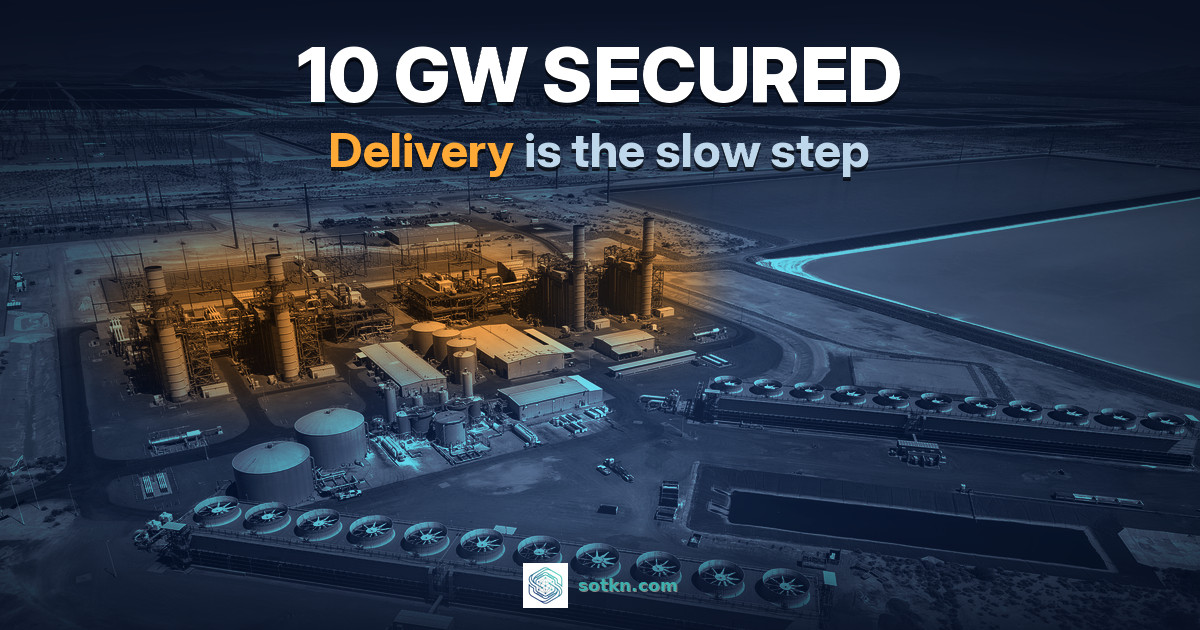
Figures come from OpenAI’s Stargate announcements (January 2025, September 2025, April 2026), its PORTS-Pike (August 2026) and Project Camellia (July 2026) pages, Oracle’s quarterly report on Form 10-Q for the quarter to 31 August 2026 and its Investor Day release filed with the SEC (28 October 2026), Epoch AI’s Abilene entry quoting Oracle’s 10 September 2026 earnings call, NEXTDC’s ASX release of 5 December 2025 and Firmus’s release of 8 September 2026. OpenAI’s gigawatt figures are its own statements about capacity it has secured, not measured running power. Oracle’s backlog and lease figures cover all of its customers; Oracle does not say how much belongs to OpenAI. The 824 MW Abilene total is our arithmetic from Oracle’s 618 MW and 75%, and matches Epoch AI’s estimate. Every share, ratio or per-gigawatt figure we derived is labelled “our arithmetic”. The featured photo is a gas power station in Arizona from Wikimedia Commons (Rsparks3, CC0), graded by Second Order; it is not a Stargate site. This page explains how the money and the constraints move. It does not give buy or sell calls. Not investment advice. Do your own research.
Last reviewed: 9 Nov 2026 · Next review: after Oracle’s second-quarter fiscal 2027 results in December 2026 and OpenAI’s next Stargate site update
Spot an error? Tell us and we will correct it and note the change here.
References
- OpenAI — Announcing The Stargate Project (21 Jan 2025) — a new company intending to invest $500 billion over four years in US AI infrastructure for OpenAI, $100 billion immediately; equity funders SoftBank, OpenAI, Oracle and MGX; SoftBank financial and OpenAI operational responsibility; Arm, Microsoft, NVIDIA and Oracle as technology partners
- OpenAI — OpenAI, Oracle, and SoftBank expand Stargate with five new AI data center sites (23 Sep 2025, updated 22 Oct 2025) — nearly 7 GW planned and over $400 billion over three years; Oracle agreement for up to 4.5 GW, a partnership exceeding $300 billion over five years; Oracle sites in Shackelford County TX, Doña Ana County NM and Wisconsin (with Vantage), plus a possible 600 MW Abilene expansion, over 5.5 GW; SoftBank sites in Lordstown OH and Milam County TX (SB Energy) up to 1.5 GW in 18 months; over 300 proposals from more than 30 states
- OpenAI — Building the compute infrastructure for the Intelligence Age (29 Apr 2026) — surpassed the 10 GW US commitment, with more than 3 GW added in the previous 90 days; Abilene runs on Oracle Cloud Infrastructure with NVIDIA GB200 systems; financing models and partnership structures may evolve
- OpenAI — OpenAI joins PORTS-Pike project (17 Aug 2026) — about 8 GW-IT in Pike County, Ohio; SB Energy builds, owns and operates under a 20-year lease to OpenAI; OpenAI pays only as completed capacity becomes available; NVIDIA invests $1.5 billion in SB Energy and gives credit support for the initial 4.25 GW-IT; first 800 MW expected in 2028 on existing AEP infrastructure; later phases need new gas plants and transmission
- OpenAI — Building AI infrastructure with the Effingham County community (22 Jul 2026) — Project Camellia in Georgia, designed and developed by OpenAI; 3.2 GW contracted from Georgia Power, delivered in phases from 2028 to 2032; OpenAI pays the full cost of infrastructure and electric service
- Oracle — Quarterly report on Form 10-Q for the quarter ended 31 August 2026 (filed 11 Sep 2026) — remaining performance obligations $664 billion (from $455 billion a year earlier), about 13% expected as revenue in 12 months, 37% in months 13–36, 34% in months 37–60; $288 billion of data center lease commitments not yet commenced, starting between the second quarter of fiscal 2027 and fiscal 2029, for 15–19 years; operating cash flow $23.1 billion including $11.4 billion of customer prepayments; capital expenditures $28.5 billion; free cash flow minus $5.4 billion
- Oracle — Investor Day 2026 press release, Form 8-K Exhibit 99.1 (28 Oct 2026) — peak capex in fiscal 2027–28; positive free cash flow in the second half of fiscal 2028 and at least $30 billion in fiscal 2029; new capital raised through fiscal 2030 limited to $20 billion, about $10 billion equity and $10 billion debt; vendor financing, customer-provided hardware and customer prepayments to cut upfront cash needs
- Epoch AI — OpenAI Stargate Abilene, AI data centers directory (accessed 9 Nov 2026) — chips owned by Oracle and used by OpenAI; quotes Oracle’s 10 Sep 2026 earnings call: 6 of the 8 campus buildings, 618 MW and 75% of total capacity, delivered to the customer; Epoch estimates 824 MW of IT power at full build
- NEXTDC — NEXTDC to Join OpenAI for Australia as an Infrastructure Partner, ASX release (5 Dec 2025) — memorandum of understanding with OpenAI for a hyperscale AI campus and GPU supercluster at S7 Eastern Creek, Sydney; OpenAI intends to be an initial offtaker; first phase expected in the second half of 2027, subject to approvals
- Firmus — Firmus surpasses 900 MW contracted capacity, adds OpenAI as anchor customer and expands into Malaysia (8 Sep 2026) — OpenAI to contract dedicated AI compute from two Firmus sites in Malaysia; more than 900 MW contracted across all customers; seven AI factories in Australia, Singapore, Indonesia and Malaysia, two operating (Australia and Singapore), five targeting ready-for-service within 24 months