Tools Paid, Currency Unnamed: Who Gets Paid While Hanmi's Exchange Line Stays Blank
Hanmi was paid on tools the customer has already taken. The currency under that profit is not named.
Hanmi Semiconductor was paid on tools the customer has already taken. The stuck step is the currency under that profit. The quarterly report filed on 13 November 2026 prints the foreign-exchange lines, and it does not say which currency they are.
KOREA PULSE · Data as at 16 Nov 2026 · Next update: after a filing that names the currency, or after the 31 December delivery date
Affects: Semiconductors — Markets: Korea · Taiwan · US
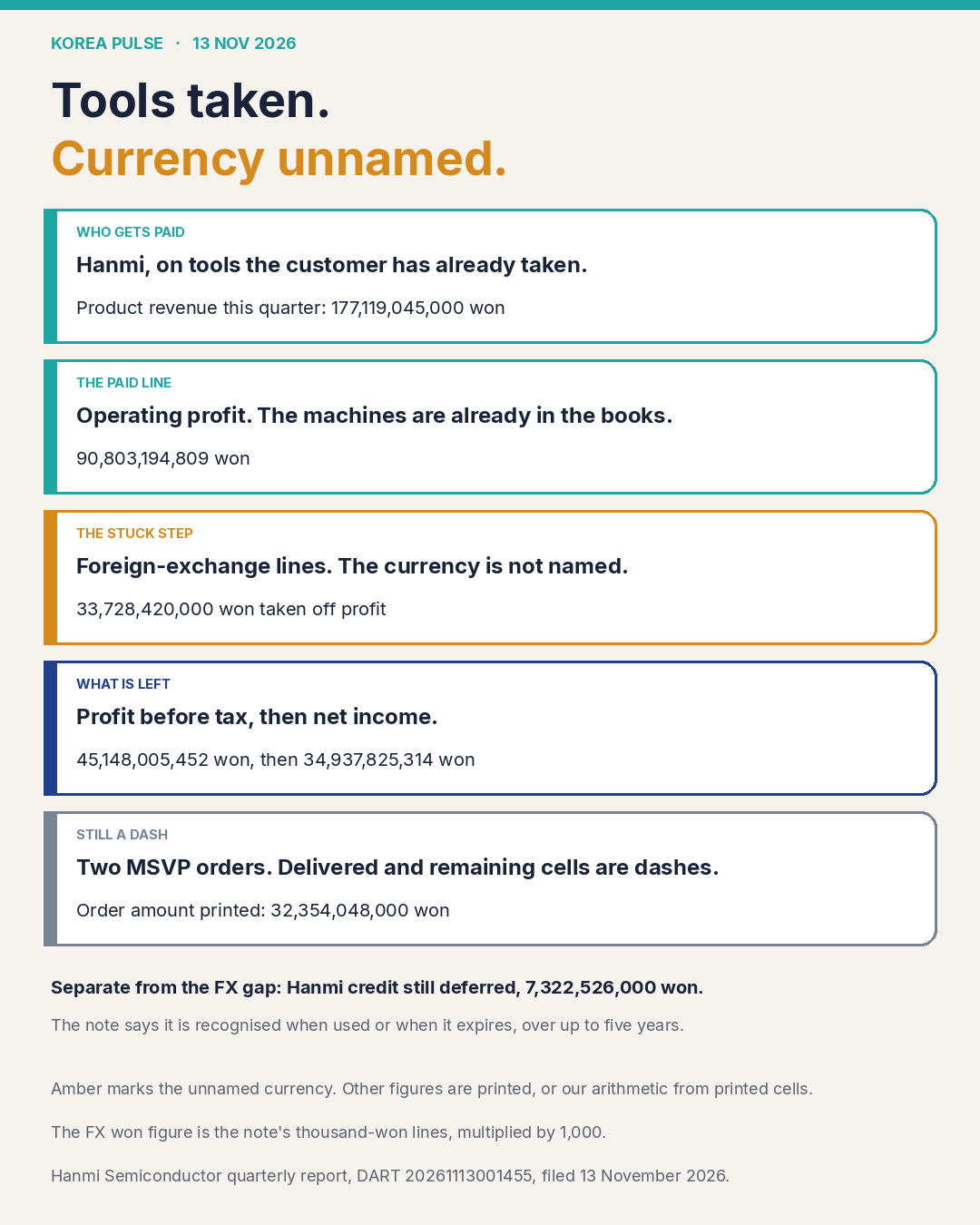
In short: For the quarter ended 30 September 2026, Hanmi's consolidated operating profit was 90,803,194,809 won on revenue of 181,014,186,807 won. Profit before tax was 45,148,005,452 won. Who gets paid is Hanmi, on equipment already accepted. The lines under operating profit do not name a currency, a customer, or a contract.
Education only, not advice to buy or sell any security. Figures are from the quarterly report for the period ended 30 September 2026, filed 13 November 2026, receipt 20261113001455. The income statement is in won. Notes used below are in thousand won where said. Multiplying by 1,000, and any division, is our arithmetic. A dash is not a zero.
The numbers that matter this month
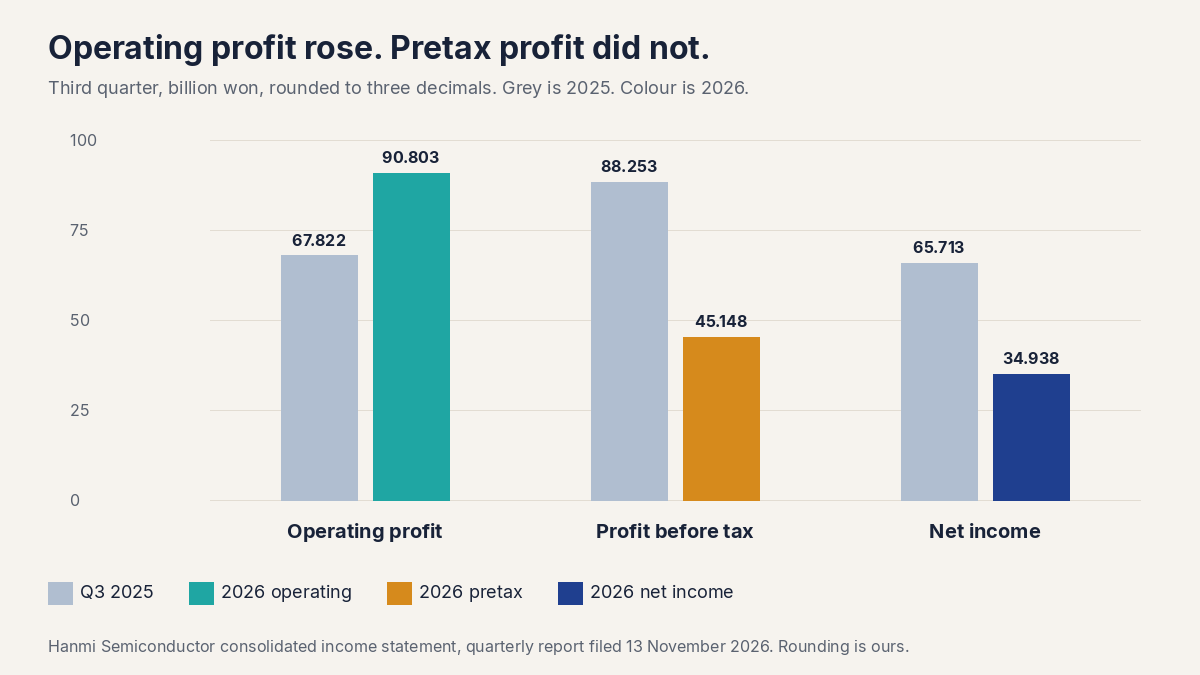
The consolidated income statement prints the quarter and the nine months, this year and last year. These are the cells. The company does not print a percentage next to them.
| Line | Q3 2026 | Q3 2025 | Nine months 2026 | Nine months 2025 |
|---|---|---|---|---|
| Revenue | 181,014,186,807 | 166,231,357,101 | 483,079,302,733 | 493,670,454,672 |
| Operating profit | 90,803,194,809 | 67,822,011,689 | 229,606,250,247 | 223,762,328,162 |
| Profit before tax | 45,148,005,452 | 88,253,009,676 | 214,768,464,658 | 243,276,264,702 |
| Income tax | 10,210,180,138 | 22,539,761,394 | 52,368,138,713 | 58,126,870,318 |
| Net income | 34,937,825,314 | 65,713,248,282 | 162,400,325,945 | 185,149,394,384 |
| Basic earnings per share | 368 won | 693 won | 1,712 won | 1,952 won |
Net income is entirely the parent's. Gross profit was 110,772,003,681 won. Cost of sales was 70,242,183,126 won, selling and administrative expenses 15,504,109,351 won, and research and development 4,464,699,521 won. Those lines are how the statement reaches operating profit.
The same receipt attaches a review report and a consolidated review report. This note uses the consolidated statements. It does not treat the quarter as a full audit.
Why does Korea matter now?
Because the tools that finish an AI chip are built here, and this quarter the toolmaker's books stopped at the currency.
An accelerator still needs a wafer, mostly made in Taiwan, a memory stack, mostly made in Korea, and a join between them. Hanmi's overview says it supplies thermo-compression bonders for high-bandwidth memory as a main line, with 2.5D, flip-chip, and other bonders beside them. It also describes MSVP, a tool that cuts a package into units and then washes, dries, inspects, sorts, and stacks them, plus a shield against electromagnetic interference. The overview says the machines go to major chip companies. It does not say which company, or which family, produced this quarter's revenue.
The product table will not close that gap. For the nine months it prints equipment of 429,044 million won and conversion kits of 54,036 million won. The printed total is 483,079 million won. The two lines add to 483,080 million won, one million above that total. That is our arithmetic. Nine-month revenue on the income statement is 483,079,302,733 won, which meets the printed total and not the sum of the lines. The report omits a price trend, because each tool is priced to the order. There is no average selling price.
This is the place that builds the machine, not a claim that the quarter was a high-bandwidth-memory quarter. The Taiwan door is the wafer. CoWoS, explained is the packaging step. This filing does not use that name.
What changed
What changed is the sign under operating profit. The tools paid more. The line beneath them took it back.
A year earlier, third-quarter operating profit was 67,822,011,689 won and profit before tax was 88,253,009,676 won. The lines under operating profit added 20,430,997,987 won. This quarter operating profit is 90,803,194,809 won and profit before tax is 45,148,005,452 won. The same stretch of the statement subtracts 45,655,189,357 won. The swing in that bridge, from a gain of 20,430,997,987 won to a loss of 45,655,189,357 won, is 66,086,187,344 won. That is our arithmetic. The filing does not print the swing.
Net income moved with it. Last year's quarter was 65,713,248,282 won. This quarter is 34,937,825,314 won, which is 30,775,422,968 won less. Operating profit rose by 22,981,183,120 won over the same quarter. Tax fell by 12,329,581,256 won, from 22,539,761,394 won to 10,210,180,138 won, which cushioned the net line and did not reverse it. Basic earnings per share fell from 693 won to 368 won.
The nine months are a different clock. Revenue is 483,079,302,733 won against 493,670,454,672 won. Operating profit is 229,606,250,247 won against 223,762,328,162 won. Net income is 162,400,325,945 won against 185,149,394,384 won. Take this quarter out and the other two quarters' net income is 127,462,500,631 won, against 119,436,146,102 won a year earlier. The hit to the net line is this quarter. Those residuals are our arithmetic. The statement does not print them as columns.
The order table adds two MSVP rows and leaves the delivery cells blank. One, dated 28 September 2026, is 7,874,048,000 won, due 31 December 2026. The other, dated 2 October 2026, is a large-area tool for AI substrates, 24,480,000,000 won, due 17 December 2027. They add to the printed total of 32,354,048,000 won. Delivered and remaining amounts are dashes. The October order sits after the quarter end. The report does not say whether either has shipped.
Our math
The company printed the cells. It did not print the rates. Every percentage below is our arithmetic.
Revenue rose by 14,782,829,706 won, which is 8.893 percent. Operating profit rose by 22,981,183,120 won, which is 33.885 percent. Net income fell by 30,775,422,968 won, which is 46.833 percent. Operating margin is 50.164 percent, against 40.800 percent a year earlier. Net margin is 19.301 percent, against 39.531 percent. Gross margin is 61.195 percent. The quarter kept more at the operating line and less at the net line.
For the nine months, revenue is down 2.145 percent, operating profit is up 2.612 percent, profit before tax is down 11.718 percent, and net income is down 12.287 percent. This quarter is 37.471 percent of nine-month revenue and 39.547 percent of nine-month operating profit.
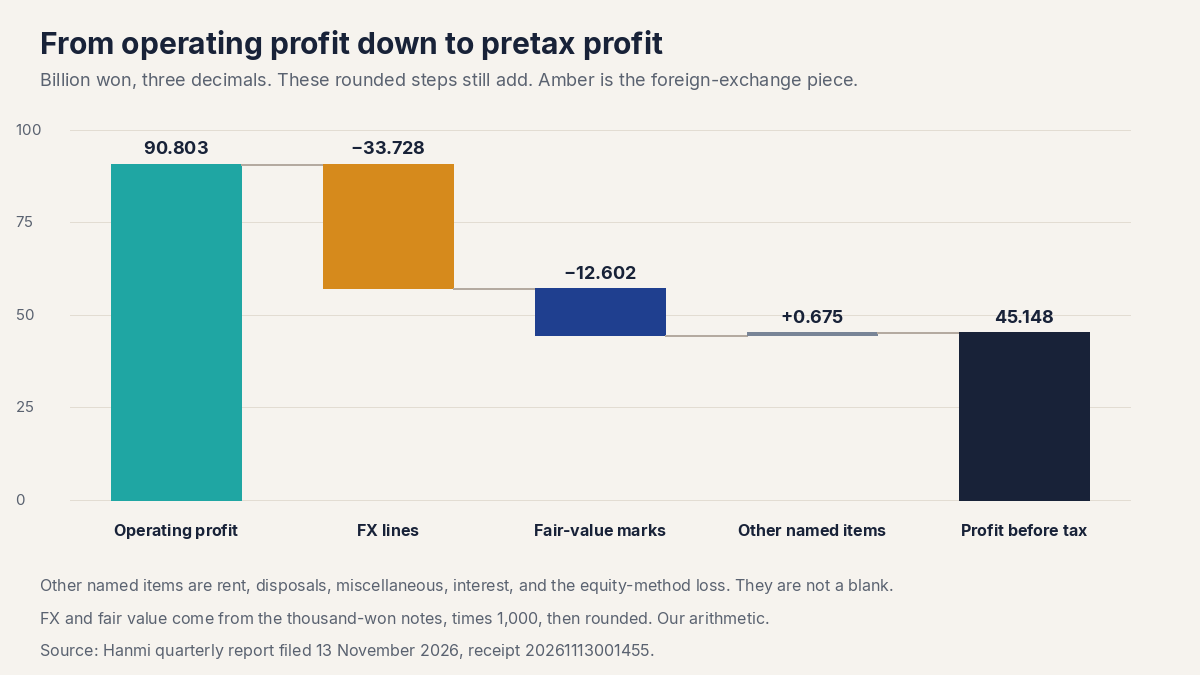
Now the bridge itself, in the order the statement prints it. Start at operating profit of 90,803,194,809 won.
| Line | Amount | Effect on profit |
|---|---|---|
| Other income | (6,069,067,467) | −6,069,067,467 |
| Other expense | 5,845,446,545 | −5,845,446,545 |
| Finance income | (7,855,869,185) | −7,855,869,185 |
| Finance cost | 25,731,810,791 | −25,731,810,791 |
| Share of equity-method loss | (152,995,369) | −152,995,369 |
| Sum, our arithmetic | −45,655,189,357 |
Subtract 45,655,189,357 from 90,803,194,809 and the result is 45,148,005,452, which is the printed profit before tax. The five lines account for the whole gap. Nothing in that gap is an unnamed plug. What the lines do not say is the currency, and which securities were marked.
The notes are in thousand won, so the split inside those lines is a thousand-won split. Multiply by 1,000 and the last three digits are ours only in the sense that they are zeros. Finance income in the statement is (7,855,869,185) won. The note's finance-income total is (7,855,869) thousand won, which is (7,855,869,000) won. The difference is 185 won. Finance cost in the statement is 25,731,810,791 won. The note totals 25,731,811 thousand won, which is 209 won higher. The split below lives with that rounding.
The quarter's foreign-exchange gain line is (8,019,761) thousand won, a negative, and the loss line is 25,708,659 thousand won. Together they reduce profit by 33,728,420,000 won, which is 73.876 percent of the gap. Interest in those two finance totals is small beside that. The fair-value gain line is (6,776,880) thousand won and the loss line is 5,824,871 thousand won, a further reduction of 12,601,751,000 won. Exchange plus fair value is 46,330,171,000 won, 674,981,643 won more than the gap. The difference the other way is rent, disposals, miscellaneous items, interest, and the equity-method loss. Netted from the same notes they are a gain of 674,981,631 won, twelve won off because the note is in thousands. Those items are named.
The nine-month exchange lines are a smaller net cost than this quarter alone. Gains of 13,914,705 thousand won against losses of 28,331,552 thousand won leave a net cost of 14,416,847,000 won. This quarter's net exchange cost is 33,728,420,000 won, so the other two quarters together are a net exchange gain of 19,311,573,000 won. That gain is not printed as its own line. The nine-month cash-flow reconciliation prints a separate translation gain of 1,419,617,168 won and a translation loss of 17,213,563,714 won, a net translation loss of 15,793,946,546 won. That is not the profit-and-loss figure. This note does not subtract them, and it does not call either one the quarter's cash.
Where does the money stick?
It sticks with Hanmi on the tool the customer has already accepted. It does not arrive as cash in the same proportion, and it does not arrive with a currency name.
Product revenue this quarter is 177,119,045 thousand won. Service is 3,894,641 thousand won. Goods are 501 thousand won. The note's total, 181,014,187 thousand won, is 193 won above income-statement revenue. Product revenue is recognised when the customer takes delivery. That 177,119,045,000 won is the paid line, 97.848 percent of the note's quarter. Service is 2.152 percent. A credit granted to the customer is deferred until it is used or it expires.
There is one segment, and the buyer is not named. Asia is 179,906,833 thousand won of the quarter, 99.388 percent. North America is 145,074 thousand won. For the nine months Asia is 97.255 percent. A separate table, in million won, prints exports of 381,911 and domestic sales of 101,168, which add to 483,079. Exports are 79.058 percent of that table. The regional note and the export table are different cuts. The report does not cross them.
Cash fell from 276,235,377,529 won to 140,066,360,025 won. Operating cash flow was 33,482,665,007 won, which is 20.617 percent of nine-month net income, our arithmetic. Investing outflow was 85,005,480,982 won, including 50,007,996,562 won on fair-value securities. Financing outflow was 77,158,084,393 won, of which dividends were 75,882,401,600 won. The exchange effect on the cash balance was a reduction of 7,488,117,136 won. Those four movements equal the drop. The dividend was paid in cash. It is not the foreign-exchange loss.
Trade receivables rose by 138,086,816,619 won, to 200,462,055,115 won. The cash-flow line shows a larger increase, 149,708,615,382 won. The gap is 11,621,798,763 won, and the report does not reconcile it or call the invoices late. Acceptance is the revenue rule. Collection is a later clock.
Is the currency still unnamed?
Yes. The lines are named. The currency on them is not.
The finance note says the company recognises exchange differences from foreign-currency transactions and from translation inside finance income and finance cost. It does not say which currency, which invoice, or which subsidiary. The quarter's exchange-gain line being negative is printed. The reason for the negative sign is not. The nine-month translation amounts in the cash-flow reconciliation are a second disclosure, and they are not a quarterly split. Silence on the currency is not a finding that the loss is unrealised, and it is not a finding that it has already been paid in cash.
Two other blanks sit beside that one, and neither of them is the bridge. The order table's delivered and remaining amounts are dashes, so the 32,354,048,000 won of MSVP orders cannot be called a backlog and cannot be called revenue. The Hanmi credit is a named deferral: at the quarter end, contract liabilities include advances of 1,636,924 thousand won and customer-credit of 7,322,526 thousand won, which add to the printed contract-liability total of 8,959,450 thousand won. At the prior year end the credit line was zero and the advance line was 7,379,331 thousand won. The note says the credit gives the customer a material right, that the amount allocated to it is deferred, and that it is expected to arise over the next five years under the arrangement, recognised when used or when it expires. That 7,322,526,000 won is revenue not yet recognised. It is 4.045 percent of this quarter's income-statement revenue. It is not part of the 45,655,189,357 won gap, and it should not be subtracted from operating profit.
Work in progress is stock, not the currency. Gross work in progress is 187,215,674 thousand won, the allowance is 47,964,531 thousand won, and the book amount is 139,251,143 thousand won. The allowance is 25.620 percent of the gross figure, our arithmetic. The nine-month write-down in cost of sales is 5,297 million won. Unfinished tools are not the line that cut profit before tax.
What dates matter
| When | What | Why it matters |
|---|---|---|
| 30 Sep 2026 | Quarter end | The income statement stops here. The 2 October order is after it. |
| 2 Oct 2026 | Large-area MSVP order, 24,480,000,000 won | Printed in this report. Delivery is dated 17 December 2027. Delivered amount is a dash. |
| 13 Nov 2026 | Quarterly report filed | Done. This is the print. |
| 31 Dec 2026 | Delivery date on the 7,874,048,000 won MSVP order | Still ahead of the filing date. The delivered cell is a dash, so the date is not evidence of a shipment. |
| Not dated here | Next quarterly filing | The report does not set it. A currency name can arrive sooner than the next set of statements. |
| Up to five years | Hanmi credit | The note's own horizon for use or expiry. Not a due date, and not the exchange line. |
Both delivery dates fall after the filing. That does not prove the tools are unshipped. It does mean the delivered amounts were left as dashes.
How is this different from the Wonik IPS quarter?
The Wonik IPS note read a 9 November preliminary filing in which 61,449 million won sat between operating profit and profit before tax with no name on it. This note reads a different company and a full quarterly report. Hanmi prints the five lines, and inside them it prints foreign exchange and fair value. The blank is the label on the money, not the existence of the line.
Hanmi's operating margin this quarter is 50.164 percent and the net margin is 19.301 percent, on our arithmetic, because the bridge is large and itemised. Do not paste Wonik's unnamed gap onto these cells. The revenue table also does not show bonders. The only orders with amounts are MSVP orders. The memory invoice is a different print.
What would change this view?
The view is that Hanmi has been paid for tools already accepted, and that the currency under that profit is still unnamed. It would change if any of these appeared in a filing:
- A currency, a subsidiary, or a contract on the exchange lines, including why the gain line is negative.
- A quarterly split of translation versus realised exchange, so the 33,728,420,000 won can be separated from cash.
- A number in either delivered-amount cell or remaining-amount cell. Until then 32,354,048,000 won is an order total, not a backlog.
- A product split of the 181,014,186,807 won. The nine-month kit line is not that split.
- A customer name. Asia at 99.388 percent of the quarter is not one.
- The bridge turning positive again, as it did a year earlier, when it added 20,430,997,987 won.
Practical takeaways
- Hanmi's third-quarter operating profit was 90,803,194,809 won, up 33.885 percent on the year-ago quarter, on our arithmetic. The rates are not printed by the company.
- Who gets paid is Hanmi, on tools the customer has already taken. Product revenue in the note is 177,119,045,000 won. No customer is named.
- The bridge from operating profit to profit before tax is a reduction of 45,655,189,357 won. Foreign exchange is 33,728,420,000 won of that, and the currency is unnamed.
- Do not treat the exchange figure as cash that left. Operating cash flow for the nine months was 33,482,665,007 won. Dividends paid were 75,882,401,600 won. Those are different piles.
- The two MSVP orders sum to the printed 32,354,048,000 won. Delivered and remaining are dashes. The Hanmi credit of 7,322,526,000 won is deferred revenue, not the exchange gap.
FAQ
What did Hanmi Semiconductor report for the third quarter of 2026?
Hanmi's consolidated revenue was 181,014,186,807 won and operating profit was 90,803,194,809 won. Profit before tax was 45,148,005,452 won and net income was 34,937,825,314 won. The quarterly report was filed on 13 November 2026.
Who gets paid on this quarterly report?
Hanmi, on equipment the customer has already taken. Product revenue is recognised at that point, and this quarter it was 177,119,045,000 won in the thousand-won note. The figure is not cash in the bank, and the report does not name the customer.
Why is the currency the stuck step?
Because the foreign-exchange lines took 33,728,420,000 won off the quarter and do not name a currency, a customer, or a contract. Operating profit is the paid line. The exchange difference underneath it is not.
Did the two MSVP orders ship?
The report does not say. It prints order amounts of 7,874,048,000 won and 24,480,000,000 won, due on 31 December 2026 and 17 December 2027. The delivered-amount cells and the remaining-amount cells are dashes, and a dash is not a number.
What date can move this view?
The first delivery date printed in the order table is 31 December 2026. The report does not set the date of the next quarterly filing. A currency name, or a number in place of either dash, would move it sooner.
Keep reading on the map
The tool was accepted. The currency on the books was not named. The map is the steps around that machine.
- Korea — the door for the memory and the tools.
- The Wonik IPS quarter — a bridge that was not itemised. This one is.
- Taiwan — the wafer those tools are built to finish.
- CoWoS, explained — the packaging step, in one place. This filing does not use the name.
- Where the stuck step moves — why a paid machine and an unnamed currency can be true together.
How we check this. Cells are from the consolidated statements and notes in the 13 November 2026 quarterly report. Thousand-won notes are multiplied by 1,000. Divisions are our arithmetic. This is not a recommendation to buy or sell.
References
- Hanmi Semiconductor, quarterly report for the period ended 30 September 2026, filed 13 November 2026, DART receipt 20261113001455. Consolidated income statement, notes on revenue, finance income and finance cost, other income and other expense, inventory, contract liabilities, segments, cash flow, and the order table. Quarterly report on DART