200 MW Booked, 911 MW Lined Up: Who Gets Paid While Korea’s AI Data Centres Wait for Tenants
Korea's carriers and Samsung SDS updated their AI data centre plans in the past two weeks. Near Seoul, LG Uplus says its 200 MW Paju site has customers for all four buildings. Outside it, KT will find tenants before it builds. Builders are paid first; the stuck step is the signed tenant.
Korea's AI data centres are being built where a customer has already signed, and waiting where one has not. In results this month, LG Uplus said its 200 MW-class site in Paju, just north-west of Seoul, has customers for all four buildings, and its data centre revenue rose 27.7%. KT said that outside the capital area it will find tenants before it commits to a site. SK Telecom is still negotiating with the next customers for Ulsan, and its AI data centre revenue dipped. The builders are paid first. The stuck step is the signed tenant.
KOREA · AI DATA CENTERS · Q3 2026 results, 29 Oct to 10 Nov 2026 · Next update: KT's next 60 MW decision, due by end-2026
Affects: AI Data Centers · Neoclouds · Hyperscalers — Markets: Korea · Malaysia · Singapore · US
Education only, not advice to buy or sell any security. Figures are as published by the companies named, unless labelled as our arithmetic. Korean won figures are not converted.
The numbers that matter this week
LG Uplus Paju, customers secured
200 MW
All four buildings · Building 1, 50 MW, opens June 2027
BookedLG Uplus AIDC revenue, Q3
₩131.7B
+27.7% on the year · +6.1% on the quarter
EarningSK Telecom AI DC revenue, Q3
₩126.1B
−7.4% on the quarter · GPU rental gap between contracts
DippedKT pipeline vs running
911 / 152 MW
About 6x what it runs today (our arithmetic) · 200 MW decided
Lined upSamsung SDS Gumi
60 MW
Up to 120 MW · ₩427.3B · done end-2028
BuildingThe signed tenant
The bind
Outside Seoul, demand has to be found before the hall is
Stuck stepFigures from LG Uplus and SK Telecom (4 Nov 2026), KT (10 Nov 2026) and Samsung SDS (29 Oct and 4 Nov 2026). Status chips are Second Order’s read.
On this page: Why it matters · LG Uplus Paju · SK Telecom · KT · Samsung SDS Gumi · Seoul vs the regions · Our math · Who gets paid · What is stuck? · Dates next · Elsewhere · What would change this · FAQ
Why do these results matter for Korea's AI data centres?
Because they show, operator by operator, which new megawatts have a paying customer behind them. Korea's AI data centre plans are large on paper. What the market has lacked is a clear read on which halls are filled before they are finished, and which are being built in the hope of a tenant. Three carriers and Samsung's IT services arm answered part of that question in the space of twelve days.
The answers split along a line on the map. Near Seoul, where power and land are scarce, the halls that can be built are booked early. Outside the capital, where power is easier to get, the operators are holding back until a customer signs. That is a different stuck step from the one we followed in October, when the question was whether the grid could reach Seoul at all.
That earlier read is in our Korea grid-queue Pulse, which covered KEPCO's finding that most capital-area data centre power requests could not be supplied on today's network, and our Pohang financing Pulse followed one of the first regional halls to be funded with half its space pre-leased. For what makes an AI hall different from an ordinary one, see what an AI data center is.
1 · Builders and power gear
Who: Construction, electrical and cooling plant for new halls
Paid: LG Uplus Q3 separate capex ₩569.8B, up 30.1% on AIDC
2 · Booked halls near Seoul
Who: Colocation and design-build-operate fees
Paid: LG Uplus AIDC revenue ₩131.7B, +27.7%
3 · GPU renters
Who: GPU-as-a-service on new long-term contracts
Paid: SK Telecom: a revenue gap while contracts switch
4 · Regional halls without a named tenant
Who: New capacity outside the capital area
Paid: KT: tenant demand first, then a business plan
What did LG Uplus say about Paju?
That it is full before it opens. LG Uplus is building an AI data centre in Paju, Gyeonggi Province, with 200 MW of power coming in. The company said on 4 November that it plans to bring four buildings online one after another by 2028. Building 1, at 50 MW, already has customers and is due to be completed and start operating in June 2027.
On the call, Ahn Hyung-gyun, who heads the enterprise AI business, went further: customer demand is also secured for Buildings 2, 3 and 4, so the company is already designing and building the later phases. He called Paju the largest AI data centre in the Seoul metropolitan area. The chief financial officer, Yeo Myung-hee, said the site has 10 to 15 years of long-term contracts already in place, which is why the company is willing to bring capacity forward.
- Revenue already moving. AI data centre revenue was ₩131.7 billion in the third quarter, up 27.7% on the year and 6.1% on the quarter. LG Uplus put the growth down to colocation and design-build-operate sales.
- Capex already rising. Separate capex was ₩569.8 billion, up 30.1% on the year, which the company tied to expanded AI data centre investment. The CFO said capex is likely to rise again next year, depending on the pace of the Paju build.
- A second, lighter model. LG Uplus said it is pursuing two to three design-build-operate projects with outside partners, including asset managers, alongside its own sites.
The 200 MW is power coming into the site, not computer load: some of it goes to cooling and conversion. For the difference between the power a site books and the power the servers use, see contracted power, explained. For how a long-term data centre lease is put together, see data center leases, explained.
Why did SK Telecom's AI data centre revenue fall?
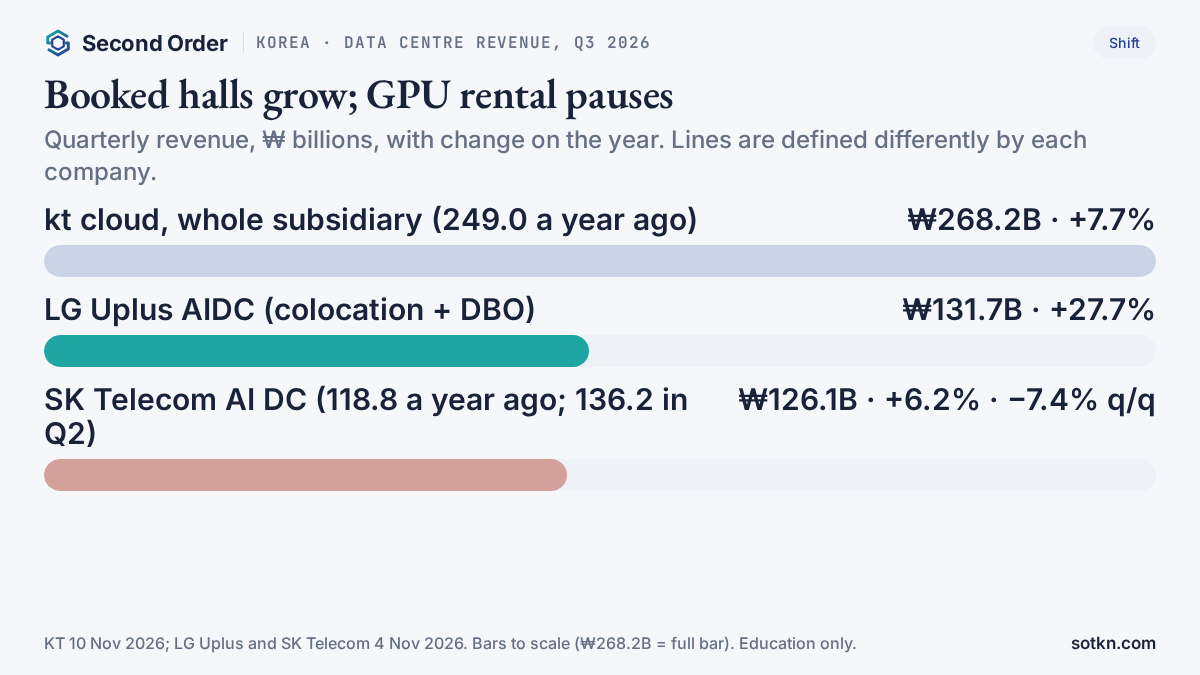
Because a GPU rental customer was between contracts. SK Telecom's AI data centre revenue was ₩126.1 billion in the third quarter, up 6.2% from ₩118.8 billion a year earlier but down 7.4% from ₩136.2 billion in the second quarter. The company said the year-on-year rise came from higher utilisation at its data centres and more subsea cable traffic. It said the quarter-on-quarter fall came mainly from a gap in GPU-as-a-service revenue during the switch to new long-term contracts.
That is a small dip, about ₩10.1 billion on the quarter (our arithmetic), but it shows how lumpy GPU rental income is when it rests on a few large deals. For how that business works, see GPU-as-a-service, explained.
The bigger news was structural. SK Telecom set up SK Hyper in July 2026 to win data centre business and SK Horizon in August to build and run the infrastructure. SK Horizon is developing about 180 MW of new data centres in Ulsan and Seoul. SK Hyper, the company said, is in discussions with potential customers on business terms, with a focus on Ulsan, and once agreements are final it plans to speed up building on sites it has already secured.
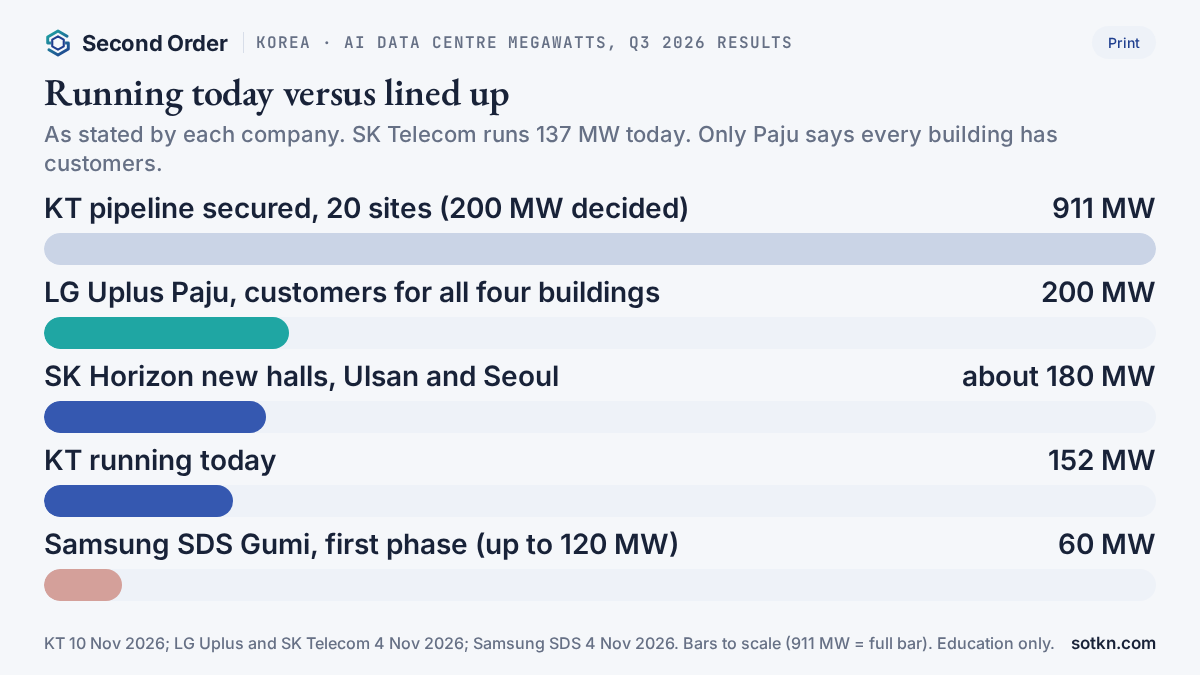
- Running today: 137 MW across eight existing data centres, per the investor briefing.
- Planned: more than 318 MW from 2030, adding new halls in Ulsan, the capital area and elsewhere.
- Spent this quarter: ₩461.4 billion of capex across SK Telecom and SK Broadband, plus another ₩148.6 billion for SK Hyper's data centre business development.
Ulsan already has one anchor. In June 2025 SK Group signed a 15-year partnership with Amazon Web Services to build a data centre in Ulsan for an AWS AI Zone, with operations expected to begin in 2027; SK leads the construction. The talks SK Hyper described this month are about the customers for what comes after that.
Read together, SK Telecom is spending on data centres now and saying the faster build depends on customer agreements that are not yet final. That is the tenant-first rule in its own words, even at a site that already has a hyperscale anchor.
What is KT's rule for where it builds?
KT spelled it out on its call on 10 November. Kim Bong-gyun, head of KT Enterprise, said the group plans to supply more than 1 GW of AI data centre capacity by 2031, based on actual demand. In the capital area it will develop only sites where electricity and the relevant permits are already secured. Outside the capital area, it will first identify tenant demand, and only then draw up a concrete business plan.
The numbers behind that plan are the most detailed any Korean operator gave this season. KT runs 152 MW today. It has 911 MW of capacity secured in its pipeline across 20 sites, plus 500 MW across 10 sites as a backup. Of the main pipeline, it has already decided on 200 MW and will decide on another 60 MW in the last two months of the year. About 80% of the 1 GW will be leased data centres and 20% owned by KT.
KT's earnings release, filed with the US SEC, gave the opening order for six sites: Bucheon in 2027; Gaebong, Gunsan and Yongin in 2028; and Ansan in 2029. Its cloud subsidiary, kt cloud, booked ₩268.2 billion of revenue in the quarter, up 7.7% from ₩249.0 billion, which KT put down to higher utilisation at its Gasan data centre and growth in design-and-build work.
So KT's pipeline is about six times what it runs today, but only about 22% of it has been decided (our arithmetic). The rest is land and power options that turn into halls when the demand shows up.
What is Samsung SDS building in Gumi, and for whom?
A 60 MW AI data centre, expandable to 120 MW, on a 46,000 square metre site in Gongdan-dong, Gumi, in North Gyeongsang Province. Samsung SDS held the groundbreaking on 2 November 2026, although construction has been under way since Gumi City approved it at the end of August. Completion is scheduled for the end of 2028. Samsung SDS disclosed in January that it would invest ₩427.3 billion in the new data centre.
The customer list is the part that stays open. Samsung SDS said it will run its own GPU services in Gumi and also a colocation business where customers install their own GPUs. It said the centre will support Samsung affiliates' manufacturing robotics work and serve outside customers. It did not name an outside tenant or say how much of the 60 MW is committed.
Gumi is one leg of a wider plan. On its third-quarter call on 29 October, Samsung SDS said it aims to expand its AI infrastructure to more than 800 MW by 2031 through its own capex, equity stakes and design-build-operate work. It was picked as preferred bidder for a design-build-operate project of more than 200 MW in the Seoul metropolitan area for Pacific Asset Management, with design and building to start as early as the end of this year and phased operations from 2029. A preferred bidder is not a signed contract.
Samsung SDS also gave the clearest statement of why Seoul-area capacity is scarce: in Korea, it said, securing power and land, particularly in the Seoul metropolitan area, is not easy, which is constraining the supply of new data centres. Its cloud revenue was ₩796.1 billion in the quarter, up 18%.
Why are Seoul and the regions moving at different speeds?
Because each side is short of something different. Near Seoul, demand is visible — LG Uplus booked a whole site — but power and land are not. A site that already has its grid connection and permits is rare, so when one exists, it fills. Paju is the example: a 200 MW-class site with long contracts signed before Building 1 is finished.
Outside the capital, power and land are easier to secure, but the operators' own words show that buyers have not yet signed there in the same way. None of the four named a signed outside tenant for a new regional site this season beyond the anchors already announced. So an operator that builds in a regional city without one takes on the risk of an empty hall. KT's answer is to wait for demand; SK Telecom's is to keep building while it negotiates; Samsung SDS's is to fill part of Gumi with its own GPUs and its affiliates' work.
For the wider pattern of where AI campuses go and why, see where AI data centers are located, and for the build clock from permit to power, see how long it takes to build an AI data center. For why governments want domestic AI capacity in the first place, see sovereign AI, explained.
What does our arithmetic show?
Running vs lined up
Revenue and spend
Two caveats. First, the companies do not define “AI data centre revenue” the same way: SK Telecom's line includes subsea cable traffic, LG Uplus's includes design-build-operate fees, and kt cloud's revenue includes public cloud. So the lines show direction, not market share. Second, SK Telecom's ₩461.4 billion of capex covers its whole telecom business, not just data centres; only the ₩148.6 billion for SK Hyper is data-centre specific.
One more sum frames the build. Counting only capacity the companies say is decided or under development — LG Uplus Paju's 200 MW, SK Horizon's roughly 180 MW, KT's 200 MW decided and Samsung SDS Gumi's first 60 MW — Korea's listed operators have about 640 MW on the way (our arithmetic), more than twice the roughly 289 MW that SK Telecom and KT run today. Only LG Uplus said this season that it has customers for every building on its new site.
For what a megawatt of AI data centre costs to build around the world, see how much it costs to build an AI data center, and for how capex moves through a company's accounts, see AI capex, explained.
Who gets paid, and in what order?
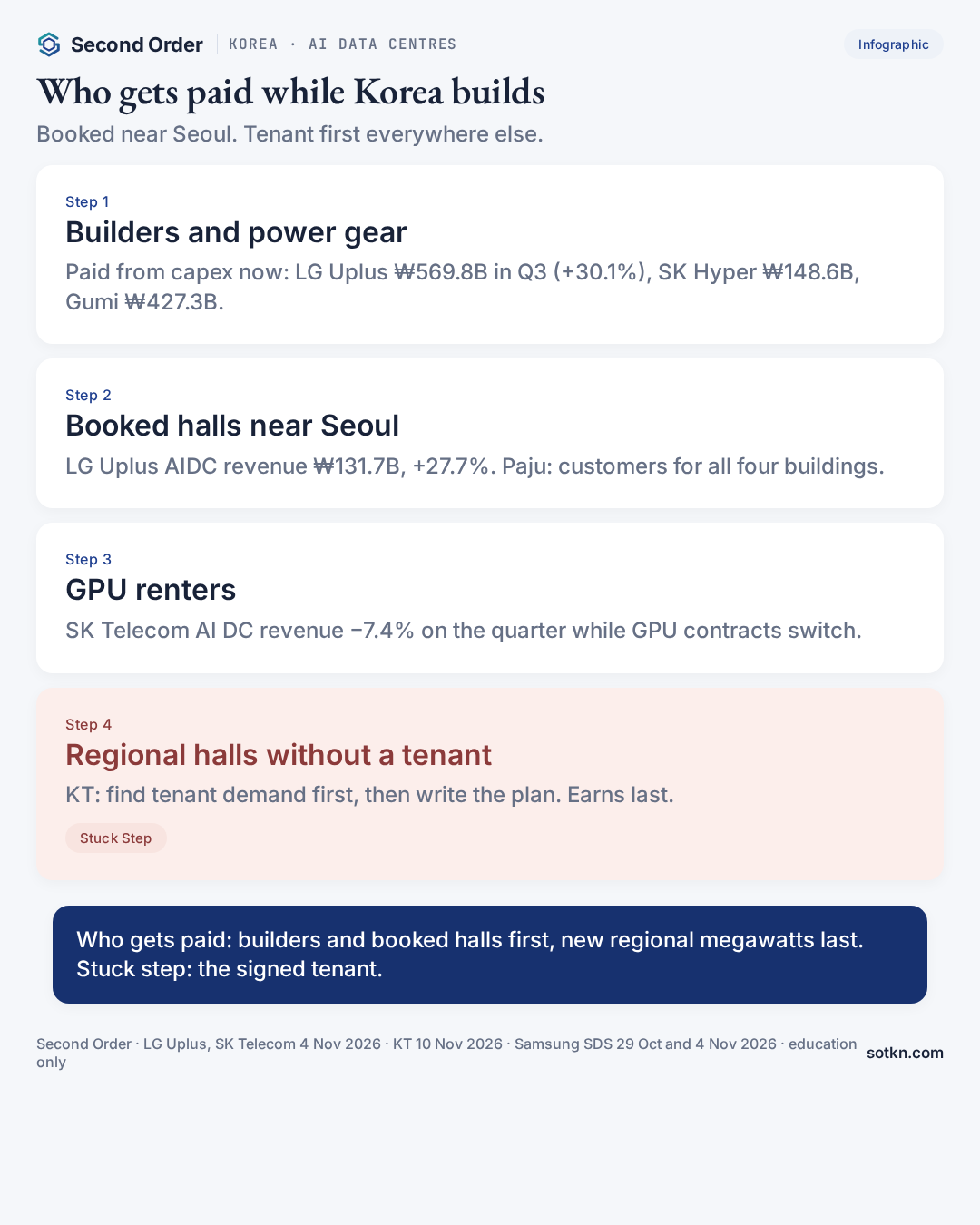
First, the builders and equipment suppliers. Capex is rising before the new halls earn: LG Uplus's separate capex was up 30.1% in the quarter on AI data centre investment, SK Telecom spent ₩148.6 billion on SK Hyper's data centre development, and Samsung SDS has ₩427.3 billion earmarked for Gumi. That money reaches contractors and electrical and cooling suppliers whether or not a tenant has signed. For who those builders are, see who builds AI data centers, and for Korean power gear booked years ahead by overseas buyers, our Korea power gear Pulse.
Second, the owners of booked halls near Seoul. LG Uplus's data centre revenue grew 27.7% on colocation and design-build-operate sales, and Paju adds capacity that already has customers. kt cloud's revenue rose 7.7% on higher utilisation at Gasan. For how retail colocation differs from a hall built for one cloud tenant, see hyperscale versus colocation data centers.
Third, the design-build-operate contractors. A carrier or IT firm that builds and runs a data centre for an asset manager is paid fees for the work without carrying the whole building on its balance sheet. LG Uplus is pursuing two to three such projects, Samsung SDS is preferred bidder on one of more than 200 MW, and KT expects about 80% of its 1 GW to sit in leased data centres rather than ones it owns.
Fourth, the GPU renters — in steps. SK Telecom's quarter shows that GPU rental income can pause when a contract ends and the next one has not started. Samsung SDS plans GPU services on Nvidia B300 chips at its Dongtan data centre from the end of this year and on Nvidia's next-generation Vera Rubin from March 2027.
Last, the regional halls that still need a customer. They earn only after a tenant signs and moves in. Until then they are cost on the balance sheet.
One-line rule: in Korea this month, builders and booked halls near Seoul are paid first; new regional megawatts are paid last. The stuck step is the signed tenant.
So what is the stuck step?
The signed tenant for capacity outside the capital. It is not money: all four companies are spending, and two are using outside investors through design-build-operate deals. It is not, outside Seoul, mainly power: KT and SK Telecom both say they have secured sites. And it is not demand in general: LG Uplus has booked a whole 200 MW-class site. Three things keep the step tight:
- The operators say so. KT will find tenant demand before it writes a business plan outside the capital area. SK Telecom will speed up once its next Ulsan customer terms are final. Neither said this quarter that those terms are signed.
- Demand still pulls toward Seoul. The one site that says it is fully booked is in the capital area, and Samsung SDS's 200 MW+ design-build-operate project is there too. The regions are where power is easier to find, not yet where buyers are queuing.
- Near Seoul, the bind is still power. KT will build there only where power and permits already exist, and Samsung SDS says power and land near Seoul are constraining supply. That is why the booked sites are few.
So-what: in Korea the scarce thing near Seoul is a powered site, and the scarce thing everywhere else is a customer willing to sign for one. The operators who have both are the ones whose data centre revenue is growing now.
Which dates test this read next?
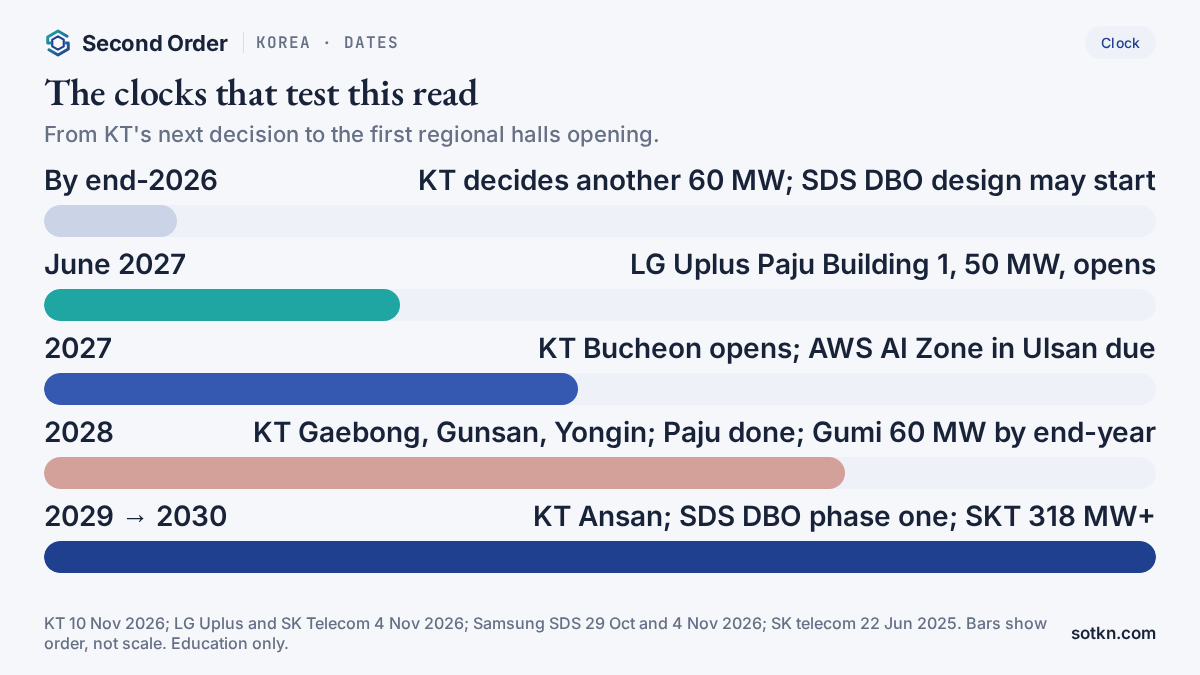
- By end-2026 — KT decides on another 60 MW. The test: whether any of it is outside the capital area with a named tenant.
- End-2026 — Samsung SDS's Seoul-area design-build-operate project may start design and building, and B300 GPU services start at Dongtan. The test: whether the preferred bid becomes a signed contract.
- Early 2027 — fourth-quarter results from all four. The test: whether SK Telecom's AI data centre revenue recovers once the new long-term GPU contracts start, and whether SK Hyper says its Ulsan customer terms are final.
- June 2027 — LG Uplus Paju Building 1, 50 MW, is due to open. The test: the first booked megawatts turning into revenue on schedule.
- 2027 — KT's Bucheon site is due to open. The test: KT's first new hall under the 1 GW plan.
- 2028 — KT's Gaebong, Gunsan and Yongin sites, all four Paju buildings, and Samsung SDS Gumi (end-2028). The test: whether Gunsan and Gumi, both outside the capital, open with customers.
- 2029 — KT's Ansan site and the Samsung SDS design-build-operate project's first phase. From 2030, SK Telecom's 318 MW+ target.
How does this compare with Malaysia, Singapore and the US?
Malaysia is turning the same question into a price. Our Malaysia booked-power Pulse followed a jump in the charge for connected power that a data centre books but leaves unused, which makes an unfilled hall costlier to hold. Korea's operators are avoiding that risk by waiting for tenants before they build outside Seoul.
Singapore shows the other end of the chain: megawatts rationed by tender and then fitted out in phases. Our Equinix SG6 Pulse followed the first tender-won hall to open, at 8 MW of a planned 20 MW.
In the US, the tenant question is being settled in very large blocks. Our Catalyst desk covered a 15-year, 910 MW powered-land lease at Riot's Corsicana campus in our Riot–Anthropic Catalyst, and today a Texas developer whose first lease ended and whose new customer paid a prepayment rather than signing a lease, in our Fermi Catalyst. The lesson travels: a prepayment or a preferred bid is not the same as a signed tenant.
What would change this view?
- SK Hyper finalises terms with new Ulsan customers, or KT names a tenant for Gunsan — the regional bind would ease.
- Samsung SDS names outside customers for Gumi before it is finished — the same.
- Paju Building 1 slips past June 2027 — the stuck step near Seoul would be the build, not the tenant.
- KEPCO or the government changes how capital-area power is allocated — more Seoul sites could open, and the regions would wait longer.
- SK Telecom's AI data centre revenue keeps falling after the new GPU contracts start — the problem would be demand, not timing.
Practical takeaways
- LG Uplus: customers secured for all four Paju buildings (200 MW-class); Building 1, 50 MW, opens June 2027
- LG Uplus AI data centre revenue ₩131.7 billion, up 27.7%; capex ₩569.8 billion, up 30.1%
- SK Telecom AI data centre revenue ₩126.1 billion, down 7.4% on the quarter on a GPU contract gap; Ulsan customer terms still in talks
- KT: 152 MW running, 911 MW lined up, 200 MW decided; tenants first outside the capital
- Samsung SDS Gumi: 60 MW to 120 MW, ₩427.3 billion, due end-2028, no outside tenant named
- About 640 MW decided or under way, more than twice the 289 MW SK Telecom and KT run today (our arithmetic)
- Builders and booked halls near Seoul are paid first. Stuck step: the signed tenant
FAQ
Which Korean AI data centres already have customers?
The clearest case is LG Uplus's Paju site north-west of Seoul, built for 200 MW of power. LG Uplus said on 4 November 2026 that Building 1, at 50 MW, already has customers and opens in June 2027, and that customer demand is secured for Buildings 2, 3 and 4 as well. Its CFO said the site carries 10 to 15 years of long-term contracts. The other operators have not said the same for their new sites.
Why do operators outside Seoul want a tenant first?
Because that is where demand is least certain. KT said on 10 November that near Seoul it will build only on sites where power and permits are already secured, while outside the capital area it will first identify tenant demand and only then draw up a concrete business plan. SK Telecom said SK Hyper is still discussing business terms with potential customers, with a focus on Ulsan, and will speed up building once agreements are final. Ulsan already has one anchor: a 15-year partnership signed in June 2025 to build a data centre there for an AWS AI Zone.
How much AI data centre capacity do Korea's carriers run today?
SK Telecom said it runs 137 MW across eight data centres, and KT said it has 152 MW, so the two together run about 289 MW on our arithmetic. LG Uplus did not give a running total in its results. Against that, KT has 911 MW of sites in its pipeline and SK Telecom plans more than 318 MW from 2030.
What is Samsung SDS building in Gumi?
An AI data centre on a 46,000 square metre site in Gumi, North Gyeongsang, which broke ground on 2 November 2026. It starts at 60 MW of power and can grow to 120 MW, with completion due at the end of 2028. Samsung SDS disclosed a ₩427.3 billion investment in January, about ₩7.1 billion per initial megawatt on our arithmetic. It plans to run its own GPU services there and rent space to customers who bring their own GPUs.
Who gets paid first while the halls are built?
On our map: the builders and equipment suppliers, paid out of capex that is already rising, such as LG Uplus's ₩569.8 billion in the third quarter; then the operators with booked halls, whose data centre revenue is growing now, like LG Uplus's ₩131.7 billion, up 27.7%. Operators that still need a tenant for a new site earn from it last.
Is this investment advice?
No. Education only. It maps who gets paid and which step is stuck. It is not a recommendation to buy or sell any security, and we leave out share prices, valuations, broker ratings and price targets on purpose.
Keep reading on the map
- Korea Markets hub — country page
- Korea grid-queue Pulse · Pohang financing Pulse · Korea power gear Pulse · Korea power-line fast track
- Malaysia booked-power Pulse · Equinix SG6 Pulse · Fermi Catalyst · Riot–Anthropic Catalyst
- AI Data Centers on the Stack · Neoclouds · Hyperscalers
- What is an AI data center? · Contracted power · Data center leases · GPU-as-a-service · How long a build takes
- All Markets doors — Taiwan, Korea, US, China, Singapore, Australia, Malaysia
How we check this. LG Uplus figures come from its Korean results release of 4 November 2026 and that day's earnings call. SK Telecom figures come from its English results release and Korean investor briefing of 4 November, and the AWS Ulsan partnership from its newsroom release of 22 June 2025. KT figures come from its third-quarter earnings release, filed with the US SEC on 10 November, and that day's earnings call. Samsung SDS figures come from its Gumi release of 4 November and its third-quarter call script of 29 October. Call quotes are from interpreted transcripts. Anything we worked out ourselves is labelled “our arithmetic”. Share prices, valuations, broker ratings and price targets are left out on purpose. The references we used are listed at the end. Our editorial standards →
Not investment advice. Do your own research.
References
- LG Uplus newsroom, LG Uplus Q3 2026 results release (Korean), 4 Nov 2026. news.lguplus.com — AIDC revenue ₩131.7 billion, up 27.7% year on year and 6.1% on the quarter, on colocation and design-build-operate sales; separate capex ₩569.8 billion, up 30.1% on AIDC investment; Paju 200 MW-class site, four buildings by 2028, Building 1 of 50 MW with customers secured, opening June 2027.
- LG Uplus Q3 2026 earnings call transcript (Exa), 4 Nov 2026. exa.ai — customer demand secured for Buildings 2, 3 and 4 at Paju; 10 to 15 years of long-term contracts in place; two to three DBO projects with asset managers; capex to rise next year.
- SK Telecom, SK Telecom Announces Q3 2026 Results (press release), 4 Nov 2026. sktelecom.com — SK Hyper and SK Horizon; about 180 MW of new data centres under development in Ulsan and Seoul; SK Hyper in talks with potential customers on business terms, with a focus on Ulsan.
- SK Telecom, 3Q26 investor briefing (Korean), 4 Nov 2026. sktelecom.com — AI DC revenue ₩126.1 billion vs ₩118.8 billion a year earlier and ₩136.2 billion in Q2, with a GPUaaS revenue gap during the move to new long-term contracts; capex ₩461.4 billion plus ₩148.6 billion for SK Hyper data centre development; 137 MW in eight data centres today, 318 MW+ from 2030.
- SK Telecom newsroom, SK Group and AWS Team Up to Build Cloud Computing Infrastructure to Support AI Innovation, 22 Jun 2025. news.sktelecom.com — 15-year partnership to build a Ulsan data centre for an AWS AI Zone, operations expected to begin in 2027, SK Group leading construction.
- KT Corp, 3Q26 Earnings Release (Form 6-K, Exhibit 99.1, SEC), 10 Nov 2026. sec.gov — AIDC capacity +1 GW by 2031; six AIDC sites to open by 2029 (Bucheon 2027; Gaebong, Gunsan, Yongin 2028; Ansan 2029); kt cloud revenue ₩268.2 billion vs ₩249.0 billion.
- KT Corp Q3 2026 earnings call transcript (The Motley Fool), 10 Nov 2026. fool.com — 152 MW today; 911 MW secured across 20 sites, 500 MW backup across 10; 200 MW decided, 60 MW more by year-end; 80% leased, 20% owned; metro sites only where power and permits are secured, tenant demand first outside the metro area.
- Samsung SDS, Samsung SDS Breaks Ground on AI Data Center in Gumi, 4 Nov 2026. samsungsds.com — groundbreaking on 2 November; 46,000 m² site; 60 MW initial, up to 120 MW; completion end-2028; own GPU services plus colocation; ₩427.3 billion disclosed in January; construction since Gumi City's approval in late August.
- Samsung SDS, Q3 2026 earnings conference call script, 29 Oct 2026. image.samsungsds.com — 800 MW+ AI infrastructure roadmap by 2031; preferred bidder for a 200 MW+ Seoul-area DBO project for Pacific Asset Management, building from as early as end-2026 and phased operations from 2029; power and land near Seoul constraining new supply; cloud revenue ₩796.1 billion, up 18%.