10 Times the Charge for Empty Power: Who Gets Paid While Malaysia Makes Data Centres Fill What They Book
Malaysia has approved 117 data centres asking for about 23,500 MW, and 55 are running. Now booking power you do not use costs about ten times more, and operators will have to report their power and chips. Builders are paid now. The wait is filling the hall.
Malaysia has approved 117 data centres that together ask for about 23,500 MW, and 55 of them are running. This week the government said that booking power and not using it now costs about ten times more, and that operators will have to report their power use and the AI chips they bring in. The stuck step is filling the booked megawatts with real load.
MALAYSIA PULSE · AI DATA CENTRES · POWER · Data as at 13 Nov 2026 (minister 10 and 12 Nov; Digital Ministry 13 Nov; Bursa filings 4–10 Nov) · Next update: the start date of the new rate, or TNB’s next results
Affects: AI Data Centers · Hyperscalers · Neoclouds — Markets: Malaysia · Singapore · Australia · US
Education only, not advice to buy or sell any security. RM is the Malaysian ringgit. A kilowatt (kW) is a thousand watts; a megawatt (MW) is a thousand kilowatts, roughly what a large shopping mall draws at full tilt. Our own sums are labelled. In October we wrote about the minister’s first warning that unused power would be billed, before any rate was set (Malaysia bills unused data centre power). This piece is the follow-up: the rate is now public, the reporting rules are coming, and the builders are still being paid.
The numbers that matter this week
Charge on booked, unused power
RM8.50 → RM89.64
Per kW of shortfall a month · about 10.5 times
New rateApproved data centres
117 · ~23,500 MW
Combined maximum demand, per the minister
ApprovedRunning today
55 of 117
19 building · 16 not started · 27 off-grid · 24 pending
StatedHyperscale build (Sunway)
RM1.74bn
Bandar Serendah, Selangor · Q4 2026 to Q4 2028
PaidInterim 275 kV supply (Jati Tinggi)
RM33.1m
Gerbil, Negeri Sembilan · nine months
PaidReal, running load
Not reported
Power use and GPU imports to be disclosed by law
Stuck stepThe Star, 11 Nov 2026; Bernama via Malay Mail, 12 and 13 Nov 2026; Sunway Construction and Jati Tinggi Bursa filings as reported, 5 and 10 Nov 2026. Status chips are Second Order’s read.
On this page: Why it matters · What changed · How the charge works · Power and chips · The 117 · Our math · Who gets paid · What is stuck? · Dates next · FAQ
Why does a charge on unused power matter?
Think of a busy restaurant on a Saturday night. A group books twenty seats and eight people turn up. The kitchen bought food for twenty, the waiter held the tables, and other diners were turned away at the door. So the restaurant starts charging a fee for every empty seat. The fee is not really about the money. It is about making people book only what they will use.
Malaysia’s grid works the same way. When a data centre asks Tenaga Nasional (TNB), the national utility, for power, TNB plans lines, substations and power plants for the full amount declared. If the hall then sits half empty, that capacity is held for nobody, and other customers who could have used it wait. The minister called this “phantom demand”: power reserved on paper that never turns into real use.
It matters for AI because an AI data centre is, at heart, a building that turns electricity into computing, and a large one draws as much as a small city (what an AI data center is; how much power one uses). Malaysia, and Johor in particular, became one of the fastest-growing places in Asia to build them. The country now has more data centre demand approved on paper than the grid has ever carried at its peak. The charge is how the government is trying to sort real demand from hopeful demand.
What did the government say this week?
Three statements in four days. On 10 November, speaking at a Bursa Malaysia sector event run with Macquarie, the minister said the connected load charge had been raised from RM8.50 to RM89.64 per kilowatt. He said TNB plans its network and sets aside capacity for the full amount a customer declares, so unused megawatts are capacity that could have served someone else. The new fee, he said, makes operators financially accountable for the capacity they contract.
In the same speech he gave the clearest count yet of the pipeline. Malaysia has approved 117 data centres with a combined maximum demand of about 23,500 MW. Of these, 55 are operating, 19 are under construction, 16 are approved but not yet started, and 27 have been approved for off-grid supply, meaning they will make or source power away from the national grid. Another 24 applications are on hold while power and water are checked. Data centres made up 43.9% of all approved investment in the first half of 2026, RM95.8 billion, up from 0.4% in 2021.
He also said data centre power is now planned separately from homes and other industry, that a special ultra high voltage tariff makes operators pay for the transmission upgrades they need, and that ordinary users will not subsidise them. Because gas turbines are in short supply worldwide, he said, the Energy Commission is speeding up a framework for self-generation, with gas, solar, hydro and batteries as options, and he wants “realistic schedules, not promises of capacity that cannot be delivered.”
On 12 November, at a separate launch, he said the duty to disclose data centre information will be written into law: electricity use, the number of GPU chips imported, the operator and hyperscaler at each site, and its location. And on 13 November the Digital Ministry said in a written reply to Parliament that it is in the final stages of drafting a Digital Infrastructure (Data Centre) Bill, aimed at the Dewan Rakyat in 2027, subject to government approval.
What has not been said matters too. The minister did not give a start date for the new rate. w.media reported that Parliament was told of the increase last month without a rate or date, and that TNB had not confirmed either. When we checked TNB’s public charges page on 13 November it still showed RM8.50 per kilowatt.
How does the connected load charge work?
The charge is not new; the size is. TNB has had a connected load charge for years as a brake on customers who declare more demand than they need. Its own page says over-declaring leads to building too much and to a higher reserve margin, and that without the charge, other customers would pay for the waste. Here is how TNB’s published rules work for a new medium or high voltage customer, which is what a data centre is:
- It lasts six years from the day supply is connected.
- When applying, the customer declares its maximum demand in phases for years one to four, so a site that plans to fill up slowly can say so up front.
- In years one to four, the charge applies in any month when actual peak demand is below 85% of what was declared for that year.
- In years five and six, it applies when actual peak demand is below 75% of the total declared.
- The charge is the rate times every kilowatt of shortfall below that reference level, worked out monthly and added to the bill.
- If the customer ever uses more than it declared, the higher figure becomes the new reference.
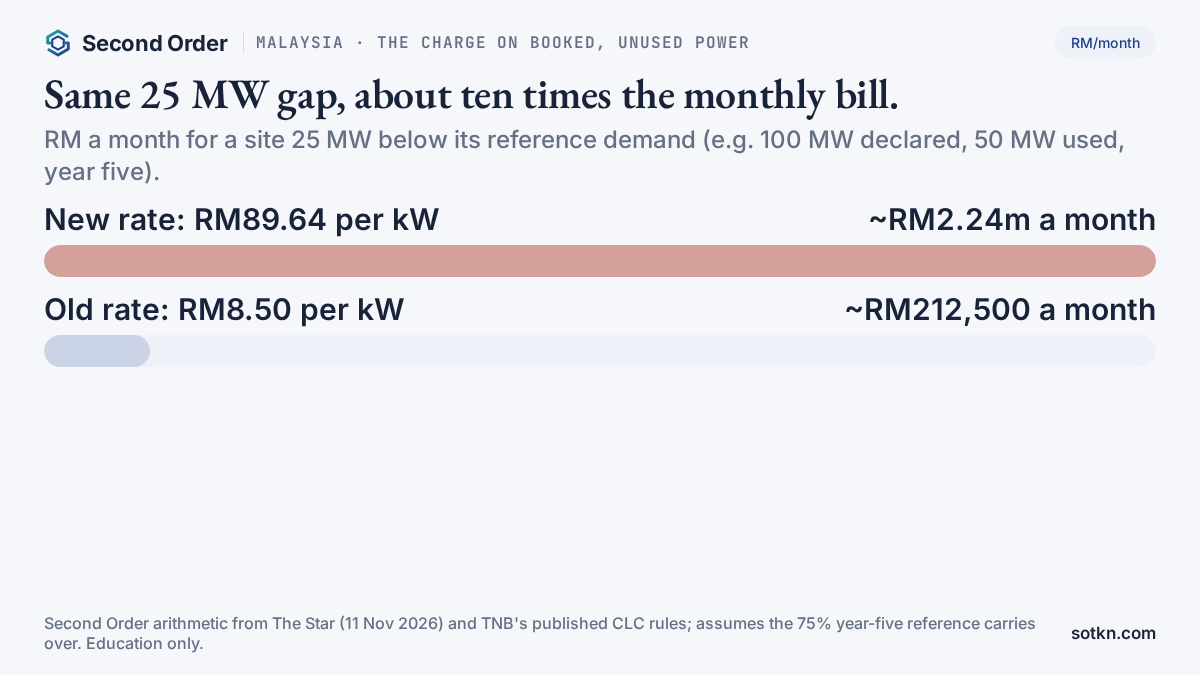
Two things follow. First, the rule does not punish a slow ramp that was declared honestly; it punishes the gap between the plan and the meter. Second, at RM8.50 per kilowatt the gap was cheap enough to ignore for a large site. At RM89.64 it is not. The minister’s own example was simpler than the formula: book 100 MW, use 50 MW, and the 50 MW not used will still be billed. Until TNB publishes the new terms, we do not know whether data centres keep the 85% and 75% cushions.
This is the difference between contracted power and used power, which we explain in more detail here (contracted power explained). The grid is built for the contract. The bill, until now, mostly followed the use.
Why does the government want to count power and chips?
Booking power is one way to look bigger than you are. The other side of the same question is what is actually inside the hall. The minister said the government needs to know who the operators and hyperscalers are for each data centre, where each one is, how much electricity it uses and how many GPUs it imports. A GPU is the chip that does most AI work; a rack of them is what turns booked power into used power.
He was also blunt about chips that leave again. He said some parties rented space in Malaysian data centres, imported GPU chips and later re-exported them, and that the Digital Ministry is reviewing whether existing laws can be used against the re-export of chips the United States restricts. “When the US imposes a restriction, as a country, we want to make sure that whatever chips arrive here are meant for our own use,” he said, adding that the government can confirm to US authorities which data centre is using the chips in question.
Put plainly, the same disclosure answers two questions. Is this hall really being used? And are the chips in it staying here? For an operator with real tenants and running racks, reporting is paperwork. For a site that booked power on hope, or a renter moving chips through, it is a problem. Malaysia already ships a large share of the world’s chip packaging work, which is why chip flows are watched closely (Malaysia’s chip export record).
The wider bill is about security and resilience: the ministry says it will give a clearer framework for protecting data centres and keeping them running, treated as critical national infrastructure. In the same reply it said Kuala Lumpur has 11 approved data centre projects, nine running and two under construction, and that average actual water use by data centres in Kuala Lumpur and Selangor was 2.4 million litres a day between January 2025 and June 2026, with supply reserves still adequate.
What does the pipeline of 117 look like?
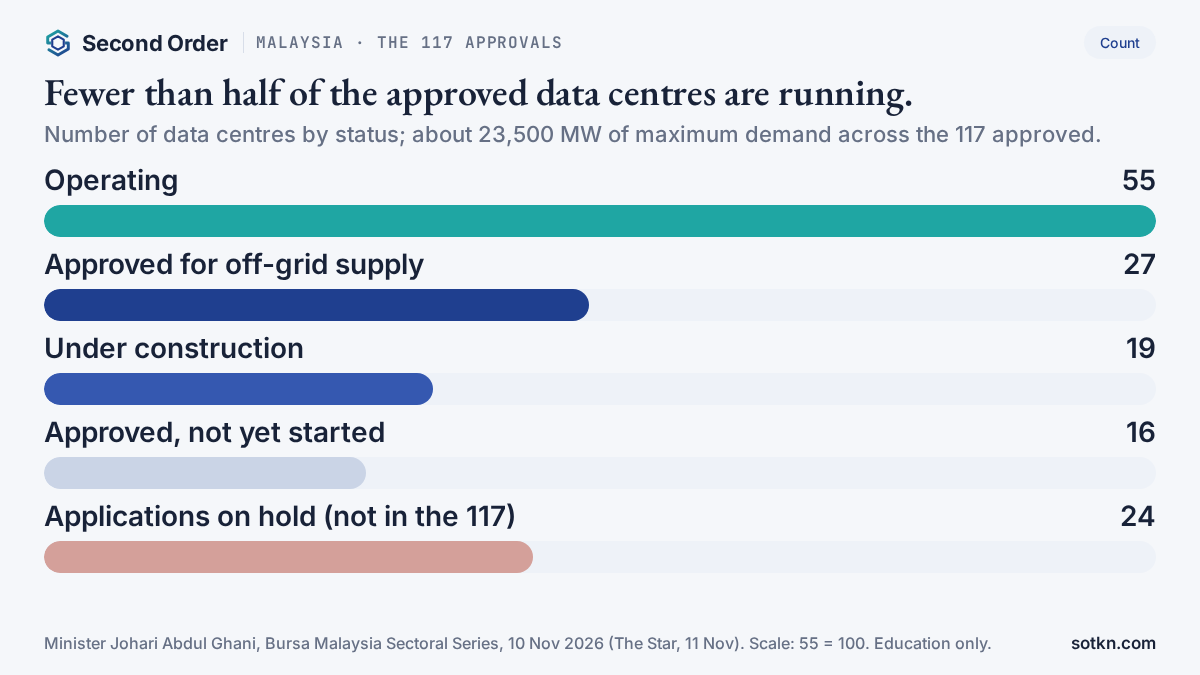
Fewer than half the approved halls are running: 55 of 117, or about 47% by count. That is normal for a building boom; halls take two or three years to build and longer to fill (how a data centre lease works). But the demand figure attached to the whole list is large. About 23,500 MW is more than the peak demand of Peninsular Malaysia’s entire grid, which TNB put at just over 22,000 MW in August (TNB needs 9,000 MW more). Not all of it will be built, and not all of it will be drawn at once. That gap between approval and use is what the charge targets.
The off-grid line is also worth a second look. Twenty-seven approvals, almost a quarter of the list, are for sites that will rely on their own or off-grid supply. That fits the minister’s push for self-generation while turbines are scarce. And 24 applications are still waiting on power and water checks, which we covered when the water-first rule was set (24 data centres on hold).
Bursa Malaysia’s chairman, Abdul Farid Alias, gave the long view at the same event: data centres use around 7% of the country’s electricity today, and that is projected to reach 31% by 2035. Close to a third of the country’s power could go to one new kind of customer within a decade. That is why the government now wants proof that bookings are real.
What does the arithmetic say?
Everything below is our arithmetic from the published figures, not a company or TNB forecast. For the charge, we assume TNB’s published formula (85% and 75% reference levels) carries over at the new rate; the final terms for data centres have not been published.
- Size of the jump: RM89.64 divided by RM8.50 is about 10.5 times, an increase of about 955%.
- Per megawatt: each megawatt of shortfall costs about RM89,640 a month at the new rate, about RM1.08 million a year, against RM8,500 a month before.
- Year-five example: a site that declared 100 MW and draws 50 MW has a reference of 75 MW (75% of 100), so it is 25 MW short. That is about RM2.24 million a month, or about RM26.9 million a year, against about RM212,500 a month at the old rate.
- The minister’s example: if all 50 MW of unused power were billed, as he described it, the charge would be about RM4.48 million a month, or about RM53.8 million a year.
- Early-years example: a site that declared 40 MW for year one and draws 20 MW has a reference of 34 MW (85% of 40), a 14 MW gap and a charge of about RM1.25 million a month.
- Where the charge stops: at 85% of the declared phase in years one to four, and 75% of the total in years five and six, the charge is zero.
- The pipeline: 23,500 MW across 117 approvals averages about 200 MW per project; 55 of 117 running is about 47%.
- The money: RM95.8 billion being 43.9% of approved investment implies about RM218 billion of total approved investment in the first half of 2026.
The lesson of the arithmetic is simple. At the old rate, holding 25 MW of spare booked power cost a big operator about as much as a few staff salaries. At the new rate it costs as much as a mid-sized building contract every year. It is now cheaper to declare honestly and ramp slowly than to book big and hope.
Malaysia: the booked-power charge and the clocks
The Star, 11 Nov 2026; TNB charges page, accessed 13 Nov 2026; w.media, 12 Nov 2026; Bernama via Malay Mail, 12 and 13 Nov 2026. Sums marked as ours are Second Order arithmetic.
Who gets paid, and who waits?
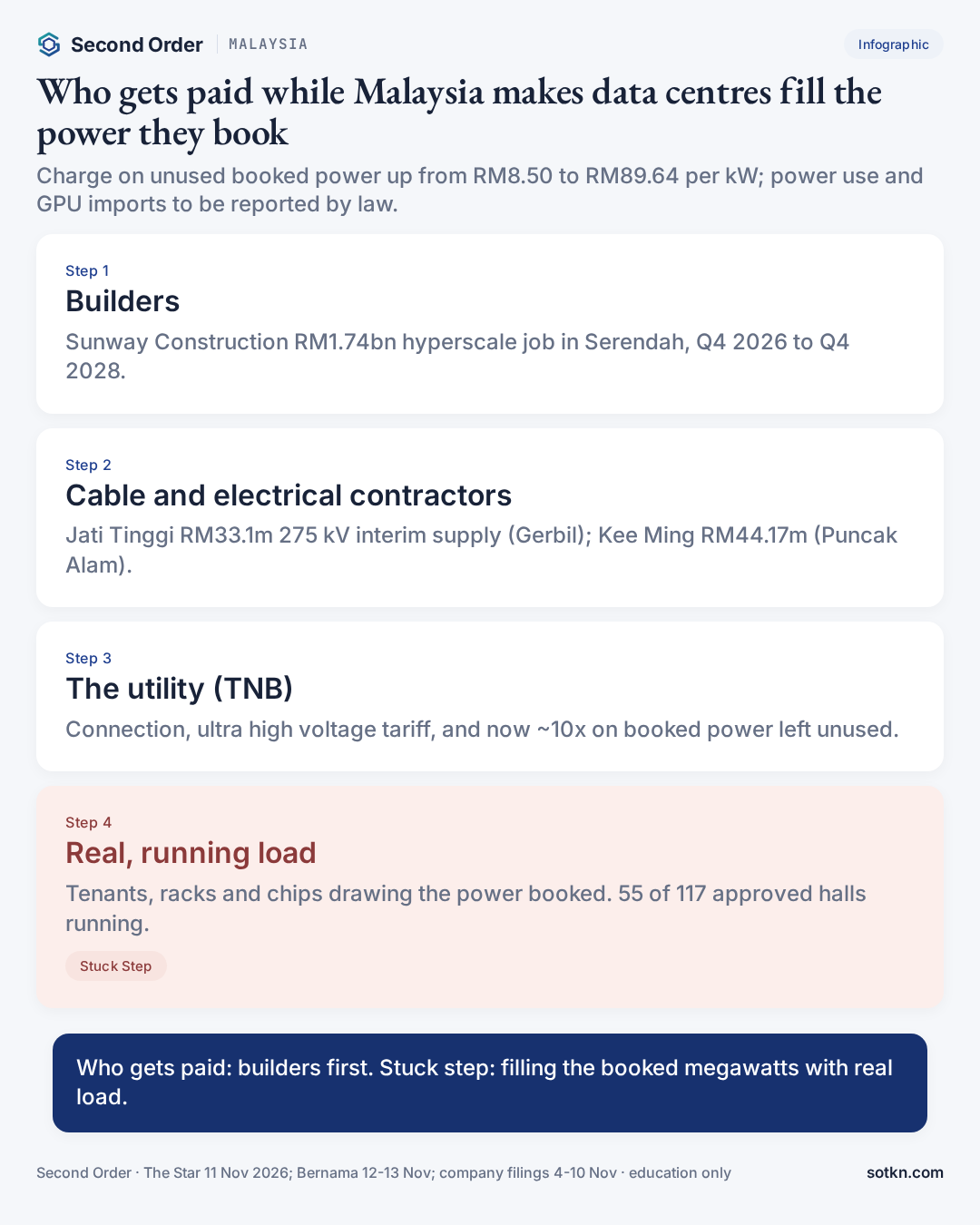
1 · Builders
Who: Sunway Construction RM1.74bn hyperscale job, Serendah (5 Nov)
Paid: Paid as work is done, Q4 2026 to Q4 2028
2 · Cable and electrical contractors
Who: Jati Tinggi RM33.1m 275 kV interim supply (10 Nov); Kee Ming RM44.17m (4 Nov)
Paid: Paid over nine months to mid-2027
3 · The utility
Who: TNB: connection, ultra high voltage tariff, and the charge on unused power
Paid: Paid on the booking, now at about ten times the old rate
4 · Own-power suppliers
Who: Gas, solar, hydro and battery suppliers for 27 off-grid approvals
Paid: Paid once the self-generation framework is set
5 · Real, running load
Who: Tenants signed, racks in, chips switched on and reported
Paid: The step the new charge and the new law test
First, the builders. Sunway Construction said on 5 November that it had signed a RM1.74 billion contract with an international hyperscaler, which it did not name, for a hyperscale data centre in Bandar Serendah, Selangor. The job covers the main buildings, supporting infrastructure and the mechanical, electrical and plumbing work. Construction starts in the fourth quarter of 2026 and is due to finish in the fourth quarter of 2028. It was the group’s seventh data centre contract this year, taking new orders to RM9.8 billion and the order book to RM13.4 billion. Builders are paid as the work is done, long before the hall has a tenant.
Second, the cable and electrical contractors. Jati Tinggi said on 10 November it had accepted a RM33.1 million subcontract to lay two circuits of 275 kV cable from a transition yard to a data centre’s substation in Gerbil, Negeri Sembilan, plus the transition yard and overhead line works. The filing calls it an interim supply, and the work runs for nine months. A week earlier the same group won a RM2.9 million job from TNB for a community battery. Kee Ming said on 4 November that it won a RM44.17 million electrical subcontract for a hyperscale data centre in Puncak Alam, Selangor, due by 30 July 2027, its third hyperscale data centre job of the year.
The word interim is worth noticing. An interim supply is a temporary connection that lets a site take power before its permanent connection is ready. It shows how hard operators push to get power on early, and it is exactly the kind of booking the new charge will now test: once connected, the meter starts counting against what was declared.
Third, the utility. TNB is paid on the connection, on the ultra high voltage tariff that makes operators carry their own transmission upgrades, and now, at about ten times the old rate, on any booked power left unused. The goal, though, is to make the charge rarely paid: if operators declare honestly, TNB plans less spare capacity and other customers are not squeezed out (how power gets from the grid to the GPU; Johor’s substation queue).
Fourth, the suppliers of power that does not come from the grid. Twenty-seven approvals are for off-grid supply, and the minister pointed to gas, solar, hydro and batteries. He even noted that Malaysia exports about 30 million tonnes of LNG a year, which he put at roughly 31,000 MW of electricity in theory, as a possible market for Petronas on commercial terms. These suppliers are paid once the self-generation rules are set and plants are ordered, which is later than the builders (Malaysia’s green power grid charge; Google’s clean power plan).
Who waits, and who now pays for waiting: the data centre owners. Land, buildings, cables and connections are paid for before a single tenant moves in. Until racks fill up, the owner earns little. Now, if the hall fills slower than the power booked for it, the owner also pays TNB for the gap, at a rate that can run to tens of millions of ringgit a year on a big site.
What is stuck, exactly?
The stuck step is real, running load: tenants signed, racks installed, chips switched on and drawing power close to what was declared. Everything before that step is moving. Land is approved, contracts are signed, cables are being laid and TNB connects sites. The step after the connection, turning booked power into used power, is the one the new charge and the new law are built to test.
It is not the builders: three contracts in a week show the supply chain is busy. It is not, for now, the grid connection itself; interim supplies are being built to get power on early. And it is not money for construction: hyperscalers are signing billion-ringgit jobs. It is whether every booked megawatt has a customer and a chip behind it. That depends on AI and cloud companies signing leases and shipping hardware on time.
The honest limits of this read are the details not yet published. We do not know the start date of the new rate, whether it applies to existing connections or only new ones, or whether data centres keep the 85% and 75% cushions. We do not know when the disclosure law will take effect or how often operators will report. If the new terms apply only to new connections, the bite is slower. If they apply to existing sites with spare bookings, operators may hand back capacity, which would free power for the 24 applications on hold.
It is the same shape we keep finding: the slow step sets the timing for everyone else, and the cost lands on whoever owns it (where the stuck step moves). In Malaysia the government has decided that the owner of an empty, powered hall should carry that cost, not the grid and not other customers.
Which dates test the read?
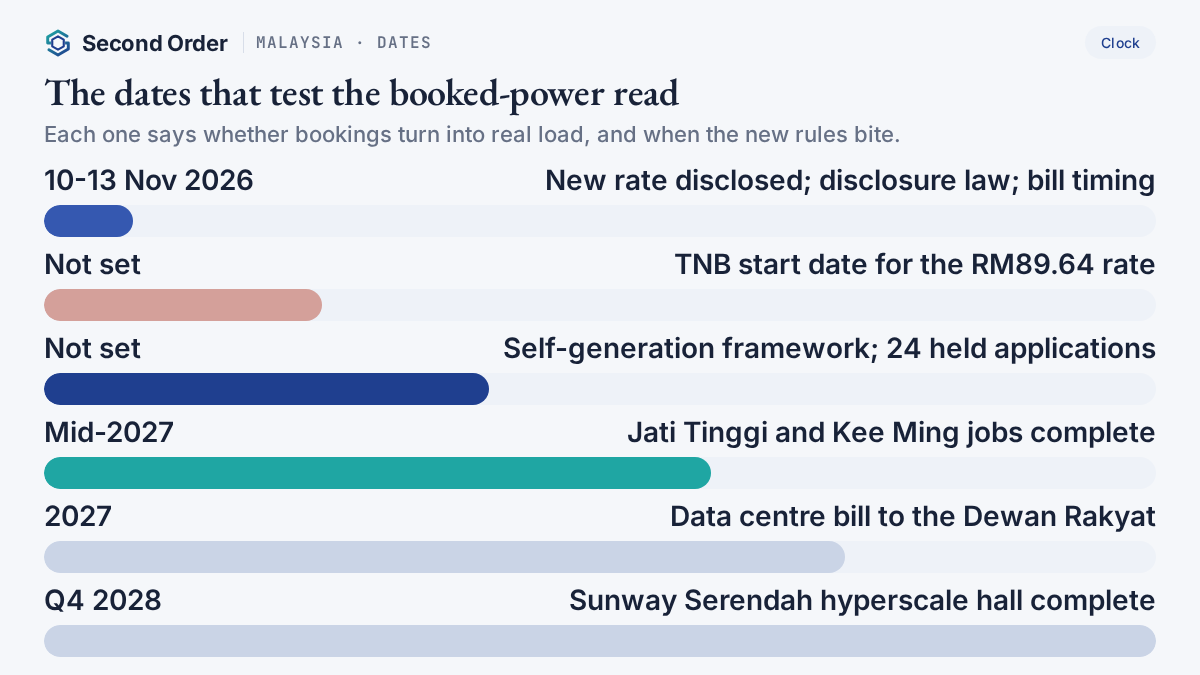
- 4 and 5 November 2026 — Kee Ming (RM44.17 million) and Sunway Construction (RM1.74 billion) data centre contracts.
- 10 November 2026 — the minister discloses the RM89.64 per kilowatt rate and the 117-project count; Jati Tinggi’s RM33.1 million interim supply job.
- 12 November 2026 — power use and GPU import disclosure to be put into law.
- 13 November 2026 — Digital Ministry: data centre bill aimed at Parliament in 2027.
- Date not set — TNB publishes the new rate and its start date; the first sign of whether existing sites are covered.
- Date not set — the Energy Commission’s self-generation framework, and decisions on the 24 applications on hold.
- Mid-2027 — Jati Tinggi’s nine-month job and Kee Ming’s 30 July 2027 completion.
- 2027 — the Digital Infrastructure (Data Centre) Bill in the Dewan Rakyat, subject to approval.
- Fourth quarter of 2028 — Sunway’s Serendah hyperscale data centre due to be completed.
Dates from The Star (11 Nov 2026), Bernama via Malay Mail (12 and 13 Nov), and the companies’ filings as reported. Mid-2027 for Jati Tinggi is our arithmetic from a nine-month job starting in November.
How does this compare with Singapore, Australia and the US?
Every market we follow is pushing the power problem back onto the builder, each in its own way. Singapore rations new data centre capacity through tenders and asks the winners for green power and efficient designs (Singapore Markets). Australia now expects new halls to bring new clean generation with them, and the rule-maker is deciding how much of the grid upgrade bill they pay (Australia Markets). In the US, buyers are paying for their own generators to skip the queue (US Markets). Malaysia’s version is a price on the gap between what a data centre books and what it uses, plus a duty to report what is inside.
How we check this. The new RM89.64 rate, the 117 approved data centres, their status and the 23,500 MW come from the minister’s 10 November speech as reported by The Star, with w.media on how the charge is worked out and what has not been published. The rules for the charge come from TNB’s own published page. The disclosure plan comes from Bernama’s 12 November report and the 2027 bill timing from the Digital Ministry’s written reply to Parliament on 13 November. The contracts come from the companies’ Bursa filings as reported. Every sum we worked out is labelled “our arithmetic”, and where we assume TNB’s published formula carries over to the new rate, we say so. Where a source is silent, such as the start date of the new rate, we say that instead of guessing. Price targets and ratings are left out on purpose. The references we used are listed at the end. Our editorial standards →
FAQ
What changed on 10 November?
Malaysia’s Investment, Trade and Industry Minister, Johari Abdul Ghani, said the connected load charge has been raised from RM8.50 to RM89.64 per kilowatt, about 10.5 times, to stop data centres booking grid capacity they do not use. In October he had told Parliament such a charge was coming but gave no rate. The start date has still not been published, and TNB’s public page still showed the old rate when we checked on 13 November.
What is the connected load charge?
It is a monthly charge TNB adds to a bill when a customer’s actual peak demand falls below a reference level set from what it declared. Under TNB’s published rules, new medium and high voltage customers face it for six years: below 85% of the demand they declared for each of years one to four, and below 75% of their total declared demand in years five and six.
How much could it cost a data centre?
On our illustrative arithmetic, assuming TNB’s published formula carries over at the new rate, a site that declared 100 MW and drew 50 MW in year five would be 25 MW short of its 75 MW reference: about RM2.24 million a month, against about RM212,500 at the old rate. The final terms for data centres have not been published.
What is the stuck step?
Filling the booked megawatts with real, running load: tenants signed, racks installed and chips switched on. Builders and electricians are being paid now. Owners who book more power than they can fill now pay for the gap, and from the coming law they will have to report their power use and chip imports.
Is this investment advice?
No. Education only. It maps who gets paid and which step is stuck. It is not a recommendation to buy or sell any security, and we leave out price targets and ratings on purpose.
References
Outbound links below are nofollow. We list only the sources actually used. Internal sotkn.com links in the body are separate.
- The Star, Curbs on DC grid hoarding, 11 Nov 2026. thestar.com.my — the minister’s 10 November speech at the Bursa Malaysia Sectoral Series: the connected load charge raised from RM8.50 to RM89.64 per kilowatt, 117 approved data centres with about 23,500 MW of maximum demand and their status, 24 pending applications, the ultra high voltage tariff, the self-generation framework, turbine shortages, the LNG comparison and the 43.9% investment share.
- w.media, Malaysia raises by 10 times penalty for data center phantom power demand, 12 Nov 2026. w.media — how the charge is calculated monthly on the shortfall below the reference demand, that the effective date was not given, and that TNB’s website still showed the old rate.
- Tenaga Nasional Berhad, Charges and penalties: Connected Load Charge, accessed 13 Nov 2026. tnb.com.my — the published rules: six years for new medium and high voltage customers, maximum demand declared in phases for years one to four, the 85% and 75% reference levels, and the RM8.50 per kilowatt rate still shown.
- Malay Mail (Bernama), Malaysia to make data centre operators disclose power use, GPU imports under new law, 12 Nov 2026. malaymail.com — the plan to put disclosure of electricity use, GPU imports, operators, hyperscalers and locations into law, 55 of 117 projects operating, the 100 MW booked and 50 MW used example, and the review of action against GPU re-exports.
- Malay Mail (Bernama), Data centre boom prompts new safeguards as Malaysia targets 2027 for regulatory bill, 13 Nov 2026. malaymail.com — the Digital Infrastructure (Data Centre) Bill aimed at the Dewan Rakyat in 2027, 11 approved projects in Kuala Lumpur (nine operating, two under construction), and average actual water use of 2.4 million litres a day in Kuala Lumpur and Selangor.
- Bursa KL, Sunway Construction secures RM1.74 billion Selangor data centre job, 5 Nov 2026. bursakl.com — the RM1.74 billion hyperscale data centre contract in Bandar Serendah for an unnamed international hyperscaler, construction from the fourth quarter of 2026 to the fourth quarter of 2028, and the RM9.8 billion of new orders and RM13.4 billion order book.
- The Edge Malaysia, Jati Tinggi wins RM33 mil contract for power supply to Gerbil data centre, 10 Nov 2026. theedgemalaysia.com — the RM33.1 million subcontract for two circuits of 275 kV cable and a transition yard as interim supply to a data centre in Gerbil, Negeri Sembilan, over nine months, and the RM2.9 million TNB community battery job.
- Business Today, Kee Ming bags RM44.17 million hyperscale data centre contract in Selangor, 4 Nov 2026. businesstoday.com.my — the RM44.17 million electrical subcontract for a hyperscale data centre in Puncak Alam due by 30 July 2027, and three hyperscale contracts worth RM72.23 million in 2026.
Not investment advice. Do your own research. Education only. Map of who gets paid and which step is stuck — not a buy list.
More on this desk: Malaysia Markets · AI Data Centers · Hyperscalers · all Markets · Singapore Markets · how much power Malaysia’s data centres use.