Korea Is Now Taiwan’s Biggest Supplier: Who Gets Paid While Taiwan’s AI Rack Makers Wait on Memory
Taiwan shipped a record US$96.76bn in October, but its imports grew faster, and Korea became its biggest single supplier for the first time, on memory chips. Memory makers keep most of each sale. Rack makers keep under 5%. The wait is memory.
Taiwan shipped a record US$96.76 billion of goods in October, but its imports grew even faster, and for the first time Korea was the single biggest country it bought from. The reason was memory chips. Memory makers keep most of every sale; the companies that build AI racks keep less than 5%. The stuck step is memory supply.
TAIWAN PULSE · SEMICONDUCTORS · MEMORY · AI SERVERS · Data as at 14 Nov 2026 (Ministry of Finance 9 Nov; Quanta call 11 Nov; company sales to 10 Nov; Korea Customs 11 Nov) · Next update: Taiwan’s November trade on 9 December
Affects: Semiconductors · Hyperscalers · AI Data Centers — Markets: Taiwan · Korea · China · US
Education only, not advice to buy or sell any security. US$ figures are from Taiwan’s trade tables; NT$ is the New Taiwan dollar, about 32.6 to the US dollar at the end of October. DRAM is the working memory in every server; HBM is a stacked, faster kind that sits right next to an AI chip. Our own sums are labelled. On the same October numbers we have already written about TSMC’s record invoice (TSMC’s NT$586.89 billion October) and Hon Hai’s rack ramp (Hon Hai’s new AI racks). This piece looks at the other side of the ledger: what Taiwan has to buy in before it can ship.
The numbers that matter this week
Taiwan exports, October
US$96.76bn
+58.9% on a year earlier · a monthly record
RecordTaiwan imports, October
US$68.89bn
+75.1% · growing faster than exports
RecordImports from Korea
US$13.0bn
+128.3% · 18.9% of imports · first time No. 1 country
NewElectronic parts imported
US$26.06bn
+109.3% · against US$32.68bn exported
Bought inGross margin: memory vs racks
85.7% vs 4.75%
Nanya vs Quanta, third quarter
PaidMemory supply
New fabs 2027–28
Existing output close to its ceiling
Stuck stepMinistry of Finance, R.O.C., 9 Nov 2026; Taipei Times, 10 and 12 Nov 2026; VLSI Korea, 4 Nov 2026. Status chips are Second Order’s read.
On this page: Why it matters · What changed · Why Korea · Bought in first · The rack makers · Our math · Who gets paid · What is stuck? · Dates next · FAQ
Why does a change in who Taiwan buys from matter?
Think of a bakery famous for its cakes. Orders pour in, and the shop sells more cakes than ever. But this year butter has doubled in price, and almost all of it comes from one dairy down the road. The bakery’s sales look wonderful. The dairy’s profits look even better. And the number of cakes the bakery can make each day depends less on how many ovens it has than on how much butter the dairy can deliver.
Taiwan is the bakery. It assembles most of the world’s AI servers and makes most of its advanced chips, so its export figures are a running scoreboard for AI spending. Memory is the butter. Every AI server needs large amounts of it: plain DRAM on the board, and HBM stacked beside each AI chip (HBM explained). The biggest makers are Korean (who makes DRAM). When Korea becomes the largest single country Taiwan buys from, it tells you where a growing share of the money in each AI rack is going before the rack ever leaves Taiwan.
It also tells you something about speed. A rack maker can add factory floor, workers and test bays. It cannot add memory. If memory output is close to fixed for the next year, then memory sets the pace for everyone downstream, and the price of memory decides how the money is split.
What did the October trade figures show?
The headline was another record. Taiwan’s exports rose 58.9% from a year earlier to US$96.76 billion, beating September’s record of US$87.22 billion by a wide margin and extending the run of year-on-year growth to 36 months. Two groups did almost all the work. Information, communication and audio-video products, the ministry’s heading for servers, graphics cards, switches and the like, rose 72.9% to US$47.60 billion. Electronic parts, mostly chips, rose 61.4% to US$32.68 billion, with integrated circuits alone at US$31.17 billion. Together they were 83% of everything Taiwan sold abroad.
The less noticed figure was the other side of the ledger. Imports rose 75.1% to a record US$68.89 billion, faster than exports. The ministry said manufacturers were buying more materials and parts to fill export orders, and that demand across the AI supply chain and higher commodity prices pushed the bill up. Imports of electronic parts rose 109.3% to US$26.06 billion. Imports of information and communication products, which includes servers and their parts coming in for final assembly or onward shipment, rose 126.4% to US$14.28 billion.
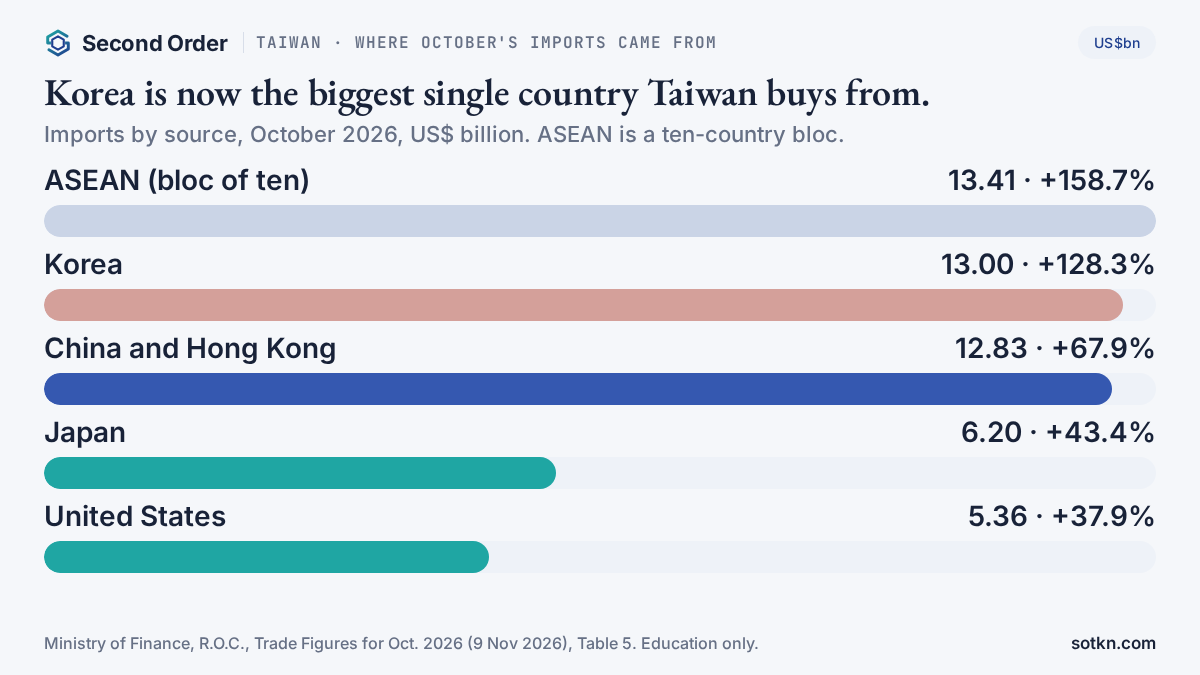
Then the line that is new. By country, Taiwan bought US$13.0 billion from Korea in October, up 128.3% from a year earlier. That is 18.9% of all imports. China and Hong Kong together supplied US$12.83 billion, or 18.6%. The ministry’s statistics chief, Beatrice Tsai, said Korea had overtaken China and Hong Kong combined to become Taiwan’s largest single-country source of imports for the first time, and that the shift was driven by memory chip purchases amid surging demand and rising prices. Taiwan’s technology makers, she said, rely heavily on Korean suppliers for key memory products.
One caveat on the ranking. The ten Southeast Asian countries of ASEAN, counted as a bloc, supplied a little more, US$13.41 billion, up 158.7%. But ASEAN is a group, not a country. Among single countries, and against China and Hong Kong counted together, Korea came first. Over the first ten months of the year, China and Hong Kong are still ahead, at US$110.1 billion against Korea’s US$89.8 billion. October is the first month the order flipped.
Why is Korea suddenly Taiwan’s biggest supplier?
Two things changed at once: how much memory an AI rack needs, and what each chip costs. AI chips are surrounded by HBM, and each new generation carries more of it. The servers around them carry large amounts of ordinary DRAM too. Samsung and SK hynix, the two Korean giants, make about two-thirds of the world’s DRAM and most of its HBM. Taiwan’s chip packagers put HBM next to AI chips, and its rack makers fill boards with DRAM, so Korean memory flows into Taiwan and leaves again inside a finished product. We covered the same trade from the Korean side when its October exports came out: memory exports had jumped mostly on price (Korea’s US$50 billion of memory).
Price is the bigger driver. Taiwan’s own memory maker Nanya is a clean example because it reports every month. Its October revenue was NT$46.48 billion, up 487.7% from a year earlier and its twelfth record month in a row. But the growth is now price, not volume. In the third quarter, Nanya said its average selling price rose more than 60% from the second quarter while the number of memory bits it shipped fell by a mid-single-digit percentage. Old long-term contracts signed at low prices ran out in June, and new contracts at much higher prices took over in July.
If that is true of a smaller maker selling mostly ordinary DRAM, it is truer still of Korean makers selling the scarcest kinds. The ministry’s statistics chief named both causes in one sentence: surging demand and rising prices. In plain terms, Taiwan is paying Korea much more for each chip, not just buying many more chips.
The early November figures from Korea point the same way. The Korea Customs Service said on 11 November that Korea’s exports in the first ten days of November rose 111.9% to about US$33.5 billion, with chips up 331.2% to US$16.6 billion, almost half of everything shipped. Exports to Taiwan rose 182.5% over those ten days. The customs release does not split that Taiwan figure by product, so we cannot say how much was memory, but the direction is clear.
How much of each export dollar is bought in first?
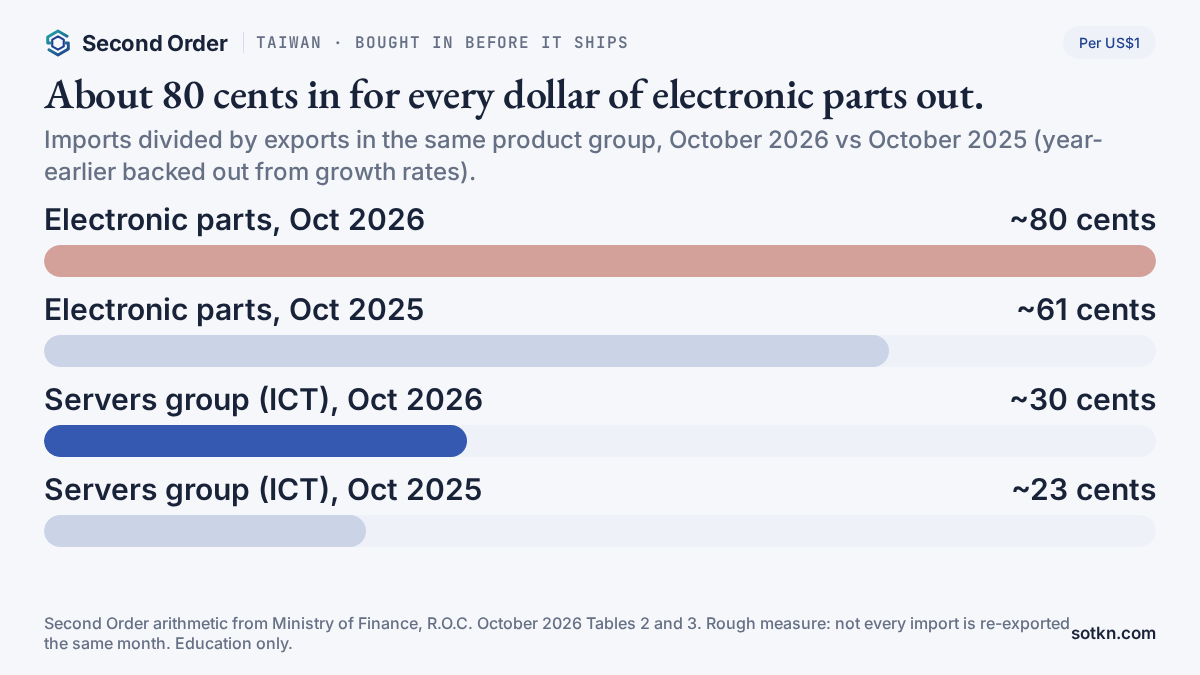
A simple way to see the shift is to put what Taiwan imports in a product group next to what it exports in the same group. It is a rough measure, because not every imported chip ends up in an export the same month, and some imports are used at home. But the change over a year is telling.
- Electronic parts: Taiwan imported US$26.06 billion and exported US$32.68 billion in October. That is about 80 cents in for every dollar out. A year earlier, using the growth rates the ministry published, it was about 61 cents (our arithmetic).
- Information and communication products, the servers group: US$14.28 billion in against US$47.60 billion out, about 30 cents per dollar, up from about 23 cents a year earlier (our arithmetic).
- The trade surplus still grew, by 29.4% to US$27.88 billion, a record. Taiwan is still adding a great deal of value. It is just paying more for its inputs than it used to.
This is not a sign that Taiwan is earning less. TSMC’s October sales were a record too (TSMC’s record October on the Wire). What it shows is that more of the value in each AI shipment is created before the parts reach Taiwan, and memory is the biggest piece of that. When an input that used to be cheap becomes scarce and expensive, the money follows the input.
What does this mean for the rack makers?
Taiwan’s AI server and rack makers had another huge month. Quanta’s October sales were NT$353.3 billion, up 104.0% from a year earlier and 8.6% from September. Wistron’s were NT$402.6 billion, up 117.6%. Gigabyte’s rose 136.7%. Together with Wiwynn and Inventec, the five reported about NT$1.07 trillion, roughly double a year earlier.
But not every line went up from September. Wiwynn’s sales slipped 4.3% month on month and Inventec’s fell 18.9%, though both were still far above a year earlier. Their filings do not say why. Monthly sales are lumpy, and a single large customer can move them, so one month is not a trend. It is a reminder that the line does not only go up.
Quanta’s results call on 11 November said the most about how the money is split. Its third-quarter revenue was a record NT$1.12 trillion, and servers were more than 80% of it. But its gross margin fell to 4.75%, from 6.84% a year earlier and 5.02% in the second quarter. The chief financial officer, Elton Yang, said the reason was a higher share of high-priced AI server systems, whose substantial material costs dilute margins. Quanta is negotiating with customers to use more consignment models for next-generation racks, to improve profitability and ease pressure on working capital. Under consignment, the customer buys the expensive parts and hands them over, so the rack maker does not have to pay for them up front (purchase commitments explained).
Quanta also said its AI server shipments edged down from the second quarter to the third as customers moved from Nvidia’s GB300 platform to the next one, Vera Rubin, and that revenue still rose because average prices were higher. The transition continues this quarter. Small-volume Vera Rubin rack shipments begin now, with more meaningful volumes in the first quarter of 2027. Newer platforms move to faster, pricier memory, HBM4 in place of HBM3E, so the platform change and the memory price rise push in the same direction (scale-up vs scale-out).
Put the two together. A rack maker’s sales can double because the rack is full of expensive memory and chips. Most of that money passes straight through to the companies that made those parts. The rack maker carries the bill while the rack is being built, then is paid when it ships. That is why its margin percentage falls even as its sales hit records, and why it wants customers to own the parts instead.
What does the arithmetic say?
Everything below is our arithmetic from the published figures, not a ministry or company forecast. Year-earlier values are backed out from the growth rates in the ministry’s tables, so they may differ slightly from the original prints.
- Imports from Korea: US$13.0 billion in October, up 128.3%, so about US$5.7 billion a year earlier. The rise was about US$7.3 billion.
- Share of the import jump: total imports rose by about US$29.5 billion from a year earlier. Korea alone accounts for about a quarter of that rise.
- Taiwan’s gap with Korea: Taiwan sold Korea US$3.85 billion and bought US$13.0 billion, a deficit of about US$9.2 billion in one month. A year earlier the gap was about US$3.1 billion, so it has roughly tripled.
- Bought in per dollar of electronic parts exported: about 80 cents, up from about 61 cents a year earlier.
- Margins side by side: on NT$100 of sales in the third quarter, Nanya kept about NT$86 as gross profit and Quanta under NT$5.
- Nanya’s scale: ten months of 2026 revenue, NT$311.8 billion, is already about 4.7 times its revenue for all of 2025.
- Rack makers’ October: Wistron plus Quanta alone, about NT$756 billion, is roughly 1.3 times TSMC’s record NT$586.89 billion for the month.
- November guide: the ministry expects November exports of US$94.2–96.7 billion. The top of that range is about level with October, so the ministry is not forecasting another step up next month.
The arithmetic makes one point twice. Taiwan is selling more than ever, and paying out more than ever for what goes in. The share kept by whoever owns the scarce part, memory, is far larger than the share kept by whoever bolts the rack together.
Taiwan, October 2026: what came in, what went out
Ministry of Finance, R.O.C., Trade Figures for Oct. 2026, 9 Nov 2026; Focus Taiwan, 9 Nov 2026. Sums marked as ours are Second Order arithmetic.
Who gets paid, and who waits?
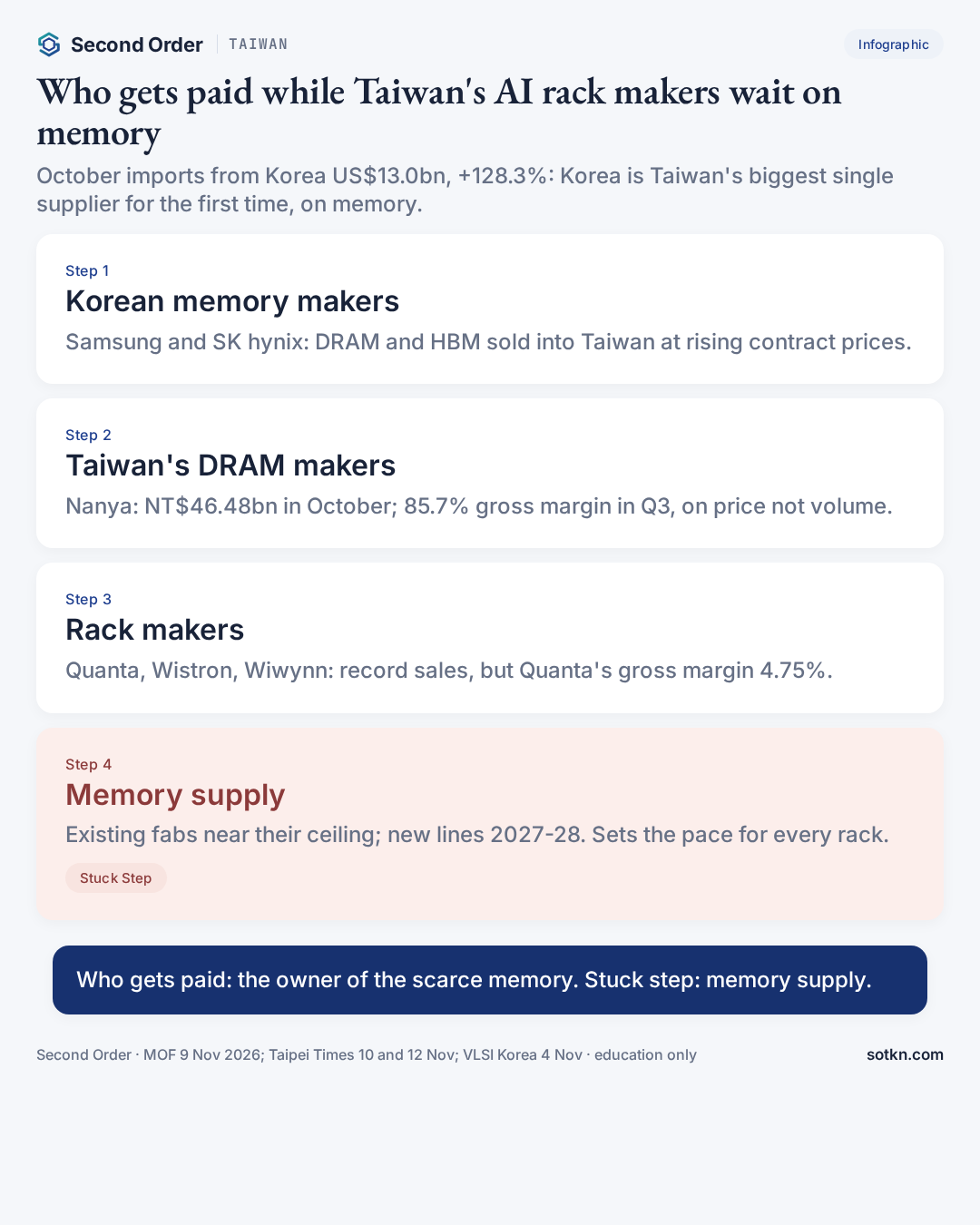
1 · Korean memory makers
Who: Samsung and SK hynix: DRAM and HBM sold into Taiwan
Paid: Paid first, at rising contract prices
2 · Taiwan’s own DRAM makers
Who: Nanya: NT$46.48bn in October, 85.7% gross margin in Q3
Paid: Paid on price while output stays flat
3 · Chip makers and packagers
Who: TSMC and packagers put HBM beside AI chips
Paid: Paid when packaged chips ship
4 · Rack makers
Who: Quanta, Wistron, Wiwynn: record sales, 4.75% gross margin at Quanta
Paid: Carry the parts bill until racks ship
5 · Memory supply
Who: Bits from existing fabs near their ceiling; new fabs 2027–28
Paid: Sets the pace for every rack
First in line are the Korean memory makers. Every dollar of the US$13.0 billion Taiwan bought from Korea in October was paid to a Korean supplier on delivery, and the ministry says memory drove the jump. They sell under contracts that are now reset at much higher prices, and Taiwanese media report that buyers want to lock in supply for as long as three years. Their customers in Taiwan pay well before the finished rack earns anything for anyone.
Second, Taiwan’s own DRAM makers. Nanya does not make HBM, but it sells the ordinary DRAM that AI servers, networking gear and storage all need, and that ordinary memory is scarce too: Nanya says AI demand is crowding out supply for phones, PCs and other everyday uses. Nanya said AI-related uses are already more than 20% of its revenue, and its third-quarter gross margin was 85.7%. It is paid on price. Its October sales rose only 3.1% from September, a sign that its output is close to the ceiling of its existing fabs.
Third, the chip makers and packagers. TSMC makes the AI chips and, with its packaging partners, puts HBM stacks right beside them on one package (the HBM base die). They are paid when the packaged chip ships to the rack maker, and TSMC’s October sales were a record. They depend on memory arriving on time, but they do not carry most of its cost.
Fourth, the rack makers, who are paid last and keep the least. They buy or receive the chips, memory, boards, power supplies and cooling, build and test the rack, and ship it to a cloud company. Their sales are the biggest numbers in Taiwan, but most of that money is the parts passing through. When memory doubles in price, the rack maker’s sales rise and its margin percentage falls, which is exactly what Quanta reported. Consignment, where the cloud customer buys the parts, is their way of handing that bill back.
Who waits: the cloud companies and AI labs at the end of the line. They pay the highest prices and start earning only when the racks are installed and switched on. If memory is short, their racks arrive later or cost more, or both (the Hyperscalers layer).
What is stuck, exactly?
The stuck step is memory supply: the number of memory bits the world’s fabs can turn out. Almost everything else in Taiwan’s AI chain can be stretched. Rack makers are adding floor space in the US and Southeast Asia; Quanta said it is on track to double its AI capacity from last year and plans NT$40–45 billion of capital spending next year, focused on power and cooling at its factories. Test bays and assembly lines can be added in months. Memory fabs take years.
Nanya’s own schedule shows the clock. Equipment moves into its new Fab 5A in the first quarter of 2027, ramping to 30,000 wafers a month by the end of 2028 and 50,000 by the end of 2030. Customer checks on its next process step begin in early 2027. The big Korean makers have their own new fabs coming, but on similar clocks, and our explainer on the memory makers found the same thing: the binding constraint is clean-room space for new memory lines, not demand (who makes DRAM).
That is why the import figure matters more than it looks. When supply is fixed and demand rises, prices rise, and more of the money goes to whoever owns the fixed supply. Taiwan’s rising import bill from Korea is that mechanism showing up in the trade tables. The rack makers can only build as many racks as memory, and the AI chips packaged with it, allow.
It is not the rack factories: they posted record sales and are still expanding. It is not demand: the ministry expects November to stay near October’s record, and Quanta expects double-digit growth in servers next year. It is not, for now, money: cloud companies are paying higher prices. It is the memory, and how fast new memory lines can be built and filled.
The honest limits of this read: the trade tables give Korea’s total, not a memory line by country, so the memory explanation is the ministry’s, not a number we can check line by line. One month can be lumpy, and China and Hong Kong are still the bigger source over the year to date. If November and December keep Korea on top, the shift is real. If memory prices level off in 2027, the import bill could stop rising even as volumes grow.
It is the same shape we keep finding: the slow step sets the timing for everyone else, and the money gathers at the scarce step (where the stuck step moves). Earlier Taiwan Pulses found it in chip packaging and in ready factory shells (Taiwan’s ready fab shells). The October trade figures say a share of it has now moved to memory, and that memory comes mostly from Korea.
Which dates test the read?
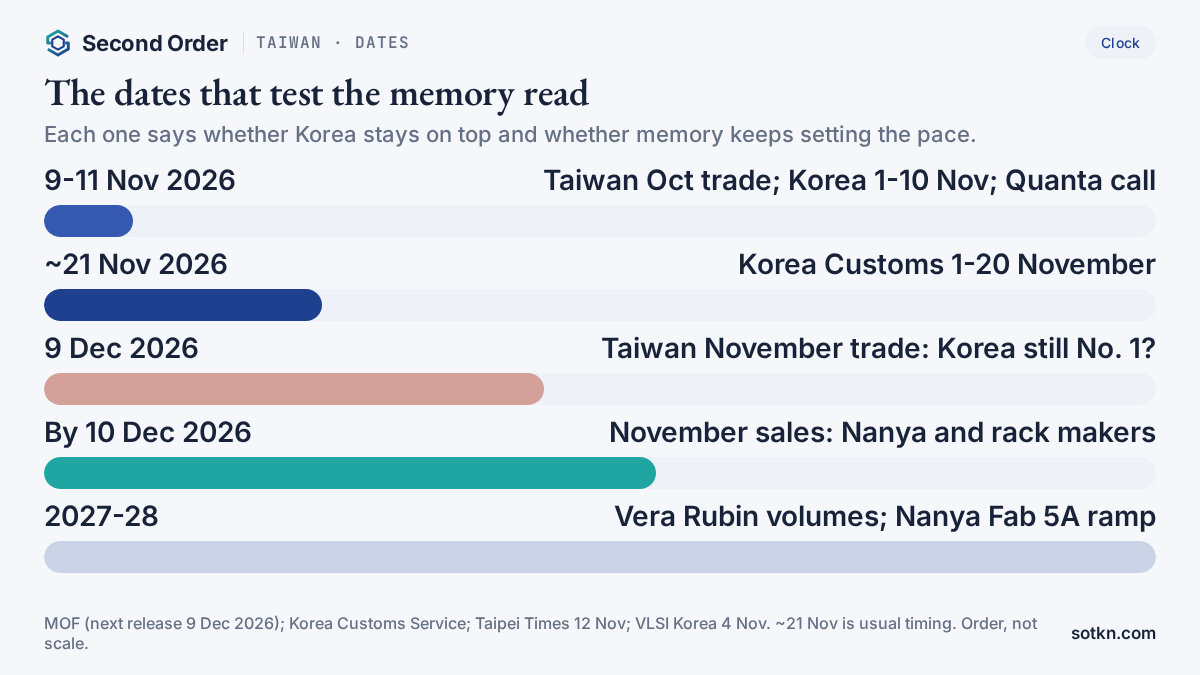
- 9 November 2026 — Taiwan’s October trade: Korea becomes the biggest single source of imports.
- 11 November 2026 — Korea’s 1–10 November exports, with chips up 331.2% and exports to Taiwan up 182.5%; Quanta’s results call.
- About 21 November 2026 — Korea Customs’ 1–20 November count: does the pace to Taiwan hold?
- 1 December 2026 — Korea’s full November exports.
- 9 December 2026, 16:00 Taipei — Taiwan’s November trade: does Korea stay on top, and does the November forecast of US$94.2–96.7 billion hold?
- By 10 December 2026 — November sales from Nanya, Quanta, Wistron, Wiwynn and Inventec: is Nanya flat, and do the rack makers keep rising?
- First quarter of 2027 — meaningful Vera Rubin rack volumes at Quanta; equipment moves into Nanya’s Fab 5A.
- End of 2028 — Nanya’s new fab at 30,000 wafers a month.
Dates from the Ministry of Finance (next release 9 Dec 2026), Korea Customs Service, Taipei Times (12 Nov 2026) and VLSI Korea (4 Nov 2026). The 21 November Korea date is the usual timing, not an announced one.
How does this look from Korea, China and the US?
From Korea, this is the other half of a record export year. Korea is close to US$1 trillion of exports for the first time, with chips nearly half of what it ships (Korea Markets). From China, the same memory boom shows up as Korea overtaking Taiwan as China’s biggest import source earlier this year, while China builds its own memory makers (China Markets). From the US, the end buyers are the cloud companies paying the higher memory prices inside every rack they order (US Markets). Taiwan sits in the middle: it buys the memory from Korea, builds it into chips and racks, and sells them to the US.
How we check this. Every trade figure comes from the Ministry of Finance’s own October release and its tables, with the Taipei Times and Focus Taiwan for what the ministry’s statistics chief said about Korea and memory. Company figures come from monthly sales filings and results calls as reported: Quanta’s from its 11 November call, Nanya’s from its October sales and third-quarter release, and the rack makers’ October sales from their filings. Korea’s November figures are the Korea Customs Service’s early count for 1–10 November. Every sum we worked out is labelled “our arithmetic”, and year-earlier values we back out from published growth rates are labelled too. The trade tables do not split memory from other chips by country, so where we say memory drove the Korea figure, that is the ministry’s explanation, not a line in the table. Price targets and ratings are left out on purpose. The references we used are listed at the end. Our editorial standards →
FAQ
What changed in Taiwan’s October trade?
Exports hit a record US$96.76 billion, up 58.9% from a year earlier, but imports rose faster, up 75.1% to US$68.89 billion. Imports from Korea more than doubled to about US$13.0 billion, 18.9% of the total, and Korea overtook China and Hong Kong combined as Taiwan’s biggest single source of imports for the first time. The Ministry of Finance put it down to memory chips.
Why does Taiwan buy so much memory from Korea?
Taiwan builds most of the world’s AI servers and packages most of its AI chips, and both need memory. The biggest memory makers, Samsung and SK hynix, are Korean. Taiwan has its own DRAM makers, such as Nanya, but they are smaller and do not make HBM, the stacked memory that sits beside AI chips. Korea’s Samsung and SK hynix make about two-thirds of the world’s DRAM. So memory comes in from Korea and leaves again inside a server or a chip package.
Who gets paid most?
On the latest figures, the memory makers. Nanya kept 85.7% of its third-quarter sales as gross profit after prices rose more than 60% in a quarter. Quanta, one of the biggest AI rack makers, kept 4.75%, and said the high material cost of AI racks was diluting its margin. Price goes to whoever owns the scarce part.
What is the stuck step?
Memory supply. Makers say output from existing fabs is nearly fixed and new fabs add little before 2027 and 2028, so more money buys a higher price, not many more chips. Rack makers can raise output only as fast as memory, and the chips that go with it, arrive.
Is this investment advice?
No. Education only. It maps who gets paid and which step is stuck. It is not a recommendation to buy or sell any security, and we leave out price targets and ratings on purpose.
References
Outbound links below are nofollow. We list only the sources actually used. Internal sotkn.com links in the body are separate.
- Ministry of Finance, R.O.C., Trade Figures for Oct. 2026 (news release), 9 Nov 2026. mof.gov.tw — October exports and imports, the leading export and import product groups, and trade with each major partner, including imports from Korea, ASEAN and China and Hong Kong.
- Taipei Times, Exports expand 58.9% to record US$96.76 billion, 10 Nov 2026. taipeitimes.com — Korea overtaking China and Hong Kong combined as the largest single source of imports for the first time on memory purchases, the reasons for the import jump, and the November forecast.
- Focus Taiwan (CNA), Taiwan’s October exports hit high, jump nearly 60% on AI demand, 9 Nov 2026. focustaiwan.tw — integrated circuit exports of US$31.17 billion, the 83% share of the two technology groups, and the US$94.2–96.7 billion November forecast.
- Taipei Times, Quanta expects server business to grow, 12 Nov 2026. taipeitimes.com — Quanta’s third-quarter gross margin of 4.75%, the material costs of AI rack systems, the move to consignment models, the GB300 to Vera Rubin transition and 2027 capital spending.
- Chip Dispatch, Taiwan AI Server Makers Double October Revenue to NT$1.07 Trillion, 12 Nov 2026. chipdispatch.com — October revenue and month-on-month changes for Quanta, Wistron, Wiwynn, Inventec and Gigabyte from their monthly filings.
- VLSI Korea, Nanya Posts a 12th Straight Monthly Revenue Record at NT$46.48B, 4 Nov 2026. vlsi.kr — Nanya’s October revenue, the third-quarter price rise and fall in bit shipments, its 85.7% gross margin, and the Fab 5A schedule.
- The Korea Times, Exports more than double in 1st 10 days of November, 11 Nov 2026. koreatimes.co.kr — Korea Customs Service figures for 1–10 November: total exports, chip exports of US$16.6 billion and their 49.7% share.
- Businesskorea, South Korea’s Exports Surge Toward $1 Trillion as Chip Shipments More Than Quadruple, 11 Nov 2026. businesskorea.co.kr — the 182.5% rise in Korean exports to Taiwan and the 77.8% rise in imports from Taiwan over 1–10 November.
- Financial News (fnnews), South Korea Leads China’s Import Market for Six Straight Months, 14 Nov 2026. en.fnnews.com — Korea moving ahead of Taiwan as China’s largest import source from April 2026 on chip demand, and Korea’s cumulative exports nearing US$1 trillion.
Not investment advice. Do your own research. Education only. Map of who gets paid and which step is stuck — not a buy list.
More on this desk: Taiwan Markets · Semiconductors · Korea Markets · all Markets · MediaTek’s accelerator stock.