Scale-Up vs Scale-Out for AI: Who Gets Paid When Clusters Get Denser
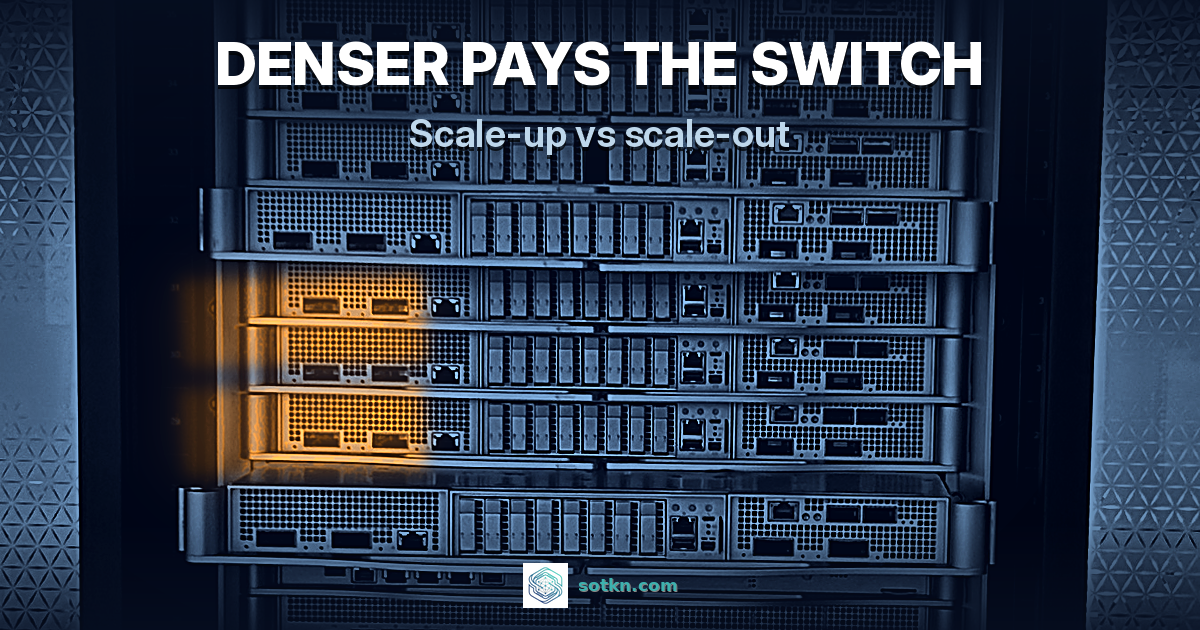
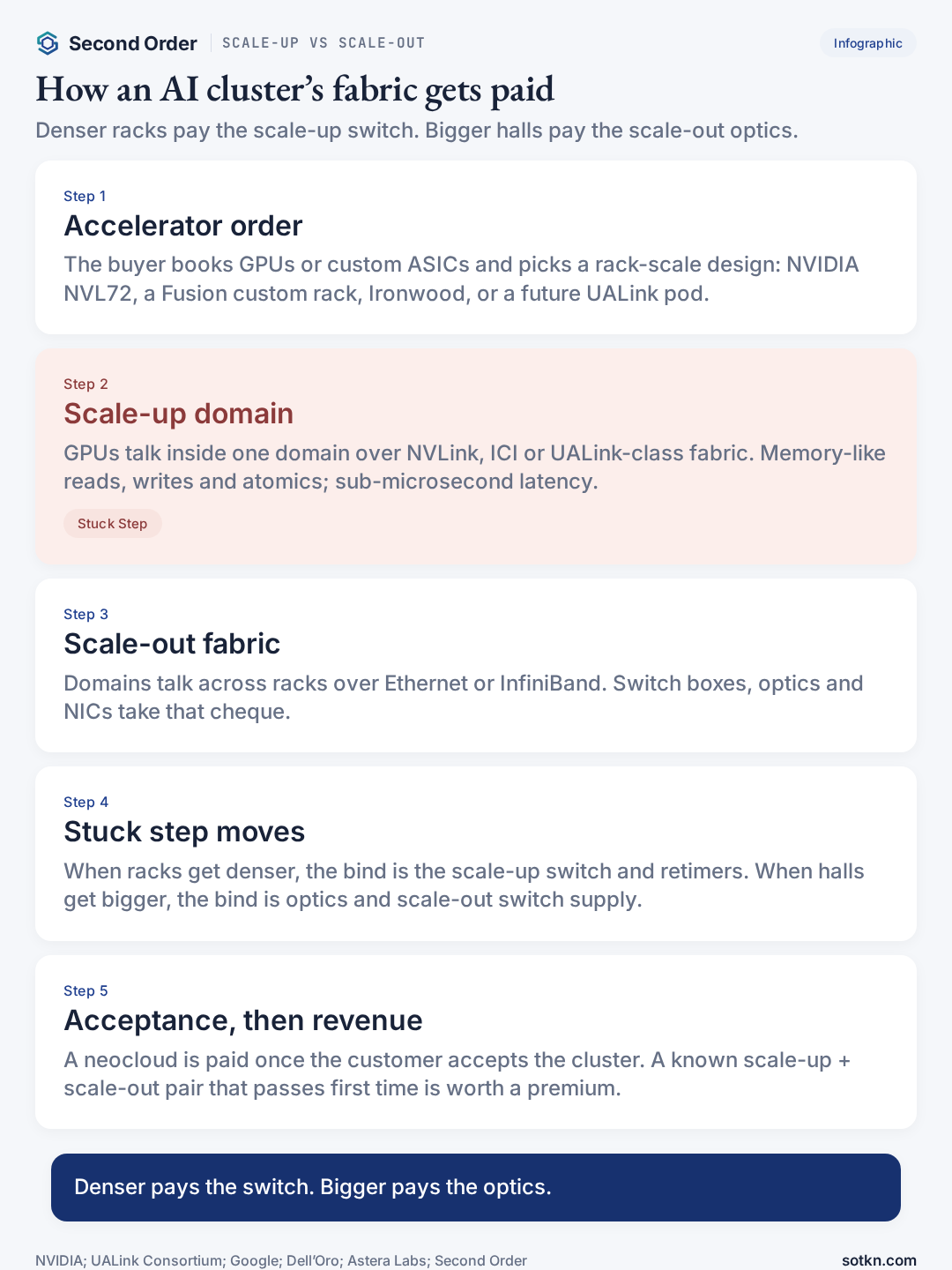
Scale-up and scale-out are the two ways an AI cluster grows. Scale-up links GPUs inside one domain; scale-out links domains across Ethernet or InfiniBand. Denser racks grow the scale-up switch cheque; bigger halls grow the optics cheque.
EXPLAINED · Versus · Last reviewed: 6 Nov 2026 · Next review: after NVIDIA’s third-quarter fiscal 2027 results (November 2026) and the first commercial UALink switch announcements
Scale-up and scale-out are the two ways an AI cluster grows. Scale-up links accelerators inside one high-bandwidth domain so they act like one machine; scale-out links those domains across racks with Ethernet or InfiniBand.
In short. Scale-up and scale-out are the two ways an AI cluster grows. Scale-up stitches accelerators into one high-bandwidth domain — NVIDIA’s NVLink, Google’s ICI, or the open UALink standard. Scale-out links those domains across racks with Ethernet or InfiniBand. Our read: denser racks grow the scale-up switch cheque; bigger halls grow the optics and scale-out switch cheque. The stuck step often moves between the scale-up switch and the scale-out optics supply. The clock is Vera Rubin, UALink silicon, and 1.6 Tb/s ports.
Why an investor cares: denser racks and bigger halls pull on different cheques. Scale-up pays the switch inside the domain; scale-out pays the boxes and optics between domains. Our NVLink Explained covers the scale-up switch; our InfiniBand vs Ethernet covers the scale-out choice. This page puts the two side by side.
What is the difference between scale-up and scale-out?
Both grow an AI cluster. They grow it in different places, with different fabrics, and they pay different suppliers.
Scale-up puts more accelerators inside one domain so they behave like one machine. The traffic is memory-like: one chip reads, writes or runs an atomic on another’s memory with sub-microsecond latency. NVIDIA’s NVLink with the NVLink Switch, Google’s Inter-Chip Interconnect on Ironwood, and the open UALink standard are all scale-up fabrics.
Scale-out links those domains across racks. The traffic is messages and collectives between many machines. The fabrics are InfiniBand or Ethernet — the same choice covered on our InfiniBand vs Ethernet page — carried on switch boxes, optics and network cards.
| Scale-up | Scale-out | |
|---|---|---|
| What it is | Accelerators talking inside one high-bandwidth domain | Domains talking across racks |
| Traffic | Memory-like reads, writes and atomics; sub-microsecond | Messages and collectives between racks; microseconds to milliseconds |
| Typical fabrics | NVLink / NVLink Switch; Google ICI; UALink; NVLink Fusion custom | InfiniBand or Ethernet (RoCE, Spectrum-X, MRC) |
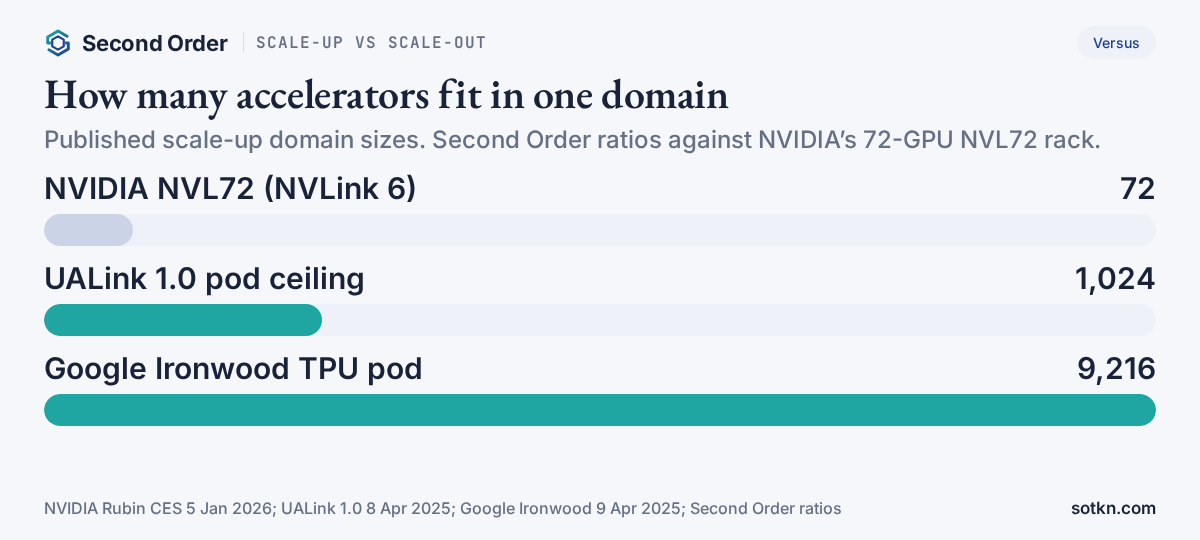
| Published domain size | 72 GPUs (NVL72); up to 1,024 (UALink 1.0); 9,216 chips (Ironwood) | Tens of thousands to 100,000+ GPUs across many domains |
| Per-link class | Terabytes per second per accelerator (NVLink 6: 3.6 TB/s) | Hundreds of gigabits per second per port (800 Gb/s now; 1.6 Tb/s ramping) |
| Who gets paid | Switch silicon (NVIDIA), Fusion renters, retimers (Astera), custom ICI builders | Switch boxes, optics, NICs; NVIDIA, Broadcom-based vendors, Celestica, Arista |
| Stuck step | Scale-up switch and retimer supply | Scale-out switch and optics supply |
Domain sizes from NVIDIA Rubin (5 Jan 2026), UALink 1.0 (8 Apr 2025) and Google Ironwood (9 Apr 2025). Scale-out port speeds and share from Dell’Oro (10 Mar 2026) and our InfiniBand vs Ethernet page. Who gets paid and the stuck step are our read.
How big is a scale-up domain today?
It depends who builds it. NVIDIA’s Vera Rubin NVL72, announced at CES on 5 January 2026, puts 72 Rubin GPUs and 36 Vera CPUs in one rack-scale domain on NVLink 6. NVIDIA said each GPU offers 3.6 TB/s of bandwidth and the rack about 260 TB/s — 259.2 TB/s by our arithmetic of 72 × 3.6.
One way to see how far that is from a scale-out link: half of 3.6 TB/s is 1.8 TB/s one way, or 14.4 Tb/s. That is 18 times an 800 Gb/s Ethernet or InfiniBand port (our arithmetic). Scale-up and scale-out are not competing at the same speed; they do different jobs.
UALink’s 1.0 specification, ratified on 8 April 2025, sets a ceiling of 1,024 accelerators in one pod at 200G per lane, with a 93% effective peak bandwidth target. That ceiling is about 14 times an NVL72 (our arithmetic). It is a specification limit, not a count of shipping systems.
Google’s Ironwood TPU, announced 9 April 2025, scales to 9,216 liquid-cooled chips linked by its own Inter-Chip Interconnect, spanning nearly 10 MW, with ICI bandwidth of 1.2 TBps bidirectional. That pod is 128 times an NVL72 by chip count (our arithmetic). Ironwood does not use NVLink or UALink; Google builds the scale-up fabric itself.
| Scale-up domain | Accelerators | vs NVL72 (our arithmetic) | Source |
|---|---|---|---|
| NVIDIA Vera Rubin NVL72 | 72 GPUs | 1× | NVIDIA CES, 5 Jan 2026 |
| UALink 1.0 pod ceiling | Up to 1,024 | ~14× | UALink Consortium, 8 Apr 2025 |
| Google Ironwood TPU pod | 9,216 chips | 128× | Google, 9 Apr 2025 |
Ratios are Second Order arithmetic (1,024 ÷ 72 ≈ 14.2; 9,216 ÷ 72 = 128). A UALink ceiling is a specification limit, not a shipping product count. Ironwood uses Google’s own ICI, not NVLink or UALink.
Who gets paid for scale-up?
Our read: the scale-up cheque goes to whoever owns the switch inside the domain, plus the parts that make the links reach.
- NVIDIA switch silicon and licences. NVLink Switch chips sit at the centre of every NVL72. NVLink Fusion, unveiled 18 May 2025, lets partners such as MediaTek, Marvell, Alchip and Astera Labs put custom silicon on the same fabric, and lets Fujitsu and Qualcomm couple custom CPUs to NVIDIA GPUs. AWS said on 2 December 2025 it is designing Trainium4 to drop in the Fusion chiplet and hit the same 72-ASIC, 3.6 TB/s, 260 TB/s envelope.
- Retimers and open fabric switches. Astera Labs reported $584.9 million of revenue in the third quarter of 2026, up about 154% from a year earlier (our arithmetic), with Scorpio fabric switches its largest product family. Its platform spans NVLink Fusion, UALink, Ethernet, PCIe and CXL — the connectivity layer around the scale-up domain.
- Custom ICI builders. Google pays its own networking team and suppliers for Ironwood’s ICI rather than renting NVLink. That is the hyperscaler path: build the scale-up fabric when the custom accelerator is large enough to justify it.
NVIDIA’s data centre networking revenue was a record $14.8 billion in the quarter to 26 April 2026, up 199% from a year earlier. On the next call networking grew another 18% sequential, which by our arithmetic is about $17.5 billion, or roughly 19.6% of that quarter’s $89.0 billion of data centre revenue. Treat $17.5 billion as a bridge, not a printed figure. That pool mixes scale-up (NVLink Switch) and scale-out (InfiniBand and Spectrum-X). Our guide to who makes AI cluster networking names the supplier map.
Who gets paid for scale-out?
Scale-out is the InfiniBand-versus-Ethernet cheque. Dell’Oro put Ethernet at more than two-thirds of AI back-end switch sales in 2025. That money goes to switch-chip designers, box makers and optics suppliers — NVIDIA Spectrum-X, Broadcom-based boxes at Celestica, Arista and Cisco, and the optics behind every port. Our InfiniBand vs Ethernet page and our optics and networking Explained cover that split.
Vera Rubin spans both sides by design. NVIDIA said the platform includes the NVLink 6 Switch for scale-up and Spectrum-6 Ethernet (or InfiniBand) for scale-out, and that Microsoft’s Fairwater and CoreWeave are among the early deployers. On the August 2026 call it put Vera Rubin at about $40 billion per gigawatt against about $25 billion for Grace Blackwell — a 60% step-up by our arithmetic — reflecting denser codesign across GPU, CPU, scale-up and scale-out.
When do clusters get denser, and when do they get bigger?
Denser means more accelerators inside one domain: NVL72 instead of an eight-GPU board, or a future UALink pod instead of a single rack. Bigger means more domains in one hall: tens of thousands of GPUs linked by scale-out fabric.
Both can happen at once. A buyer can take denser Rubin racks and still fill a hall with hundreds of them. The cheques just move. More density raises the scale-up switch and retimer bill per rack. More hall size raises the optics and scale-out switch bill across the floor.
For a neocloud, the practical question is which reference design passes cluster acceptance first. A known NVLink-plus-InfiniBand or NVLink-plus-Spectrum-X pair is a path to revenue. Hyperscalers with custom silicon face a longer choice: rent NVLink through Fusion, wait for UALink silicon, or build ICI-class fabric themselves. Our neocloud vs hyperscaler comparison covers that buyer split.
Where is the stuck step?
Our read: it moves. When the industry is packing more GPUs into one domain, the bind is the scale-up switch — NVLink Switch supply, Fusion chiplets, retimers, and eventually UALink switch ASICs. When the industry is filling halls with many domains, the bind is scale-out switch and optics supply. Dell’Oro said in 2026 it expects AI back-end switch supply to stay tight for one to two years; that is the scale-out side of the same clock.
The clocks to watch are Vera Rubin’s ramp (NVIDIA began production shipments and said every major hyperscaler, AI cloud and system OEM had ordered), the first commercial UALink switches, and 1.6 Tb/s scale-out ports. Our rack-scale AI Explained covers why the rack became the unit of compute.
What would change the view?
- UALink ships at volume before Rubin fills. If open scale-up switches reach the market in 2026–27 at competitive radix, more of the scale-up cheque leaves NVIDIA’s Switch silicon.
- Fusion becomes the default for custom ASICs. If Trainium-class designs standardise on NVLink Fusion, NVIDIA keeps the scale-up rent even when the accelerator is not a GPU.
- Scale-out supply loosens first. If 1.6 Tb/s optics and switches ship cleanly, the stuck step slides back to the scale-up switch and HBM, and the optics cheque loses pricing power.
Common misconceptions
- People assume InfiniBand is scale-up. Actually InfiniBand is scale-out between racks. Scale-up inside the rack is NVLink, ICI or UALink-class fabric.
- People assume scale-up replaces scale-out. Actually every large cluster needs both: a domain to think fast, and a fabric to link many domains.
- People assume a denser rack means less networking spend. Actually density moves spend into the scale-up switch; hall size moves it into optics and scale-out switches.
- People assume UALink’s 1,024 figure is shipping today. Actually it is a specification ceiling from April 2025; commercial switch silicon is the open clock.
FAQ
What is the difference between scale-up and scale-out?
Scale-up links accelerators inside one high-bandwidth domain so they share memory-like traffic. Scale-out links those domains across racks with Ethernet or InfiniBand so many domains act as one cluster.
Is NVLink scale-up or scale-out?
Scale-up. NVLink and the NVLink Switch stitch GPUs inside a rack-scale domain. Links between racks use InfiniBand or Ethernet, which is scale-out.
What is UALink?
UALink is an open scale-up interconnect ratified in April 2025. The 1.0 specification targets 200G per lane and up to 1,024 accelerators in one pod, as an alternative to proprietary scale-up fabrics.
Is InfiniBand the same as scale-up?
No. InfiniBand is a scale-out fabric between racks. Scale-up inside the rack is NVLink, Google’s ICI, UALink-class fabrics, or similar. Our InfiniBand vs Ethernet page covers the scale-out choice.
Who gets paid for scale-up?
NVIDIA for NVLink Switch silicon and NVLink Fusion licences; Astera Labs and other retimer and fabric-switch makers; custom ICI builders such as Google’s own networking team. Scale-out pays switch boxes, optics and NICs.
Does a denser rack mean less networking spend?
Not necessarily. A denser rack moves spend into the scale-up switch. A bigger hall of many racks moves spend into scale-out optics and switches. Both can grow at once.
Is this a list of stocks to buy or sell?
No. This page explains scale-up versus scale-out and where the money goes. It does not rank companies or give buy or sell calls. Not investment advice. Do your own research.
Related: NVLink; InfiniBand vs Ethernet; what a neocloud is; what a hyperscaler is; GPU clusters; purchase commitments.
Stack doors
Layer: Neoclouds. Also: Semiconductors; Hyperscalers. Markets: United States; Taiwan.
Get the Wire — short daily notes when AI fabrics, switches and optics move.
Not investment advice. Do your own research.
How we check this
NVL72 bandwidth, chip set and Spectrum-6 scale-out come from NVIDIA’s Rubin CES release of 5 January 2026. NVLink Fusion partners and the scale-up / Spectrum-X split come from NVIDIA’s 18 May 2025 release and its 2 December 2025 AWS Trainium4 blog. UALink’s 1,024-accelerator ceiling, 200G-per-lane signalling and 93% bandwidth target come from the UALink Consortium’s 8 April 2025 1.0 release. Ironwood’s 9,216-chip pod and 1.2 TBps ICI come from Google’s 9 April 2025 announcement. NVIDIA networking revenue comes from its first-quarter fiscal 2027 CFO commentary and its second-quarter call of 26 August 2026. Astera’s Scorpio fabric-switch revenue comes from its third-quarter results of 3 November 2026. Ethernet’s share of AI back-end switch sales comes from Dell’Oro’s 10 March 2026 release. Domain-size ratios against NVL72, NVLink’s one-way multiple of an 800 Gb/s link, the Q2 networking bridge and Astera’s year-over-year change are our arithmetic, checked in code and labelled as ours on the page. Who gets paid and the stuck step are our read. The featured photograph is credited in its caption. This page compares two ways clusters grow. It does not rank companies or give buy or sell calls. Not investment advice. Do your own research.
Last reviewed: 6 Nov 2026 · Next review: after NVIDIA’s third-quarter fiscal 2027 results (November 2026) and the first commercial UALink switch announcements
Spot an error? Tell us and we will correct it and note the change here.
References
- NVIDIA — Rubin platform launch at CES (5 Jan 2026) — NVLink 6: 3.6 TB/s per GPU and 260 TB/s per Vera Rubin NVL72 rack of 72 GPUs and 36 CPUs; HGX Rubin NVL8 links eight GPUs; Rubin products from partners in the second half of 2026; AWS, Google Cloud, Microsoft and OCI among first to deploy
- NVIDIA — NVLink Fusion for semi-custom AI infrastructure (18 May 2025) — NVLink Fusion lets hyperscalers and others connect custom chips to NVLink scale-up; MediaTek, Marvell, Alchip, Astera Labs, Synopsys and Cadence first adopters; Fujitsu and Qualcomm CPUs; Spectrum-X for scale-out
- NVIDIA Technical Blog — AWS integrates NVLink Fusion for Trainium4 (2 Dec 2025) — AWS designing Trainium4 to integrate with NVLink 6 and NVIDIA’s MGX rack; NVLink Fusion chiplet dropped into custom chips; up to 72 custom chips all-to-all at 3.6 TB/s each, 260 TB/s total
- UALink Consortium — UALink 200G 1.0 Specification released (8 Apr 2025) — open scale-up interconnect from a consortium of more than 85 member companies; 200G per lane for up to 1,024 accelerators in a pod; 93% effective peak bandwidth target; multiple vendors developing UALink accelerators and switches
- Google — Ironwood, the first Google TPU for the age of inference (9 Apr 2025) — seventh-generation TPU scales to 9,216 liquid-cooled chips linked by Google’s Inter-Chip Interconnect (ICI), nearly 10 MW; ICI bandwidth 1.2 TB/s bidirectional per chip; 256-chip and 9,216-chip configurations
- NVIDIA — CFO commentary, first quarter fiscal 2027 (quarter ended 26 Apr 2026) — data center networking revenue a record $14.8 billion, up 199% from a year earlier and up 35% from the prior quarter
- NVIDIA — second-quarter fiscal 2027 earnings call transcript (26 Aug 2026) — networking revenue a record, up 18% sequential; Spectrum-X Ethernet up 2.6× year-over-year; Vera Rubin spans NVLink and InfiniBand or Ethernet; data center revenue $89.0 billion; about $40bn per gigawatt for Vera Rubin vs $25bn Grace Blackwell
- Astera Labs — third-quarter 2026 results (3 Nov 2026) — revenue $584.9 million, up 154% year-over-year; Scorpio fabric switches largest product family, led by Scorpio X-Series 320-lane; Q4 guide $730–750 million; platform spans CXL, Ethernet, NVLink Fusion, PCIe, UALink
- Dell’Oro Group — Ethernet more than doubles InfiniBand in AI scale-out networks in 2025 (10 Mar 2026) — Ethernet more than two-thirds of AI back-end switch sales in 4Q 2025 and full-year 2025; Amazon, Microsoft, Meta, Oracle and xAI adopting Ethernet; 800 Gbps vast majority; 1.6 Tbps expected 2H26