InfiniBand vs Ethernet for AI: Who Gets Paid When the Fabric Changes
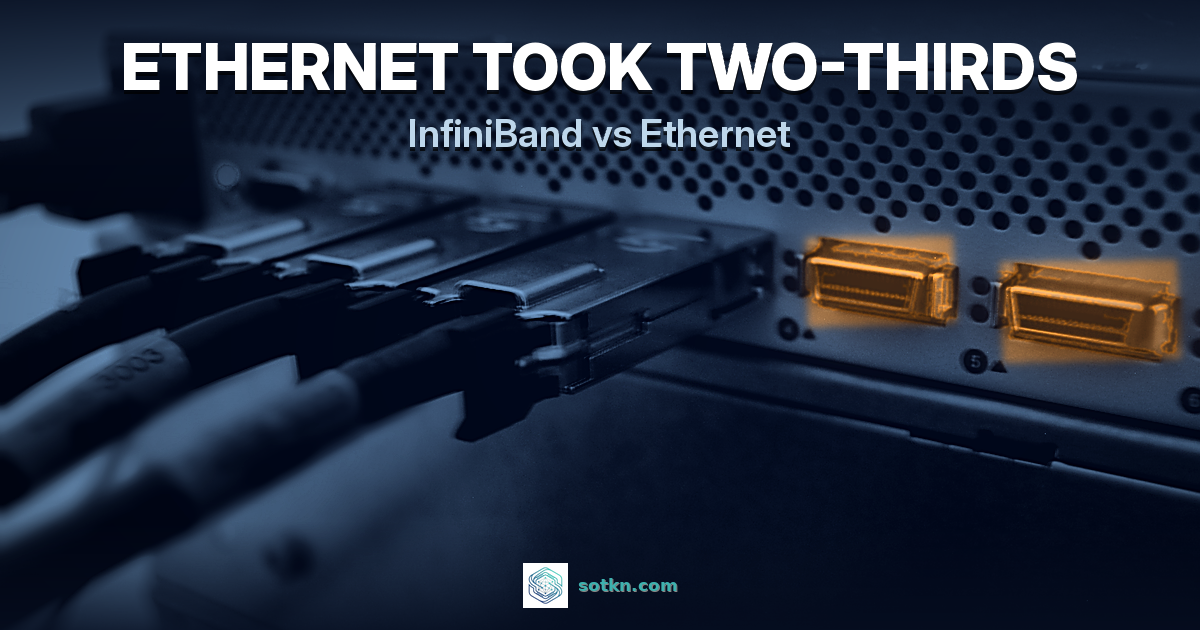
InfiniBand and Ethernet are the two network fabrics that link GPUs across racks in an AI cluster. Ethernet took about two-thirds of AI back-end switch sales in early 2026, but NVIDIA sells both. The fabric choice decides how the networking cheque is split; switch supply is the stuck step.
EXPLAINED · Versus · Last reviewed: 4 Nov 2026 · Next review: after NVIDIA’s third-quarter fiscal 2027 results (November 2026) and Dell’Oro’s 3Q 2026 AI back-end report
InfiniBand and Ethernet are the two network fabrics that link GPUs across racks in an AI cluster. InfiniBand is a specialist fabric sold mainly by NVIDIA; Ethernet is the open standard most data centres already run, tuned for AI by many vendors.
In short. InfiniBand and Ethernet are the two ways to wire GPUs together across racks. InfiniBand is NVIDIA’s specialist fabric; Ethernet is the open standard, now tuned for AI. Ethernet took about two-thirds of AI back-end switch sales in early 2026, but InfiniBand sales still more than tripled in the same quarter. Our read: the choice is less about speed than about who gets the networking cheque. InfiniBand keeps it with NVIDIA; Ethernet splits it between chip designers, box makers and optics suppliers. Either way, switch supply is the stuck step.
Why an investor cares: the network is about a fifth of what NVIDIA sells into data centres (our arithmetic below), and the fabric choice decides who else shares that money. Our guide to who makes AI cluster networking names the suppliers; this page explains the choice they are selling into.
What is the difference between InfiniBand and Ethernet?
Both carry data between GPUs in different racks, the traffic engineers call scale-out or back-end. They differ in who designs them, how they avoid losing data, and who sells them.
InfiniBand was built for supercomputers, where thousands of processors work on one job and a single late message holds everyone up. It is designed not to drop data: a sender transmits only when the receiver has room. Today it is sold mainly by NVIDIA, which owns the main InfiniBand maker, Mellanox.
Ethernet is the network almost every data centre already runs, from office links to cloud servers. It was designed to tolerate lost packets and resend them, which is fine for web traffic and costly for AI training. The AI versions add ways to keep data flowing without loss, or to recover fast when it is lost.
| InfiniBand | Ethernet for AI | |
|---|---|---|
| What it is | A specialist fabric built for supercomputers | The open standard every data centre runs, tuned for GPU traffic |
| Who sells it | Mainly NVIDIA, end to end: switches, network cards, cables | Many: NVIDIA Spectrum-X, Broadcom chips in Arista, Cisco and Celestica boxes, and others |
| How it avoids lost data | Lossless by design: a sender only transmits when the receiver has room | Lossless or near-lossless by tuning (RoCE), or by new protocols that recover fast (MRC) |
| Port speed in 2026 | 800 Gb/s, shipping with Blackwell Ultra | 800 Gb/s mainstream; 1.6 Tb/s sampling, ramp in the second half |
| Share of AI back-end switch sales | About one-third (1Q 2026) | About two-thirds (1Q 2026) |
| Typical buyer | Neoclouds and labs on NVIDIA’s reference design; upgrades of existing clusters | Amazon, Microsoft, Meta, Oracle, xAI and OpenAI’s largest clusters |
| Who gets paid | NVIDIA keeps most of the network cheque | The cheque splits across chip, box and optics suppliers |
Shares from Dell’Oro Group’s AI back-end switch reports of 10 March and 2 June 2026; one-third is our arithmetic from “about two-thirds”. Buyers from Dell’Oro (10 March 2026) and OpenAI (5 May 2026).
Why did AI clusters start on InfiniBand?
Because it worked out of the box. Training a large model means thousands of GPUs exchanging results in lockstep, many times a second. If one transfer arrives late, every GPU waits. InfiniBand’s lossless design and direct memory access, where one machine writes straight into another’s memory, were built for exactly that pattern.
It also came bundled. A buyer ordering NVIDIA GPUs could take NVIDIA’s network, cards and cables in the same reference design and know it had been tested together. That bundle is still the default on NVIDIA’s cloud partner programme, and it is why InfiniBand sits on so many neocloud bills of materials.
How did Ethernet catch up?
By borrowing InfiniBand’s tricks and then adding new ones. The first was RoCE, RDMA over Converged Ethernet, which gives Ethernet the same direct memory writes. The second was scale: hyperscalers already ran Ethernet everywhere and had large network teams to tune it.
Meta tested the two side by side. In March 2024 it described two clusters of 24,576 GPUs each, 49,152 in total by our count. One ran RoCE Ethernet on Arista and Meta-designed switches; the other ran NVIDIA InfiniBand. Both linked GPUs at 400 Gb/s, and Meta said both trained large models without network bottlenecks. Meta said it was training Llama 3 on the Ethernet one.
Then came the protocols. On 5 May 2026 OpenAI published MRC, Multipath Reliable Connection, built with AMD, Broadcom, Intel, Microsoft and NVIDIA. It extends RoCE and draws on work by the Ultra Ethernet Consortium. Instead of sending each transfer down one path, it sprays the packets across hundreds of paths and routes around a broken link in microseconds. OpenAI said a conventional network could take seconds or tens of seconds, and that a single failure would often crash a training job.
MRC already runs on all of OpenAI’s largest GB200 clusters, including the Oracle site in Abilene, Texas, and Microsoft’s Fairwater. The bigger change is the shape of the network. Split each 800 Gb/s card into eight 100 Gb/s planes, and a 64-port switch acts like a 512-port one.
| Design | Ports per switch | Switch tiers | GPUs it can link (our arithmetic) |
|---|---|---|---|
| Conventional, one plane | 64 at 800 Gb/s | Two | 2,048 |
| Conventional, one plane | 64 at 800 Gb/s | Three | 65,536 |
| Multi-plane (OpenAI MRC) | 512 at 100 Gb/s, eight planes | Two | 131,072 |
OpenAI said on 5 May 2026 that splitting each 800 Gb/s network card into eight 100 Gb/s planes lets a 64-port switch act as a 512-port one, linking about 131,000 GPUs on two tiers where a conventional network needs three or four. GPU counts use the standard fabric formulas (ports squared ÷ 2 for two tiers, ports cubed ÷ 4 for three) and are Second Order arithmetic.
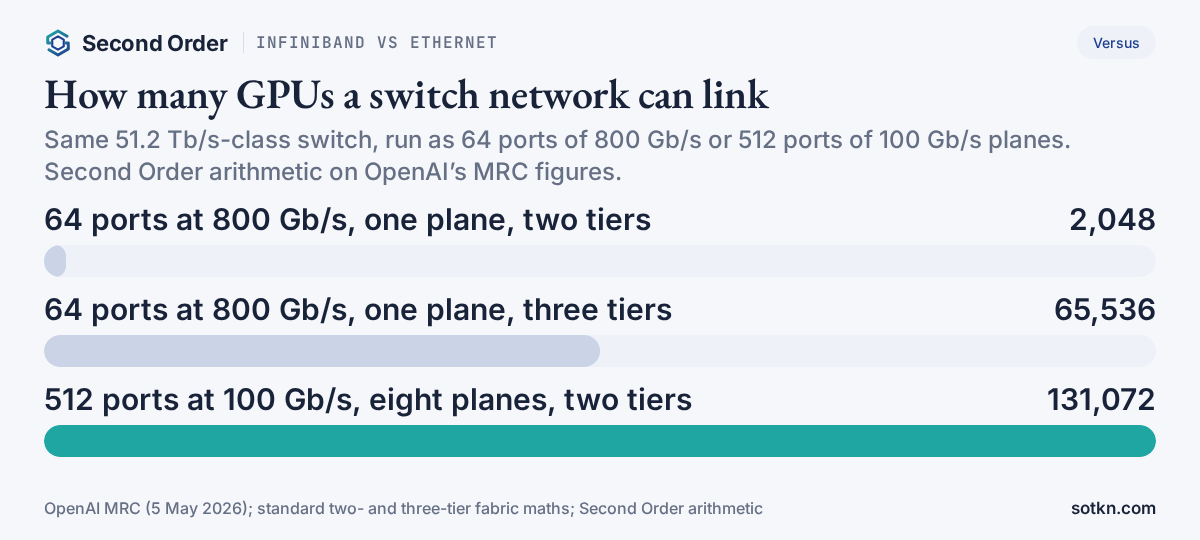
Fewer tiers means fewer switches, fewer parts to fail and less power for the same cluster. OpenAI said as much, and added that it lowers the total cost of the network. Our read: that is a cost argument for Ethernet that has nothing to do with headline speed.
Which one is winning in AI clusters?
Ethernet, by new sales. Dell’Oro Group put Ethernet at more than two-thirds of AI back-end switch sales for 2025, and at about two-thirds in the first quarter of 2026. That makes it roughly twice the size of InfiniBand (our arithmetic). Dell’Oro named Amazon, Microsoft, Meta, Oracle and xAI as Ethernet adopters, and said supply constraints were pushing buyers towards more than one vendor.
InfiniBand is not shrinking. In the same first quarter, Dell’Oro said InfiniBand sales more than tripled, carried by 800 Gb/s switches shipping with NVIDIA’s Blackwell Ultra. It added that much of that was upgrades to clusters already built on InfiniBand rather than new ones. Our read: InfiniBand keeps its installed base; Ethernet wins most of the new halls.
The whole pool is growing fast. In the second quarter of 2026, sales of switches for AI back-end networks passed those for ordinary front-end data centre networks for the first time, Dell’Oro said, and Ethernet extended its lead again.
Does NVIDIA lose if Ethernet wins?
No, because NVIDIA sells both. Its data centre networking revenue was a record $14.8 billion in the quarter to 26 April 2026, up 199% from a year earlier. In the next quarter networking grew another 18%, which by our arithmetic is about $17.5 billion, or roughly 19.6% of that quarter’s $89.0 billion of data centre revenue. Treat $17.5 billion as a bridge, not a printed figure.
On the same call NVIDIA said Spectrum-X, its AI Ethernet line, grew 2.6 times from a year earlier, and that its next rack, Vera Rubin, can use InfiniBand or Ethernet between racks. Dell’Oro placed NVIDIA second in Ethernet AI back-end switch sales in both the first and second quarters of 2026, close behind Celestica.
What changes is how much of the cheque NVIDIA keeps. With InfiniBand it sells the switch, the network card and often the cables. With Ethernet it competes for the switch against Broadcom-based boxes, and may sell only the card.
Who gets paid under each fabric?
Our read: InfiniBand pays one supplier for most of the network; Ethernet pays several, and charges the buyer in engineering time.
- NVIDIA, either way. All of the InfiniBand network, a large share of AI Ethernet through Spectrum-X, and the NVLink links inside each rack.
- Switch-chip designers. On Ethernet not made by NVIDIA, the switch chip usually comes from Broadcom, whose Tomahawk chips sit in many of these boxes. Broadcom is also a co-developer of MRC.
- Box makers. Celestica, which Dell’Oro placed first in Ethernet AI back-end switch sales in early 2026, builds switches to hyperscaler designs; Arista and Cisco sell branded ones. Arista’s third-quarter 2026 revenue rose 58.5% to $3.66 billion, and product revenue rose about 67% (our arithmetic).
- Optics makers. Every port between racks needs an optical link, and faster ports need more expensive ones. The optics are paid for whichever fabric wins.
- The buyer’s own network team. Ethernet’s lower supplier bill is partly paid back in tuning. Meta and OpenAI spent years on it; a small neocloud may not have those people.
Arista shows how much is paid before it is counted. It held $6.84 billion of deferred revenue on 30 September 2026, by our sum of the current and non-current lines, about 1.9 quarters of its third-quarter revenue. That is up $1.47 billion since the end of 2025. Inventories rose about 43% over the same nine months. Our Analysis on AI optics sold out to 2029 follows the same money one step down the cable.
Why do neoclouds often pick InfiniBand?
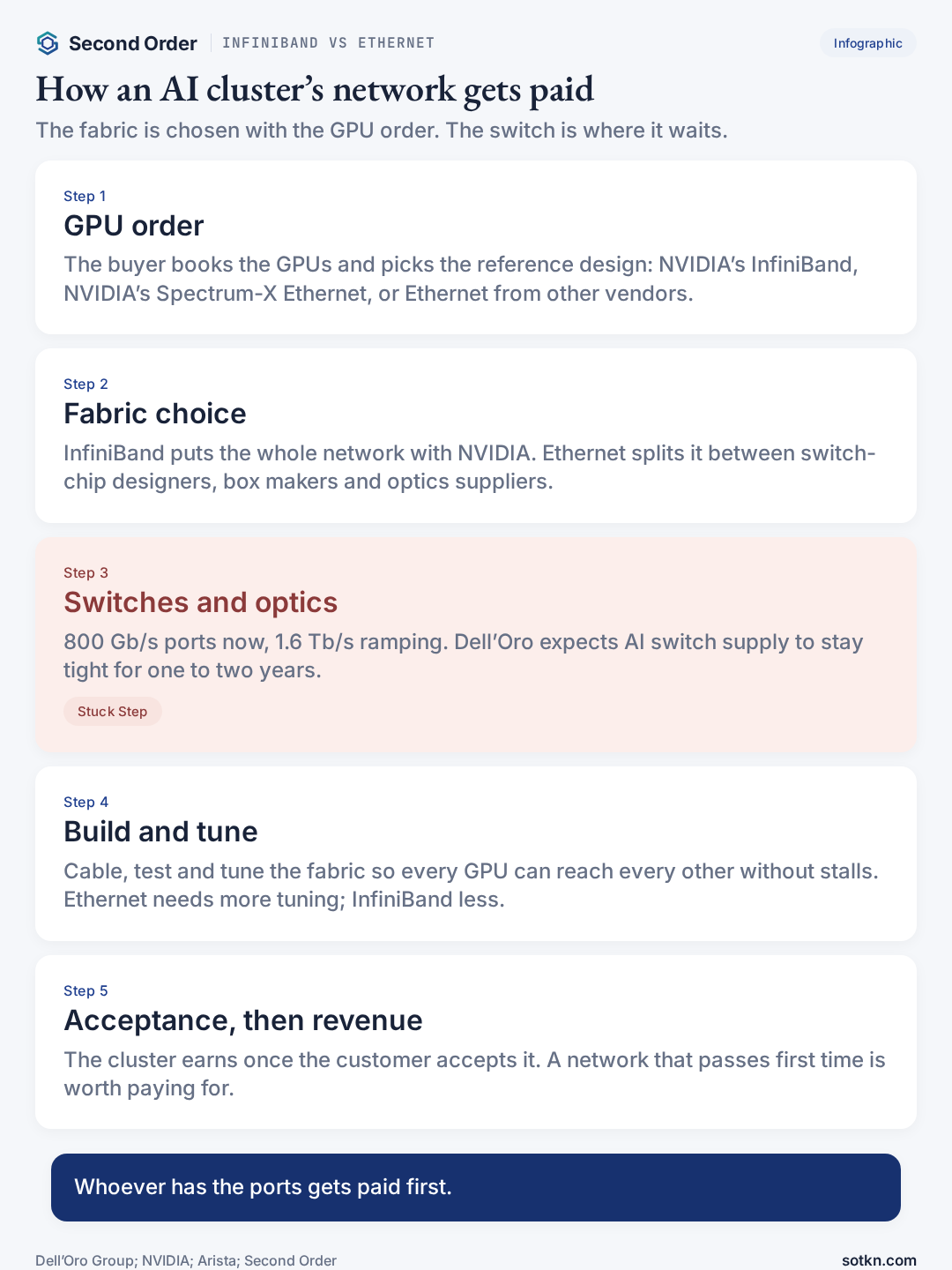
Our read: because time to revenue matters more than the network bill. A neocloud is paid when its customer accepts the cluster, and a fabric that passes the cluster acceptance tests first time is worth a premium. NVIDIA’s reference design with InfiniBand is a known way to get there.
Hyperscalers sit on the other side of that trade. They buy enough GPUs to want more than one network supplier, and they employ the engineers to tune Ethernet themselves. Our comparison of neoclouds and hyperscalers covers the wider difference between the two buyers, and our Stack page on CoreWeave covers the largest neocloud.
That may be shifting. NVIDIA said in August 2026 that its Vera Rubin racks can use InfiniBand or Ethernet between racks, and its Spectrum-X Ethernet sales grew 2.6 times in a year. A neocloud can now choose Ethernet without leaving NVIDIA.
Where is the stuck step?
Our read: switch and optics supply, not the protocol. Dell’Oro said in September 2026 that it expects the AI back-end switch market to stay supply-constrained, not demand-constrained, for at least the next one to two years. Supply, it said, will shape who gains share.
The clock is the speed upgrade. 800 Gb/s ports make up the vast majority of AI Ethernet shipments, and 1.6 Tb/s switches began sampling in 2026, with a ramp due in the second half. Every new GPU generation pulls the network up a step, and whoever holds the new ports first gets paid first. Our guide to optics and networking in AI clusters covers the parts that go into each port.
For a buyer the cost of a missing switch is the whole cluster. GPUs that cannot talk to each other cannot train or serve a model, so an idle network idles everything behind it. Our guide to GPU clusters covers what sits behind the switches.
What would change the view?
- InfiniBand wins new halls again. If Dell’Oro’s next reports show InfiniBand growth coming from new clusters rather than upgrades, the fabric is not as settled as this page assumes.
- Switch supply loosens. If 1.6 Tb/s ships on time and lead times shorten, the stuck step moves back to GPUs, power or memory, and box makers lose pricing power.
- NVIDIA keeps Ethernet for itself. If Spectrum-X takes most AI Ethernet growth, the cheque splits less than Ethernet’s share suggests.
Common misconceptions
- People assume Ethernet has replaced InfiniBand. Actually InfiniBand sales more than tripled in early 2026; Ethernet just grew faster from new clusters.
- People assume Ethernet winning is bad for NVIDIA. Actually NVIDIA sells AI Ethernet too and came second in Ethernet AI back-end switch sales in 2026.
- People assume InfiniBand is faster. Actually both ship at 800 Gb/s per port; the difference is how each handles congestion and failures.
- People assume the protocol is the bottleneck. Actually supply of switches and optics is, and Dell’Oro expects it to stay tight for one to two years.
FAQ
What is the difference between InfiniBand and Ethernet?
InfiniBand is a specialist network built for supercomputers, sold mainly by NVIDIA, that is designed not to drop data. Ethernet is the open standard almost every data centre already runs, sold by many vendors, and it has been tuned to behave like InfiniBand for AI work.
Is InfiniBand faster than Ethernet?
Not by headline speed any more. Both now ship at 800 gigabits per second per port in AI clusters, with 1.6 terabits sampling in 2026. InfiniBand’s edge has been predictable latency out of the box; Ethernet closes the gap with tuning and new protocols.
Is Ethernet replacing InfiniBand in AI clusters?
It is taking most new sales, not replacing it. Dell’Oro put Ethernet at about two-thirds of AI back-end switch sales in early 2026, yet InfiniBand sales more than tripled in the same quarter. Both are growing; Ethernet is growing faster.
Does NVIDIA make Ethernet switches?
Yes. NVIDIA sells InfiniBand and its own AI Ethernet line, Spectrum-X, and said Spectrum-X sales grew 2.6 times in the year to its second quarter of fiscal 2027. Its next rack, Vera Rubin, can use either for links between racks.
What is RoCE?
RoCE, RDMA over Converged Ethernet, lets one computer write straight into another’s memory over Ethernet, the trick InfiniBand was built around. Meta trained Llama 3 on a RoCE cluster of 24,576 GPUs, and OpenAI’s MRC protocol extends it.
Why do neoclouds use InfiniBand?
Our read: speed to revenue. A neocloud is paid once a cluster passes the customer’s acceptance tests, and NVIDIA’s reference design with InfiniBand is a known way to pass them. Hyperscalers have network teams large enough to tune Ethernet themselves.
Is this a list of stocks to buy or sell?
No. This page explains InfiniBand and Ethernet and where the money goes. It does not rank companies or give buy or sell calls. Not investment advice. Do your own research.
Related: GPU utilisation; rack-scale AI; what a neocloud is; AI training vs inference.
Stack doors
Layer: Neoclouds. Also: Nebius. Markets: United States.
Get the Wire — short daily notes when AI networks, switches and optics move.
Not investment advice. Do your own research.
How we check this
Market shares, the buyers adopting Ethernet, the InfiniBand rebound and the supply outlook come from Dell’Oro Group’s AI back-end switch press releases of 10 March, 2 June and 3 September 2026. NVIDIA’s networking revenue comes from its first-quarter fiscal 2027 CFO commentary and its second-quarter call of 26 August 2026. Arista’s revenue, deferred revenue and inventories come from its third-quarter results of 3 November 2026. The multi-plane design and failure-recovery times come from OpenAI’s MRC post of 5 May 2026, and the two 24,576-GPU clusters from Meta’s engineering post of 12 March 2024. NVIDIA’s second-quarter networking bridge, its share of data centre revenue, Arista’s deferred revenue in quarters, the inventory change and the GPU counts per switch tier are our arithmetic, checked in code and labelled as ours on the page. Who gets paid and the stuck step are our read. The featured photograph is credited in its caption. This page compares two network fabrics. It does not rank companies or give buy or sell calls. Not investment advice. Do your own research.
Last reviewed: 4 Nov 2026 · Next review: after NVIDIA’s third-quarter fiscal 2027 results (November 2026) and Dell’Oro’s 3Q 2026 AI back-end report
Spot an error? Tell us and we will correct it and note the change here.
References
- Dell’Oro Group — Ethernet more than doubles size of InfiniBand in AI scale-out networks in 2025 (10 Mar 2026) — Ethernet more than two-thirds of AI back-end switch sales in 4Q 2025 and full-year 2025; Amazon, Microsoft, Meta, Oracle and xAI adopting Ethernet; supply constraints drive vendor diversity; Celestica and NVIDIA about 50% of Ethernet AI back-end in 2025
- Dell’Oro Group — Ethernet extends lead in AI scale-out networks despite strong InfiniBand rebound (2 Jun 2026) — Ethernet about two-thirds of AI cluster switch sales in 1Q 2026; InfiniBand sales more than tripled with 800 Gbps Blackwell Ultra switches, much of it upgrades of installed clusters; Celestica, NVIDIA, Arista, Cisco order
- Dell’Oro Group — AI back-end network switch sales surpass front-end for the first time in 2Q 2026 (3 Sep 2026) — AI back-end switch sales passed front-end networks in 2Q 2026; Ethernet extended its lead; market expected to stay supply-constrained for at least one to two years; 1.6 Tbps sampling, ramp in second half of 2026
- NVIDIA — CFO commentary, first quarter fiscal 2027 (quarter ended 26 Apr 2026) — data center networking revenue a record $14.8 billion, up 199% from a year earlier and up 35% from the prior quarter
- NVIDIA — second-quarter fiscal 2027 earnings call transcript (26 Aug 2026) — networking revenue a record, up 18% from the prior quarter; Spectrum-X Ethernet up 2.6 times from a year earlier; Vera Rubin spans NVLink and InfiniBand or Ethernet; data center revenue $89.0 billion
- Arista Networks — third-quarter 2026 results (3 Nov 2026) — revenue $3.66 billion, up 58.5%; product revenue $3.19 billion; fourth-quarter guide $3.9 to $4.0 billion; deferred revenue $5.10 billion current plus $1.74 billion non-current; inventories $3.21 billion against $2.25 billion at end-2025; open Ethernet rack-scale designs for scale-up and scale-out
- OpenAI — Supercomputer networking to accelerate large scale AI training (5 May 2026) — MRC protocol with AMD, Broadcom, Intel, Microsoft and NVIDIA, extends RoCE; deployed on OpenAI’s largest GB200 clusters incl. OCI Abilene and Microsoft Fairwater; eight 100 Gb/s planes per 800 Gb/s interface; about 131,000 GPUs on two switch tiers; failures routed around in microseconds instead of seconds
- Meta Engineering — Building Meta’s GenAI infrastructure (12 Mar 2024) — two 24,576-GPU clusters, one on RoCE Ethernet (Arista 7800 and Meta-designed rack switches), one on NVIDIA Quantum2 InfiniBand, both at 400 Gbps; both used for large GenAI training without network bottlenecks; Llama 3 trained on the RoCE cluster