NT$586.89 Billion Invoiced: Who Gets Paid While TSMC's October Back End Stays Unnamed
TSMC was paid NT$586.89 billion for October. The back end is still off this print.
TSMC was paid NT$586.89 billion for October 2026. The stuck step is the back end. The 10 November print is one revenue line, and it does not say how much of that invoice was a finished package.
TAIWAN PULSE · Data as at 13 Nov 2026 · Next update: after TSMC's November revenue
Affects: Semiconductors — Markets: Taiwan · Korea · US
In short: On 10 November 2026 TSMC reported October revenue of NT$586.89 billion, up 14.7% from September and 59.7% from a year earlier. Who gets paid is TSMC. The filing does not split the month by node, customer, or package, and it does not update the 15 October comment that the back end was still a little short.
Education only, not advice to buy or sell any security. Figures are from the 10 November revenue report and Form 6-K, the 2026 monthly table, and the 15 October release, results page, and call. Divisions and subtractions are labelled our arithmetic. October revenue is not a profit, a cash balance, or a guarantee. The 2026 monthly figures are unaudited.
The numbers that matter this month
The press sentence says approximately NT$586.89 billion. The table, in NT$ million, prints 586,890. Those are the same number. The 6-K status report, in thousands, prints 586,890,319, which rounds to that cell. September appears only in the million table, so the month-on-month working uses 586,890 and 511,857.
| Period | Net revenue | Printed change |
|---|---|---|
| October 2026 | 586,890 | — |
| September 2026 | 511,857 | +14.7% from September |
| October 2025 | 367,473 | +59.7% from a year earlier |
| January–October 2026 | 4,485,617 | — |
| January–October 2025 | 3,130,437 | +43.3% from a year earlier |
The fourth-quarter guide, printed on 15 October and not restated here, is still US$52.3 billion to US$54.3 billion, at NT$31.8 per US dollar for the margin guide. Gross margin is guided at 65% to 67%. Operating margin is guided at 56.5% to 58.5%. The last mix is also from that day: 2-nanometre was 8% of wafer revenue, 3-nanometre 33%, 5-nanometre 28%, 7-nanometre 10%, and advanced technologies 79%. Third-quarter gross margin was 66.4%. None of those percentages is in the October revenue report. The loan, the guarantees, and the derivative book in the same 6-K are not this invoice. They are separated below.
Why does Taiwan matter now?
Because the leading-edge wafer is still invoiced here, and the package that finishes an AI chip is still not a line on that invoice.
The buyer needs the wafer, a memory stack made mostly in Korea, and a package that joins them. TSMC makes the wafer and, on the 15 October wording, the CoWoS package customers still choose first. October's NT$586.89 billion says the month was paid. It does not say the package kept up. The chairman said demand was still higher than supply, the gap was still quite big, and the back end was still a little short. A GlobalFoundries interposer deal was part of that supply plan. This filing does not replace those sentences. The Korea door is the memory side. CoWoS, explained maps the package.
What changed
What changed on 10 November is the size of one month, not the identity of the step.
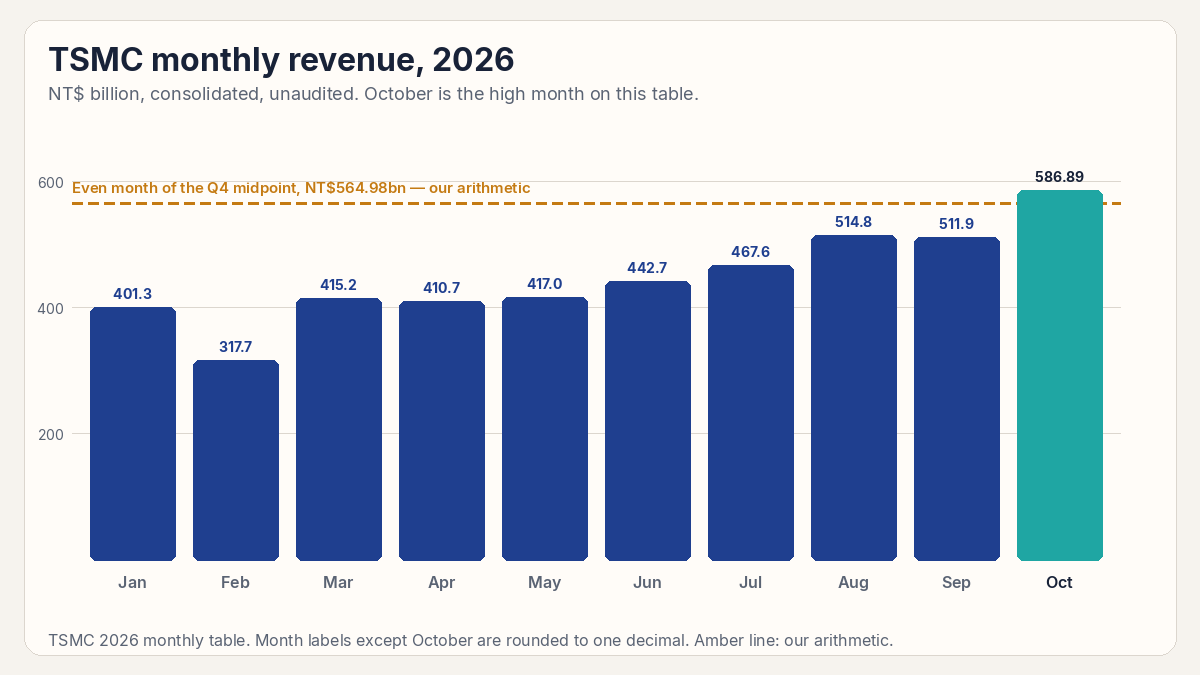
September was NT$511,857 million. October is NT$586,890 million, the high month on the 2026 table. August was NT$514,806 million, so September had dipped NT$2,949 million before this step up. October is NT$72,084 million above August. It is not the year's largest step: March rose NT$97,534 million off a short February. This step is the largest since March, and it came off an already high month.
The 15 October guide was not rewritten on 10 November. Revenue was expected at US$52.3 billion to US$54.3 billion. At NT$31.8 per US dollar, gross margin was 65% to 67% and operating margin 56.5% to 58.5%. The CFO called the midpoint a 14% sequential increase, or 58% from a year earlier, and said gross margin was guided down 40 basis points from 66.4%, to 66% at the midpoint, because of the 2-nanometre ramp and overseas fabs. The chairman put full-year 2026 growth around 44% in US dollars and reiterated a capital budget of US$60 billion to US$64 billion. The ten-month NT$ rise of 43.3% is a different unit and a shorter window. It is not that outlook.
The 6-K did add a balance-sheet-style status report for October. It is easy to misread, so the lines are separated here.
| Item | Board-approved or notional | Outstanding or mark-to-market |
|---|---|---|
| Loan, TSMC Development to TSMC Washington | Approved 3,915,120; limit 35,419,601 | Outstanding 3,915,120 |
| Guarantee for TSMC North America | 2,714,917 | 2,714,917 |
| Guarantee for TSMC Global | 176,180,400 | 176,180,400 |
| Guarantee for TSMC Arizona | 457,993,793 | 326,953,998 |
| TSMC parent forwards, outstanding notional | 441,197,649 | Mark-to-market (6,251,892) |
The Arizona gap is the open amount: approved minus outstanding is NT$131,039,795 thousand. The filing does not say why. On 15 October the company said the second Arizona fab's construction was complete, tools were moving in, and volume production was aimed at the third quarter of 2027, slightly ahead of the prior schedule. That build comment does not explain the gap. Do not add the undrawn approval to NT$586.89 billion.
The parent's cumulative unrealised loss on forwards is NT$3,236,695 thousand, and the realised loss on expired contracts is NT$8,424,700 thousand, both from the start of 2026 through October. The other entities in that section are far smaller, or blank. None of this is October revenue.
Our math
The company printed the rates. This section checks them, then puts October against the fourth-quarter guide. Every step that is not a printed cell is our arithmetic.
Month on month: 586,890 minus 511,857 is 75,033. Divide 75,033 by 511,857 and the result is 14.659%. The company prints 14.7%. The difference is rounding.
Year on year: 586,890 minus 367,473 is 219,417, and 219,417 divided by 367,473 is 59.710%. The company prints 59.7%. The status report's unrounded thousands, 586,890,319 against 367,473,051, give the same 59.710% at three decimals.
Ten months: 4,485,617 minus 3,130,437 is 1,355,180, and 1,355,180 divided by 3,130,437 is 43.290%. The company prints 43.3%. The press sentence's NT$4,485.62 billion is the table's 4,485,617 million, rounded. July plus August plus September is NT$1,494.243 billion. The 15 October release prints NT$1,494.24 billion. The months and the quarter meet at that rounding.
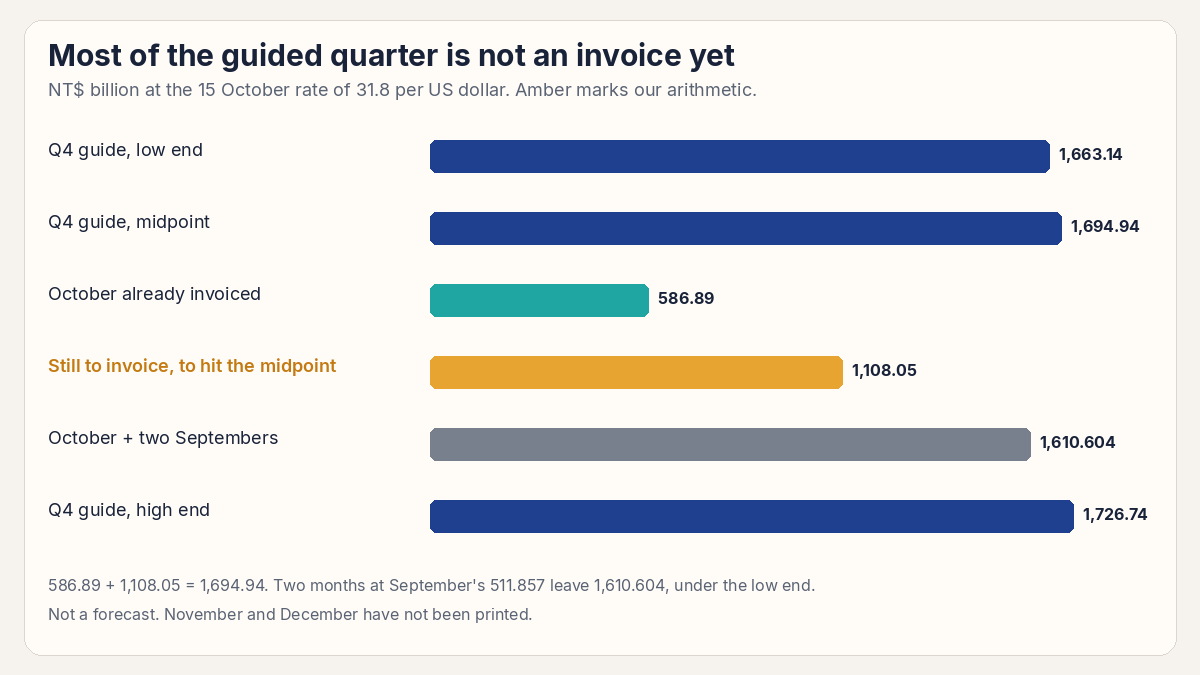
Now the guide, which October does not restate. The low end is US$52.3 billion. The high end is US$54.3 billion. The midpoint is US$53.3 billion, the average of those two ends. The margin guide uses NT$31.8 per US dollar. Apply that rate, and only that rate:
52.3 times 31.8 is NT$1,663.14 billion. 54.3 times 31.8 is NT$1,726.74 billion. 53.3 times 31.8 is NT$1,694.94 billion. An even month is one third of each. The low end's even month is NT$554.38 billion. The midpoint's even month is NT$564.98 billion. The high end's even month is NT$575.58 billion.
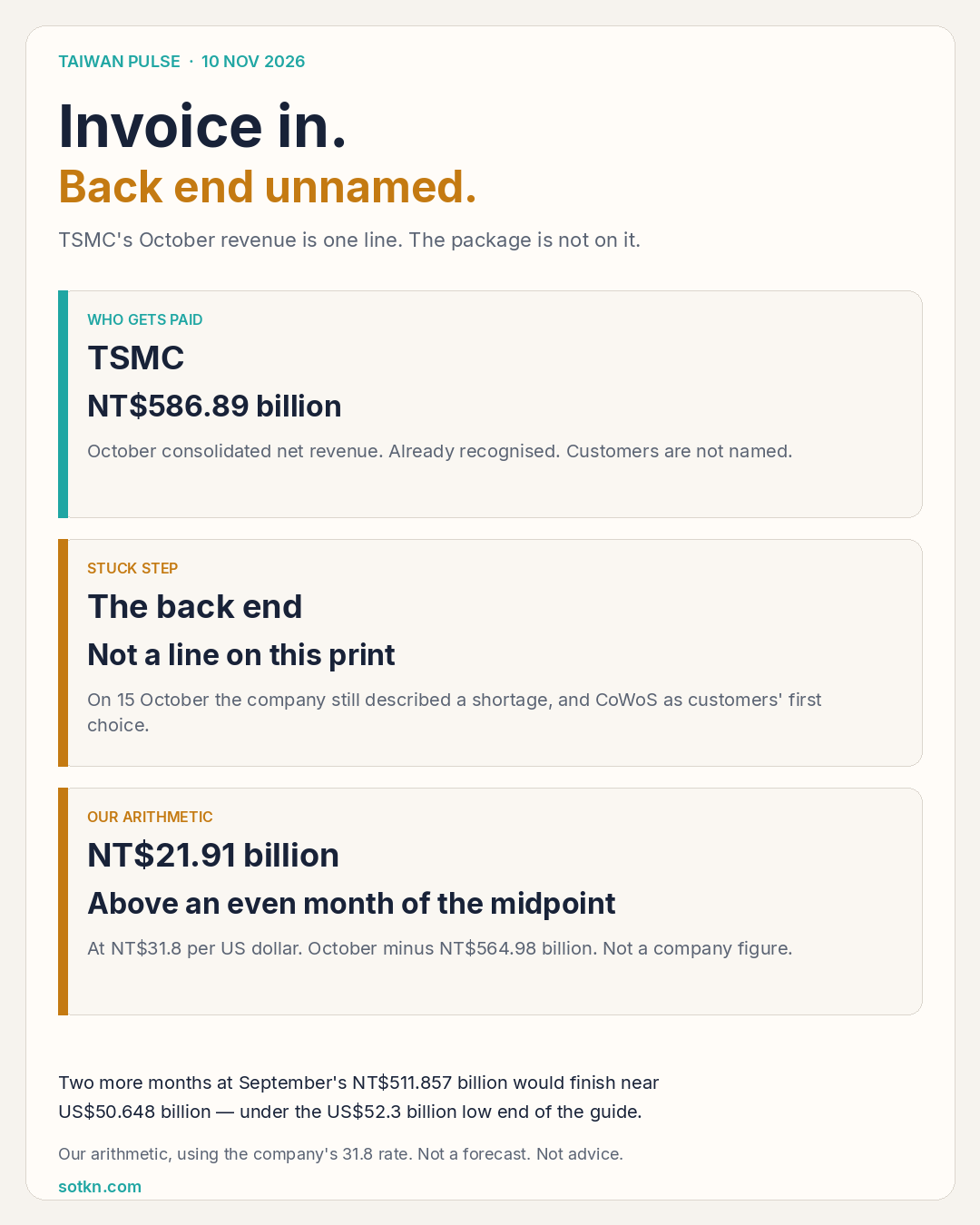
October, NT$586.89 billion, is above all three. Against the midpoint's even month, 586.89 minus 564.98 is NT$21.91 billion, which is 3.878% above that even month. October is 586.89 divided by 1,694.94, or 34.626% of the midpoint. An even month would be 33.333%. The gap is 1.293 percentage points of the guided quarter. October is also 35.288% of the low end and 33.988% of the high end.
Two months are still blank. Left of the low end: 1,663.14 minus 586.89 is NT$1,076.25 billion, or NT$538.125 billion a month. Left of the midpoint: NT$1,108.05 billion, or NT$554.025 billion a month. September was NT$511.857 billion. The low end's remaining average is NT$26.268 billion, or 5.132%, above September. The midpoint's is NT$42.168 billion, or 8.238%, above it. The next two months can cool from October and still land in the guide. They cannot fall back to September and stay inside it.
If November and December match September, the quarter is NT$1,610.604 billion. Divide by 31.8 and the result is US$50.648 billion, which is US$1.652 billion under the US$52.3 billion low end. If they match October, the quarter is NT$1,760.67 billion, or US$55.367 billion, which is US$1.067 billion over the high end. This filing does not say which path November takes.
The CFO's 14% at the midpoint checks: 53.3 minus 46.72 is 6.58, and 6.58 divided by US$46.72 billion is 14.084%. The 58% year-on-year figure is his. The October documents do not print the year-ago fourth quarter in dollars, so this note does not recompute it.
TSMC did not print October in US dollars. NT$586.89 billion divided by 31.8 is US$18.456 billion. That is our arithmetic, not a company figure. The third quarter's actual average, on the 15 October table, was 31.98. The same revenue divided by 31.98 is US$18.352 billion. The gap is US$0.104 billion. Set against the US$1.652 billion hole from two September-sized months, 1.652 divided by 0.104 is 15.9. The rate gap between two company-printed rates is much smaller than the two unprinted months. Neither rate is October's own average. The filing does not print that.
Still our arithmetic: ten-month revenue of NT$4,485.617 billion is NT$448.562 billion a month, so October is 30.838% above the average month and 13.084% of the ten-month total. Arizona's outstanding guarantee is 71.388% of the approval (326,953,998 divided by 457,993,793). The gap is NT$131.040 billion. The Washington loan, 3,915,120 divided by the 35,419,601 limit, is 11.054%. The parent's NT$6.252 billion mark-to-market loss is 1.065% of October revenue if you divide them. Do not. A derivative mark is not revenue.
Where does the money stick?
It sticks with TSMC on the wafer already recognised. It does not show up as a separate package line.
The invoice is the evidence the wafer step was paid: 59.7% above October 2025. Margin is not in this print. Third-quarter gross margin was 66.4%, and the fourth-quarter guide is 65% to 67% because of the 2-nanometre ramp and overseas fabs. Revenue can rise while that guided margin ticks down.
On 15 October, CoWoS was still the first-choice package, and the company still described a shortage. This filing has no packaging row, so none of the NT$75,033 million month-on-month increase can be assigned to a package without a guess. The Arizona figure is a different pile: support for a subsidiary, not October wafer cash. The US door is where that build belongs. The hedge notional is a face amount, not a loss, and this document has no profit line to subtract the NT$6.252 billion mark from.
Is the back end still short?
Yes, on the last statement the company made, because the new print does not replace it.
The 10 November report measures revenue, a loan, three guarantees, and derivatives. It does not measure back-end output, CoWoS capacity, or the share of revenue that was a finished package. The 15 October call is still the latest description: demand above supply, CoWoS still the first choice, a little bit of a shortage on the back end.
Silence is not proof the shortage closed, and it is not proof it got worse. October at 3.878% above an even month of the midpoint is a statement about the invoice. The package could be inside that line, or still behind it. This table cannot tell those stories apart.
A strong November would confirm the invoice, not the package. The step moves if the company says the shortage has closed, or prints a split. N2 has been in high-volume manufacturing since the fourth quarter of 2025 and diluted gross margin. This line does not say what share of NT$586.89 billion was a 2-nanometre wafer.
What dates matter
| When | What | Why it matters |
|---|---|---|
| 10 Nov 2026 | October revenue and the Form 6-K status report | Done. The invoice is NT$586.89 billion. The mix is unnamed. |
| Around 10 Dec 2026 | November revenue | Not a date printed in this filing. October's report was issued on the 10th, which is why the next one is likely around then. It is the second month of the guide. |
| Not dated here | Fourth-quarter results | The last results were 15 October. This filing does not set the next date. That is where a node mix, a margin, and a fresh back-end comment would show up. |
| Third quarter of 2027 | Arizona second fab, volume production | The 15 October call said this was slightly ahead of the prior schedule. It is a build date, not an October invoice. |
This monthly release did not update the 15 October guide, the NT$31.8 rate, the "around 44%" dollar outlook, or the US$60–64 billion capital budget.
How is this different from the September revenue pulse?
The September revenue pulse read August, NT$514,806 million on this table, and used outside capacity reports. This note does not. October is NT$72,084 million above August. A high month still does not name the step.
The 21 October pulse had the mix: 2-nanometre at 8% of wafer revenue, gross margin 66.4%, and the guide. This note is the first month inside that guide. On our arithmetic it sits NT$21.91 billion above an even month of the midpoint, and the back end is still not a line.
Hon Hai's October revenue, covered here on 9 November, is a different company and a different step. The two Octobers should not be added.
What would change this view?
The view is that the foundry has been paid for October and the back end is still the unnamed step. It would change if any of these printed:
- November or December revenue low enough, at NT$31.8 per dollar, that the quarter misses US$52.3 billion. Two September-sized months already sit US$1.652 billion under that floor, on our arithmetic.
- A company-printed October exchange rate far enough from 31.8 to move the dollar reading by more than the US$0.104 billion gap between 31.8 and the third quarter's 31.98.
- A split, monthly or quarterly, that shows how much of the invoice was advanced packaging, or that shows it was not.
- A company statement that the back-end shortage has closed, or that CoWoS is no longer customers' first choice.
- A fourth-quarter gross margin outside 65% to 67% for a reason other than the 2-nanometre ramp and the overseas fabs the company already named.
- The Arizona outstanding guarantee moving to the full approved amount, or the approved amount being cut. That would change the guarantee paragraph only. It would not rewrite the October invoice.
Practical takeaways
- TSMC was paid NT$586.89 billion for October, up 14.7% on the month and 59.7% on the year. The rates are the company's. The subtractions are in Our math.
- Who gets paid is the foundry, on revenue already recognised. No customer, node, or package is named.
- On our arithmetic, October is NT$21.91 billion above an even month of the midpoint. Two September-sized months would still finish near US$50.648 billion, under the low end.
- Do not subtract the hedge mark, or add the undrawn Arizona guarantee, to this revenue.
- The back-end shortage is still the 15 October statement. The step moves when a document measures the package.
FAQ
What was TSMC's October 2026 revenue?
NT$586.89 billion, consolidated. The 10 November table prints that as NT$586,890 million, up 14.7% from September and 59.7% from October 2025. January through October reached NT$4,485,617 million, up 43.3%.
Who gets paid on this print?
TSMC, on revenue it has already recorded for October. The figure is an invoice for work the company has recognised, not a forecast and not the Arizona guarantee in the same filing. The print does not name the customers.
Why is the back end still the stuck step?
Because this revenue line does not measure it. On 15 October the company said it still had a little bit of a shortage on the back end, and that CoWoS was still customers' first choice. The 10 November report does not update either sentence.
Does October lock in the fourth-quarter sales guide?
No. At the guide's own rate of NT$31.8 per US dollar, October sits above an even month of the US$52.3 billion to US$54.3 billion range. Two further months at September's revenue would still finish near US$50.648 billion, under the low end. That is our arithmetic, and the filing does not print October's exchange rate.
What date can move this view?
TSMC's November revenue report. October's was issued on 10 November, so the next one is likely around 10 December, and the company has not put that date in this filing. A quarterly mix, with a node split and a packaging comment, is the print that would name the step this month leaves blank.
Keep reading on the map
The invoice is one month. The map is the steps around it.
- Taiwan — the door for the wafer and the package.
- The third-quarter pulse — the last print that actually split the mix.
- August revenue — the month this table has now moved past.
- CoWoS, explained — what the back end is, in one place.
- Korea — the memory on the other side of the same package.
- Where the stuck step moves — why a paid invoice and a short step can be true together.
How we check this. Revenue cells are from the 10 November table or the 6-K. The guide, the 31.8 rate, and the third-quarter mix are from the 15 October release and results page. The back-end comment, the 44% dollar outlook, and the capital budget are from that day's call, paraphrased and dated. Divisions and subtractions are labelled our arithmetic. This is not a recommendation to buy or sell.
References
- TSMC, October 2026 revenue report, issued 10 November 2026. Consolidated net revenue approximately NT$586.89 billion. TSMC press release
- TSMC, Form 6-K signed 10 November 2026, including the revenue table in NT$ million and the October status report on revenue, lending, guarantees, and derivatives in NT$ thousand. Form 6-K
- TSMC, 2026 monthly revenue table, consolidated, unaudited. October and the earlier months used in the chart. Monthly revenue, 2026
- TSMC, third-quarter 2026 earnings release, 15 October 2026. Fourth-quarter guide, NT$31.8 assumption, and the third-quarter mix and margins. Earnings release (PDF)
- TSMC, third-quarter 2026 quarterly results page. Guidance table: third-quarter actual US$46.72 billion at 31.98, fourth-quarter guide US$52.3–54.3 billion at 31.8. Quarterly results
- TSMC, third-quarter 2026 earnings call transcript, 15 October 2026. Back-end shortage, CoWoS as the first choice, the 44% dollar outlook, and the capital budget. Earnings call transcript (PDF)