100.0% of the Hours: Who Gets Paid While Samsung's Spare-Bit Line Stays Blank
Samsung's Device Solutions division is already paid on the quarter. The 16 November 2026 report prints memory lines open for every hour, and capacity equal to the bits already packaged. The spare-bit line is blank.
Home › Markets › Korea › Hours full, spare bits unnamed
Samsung’s Device Solutions division is already paid on the quarter. The quarterly report filed on 16 November 2026 prints memory lines as open for every hour in the nine months to 30 September, and it sets capacity equal to the bits already packaged. The spare-bit line is blank. That is the stuck step.
KOREA PULSE · Semiconductors · Data as at 16 Nov 2026 · Next update: when a later Samsung report prints a spare-bit figure, or names the next results date
Affects: Semiconductors · Hyperscalers — Markets: Korea · Taiwan · US
Education only, not advice to buy or sell any security. Every figure below is from Samsung Electronics’ quarterly report submitted on 16 November 2026, unless a sum is marked as our arithmetic. Where the report is silent, this note says so.
The numbers that matter this month
| Line | Figure | What the report is counting |
|---|---|---|
| Memory hours, 1 Jan–30 Sep 2026 | 100.0% | 65,520 hours used of 65,520 available |
| Memory capacity | 2,000,437,183 | Thousand 1Gb-equivalents, package-out basis |
| Memory output | 2,000,437,183 | Same unit, same number |
| Spare bits | Unnamed | Capacity minus output is zero by the formula |
| DS sales, three months | 147,104,100 | Million won. Memory products 140,693,887 |
| DS operating profit, three months | 106,536,477 | Million won |
| Construction in progress, book | 69,865,300 | Million won, from the 억원 rollforward |
Status on the spare-bit row is ours: the report does not print a status. The other rows are printed. Full sources are at the end.
Why does Korea matter now?
Because the memory beside an AI chip is still mostly made in Korea, and this statutory report is the new print. The bill is already on the invoice. What the filing adds is an hour clock that looks full and a capacity number that cannot show unused bits.
Device Solutions is the chip division: memory, foundry and the logic chips Samsung designs. In the three months to 30 September it booked 147,104,100 million won of sales. Memory products were 140,693,887 million won of that. Our arithmetic: memory was 95.642 percent of Device Solutions sales in the quarter, and 94.381 percent of Device Solutions sales across the nine months (336,314,110 of 356,335,814 million won). The profit sits on the same side. Device Solutions operating profit was 106,536,477 million won in the quarter.
The other Korean memory maker, SK hynix, already had its own third-quarter pulse. Hanmi Semiconductor’s quarterly report, filed three days before this one, was a toolmaker story about an exchange line. This note does not reopen those. It stays on the Samsung form that arrived on 16 November, and on the one cell that form leaves blank.
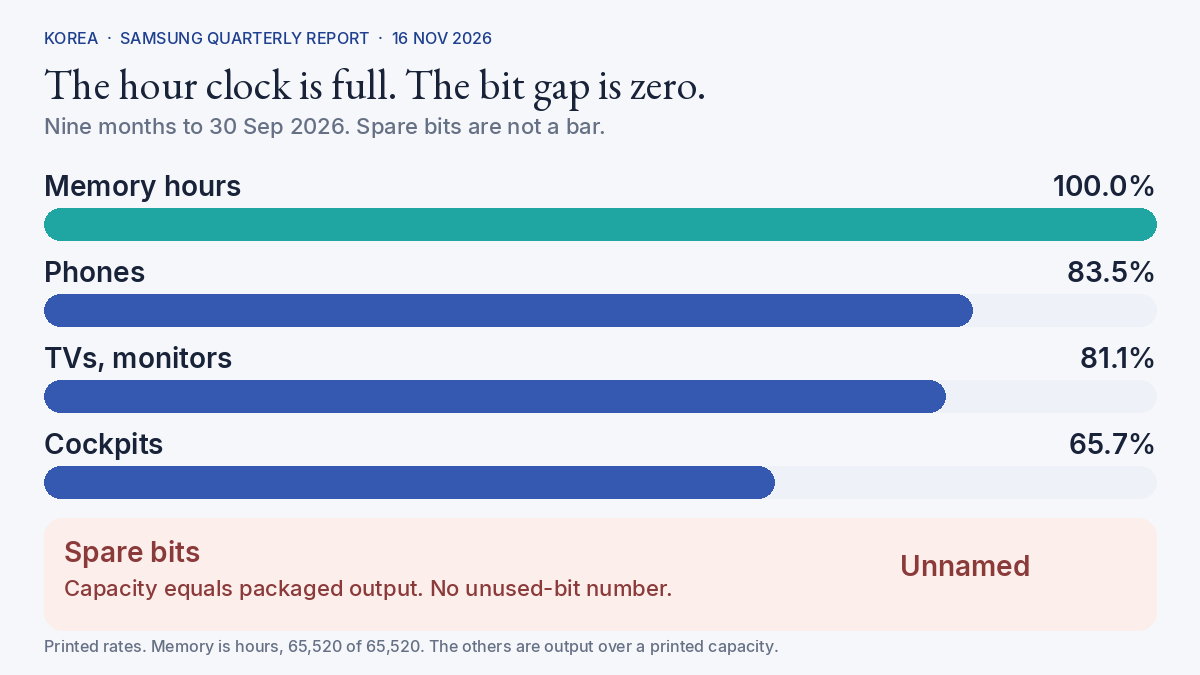
Phones, TVs and cockpits are output divided by a larger capacity. Memory is not. The report defines memory capacity as packaged output divided by the utilization rate. At a 100.0 percent hour clock, capacity is forced to equal output. The form has not measured slack. It has defined it away.
What changed
The new document is the quarterly report for the 58th fiscal year, third quarter, submitted to the Financial Services Commission and the Korea Exchange on 16 November 2026. The accounting period on the face of the statements is 1 January to 30 September 2026. The income statement also splits the latest three months.
Group sales in those three months were 195,253,209 million won. Cost of sales was 59,989,357, gross profit 135,263,852, and operating profit 107,440,482. The lines tie. Nine-month sales were 500,626,123 million won and nine-month operating profit was 254,165,691. The report’s prose says nine-month sales rose 108.8 percent from a year earlier. Our arithmetic on the income statement is 108.796 percent, which rounds to that rate.
The quarter’s profit is not a new headline. What changed on 16 November is the production section and the property rollforward.
Memory capacity for the current column is 2,000,437,183 thousand 1Gb-equivalents. Memory output is the same 2,000,437,183. The prior full years match themselves too: 2,245,908,090 for 2025 and 2,238,240,405 for 2024, capacity and output alike. The footnote says Device Solutions memory capacity is packaged output, converted to 1Gb, divided by the utilization rate. The hour table then prints the rate used for this period: available hours 65,520, actual hours 65,520, utilization 100.0 percent.
The prose rounds output to 2,000,437 million pieces. The table is 2,000,437.183 million. The dropped 0.183 million pieces are rounding, not a second pile.
The 273 days fix the window. The report says operating days, including holidays, are 273. From 1 January to 30 September 2026 is 273 days. Our arithmetic: 31+28+31+30+31+30+31+31+30 = 273. The hour clock is the nine months, not a 90-day quarter.
The report’s own hour formula is days times line count times 24. Our arithmetic: 273 times 24 is 6,552 hours for one line, and 65,520 divided by 6,552 is 10 exactly. The report does not print the number 10. It does not say what those 10 units are. They are not named as fabs, campuses or cities. Leave them unnamed.
Other products use a different ruler. TVs and monitors printed 81.1 percent; our division of 33,884 by 41,793 is 81.076 percent. Phones printed 83.5 percent; 167,790 of 200,960 is 83.494 percent. Cockpits printed 65.7 percent; 4,025 of 6,130 is 65.661 percent. Those gaps are on the page. Memory’s gap is not, while hours stay at 65,520 of 65,520.
Capacity also equals output in the 2024 and 2025 columns. This report does not print those years’ hours, so we do not claim the lines ran every hour then.
Nine-month output is 89.070 percent of full-year 2025 output, our arithmetic. Dividing by nine, against the 2025 figure divided by twelve, the monthly pace is 18.760 percent faster than 2025’s average month. The report does not print the first nine months of 2025, so this is not a year-on-year rate.
Our math
Each percentage below is our arithmetic on printed cells. The label is our arithmetic. We do not replace a printed rate with it when the report already rounded.
Device Solutions margin in the quarter is 106,536,477 divided by 147,104,100, which is 72.423 percent. Nine-month Device Solutions margin is 249,395,770 divided by 356,335,814, which is 69.990 percent. Group operating margin is 55.026 percent in the quarter and 50.770 percent across the nine months. Group gross margin is 69.276 percent in the quarter. Quarter net profit was 75,136,138 million won, a net margin of 38.481 percent.
Device Solutions is 99.159 percent of the quarter’s consolidated operating profit, on our division of 106,536,477 by 107,440,482. The four named divisions do not add up to that total. Device eXperience lost 825,216 million won. Display made 1,106,855. Harman made 607,353. With Device Solutions, that is 107,425,469. The consolidated line is 107,440,482. The gap is 15,013 million won. The note says other is not shown separately, and the elimination column on operating profit is zero. The 15,013 stays unnamed. We do not call it an elimination.
The nine-month version of the same gap is larger. Named divisional operating profit sums to 254,113,818 million won. Consolidated operating profit is 254,165,691. The gap is 51,873 million won, and the elimination column is again zero. The narrative table, in units of 100 million won, prints Device Solutions as 98.1 percent of the mix. Our division of the note’s nine-month Device Solutions profit by consolidated profit is 98.123 percent. Our division by the sum of the four named divisions is 98.143 percent. Both round to 98.1 percent at one decimal. The report does not say which denominator it used. We do not pick one and call it the printed method.
Sales by named division do tie, because the elimination is printed. In the quarter: devices 52,054,489, Device Solutions 147,104,100, display 7,997,332, Harman 4,328,313, elimination minus 16,231,025, total 195,253,209. Nine-month elimination is 43,339,566 million won and the total ties the same way. The product cut does not. TVs, phones, memory and panels sum to 193,207,240 million won in the quarter, 2,045,969 short of sales. Across nine months the unnamed product gap is 12,375,979 million won. The note says other products are not shown separately.
From operating profit to net profit, the quarter’s face ties. Other income 504,892, other expense 255,829, equity-method gain 358,117, finance income 4,594,021 and finance cost 14,109,461 take 107,440,482 to pretax profit of 98,532,222. Tax of 23,396,084 leaves net profit of 75,136,138. The finance cost is not split, and we do not call it currency. A translation loss of 22,528,499 million won in other comprehensive income is a different line, not cash.
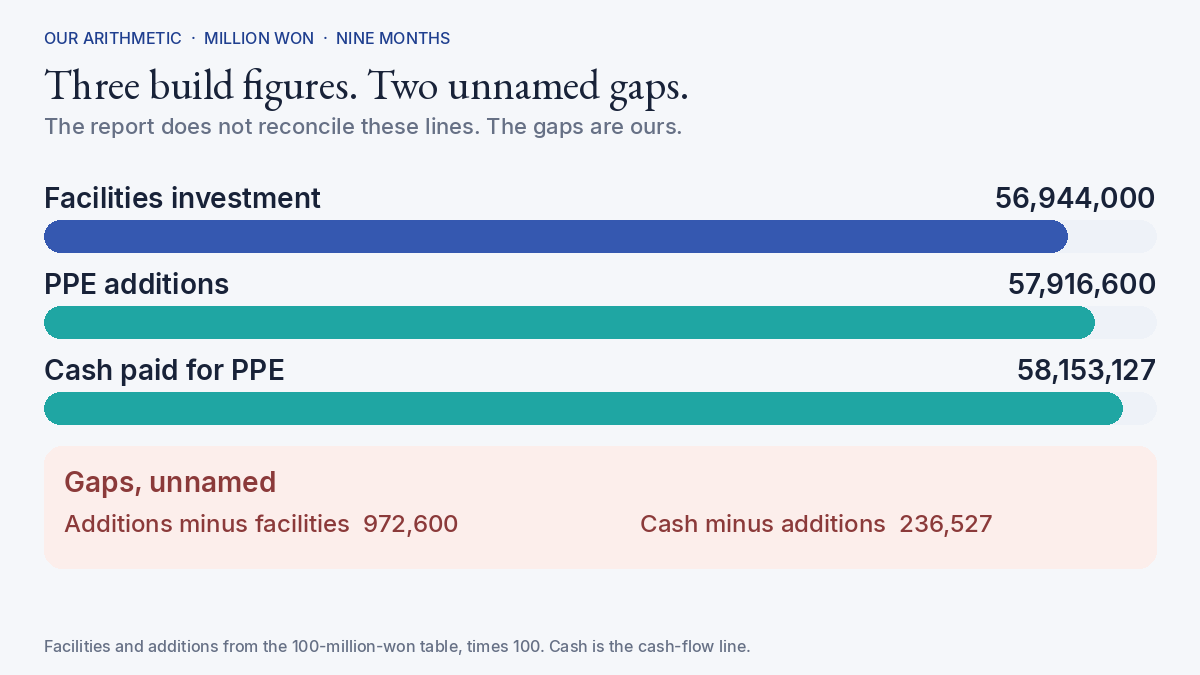
Three build figures refuse to meet. Facilities investment for January to September is 569,440 in units of 100 million won, and the three divisions inside it sum exactly. In million won that is 56,944,000. Device Solutions is 527,509 of that unit, 92.636 percent, our arithmetic.
Property additions in the same unit are 579,166, and the five asset lines inside that total sum exactly. In million won that is 57,916,600. Additions minus facilities investment are 972,600 million won. The report does not name the gap.
Cash paid for property, plant and equipment was 58,153,127 million won. Cash minus additions is 236,527 million won. Cash minus the facilities table is 1,209,127, which is 972,600 plus 236,527. Our arithmetic. The report does not reconcile the three lines. None of them is free cash flow. Operating cash flow was 243,942,116. Subtracting the equipment cash leaves 185,788,989, our arithmetic, and that remainder is not a printed subtotal.
Construction in progress does tie on its own row. Opening 567,653, additions 161,535, disposals 13, other minus 30,522, closing 698,653, in units of 100 million won. Closing book is 69,865,300 million won, 29.856 percent of the property book in that table. The balance sheet prints property of 234,009,261 million won and does not split out construction in progress. The table converts to 234,009,200. The 61 million won difference is rounding. Unfinished plant is not a count of spare bits.
Where does the money stick?
It sticks in three places the form will name, and it stops at the cell the form will not.
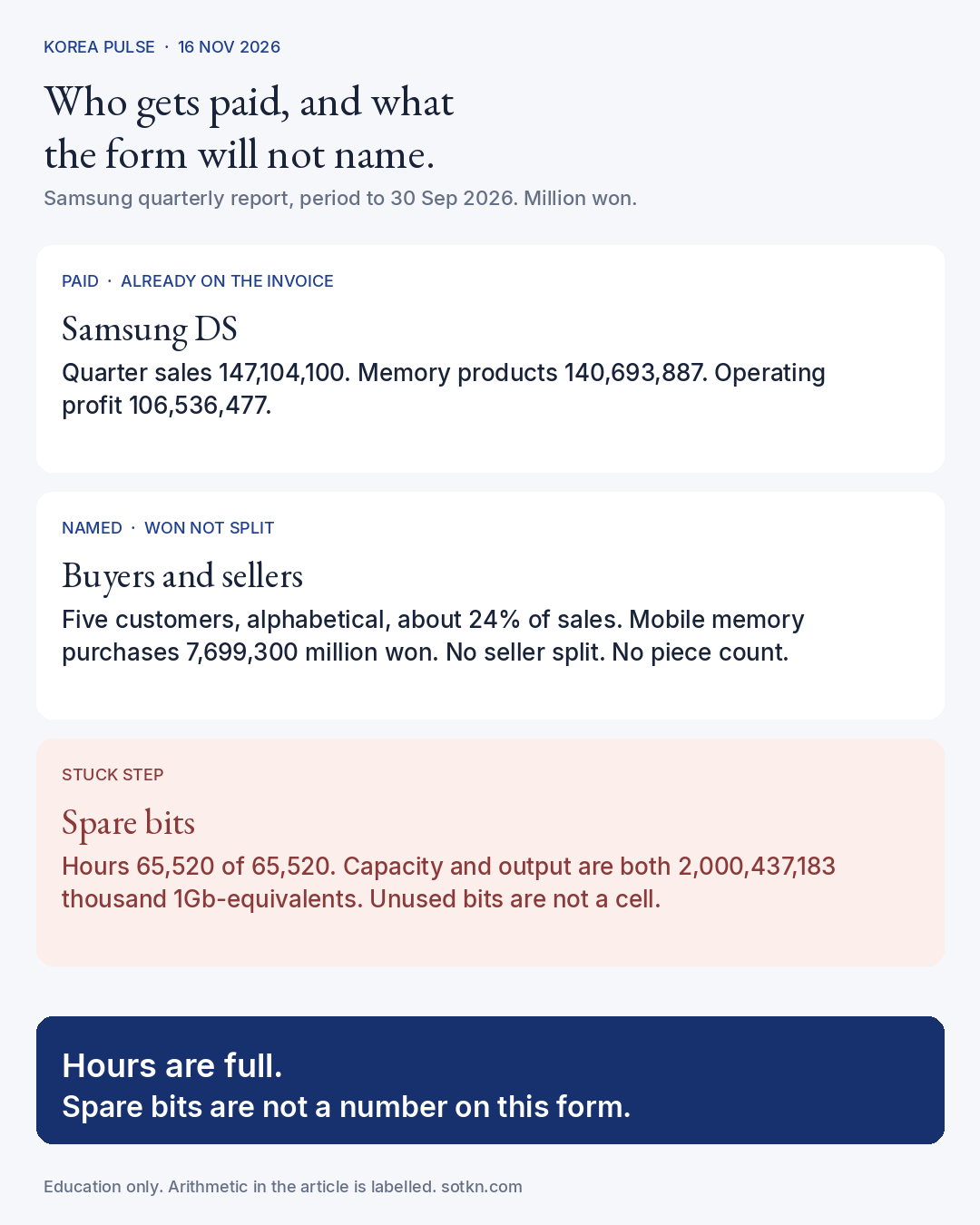
First, Samsung, on sales already recognized. The quarter’s memory products are 140,693,887 million won inside Device Solutions sales of 147,104,100. Operating profit on the division is 106,536,477. That cash is not a forecast. It is the invoice the statements have already taken.
Second, the sellers of mobile memory into the device business, on a purchase line that does not split them. The materials table prints mobile-memory purchases of 76,993 in units of 100 million won, 7,699,300 million won, and a printed share of 12.3 percent of that division’s material purchases. Our division of 76,993 by the printed subtotal of 624,307 is 12.333 percent, which rounds to 12.3. The named sellers are Micron, Kioxia and others. The report does not say how much of the 76,993 belongs to each name. It says the mobile-memory price is about 263 percent higher than the prior year’s annual average, and that the price series includes internal transactions. It does not print the number of pieces. A price change without a volume cannot be turned back into a unit count. We do not invent one.
Third, the buyers, as a list without won. The main customers named are Alphabet, Amazon, Apple, Hong Kong Techtronics, Supreme Electronics and others, alphabetical, and the top five were about 24 percent of sales. If 24 percent were exact on nine-month sales of 500,626,123 million won, our arithmetic is 120,150,270. The true amount is unnamed. Alphabetical order is not a ranking.
Contract liabilities were 24,147,546 million won at 30 September, against 13,978,566, a rise of 10,168,980 million won or 72.747 percent, our arithmetic. The note says they sit inside advances, accrued expenses and other liabilities. Advances alone are 2,744,666 million won. We do not subtract one from the other. The report does not call the stock a memory prepayment.
Inventory was 71,995,171 million won, up 36.777 percent from 52,636,828. Work in progress was 33,578,642, 46.640 percent of the total, our arithmetic. The four division rows sum to 73,017,616, which is 1,022,445 above the printed total. That gap is unnamed. Work in progress is not a spare-bit figure.
Is the spare-bit line still stuck?
Yes. This report still has no number for bits the lines did not package.
Available hours equal actual hours, so the rate in the capacity formula is 100.0 percent and the capacity cell copies output. Subtracting them is zero. Zero means the formula has nowhere to put slack. It does not mean a count of unused 1Gb-equivalents came out at none. Phones at 83.5 percent, TVs at 81.1 percent and cockpits at 65.7 percent show what a real gap looks like on the same page.
Construction in progress, 69,865,300 million won, is unfinished plant. The report does not convert it into 1Gb-equivalents. The implied line count of 10 is not printed, and the report does not say what a line is. Samsung is paid on packaged, invoiced output. The spare-bit line stays blank.
What dates matter
16 November 2026 is the filing date of this report. The balance-sheet date is 30 September 2026. Both are already in the past.
The next date the report names is the physical inventory count, at the end of May and the end of November. End of November 2026 is the coming count. The report does not say that count will publish a spare-bit number. It says semiconductor and display line inventory is sampled.
The report does not print the next results date or a dividend record date. We do not borrow one from the 29 October call. Cash dividends paid in the nine months were 8,678,680 million won, and treasury-share purchases were 25,778,665 million won. Those are cash-flow totals, not the next cheque.
How is this different from the 29 October clean-room pulse?
The 29 October pulse used the results release and the call. Its stuck step was the clean room. That note stands as a reading of the call. This note does not restate it and does not import its timings.
This print is the statutory report filed on 16 November. It prints an hour clock at 100.0 percent and a capacity cell copied from packaged output. A full hour clock and a full clean room are different claims. One is on this form. The other was on the call.
It is also a different Korea story from SK hynix’s third-quarter pulse and from Hanmi’s exchange line. Those filings name different companies and different blank cells. We do not add Samsung’s hour clock to either of them.
What would change this view?
- A later Samsung report prints memory utilization as output against a capacity larger than output, and names the gap in 1Gb-equivalents.
- The hour table prints actual hours below available hours, and the capacity cell stops matching output.
- The facilities-investment table, the property additions and the cash paid for equipment are reconciled to one figure, with the 972,600 million won and the 236,527 million won named.
- The top five customers are given won amounts, so “about 24 percent” is no longer the only figure.
- Mobile-memory purchases are split by seller and by pieces, so the 263 percent price line can be checked against a volume.
- The 15,013 million won and the 51,873 million won of unnamed divisional operating profit are given a line.
Until one of those is printed, the spare-bit line stays blank, and the 100.0 percent remains a statement about hours.
Practical takeaways
- Device Solutions is paid on 147,104,100 million won of quarterly sales, including 140,693,887 of memory products.
- Hours are 100.0 percent, 65,520 of 65,520, so capacity copies output at 2,000,437,183 thousand 1Gb-equivalents.
- The implied line count is 10, and the report does not say what the 10 are.
- The spare-bit line is the stuck step. The 972,600 and 236,527 million won build gaps stay unnamed.
FAQ
What utilization rate does Samsung’s 16 November 2026 quarterly report print for memory?
It prints 100.0 percent. Available hours and actual hours are both 65,520 across the 273 days from 1 January to 30 September 2026. That rate is hours open, not unused bits.
Why does 100 percent utilization not show spare bits?
Because capacity is defined as packaged output divided by the utilization rate. At 100.0 percent both cells are 2,000,437,183 thousand 1Gb-equivalents. The form has no cell left for bits that were not packaged.
Who gets paid on this print?
Samsung’s Device Solutions division, on 147,104,100 million won of quarterly sales already recognized, including 140,693,887 million won of memory products. Named customers and mobile-memory sellers are listed without a won split.
How is this different from Samsung’s 29 October 2026 results?
The 29 October pulse read the results call, where the stuck step was new clean-room space. This note reads the quarterly report filed on 16 November, which prints a full hour clock and a capacity figure copied from output. The spare-bit line is the stuck step on this form. The report does not restate the call’s fab timings.
Is this investment advice?
No. It is education only. It maps who gets paid and which step is stuck. It is not a recommendation to buy or sell any security, and it leaves out share prices, broker ratings and price targets on purpose.
Keep reading on the map
- Korea Markets — the country page
- Samsung’s 29 October clean-room pulse · SK hynix third quarter · Hanmi’s exchange line
- Taiwan · US · China — the other Markets pages
- Semiconductors on the stack · Hyperscalers · Capex versus depreciation
- Where does the stuck step move? · The Wire · How we check facts
How we check this. Hours, capacity, output, sales, profit, the property rollforward, cash flow, inventory and the customer and materials lines come from Samsung Electronics’ quarterly report for 1 January to 30 September 2026, submitted on 16 November 2026. Sums we worked out are labelled our arithmetic. The 29 October note is linked, not re-quoted as a figure here. Our editorial standards.
Not investment advice. Do your own research.
References
- Samsung Electronics, Quarterly Report for the 58th fiscal year, third quarter (1 January 2026 to 30 September 2026), submitted 16 November 2026. Samsung IR PDF — the income statement, the production and hour tables, the property rollforward, the facilities-investment table, the cash-flow statement, inventory, contract liabilities, and the customer and materials lines.