102.9% Full: Who Gets Paid While Hua Hong's Specialty Slots Stay Tight
Hua Hong was paid $987.1 million with the fabs at 102.9%. The specialty wafer slot is still the stuck step.
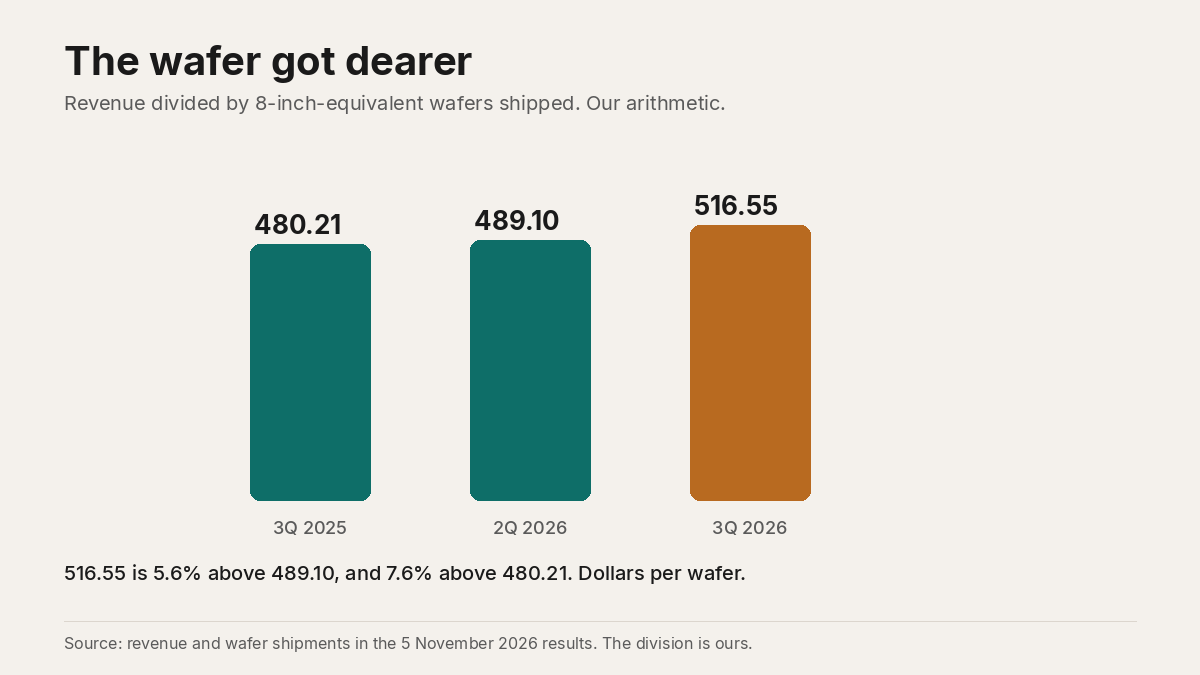
Hua Hong Grace was paid on the wafers that left a full specialty fab. Third-quarter revenue was $987.1 million, and on our arithmetic the price of an 8-inch-equivalent wafer rose to $516.55. The stuck step is the specialty slot. Utilization was 102.9%. Month-end capacity rose, and the company still describes tight supply in MCU, flash, power management and power discrete.
CHINA PULSE · Data as at 6 Nov 2026 · Next update: when the fourth-quarter guide is a closed print
Affects: Semiconductors — Markets: China · Taiwan · Korea
In short: On 5 November Hua Hong Grace published the quarter ended 30 September. Revenue was $987.1 million, utilization 102.9%, and shipments 1.911 million 8-inch-equivalent wafers. The ex-Huali column beat the prior guide. The fourth-quarter guide is $1,080 million to $1,090 million, with no capacity figure beside it. The foundry was paid. The specialty slot is still tight.
Education only, not advice to buy or sell any security. Figures are from Hua Hong Grace's third-quarter results published 5 November 2026. Lines marked our arithmetic are worked on this page. The statements in the release are unaudited. Comparative quarters are restated for the Huali Micro combination.
The numbers that matter this month
The trigger is the 5 November results for the quarter ended 30 September 2026. Huali Micro closed in the quarter and was treated as a combination under common control, so the prior two quarters in this release are restated. The guide was written against the column that excludes Huali, not against the consolidated $987.1 million.
| Line | Figure | What it is |
|---|---|---|
| Quarter ended | 30 September 2026 | The books this release reports |
| Revenue | $987.1 million | +19.9% vs restated 3Q 2025. +9.9% vs restated 2Q 2026 |
| Revenue excluding Huali | $803.4 million | Guide was $770–780 million |
| Gross margin | 24.6% | +7.6 points year on year. +4.7 points quarter on quarter |
| Gross margin excluding Huali | 19.9% | Guide was 16–18% |
| Profit attributable to owners | $123.4 million | +147.1% year on year. +77.7% quarter on quarter |
| Wafers shipped | 1.911 million | 8-inch equivalent. +11.5% year on year. +4.0% quarter on quarter |
| Month-end capacity | 636,000 | 8-inch equivalent, 30-day basis. Was 593,000, then 543,000 |
| Utilization | 102.9% | Was 104.1% in 2Q. Was 108.7% a year earlier |
| 12-inch revenue | $697.9 million | 70.7% of revenue. +23.7% year on year |
| Capital expenditure | $601.0 million | $571.8 million of it is 12-inch |
| Operating cash flow | $377.3 million | +35.2% year on year. −10.1% quarter on quarter |
| Capital from non-controlling interests | $1,167.6 million | Inside financing inflow of $1,114.6 million |
| Fourth-quarter revenue guide | $1,080–1,090 million | Gross margin guide 25–26%. No capacity figure |
Source: Hua Hong Grace third-quarter results, 5 November 2026, including the revenue, capacity, cash and capital-expenditure tables. Dollar figures in the release are unaudited. The 30-day capacity note is the company's footnote.
Why does China matter now?
Because the specialty foundry that serves a large share of China's MCU, flash, power and analog demand just printed a quarter in which the fabs were more than full, and said some of those lines are still tight.
Hua Hong Grace runs three 8-inch fabs and one 12-inch fab in Shanghai, and two 12-inch specialty fabs in Wuxi, with construction underway on a further Wuxi 12-inch line it calls Wuxi III. It sells wafers, not finished phones. In this quarter 97.3% of revenue was wafers. China, including the mainland and Hong Kong, was $760.8 million, 77.1% of revenue. The buyers on the other side of that invoice are the chip designers who cannot ship an MCU, a flash part, a MOSFET or a power-management chip until a wafer slot exists.
That is a different stuck step from Taiwan's CoWoS gate, from Korea's high-bandwidth memory, and from CXMT's memory samples. Computing here is $14.0 million, 1.4% of revenue. A full specialty fab pays the foundry for MCU, flash and power. It does not clear an accelerator waiting on a different process.
The Naura pulse was waiting on this print. Naura's own sales had slowed because parts for the tools were short, while foundry customers were already paying. This release is the foundry side of that wait. It does not name a tool vendor. It does print a fab that is still above 100%, and $601.0 million of capital spending, almost all of it 12-inch.
What changed
The ex-Huali column beat the guide, and the consolidated column is the one that includes the combination.
Revenue of $987.1 million compares with a restated $823.1 million a year earlier and a restated $898.5 million in the second quarter. The president, Dr Peng Bai, says utilization stayed high, shipments and prices trended up, and capacity projects are on schedule. He says demand is higher for MCU, flash, power management and power discrete, with tight supply in some segments even as capacity expands, and that rising volume and prices are expected to continue for some time.
The guide that was beaten is not the consolidated number. Excluding Huali, revenue was $803.4 million, against a range of $770 million to $780 million. Gross margin on that column was 19.9%, against a range of 16% to 18%. The consolidated gross margin is 24.6%. Both can be true. One is the business the old guide described. The other is the business after the combination.
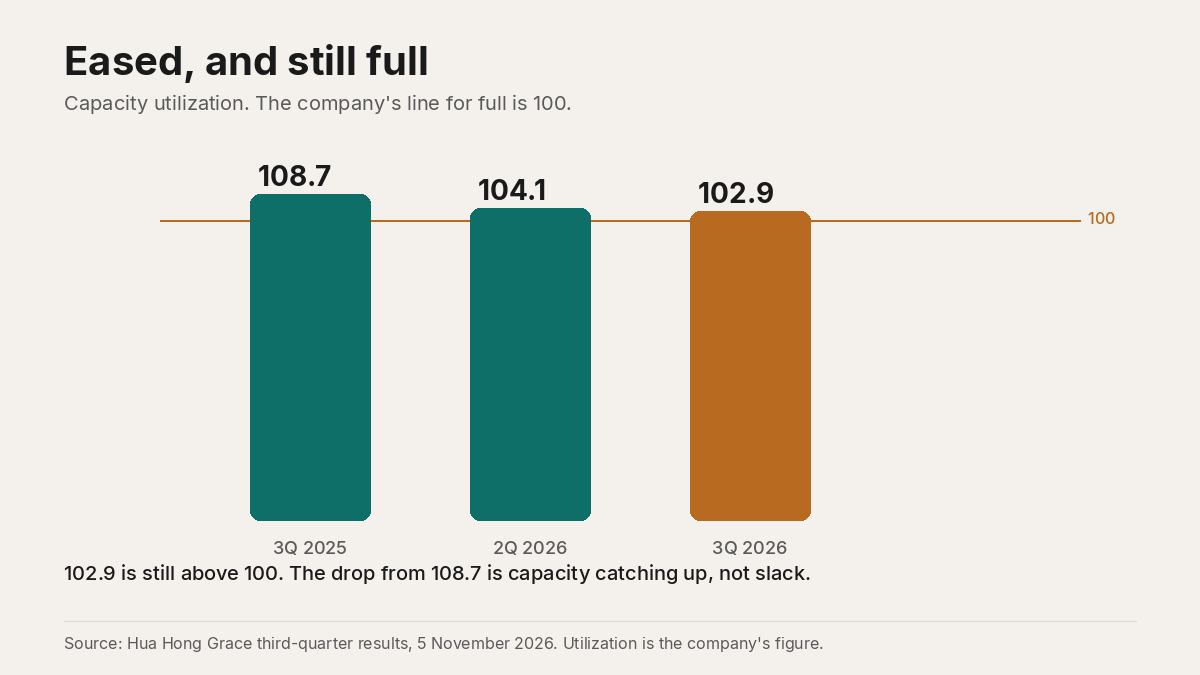
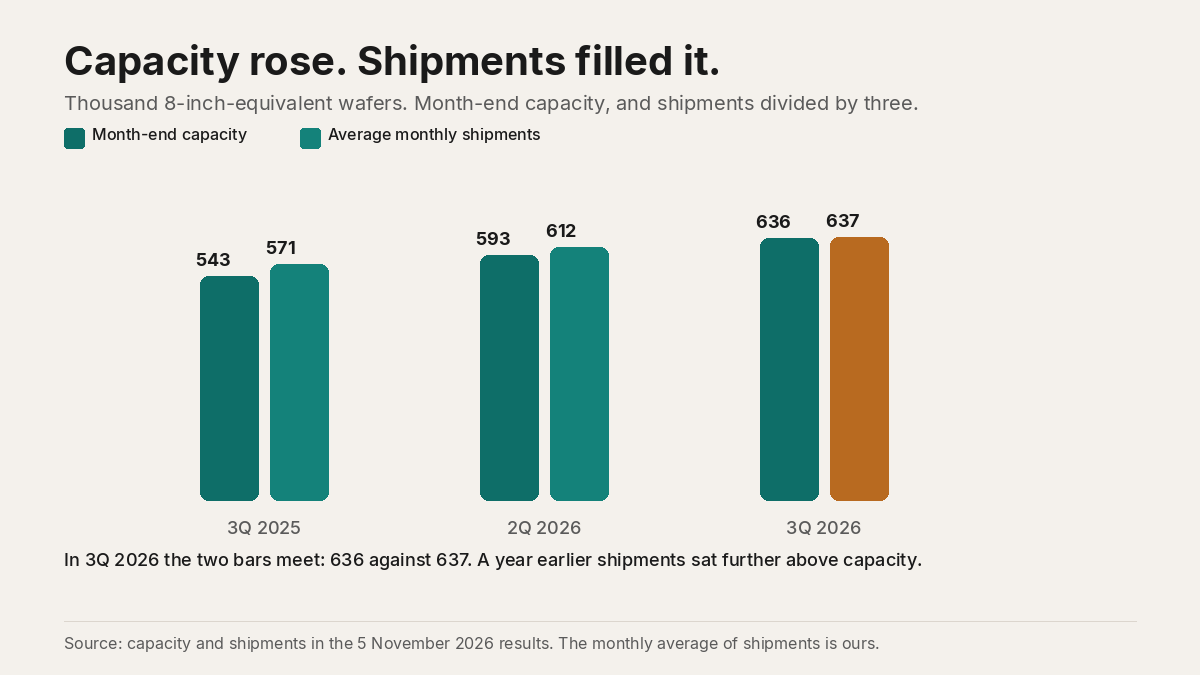
Shipments were 1.911 million 8-inch-equivalent wafers, from 1.837 million and, a year earlier, 1.714 million. Month-end capacity was 636,000 wafers on a 30-day basis, from 593,000 and 543,000. Utilization was 102.9%, from 104.1% and 108.7%. Capacity grew faster than shipments. Utilization eased. It did not fall through 100%.
The mix moved toward 12-inch without leaving 8-inch behind. Twelve-inch revenue was $697.9 million, 70.7% of the total, up 23.7%. Eight-inch revenue was $289.2 million, up 11.8%. Of $601.0 million of capital expenditure, $571.8 million was 12-inch and $29.2 million was 8-inch.
Embedded non-volatile memory was the fastest platform, $252.5 million, up 42.5%, on MCU and smart-card chips. Flash was $147.6 million, up 28.2%. Power discrete was $202.0 million, up 19.5%. Analog and power management was $199.9 million, up 13.5%. Logic and RF was flat, down 0.3%. Consumer electronics was $688.2 million, 69.7% of revenue. Communications fell 28.4% on image sensors. Computing was $14.0 million, 1.4%. China was $760.8 million, 77.1%, and it was not the fastest-growing region: North America rose 75.1% and Europe 104.3%.
Operating cash was $377.3 million. Investing cash used $550.0 million, including $601.0 million in fixed assets. Financing brought in $1,114.6 million, including a $1,167.6 million capital contribution from non-controlling interests. Cash rose $986.0 million. Other payables rose by $377.1 million, mainly, the company says, capital-expenditure payables. Trade payables fell by $72.2 million.
Our math
These lines are our arithmetic. A total that matches a printed total is the company's. A price per wafer, a bridge, and a ratio of one printed line to another are ours.
The five platform lines add to $987.133 million. So do geography, end market and node. Nothing in those additions is an unnamed accelerator.
Price per wafer is revenue divided by wafers shipped. $987.133 million over 1.911 million wafers is $516.55. The restated prior quarter is $489.10. A year earlier it is $480.21. The latest price is 5.6% higher than the prior quarter and 7.6% higher than a year earlier. Shipments rose 4.03% quarter on quarter. Price and volume together are 9.87%, which is the revenue change. Year on year they are 19.93%, and the release prints 19.9%. The company says gross margin rose primarily on price, partly offset by depreciation. It does not split those two. We do not invent the split.
Gross profit rose $63.416 million quarter on quarter. Volume at the old margin is $17.684 million of that. The higher margin on the new revenue is $45.732 million. Year on year, gross profit rose $102.330 million: $27.967 million from volume at the old margin, and $74.363 million from the margin rate. We do not assign that $74.4 million to price alone.
The gap between the consolidated column and the ex-Huali column is the acquisition's effect in this presentation, not a separate Huali income statement. Revenue gap $183.732 million, gross-profit gap $82.679 million, a 45.0% margin on the gap. The ex-Huali revenue of $803.401 million beat a guide whose top was $780 million by $23.401 million, 3.0%. The ex-Huali margin of 19.9% beat a guide of 16% to 18%.
Utilization of 102.9% is the company's: average monthly output over estimated monthly capacity. Our check is different. Three times month-end capacity of 636,000 is 1.908 million wafers. Shipments of 1.911 million are 100.2% of that. We do not replace 102.9% with 100.2%. Both are at or above full. Average monthly shipments were 637,000 against month-end capacity of 636,000. A year earlier they were 571,000 against 543,000. The gap closed. Closed is not spare.
Of the $164.055 million revenue increase, 12-inch wafers were 81.5% and embedded non-volatile memory was 45.9%. Consumer electronics was 87.7% of the net increase, lifted by the communications decline. China was 59.0% of the increase against 77.1% of revenue.
The fourth-quarter guide is $1,080 million to $1,090 million, and the midpoint is 9.9% above this quarter. If the wafer price stayed at $516.55, the midpoint would need 2.100 million wafers, about 189,000 more than this quarter, and the range would need about 180,000 to 199,000 more. That division is ours, and it holds only if the price does not move. The release says volume and prices are both expected to keep rising, and it prints no fourth-quarter capacity. Month-end capacity rose by 43,000 wafers a month last quarter. That is a different measure from extra wafers across a quarter. We do not turn 43,000 into a verdict on the guide.
Capital expenditure of $601.033 million minus operating cash of $377.277 million is a $223.756 million gap. Twelve-inch spending is 95.1% of the capital expenditure. Other payables rose $377.075 million, mainly, the company says, for capital expenditure. We do not claim every dollar of that rise is an unpaid tool. The $1,167.6 million from non-controlling interests is larger than the quarter's capital expenditure. Operating cash did not fund the tools.
Subsidies were $11.939 million, 9.7% of attributable profit of $123.435 million. Finance costs were $29.500 million, 23.9% of that profit. The margin move is not a grant. Inventories rose 3.7%, and inventory days were 88 against 87. Receivable days fell from 41 to 34. The fab is not filling a warehouse, and customers are paying sooner.
This is not a price call.
Where does the money stick?
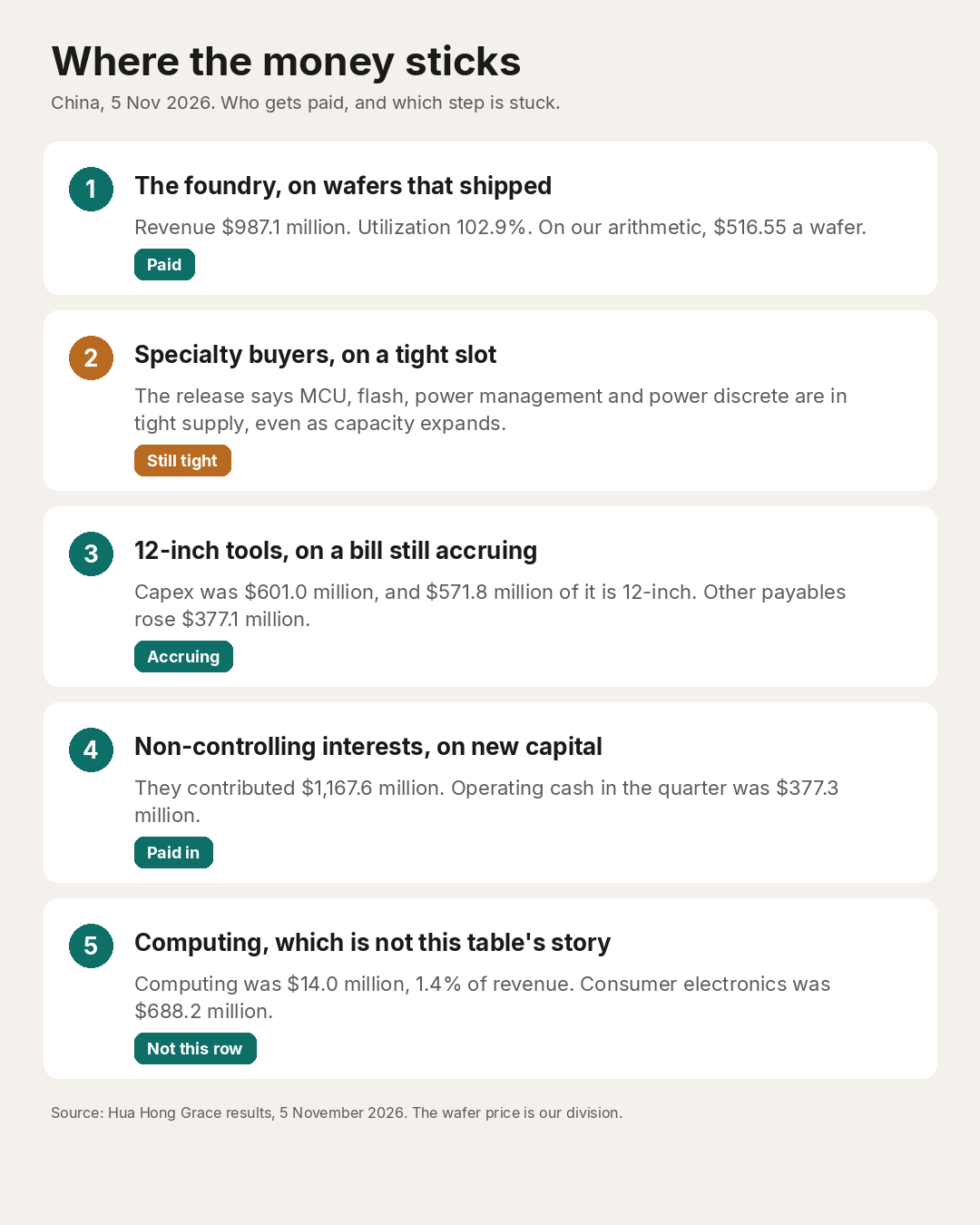
Five seats. The foundry was paid. The specialty buyer is stuck. The tool bill is accruing. A minority owner wrote the capital cheque. Computing is barely in the table.
- The foundry, on wafers that shipped. $987.1 million, 24.6% gross margin, 102.9% utilization, and on our arithmetic $516.55 a wafer. This is who gets paid for the slot.
- Specialty buyers. The stuck step. The release says MCU, flash, power management and power discrete are in tight supply even as capacity expands. It names no customer and no backlog multiple. Image sensors moved the other way.
- Twelve-inch tool vendors. Capital expenditure $601.0 million, of which $571.8 million is 12-inch. Other payables rose $377.1 million, mainly for that bill. The release names no vendor.
- Non-controlling interests. They contributed $1,167.6 million, more than operating cash and more than capital expenditure. The fab's own quarter did not fund the build.
- Computing. $14.0 million. The Cambricon pulse is a designer waiting on a different wafer. Flash here is $147.6 million, not high-bandwidth memory.
The money sticks at the specialty slot, and it is being spent ahead at the 12-inch tool. The image-sensor buyer is the seat that loosened.
Is the specialty slot still stuck?
Yes. Utilization is 102.9% after month-end capacity rose from 593,000 to 636,000 wafers. The company says supply is tight in some segments even as that capacity expands, and that rising volume and prices are expected to continue for some time. A step is unstuck when utilization falls through 100% and the price stops doing the work. Neither of those is in this release.
Capacity over the year rose 17.1% and shipments rose 11.5%, which is why the rate eased, into a book that was already above full. Logic and RF was flat, and communications fell 28.4% on image sensors. That is mix. Embedded non-volatile memory rose 42.5%, and the company names MCU, flash, power management and power discrete as the tight lines. Wuxi III is under construction with no capacity and no date. The fourth-quarter guide asks for about 10% more revenue and a margin of 25% to 26%. It does not print utilization. If the extra revenue arrives with the price still rising, the slot is still the scarce object.
What dates matter
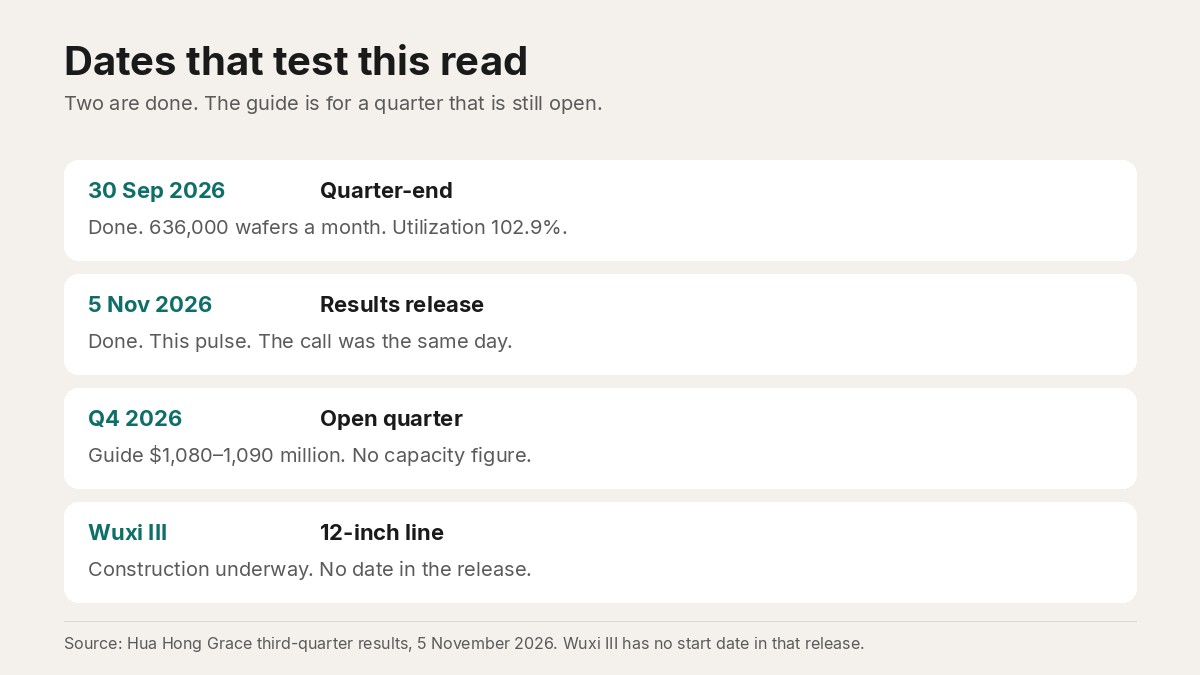
Four markers. Two have already happened. The one that tests the stuck step does not have a capacity figure attached.
| When | What | What would count |
|---|---|---|
| 30 Sep 2026 | Quarter-end. Huali combination closed. | Done. Capacity 636,000. Utilization 102.9%. |
| 5 Nov 2026 | Results published. A call was held the same day. | Done. This pulse uses the release, not a secondhand call summary. |
| Fourth quarter 2026 | Guide: revenue $1,080–1,090 million, gross margin 25–26%. | The test. A closed print of utilization, shipments and price. The guide has no capacity line. |
| Wuxi III | 12-inch line under construction. | No date in the release. A construction sentence is not a wafer. |
SMIC's third quarter is the next large foundry print on this map. This release does not set that date. It is a different process, not a second copy of this table.
How is this different from the Naura tool wait?
The 31 October Naura pulse was a tool maker whose deliveries had slowed while customers paid ahead. This print is a fab those tools are meant to fill. Revenue rose 9.9%, utilization stayed above 100%, and the company says the projects are on schedule. This release does not name Naura, and it does not say the capacity step arrived late.
It is not the SMIC utilization pulse, which is a different book of processes. Hua Hong describes itself as specialty: non-volatile memory, analog and power, logic and RF, and power discrete. Nodes at 65 nanometres and below are 44.4% of revenue. That is not leading-edge logic, and it is not CoWoS. Computing is $14.0 million. The president's sentence on artificial intelligence does not create an accelerator row. The dollars that grew are MCU, flash, MOSFET and PMIC.
What would change this view?
Who gets paid today is Hua Hong, on wafers that shipped from a fab above full, at a higher price on our arithmetic. The stuck step is the specialty slot. It moves if any of these print.
- A closed quarter prints utilization at or below 100%. Easing from 108.7% to 102.9% does not do it.
- The price per wafer, revenue divided by shipments, stops rising.
- Fourth-quarter revenue lands in the guide while utilization falls. The guide alone cannot show that.
- The tight-supply sentence is dropped, or it moves onto image sensors, the line that shrank.
- Wuxi III is given a capacity and a date that show up in the month-end figure. Construction underway does not change 636,000.
- The audit moves these unaudited lines enough to change $516.55 or the platform addition.
Practical takeaways
- The foundry was paid: $987.1 million of revenue, 24.6% gross margin, 102.9% utilization. On our arithmetic the wafer was $516.55, up 5.6% in the quarter and 7.6% on the year.
- The guide that was beaten is the ex-Huali column, $803.4 million against $770–780 million, and 19.9% against 16–18%. The consolidated $987.1 million is a different column. The gap between them carries a 45.0% margin on our arithmetic.
- Twelve-inch wafers were 81.5% of the year's dollar increase in revenue, and 95.1% of the capital expenditure. The tool bill is accruing. A $1,167.6 million capital contribution, not operating cash, covered it.
- Computing is $14.0 million, 1.4% of revenue. The stuck step is MCU, flash, power management and power discrete. Image sensors got easier. The next test is a closed fourth quarter with a utilization line, which the guide does not include.
FAQ
Who gets paid on Hua Hong's 5 November print?
Hua Hong Grace, on wafers shipped in the quarter ended 30 September. Revenue was $987.1 million. On our arithmetic the wafer price was $516.55, up from $489.10. Buyers in the tight segments are waiting.
What was the utilization, and did capacity create slack?
Utilization was 102.9%, from 104.1% and, a year earlier, 108.7%. Month-end capacity rose from 593,000 to 636,000 wafers. The rate eased. It stayed above full.
Did the quarter beat the guide the company had set?
Excluding Huali, revenue was $803.4 million, above $770–780 million, and gross margin was 19.9%, above 16–18%. The consolidated $987.1 million is not the column that guide was written against.
Is this an artificial-intelligence foundry print?
The president says artificial-intelligence demand is running. Computing was $14.0 million, 1.4% of revenue. Consumer electronics was 69.7%. The dollars that grew are MCU, flash, MOSFET and PMIC.
Is the specialty slot still stuck?
Yes. Utilization is still above 100% after capacity rose. The company says some segments stay tight and that volume and prices should keep rising. No quarter in this release shows utilization through 100%.
What date matters next?
The open fourth quarter, guided at $1,080–1,090 million of revenue and a 25–26% gross margin. The release prints no fourth-quarter capacity, and no date for Wuxi III. The test is a closed utilization line.
Keep reading on the map
- Markets: China: Naura, tools waiting on parts · China: SMIC utilization · China: Cambricon's inventory · China
- Explained: HBM, explained — a different stuck step, in Korea, not this wafer
- The Stack: Semiconductors
Get the Wire. A free brief every day, here and in your inbox. Subscribe free
How we check this
Revenue, margins, shipments, capacity, utilization, the platform and geography tables, capital expenditure, cash flow and the fourth-quarter guide are from the Hua Hong Grace third-quarter results published 5 November 2026. The price per wafer, the gross-profit bridge, the column gap and the ratios of one printed line to another are marked our arithmetic. The release is unaudited, and the comparative quarters are restated for the Huali combination. We do not use a call summary for any figure.
Last reviewed: 6 Nov 2026 · Next review: when the fourth quarter closes with a utilization line