What Does Huawei Do? The Cloud Bill That Stays Inside
Huawei booked CNY32,161 million of cloud revenue from outside customers in 2025, 3.5% less than a year earlier, while cloud activity including sales to its other businesses was CNY72,075 million.
STACK · Hyperscalers · Status: Holding · Last reviewed: 11 Nov 2026
Huawei booked CNY32,161 million of cloud revenue from outside customers in 2025, 3.5% less than a year earlier, while cloud activity including sales to its other businesses was CNY72,075 million.
In short. Huawei sells equipment, phones, power gear, car parts and a cloud. The cloud line in the audited segment table is only what outside customers paid. In 2025 that was CNY32,161 million, down from CNY33,325 million. The same report says cloud revenue including other Huawei segments was CNY72,075 million. Our arithmetic: CNY39,914 million of cloud activity never left the group. The stuck step is the ledger. The chairman says computing grew quickly. The table does not show a computing line, and it does not show a cloud profit.
Why this sits on the hyperscaler layer: a hyperscaler is large enough that its bills set demand for chips, halls and power. Huawei is that kind of buyer and seller in China, with its own Ascend machines and its own cloud. For the shape of the layer, start with what a hyperscaler is. This page is about which Huawei invoice is the cloud, who is paid, and which number is missing.
Numbers that matter
| Number | What it is | Why it matters |
|---|---|---|
| CNY32,161m | Cloud computing revenue, 2025, sales to outside customers | Down 3.5% from CNY33,325m. This is the cloud line in the segment table |
| CNY72,075m | Cloud revenue in 2025 including other Huawei segments | The note under the table. Our arithmetic: CNY39,914m stayed inside the group |
| CNY375,014m | ICT infrastructure revenue, 2025 | Up 2.6%. Computing equipment sits in this line. Huawei does not split it out |
| CNY192,310m | Research and development expense, 2025 | 21.8% of revenue. This is where the chip and software work is paid for |
| CNY935,630m | Cash paid to suppliers and employees, 2025 | The cheque that leaves. Outside cloud is 3.4% of it, our arithmetic |
| CNY361,426m | Cash and short-term investments, 31 Dec 2025 | Down 2.9% from CNY372,232m. Money is not what binds |
Company figures are the audited 2025 annual report, released 31 March 2026. The 2024 column was restated. Sums, shares and the inside-cloud figure are our arithmetic.
What does it actually do?
Huawei sells five businesses the segment table names. ICT infrastructure, networks plus computing equipment, was CNY375,014 million, 42.6% of revenue, our arithmetic. Consumer devices were CNY344,473 million. Digital power was CNY77,312 million. Intelligent automotive solutions, parts for other carmakers, were CNY45,018 million. Cloud sold to outside customers was the smallest of the five, CNY32,161 million, 3.7% of the CNY880,941 million group, our arithmetic.
The cloud product is real, and the counts are not yuan. By the end of 2025 Huawei Cloud covered 34 regions and 101 availability zones, in more than 170 countries and regions. More than 1,800 customers were on its AI Cluster Service. The report also counts more than 10 million cloud developers and 59,000 partners. A 384-NPU SuperPoD had been deployed at scale in internet, finance, telecommunications and electric power, and Huawei delivered more than 600 computing-platform projects in 2025, one of them in 14 days. A machine handed over as equipment can be booked in ICT. The same machine, billed as cloud, can be booked on the cloud line. The report does not say which invoice the SuperPoDs used.
The words and the table point different ways. The rotating chair says the computing business kept seizing AI opportunities, and that Huawei Cloud honed its competitiveness around core services. Later the chair says computing grew rapidly. That phrase is not attached to the cloud line, and the cloud line fell. Automotive revenue was about 1.4 times the outside cloud line, and digital power about 2.4 times, our arithmetic. The growth the table will show you is cars and power.
How does it make money?
Outside customers pay the consolidated revenue: CNY880,941 million, up 2.2%, which the company also states as US$126,018 million at the 31 December 2025 rate of 6.9906. Cash collected for goods and services was CNY1,012,482 million. Suppliers and employees were paid CNY935,630 million. That is the first cheque. Research and development, CNY192,310 million, overlaps it: about 114,000 of approximately 213,000 employees worked in R&D, about 53.7% of the workforce, as the report states both figures.
Cloud has a second bill that does not survive into group revenue. The note says segment revenue is sales to external customers, then, for cloud only, that revenue including other segments was CNY72,075 million. Take the outside line off that total and CNY39,914 million remains, 55.4% of the cloud activity in the note, our arithmetic. At the year-end rate that outside line is about US$4.6 billion and the inside remainder about US$5.7 billion, our arithmetic. Sister businesses are the larger cloud customer. On consolidation those sales cancel, and there is no profit on them to read.
Group gross profit was CNY408,298 million, a 46.3% margin, up from 44.4%, while cost of sales fell. Operating profit was CNY96,937 million, an 11.0% margin. Net profit was CNY68,036 million, of which CNY67,104 million was for the equity holders. Those can rise while outside cloud falls, because the other lines dwarf it. Operating cash flow was CNY127,384 million, up 44.1%. Investing cash was CNY74,794 million. Borrowings, our sum of the short and long lines, were CNY239,284 million, down from CNY264,871 million. The year was funded from operations.
Contract liabilities were CNY116,816 million, up 19.9%: deferred warranty service, vouchers, and advances on ICT, consumer and cloud, in one balance. Cash billed for work not yet performed was CNY86,482 million, and CNY67,078 million of the opening balance became revenue. That is not a cloud prepay you can isolate. Remaining performance obligations were CNY116,757 million, mainly ICT, with 77% expected within a year.
What limits it?
The outside bill is 3.7% of revenue and it shrank. Treating Huawei as a cloud company means reading the wrong line. The inside bill is the second limit. More than half the cloud activity in the note is eliminated, and the note gives no 2024 figure for that same total, so you cannot tell whether the inside bill grew.
In 2025 the group also moved some products between segments and changed how one business charges another. It restated 2024 on the new basis. The 3.5% drop, CNY1,164 million on our arithmetic, is the drop after that restatement. It is not a comparison with the unadjusted cloud line in the previous annual report, and the filing does not say which products moved. Volume, price and the new rules are not separated.
Geography is a sentence without yuan. China revenue was CNY616,249 million, up 0.2%, and every segment there met its forecast, with no China cloud number. Cloud met its forecast in EMEA, grew in Asia Pacific, and grew rapidly in the Americas inside a regional total of only CNY37,184 million. A rise on a small base can sit inside a group decline. The report's rounded mix is about 70% China, 18% EMEA, 6% Asia Pacific and 4% Americas. That mix is not a cloud split.
The split itself is the year to 31 December 2025. A scanned half-year bond report was posted on China Money on 31 August 2026. We do not take a cloud line from the scan or from news rewrites of it. Until a segment table can be read, the last cloud yuan on this page is the 2025 outside line.
Who else does this?
Alibaba, Tencent and Baidu each put a cloud or AI-cloud figure in consolidated revenue, and on their pages that figure has been the growth line. Huawei puts only the outside piece there, and in 2025 it fell. Baidu is the closest shape, a cloud that also designs its own chip. Huawei adds a second ledger, ICT, where an Ascend system can be sold as equipment.
Google can use a TPU inside the same group without a sale to a stranger. Huawei's note is the rare place that inside bill is written down. China Mobile writes a different one. In the first half of 2026 its computing services were RMB52.9 billion, up 14.0%, defined as data centers, cloud services and cloud applications together. That half is about 1.6 times Huawei's full-year outside cloud, our arithmetic, and it is not the same product. Intelligent computing inside it was RMB5.3 billion, up 130.1%. Huawei prints no equivalent.
What would change this view?
- The outside bill turns up. A later report, with the same note, shows cloud sales to external customers above CNY32,161 million and says whether the inside CNY39,914 million shrank. Growth that is only internal would not change the view.
- ICT splits. Connectivity and computing get separate yuan. The chair's line that computing grew rapidly becomes a number, and a SuperPoD can be traced to a ledger.
- A cloud profit appears. Today the 46.3% gross margin and the 11.0% operating margin are group figures. A cloud margin would show whether the outside invoice, or the inside one, earns anything.
- The note vanishes. If the next annual report drops the including-segments sentence, the inside bill goes dark. That would make this view weaker, not stronger.
- A readable 2026 file. A half-year or full-year segment table we can read, rather than a scan, is the clock. The 2026 annual report is the one that should carry it.
Practical takeaways
Read the note under the cloud line before the line itself. CNY32,161 million is what strangers paid, down 3.5% on a restated comparison. CNY72,075 million includes Huawei selling cloud to itself. Cash is not the stuck step: suppliers and staff were paid CNY935,630 million, and cash and short-term investments were still CNY361,426 million. Computing growth is a sentence. Cloud profit is not a line.
A neocloud lives on the accelerator hour. A hyperscaler can let one line shrink because the others pay the wages. Huawei did that in 2025. The Ascend pool going into a China Telecom hall is a delivery. It still does not say whether Huawei was paid as a cloud or as a box. Not investment advice. Do your own research.
FAQ
What does Huawei do?
Huawei sells telecom and computing equipment, phones, digital power, car components and cloud services. In 2025, audited revenue was CNY880,941 million. The cloud line in the segment table, which is sales to outside customers, was CNY32,161 million.
How big is Huawei Cloud?
Outside customers accounted for CNY32,161 million of cloud revenue in 2025, down 3.5%, and 3.7% of group revenue on our arithmetic. Cloud revenue including other Huawei segments was CNY72,075 million. The CNY39,914 million difference is our arithmetic.
Why does most of the cloud bill stay inside?
Other Huawei businesses buy cloud from the cloud business. Those sales are removed when the group accounts are added together, so they are not part of the CNY880,941 million. On our arithmetic they are 55.4% of the cloud activity in the note.
Did Huawei's cloud grow in 2025?
The outside line fell. The company says cloud grew in Asia Pacific, grew rapidly in the Americas, and met its forecast in EMEA. It does not publish the yuan for those regions, and it restated 2024 after moving products between segments.
Where do Ascend systems show up in the accounts?
They do not have their own revenue line. Computing equipment sits inside ICT infrastructure, which was CNY375,014 million, up 2.6%. A system sold as a product and a system billed as cloud can land on different lines. The report does not say which one the SuperPoDs used.
Is this a recommendation to buy Huawei?
No. This page explains which invoice is the cloud and which number is missing. It gives no buy or sell calls. Not investment advice. Do your own research.
Keep reading on the map
Layer: Hyperscalers on The Stack. Mechanism: hyperscaler, explained. Markets door: China, including the Ascend 950DT pool. Wire: Microsoft trimming the neocloud bills it will keep paying, the opposite problem from a cloud bill that never leaves the group.
Get the Wire — a short daily note when a hyperscaler bill, a chip line or a hall changes.
Not investment advice. Do your own research.
How we check this
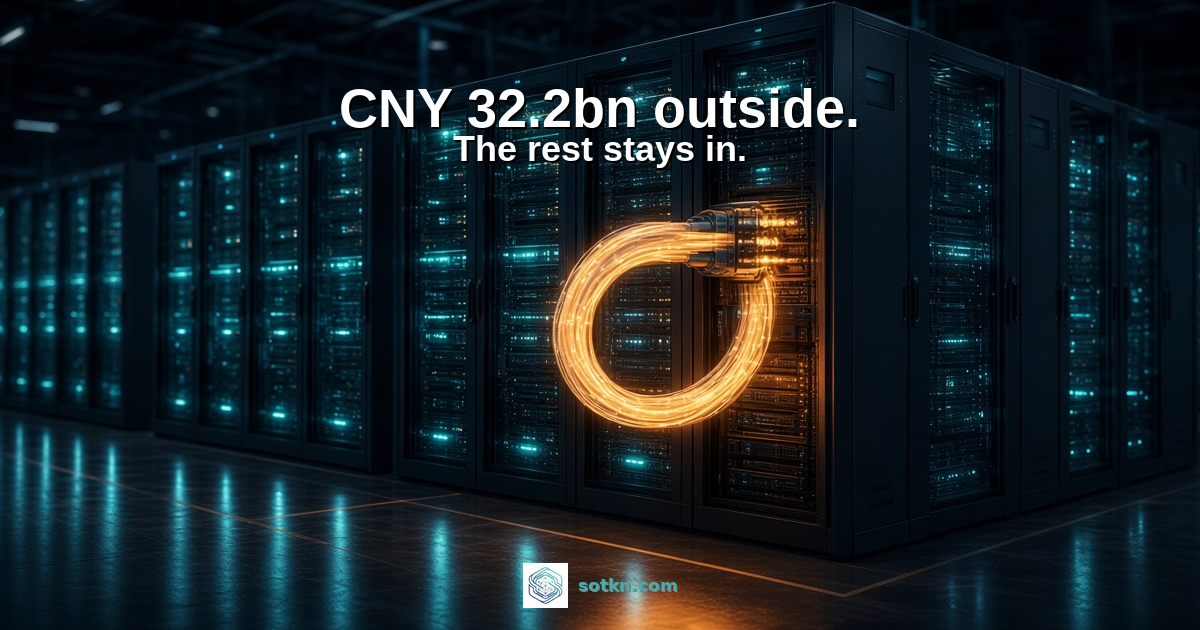
Figures are from Huawei's 2025 annual report. KPMG's opinion is dated 27 March 2026 and the report was released on 31 March 2026. We used the English PDF and checked the cloud note against the Chinese PDF. The China Mobile comparison is its 2026 interim report, filed in Hong Kong on 27 August 2026. Sums, shares, the inside-cloud figure and dollar conversions at the closing rate of 6.9906 are our arithmetic. China Money posted a scanned half-year bond report on 31 August 2026. We took no revenue and no cloud line from that scan, and none from news rewrites of it. The featured image is a concept render of a hall and a fiber loop, not a Huawei site. No buy or sell calls. Not investment advice. Do your own research.
Last reviewed: 11 Nov 2026 · Next review: when Huawei's 2026 annual report prints a cloud segment line, and sooner if a readable segment table appears before then
Spot an error? Tell us and we will correct it and note the change here.
Sources
- Huawei — 2025 Annual Report, English PDF (released 31 March 2026; KPMG opinion 27 March 2026) — segment table; cloud note of CNY72,075 million including other segments; restatement of comparatives; regions; cash flow; contract liabilities; R&D; employees; cloud regions, AICS customers, SuperPoD deliveries
- Huawei — 2025 annual report, Chinese PDF (same release) — the segment footnote that the cloud figure including cross-segment transactions is CNY72,075 million
- Huawei — Releases 2025 Annual Report (31 March 2026) — release date; revenue CNY880.9 billion; net profit CNY68 billion; R&D CNY192.3 billion; KPMG audit; closing rate US$1 = CNY6.9906
- Huawei — 2025 annual report page (read 11 Nov 2026) — the same segment table and the including-segments note, as published on the company site
- China Mobile — 2026 Interim Report (27 August 2026) — computing services RMB52.9 billion, up 14.0%, defined as data centers, cloud services and cloud applications; intelligent computing services RMB5.3 billion, up 130.1%
- China Money — Huawei Investment & Holding 2026 half-year report page (posted 31 August 2026) — a scanned filing. Used only to record that we did not take segment figures from it
S
Writes Second Order by TKN — a plain-English map of AI infrastructure and semiconductors for non-specialist investors. Focus: who gets paid, where money sticks, and which step is stuck.
Covers AI infrastructure, semiconductors, and second-order stack reads.