What Does Baidu Do? The Own-Chip Cloud Model
Baidu rents AI computing built partly on its own Kunlun chips, sells model tokens, and still runs China's biggest search engine. Its quarterly capex tripled in a year; chip supply, not demand, is the step that binds.
STACK · Hyperscalers · Status: Tightening · Last reviewed: 8 Nov 2026
Baidu runs China's largest search engine, but the part of the company that now sets its course is a cloud that rents AI computing. It buys GPU servers, designs its own AI chips through a subsidiary called Kunlunxin, and sells computing power and AI models to Chinese companies by the month and by the token.
In short. Baidu, China's biggest search company, now earns half its core revenue from AI. Its fastest-growing line is AI Cloud Infra, which rents AI computing to companies and sells model tokens, partly on chips designed by its own Kunlunxin unit. In April–June 2026 that line made RMB7.3 billion, and GPU Cloud revenue inside it grew 283% from a year earlier. Our read: Baidu pays server makers, chip suppliers, landlords and banks first, then earns it back by the month. The stuck step is chips. Baidu has RMB283 billion of cash and investments, but says computing supply is constrained and export controls limit what it can buy.
Why an investor cares: Baidu's quarterly capex tripled in a year and its free cash flow turned sharply negative, the hyperscaler pattern in miniature. For the basics of the group, start with who the hyperscalers are. This page is about how Baidu's version makes money, who it pays, and where it gets stuck.
Numbers that matter
| Number | What it is | Why it matters |
|---|---|---|
| RMB7.3bn | AI Cloud Infra revenue, April–June 2026 | Up 50% on a year earlier, but down 17% from RMB8.8bn in the first quarter |
| 283% | Year-on-year growth in GPU Cloud revenue, second quarter | The renting of AI computing is what is driving the cloud |
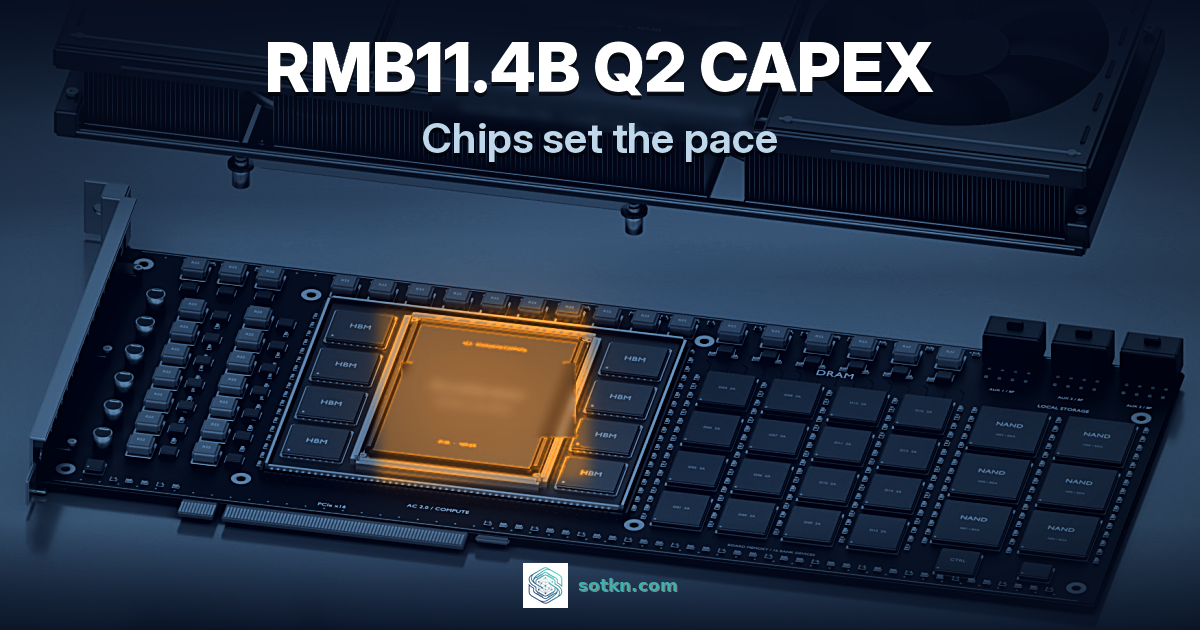
| RMB11.4bn | Capex in the second quarter of 2026 | Three times the RMB3.8bn of a year earlier; the first half already tops all of 2025, our arithmetic |
| −RMB8.0bn | Free cash flow in the second quarter | Operating cash flow of RMB3.4bn did not cover the spending |
| RMB49.1bn | Bank loans at 30 June 2026 | Up from RMB25.8bn six months earlier, our sum of short- and long-term loans |
| RMB283.1bn | Total cash and investments at 30 June | Money is not what binds; chips are |
Company figures are listed at the end of the page. Sums, ratios and comparisons are our arithmetic from Baidu's quarterly releases.
What does Baidu actually do in AI?
It sells AI at four levels at once. At the bottom is the chip. Kunlunxin, a Baidu subsidiary that outside investors also own, has developed and sold three generations of Kunlun AI chips over more than a decade. Its latest, the M100, is built for running models at scale, a job known as inference, and a larger M300 is planned for 2027. In November 2025 the head of Baidu AI Cloud, Shen Dou, said Kunlun's P800 chips already handled the vast majority of Baidu's own inference.
Above the chip is the cloud. Baidu AI Cloud rents out servers full of accelerators, Kunlun and others, which Baidu reports as GPU Cloud. It also runs Qianfan, a model-as-a-service platform where customers pay per token to call ERNIE, Baidu's own model family, or other leading Chinese models such as DeepSeek, Kimi, GLM and MiniMax. Our explainer on AI tokens versus GPU hours sets out why those are two different bills for the same chip.
Above the cloud are models and apps. ERNIE powers Baidu's AI search, the ERNIE Assistant, digital human hosts for e-commerce livestreams, the Miaoda app builder and the DuMate agent. Baidu Wenku and Baidu Drive sell AI features by subscription. At the far end sits Apollo Go, the robotaxi service, which runs in 28 cities and is a separate bet from the cloud.
Underneath sits the old business. Online marketing, mostly search ads, brought in RMB13.1 billion in the second quarter, down 19% from a year earlier as Baidu rebuilt search around AI answers and held back on selling ads against them.
How does Baidu make money from AI cloud?
Mostly by renting computing. Baidu reports three AI revenue lines, which together it calls its Core AI-powered Business. In April–June 2026 they made RMB12.5 billion, half of Baidu's general business revenue of RMB25.2 billion. AI Cloud Infra was the biggest, at RMB7.3 billion. AI Applications made RMB2.5 billion and AI-native marketing services RMB2.6 billion.
Inside AI Cloud Infra, the engine is GPU Cloud, which Baidu used to call subscription-based revenue from AI accelerator infrastructure. That name tells you the model: customers reserve accelerator capacity and pay for it on a recurring basis, much as they would rent from a neocloud. GPU Cloud revenue grew 143% year on year in the fourth quarter of 2025, 184% in the first quarter of 2026 and 283% in the second. Baidu does not disclose the GPU Cloud figure in yuan.
The customers are Chinese companies. In August management named online gaming, e-commerce and lifestyle content firms as key clients, with demand also from autonomous driving, smartphone makers and financial services. Revenue from robotics customers grew about six times year on year.
The token business is smaller but growing faster. Revenue from outside customers' token usage on Qianfan rose more than ninefold year on year in the second quarter, management said, though it remains a small share of AI Cloud Infra. Our guide to training versus inference explains why inference demand, the kind that bills per token, is the one Baidu is chasing with its chips.
Management says GPU cloud carries better margins than traditional CPU cloud, because high-quality supply is tight, and that AI Cloud Infra profit and margins rose year on year in the second quarter. Baidu does not publish a cloud margin, so that cannot be checked from the filings.
How fast is Baidu spending?
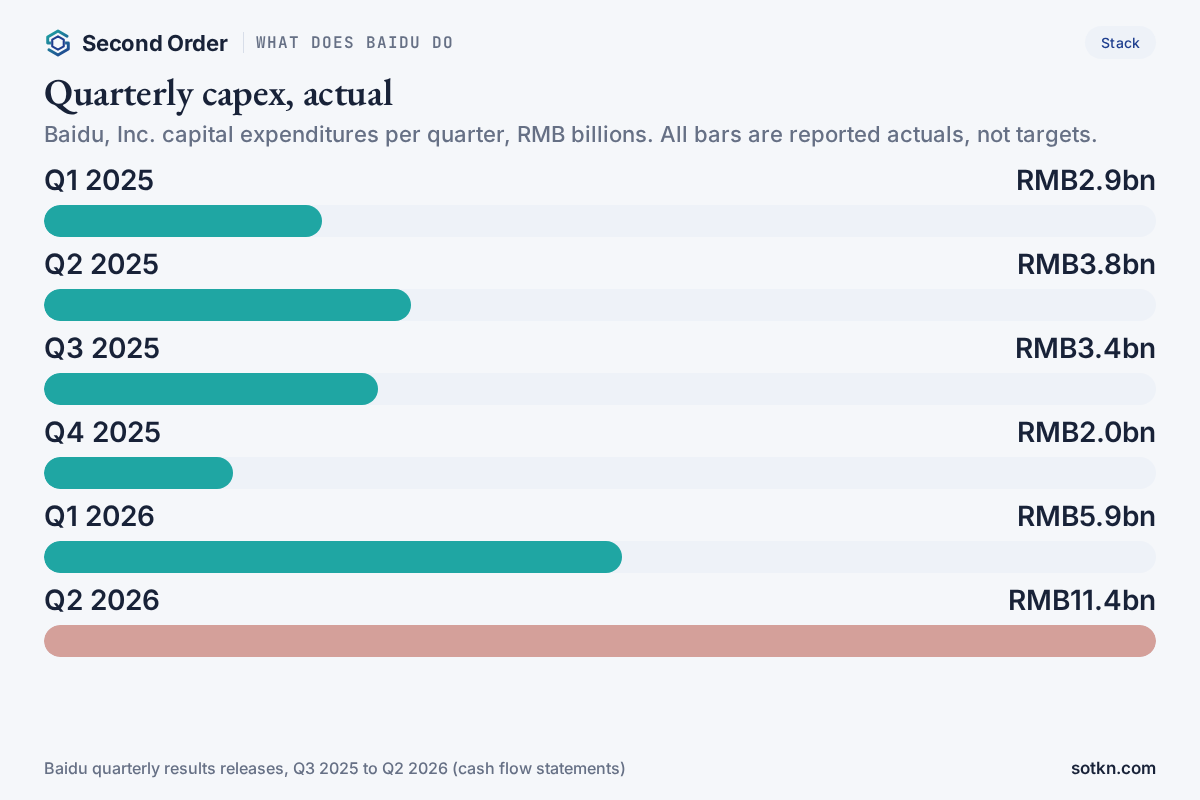
The chart shows the turn. For years Baidu spent modestly: RMB11.2 billion of capex in 2023, RMB8.1 billion in 2024 and RMB12.1 billion in 2025, mostly on servers, network equipment and other computer hardware, according to its annual report. Then spending jumped to RMB5.9 billion in the first quarter of 2026, double a year earlier, and nearly doubled again to RMB11.4 billion, about US$1.7 billion, in the second. The first half alone, RMB17.3 billion, is more than all of 2025, our arithmetic.
The revenue has not kept pace within the quarter. AI Cloud Infra fell from RMB8.8 billion in the first quarter to RMB7.3 billion in the second, while capex nearly doubled. Baidu did not explain the drop, and because it gives GPU Cloud only as a growth rate, we cannot tell which part of the line fell. The point for investors is timing: capex is cash out the door when servers are bought, while rental revenue arrives month by month once they are installed. Our explainer on capex versus depreciation shows why the profit hit comes later still.
That timing shows up in cash. Free cash flow, Baidu's own measure of operating cash flow minus capex, was minus RMB7.95 billion in the second quarter and minus RMB11.2 billion across the first half, our sum. The finance chief called it a critical phase of investment. Our guide to free cash flow explains why the same thing has happened at much larger scale in the US.
Who gets paid first?
- Server and chip suppliers. Baidu's capex goes mainly on servers, networking and other hardware, on its own account. Kunlunxin supplies at least part of the chips, since Kunlun P800s run most of Baidu's inference, and because it is a majority-owned subsidiary, that share of the spending stays inside the group. Kunlunxin also sells outside: Yicai reported in November 2025 that its users included China Merchants Bank, China Southern Power Grid, Geely and Vivo.
- Landlords and lessors. Baidu's servers sit in its own data centers and in third-party ones. It paid RMB3.9 billion of operating lease costs in 2025, and the leased assets on its balance sheet doubled in six months, from RMB9.3 billion at the end of 2025 to RMB18.6 billion at 30 June 2026. Our page on GDS explains how China's data center landlords get paid.
- Banks. Short- and long-term loans rose from RMB25.8 billion to RMB49.1 billion over the same six months, our sum, while notes payable fell by RMB7.5 billion. The finance chief said in May that Baidu was funding AI with operating leases, finance leases and low-cost bank borrowings alongside its own cash.
- Baidu, last and by the month. Cloud customers pay recurring fees for reserved accelerator capacity and per-token charges on Qianfan, and app users pay subscriptions. Cash comes back only after the servers are bought, housed, powered and switched on.
The pattern matches the rest of the layer: the builder pays upfront for chips, halls and power, then earns it back over the life of the hardware. Our guide to finance leases versus operating leases explains why the type of lease Baidu signs changes how much of this looks like borrowing.
What is the stuck step?
Chips. Not money, and not demand. Baidu ended June with RMB283.1 billion of cash and investments, about US$41.7 billion, against a quarter's capex of RMB11.4 billion. On our read, it could afford far more servers than it is buying. And on the demand side management has been plain: on the May call it said demand was strong and high-quality supply relatively tight, and in August Robin Li, Baidu's chief executive, said computing supply remained constrained across the market.
The first constraint is imported chips. Baidu's annual report says US export controls since 2022 could limit its access to advanced semiconductors, and that if it cannot buy enough chips it may face capacity constraints, higher costs and lower performance. It adds that trade tensions with the US may affect the consistent supply of GPUs, which it calls critical to running cloud services. Those are risk factors, not reports of a shortage, but they set the ceiling on what Baidu can buy from abroad.
The second constraint is home-grown chips. On the May call Shen Dou said domestic AI chips still face near-term challenges in capacity and supply-chain maturity, partly because demand is growing faster than supply, and in August management said domestic supply was likely to stay constrained for some time. The bottlenecks behind that sit further down the stack: wafers, packaging and especially memory. Our pages on China's access to HBM and the first Ascend 950DT card pool show the same squeeze across China's chip makers, Huawei included.
A third, smaller risk is political. In June 2026 the US Defense Department added Baidu to its list of Chinese Military Companies. Baidu disputes the designation and says the list is not a sanctions list and will not affect its business.
Our read on the stuck step: for the next year, Baidu's cloud grows as fast as it can get accelerators, its own and others', into service. The cash is there and the customers are there. That is why we mark the status Tightening rather than Holding.
Where does Kunlunxin fit?
Kunlunxin is Baidu's answer to the chip constraint, and potentially a business in its own right. Baidu began developing chips in 2011 and spun the unit out as a separate company in 2021. Yicai, citing business registry data, put Baidu's stake at about 59% in late 2025. On the May call Baidu said Kunlun chips were among the first domestic AI chips deployed commercially in a single cluster of more than 30,000 accelerators.
Owning the chip lets Baidu tune chips, software and models together, which management says lowers its costs, and gives it a supply line it controls, as far as the factories that make Kunlun chips allow. It is the same logic as Google's TPUs, on a much smaller scale; our guide to who makes custom AI chips shows who else is trying it.
Kunlunxin also needs outside money. It filed a confidential application to list in Hong Kong on 1 January 2026. It needs exchange approval and a filing with China's securities regulator, and Baidu says there is no assurance on timing; in August it said only that the process was under way. Baidu itself moved to a dual-primary Hong Kong listing on 31 August, and its shares joined the Stock Connect programmes in September, opening them to more mainland investors.
Who else does this?
Baidu sits beside its two big Chinese rivals on this layer, at a much smaller scale. In the June 2026 quarter Alibaba spent RMB67.7 billion of capex and Tencent RMB52.8 billion, as our pages on each report, against Baidu's RMB11.4 billion. Alibaba runs China's largest public cloud and designs chips through its T-Head unit; Tencent reports its cloud inside a wider fintech and business services segment. On our read, Baidu leans harder on the cloud for growth than either, because its advertising business is shrinking.
All three face the same gate. Our Markets piece on Alibaba's 20 GW plan shows the biggest of them also waiting on chips. In the US the wait sits further along the chain, in halls and power: today's Wire on Microsoft's neocloud roster shows Microsoft trimming partners as rented GPU capacity runs late. For how the US firms secure electricity, see how hyperscalers buy power.
What would change this view?
- Easing: third-quarter results show AI Cloud Infra growing again from the second quarter as the new servers bill, management stops describing supply as constrained, the M300 arrives on schedule in 2027, or the Kunlunxin listing raises fresh money for chip supply.
- Tightening further: capex keeps climbing while AI Cloud Infra stays flat, management points to chip shortages for slower growth, or new US export rules narrow what Baidu can buy.
- A demand shift: GPU Cloud growth drops out of triple digits, or rental prices fall as more Chinese capacity comes on line, which would test the margin story.
What should you watch on 16 November?
Baidu reports third-quarter results on 16 November 2026. Three lines matter for this page. First, AI Cloud Infra revenue against the RMB7.3 billion of the second quarter: does the spending start to bill? Second, capex against RMB11.4 billion: is the pace still rising? Third, anything management says about chip supply, Kunlun output and the Kunlunxin listing. Our explainer on hyperscaler capex lines to watch shows which numbers to check in any of these reports.
Practical takeaways
Read Baidu as a search company turning into an AI cloud with its own chip, paid by the month and gated by supply. Its cloud revenue depends on how many accelerators it can put into service each quarter, not on finding customers or cash. Our guide to GPU financing shows how that hardware gets paid for elsewhere.
FAQ
What does Baidu do?
Baidu runs China's largest search engine and a set of AI businesses. The fastest-growing is AI Cloud Infra, which rents AI computing and sells model tokens through its Qianfan platform. It also designs AI chips through Kunlunxin and runs the Apollo Go robotaxi service.
How big is Baidu's AI cloud?
AI Cloud Infra had RMB7.3 billion of revenue in April–June 2026, about US$1.1 billion, up 50% from a year earlier but down from RMB8.8 billion in the first quarter. Within it, GPU Cloud revenue grew 283% year on year.
Does Baidu make its own AI chips?
Yes. Its Kunlunxin subsidiary has commercialised three generations of Kunlun AI chips. The inference chip M100 is the latest, and the M300 is planned for 2027. Kunlunxin has applied to list separately in Hong Kong.
Is Baidu a hyperscaler?
On our reading it is a smaller one. It owns and leases data center capacity, buys servers at scale, trains its own foundation models and rents computing to outside customers. Its capex is a small fraction of what the US hyperscalers spend, but it is one of the few with its own AI chip at commercial scale.
What limits Baidu's AI cloud?
Chip supply, on Baidu's own account. Its annual report warns that export controls could leave it short of advanced chips, and management said in 2026 that computing supply was constrained. It has the cash; the gate is getting enough chips into service.
Is this a recommendation to buy Baidu?
No. This page explains how Baidu's AI cloud makes money and where it can get stuck. It gives no buy or sell calls. Not investment advice. Do your own research.
Keep reading on the map
Layer: Hyperscalers on The Stack. Also on the layer: Microsoft, Amazon and Apple. Explained: AI tokens and AI capex. Markets: China's AI compute build. Analysis: the China-licence stuck step at Lam Research.
Get the Wire — short daily notes when compute, chips and GPU financing move.
Not investment advice. Do your own research.
How we check this
Figures come from Baidu's results releases for the third quarter of 2025 and the first and second quarters of 2026, its 2025 annual report on Form 20-F, its January 2026 announcement on the Kunlunxin spin-off, its June 2026 statement on the US Chinese Military Companies list and its investor relations notices, all read on 8 November 2026. Baidu's AI segment figures are unaudited management figures, as the company notes. Call remarks come from third-party transcripts; we use them only where the meaning is clear and do not use their analyst estimates. Sums, ratios and US dollar conversions are our arithmetic and are labelled as ours. Who gets paid and the stuck step are our read. The featured image is a graded concept render of a generic AI accelerator card, not a Kunlun chip. This page explains a business. It gives no buy or sell calls. Not investment advice. Do your own research.
Last reviewed: 8 Nov 2026 · Next review: after Baidu's third-quarter results on 16 November 2026, and sooner if the Kunlunxin listing or chip export rules move
Spot an error? Tell us and we will correct it and note the change here.
References
- Baidu — Announces second quarter 2026 results (18 Aug 2026) — AI Cloud Infra RMB7.3bn; GPU Cloud up 283%; AI-powered business RMB12.5bn; online marketing down 19%; capex, cash flow, loans, leases; cash and investments RMB283.1bn
- Baidu — Announces first quarter 2026 results (18 May 2026) — AI Cloud Infra RMB8.8bn; GPU Cloud up 184%; capex RMB5.9bn this quarter, RMB2.9bn in Q1 2025 and RMB2.0bn in Q4 2025
- Baidu — Announces third quarter 2025 results (18 Nov 2025) — capex RMB3.4bn in Q3 2025 and RMB3.8bn in Q2 2025
- Baidu — Annual report on Form 20-F for 2025 (filed March 2026) — capex 2023–2025 and what it buys; export-control and GPU supply risks; lease costs
- Investing.com — Baidu Q2 2026 earnings call transcript (18 Aug 2026) — supply constrained; GPU Cloud and Qianfan growth; Kunlun M100 and M300; domestic chip supply; critical phase of investment
- Platform Aeronaut — Baidu Q1 2026 earnings call transcript (18 May 2026) — 30,000-accelerator Kunlun cluster; domestic chip capacity limits; GPU cloud margins; leases and bank borrowing
- Baidu — Proposed spin-off and separate listing of Kunlunxin (Form 6-K exhibit, 2 Jan 2026) — confidential Hong Kong listing application of 1 January 2026; approvals needed; no assurance on timing
- Yicai Global — Baidu to launch next-gen AI chip next year, plans M300 for 2027 (13 Nov 2025) — P800 runs most of Baidu's inference; M100 and M300 timing; outside users; Baidu stake of about 59%
- Baidu — Responds to inclusion on U.S. CMC list (9 Jun 2026) — Baidu disputes its designation; says the list is not a sanctions list
- Baidu — Investor relations press releases (read 8 Nov 2026) — third-quarter results date of 16 November 2026; dual-primary listing 31 August; Stock Connect inclusion 6 September