97.3% Full, Tools 16–24 Months Away: Who Gets Paid While SMIC Waits for Machines
SMIC shipped more than 3 million wafers in a quarter for the first time and ran its fabs 97.3% full. Its co-CEO then said an order for new chipmaking tools now gets a 16 to 24 month answer. Full fabs are paid today; new space waits for machines.
SMIC’s fabs are full, and the next machine is a long way off. On 12 November China’s leading chip foundry reported a record quarter, with its factories 97.3% busy and a margin above its own forecast. The next day its co-CEO told analysts that a new order for chipmaking tools now gets an answer of 16 to 24 months, and that machines due this year are slipping. Full fabs are being paid today. New space waits for tools. The stuck step is the tool delivery slot.
CHINA PULSE · SEMICONDUCTORS · FOUNDRY · WAFER FAB EQUIPMENT · Data as at 15 Nov 2026 (SMIC Q3 results 12 Nov; call 13 Nov) · Next update: SMIC fourth-quarter results around February 2027
Affects: Semiconductors · Hyperscalers — Markets: China · US · Taiwan · Korea
Education only, not advice to buy or sell any security. All figures are US dollars unless we say otherwise. A foundry makes chips that other companies design. SMIC counts its output in “8-inch equivalent” wafers, a common yardstick that lets 8-inch and 12-inch wafers be added together. Wafer fab equipment, or WFE, is the industry’s word for the machines that make chips on those wafers (who makes wafer fab equipment). We covered SMIC’s second-quarter print and its guide in October (SMIC’s 93.7% utilization and SMIC’s margin guide). This Pulse closes that loop: the guide has now become a result, and management has told us what limits the next one.
The numbers that matter this week
Q3 2026 revenue
$3.19bn
Up 6.1% on the quarter · up 33.9% on the year
NewGross margin
29.9%
Guide was 26%–28% · 25.3% last quarter
PaidUtilization
97.3%
From 93.7% · 3.03 million wafers shipped, a first above 3 million
FullCapital spending
$1.09bn
Down from $1.84bn · below depreciation of $1.27bn (our arithmetic)
SlippedQ4 guide
+4% to +6%
Margin 26%–28% · about $3.32bn–$3.38bn (our arithmetic)
GuideTool delivery slot
16–24 months
Quoted for new orders · over 24 for the scarcest tools
Stuck stepSMIC results announcement, 12 Nov 2026, and earnings call, 13 Nov 2026. Status chips are Second Order’s read.
On this page: Why it matters · What was reported · Why full fabs paid more · The tool delivery slot · Where the demand is · Our math · Who gets paid · What is stuck? · Dates next · FAQ
Why does a foundry’s waiting list for machines matter for AI?
Picture a printing shop with one press that has run flat out for months. Every hour is booked. The owner has ordered a second press, but the press maker says delivery takes sixteen to twenty-four months, and the very best models take longer. Meanwhile customers keep calling. The owner can raise prices a little, squeeze more sheets through the press she has, and stop using it for test runs. What she cannot do is print more than one press can print.
SMIC is that print shop, on a very large scale. It runs fabs in Shanghai, Beijing, Tianjin and Shenzhen, and in the third quarter it made chips equal to more than 3 million 8-inch wafers. Chinese customers took 90.8% of its sales. Many of those chips are not the headline AI processors. They are the power, memory and control chips that sit around them: power management, specialty memory and controllers. Management said demand for these “AI companion chips” came in faster than it expected. An AI server does not work without them, and neither does a car, a factory robot or a phone charger. SMIC describes itself as the front runner among foundries on the Chinese mainland (the Semiconductors layer).
So the question this quarter is not whether SMIC’s customers want more chips. They plainly do. The question is how fast SMIC can add space to make them. Its co-chief executive Zhao Haijun answered in plain words on the call: the machines SMIC expected to receive this year will not all arrive, because the whole world is ordering at once and delivery times have stretched far beyond a quarter. The wait for the tool, not the wish for the chip, sets the pace.
What did SMIC report on 12 November?
SMIC published its results at 17:40 Hong Kong time on Thursday 12 November, after the market had closed, and held its call on the morning of Friday 13 November. The quarter ran from July to September. It beat the guide SMIC gave in August, which was revenue up 2% to 4% and a gross margin of 26% to 28%. It delivered revenue up 6.1% and a margin of 29.9%.
- Revenue: $3,190.0 million, up 6.1% on the second quarter ($3,005.6 million) and up 33.9% on a year earlier ($2,381.8 million).
- Gross profit: $953.2 million, up 25.3% on the quarter and 82.3% on the year. Gross margin 29.9%, up from 25.3% and 22.0%.
- Operating profit: $710.1 million, up 32.9% on the quarter. Profit attributable to SMIC’s owners: $428.4 million, up 123.4% on the year but 10.6% lower than the second quarter, which had a $275.9 million gain from investments held through associates. This quarter that line was a $32.1 million loss.
- Wafers shipped: 3,033,683 8-inch equivalents, up 5.7% on the quarter and 21.4% on the year. The first time above 3 million.
- Capacity: 1,116,750 8-inch-equivalent wafers a month, up from 1,096,500, about 20,000 more.
- Utilization: 97.3%, up from 93.7% in the second quarter and 95.8% a year earlier.
- Capital spending: $1,094.3 million, down from $1,835.7 million.
- Where the sales went: China 90.8% (86.2% a year earlier), America 7.8% (10.8%), Eurasia 1.4% (3.0%).
- Guide for the fourth quarter: revenue up 4% to 6% on the quarter and a gross margin of 26% to 28%. For all of 2026, management expects revenue above $12 billion, about 30% more than 2025, and a margin around 26%.
The market read it warmly but not wildly. Reuters, using LSEG data, put the analyst average at $3.09 billion for revenue and $418.4 million for owners’ profit, and SMIC beat both. A second summary of the call quoted a revenue estimate of $3.11 billion, which it also beat. Depending on the source, the beat was about $80 million to $100 million on sales. SMIC’s Hong Kong shares had closed Thursday at HK$48.74 and rose about 4.7% to HK$51.05 in early trading on Friday. That is an early move, not a close. We think the more useful part of the day was the call, because it explained why the next quarter’s guide is shaped the way it is.
Why did fuller fabs pay so much more?
A foundry is mostly a very expensive building full of machines that lose value whether they run or sit idle. That loss is depreciation. In the third quarter SMIC wrote off $945.8 million of machines inside its cost of sales, about 42% of that cost. So the profit game is simple: put more wafers through the same machines and the same bill is spread wider.
That is exactly what happened. Revenue rose 6.1% while the cost of making the wafers fell 0.4%. SMIC says the margin gain came from the higher utilization rate and a change in product mix. Zhao added a detail that explains how utilization reached 97.3%. SMIC normally plans around 95% busy and keeps the rest of its capacity for tuning lines, engineering experiments and research with customers. In the third quarter, customers needed wafers urgently, so SMIC cut back the engineering and research runs and pushed paying wafers through instead. In plain terms, it borrowed time from the lab to feed the orders.
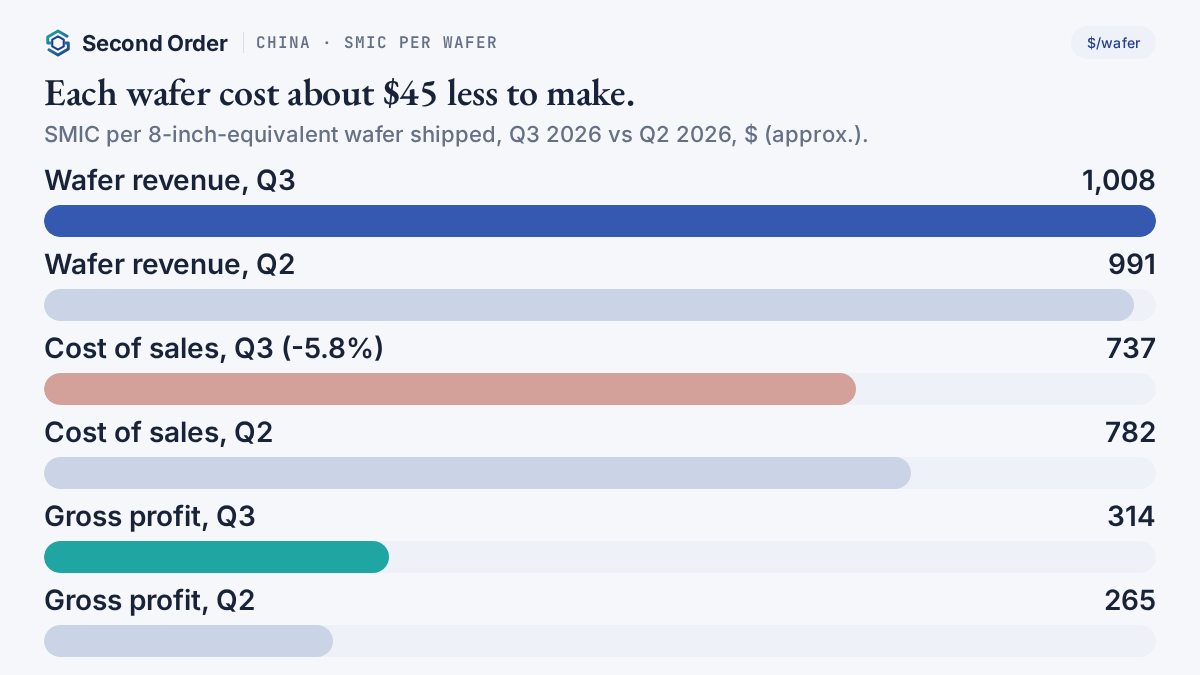
Our arithmetic shows how much that was worth. Dividing the published wafer revenue by wafers shipped, a wafer sold for about $1,008 in the third quarter against about $991 in the second, up 1.8%, which matches the 1.8% rise in average wafer price Zhao quoted. Dividing the cost of sales by wafers shipped, the cost fell from about $782 to about $737 a wafer, down about 5.8%. Gross profit per wafer rose from about $265 to about $314. Price helped a little. Filling the fab did most of the work.
Then comes the guide, which looks like a step down. Gross margin of 26% to 28% sounds weaker than 29.9%, and analysts asked about it directly. Zhao’s answer was that the fourth quarter is the same guide as the third, not a fall. He gave three reasons. Customers order hard in the third quarter, then go quiet in the fourth while they plan the next year, so fewer new wafers enter the line in October to December. SMIC plans to run more engineering and research wafers again, which pulls utilization down a little. And costs for depreciation and raw materials keep rising. Revenue still rises 4% to 6%, and Zhao said about half of that comes from more wafers (2% to 3%) and half from higher prices (2% to 3%), as price increases agreed with customers land in stages.
Hua Hong, SMIC’s smaller neighbour in specialty chips, reported utilization of 102.9% ten days earlier, and our Analysis desk has asked what that full slot already assumes (Hua Hong’s specialty slots and Hua Hong: what the price assumes). Two Chinese foundries running at or near their ceilings in the same quarter is the first half of this story. The second half is what they say they are waiting for.
What exactly did SMIC say about tools?
Two executives spoke to it, and the message was consistent. In the written results, SMIC said the global equipment supply chain is tight, delivery times are long, and delivery dates for some equipment are uncertain. It added that this will not stop this year’s expansion plan from going ahead but may make capital spending uneven across the year.
On the call Zhao went further. He said the whole industry is ordering at once, with a kind of panic: companies that might not need a machine this year are ordering now for fear of missing out. That pushes the delivery time for everyone beyond a single quarter. Machines SMIC expected to receive this year will not come, so they roll into next year, and from next year into the year after. If SMIC asks for a machine today, he said, the answer is generally 16 months or 24 months, and for the tightest tools it is more than 24. The result is that SMIC spends less each quarter than it planned.
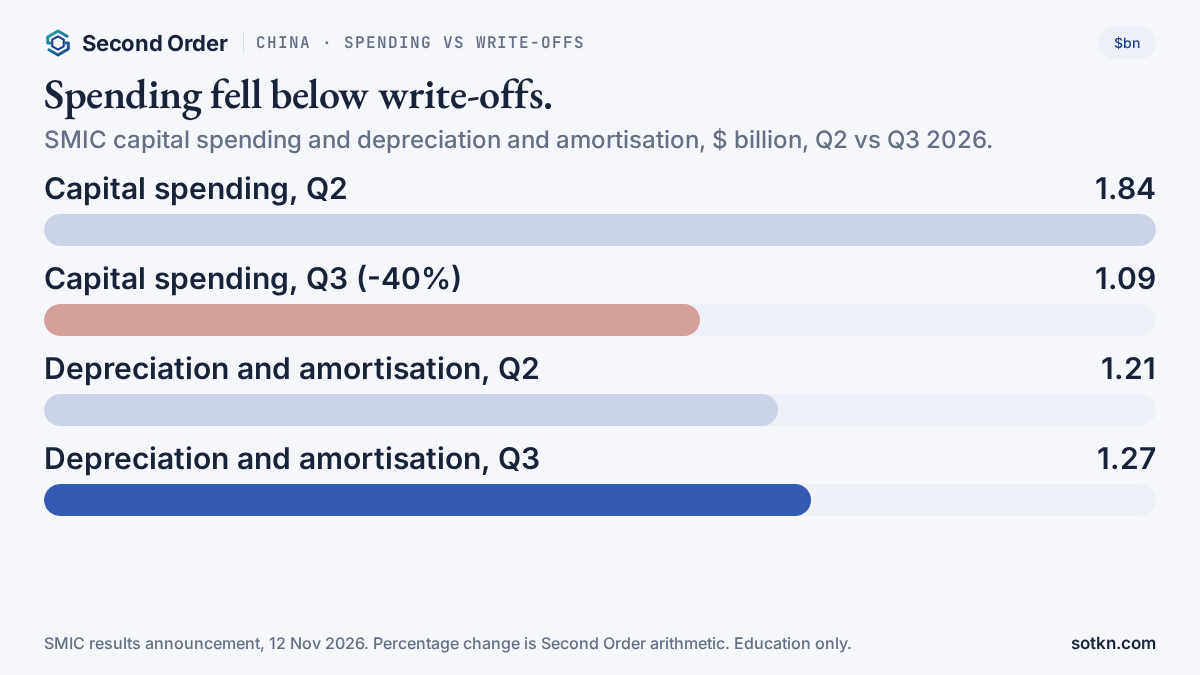
The numbers show it. Capital spending fell to $1.09 billion from $1.84 billion, a drop of about 40% in one quarter (our arithmetic), in a quarter when utilization hit a record. That is not a company losing its appetite. It is a company that has money and orders but cannot get the machines. The cash flow statement points the same way: cash paid for property and equipment was $1.39 billion in the quarter, against $1.54 billion in the second.
Finance head Wu Junfeng confirmed that 2026 spending will come in slightly below plan because of delivery times, and that depreciation will keep growing anyway: the machines already installed keep losing value, and next year’s depreciation will be higher still. Zhao also warned of a price effect. Raw materials and electricity costs SMIC can offset by running its fabs better. The price of the main process tools is rising, and he said SMIC will talk to customers about sharing that increase.
This is a Chinese version of a story we told this morning in the US: Applied Materials said clean room space was its customers’ gate, and KLA said its own lead times were about 12 months (Applied Materials and the clean room gate). SMIC is quoting 16 to 24 months. Different company, different tools, same shape: the people who need the machines are waiting in a longer line than the people who make them admit to.
There is a China-specific wrinkle our readers should keep in mind. Chinese tool makers are growing fast, and our October Pulse found Naura’s tools waiting on parts (Naura’s tools wait on parts). Our Analysis desk has also looked at Lam Research’s China licence (Lam Research and China licences). SMIC did not tell us how much of its order book is with domestic suppliers or foreign ones, and we will not guess. What it said is that no supplier it asked can promise a quick delivery.
Where is the demand coming from?
Not from phones. SMIC’s own mix tells the story, and management was blunt about it. By application, smartphones fell to 14.3% of wafer revenue from 21.5% a year earlier, and by our arithmetic smartphone wafer revenue fell about 9% in the quarter. Consumer electronics, still the largest group at 40.6%, fell about 1%. Zhao said these segments remain soft.
- Industrial and automotive: 19.3% of wafer revenue, up from 11.9% a year earlier and 16.5% last quarter. By our arithmetic its revenue rose about 26% on the quarter. SMIC sells power-management and battery-monitoring chips here and says orders are recovering from a low base.
- Computers and tablets: 18.3%, up from 15.2% a year earlier. Revenue rose about 26% on the quarter, which management credits to Chinese customers switching to local suppliers.
- Connectivity and IoT: 7.5% of wafer revenue, up about 18% on the quarter on the same switch.
- AI companion chips: management said “pull-in” demand for power-management (BCD) chips, specialty memory and memory controllers outran what it expected three months earlier.
- Wafer size: 12-inch wafers were 78.9% of wafer revenue. 12-inch revenue rose 9% and 8-inch 4%, because SMIC’s new capacity is mostly 12-inch.
Specialty memory deserves a note. Zhao said SMIC is the largest domestic supplier of NOR and NAND flash, the memory used in devices such as earphones, and that prices had gone up in step with the market and are now steady. Small, low-density NOR chips are roughly in balance. Large-capacity ones are still short. He drew a contrast with ordinary DRAM, where he said the AI surge has been so strong that it has squeezed out non-AI products: sub-1,000-yuan phones have disappeared and the memory alone in a network security camera can now cost more than the whole camera used to sell for. Those are his words and his examples, not our data, but they match what our Korea and Taiwan desks see from the memory makers (who makes DRAM).
On the outlook, Zhao said AI computing demand is still short of supply, that 2027 will be very tight, and that the industry broadly expects tightness to last into the second half of 2028. After mid-2028, he said, memory built for AI may come into rough balance, while computing chips and the support chips around them may still be short (what Huawei does sits at the centre of China’s AI chip demand). That timeline matters for the next section, because it lines up with something we can calculate.
What does the arithmetic say?
Everything below is our arithmetic from the published figures, not an SMIC forecast. Per-wafer numbers divide dollars by 8-inch-equivalent wafers shipped, so they are averages across very different products.
- The delivery clock: a tool ordered in mid-November 2026 with a 16 to 24 month lead time would arrive between about March 2028 and November 2028, and later for the scarcest tools. Zhao said AI memory supply and demand may balance after mid-2028. A machine ordered today may arrive about when the squeeze is expected to ease.
- Spending below write-offs: capital spending of $1,094 million was about 86% of depreciation and amortisation of $1,270 million. In the second quarter it was about 150% ($1,836 million against $1,212 million). A company that builds capacity spends more than it writes off. This quarter SMIC spent less.
- Per wafer: wafer revenue about $1,008 (up 1.8%), cost of sales about $737 (down 5.8%), gross profit about $314 (up about 18%). Of the $45 fall in cost, about $10 is lower depreciation per wafer ($312 from $322) and about $35 is lower other manufacturing cost ($426 from $460).
- Depreciation share: depreciation and amortisation was about 39.8% of revenue, from 40.3% last quarter and 41.8% a year ago. Zhao made the same point: depreciation grew about 30%, revenue grew about the same, so the share barely moved.
- Fourth quarter: 4% to 6% on $3,190.0 million is about $3,318 million to $3,381 million. If half comes from price, as Zhao said, only about 2% to 3% more wafers go out the door, about 3.1 million, on a capacity base that grew only 1.8% last quarter.
- Cash: operating cash flow was $1,182 million. Cash paid for property and equipment was $1,388 million and $1,306 million went into associates. SMIC borrowed $2,309 million and repaid $1,569 million. Total debt rose by about $885 million to $14.9 billion; net debt, after $13.4 billion of cash and deposits, was about $1.50 billion, up from about $0.16 billion.
- Waiting to collect: trade and other receivables rose about 52% to $2.29 billion while revenue rose 6%. That is about 66 days of sales, against about 46 days last quarter. The announcement does not explain it. Inventories rose about 11% to $4.83 billion.
- Minority owners: $222.5 million, about 34%, of profit for the period belongs to non-controlling interests, the other shareholders in SMIC’s subsidiary fabs. They also put in $152.6 million of capital in the quarter.
The arithmetic says three things. Demand is not the constraint: SMIC borrowed time from its own lab to ship more. Money is not the constraint: it borrowed more in the quarter and still holds $13.4 billion of cash and deposits. The binding limit is the calendar for machines. The receivables jump is the one number we cannot explain from the announcement, and we flag it as a question, not a finding.
SMIC, Q3 2026 at a glance
SMIC results announcement, 12 Nov 2026; SMIC earnings call, 13 Nov 2026. Sums marked as ours are Second Order arithmetic.
Who gets paid, and who waits?
1 · SMIC on wafers
Who: SMIC, on each wafer shipped from full fabs
Paid: $953 million of gross profit in the quarter
2 · Chinese chip designers
Who: Customers in power, memory, control, industrial and auto chips
Paid: As their chips sell; they gain from local sourcing
3 · Toolmakers with delivery slots
Who: The makers of etch, deposition, inspection and other machines
Paid: As machines ship and are accepted; price rises ahead
4 · Builders and suppliers
Who: Clean room builders, power, water and gas systems, parts suppliers
Paid: While halls are built and fitted
5 · Lenders and minority owners
Who: Banks funding $14.9bn of debt; partners in subsidiary fabs
Paid: Interest and a 34% share of profit
6 · The tool delivery slot
Who: 16–24 months for new orders; more for the scarcest
Paid: Sets when new capacity can switch on
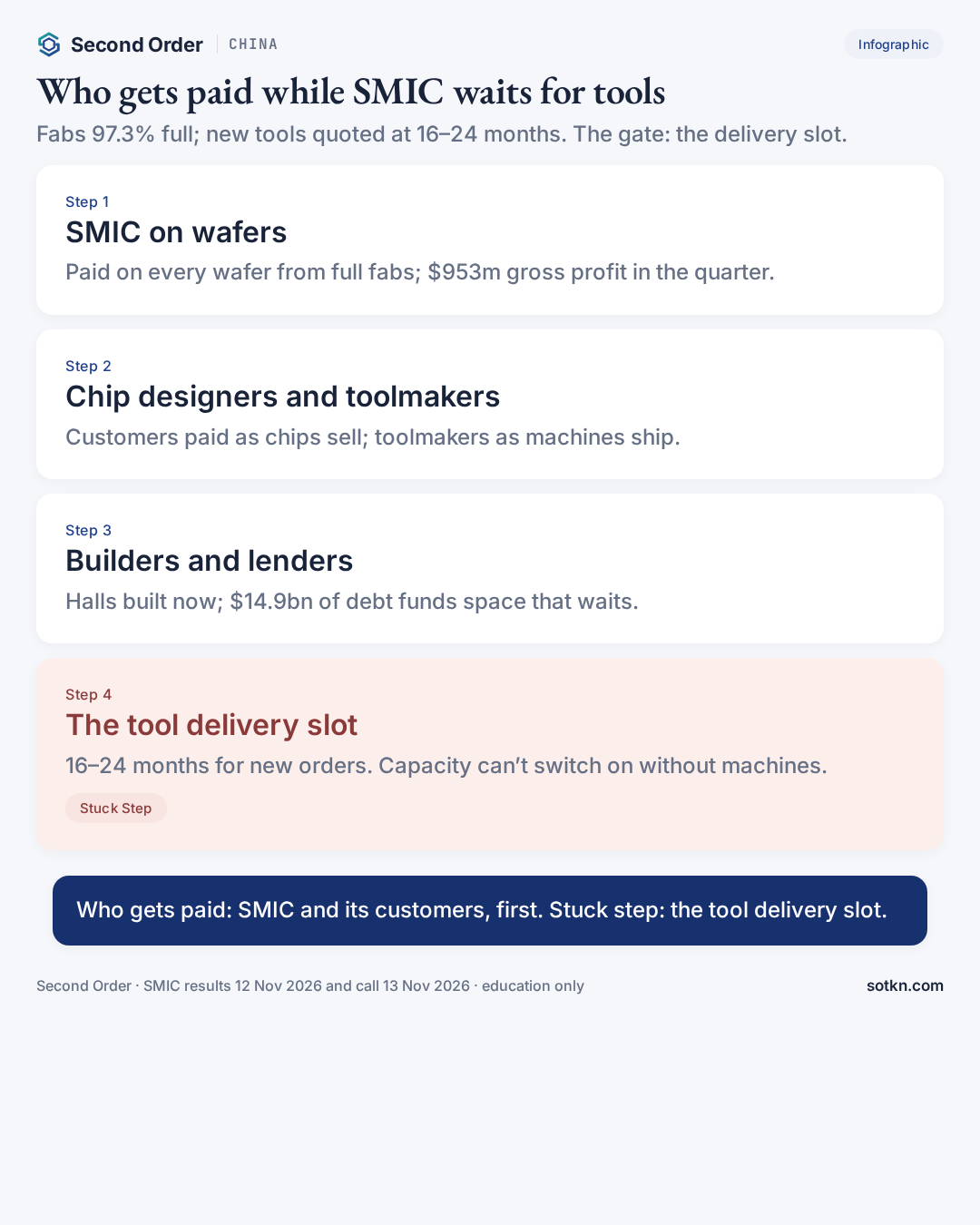
First in line is SMIC itself, but only for what its present machines can produce. Every wafer it ships earns about $314 of gross profit on our arithmetic, up from $265. The weakness in the position is that it cannot add many more wafers quickly. Its capacity grew 1.8% in the quarter.
Second, SMIC’s customers: the Chinese designers of power, memory-control, industrial and car chips. They are being paid for the local-sourcing shift management described, and they are the people competing for the same scarce wafers. When capacity is short, price rises are how the shortage gets shared. SMIC says it will follow the market on price and is never the first to raise it.
Third, the toolmakers. Whoever holds delivery slots for etch, deposition, cleaning, inspection and the other machines is paid as tools ship and are accepted, and has the leverage to raise prices. We do not know which supplier sells SMIC what and neither does SMIC’s release. For the global picture see our explainer and the Applied Materials Pulse (who makes wafer fab equipment, what Applied Materials does, what KLA does).
Fourth, the people who build and fit out the halls. A fab needs a sealed clean room before any machine can be rolled in, and power and water before it can run (clean rooms explained). They are paid while the building goes up, which for SMIC means paying now for space that will wait for machines. Fifth, the lenders and minority owners: SMIC’s debt grew to $14.9 billion, and about a third of its profit belongs to partners in its subsidiary fabs (capex versus depreciation explained).
What is stuck, exactly?
The stuck step is the delivery slot for chipmaking tools. It is not demand: SMIC cut its own research wafers to fill orders. It is not money: it borrowed and holds $13.4 billion in cash and deposits. It is not, on SMIC’s account, the rooms or the people. It is the queue for the machines.
The clock has three parts. First the order and the wait: 16 to 24 months, longer for the scarcest tools. Second the install: tools have to be rolled in, connected and tuned. Third the qualification: SMIC said in August that newly added capacity still has to qualify with customers, and our October Pulse noted that full fabs are not the same as leading-edge parity. A machine ordered now earns its first wafer for a customer some time after the 2028 dates above.
There are honest reasons for caution. First, the quotes of 16 to 24 months come from management speaking on a call, and different tools have different waits; SMIC gave no list. Second, SMIC said 2026 expansion is on track, so near-term capacity will still grow, only more slowly. Third, if AI spending cools or phone demand weakens further, SMIC could find itself with new machines arriving in a softer market; the fourth quarter is already seasonally slower. Fourth, the receivables jump and a net debt that has risen ninefold in a quarter are worth watching. Fifth, politics: about one tenth of sales is outside China, and rules on what tools can be sold into China can change. The one-line rule our Analysis desk keeps coming back to applies: the slow step sets the timing for everyone else, and the money gathers at the scarce step (where the stuck step moves).
It also fits the pattern across our China Pulses this autumn: CXMT’s samples, Naura’s parts, Hua Hong’s full slots and the 8-inch power foundries each pointed at a different link in the same chain (CXMT’s Q3 samples, China’s 8-inch power foundries). SMIC’s own words now put a number on the wait.
Which dates test the read?
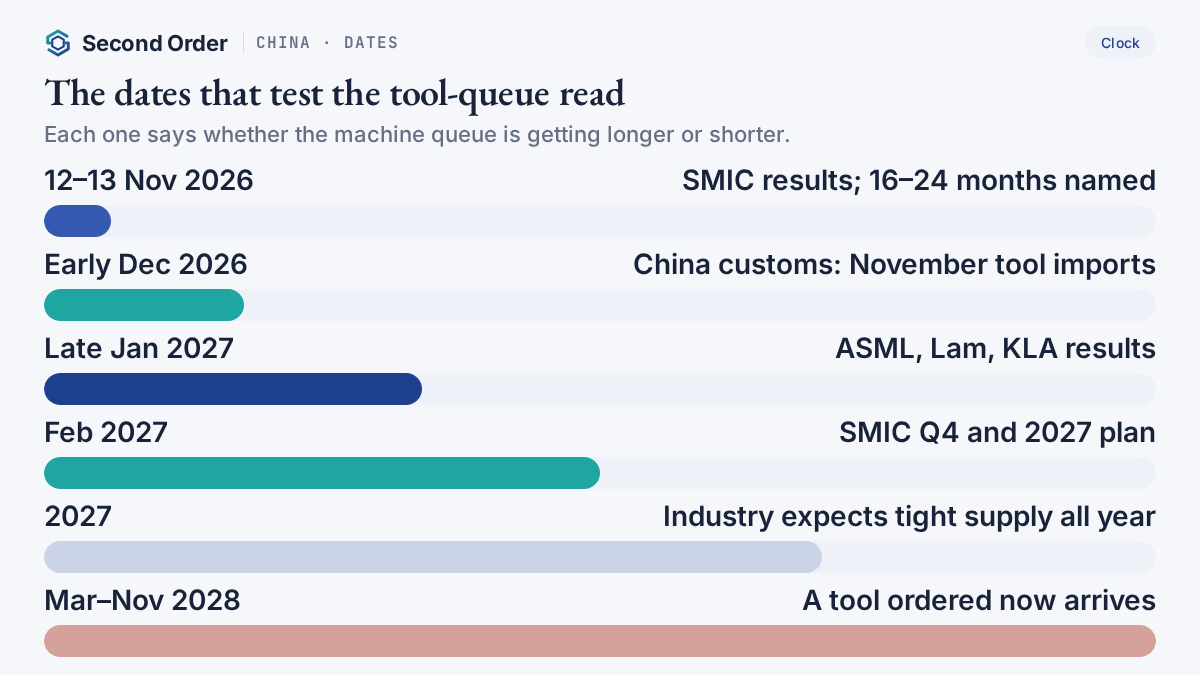
- 12–13 November 2026 — SMIC’s results and the call that named 16 to 24 months.
- Early December 2026 — China’s customs data for November, usually out in the first ten days of the month: do chip-tool imports keep rising?
- Late January 2027 — ASML, Lam Research and KLA report: do their lead times and order books say the queue is getting longer or shorter?
- Around 10 February 2027 — SMIC’s fourth-quarter and full-year results (it reported on 10 February this year): did capital spending catch up, and what is the 2027 plan?
- Mid-February 2027 — Applied Materials’ next quarter, to see whether the clean room and parts limits it named hold.
- 2027 — SMIC and the industry expect tight supply all year.
- March to November 2028 — when a tool ordered now would arrive on a 16 to 24 month quote (our arithmetic), around when AI memory supply is expected to balance.
Dates from SMIC’s call (13 Nov 2026) and TechBag (SMIC’s 2026 release dates). Early-December, late-January and mid-February dates are usual timing, not announced ones.
How does this look from the US, Taiwan and Korea?
From the US, the same quarter showed Applied Materials with China at about a quarter of its sales and expecting that share to fall in 2027, and with customers asking for tools faster than it can ship them (US Markets). From Taiwan, the advanced foundry is paid on the other end of the same demand, leading-edge AI chips and their packaging, where our Taiwan desk has tracked tools and factory space as the queue (Taiwan Markets). From Korea, the memory makers are spending heavily on tools and say their shortages run through 2028 (Korea Markets). SMIC sits between them: it is not a leading-edge AI chip maker, but the chips it makes are inside the servers, cars and appliances the others sell.
For readers who want the one tool whose own supply is short, see what ASML does and what it said about 2027 and 2028 (what ASML does, ASML supply short of demand). For the full set of China notes, see China Markets.
How we check this. SMIC’s figures come from its third-quarter results announcement on the Hong Kong exchange, dated 12 November 2026: revenue, margins, costs, shipments, utilization, capital spending, the balance sheet and the guide. What management said about tools, pricing, demand and 2027 to 2028 comes from the published transcript of the 13 November call, checked against TrendForce’s account of it. Analyst averages and the early share move come from a Reuters report carried by Investing.com. Earlier quarters come from our own earlier Pulses and from TechBag’s table of SMIC’s releases. Every sum we worked out is labelled “our arithmetic”. SMIC does not publish revenue by named customer, by node or by fab, so we do not guess which customer bought what or which tool is late. Price targets and ratings are left out on purpose. The references we used are listed at the end. Our editorial standards →
FAQ
What did SMIC report on 12 November?
SMIC, which describes itself as the front runner among chip foundries on the Chinese mainland, reported third-quarter revenue of $3.19 billion, up 6.1% on the second quarter and 33.9% on a year earlier. Gross margin was 29.9%, above the 26% to 28% range it had guided. It shipped more than 3 million wafers, counted as 8-inch equivalents, for the first time and ran its fabs 97.3% full. It guided the fourth quarter to revenue growth of 4% to 6% and a margin of 26% to 28%.
What is the stuck step?
The delivery slot for chipmaking tools. SMIC’s co-CEO said suppliers now quote 16 to 24 months for a new order, more than 24 months for the scarcest tools, and that machines SMIC expected this year are slipping into next year and the year after. Fabs are full today. New capacity cannot be switched on until the machines arrive.
Why did SMIC spend less on capital projects?
Capital spending was $1.09 billion in the third quarter, down from $1.84 billion in the second. Management said the reason is delivery: global tool supply is tight, lead times are long, and some equipment it expected in 2026 will arrive later. It says the 2026 expansion plan still holds but spending may be uneven.
Who gets paid first?
SMIC is paid on each wafer it ships, and its Chinese customers are paid when their chips sell. The toolmakers that hold delivery slots are paid when machines ship and are accepted. Chipmakers wait, because new rooms cannot earn until the machines arrive and are qualified.
Is this investment advice?
No. Education only. It maps who gets paid and which step is stuck. It is not a recommendation to buy or sell any security, and we leave out price targets and ratings on purpose.
References
Outbound links below are nofollow. We list only the sources actually used. Internal sotkn.com links in the body are separate.
- SMIC, Reports Unaudited Results for the Three Months Ended September 30, 2026 (Hong Kong exchange announcement), 12 Nov 2026. www1.hkexnews.hk — revenue, gross margin, cost of sales and depreciation, revenue by region, application and wafer size, capacity, shipments, utilization, capital spending, the balance sheet, cash flow and the fourth-quarter guide.
- Investing.com, Earnings call transcript: SMIC tops revenue forecast in Q3 2026 on AI demand, 12–13 Nov 2026. investing.com — what the co-CEO and finance head said on the 13 November call: tool lead times, capital spending, utilization, the price and volume split of the fourth-quarter guide, specialty memory, 2027 and 2028 supply.
- Investing.com (Reuters), SMIC shares rise nearly 5% after third-quarter earnings beat estimates, 12 Nov 2026. investing.com — the LSEG analyst averages for revenue and profit and the early share move on 13 November.
- TrendForce, SMIC Sees Capacity Tightness Through 2027, Possibly into 2H28; Equipment Lead Times Stretch to 16–24 Months, 13 Nov 2026. trendforce.com — a second account of the call: tightness through 2027 and into the second half of 2028, and the 16–24 month tool quotes.
- TechBag, SMIC revenue up 33.9% to US$3.19bn; margin guide 26–28%, 12 Nov 2026. thetechbag.com — SMIC’s earlier quarterly revenue and margin history, and the comparison of this quarter with SMIC’s own August guide.
Not investment advice. Do your own research. Education only. Map of who gets paid and which step is stuck — not a buy list.
More on this desk: China Markets · Semiconductors · who makes wafer fab equipment · SMIC utilization · all Markets.