Tools Ready, Rooms Not: Who Gets Paid While Applied Materials Waits on Chipmakers’ Clean Rooms
Applied Materials sold a record $10.41 billion of chipmaking tools and services last quarter and expects tool spending to rise more than 30% in 2027. Its finance chief named the limit: clean room space. Tools are ready; rooms are not.
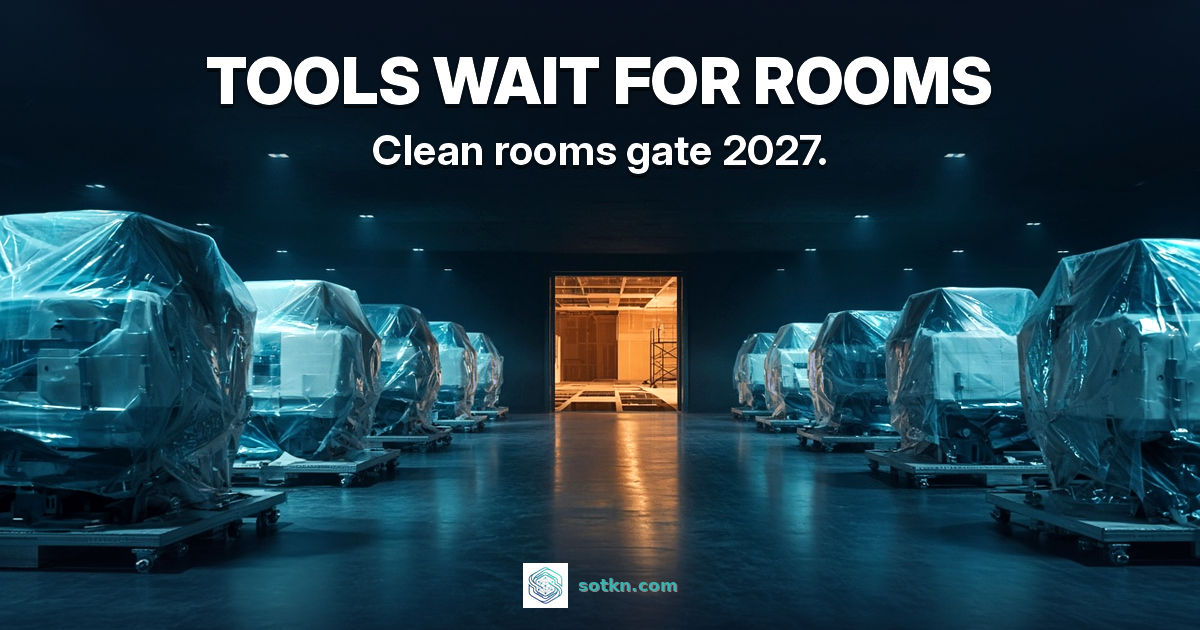
Applied Materials can sell every chipmaking tool it can build, and it is planning to build twice as many by 2028. The limit it named on 12 November was not its own factories. It was the rooms the tools go into. The largest US maker of chip equipment posted a record $10.41 billion quarter, said industry tool spending should rise more than 30% in 2027, and said clean room capacity sets how much the industry can take. The stuck step is clean room space.
US PULSE · SEMICONDUCTORS · WAFER FAB EQUIPMENT · DRAM · Data as at 15 Nov 2026 (Applied Materials Q4 FY2026 results and call 12 Nov; share move 13 Nov) · Next update: ASML, Lam Research and KLA results in late January 2027
Affects: Semiconductors · Hyperscalers · AI Data Centers — Markets: US · Taiwan · Korea · China
Education only, not advice to buy or sell any security. All figures are US dollars. Wafer fab equipment, or WFE, is the industry’s word for the machines that make chips on silicon wafers: tools that lay down thin films, etch patterns, polish, implant and measure (who makes wafer fab equipment). A clean room is the sealed, filtered hall those tools sit in (clean rooms explained). Our own sums are labelled. On 15 October our Analysis desk asked whether Applied’s price assumed the scanner slot was its stuck step (Applied and the scanner slot). This quarter answers part of that question, with a different bottleneck named out loud.
The numbers that matter this week
Q4 FY2026 revenue
$10.41bn
Up 53% on a year earlier · a record
NewEquipment (Semiconductor Systems)
$8.0bn
Up 64% · record sales in Korea and Taiwan
PaidDRAM share of equipment
33%
From 28% a year earlier · a record
MemoryQ1 FY2027 guide
$11.1bn ± $0.5bn
14 weeks, not 13 · about flat per week (our arithmetic)
Guide2027 tool market
+30% or more
Applied’s view of wafer fab equipment
OutlookClean room space
The gate
Many new fabs come online in 2029–2030
Stuck stepApplied Materials Q4 FY2026 results and earnings call, 12 Nov 2026. Status chips are Second Order’s read.
On this page: Why it matters · What was reported · The memory shift · The clean room gate · Lam and KLA · Our math · Who gets paid · What is stuck? · Dates next · FAQ
Why does a tool maker’s quarter matter for AI?
Think of a bakery chain that wants to open forty new shops. The oven maker is flat out: every oven it builds is sold before it leaves the factory, and it is building a second factory. But an oven cannot go into a shop that has no walls, no gas line and no extractor fan. If the shop fit-outs run late, the ovens sit wrapped in a warehouse. The oven maker is busy, the bakery chain is impatient, and the thing that sets the pace is the builders finishing the shops.
Chips work the same way. Every AI server needs leading-edge logic chips, DRAM memory and advanced packaging to join them. All three are made with machines from a short list of companies, and Applied Materials is the largest US one and among the biggest anywhere (what Applied Materials does). Applied’s chief executive Gary Dickerson said on the call that about 60% of the capital cost of an AI data centre is silicon, and more than 85% of that silicon is leading-edge logic, DRAM and advanced packaging. Those three areas are exactly where Applied sells the most.
So the question this quarter answers is not “is AI demand real?” Applied’s customers are answering that by ordering. The question is “what limits how fast the chip supply can grow?” Applied’s answer was unusually direct. Its finance chief Brice Hill said clean room capacity remains a gating factor for how much equipment the industry can consume. In plain terms: the tools are coming, and the rooms are what everyone is waiting for.
What did Applied Materials report on 12 November?
Applied reported after the US market closed on Thursday 12 November, Friday morning in Singapore and Tokyo. The quarter ran to 25 October 2026 and closed its fiscal year. It was the biggest quarter in the company’s history by revenue and by dollar growth.
- Revenue: $10.41 billion, up 53% on a year earlier and 14% on the previous quarter.
- Fiscal year: $34.45 billion of revenue, up 21%, the seventh year of growth in a row.
- Profitability: non-GAAP gross margin 50.6% and operating margin 35.3%, both records. GAAP operating income was $3.66 billion.
- Equipment (Semiconductor Systems): $8.0 billion, up 64%, with record sales in Korea and Taiwan.
- Customer mix of equipment: foundry and logic 58%, DRAM 33%, flash memory 9%. A year earlier it was 66%, 28% and 6%.
- Service (Applied Global Services): $1.90 billion, up 26%, a record for both service and spare parts.
- Cash: record operating cash flow of $3.30 billion and free cash flow of $2.62 billion. Applied spent $2.0 billion buying back shares and $421 million on dividends.
- Outlook: first-quarter fiscal 2027 revenue of $11.1 billion, plus or minus $500 million, with equipment around $8.7 billion and service around $2.0 billion, in a quarter that has 14 weeks instead of the usual 13.
Two other items in the release matter for the map. Applied agreed to buy more shares in Besi, the Dutch maker of hybrid bonding machines, to take its stake to about 20%. And it took a $253 million charge earlier in the year to settle an export controls matter with the US Commerce Department. The second explains why China is a careful subject on every US tool maker’s call.
The market’s reaction was cooler than the numbers. Shares edged up after hours, then traded about 6% lower during Friday 13 November. The reason was the guide. Reuters, using LSEG data, put the analyst average for first-quarter revenue at $10.89 billion, which Applied’s $11.1 billion beat. A tally reported by Yahoo Finance put the average at $11.41 billion, which the guide missed. Depending on whose average you read, the same number was a beat or a miss. We think the more useful point is what management said held the number back.
Why did memory tools nearly double?
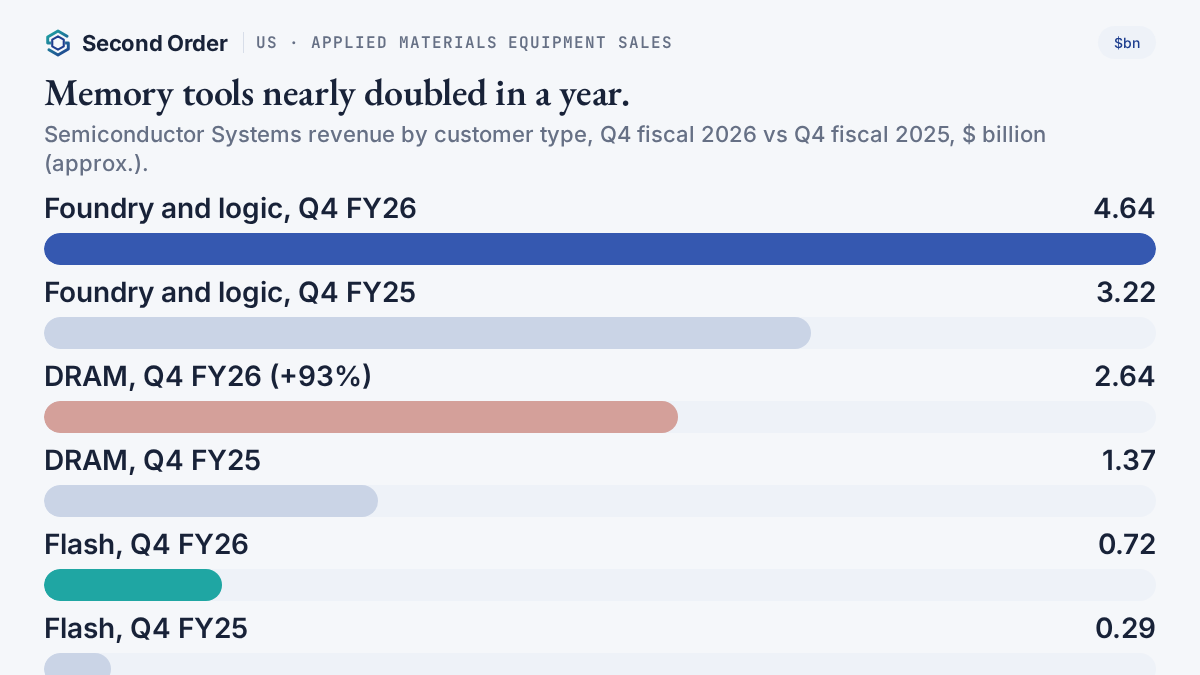
The biggest change inside the quarter was memory. DRAM made up 33% of Applied’s equipment sales, up from 28% a year earlier, and the company said DRAM revenue hit an all-time high. In dollars that is about $2.64 billion of DRAM tools in the quarter against about $1.37 billion a year earlier, an increase of about 93% (our arithmetic). Foundry and logic grew too, by about 44%, but memory grew twice as fast. This is the same demand our Korea and Taiwan desks have been tracking from the other side: memory makers sold out of the DRAM and HBM that AI servers need (who makes DRAM).
Hill said leading-edge logic and DRAM fabs are running at full utilisation, with NAND flash not far behind. Customers are doing two things at once: upgrading existing lines to squeeze out more wafers, and building new ones. Dickerson said customers are being much more aggressive on new greenfield factories than before. Both need tools, but only the upgrades can happen inside rooms that already exist. That is the hinge of this story. Memory makers have already been selling future output in advance; Micron, for example, has locked up most of its 2027 supply (Micron locks 75% of 2027 output).
Advanced packaging is the other memory story. Applied expects its packaging revenue to rise about 90% this calendar year, and said much of that is for HBM, the stacked memory that sits beside AI chips. It says it serves about 80% of the process steps around hybrid bonding, a newer way of joining chips face to face (hybrid bonding explained). Its bigger stake in Besi, which makes the bonding machines themselves, is a bet that this step grows (what Besi does). Yesterday’s Korea Pulse showed the same pull from the customer side, with Samsung breaking ground on a new HBM packaging hub where most of the money is tools (Samsung’s Onyang HBM lines).
What exactly did Applied say about clean rooms?
Management split the limits into near term and medium term, and it is worth keeping them apart.
Near term, the limit is parts. Hill said there are a few pinch points in the supply chain and that the first-quarter number would be slightly higher if everything were perfectly available. He called it not a major impact. Applied has raised its forecast to suppliers every quarter this year, works with more than 2,000 of them, and said almost all need to add capacity and labour. It added only about $300 million of inventory in the quarter, to $6.9 billion, and Hill said he would like to hold more.
Medium term, the limit is rooms. Hill said clean room capacity remains a gating factor for how much equipment the industry can consume. Asked whether 2027 could beat the 30% forecast the way 2026 beat early expectations, he said the big equation is governed by the clean room that can become available. In 2026 customers found extra space by adding rooms, pulling projects forward and upgrading lines. Those tricks can be used again, but not without limit.
Then came the long-term signal. Applied tracks fab construction around the world, and for the third quarter in a row it added more than ten major new fabs and expansion projects to that tracker. Many of them, Hill said, are not expected to come online until 2029 and 2030. Applied is tracking more than 20 fab ramps and line expansions in 2027 alone. Its largest customers now give it rolling eight-quarter forecasts and earlier orders.
Analysts tested whether demand might soften. UBS asked whether any customer had tried to take delivery a quarter or two later than planned, given worries that data centre shells and chips are out of step. Dickerson’s answer was a flat no: nobody, he said, is asking to slow down, and customers keep asking Applied to ship earlier. Bank of America asked what a slowdown in data centre building would do. Hill said demand for DRAM and leading-edge logic exceeds supply by enough to leave a buffer, and that phones, PCs and TVs are short of memory too.
Put together, the message is a queue in a specific order. Customers have budgets and want tools. Applied can build more tools each quarter and plans to double its output. Between the two sits a construction job: a clean room has to be built, sealed, powered, plumbed with ultra-pure water and gases, and certified before a tool can be rolled in. The building, not the order book, decides when the tool earns anything.
Do Lam Research and KLA see the same thing?
Broadly, yes. Lam Research, the US etch and deposition specialist, reported record September-quarter revenue of $8.22 billion on 21 October and guided the December quarter to $8.60 billion, plus or minus $400 million (what Lam Research does). Its deferred revenue, cash customers have paid ahead of recognition, rose to $2.66 billion from $2.43 billion a quarter earlier. China was still 35% of Lam’s sales, a much bigger share than at Applied.
KLA, which makes the inspection and measurement tools that find defects, guided its December quarter to $4.7 billion on 29 October and put the 2026 equipment market in the mid-$150 billion range (what KLA does). It said its lead times average about 12 months, longer for some products because high-end optical parts are short. Its chief executive Richard Wallace gave the clearest example of the room problem: one customer could not take equipment because its clean room was delayed. He added that clean room builds often slip, sometimes because the power for them arrives late.
ASML, the Dutch maker of lithography scanners, has said its planned supply for 2027 and 2028 will not fully meet customer demand (ASML supply short of demand). That is a different bind: there, the tool itself is scarce. For Applied, Lam and KLA, which make the many other tools around the scanner, the bind they now describe is mostly the room and the parts, not their own assembly lines.
What does the arithmetic say?
Everything below is our arithmetic from the published figures, not an Applied forecast. Mix dollars apply Applied’s published percentages to its equipment revenue, so they are approximate.
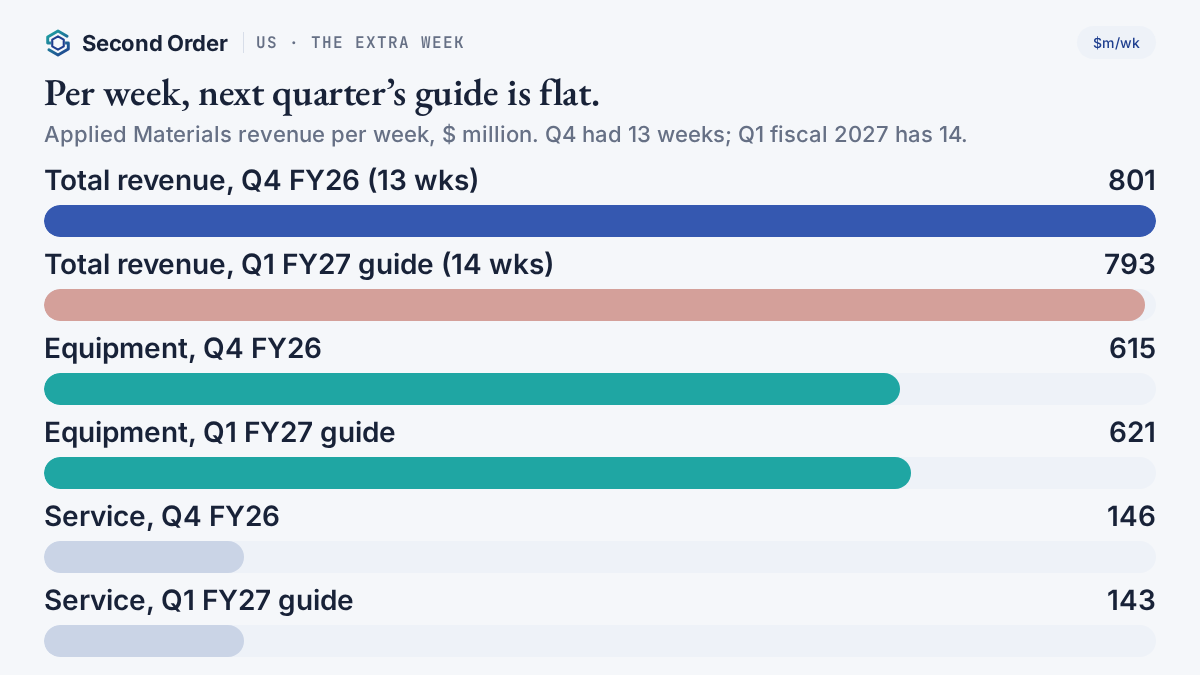
- Per week: $10.41 billion over 13 weeks is about $801 million a week. The $11.1 billion guide over 14 weeks is about $793 million a week, about 1% lower. Equipment per week is about flat: $8.0 billion over 13 weeks is $615 million; $8.7 billion over 14 weeks is $621 million. The headline rise in the guide is mostly the extra week.
- Memory dollars: 33% of $8.0 billion is about $2.64 billion of DRAM tools, up about 93% from about $1.37 billion. Flash rose about 2.5 times, from about $0.29 billion to about $0.72 billion.
- Doubling: Applied said it can double systems output from fourth-quarter levels by 2028. On $8.0 billion a quarter, that is capacity for about $16 billion a quarter, or about $64 billion a year, at today’s prices. Fiscal 2026 equipment revenue was $26.1 billion.
- The market: KLA’s mid-$150 billion estimate for 2026 plus 30% would be roughly $200 billion of wafer fab equipment in 2027. Against Hill’s cloud capital spending of well over $1 trillion in 2027, chip tools would be about a fifth.
- The AI data centre share: 60% of capital cost in silicon, times 85% of that in leading-edge logic, DRAM and packaging, is about 51% of an AI data centre’s capital cost flowing to the chips Applied’s tools make.
- Customer cash ahead: contract liabilities, mostly customer deposits and billings ahead of revenue, rose to $3.59 billion from $2.57 billion a year earlier, up about 40%. That is about 45% of one quarter of equipment sales.
- Waiting to collect: receivables rose about 74% to $9.0 billion while revenue rose 53%. At the quarter’s pace that is about 79 days of sales, against about 69 days a year earlier. Some of the gap is tools shipped but not yet paid for.
- Its own factories: capital spending of $2.67 billion in fiscal 2026 was about 8% of revenue. Property and equipment rose about 27% to $5.85 billion; headcount rose about 14% to 41,500.
The arithmetic says three things. Demand is not the constraint: customers are paying deposits and taking tools as fast as they come. Applied’s own factory is a small constraint today and is being doubled. And the guide is flat per week, which is what a supply-limited quarter looks like. The money is ready, the tools are nearly ready, and the next bottleneck is the building around them.
Applied Materials, Q4 fiscal 2026 at a glance
Applied Materials Q4 FY2026 results and earnings call, 12 Nov 2026; KLA earnings call, 29 Oct 2026. Sums marked as ours are Second Order arithmetic.
Who gets paid, and who waits?
1 · Tool makers
Who: Applied, Lam, KLA and peers; deposition, etch, polishing, inspection
Paid: As tools ship and are accepted; deposits ahead
2 · Service crews
Who: Applied Global Services on 37,000+ connected chambers
Paid: Every quarter the installed tools run flat out
3 · Parts suppliers
Who: 2,000+ suppliers; optics, valves, robots, power parts
Paid: As they add capacity and labour
4 · Clean room builders
Who: Contractors, utilities, water, gas and power systems
Paid: While the halls go up
5 · Chipmakers
Who: Memory makers and foundries buying the tools
Paid: When new wafers become chips they can sell
6 · Clean room space
Who: Many tracked fabs online 2029–2030
Paid: Sets how many tools can be installed
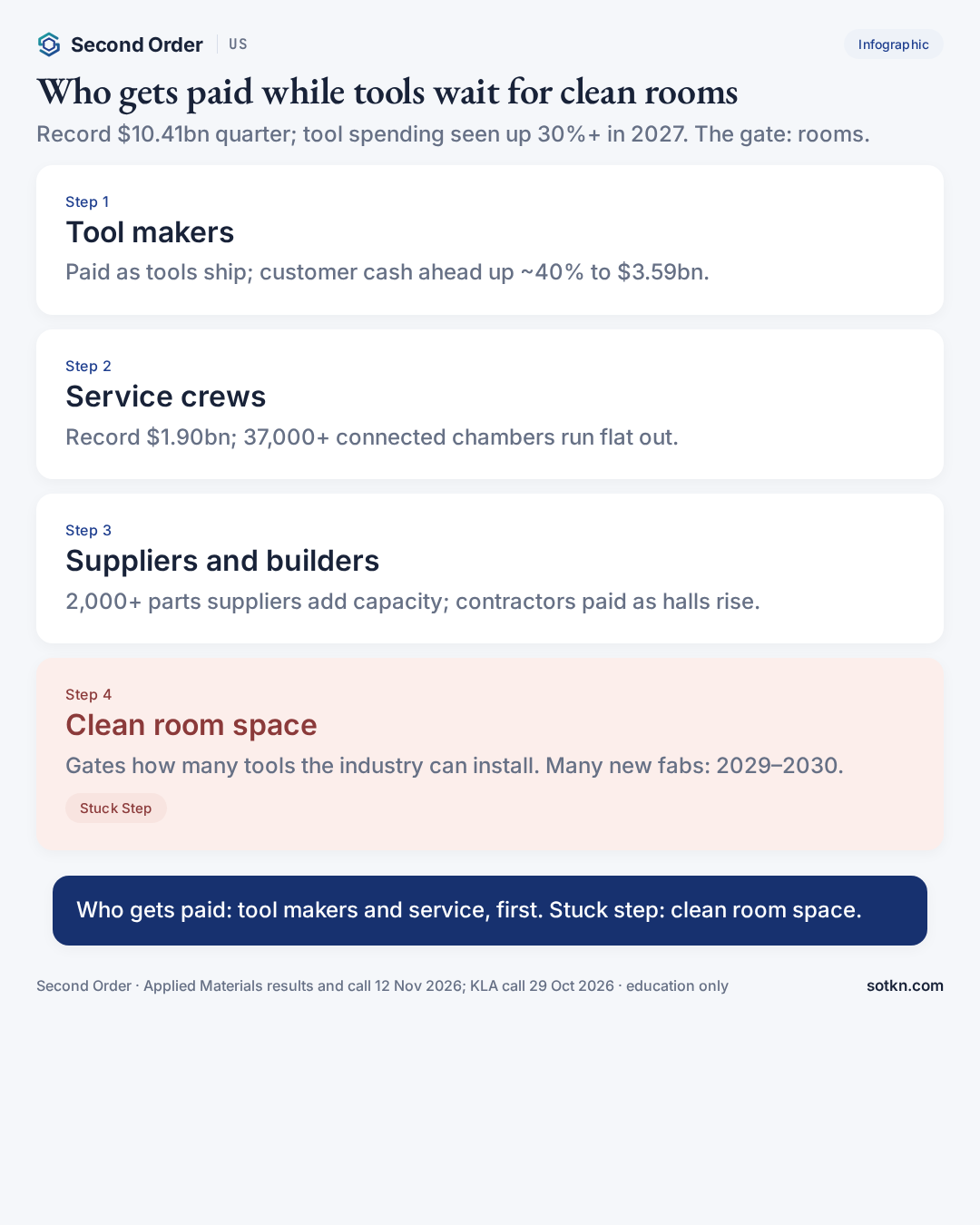
First in line are the tool makers. They are paid as tools ship and are accepted, and often take deposits before that. Applied’s 64% jump in equipment sales and its record margins show what happens when a supplier sells into a market that wants more than it can make: Hill said higher prices for new, more valuable tools helped margins, along with the product mix. Lam and KLA are being paid on the same budgets.
Second, the service business, which is quietly one of the best seats in the chain. Applied Global Services earned a record $1.90 billion. Fabs running at full capacity need spare parts, upgrades and maintenance on tools they already own, and squeezing more wafers out of an existing room is the fastest way to add output when new rooms are late. Applied says more than 37,000 chambers are connected to its AI-based monitoring services, growing more than 20% a year. Every month a new room is delayed, the old rooms work harder, and service gets paid.
Third, the parts suppliers. Applied has more than 2,000, and Hill said nearly all need to add capacity and workers. KLA named high-end optics as its own bottleneck. Suppliers are paid as they grow, with eight-quarter forecasts in hand. China’s domestic tool makers face a harder version of the same parts problem (Naura’s tools wait on parts).
Fourth, the people who build clean rooms: general contractors, mechanical and electrical engineers, the makers of filtered-air ceilings, ultra-pure water plants, gas and chemical systems, and the utilities that bring power. Applied does not name them and neither do we. They are paid while the building rises, before any tool is installed. Our Taiwan desk saw the buyer’s side of this on 2 November, when a chipmaker paid for a ready-built shell so its machines would not wait for floors (Taiwan’s ready fab shell).
Last are the chipmakers themselves, who pay everyone above and are paid only when the new wafers become chips. Their money is committed now; the extra revenue arrives when rooms are certified, tools are installed and qualified, and yields rise. Behind them wait the AI chip designers and the cloud companies, who need the memory and logic those rooms will make (the Hyperscalers layer).
What is stuck, exactly?
The stuck step is clean room space at the chipmakers. It is not demand: customers want tools sooner, not later, and Applied’s deposits are rising. It is not, for now, Applied’s own factories: supply pinch points cost it a little in the first quarter, and it is doubling output. It is the room: the sealed, powered, plumbed hall that has to exist before a single tool can earn money.
The clock has three parts. First the building: a large fab clean room can take a year or more to build and fit out, and KLA said builds often slip, sometimes because the power arrives late. Second the tools: lead times for some tools are around a year, so they are ordered against a room’s expected finish date, and a late room leaves tools waiting. Third the ramp: once tools are in, they have to be qualified and the line has to reach good yields before it makes chips in volume. Applied’s tracker says many of the newest projects do not open until 2029 and 2030.
There are honest reasons for caution. First, management talks its own market, and a 30% forecast is a view, not an order book. Second, the per-week flat guide could reflect timing of acceptances rather than a real ceiling. Third, if AI spending cools, a doubled factory could sit partly idle; Applied is building capacity for a range of scenarios, and the downside one is real. Fourth, China, still 25% of revenue, is expected to fall below a quarter of sales in 2027 as other regions grow faster, and US export rules can change. Our Analysis desk laid out what happens if new clean rooms open but sit empty in 2028, which is the opposite risk to this one (if new clean rooms sit empty).
It is the same shape we keep finding: the slow step sets the timing for everyone else, and the money gathers at the scarce step (where the stuck step moves). In October our Analysis desk asked whether Applied’s stuck step was the scanner slot. Applied’s equipment sales of $8.0 billion came in slightly above the roughly $7.9 billion it had guided, so chambers kept shipping. But the company itself now points one step further out, past the scanner, to the room. In memory the same limit showed up earlier: Micron can buy tools early, but cannot make many more DRAM chips until its new clean rooms ramp (Micron’s Idaho 10-K).
Which dates test the read?
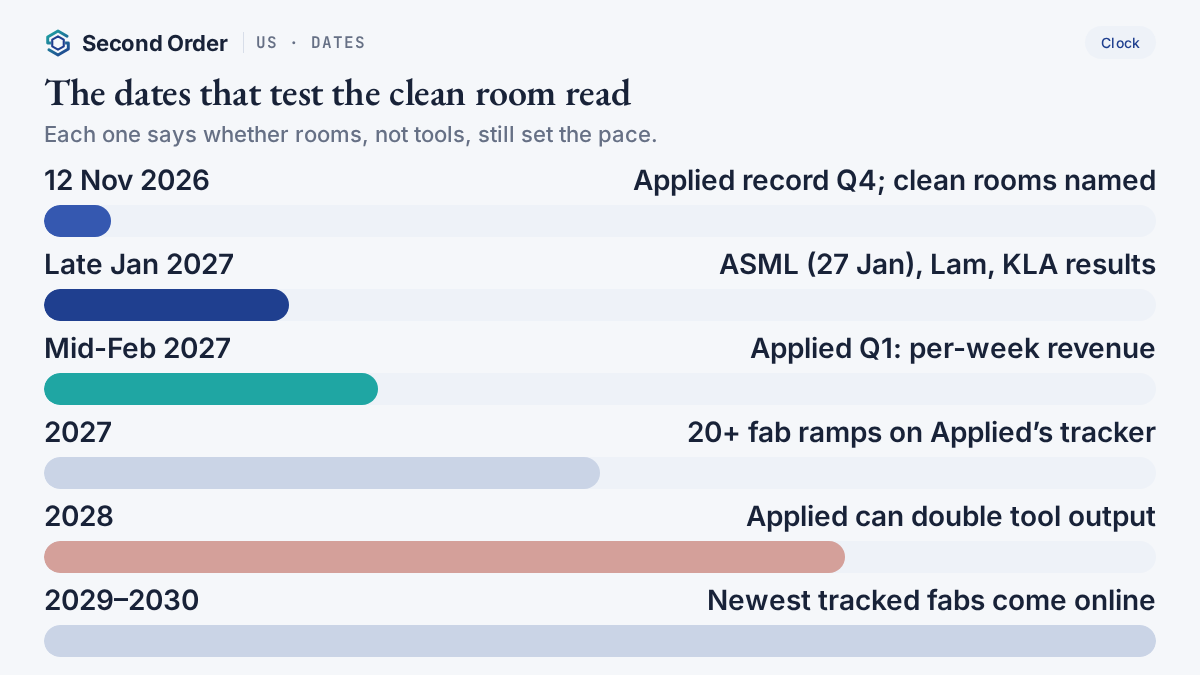
- 12 November 2026 — Applied’s record fourth quarter and the clean room comment.
- Late November 2026 — Nvidia’s quarterly results: does demand for AI chips, and so for memory and logic, keep rising?
- 27 January 2027 — ASML’s fourth-quarter results: is scanner supply for 2027 and 2028 still short?
- Late January 2027 — Lam Research and KLA report the December quarter: did shipments slip because rooms were late?
- Mid-February 2027 — Applied’s first-quarter results: does per-week revenue rise, or stay flat because of supply and rooms?
- 2027 — More than 20 fab ramps and line expansions on Applied’s tracker.
- 2028 — Applied’s capacity to double equipment output from fourth-quarter 2026 levels.
- 2029 to 2030 — Many of the newest tracked fabs come online; Applied more than doubles manufacturing and lab capacity by 2030.
Dates from Applied Materials’ earnings call (12 Nov 2026) and Yahoo Finance (13 Nov 2026). Late-January, mid-February and late-November dates are the companies’ usual timing, not announced ones.
How does this look from Taiwan, Korea and China?
From Taiwan, Applied’s single biggest region, the sales are the foundries and packagers building leading-edge logic and AI chip packages. Taiwan bought $2.92 billion of Applied’s goods and services in the quarter, up 59%, and 28% of the total (Taiwan Markets). From Korea, the memory makers bought $1.81 billion, up 49%, as they race to add DRAM and HBM (Korea Markets). From China, sales rose 35% to $2.64 billion but fell to 25% of the total from 29%, and Applied expects that share to keep shrinking in 2027 (China Markets). In the US, Applied’s home market, sales doubled to $1.32 billion, about 13% of the total, as American fabs add tools (US Markets). Every one of those regions is building clean rooms. How fast they finish decides how fast the tools are switched on.
For readers who want the mechanism, our explainer on memory process tools walks through why HBM needs more steps per wafer than ordinary DRAM, which is part of why memory tools grew so fast (memory process tools for HBM). And for the one tool whose own supply is short, see what ASML does (what ASML does).
How we check this. Applied Materials’ figures come from its fourth-quarter results release of 12 November 2026: revenue, margins, segment mix, revenue by region, the balance sheet and the outlook. What management said about clean rooms, supply, the 2027 market and the 2028 output plan comes from the published call transcript. Lam Research’s figures come from its 21 October results release, and KLA’s from its 29 October call. Analyst averages and the share move come from Reuters and Yahoo Finance. Every sum we worked out is labelled “our arithmetic”. Applied does not publish revenue by named customer or by fab, so we do not guess which chipmaker bought what. Price targets and ratings are left out on purpose. The references we used are listed at the end. Our editorial standards →
FAQ
What did Applied Materials report on 12 November?
Applied Materials, the largest US maker of chipmaking equipment, reported record revenue of $10.41 billion for the quarter to 25 October 2026, up 53% from a year earlier, and $34.45 billion for the fiscal year. Its equipment segment sold $8.0 billion, with a record share from DRAM memory. It guided the next quarter, which has 14 weeks instead of 13, to about $11.1 billion, and said tool spending across the industry should rise more than 30% in 2027.
Why do clean rooms matter for a tool maker?
Chipmaking tools can only be installed in a clean room, a sealed hall with filtered air, controlled vibration, power, ultra-pure water and chemical lines. Applied’s finance chief said clean room capacity remains a gating factor for how much equipment the industry can take. If a chipmaker’s room is late, the tools wait, and so does the revenue on them.
Who gets paid first?
Applied and its peers are paid as tools ship and are accepted, and they collect service fees on more than 37,000 connected chambers already in factories. The builders of clean rooms are paid while the halls go up. Applied’s 2,000-plus suppliers are paid as they add capacity. Chipmakers are paid last, when the new wafers become chips they can sell.
What is the stuck step?
Clean room space at the chipmakers. Applied says customers want tools as fast as it can ship them and that its own supply pinch points are small. What limits how many tools the industry can install in 2027 is how fast new rooms are finished. Many of the new fabs on Applied’s tracker do not come online until 2029 and 2030.
Is this investment advice?
No. Education only. It maps who gets paid and which step is stuck. It is not a recommendation to buy or sell any security, and we leave out price targets and ratings on purpose.
References
Outbound links below are nofollow. We list only the sources actually used. Internal sotkn.com links in the body are separate.
- Applied Materials, Applied Materials Announces Fourth Quarter and Fiscal Year 2026 Results, 12 Nov 2026. appliedmaterials.com — quarterly and annual revenue, margins, segment revenue and mix, revenue by region, the balance sheet including contract liabilities, receivables and inventory, cash flow, the Besi stake and the first-quarter outlook.
- The Motley Fool, Applied (AMAT) Q4 2026 Earnings Call Transcript, 13 Nov 2026. fool.com — the 2027 wafer fab equipment outlook, clean room capacity as the gating factor, the plan to double systems output by 2028, rolling eight-quarter forecasts, supply pinch points, the 14-week first quarter and the China share for 2027.
- Reuters via Investing.com, Applied Materials forecasts quarterly revenue above estimates on strong AI chip demand, 12 Nov 2026. investing.com — the LSEG analyst average for the first-quarter revenue guide, China sales growth and the Austin, Texas, manufacturing work.
- Yahoo Finance (TIKR), Applied Materials Sinks 6% After Record Quarter, 13 Nov 2026. finance.yahoo.com — the share move on 13 November, an alternative analyst average for the first-quarter guide, and the Lam Research, KLA and ASML read-across.
- Lam Research, Lam Research Corporation Reports Financial Results for the Quarter Ended September 27, 2026, 21 Oct 2026. investor.lamresearch.com — Lam’s September-quarter revenue, deferred revenue, regional mix and its December-quarter guide.
- The Motley Fool, KLA (KLAC) Q1 2027 Earnings Call Transcript, 29 Oct 2026. fool.com — KLA’s December-quarter guide, its 2026 equipment market estimate in the mid-$150 billion range, lead times of about 12 months and a customer that could not take tools because its clean room was late.
Not investment advice. Do your own research. Education only. Map of who gets paid and which step is stuck — not a buy list.
More on this desk: US Markets · Semiconductors · who makes wafer fab equipment · clean rooms explained · what Applied Materials does · all Markets.