$227.5 Million Still Deferred: Who Gets Paid While Netlist's Upfront Fee Stays Unrecognized
Samsung paid Netlist $227.5 million net in the third quarter. License revenue was $44.9 million. The upfront fee is still deferred through July 2031.
Samsung has paid Netlist. The step that is stuck is recognition of the upfront license fee. Net cash from Samsung this quarter is $227.5 million. License fee revenue is $44.910 million. The Form 10-Q filed the same day still carries $227.5 million of the upfront fee as unrecognized, and it runs the remainder through July 2031.
US PULSE · Data as at 11 Nov 2026 · Next update: when the quarter ending 2 January 2027 recognizes the product advances, or when a filing splits the $44.910 million
Affects: Semiconductors — Markets: United States
In short: On 10 November 2026 Netlist filed unaudited third-quarter results and a Form 10-Q for the quarter ended 26 September 2026. Product sales are $60.194 million. Samsung license fees recognized are $44.910 million. The 10-Q says $227.5 million of the upfront license fee is still unrecognized. Our arithmetic puts $179.6 million of that upfront past the next twelve months.
Education only, not advice to buy or sell any security. Figures are from the company filings dated as shown. Where we divide or subtract printed numbers, the working is labelled our arithmetic.
The numbers that matter this month
The quarter recognized a license fee for the first time, and it left a much larger upfront fee in deferred revenue.
The earnings release gives condensed statements in thousands of dollars, unaudited. The lines below stay in those thousands. $60,194 thousand is $60.194 million. A second table, from the 10-Q note, is in the millions the note actually prints.
| Line, in thousands | Quarter ended 26 Sep 2026 | Quarter ended 27 Sep 2025 | Nine months 2026 |
|---|---|---|---|
| Net product sales | 60,194 | 42,234 | 274,931 |
| License fee | 44,910 | — | 44,910 |
| Net sales | 105,104 | 42,234 | 319,841 |
| Gross profit | 68,857 | 1,838 | 114,129 |
| Operating income (loss) | 40,571 | (7,150) | 50,475 |
| Net income (loss) | 85,448 | (7,010) | 95,496 |
Every license dollar in the nine-month column is this quarter's license dollar. The line was zero a year earlier. Product sales are the other line, and the 10-Q says they are resales of third-party memory plus sales of Netlist's own modular subsystems, recognized when control passes. This quarter the company stopped showing resale and own modules as separate categories. The reader gets a license line and loses that older split.
| 10-Q note, in millions | At 26 Sep 2026 |
|---|---|
| Net cash received from Samsung | 227.5 |
| Same receipt, including withholding | 272.5 |
| Unrecognized upfront license fee | 227.5 |
| Of that upfront, expected within 12 months | 47.9 |
| Product advances, not yet shipped | 30.5 |
| Deferred revenue, as the note totals it | 258.0 |
The 10-Q uses $227.5 million for the net cash, which it says is the upfront plus the first quarterly fee, and uses $227.5 million again for the unrecognized upfront. Same figure, two descriptions.
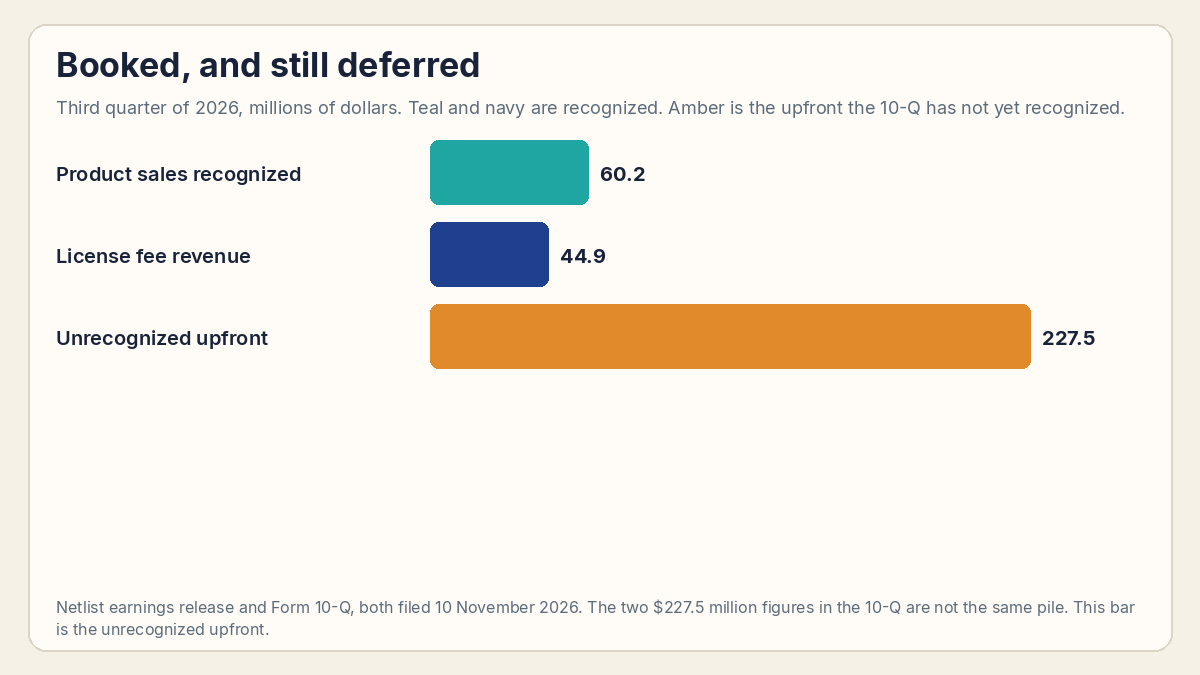
The chart rounds to one decimal. The table keeps the thousands. Amber is the unrecognized upfront. Balance-sheet deferred revenue is $78,405 thousand current and $179,641 thousand noncurrent, summing to $258,046 thousand. The note's $258.0 million is that stock, rounded. The December 2025 balance, $30,570 thousand, was product advances.
Why does the United States matter now?
The United States is where this balance sheet is filed, and the balance sheet is where a paid license becomes a liability until the clock runs.
Netlist is a Delaware corporation with its headquarters at 111 Academy, Suite 100, Irvine, California. The quarter is a US GAAP report. Semiconductors are the layer. The payer on the new license is Samsung Electronics, and the cash Netlist kept is net of Korean withholding. The withholding is a line in that US filing.
Deferred revenue is cash a company has and has not yet earned. That is the object on this page. Customers who already took delivery paid for $60.194 million of product, and that revenue is recognized. Samsung paid for a five-year right to use the patent portfolio. The upfront piece of that payment is still deferred. A later US name, Micron, signed on 5 October, after this quarter closed. Micron's fees are in the 10-Q as a subsequent event. They are not in these sales.
What changed
A settlement became a license, the license became one quarter of revenue, and most of the upfront stayed unearned.
The 10-Q says the Samsung patent cross-license was signed on 4 August 2026. In the litigation note the effective date is 1 July 2026. The Form 8-K filed on 5 August 2026 dates the same license as effective 31 July 2026, and the supply-agreement paragraph in this 10-Q also uses 31 July 2026. Both documents run the fee window through the second calendar quarter of 2031, and the revenue note runs the unrecognized upfront through July 2031. The day in July is not the same sentence in every document. This pulse does not pick one.
Samsung paid an upfront license fee of $200 million and a first quarterly fee. The quarterly fee is up to $27.5 million net, set by a revenue-based formula, and it can be adjusted. The 10-Q says the cash received was $227.5 million net and $272.5 million including Korean withholding that Samsung pays on Netlist's behalf. Samsung grosses the payment up so Netlist receives the stated net amount. The withholding is recorded as an income tax asset until it is used.
The upfront is recognized straight-line over the term. The quarterly fee is a sales-based royalty, booked in the quarter it relates to. Future royalties are left out of the remaining-performance-obligation disclosure. On current estimates, the 10-Q says no variable consideration was excluded from the transaction price. Later quarters can still be adjusted. They are not a receivable.
A year earlier the quarter was an operating loss of $7,150 thousand. This quarter's operating income is $40,571 thousand. The chief executive says product growth came from AI and data-center demand. He does not name customers. The largest three product customers in the 10-Q are 25 percent, 24 percent and 15 percent of product sales, and they are letters, not names. Operating expenses were $28,286 thousand, including $16,211 thousand of intellectual-property legal fees. A supply right allows up to $300 million of DRAM and NAND purchases a year. The filing does not say how much was used.
On 5 October, after the quarter, Netlist licensed Micron at $30 million a quarter from the fourth calendar quarter of 2026 through the third calendar quarter of 2031, a stated $600 million. Court dismissals wait on the first receipt. That cash is not in these statements. New patent cases followed on 16 October, 4 November and 5 November, including an International Trade Commission complaint naming Kingston and Lenovo. Samsung's cases are dismissed. A 2009 Google case is described as stayed until a Samsung case, including appeal, is resolved. The 10-Q does not say the stay has lifted.
Our math
The printed totals foot. The bridges the notes do not draw are our arithmetic.
Our arithmetic, from the thousands in the earnings release and the millions in the 10-Q:
- Net cash: 200.0 + 27.5 = 227.5. That matches the net receipt the 10-Q describes as the upfront plus the first quarterly fee.
- Withholding: 272.5 − 227.5 = 45.0. That is $45.0 million paid to the Korean tax authority on Netlist's behalf. The 10-Q prints both ends and does not print $45.0 million as its own line.
- Gross receipt minus the unrecognized upfront is also 272.5 − 227.5 = 45.0, because both descriptions use $227.5 million. License fee revenue is $44.910 million. The $0.090 million between $45.0 million and $44.910 million is unnamed. We do not call $45.0 million the revenue.
- Upfront past twelve months: 227.5 − 47.9 = 179.6. The balance sheet's noncurrent deferred revenue is $179,641 thousand, which is $179.641 million. The $0.041 million gap is rounding.
- Current deferred revenue is $78.405 million. Subtract $47.9 million and $30.505 million remains, beside the note's $30.5 million of product advances. The $0.005 million is rounding.
- Net ceiling if every quarter hits the maximum: 200 + 20 × 27.5 = 750.0, the printed "up to $750.0 million." It is not a receivable. The gross ceiling is approximately $898.2 million.
- Product gross profit, because the release says the license fee has no cost of sales: 60,194 − 36,247 = 23,947, and 23,947 ÷ 60,194 = 39.783 percent. Blended margin is 68,857 ÷ 105,104 = 65.513 percent, which rounds to the printed 65.5 percent, against 4.352 percent a year earlier, the printed 4.4 percent.
- License share: 44,910 ÷ 105,104 = 42.729 percent, the 10-Q's "approximately 43 percent." Operating income without the license fee: 40,571 − 44,910 = −4,339, a loss of $4.339 million.
- Tax: 43,982 ÷ 51,514 = 85.379 percent, which rounds to the printed (85.4) percent for the nine months. The same benefit over this quarter's pretax profit is 106.068 percent. The 10-Q states (85.4) percent for both periods. It released $56.5 million of valuation allowance, $48.6 million of it a discrete benefit and $7.9 million in the annual rate. The income-statement benefit is $43,982 thousand. The $4.618 million between $48.6 million and that line is unnamed.
- Cash highlight: 327.7 − 40.7 = 287.0, then 287.0 − 227.5 = 59.5. The highlight does not itemize the $59.5 million. Nine-month option and warrant proceeds are $42.0 million, and the Samsung share issue is $1.0 million. Those are not a quarterly split of the $59.5 million.
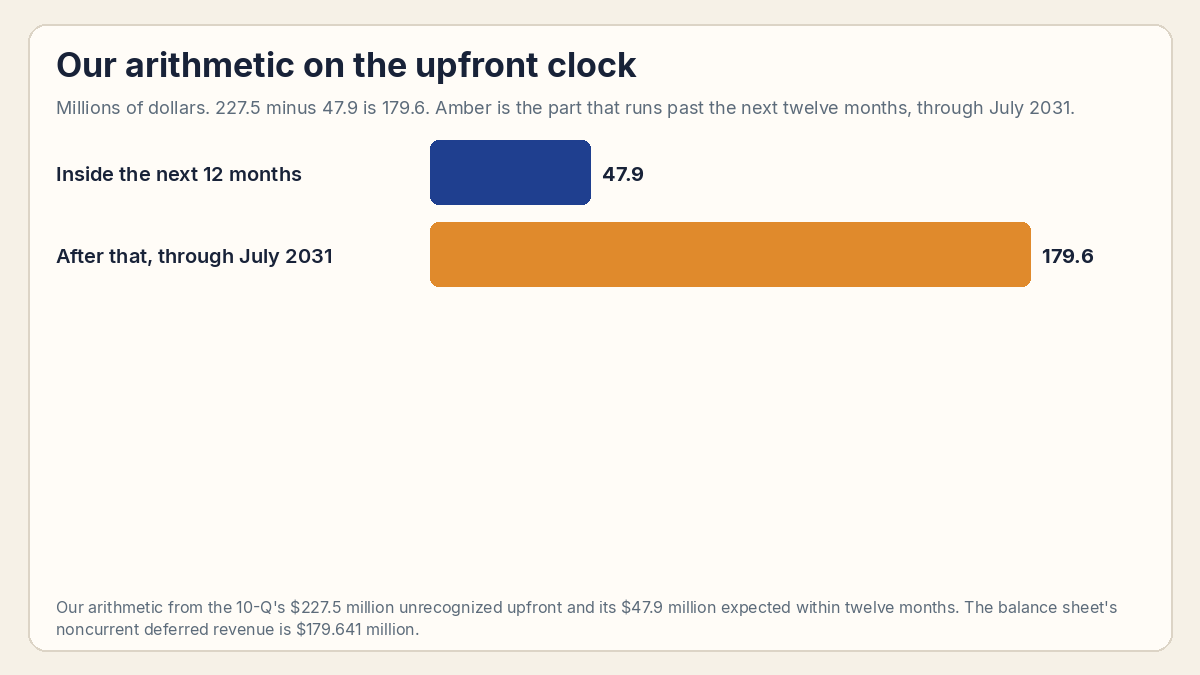
Amber is 227.5 minus 47.9, our arithmetic. Navy is the $47.9 million the 10-Q expects inside twelve months.
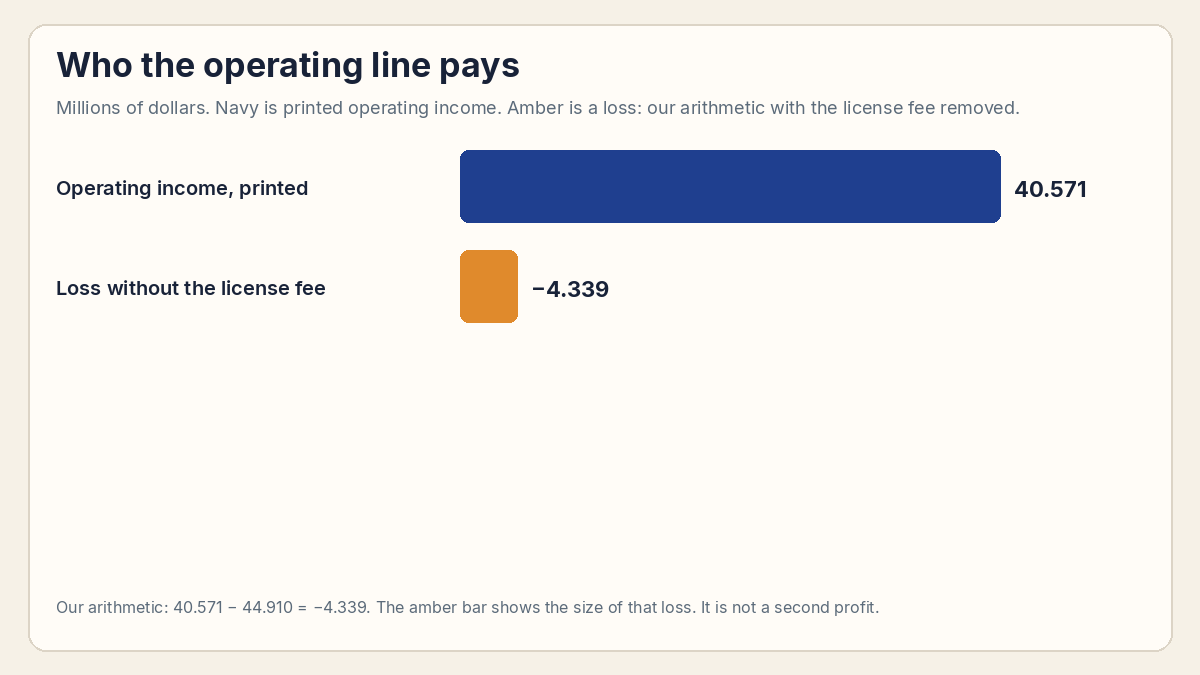
The amber figure is the loss, and the label carries the minus sign.
Where does the money stick?
It sticks in the upfront fee, on a clock that runs through July 2031. A smaller pile sticks in product that has been paid for and not shipped.
Samsung has the license. Netlist has the net cash. The upfront is earned as time passes. The stuck balance is the unrecognized $227.5 million, and our arithmetic puts $179.6 million of it past the next twelve months.
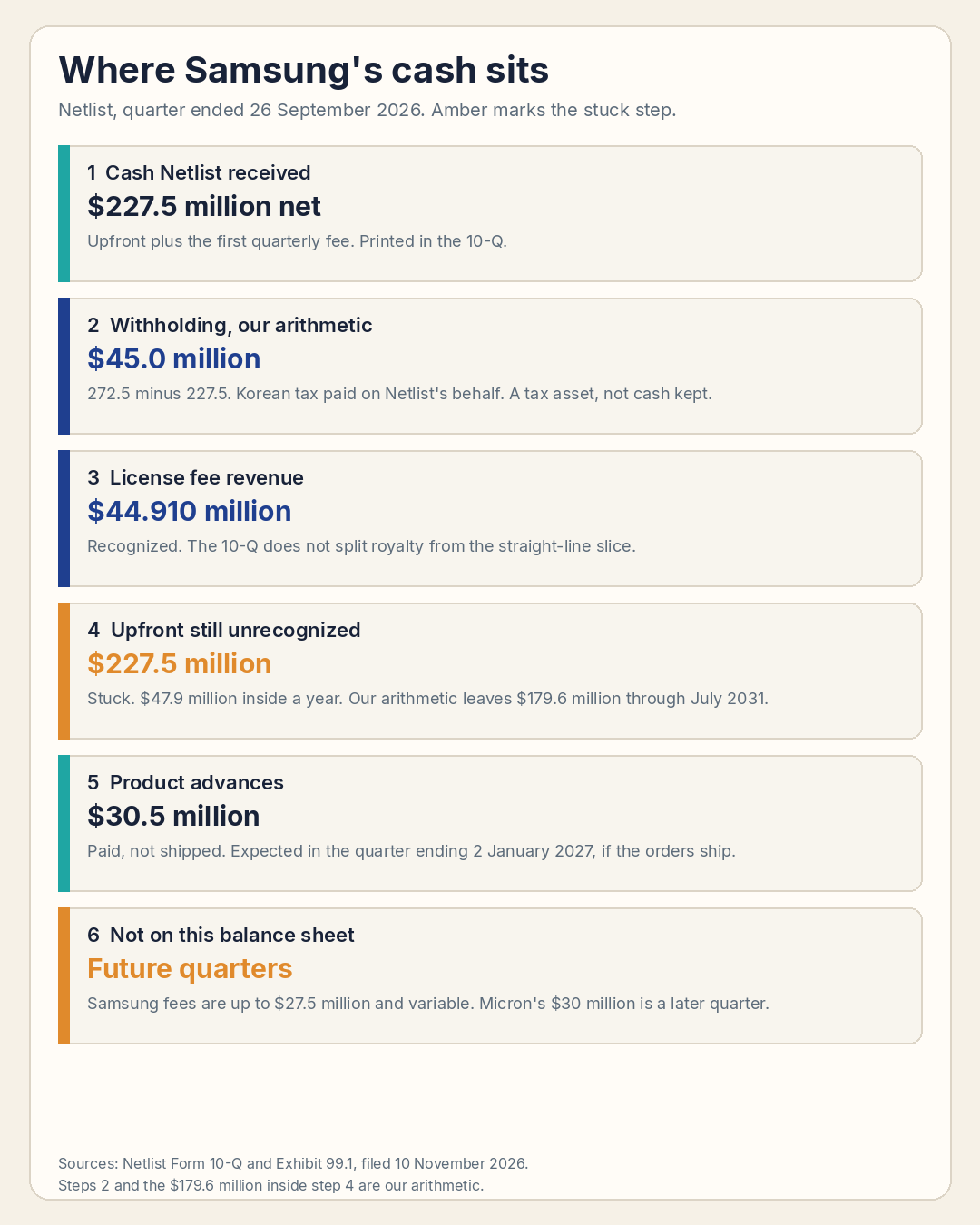
The $30.5 million of product advances is the short clock. The 10-Q expects that revenue in the quarter ending 2 January 2027, upon shipment. That quarter has 14 weeks. If the orders slip, the cash stays deferred.
Capitalized contingent legal fees are approximately $32.9 million, with about $1.8 million amortized this quarter onto a line the 10-Q does not name. The prepaid supply asset is $15.5 million. Our arithmetic: a $17.0 million grant-date fair value minus $1.0 million of cash is the $16.0 million asset the note describes, and 16.0 − 0.5 = 15.5 after this quarter's cost-of-sales amortization.
The chief financial officer says the quarter produced $245 million of operating cash flow. The cash-flow statement in the release is nine months, at $244,991 thousand. It does not print a quarterly operating-cash line. Restricted cash is $10,000 thousand.
Is the upfront still stuck?
Yes. The unrecognized upfront is $227.5 million, the revenue line does not show how much of $44.910 million was the royalty, and the later quarterly fees are not a booked receivable.
Straight-line recognition means some of the upfront is already earned. The 10-Q prints the remainder, not that slice. The approximate $239 million gross upfront minus $227.5 million is $11.5 million, our arithmetic on an approximate figure. It is not a printed amortization line, and it is not peeled out of the $44.910 million.
The quarterly fee is "up to" $27.5 million net, on a formula, and the August 8-K adds refund rights. This quarter's receipt included a fee at that figure. The next nineteen quarters are not printed, and the $750.0 million ceiling is not a receivable. Micron's $600 million is a later agreement. The first Micron receipt was not cash at 26 September. The upfront cheque has cleared. The earning of it has not.
What dates matter
The quarter is closed. The clocks that can move the deferred balances are still open.
| When | What | Why it matters |
|---|---|---|
| 1 July 2026 | License effective date in the 10-Q litigation note | The date that note uses for the twenty-quarter window. |
| 31 July 2026 | License effective date in the 5 August 8-K, and the supply agreement in the 10-Q | The other day in July. This pulse does not choose between them. |
| 4 August 2026 | Samsung license, settlement and supply agreements | The contract behind the upfront fee. |
| 26 September 2026 | Quarter end | The balance sheet date. Micron is not in it. |
| 5 October 2026 | Micron license | $30 million a quarter from the fourth calendar quarter of 2026. Not these sales. Dismissals wait on the first receipt. |
| 16 Oct, 4 Nov, 5 Nov 2026 | New patent complaints, including an ITC filing | After the quarter. The legal-cost line is not finished because Samsung settled. |
| 10 November 2026 | Earnings release, 8-K and 10-Q. Call at 5:00 p.m. Eastern | This pulse uses the filings. It does not use the webcast. |
| Quarter ending 2 January 2027 | Fourteen-week fourth quarter | The 10-Q expects the $30.5 million of product advances to be recognized on shipment. |
| July 2031 | End of the unrecognized upfront, as the revenue note writes it | The long clock. The last Samsung quarterly window in the same filing is the second calendar quarter of 2031. |
The earnings release says the statements are unaudited. The filing does not give a later review date.
How is this different from the chip print?
The 5 November Qualcomm pulse had handsets in the books and no data-center row. Here the cash is in the bank, license revenue is $44.910 million, and the upfront beside it is still deferred.
The 10 November Wonik IPS pulse stopped at an unnamed bridge under operating profit. Netlist's net income is larger than operating income because of the tax benefit. The hole is the upfront, above revenue.
This week's CoreWeave wire is a backlog waiting on power that is not live. Netlist's wait is the earning schedule on cash already received.
What would change this view?
The view is that Samsung has paid, delivered product has been recognized, and the upfront stays deferred through July 2031. A filing would change it by doing any of these.
- [ ] A note splits the $44.910 million between the quarterly royalty and the straight-line slice of the upfront.
- [ ] The next twelve months recognize something other than the $47.9 million the 10-Q expects from the upfront.
- [ ] Samsung's formula, an adjustment, or a refund cuts the upfront or prints a quarterly fee below $27.5 million net.
- [ ] Micron's initial $30 million arrives, and the filing shows how much of it is deferred.
- [ ] The $30.5 million of product advances is not recognized in the quarter ending 2 January 2027.
- [ ] A reviewed statement moves operating income off $40,571 thousand, or puts the license fee inside cost of sales.
- [ ] The 10-Q's silence on the Google stay is replaced by a line that says the stay has lifted or has ended.
The view holds while the 10 November 10-Q stands and the upfront remains unrecognized.
Practical takeaways
- Product sales were $60.194 million and Samsung license fees were $44.910 million. Operating income was $40.571 million. Net income was $85.448 million.
- Net cash from Samsung was $227.5 million. The unrecognized upfront is also $227.5 million. Our arithmetic puts $179.6 million of that upfront past twelve months, through July 2031.
- Without the license fee, operating income is a loss of $4.339 million, our arithmetic. Product gross margin is 39.783 percent. Blended gross margin is the printed 65.5 percent.
- $30.5 million is cash for product the 10-Q says ships after quarter-end, expected by 2 January 2027. Micron's $30 million quarters are not in these sales.
- The license effective date is 1 July in one 10-Q note and 31 July in the August 8-K. The revenue note still runs the upfront through July 2031.
FAQ
What did Netlist report for the third quarter of 2026?
Net sales were $105.104 million for the quarter ended 26 September 2026, of which product sales were $60.194 million and Samsung license fees were $44.910 million. Operating income was $40.571 million and net income was $85.448 million. The statements in the earnings release are unaudited.
Who gets paid on this print?
Customers who already received memory, and Samsung, which has paid for the license. Netlist recognized the product sales and $44.910 million of license fees. The upfront fee is still deferred.
Why is the upfront license still deferred?
The 10-Q says the upfront license fee is recognized straight-line over the term, and $227.5 million of it was still unrecognized at 26 September 2026. Of that balance, $47.9 million is expected within twelve months and the rest through July 2031.
Is the upfront still stuck?
Yes. The unrecognized upfront is $227.5 million, the 10-Q does not split the $44.910 million between the quarterly royalty and the straight-line slice, and the later quarterly fees are not booked as a receivable.
When does the next hard number land?
The 10-Q expects the $30.5 million of product advances to be recognized in the quarter ending 2 January 2027, upon shipment. Micron's first $30 million fee belongs to the fourth calendar quarter of 2026, which this quarter's statements do not include.
Keep reading on the map
- Explained: Deferred revenue
- This door: United States · Qualcomm's missing data-center row
- Sibling doors: Taiwan · Korea · Wonik IPS and the unnamed net line · China
- The stack: Semiconductors · CoreWeave's backlog and power that is not live
How we check this
The thousands are Exhibit 99.1 to the 10 November 2026 Form 8-K. The deferred-revenue split, the tax note, Samsung's terms, Micron, and the later complaints are the Form 10-Q filed the same day. The 31 July date is the 5 August 2026 Form 8-K. The 1 July date is the 10-Q litigation note. Where a source is silent, the piece says so.
Last reviewed: 11 Nov 2026 · Next review: when Netlist reports the quarter ending 2 January 2027, or when a filing splits the $44.910 million license fee.
References
- Netlist, Inc., Exhibit 99.1 to the Form 8-K filed 10 November 2026. Unaudited condensed statements for the quarter ended 26 September 2026, in thousands, the gross-margin sentence, the cash highlight, and the chief executive and chief financial officer quotations. Exhibit 99.1, 10 November 2026
- Netlist, Inc., Form 10-Q for the quarterly period ended 26 September 2026, filed 10 November 2026. Revenue recognition, deferred revenue, income taxes, the supply asset, customer and supplier concentration, litigation, and the Micron subsequent event. Form 10-Q, quarter ended 26 September 2026
- Netlist, Inc., Form 8-K filed 5 August 2026. Samsung license effective 31 July 2026, the upfront and quarterly fee terms, withholding, adjustment and refund rights, and the five-year term. Form 8-K, 5 August 2026