
Booked Six Months: Who Gets Paid as China's 8-Inch Lines Fill on AI Power
China's legacy 8-inch foundries have been running full on AI-server power semiconductors since the start of the year, while TSMC and Samsung cut capacity. Order books stretch about six months. Foundries are paid first; server builders wait on the wafers.

China's older chip factories are full. On 16 October The Herald Business reported that market researcher SigmaIntel sees Chinese legacy foundries including SMIC, Hua Hong and Nextchip running at full capacity since the start of the year on power semiconductors for AI servers. At the same time TSMC and Samsung are cutting 8-inch capacity, shrinking the global pool by about 6% this year. Order books stretch about six months. The foundries are paid as wafers ship. The stuck step is the 8-inch line itself.
CHINA PULSE · SEMICONDUCTORS / AI DATA CENTERS · Data as at 16 Oct 2026 · Next update: Q1 2027 mature-node wafer price prints, date not set
Affects: Semiconductors · AI Data Centers · Hyperscalers — Markets: China · Taiwan · Korea · US
Education only, not advice to buy or sell any security. Figures are as stated by the companies or reported. Full utilisation is not the same as finished new capacity. Our own sums are labelled.
The numbers that matter this week
Chinese legacy 8-inch
Full
SMIC, Hua Hong, Nextchip since early 2026
ReportedGlobal 8-inch capacity
~6% down
TSMC and Samsung cutting · further ~2% by 2027
ReportedOrder-book visibility
~6 months
8-inch industry books already filled out
Stuck stepSMIC Q2 sales
+36% YoY
TrendForce via Herald · about US$3B (SCMP)
ReportedHua Hong / Nextchip Q2 sales
+17% / +21%
TrendForce via Herald Business 16 Oct
ReportedQ1 2027 8-inch wafer prices
+4%
vs Q4 2026 · mature 12-inch +5 to 8%
ReportedFigures from SigmaIntel as reported by The Herald Business on 16 October 2026, TrendForce research notes of May, June and August 2026, and SCMP's 13 August 2026 earnings report. Status chips are Second Order’s read.
On this page: Why it matters · What changed · Why 8-inch · Who fills the gap · Prices and earnings · Our math · Who gets paid · What is stuck? · Dates next · What would change this · FAQ
Why does an old wafer size decide who gets paid in AI halls?
Because the chips that move power inside an AI server still mostly come from 8-inch lines. Leading GPUs and accelerators grab the headlines and the advanced packaging slots. But every rack still needs power-management ICs, discrete power devices and high-voltage converters to turn hall power into the voltages the boards can use. Many of those parts remain on mature processes run on 200-millimetre wafers. When those lines fill up, the bind shows up not as a missing GPU, but as a missing voltage regulator, PSU stage or PMIC behind the rack.
That is a different stuck step from the ones we have already mapped in China this month. On 9 October our SMIC margin Pulse followed logic folding and the gross-margin guide. On 12 October our CXMT server DRAM Pulse followed memory for AI servers. On 14 October our NBS storage and power Pulse followed the macro print. This Pulse sits one layer down the power chain: the foundry floor that still makes the chips that feed the hall.
For what those halls are, see what an AI data center is. For why the rack, not the single chip, is now the unit that sets power demand, see rack-scale AI, explained.
1 · 8-inch capacity binds
Who: Power chips for AI servers
Paid: Books ~6 months out · global pool ~6% smaller
2 · Chinese legacy lines fill
Who: SMIC, Hua Hong, Nextchip
Paid: Full since early 2026 on AI power orders
3 · Prices and tools follow
Who: Wafer ASP up · equipment at existing fabs
Paid: SMIC 8-inch hikes estimated 10–20% this year
4 · Server and hall builders wait
Who: OEMs, PSU and VRM makers, DC operators
Paid: Cannot energise denser racks without the parts
What did SigmaIntel and the earnings trail say?
Three strands landed together. One is today's Herald Business report of SigmaIntel's view. The second is the August earnings trail for SMIC and Hua Hong. The third is TrendForce's earlier research on how AI power ICs and capacity cuts reset mature-node pricing.
- 16 October — full capacity, shrinking pool. SigmaIntel, via The Herald Business, said Chinese legacy foundries including SMIC, Hua Hong and Nextchip have been operating at full capacity since the start of the year. Demand for power semiconductors used in AI servers is strong enough that even full capacity is not enough. Samsung and TSMC's cutbacks are projected to shrink global 8-inch foundry capacity by about 6% this year and about another 2% by 2027. Order books across the 8-inch industry are already filled about six months out.
- 16 October — prices still rising into 2027. SigmaIntel expects wafer prices for mature processes of 28 nanometres and above, measured on 12-inch wafers, to rise 5 to 8% in the first quarter of next year versus the fourth quarter of this year. Eight-inch wafer prices are expected to rise about 4%. High utilisation plus higher power and materials costs make further process price increases hard to avoid.
- August earnings — utilisation at the ceiling. TrendForce's mid-August read of the earnings calls put SMIC's second-quarter utilisation at 93.7% and Hua Hong's at 102.8%. SMIC Co-CEO Zhao Haijun said wafer starts were exceeding earlier expectations as AI servers and data centres pulled in logic, power-management and optical parts. BCD power-management products were already booked through the end of 2027. SMIC said it aims to keep utilisation around 95%, leaving about 5% for research.
- May–June research — the pattern was already visible. TrendForce wrote in May that average 8-inch utilisation among the world's top ten foundries would approach 90% in 2026, up from about 80% in 2025, and stay above 80% through the first half of 2027 as TSMC and Samsung kept cutting 8-inch. A June follow-up said Chinese 8-inch lines were the first wave to hit full utilisation, with foundry prices up between 5 and 15% from the first to the second quarter of 2026.
Put together, today's report is not a one-day surprise. It is the public confirmation that the AI power-chip order wave has sat on Chinese 8-inch lines for most of the year while the global pool of those lines got smaller.
Why is 8-inch still the bind for AI power chips?
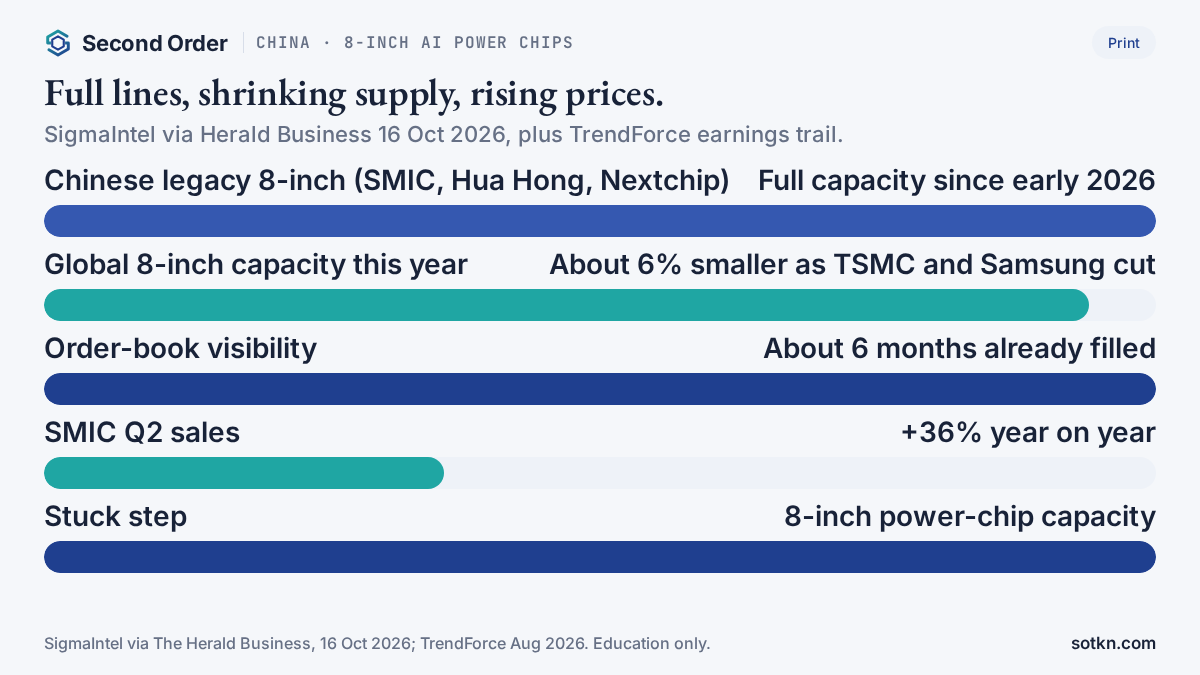
Eight-inch foundries make chips on 200-millimetre wafers. They are not where the densest AI accelerators are built. They are where a long list of supporting chips is still cheapest and most proven to make: power management ICs, power discrete devices, some image sensors and display drivers. AI data centres did not retire that list. They multiplied it. Each denser rack needs more conversion stages, more regulation and more protection devices between the hall's power feed and the GPU board.
Sigmaintell, as summarised on 15 October, put the point bluntly: average capacity utilisation across major global wafer fabs was seen reaching about 91% in the fourth quarter of 2026, with 8-inch lines at full load on AI-related power-management ICs and power devices, and order visibility generally approaching six months. The 48-volt high-voltage power-management ICs used in AI servers were still predominantly produced on 8-inch processes. The bind here is capacity for those parts, not the definition of the chip.
Two supply moves tightened the same knot. First, leading foundries such as TSMC and Samsung have been reducing 8-inch capacity since the second half of 2025 to free space and capital for larger 12-inch lines and advanced nodes. Second, AI server, general-purpose server and edge-AI demand kept pulling power-related processes. TrendForce's May note said that mix pushed top-ten 8-inch utilisation toward 90% in 2026 even as the installed base shrank. A smaller pool running hotter is the definition of a stuck step.
Expansion does not clear it quickly. SigmaIntel told The Herald Business the shortage is unlikely to ease fast because of the time 8-inch foundries need to add capacity. New tools in an existing bay are faster than a greenfield fab, which is why SMIC has talked about adding equipment where space already exists, but even that is measured in quarters and qualification cycles, not weeks. Meanwhile the books are already filled about half a year ahead.
Who fills the gap when TSMC and Samsung step back?
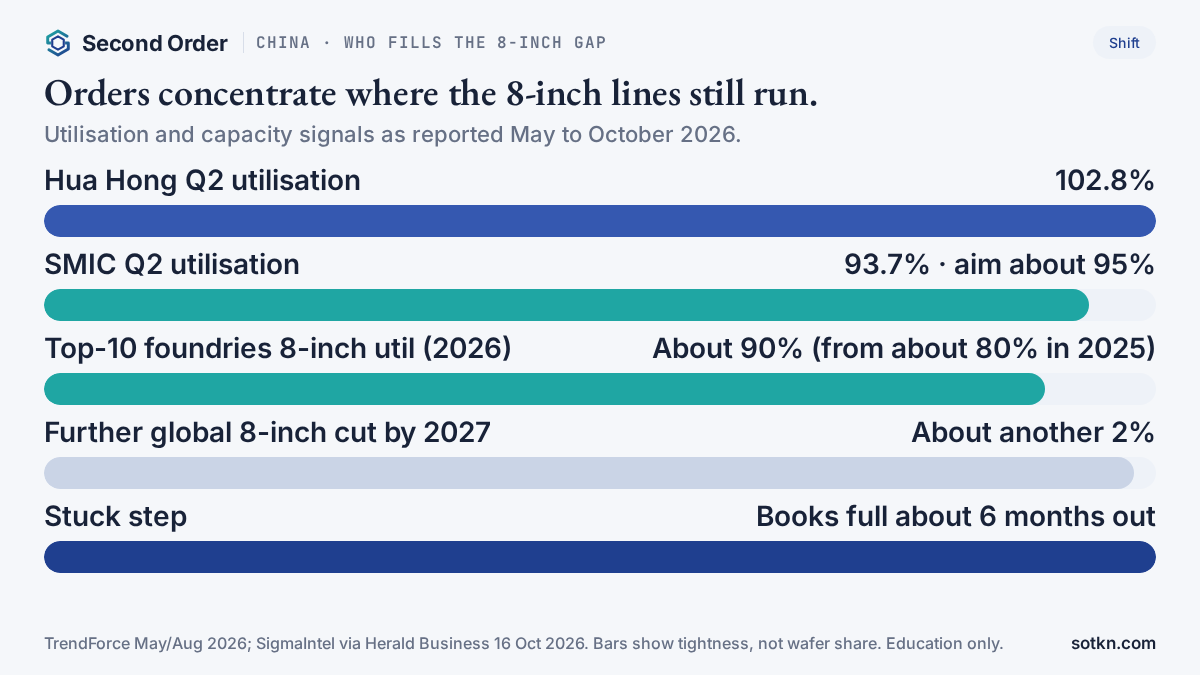
Orders concentrate on the foundries that kept mature 8-inch and specialty lines open. In China that means SMIC, Hua Hong and Nexchip (also styled Nextchip in some reports), among others. SigmaIntel's full-capacity call since early 2026 is the demand side of that concentration. TrendForce's May note described the same migration from the supply side: as Taiwanese foundries shifted capacity and raised prices, customers in high-voltage and related processes increasingly turned to Chinese foundries for more stable pricing and capacity availability, a shift visible since the second half of 2025.
What SigmaIntel flagged (16 Oct)
What the earnings trail showed
Hua Hong is also building more specialty capacity, not only sweating what it has. TrendForce relayed that its Fab 9B project in Wuxi is planned as a 12-inch specialty line with about 55,000 wafers a month, about RMB 3.8 billion of investment, aimed for completion by January 2027, and that its acquisition of HLMC's Fab 5 had received registration approval. Those projects matter for 2027 supply. They do not erase a six-month 8-inch book that is already full today.
SMIC, for its part, lifted monthly capacity by about 1.7% quarter on quarter to about 1.1 million 8-inch-equivalent wafers in the second quarter and added some 12-inch capacity, while saying it could add equipment at existing fabs with available space. That is the behaviour of a foundry defending a full book, not hunting for loading.
None of this says Chinese foundries now own the whole AI server. Advanced accelerators, HBM and CoWoS-class packaging still sit elsewhere on the map, which is why our semiconductors layer and Taiwan and Korea Pulses keep their own stuck steps. The claim here is narrower: for the power chips that still run on 8-inch, the paying seats are concentrating where those lines are still open and full.
What are prices and earnings doing while the lines stay full?
They are rising with utilisation. The Herald Business reported industry estimates that SMIC's cumulative 8-inch process price increases this year would reach 10 to 20%, and that Hua Hong raised prices by 5 to 10% in the first quarter. SigmaIntel's forward look adds another step: about 4% on 8-inch wafers in the first quarter of 2027 versus the fourth quarter of 2026, and 5 to 8% on mature 12-inch.
Earnings have followed the loading. TrendForce figures cited on 16 October put SMIC's second-quarter sales up 36% year on year, Hua Hong's up 17% and Nextchip's up 21%. SCMP's mid-August report put SMIC's June-quarter revenue at about US$3 billion, up 36% year on year, with net profit up 261.7% to about US$479.2 million, and Hua Hong's net profit up 385.9% to about US$38.6 million. Those profit jumps mix volume, mix and price; the Pulse's point is simply that full books and rising process prices are already visible in reported sales.
Capital is noticing the same specialty-foundry story. The Herald Business noted that Yuexin Semiconductor, a Guangzhou-based 12-inch foundry, listed on Shenzhen's ChiNext board this week and raised about RMB 6.16 billion, roughly US$921 million, before any overallotment. That is not an 8-inch print, but it is another sign that Chinese mature and specialty capacity is being funded while advanced-node geopolitics stay loud.
For the hall side of the same power problem in another market, see our US Pulse on AI halls buying their own power. Different country, same theme: whoever clears the power step gets paid before whoever waits on it.
Our math: what do the numbers say?
- Capacity shrink vs books: a global 8-inch pool about 6% smaller this year, with books filled about six months out, means the remaining lines are rationing time, not hunting orders (our arithmetic on the reported figures).
- Further shrink: another about-2% cut by 2027 on top of this year's 6% is a multi-year tightening, not a one-quarter blip (our arithmetic).
- Utilisation headroom at SMIC: aiming for about 95% with a 5% research buffer, from 93.7% in Q2, leaves very little spare for a surprise AI power-chip surge (reported targets; our read).
- Hua Hong above 100%: 102.8% utilisation means the line is past nameplate through mix, overtime or equivalent measures — there is no idle 8-inch cushion there (reported).
- BCD booked into 2027: SMIC's power-management book through end-2027 is longer than the six-month industry visibility SigmaIntel cites, so the tighter products are even more pre-sold (reported; our comparison).
- Price stack this year into next: SMIC's estimated 10 to 20% cumulative 8-inch hikes in 2026 plus SigmaIntel's about-4% Q1 2027 step is a sustained ASP climb, not a single print (reported bands; our stacking).
- Sales vs capacity: SMIC sales +36% year on year while monthly capacity only edged up about 1.7% quarter on quarter implies price and mix did heavy lifting alongside volume (reported; our read).
- Who waits: every month of 8-inch power-chip lead time is a month an AI server BOM cannot close, even if the GPU allocation is in hand (our read of the stuck step).
What this tells you: money and demand are not what is missing on these lines. The missing piece is open 8-inch capacity for power parts, and the global pool of that capacity is getting smaller while Chinese legacy lines are already full.
Who gets paid first?
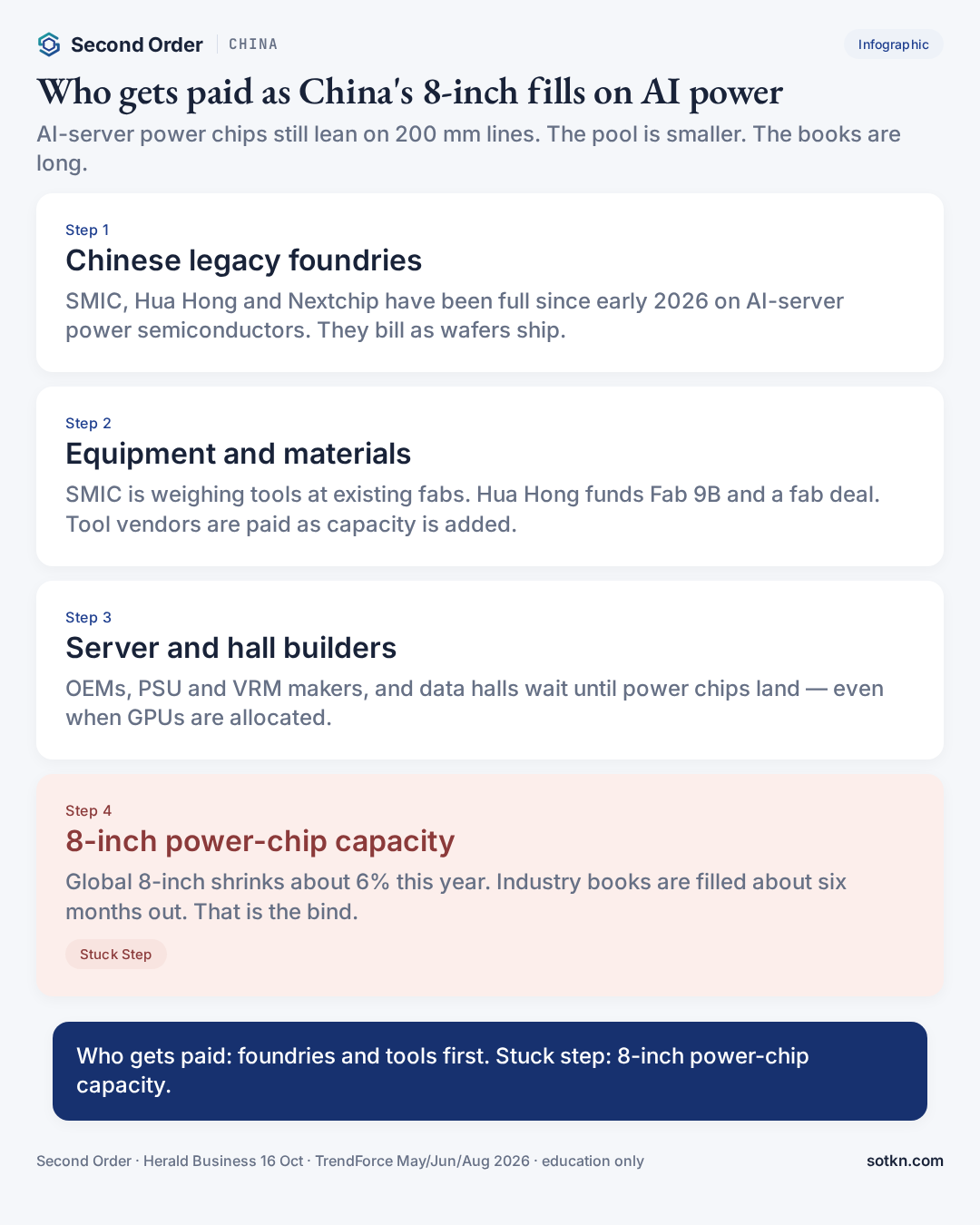
First, the Chinese legacy foundries — as wafers ship. SMIC, Hua Hong and Nexchip bill customers when lots move through a full line. With utilisation at or above practical ceilings and process prices up, that cash arrives before a single AI rack is energised. The six-month book is their backlog, not their hope.
Second, the equipment and materials vendors — when tools and chemicals are installed or consumed. SMIC talking about adding equipment at existing fabs, and Hua Hong funding Fab 9B and a fab acquisition, are orders for tool makers and construction partners. They are paid while the end server is still on a drawing board.
Third, the power-device and PMIC designers — if they already hold foundry slots. A design house with wafers booked into 2027 can ship; one still hunting an 8-inch slot waits. Allocation, not ideas, decides who collects.
Fourth, the server OEMs, PSU and VRM makers — only when the parts land. They cannot ship a complete AI server BOM, or close a denser rack design, until the power stages arrive. Their revenue waits on the foundry clock even when GPU supply is the louder headline.
Fifth, the data-hall owners and tenants — when racks switch on and stay busy. A hall with power and GPUs but missing conversion stages still earns nothing. For why idle compute earns nothing, see GPU utilization, explained. For the wider pattern of cash sticking at the stuck step, see where the stuck step moves.
One-line rule: on China's 8-inch AI power-chip wave right now, foundries and tool vendors are paid as wafers and equipment move, designers are paid if they already hold slots, and server and hall operators wait on the parts. The stuck step is 8-inch power-chip capacity.
So what is the stuck step?
Eight-inch / power-chip capacity — the wafer starts that turn AI-server power designs into parts. Not GPU advanced packaging: that bind lives on other floors. Not hall megawatts alone: our US and Korea Pulses cover those. Three things make this step stick:
- Pool size: TSMC and Samsung are cutting 8-inch, shrinking global capacity about 6% this year and about another 2% by 2027, while AI power demand rises.
- Loading: Chinese legacy lines named by SigmaIntel have been full since early 2026; SMIC and Hua Hong printed 93.7% and 102.8% utilisation in the second quarter.
- Clock: industry books are filled about six months out, SMIC's BCD power-management is booked through end-2027, and new capacity takes longer than a quarter to qualify.
So-what: whoever already sits on those 8-inch slots gets paid as prices rise. Whoever needs incremental power chips for denser AI racks waits, even if the GPU and the hall power feed look fine on paper. The same shape — capacity binds, cash sticks upstream — showed up when Alibaba's power ambitions met the grid, and when Korea's ICT export print showed who got paid on finished goods. Different door, same map rule.
Which dates test this read next?
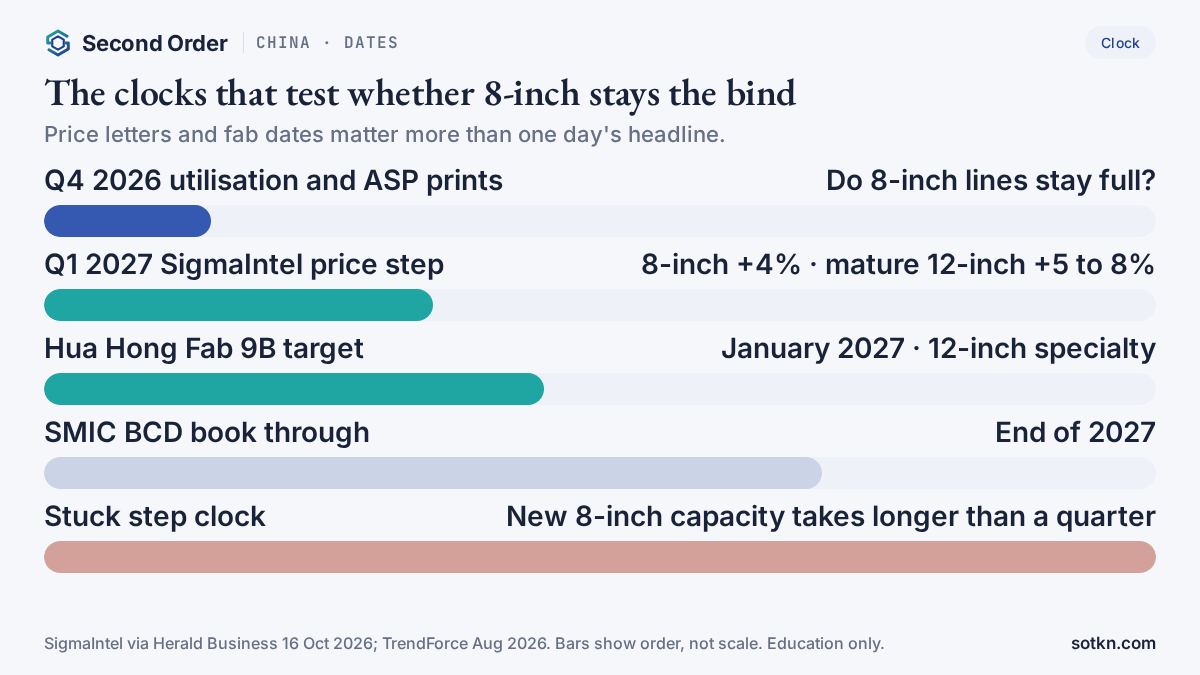
- Fourth quarter of 2026 — foundry utilisation and ASP prints. The test: whether 8-inch stays at full load and whether the next price letter lands.
- First quarter of 2027 — SigmaIntel's +4% 8-inch and +5 to 8% mature 12-inch price step. The test: whether customers accept another hike while books stay long.
- Through end-2027 — SMIC BCD power-management book. The test: whether that book stretches again or finally shows open slots.
- January 2027 — Hua Hong Fab 9B completion target (12-inch specialty). The test: whether new specialty capacity eases any spillover from 8-inch power demand.
- Not set — SMIC equipment adds at existing fabs. The test: whether incremental tools show up as named capacity, or only as commentary.
The price and utilisation dates test whether the bind is still tightening. The fab dates test whether supply can catch the book without another year of rationing.
What would change this view?
- TSMC or Samsung reverse 8-inch cuts and reload mature power capacity — the global pool stops shrinking and Chinese lines lose some spillover.
- AI-server power designs migrate quickly onto 12-inch in volume — the 8-inch bind eases even if those lines stay full on other products.
- SMIC, Hua Hong or Nexchip report open 8-inch slots and falling utilisation — demand, not capacity, would become the story.
- A sharp drop in AI server builds cuts PMIC and power-device orders — the six-month book would shorten for cyclical reasons, not because supply caught up.
Practical takeaways
- SigmaIntel via Herald Business (16 Oct): Chinese legacy foundries including SMIC, Hua Hong and Nextchip full since early 2026 on AI-server power chips
- Global 8-inch capacity set to shrink about 6% this year as TSMC and Samsung cut, with about another 2% by 2027
- Order books across 8-inch are filled about six months out; SMIC BCD power-management booked through end-2027
- SMIC Q2 sales +36% YoY; Hua Hong +17%; Nextchip +21% (TrendForce via Herald); SMIC util 93.7%, Hua Hong 102.8%
- Foundries and tool vendors are paid as wafers and equipment move; server and hall operators wait on the parts
- Stuck step: 8-inch power-chip capacity
FAQ
What is an 8-inch foundry?
It is a chip factory that makes chips on 200-millimetre wafers, often called 8-inch wafers. These lines are older and less dense than today's cutting-edge plants, but they are still the main place to make many power chips, image sensors and display drivers. Contract factories such as parts of SMIC, Hua Hong and Nexchip run a lot of this work for other companies.
Why do AI servers need so many power chips?
An AI rack draws far more electricity than an ordinary server rack. That power has to be converted, stepped down and regulated at every stage — from the hall's power supply units down to the voltage regulators next to each GPU. Those jobs sit on power-management chips and power devices that are still mostly made on 8-inch lines.
Why are TSMC and Samsung cutting 8-inch capacity?
They are shifting floor space and investment toward larger 12-inch wafers and more advanced processes, where margins and demand for leading chips are higher. SigmaIntel says that pullback shrinks global 8-inch capacity by about 6% this year. Orders that still need 8-inch then concentrate on the foundries that kept those lines, including Chinese ones.
Is this the same story as SMIC's Q2 margin guide?
No. Our 9 October Pulse covered SMIC's logic and margin guide. This Pulse is about the 8-inch power-chip bottleneck and how AI server demand fills those older lines while global capacity shrinks. The companies overlap; the stuck step is different.
Is this investment advice?
No. Education only. It maps who gets paid and which step is stuck. It is not a recommendation to buy or sell any security.
Keep reading on the map
- China Markets hub — country page
- SMIC margin Pulse — logic folding and the Q3 guide
- CXMT server DRAM Pulse — memory for AI servers
- NBS storage and power Pulse — the macro print
- US halls buy their own power — another power stuck step
- Semiconductors on the stack · AI Data Centers
- All Markets doors — Taiwan, Korea, US, China, Singapore, Australia, Malaysia
How we check this. The full-capacity read on Chinese 8-inch foundries, the about-6% global capacity shrink, the six-month order books and the next-year price outlook come from SigmaIntel as reported by The Herald Business on 16 October 2026. Utilisation, BCD booking into 2027 and monthly wafer counts come from SMIC and Hua Hong earnings coverage via TrendForce in August 2026. The broader 8-inch utilisation and price-rise pattern comes from TrendForce research notes of May and June 2026. Q2 sales gains cited by The Herald Business are attributed there to TrendForce; SCMP's August report gives the dollar sales figure for SMIC. Analyst price targets and buy calls are left out on purpose. Anything we worked out ourselves is labelled “our arithmetic”. Full capacity and a preferred expansion plan are not the same as finished new lines, and we say so. The references we used are listed at the end. Our editorial standards →
Not investment advice. Do your own research.
References
- The Herald Business, China's legacy foundries ride AI wave to full capacity, 16 Oct 2026. biz.heraldcorp.com — SigmaIntel full-capacity read on SMIC, Hua Hong and Nextchip; global 8-inch shrink; six-month books; price outlook.
- The Herald Business (Korean), Chinese foundries at full tilt on AI, 16 Oct 2026. biz.heraldcorp.com — same SigmaIntel brief in Korean, dated 16 October.
- TrendForce, China's Top Two Foundries Hit Capacity Crunch, 17 Aug 2026. trendforce.com — SMIC 93.7% and Hua Hong 102.8% utilisation; BCD power-management booked through end-2027.
- TrendForce, Capacity Cuts and Surging Demand for AI Power ICs, 7 May 2026. trendforce.com — top-10 foundries' 8-inch utilisation near 90% in 2026; TSMC and Samsung cuts; order spillover to China.
- TrendForce, AI Component Capacity Squeeze to Extend Mature-Node Price Increases in 2027, 30 Jun 2026. trendforce.com — Chinese 8-inch first wave of full utilisation; foundry price rises of 5 to 15 percent.
- NewTimeSpace, Sigmaintell 8-inch foundry capacity outlook, 15 Oct 2026. newtimespace.com — Q4 2026 fab utilisation about 91%; 48V high-voltage PMICs for AI servers still mostly on 8-inch.
- South China Morning Post, AI demand drives triple-digit profit growth for SMIC, Hua Hong, 13 Aug 2026. scmp.com — SMIC Q2 sales up 36% year on year to about US$3 billion; Hua Hong profit surge.
- Reuters via TrendForce coverage, SMIC monthly capacity, Aug 2026. trendforce.com — SMIC monthly capacity about 1.1 million 8-inch-equivalent wafers in the second quarter.