Server DRAM by Year-End: Who Gets Paid While CXMT Proves Its New Chip
China's biggest memory maker, CXMT, says it will launch server memory on a new, denser DRAM cell by the end of 2026. It already earned ¥77.6 billion in the first half. The big three are paid first while server DRAM stays short. The stuck step is server testing.

China's biggest memory maker wants into the server. On 10 October, CXMT's president said it will launch a server memory stick built on a new, denser DRAM cell by the end of 2026. Server memory is the part of the chip market that is short right now, and the most profitable. Samsung, SK hynix and Micron are paid first. Server testing is the step that sets the pace.
CHINA PULSE · Data as at 12 Oct 2026 · Next update: CXMT's third-quarter report, due by the end of October
Affects: Semiconductors · HBM and memory · Hyperscalers — Markets: China · Korea · US
Education only, not advice to buy or sell any security. Figures are as reported; a launch target is not a shipment. Our own sums are labelled.
The numbers that matter this week
Server memory launch target
End-2026
DDR5 RDIMM on a 4F² cell · said 10 Oct
PrimaryMore cells in the same space
30-50%
4F² against today's 6F² cells
ReportedCXMT revenue, first half
¥150.3B
Up 873.6% on a year earlier
PrimaryCXMT net profit, first half
¥77.6B
Against a ¥2.3B loss a year earlier
PrimaryCXMT share of DRAM revenue, Q2
9.5%
Up from 7.6% in Q1 · fourth in the world
PrimaryServer testing
Months
Hundreds of processor and board checks
Stuck stepFigures from CXMT's half-year report, its 10 October conference speech as reported, and TrendForce, August to October 2026. Status chips are Second Order’s read.
On this page: Why it matters · What CXMT said · What is 4F²? · Why servers are harder · How much CXMT earns · Our math · Who gets paid · What is stuck? · Dates next · What would change this · FAQ
Why does a Chinese memory chip matter for the AI build?
Because memory is one of the parts the AI build is short of, and server memory most of all. Every AI server needs two kinds. The famous one is HBM, the stacked memory beside each AI chip. The plain one is the DDR5 sticks beside the server's main processor. AI agents, which call many tools and hold a lot of data while they work, run on ordinary servers too, and those servers need more of the plain kind.
TrendForce, the Taiwan market researcher, said on 30 September that cloud companies and server makers are buying more server memory for agentic AI. It expects server DRAM to stay undersupplied through the fourth quarter, with ordinary DRAM contract prices up 10% to 15% on the quarter. Suppliers are moving their best factory lines to server products, which leaves phones and PCs short too.
Three companies make almost all of that memory: Samsung, SK hynix and Micron. Micron said on 1 October that more than 75% of its output for its 2027 year is already committed, as we noted in the Micron 2027 output Wire. A fourth seller that can pass server tests would change who has the bargaining power. That is why CXMT's plan matters outside China.
1 · AI servers need more memory
Who: Cloud companies, server makers
Paid: Server DRAM undersupplied in Q4
2 · The big three sell it
Who: Samsung, SK hynix, Micron
Paid: Contract prices still rising
3 · CXMT tries to enter servers
Who: CXMT, on a new 4F² cell
Paid: Launch target end-2026
4 · Buyers test before they buy
Who: Processor makers, server makers, clouds
Paid: Hundreds of checks per platform
What did CXMT say on 10 October?
CXMT's president, Cao Kanyu, spoke at the fourth Integrated Circuits and Chiplet Conference in Shanghai, held on 9 and 10 October. Chinese business papers and TrendForce reported four points.
- A new memory cell. CXMT has made key progress on a 4F² DRAM design. Its core is a transistor CXMT designed itself, called a vertical surrounded gate, which stands upright and is wrapped by its control gate.
- A new way to build it. The design makes the memory cells and the control circuits on separate wafers, then joins the two wafers face to face with hybrid bonding, a way of fusing copper contacts directly.
- A product with a date. CXMT expects to launch a new DDR5 RDIMM, server memory, using these technologies by the end of the year.
- A patent wall. CXMT says it holds more than 300 published patent families on 4F², more than any other maker. It published its first paper on the design in 2021 and updates in 2023 and 2025.
What it did not say matters too. The speech gave no speed, no capacity per stick and no exact launch date. The STAR Market Daily, which first reported the speech, noted that. A Korean paper, Money Today, reported that the first product may use the new design only in part.
The speech follows a busy September. CXMT put its fifth-generation DRAM process, which it calls G5, and its LPDDR6 phone memory into mass production, TrendForce said. The server stick is the next step up.
What is 4F², in plain English?
A DRAM chip is a grid of billions of tiny cells. Each cell holds one bit, as a charge in a small capacitor with a transistor as its door. Chipmakers measure the size of a cell in F, the smallest line they can print. Today's cells take about six F-squares of space each, so they are called 6F².
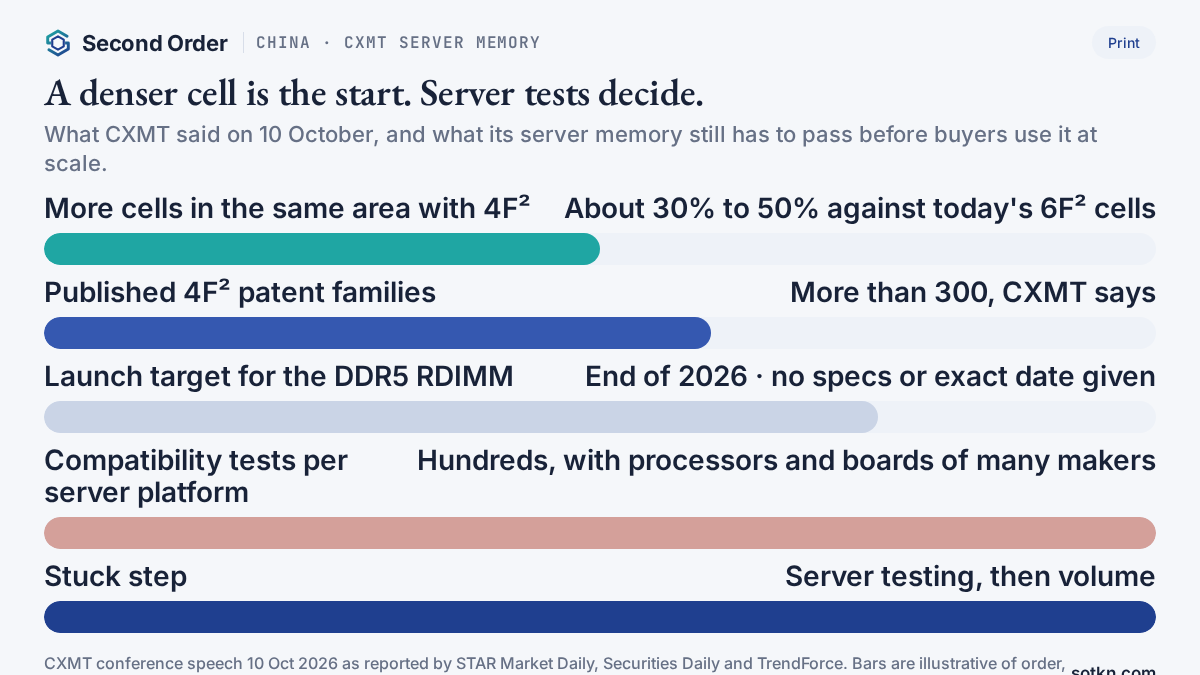
A 4F² cell takes four. The trick is to stand the transistor on end, so it sits under the capacitor rather than beside it. That frees space. TrendForce put the gain at about 30% to 50% more memory in the same area. More bits from each wafer, without a smaller line, is the prize every memory maker is chasing.
It is hard. Moving from 6F² to 4F² changes the base design, so old process steps cannot simply be reused. CXMT said it had to solve new problems in the word lines and bit lines, the wires that reach each cell. The control circuits also get in the way, which is why the cells and the circuits are built on separate wafers and bonded.
The big three are working on it too, but more slowly. Samsung showed a 16-gigabit test chip with 4F² cells and wafer bonding at ISSCC, the chip industry's main conference, in 2026. A Korean paper, Economy Tribune, reported that Samsung is putting hybrid bonding first and does not expect it on the market before 2028, with no firm date for 4F². SK hynix is working on its own upright-transistor version. Tian Feng, an industry analyst quoted by the Global Times, said none of the top three has yet made 4F² at large scale.
Why is server memory harder than phone memory?
Because servers never rest, and buyers test everything first. A CXMT manager told Securities Daily what a server stick must do.
- Run 24 hours a day, 7 days a week, without errors.
- Survive the voltage jolt when a technician swaps a part while the server stays on.
- Pass hundreds of compatibility tests with processors and boards from different makers and different generations.
- Carry fast signals along the long wires of the stick without them fading or flipping bits.
That is where the big three have a long lead. SK hynix brought the first DDR5 to market in 2020. In December 2025 it became the first to have a 256-gigabyte DDR5 RDIMM, made with 32-gigabit chips, validated for Intel's Xeon 6 server processors, Economy Tribune reported. Samsung already makes 128-gigabyte server sticks in volume.
Validation is slow on purpose. A cloud company will not put a new memory supplier into thousands of servers until the processor maker, the server maker and its own engineers have all signed off. A launch at the end of 2026 starts that clock. It does not end it. For how memory makers turn wafers into server parts, see what Micron does and what SK hynix does.
How much is CXMT earning already?
A lot, and without servers. CXMT's first half-year report since listing, filed in Shanghai on 28 August, showed the memory shortage at work.
- Revenue of ¥150.3 billion in the first half of 2026, up 873.6% on a year earlier.
- Net profit of ¥77.6 billion, against a loss of ¥2.3 billion a year earlier. Profit before one-off items was higher still, ¥78.8 billion, so it came from selling memory, not from subsidies.
- The second quarter alone brought about ¥99.5 billion of revenue and ¥52.8 billion of profit, up 113% on the first quarter.
- Cash from operations was ¥131.2 billion, more than the profit. Money owed by customers at the end of June was only ¥6.7 billion.
- DDR memory brought in ¥69.5 billion and LPDDR phone memory ¥78.2 billion.
Compare that with the recent past. CXMT lost money every year from 2022 to 2024, more than ¥30 billion in all, and made its first annual profit, ¥1.9 billion, in 2025. The 21st Century Business Herald noted that with so little owed by customers, CXMT is in the strong position of being paid before it delivers.
CXMT, first half of 2026
The server memory market
Our math: what do the numbers say?
- Second-quarter profit margin: ¥52.8 billion of profit on about ¥99.5 billion of revenue is about 53 cents of profit on every yuan of sales (our arithmetic).
- One quarter against a whole year: the ¥52.8 billion second-quarter profit is about 28 times CXMT's profit for all of 2025 (our arithmetic).
- Paid before delivery: ¥6.7 billion owed by customers is about 4% of first-half revenue, and cash from operations was about 1.7 times profit (our arithmetic).
- Share: Samsung, SK hynix and Micron held about 87.6% of DRAM revenue in the second quarter, about nine times CXMT's 9.5% (our arithmetic from TrendForce's figures). CXMT gained 1.9 points in one quarter.
- Density: if a 4F² cell fits 30% to 50% more bits in the same area, the same wafers could in theory yield 1.3 to 1.5 times the memory (our arithmetic). That holds only if yields match today's, which nobody has shown yet.
- Micron's next quarter: $61.5 billion against $54.23 billion is about 13% growth in three months (our arithmetic).
What this tells you: CXMT does not need servers to make money this year. The shortage already pays it on phone and PC memory. Servers are where the highest prices are, and where the three incumbents earn the most. For why a profit is not yet cash spent on new capacity, see cash capex, explained.
Who gets paid first?
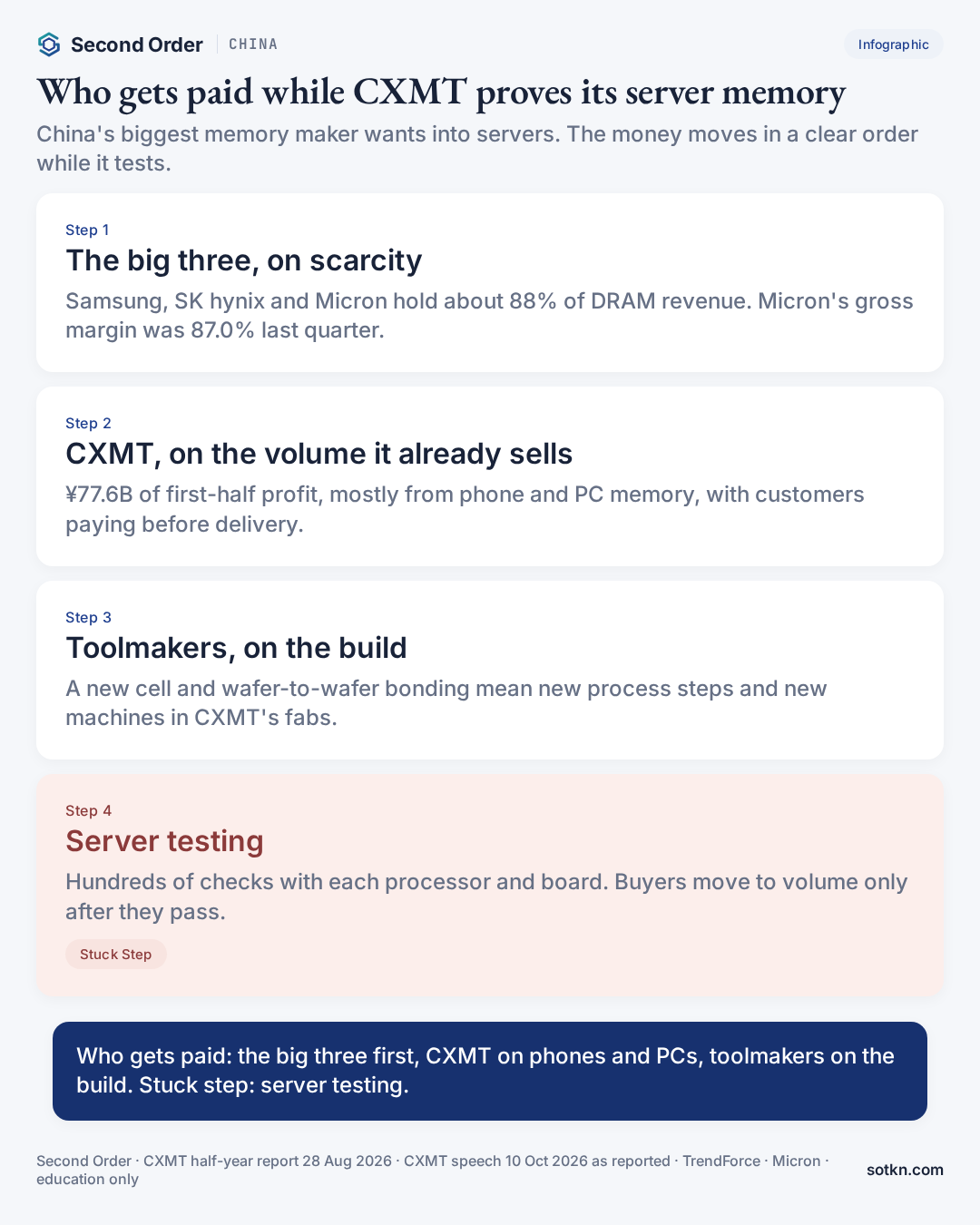
First, the big three — on scarcity, now. Server memory is short this quarter and contract prices are still rising. Micron's gross margin was 87.0% in the quarter to 3 September, and it guided about 86.25% for the next. Samsung guided ₩107.4 trillion of operating profit for the third quarter, as we covered in the Samsung Q3 Pulse. Today's Micron 10-K Pulse shows the deposits customers have already paid to hold their place in line.
Second, CXMT — on the volume it already sells. Its money today comes from phone and PC memory, sold into a short market and paid for up front. A server launch is extra, not the base. The first-half split, ¥69.5 billion from DDR and ¥78.2 billion from LPDDR, shows where the volume is.
Third, the toolmakers — on the build. A new cell and wafer-to-wafer bonding mean new process steps and new machines in CXMT's fabs, on top of the extra lines it is adding. Memory makers everywhere are buying tools and parts at higher prices; see the ASML parts price Wire and memory process tools, explained.
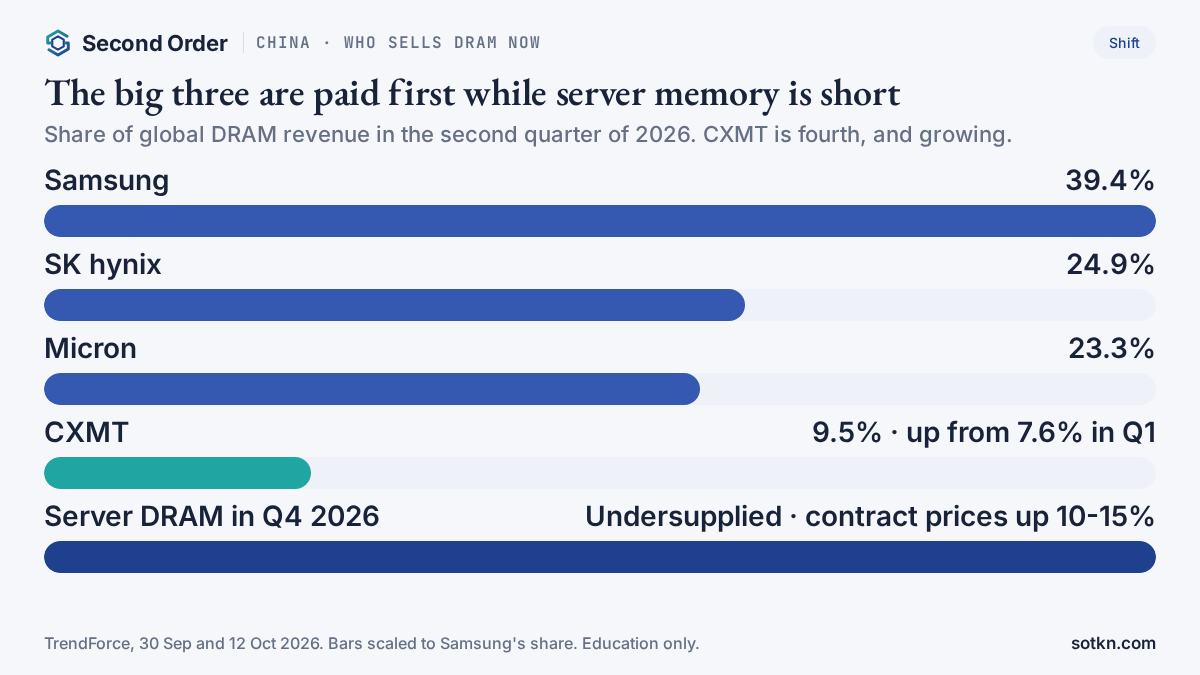
Fourth, the buyers — who pay and wait. Chinese cloud companies and server makers pay the big three's prices now. A second source that passes their tests would give them leverage on price and supply. Until then they wait. For how much one Chinese cloud plans to build, see Alibaba's 20 GW Pulse; for what a hyperscaler is, see hyperscalers, explained.
One-line rule: while CXMT proves its server memory, the big three are paid first on scarcity, CXMT is paid on the phone and PC memory it already sells, toolmakers on the build, and buyers pay and wait. The stuck step is server testing.
So what is the stuck step?
Server testing, also called qualification. Not demand, which is strong. Not money, which CXMT has: it held ¥143.4 billion in cash at the end of June. Three things make it stick:
- Time: a launch at the end of 2026 starts months of checks with each processor and server platform. Buyers move to volume only after that.
- Yield: a new cell built a new way has to come off the line with few faulty chips. A first product that uses the design only in part would be a sign this step is still being worked out.
- Trust: server buyers run memory day and night for years. They pick suppliers with long records. CXMT's record so far is in phones and PCs.
So-what: CXMT's plan does not ease the server memory shortage this quarter or next. It puts a name and a date on a possible fourth supplier. If the tests go well, the shortage could ease faster than the big three's plans suggest, starting in China. If they drag, the incumbents keep their pricing. The same pattern, where a real advance waits on a slow gate, shows up in SMIC's wafer story and in Korea's HBM wafer mix. For the general rule, see where does the stuck step move?.
Which dates test this read next?
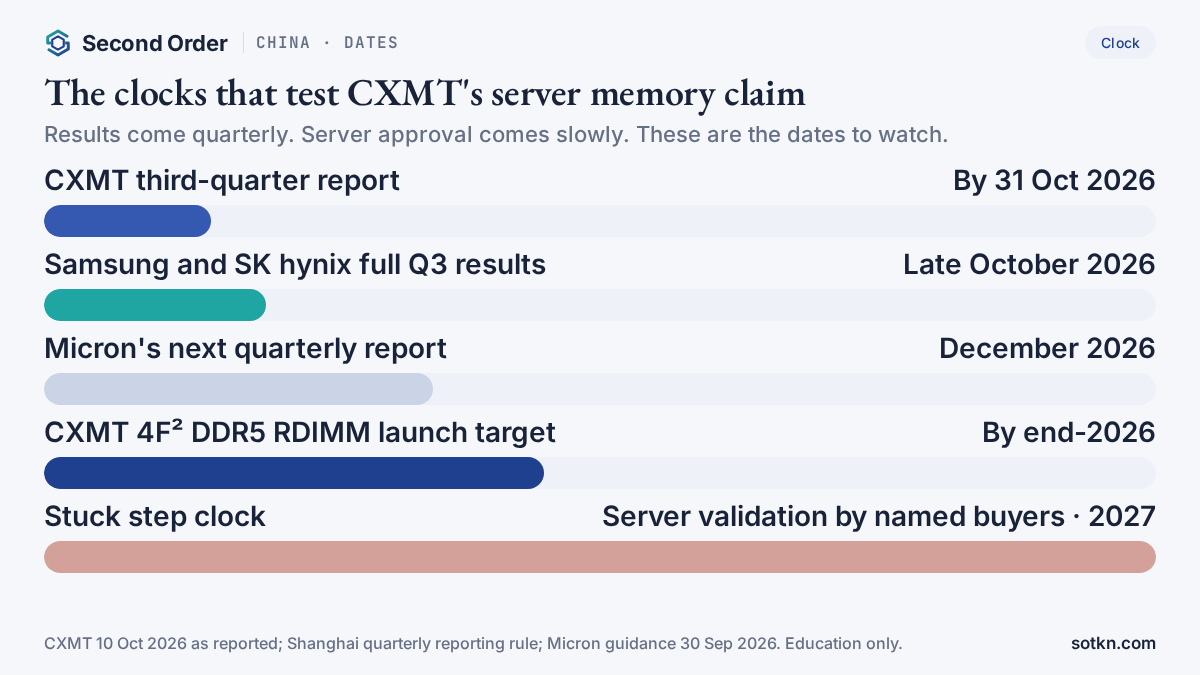
- By 31 Oct 2026 — CXMT's third-quarter report, under Shanghai's rule that quarterly reports come out within a month. The test: does profit keep rising, and does it say more about the server stick?
- Late October 2026 — Samsung and SK hynix usually give full third-quarter results. The test: what they say about server memory prices and supply for 2027.
- December 2026 — Micron reports the quarter it guided at $61.5 billion. The test: does the margin hold near 86%?
- By 31 Dec 2026 — CXMT's own target to launch the 4F² DDR5 RDIMM. The test: a named spec and a named first customer.
- 2027 — server qualification. The test: a processor maker or a major Chinese cloud confirming it has validated CXMT server memory.
- 2028 — the earliest Samsung's hybrid-bonded DRAM is expected on the market, as reported.
The year-end launch matters, but the first validation by a named buyer matters more. That is when the stuck step starts to move.
What would change this view?
- A major Chinese cloud or server maker says it has validated CXMT's server memory early in 2027 — the stuck step moves faster than we expect.
- The first product turns out to be mostly the old cell design — the density gain is further away than the headline suggests.
- Server memory prices stop rising before CXMT is ready — the prize shrinks and the race matters less.
- New export rules limit the tools CXMT needs for bonding or the new cell — the build step, not testing, becomes the bind.
Practical takeaways
- CXMT said on 10 October it will launch DDR5 server memory on a 4F² cell by the end of 2026
- 4F² can fit about 30% to 50% more memory in the same area; no maker has yet made it at large scale
- CXMT earned ¥77.6 billion in the first half, mostly from phone and PC memory, paid up front
- Server DRAM stays undersupplied in the fourth quarter; the big three hold about 88% of DRAM revenue
- Stuck step: server testing, with each processor, board and buyer
FAQ
What is CXMT?
ChangXin Memory Technologies is China's biggest maker of DRAM, the working memory in phones, PCs and servers. It is based in Hefei and listed on Shanghai's STAR Market in July 2026. Until now it has mostly sold memory for phones and PCs.
What is a DDR5 RDIMM?
It is the standard memory stick in a server. “Registered” means it carries an extra chip that steadies the signals, so a server can hold many sticks and run day and night without errors. Each new one must be tested with the server's processor and board before buyers will use it.
What does 4F² mean?
F is the smallest feature a chipmaker prints. Today's DRAM cells take about six F-squares of space each. A 4F² cell takes four, by standing the transistor upright. The same chip area can hold about 30% to 50% more cells.
Is this investment advice?
No. Education only. It maps who gets paid and which step is stuck. It is not a recommendation to buy or sell any security.
Keep reading on the map
- China Markets hub — country page
- Micron's 10-K Pulse — the US memory story today
- Samsung's Q3 Pulse — the Korean side of the shortage
- What is HBM? · HBM and memory on the stack
- All Markets doors — Taiwan, Korea, US, China, Singapore, Australia, Malaysia
How we check this. CXMT's plans come from its president's conference speech as reported by named Chinese and industry outlets. Its results come from its half-year report filed in Shanghai. Market shares come from TrendForce and Counterpoint as published. Micron's figures are from its own results release. Price outlooks are TrendForce's. Analyst price targets and buy calls are left out on purpose. Anything we worked out ourselves is labelled “our arithmetic”. A launch target is not a shipment, and we say so. The references we used are listed at the end. Our editorial standards →
Not investment advice. Do your own research.
References
- STAR Market Daily (Cailian Press), CXMT announces 4F² DRAM progress, products by year-end, 10 Oct 2026. cls.cn — the conference speech, patent families, no specs or exact date.
- TrendForce News, CXMT Accelerates 4F² DRAM Push, Eyes Year-End Server DDR5 RDIMM Launch, 12 Oct 2026. trendforce.com — density, hybrid bonding, Q2 DRAM shares, Samsung and SK hynix timelines.
- Global Times, CXMT's innovative 4F² DRAM marks breakthrough in China's push into server memory chips, 11 Oct 2026. globaltimes.cn — industry comment and Counterpoint share figures.
- Securities Daily via 10jqka, CXMT 4F² technical breakthrough, new DDR5 RDIMM expected by year-end, 11 Oct 2026. news.10jqka.com.cn — what server memory has to pass, in the company's words.
- 21st Century Business Herald, CXMT publishes its first half-year report since listing, 28 Aug 2026. m.21jingji.com — first-half revenue, profit, cash flow, receivables, product split.
- CXMT, 2026 Half-Year Report (Shanghai Stock Exchange filing), 29 Aug 2026. static.sse.com.cn — the filed half-year accounts.
- TrendForce, AI Server Demand Sustains Memory Contract Price Increases in 4Q26, 30 Sep 2026. trendforce.com — fourth-quarter DRAM contract prices and server DRAM supply.
- Micron Technology, Reports Record Fiscal Fourth-Quarter and Full-Year 2026 Results, 30 Sep 2026. investors.micron.com — quarterly revenue, gross margin and guidance.