Storage +46.7%: Who Gets Paid While China's Power Price Stays Minus
NBS printed September prices on 14 October. Who gets paid is the device step — storage, computers, phones. The stuck step is electricity: factory power prices are still falling.

China's statistics office printed September prices this morning. Who gets paid is the device step: data-storage, computers, tablets and phones. The stuck step is electricity. Factory power prices are still falling while the halls that use them are already on.
CHINA PULSE · Data as at 14 Oct 2026 · Next update: after October CPI/PPI, around 10 November
Affects: Semiconductors · Hyperscalers · Power — Markets: China · US · Korea
Education only, not advice to buy or sell any security. Figures are from the National Bureau of Statistics print dated 14 October 2026. Our own sums are labelled “our arithmetic”.
The numbers that matter this month
Headline PPI (Sep 2026)
+5.0% YoY
+1.2% MoM · widened 1.2 points from August
PrimaryData-storage devices, CPI
+46.7% YoY
Tablets +23.6% · computers +21.8% · phones +14.9%
Paid nowComputers, communications & electronics, PPI
+5.8% YoY
+0.4% MoM · electrical machinery +6.2% YoY
AI-namedElectricity & heat production, PPI
−3.9% YoY
−0.2% MoM · Jan–Sep −4.0%
Stuck stepFuels & power, purchase prices
+13.6% YoY
+3.7% MoM · overall purchases +6.9% YoY
Inputs dearerHeadline CPI (Sep 2026)
+0.9% YoY
+0.2% MoM · core CPI +1.0%, unchanged
PrimaryFigures from NBS CPI, PPI and Dong Lijuan’s interpretation, all dated 14 Oct 2026, 09:30 Beijing. Status chips are Second Order’s read.
Why does China matter now?
Because China makes a large share of the world’s computers, phones and storage devices, and is building AI halls that cannot import the usual chips. An NBS price print is a country-wide invoice for that map.
Two earlier China pulses already showed the cash. On 2 October we covered NBS’s January–August industrial-profit print: electronics profits were up 1.1 times and carried 62% of the whole industrial profit jump — see 62% of the Jump. On 7 October we covered Alibaba’s plan to run more than 20 GW of data centres by 2032, with June-quarter capex at RMB67.7 billion — see Alibaba’s 20 GW Pulse. Today’s print is not another profit or capex number. It is the September price list.
Prices say who can raise the invoice this month. Profits say who kept the cash. They agree on devices. They still disagree on power.
1 · Devices on the shelf
Who: Storage, computer, tablet and phone makers
Paid: CPI prices up 15–47% year on year
2 · Electronics factories
Who: Computer, communications and electronics; electrical machinery
Paid: PPI +5.8% and +6.2% YoY
3 · Coal, oil, metals
Who: Extractors and refiners
Paid: Most of the PPI month — not the AI map
4 · Electricity and heat
Who: Power generators and heat suppliers
Paid: Factory prices still −3.9% YoY
Labels: Paid first = selling prices rose most. NBS named AI = electrical machinery and electronics, both +0.4% on the month. Stuck step = factory electricity still falling.
If you only remember one thing: a 5% PPI is not an AI boom on the generator’s invoice. Most of the monthly jump is oil, metals and coal. The AI-named pair added 0.07 points. Power generation is still minus.
What changed on 14 October
At 09:30 Beijing, NBS released three documents together: the September consumer-price report, the September producer-price report, and Dong Lijuan’s reading of both. Dong is chief statistician of the bureau’s urban department. The English mirror was not yet up when we filed; the Chinese originals are dated 14 October 2026.
Headline CPI rose 0.9% year on year, 0.1 points wider than August’s 0.8%, and 0.2% on the month. Core CPI was unchanged at 1.0%. Food fell 1.7%. Gasoline rose 16.6% and accounted for about 0.47 points of the CPI rise, Dong said. That is oil, not chips.
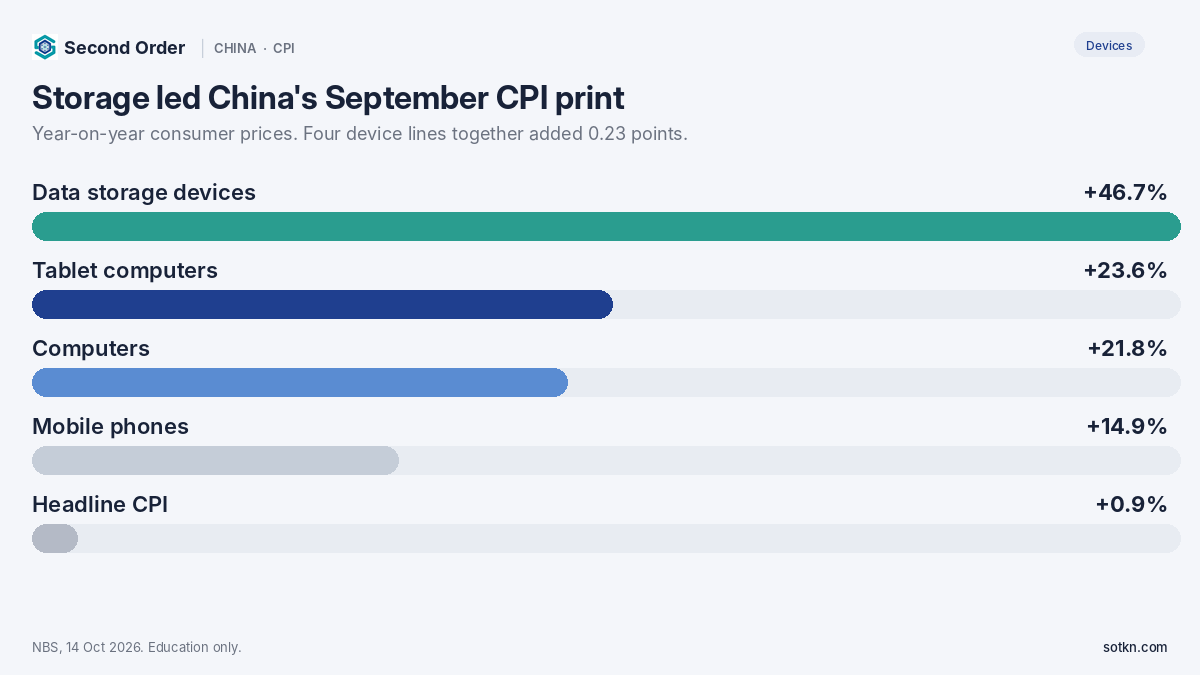
The device lines sat under industrial consumer goods. Dong wrote that higher costs pushed mobile-phone, computer, data-storage and tablet prices up 3.7%, 2.0%, 1.7% and 1.5% on the month, together adding about 0.04 points to monthly CPI. Year on year the same four lines rose 14.9%, 21.8%, 46.7% and 23.6%, together adding about 0.23 points. The bureau named the driver as costs, not a fashion cycle.
Headline PPI rose 5.0% year on year, 1.2 points wider than August’s 3.8%, and 1.2% on the month, 0.8 points wider than August’s 0.4%. Purchase prices for industrial producers rose 6.9% year on year and 1.2% on the month. From January to September, factory-gate prices were up 2.3% and purchase prices 3.6%.
Dong split the monthly PPI into three stories. First, international crude oil and non-ferrous metals: petroleum extraction, refined products, organic chemicals, non-ferrous ore and smelting together added about 0.63 points. Second, coal for winter heating and a bounce in steel and cement after seven months of falling building-materials prices, together about 0.38 points. Third — and this is the sentence that puts the print on the AI map — “accelerated development in areas such as artificial intelligence and computing-power-electricity coordination” lifted electrical machinery and computer, communications and other electronic equipment, both +0.4% on the month, together about 0.07 points.
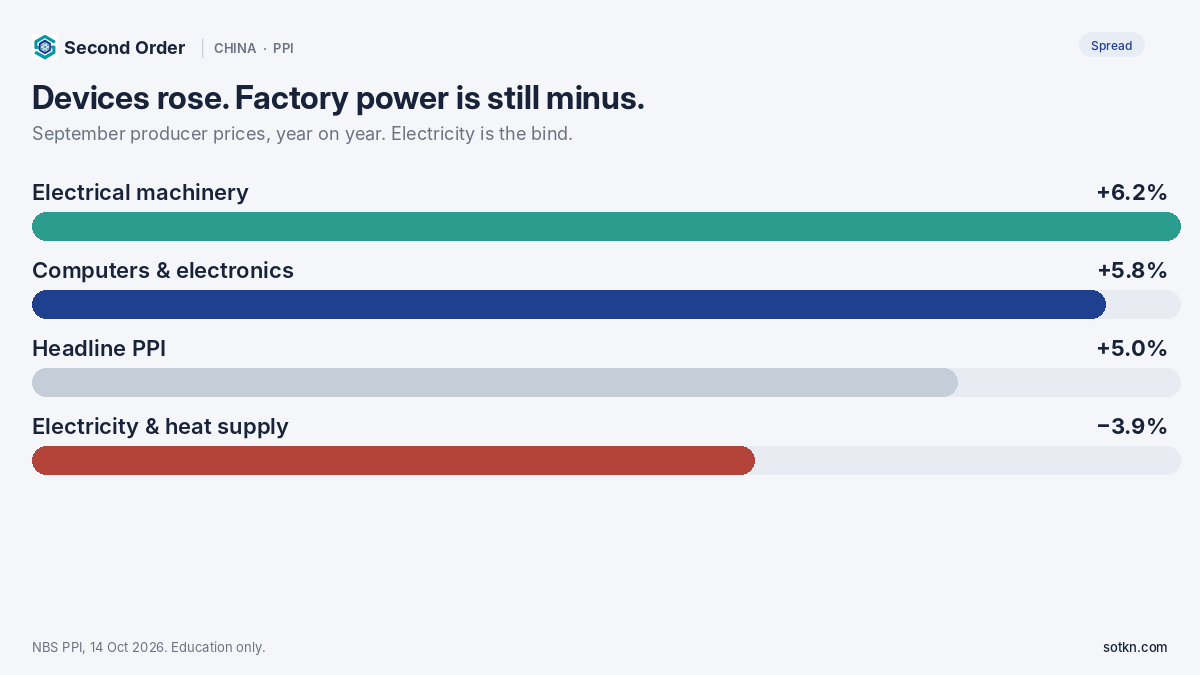
Year on year, computers, communications and electronics rose 5.8%. Electrical machinery rose 6.2%. Electricity and heat production and supply fell 3.9% year on year and 0.2% on the month. For January–September the same power line is −4.0%. The table in the PPI release is the source for those three power numbers. NBS did not say the halls are dark. It said the generator’s factory price is still going down.
Our math: labelled our arithmetic
The bureau already did the hard attribution. What follows is simple division on its own figures, labelled as ours.
- Four device lines and the CPI rise. Dong put their year-on-year contribution at 0.23 points of a 0.9% CPI. That is 0.23 ÷ 0.9 = 26% of the CPI rise (our arithmetic). One consumer-price point in four, from storage, tablets, computers and phones.
- Storage versus phones. Data-storage devices at +46.7% against phones at +14.9% is 46.7 ÷ 14.9 ≈ 3.1 times (our arithmetic). The storage line is the one that sits closest to AI servers and to the memory shortage we mapped on Monday’s CXMT pulse.
- Oil and metals versus the PPI month. 0.63 points of a 1.2% monthly PPI is 0.63 ÷ 1.2 = 53% (our arithmetic). Coal, steel and cement at 0.38 points are 32%. The AI-named pair at 0.07 points are 6% (our arithmetic). A 5% PPI is mostly commodities. It is not mostly AI.
- The three stories leave a remainder. 0.63 + 0.38 + 0.07 = 1.08 points against a 1.2% month, so about 0.12 points, or 10%, sits in other industries (our arithmetic). We do not assign that remainder to chips.
- Electronics versus power. Computers and electronics at +5.8% against electricity and heat at −3.9% is a 9.7 point spread (our arithmetic). Electrical machinery at +6.2% against the same power line is 10.1 points (our arithmetic).
- Purchase prices versus factory-gate. Industrial purchase prices +6.9% against PPI +5.0% is a 1.9 point gap (our arithmetic). Fuels and power purchases at +13.6% against electricity factory-gate at −3.9% is 17.5 points (our arithmetic). The people who buy power and fuel paid more. The people who sell factory electricity did not.
- Means of production did the work. NBS said means of production rose 6.5% year on year and added 5.07 points to PPI. Consumer goods fell 0.1% and took off 0.03 points. 5.07 − 0.03 = 5.04, against a 5.0% headline (our arithmetic; rounding).

What this tells you: the device step cleared a price increase that is large enough to show up in CPI. The power step did not. The monthly PPI jump is real, and most of it is not AI. NBS still chose to name artificial intelligence and computing-power-electricity coordination as a third, smaller, monthly driver. We take the naming, and we take the 6% share, and we do not confuse them with the 53%.
This is not a shipment, yield, or company ASP. Stay on the CXMT and SMIC pulses for those.
Where does the money stick?
At the steps whose selling prices rose, and not at the step whose selling prices fell.
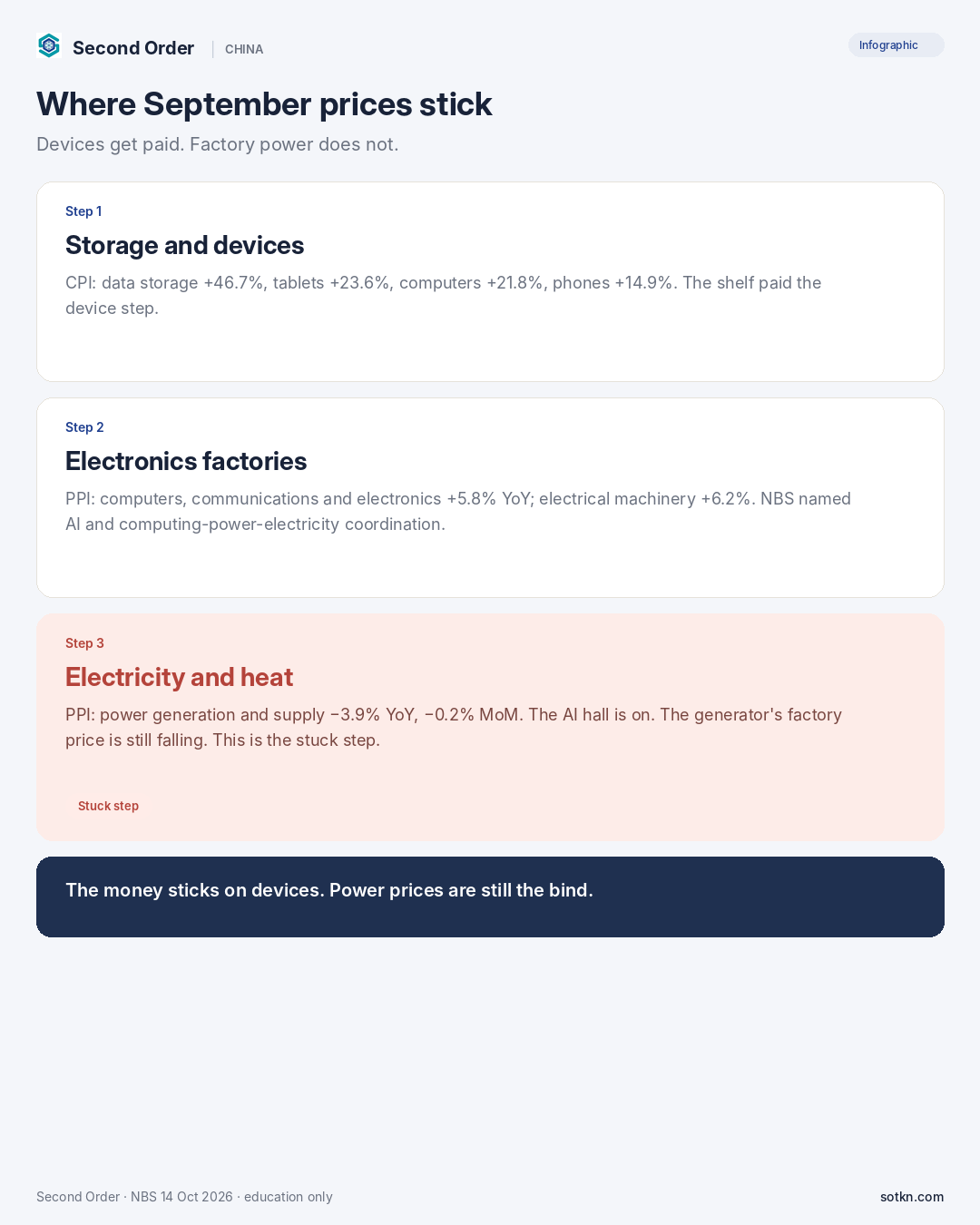
1. Device makers. Storage, computers, tablets and phones are the only consumer lines in this print that look like an AI-era shortage. Dong attributed the monthly rise to costs. Costs that stick in the selling price are the definition of a scarce step. For why memory is short in servers this quarter, see CXMT’s server-DRAM Pulse and Micron’s 10-K Pulse.
2. Electronics and electrical-machinery factories. The PPI lines NBS tied to AI and to computing-power-electricity coordination rose 5.8% and 6.2% year on year. That is the factory invoice, not the retail shelf. It includes servers, communications gear, and the electrical kit that sits between a hall and the grid. For the policy version of that coordination, see China’s power–computing Pulse.
3. Commodity producers. Coal, oil, chemicals and non-ferrous metals took most of the PPI month. They get paid. They are not the AI map. We list them so the 5.0% headline is not misread as a chip boom.
4. Power generators — not yet. Electricity and heat production and supply is still minus, on the month, the year and the first nine months. Halls can be full and the generator’s factory price can still fall when tariffs are set by the state rather than by the watt-hour the GPU uses. That is the bind we have been mapping under speed-to-power and, in the United States, under PJM’s 6.8 GW shortfall. China’s version in this print is a minus sign, not a queue.
One-line rule: while September prices hold this shape, device and electronics makers are paid on the invoice, commodity producers are paid on the bulk of PPI, and power generators wait on a tariff that has not turned. The stuck step is electricity.
Is electricity still stuck?
Yes. A minus 3.9% factory-gate price, a minus 0.2% month, and a minus 4.0% January–September average is not a step that has started to collect AI rent.
Three things keep it stuck. First, the tariff. China still sets a large share of industrial power prices administratively. Demand from AI halls can rise, as NBS said it did, without the generator’s list price rising in the same month. Second, the fuel bill. Purchase prices for fuels and power rose 13.6% year on year. That is the generator’s input, not its output. Third, the mix. Heat and legacy industrial load still dominate the electricity-and-heat PPI line. A new hall does not reweight that basket overnight.
So-what: NBS naming “computing-power-electricity coordination” as a demand driver is not the same as power getting paid. Coordination is a plan. A PPI plus would be a receipt. We have the plan in the September power–computing Pulse and in the data-services power Pulse. We do not yet have the receipt. For the longer clock, see where the stuck step moves: memory binds in quarters, power binds in years.
HBM and server DRAM remain short on the chip side. That is a different stuck step, dated in the CXMT and Micron pulses. Today’s print does not unstick them. It shows that even when devices clear higher prices, the watt behind the rack still does not.
What dates matter
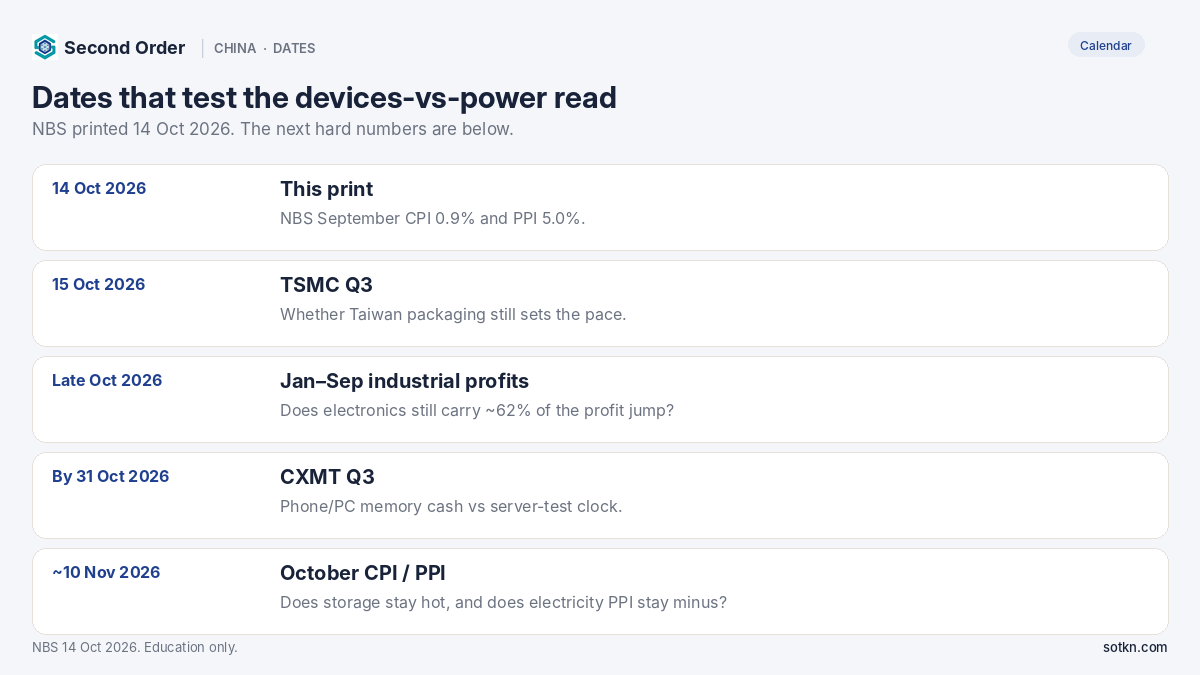
- 14 October 2026, midday Beijing — China Customs usually prints September trade the same day. Watch electronics lines, not the headline. We file on the 09:30 NBS print.
- 15 October 2026 — TSMC’s third-quarter results. Taiwan is still where leading-edge wafers and CoWoS packaging sit. China’s device CPI does not replace that gate.
- Late October 2026 — NBS industrial profits for January–September, the sequel to the 28 September print we covered on 2 October. The test: does electronics still carry something like 62% of the profit jump, or did September prices arrive without the cash?
- By 31 October 2026 — CXMT’s third-quarter report, under Shanghai’s one-month rule. The test: phone and PC memory cash versus the server-test clock from Monday’s pulse.
- Around 10 November 2026 — October CPI and PPI. The test: does data-storage stay in the 40s year on year, and does electricity and heat stay minus? A plus on power would be the first receipt.
The next CPI/PPI is the date that can move this view. Trade, TSMC and CXMT can only colour it.
How is this different from the electronics-profits Pulse?
The 2 October pulse was a profit print: electronics made ¥847.5 billion in the first eight months, up 1.1 times, and carried 62% of industrial profit growth. Who got paid was that P&L. The stuck step then was still advanced HBM — a chip constraint.
Today is a price print. Who gets paid is the device and electronics invoice in September. The stuck step is electricity’s factory price, which was already minus in the profit print (electricity and heat profits were down 15.1% in January–August) and is still minus in PPI. The two pulses agree on devices. They now name power, not HBM, as the price bind in this particular statistic. HBM is not unstuck. It is simply not what NBS measured this morning.
It is also different from Alibaba’s 20 GW plan (capex, 2032) and from PJM’s 6.8 GW US shortfall (a capacity auction). Same family of bind — watts — different receipt.
What would change this view?
- Electricity and heat PPI turns positive year on year — the stuck step starts to collect.
- The four device CPI lines cool together, and Dong stops attributing monthly rises to costs — the device step is no longer scarce on the shelf.
- NBS drops artificial intelligence and computing-power-electricity coordination from the monthly PPI note — the bureau itself would be walking back today’s naming.
- January–September industrial profits show electronics contributing far less than 62% of the jump — prices without cash.
- A large Chinese cloud or State Grid print shows hall power being billed at a new, higher industrial tariff — a receipt, not a plan.
The view stays intact while storage CPI stays in the double-to-triple tens, electronics PPI stays positive, and electricity PPI stays minus.
Practical takeaways
- NBS on 14 October: September CPI +0.9% YoY, PPI +5.0% YoY and +1.2% MoM
- Data-storage devices +46.7% in CPI; four device lines added 0.23 points, about 26% of the CPI rise (our arithmetic)
- Computers and electronics PPI +5.8%; electrical machinery +6.2%; NBS named AI and computing-power-electricity coordination for a 0.07-point monthly lift
- Most of the PPI month is still oil, metals and coal (53% + 32%, our arithmetic), not AI
- Stuck step: electricity and heat PPI −3.9% YoY. Device makers are paid. Generators are not
FAQ
What did China CPI and PPI do in September 2026?
CPI rose 0.9% year on year and 0.2% on the month. PPI rose 5.0% year on year and 1.2% on the month. Both year-on-year rates widened from August. NBS printed the figures at 09:30 Beijing on 14 October 2026.
Why do data-storage prices matter for AI?
AI servers are heavy on storage and memory as well as on accelerators. A 46.7% year-on-year rise in data-storage devices in the CPI is the consumer-price version of a shortage that memory makers have already been paid for in profits. It is a price, not a shipment.
Did NBS say AI caused the 5% PPI?
No. Dong Lijuan split the monthly PPI into oil and metals (about 0.63 points), coal and building materials (about 0.38 points), and an AI-named pair of electrical machinery and electronics (about 0.07 points). On our arithmetic that pair is 6% of the month.
Why is electricity the stuck step if halls are being built?
Because the PPI line for electricity and heat production and supply is still −3.9% year on year. Building a hall is demand. A factory-gate plus would be the generator getting paid. China still sets much of that tariff. Demand can rise first.
Is this investment advice?
No. Education only. It maps who gets paid and which step is stuck. It is not a recommendation to buy or sell any security.
Keep reading on the map
- China Markets hub — country page
- 62% of the Jump — the January–August profit print
- Alibaba’s 20 GW Pulse — who pays before the hall exists
- CXMT server DRAM — the memory-side stuck step
- Speed-to-power, explained · Where the stuck step moves
- All Markets doors — Taiwan, Korea, US, China
How we check this. All September 2026 CPI and PPI figures come from NBS releases dated 14 October 2026, 09:30 Beijing, plus Dong Lijuan’s interpretation the same morning. Industry PPI rows (electronics, electrical machinery, electricity and heat, fuels and power purchases) come from those tables, not from press summaries. Earlier profit and capex figures are from our own dated pulses, each tied to an NBS or company print. Anything we divided ourselves is labelled “our arithmetic”. A price index is not a company’s ASP, and we say so. Our editorial standards →
Not investment advice. Do your own research.
References
- National Bureau of Statistics, 2026年9月份居民消费价格同比上涨0.9%, 14 Oct 2026, 09:30. stats.gov.cn — headline CPI, urban/rural, food and non-food.
- National Bureau of Statistics, 2026年9月份工业生产者出厂价格同比上涨5.0% 环比上涨1.2%, 14 Oct 2026, 09:30. stats.gov.cn — PPI and purchase prices; electronics +5.8% YoY / +0.4% MoM; electricity and heat −3.9% / −0.2%; fuels and power purchases +13.6% / +3.7%.
- Dong Lijuan, NBS Urban Department, 解读2026年9月份CPI和PPI数据, 14 Oct 2026, 09:30. stats.gov.cn — device CPI contributions; AI and computing-power-electricity coordination named on the 0.07-point electronics/electrical pair.
- NBS, Profits of Industrial Enterprises above the Designated Size from January to August 2026, 29 Sep 2026. stats.gov.cn — electronics profits +110%; electricity and heat profits −15.1%; prior profit pulse.