Lumentum says its AI data center optics are sold out to early 2029
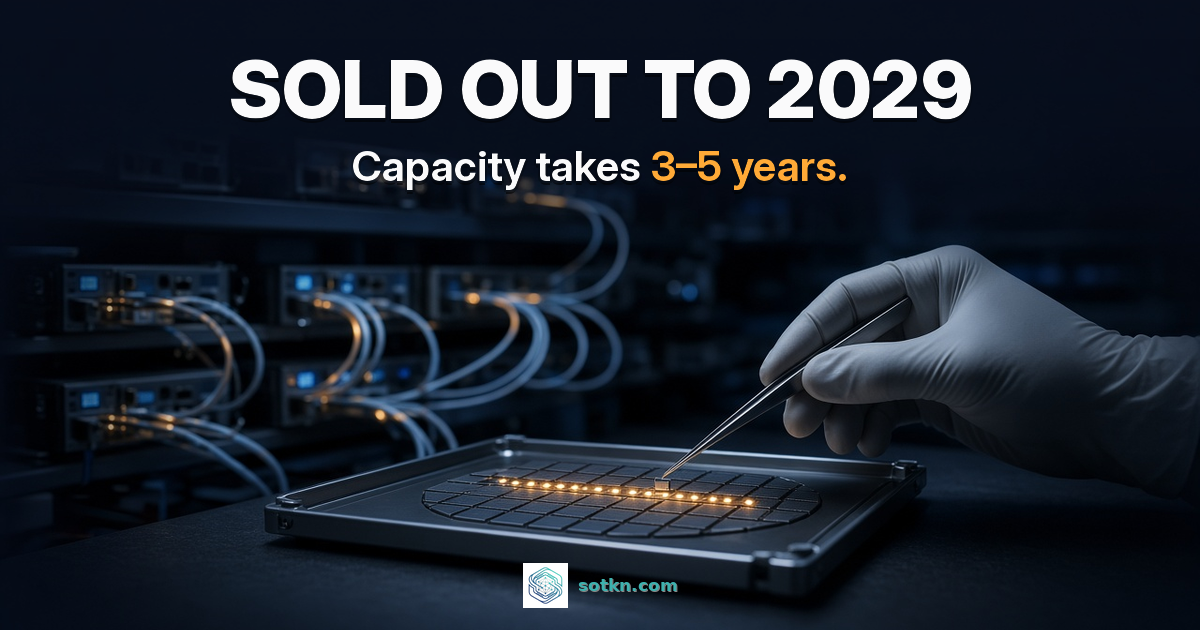
Lumentum's CEO says its optical parts for AI data centers are sold out through early 2029, with about 70% of demand for some products unmet through next year. The stuck step is laser fab capacity, which takes three to five years to add.
WIRE · SEMICONDUCTORS · US · Data as at 10 Oct 2026
Lumentum says it cannot make enough of the lasers that move data between AI chips. On 9 October 2026 chief executive Michael Hurlston told Bloomberg in Tokyo that its optical parts are "completely sold out" through early 2029. For some products it cannot meet about 70% of demand through next year; for others, about 30% stays unmet through 2028. On the semiconductors layer, this is a supply step that money alone does not fix fast: new capacity takes three to five years to build.
What happened
The claim
Optical components sold out through early 2029; customers starting to lock in orders for 2030
Bloomberg interview, 9 Oct 2026
The gap
About 70% of demand unmet for some products through 2027, about 30% for others through 2028
Bloomberg via Japan Times and Quartz, 9 Oct 2026
Six months ago
Hurlston said capacity would be fully committed by 2028. The sold-out window has moved out about a year
Bloomberg, 9 Oct 2026
The build
At least $350 million into its Sagamihara, Japan site and a neighbouring plant; more capacity in Caswell, England
Quartz, citing Lumentum and Bloomberg, 9 Oct 2026
Lumentum shares rose about 6% in premarket trading on Friday, Bloomberg reported.
Why cash cares
Lumentum makes indium phosphide lasers, the light sources inside the optical links that connect GPUs and servers in an AI data center. Every faster cluster needs more of these links. Nvidia put $2 billion into Lumentum earlier this year, alongside a similar bet on its rival Coherent.
The money is already showing up. Lumentum reported $1.01 billion of revenue in its quarter to June 2026, up from $480.7 million a year earlier, and guided $1.225 billion to $1.275 billion for the quarter to September. Here is our own arithmetic, not a reported figure: the guidance midpoint of $1.25 billion is about 2.6 times the year-ago quarter, and four quarters at that pace would be about $5 billion, against $3.0 billion for the whole of fiscal 2026.

Figure: Sold out clock. Revenue has more than doubled in a year, and the company still says it is far behind demand. The stuck step is new laser capacity, which takes three to five years to build.
The step that is still open
Being sold out caps how much more Lumentum can sell, however high demand goes. "We are really trying to catch up, add capacity as fast as we can, but we are very, very far behind what customers want," Hurlston told Bloomberg. He said the company has scaled output at its Tokyo-area factory about twelve times in two years, and that widening its product range will likely need an acquisition within the next year.
The second-order read
Who gets paid. Lumentum, with full order books and pricing that its margins suggest is holding: non-GAAP gross margin crossed 50% last quarter. Coherent, the other big Western supplier, sells into the same shortage. The makers of the tools and materials that go into new laser lines get paid during the build.
Who pays. Hyperscalers, who Hurlston said are "willing to put money behind" new capacity and are taking on some of the capital spending risk. Nvidia already paid in with its $2 billion investment.
Who waits. Data center builders and cloud buyers who did not lock in supply: for some parts, seven in ten orders go unfilled through next year. If the US goes ahead with a reported ban on new Chinese optical transceiver models, Counterpoint Research told Bloomberg that Lumentum and Coherent could not fill the gap, so the wait would get longer.
Stuck step. Laser fab capacity. Orders for 2030 are already coming in, but new lines take three to five years.
Two cautions
The sold-out claim and the 70% and 30% figures come from a CEO interview, not a filing. Lumentum has not published a backlog figure.
Our $5 billion figure assumes four quarters at the guided midpoint. Lumentum has given no guidance beyond the quarter to September.
What to watch
- Lumentum's next quarterly results: whether revenue lands in the guided range, and any spending figure for new capacity or an acquisition.
- US rules on Chinese optical transceivers: a ban would push more orders onto Lumentum and Coherent, which are already sold out.
Read: Semiconductors, GlobalFoundries signs $2B deal to make TSMC's AI chip interposers in New York, and If AI Chip Substrates Stay Short Into 2028, Where Does Cash Stick?
Get the Wire. A free brief every day, here and in your inbox. Subscribe free →
Sources: Bloomberg via The Japan Times, "Nvidia-backed Lumentum sold out of AI server parts till 2029", 9 Oct 2026: sold out through early 2029, about 70% of demand unmet for some products through next year and 30% for others through 2028, six months ago on track to sell out by 2028, $2 billion Nvidia investment alongside Coherent; Bloomberg, 9 Oct 2026: customers starting to lock in 2030 orders, shares up about 6% premarket; Quartz, 9 Oct 2026: CEO quotes, twelvefold Tokyo-area scale-up, at least $350 million for Sagamihara and a neighbouring site, Caswell capacity, hyperscalers sharing capex risk, possible acquisition, three to five years to build capacity, Counterpoint on a reported US ban of new Chinese transceiver models; Lumentum fiscal Q4 and full-year 2026 results, 11 Aug 2026: Q4 revenue $1.01 billion vs $480.7 million a year earlier, fiscal 2026 revenue $3.014 billion, non-GAAP gross margin 50.4%, Q1 fiscal 2027 guidance $1.225 billion to $1.275 billion. The 2.6 times and $5 billion figures are our arithmetic. Not investment advice. Do your own research.