If AI Chip Substrates Stay Short Into 2028, Where Does Cash Stick?
Every AI chip sits on a small board, and the boards are short. The board is about 0.26% of a Rubin rack, but a month of waiting costs more than the board. Who gets paid while it lasts?
ANALYSIS · MEMBERS CONTINUE · 4 min free / 13 min full · Data as at 8 Oct 2026
Every AI chip sits on a small board called a substrate. Those boards are short, and forecasts say the gap widens until 2028. The board is a tiny part of a rack's cost, but a missing board holds the whole rack. This piece maps where the cash sticks, and which step is really stuck.
In short
- The question: if AI chip substrates stay short into 2028, where does the cash stick?
- The answer: Scenario B. Board makers who can reprice get paid first, then the film maker through a 30% price rise. Buyers pay more and pay early. The stuck step is the glass cloth inside the board, and its main maker has chosen volume over price. The bind and the cash sit in different places
- Why: on 6 October 2026, Nittobo said its T-glass cloth lines are full. It makes over 90% of that cloth, by Nikkei's estimate. On 28 September, Samsung Electro-Mechanics (SEMCO) approved ₩6.78 trillion (~$5 billion) of new board lines, part-paid by customers, with output from September 2028
- The size of the part: Morgan Stanley puts the boards in one Nvidia Rubin rack at about $20,300, in a rack costing about $7.8 million: about 0.26% (ours)
- Behind the wall: who gets paid, in order · three scenarios, arithmetic shown · what a month of waiting costs next to the board · six practical takeaways · Members' FAQ
- What would break it: the cloth binding harder so new lines sit idle (A), or every 2027–28 line landing at once and prices flattening (C)
- Nothing here is a recommendation. This maps what today's prints already assume, with the working shown
What's in this piece: the numbers that matter · why the board sits in the middle of the chain · what the map assumes in one line · members from here · who gets paid, in order · three scenarios, arithmetic shown · our read · what would change the view, with dates · practical takeaways · FAQ · sources
The numbers that matter
| What | Figure | Date | What it tells us |
|---|---|---|---|
| Nittobo T-glass cloth | Lines full; share over 90% (Nikkei estimate) | Nikkei, 6 Oct 2026 | The tightest input has one main maker |
| Nittobo prices | Planned rises "largely done" | Nittobo, Aug and Oct 2026 | The tightest maker is not pushing price |
| SEMCO new lines | ₩6.78T (~$5B); customers fund part and guarantee volumes; Sejong output from Sept 2028 | SEMCO filing, 28 Sep 2026 | Buyers pay early to hold a place |
| SEMCO prices | FC-BGA prices up 10–20% in Q3 | iM Securities estimate, 6 Oct 2026 | Board makers with room are repricing |
| Ajinomoto ABF film | Price up about 30% from Q3 2026 | DIGITIMES, 13 May 2026 | The film maker took price |
| Unimicron | Capacity up 30–40% by 2027; no customer money disclosed | The Inference, 2 Oct 2026 | New lines, paid for by the maker |
| Forecast gap | ~10% (H2 2026), ~21% (2027), ~42% (2028) | Institutional estimate, via ic.net, 7 Aug 2026 | The gap is forecast to widen, not close |
| Rubin rack | Rack ~$7.8M; substrates ~$20,300; GPU board ~$200 | Morgan Stanley, 21 May 2026 | The board is a tiny line in the bill |
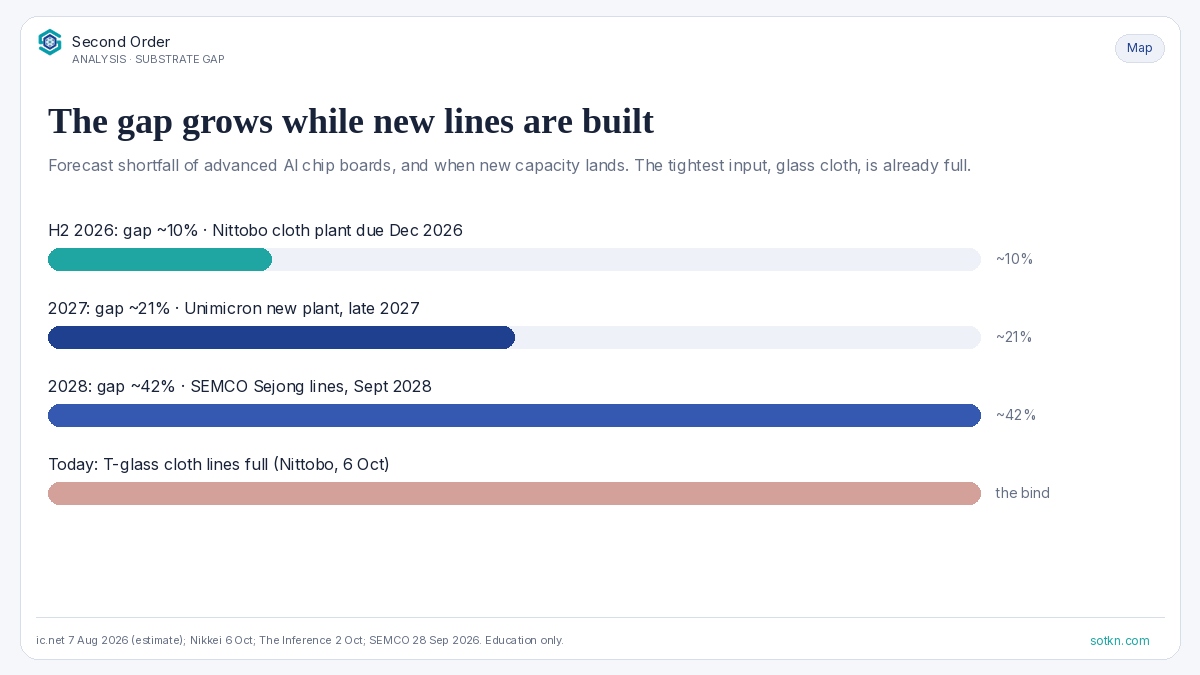
Chart 1 — The forecast gap, and when new capacity lands. Sources: ic.net 7 Aug 2026; Nikkei 6 Oct 2026; The Inference 2 Oct 2026; SEMCO 28 Sep 2026. Education only.
Why does the board sit in the middle of the chain?
A substrate is the small, many-layered board a chip package sits on. It carries power and signals from the chip to the server board below. IC substrates and ABF, explained covers how it works; the Semiconductors layer shows where it sits.
Three things go into a high-end board, and each has its own clock:
- Glass cloth. Woven glass that keeps the board flat when it heats up. The best grade is T-glass. Nittobo makes most of it
- Build-up film. The insulating layers between the copper wiring. Ajinomoto makes about 95% of it (ABF is Ajinomoto Build-up Film)
- Board lines. The factories that make finished boards: Ibiden, Unimicron, SEMCO, Nan Ya PCB and a few others
AI chips need the biggest boards. Nvidia's Rubin GPU board costs about $200, double the last generation, Morgan Stanley estimates (WallStreetCN via Futu, 21 May 2026). Big CPUs compete for the same lines: Ibiden expects about 28 million server CPUs this year, twice the ~14 million AI GPUs (iM Securities via StockHub, 6 Oct 2026).
On 6 October 2026, Nittobo's president told Nikkei that T-glass demand is "very strong", supply is short and the lines are full. Nittobo is adding a yarn furnace in Taiwan and a cloth plant in Fukushima (MoneyDJ via TechNews, 6 Oct 2026). The Fukushima plant is due in December 2026. The yarn may be the next thing to run short (AI Industry Today, 6 Oct 2026).
Eight days earlier, SEMCO approved ₩6.78 trillion for new lines in Sejong and Vietnam. The Sejong part, ₩4.27 trillion, equals 43.6% of its equity. Output starts in September 2028. Customers pay part of the cost and guarantee volumes. Local reports say Nvidia prepaid the most; SEMCO has not confirmed that (Korea Herald, 29 Sep 2026).
On 30 September, Unimicron disclosed a site purchase of more than NT$10 billion. It aims for 30–40% more board capacity by 2027, with no customer money disclosed (The Inference, 2 Oct 2026).
So in ten days the tightest input said it is full, and two big board builds were set: one part-paid by buyers, one paid by its maker. Today's TSMC Wire showed the chips above these boards still selling ahead of plan. This piece asks the money question one layer down: while boards stay short, who gets paid, and who waits?
What does the map already assume?
Three answers compete:
- The cloth binds harder. Glass yarn runs short. New board lines finish but wait for cloth
- Boards stay short, inputs just keep pace. Cloth and film feed the lines but do not end the gap. New lines land in late 2027 and 2028, into a gap still forecast to widen
- Everyone catches up at once. More cloth suppliers and every 2027–28 line land together. Prices flatten by 2028
A tip sheet would pick a stock. Analysis asks which answer today's prints already need.
Our read, in one line: the map already assumes Scenario B. Boards stay short into 2028 because most new lines land in the forecast's widest years. The board makers who can reprice get paid first, because the board is about 0.26% of a Rubin rack and a month of waiting costs more than the board. The glass cloth is the stuck step, but its main maker has chosen volume over price. The bind and the cash sit in different places. The scenarios and the arithmetic are below.
The free preview ends here.
—— Still to read · ~9 of 13 minutes ——
MEMBERS CONTINUE HERE
- Who gets paid, in order, and who waits
- Three scenarios with the arithmetic
- What a month of waiting costs next to the board
- Six practical takeaways
- Members' FAQ