What Is a Power Purchase Agreement? How AI Data Centers Lock In Power
A power purchase agreement is a long-term contract to buy electricity from a specific plant at an agreed price. Hyperscalers now sign about half of the world’s corporate clean power deals, and the scarce thing they are paying for is firm megawatts the grid can deliver.
EXPLAINED · Mechanism · Last reviewed: 8 Nov 2026 · Next review: after BloombergNEF’s 2026 corporate energy tally (early 2027) and Constellation’s Crane restart date
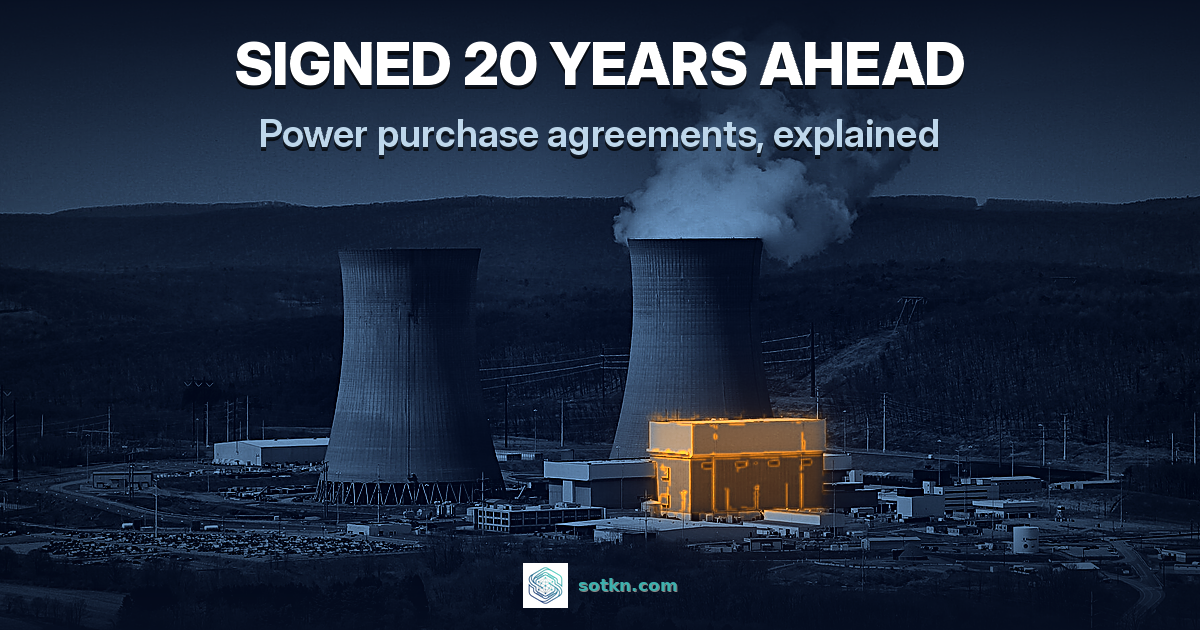
A power purchase agreement (PPA) is a long-term contract in which a buyer agrees to pay for electricity from a specific power plant at an agreed price, usually for 10 to 20 years.
In short. A power purchase agreement, or PPA, is a long-term contract to buy electricity from a specific plant at an agreed price. Hyperscalers now sign about half of the world’s corporate clean power deals, and their recent contracts are 20-year bets on nuclear plants that are being restarted, upgraded or kept open. The generator gets paid for years of output it can now finance. Our read: the stuck step is not the signature but firm megawatts the grid can deliver, so the clock to watch is when contracted power actually starts flowing, from late 2026 through the early 2030s.
Why an investor cares: a PPA turns a data center’s future power bill into a generator’s contracted revenue, signed years before the first megawatt flows. That makes it one of the clearest places to see who gets paid for AI before the chips even arrive. Our guide to how much power an AI data center uses covers the size of the load; this page covers the contract that buys it.
What is a power purchase agreement?
A PPA is a contract between a buyer and a power plant. The buyer commits to pay for the plant’s electricity, or a share of it, for a long period at a price both sides agree up front. The plant owner gets a revenue stream it can borrow against. The buyer gets a known price and, usually, a claim on the clean or firm energy that plant produces.
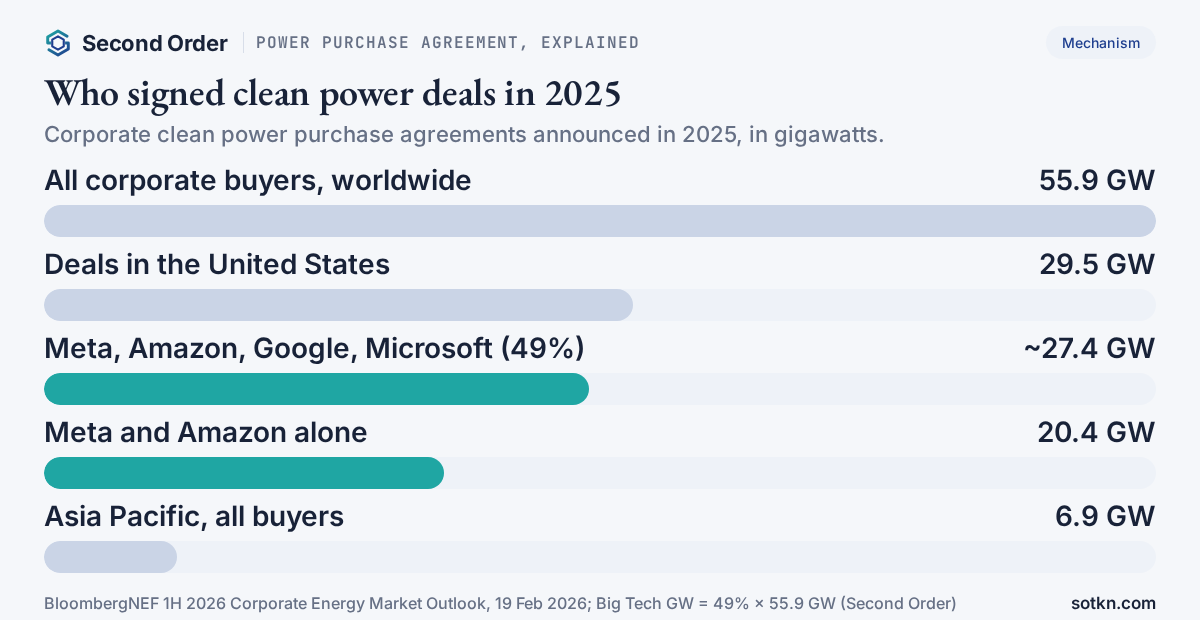
The buyer mix has changed. BloombergNEF counted 55.9 gigawatts of corporate clean power deals worldwide in 2025, down 10% from the 2024 record, and found that four companies, Meta, Amazon, Google and Microsoft, accounted for 49% of the total. That is about 27 gigawatts, by our arithmetic.
The buyer base has also narrowed. BloombergNEF said the number of different companies signing deals in the United States fell by about half, to 33, even as US volume hit a record 29.5 gigawatts. In plain terms, close to half of the corporate PPA market is now four hyperscalers.
How does a power purchase agreement work?
Every PPA answers four questions: which plant, how much power, at what price, and for how long. The answers decide who carries the risk. A fixed price over 20 years moves the risk of falling power prices from the generator to the buyer, and the risk of rising prices the other way.
Talen put this plainly when it signed its expanded Amazon contract in June 2025: the long-term deal would significantly cut its market risk and its reliance on a federal nuclear tax credit. That is the generator’s side of the bargain. The buyer’s side is price certainty on a load that will run around the clock for decades.
The contract does not usually mean the data center runs on that plant’s electrons. In most deals the plant sends its output into the grid, the campus draws from the same grid, and the contract matches the two on paper and in money.
Physical vs virtual PPA: what is the difference?
A physical PPA delivers power. The buyer, or a retail supplier acting for it, takes the energy through the grid and pays the agreed price. A virtual PPA, also called a financial PPA, delivers only money. The plant sells its power into the wholesale market at whatever the market pays, and the buyer settles the gap: if the market price is below the agreed price, the buyer pays the difference; if it is above, the buyer receives it.
LevelTen Energy, which runs a marketplace for these contracts, publishes a widely used benchmark of what North American wind and solar developers are offering. For the third quarter of 2026 it put the benchmark solar offer at $64.23 per megawatt-hour and wind at $68.27.
| Type | How power moves | How money moves | Recent AI example |
|---|---|---|---|
| Physical PPA (grid-delivered) | Plant sends power into the grid; the buyer is served through the same grid | Buyer pays the agreed price for the contracted energy | Talen and Amazon at Susquehanna, after the move to front-of-the-meter |
| Virtual or financial PPA | Plant sells into the wholesale market; the buyer keeps buying from its normal supplier | Cash settles the gap between market price and agreed price | A common structure for corporate wind and solar deals |
| Co-located (behind the plant) | Campus wired directly to the plant, partly or fully off the grid | Buyer pays the plant directly | The original Talen–Amazon arrangement before 2026 |
| Upgrade-funded PPA | Buyer’s contract pays for new output at an existing plant, which goes to the grid | Long-term price covers the cost of the uprate | Google and Constellation, 890 MW of uprates; Meta and Vistra, 433 MW |
Simplified. Real contracts mix features, and terms such as price are rarely published. Examples are illustrative, not a ranking.
A third form, co-location, wires a campus straight to a plant. The original Talen and Amazon arrangement at Susquehanna in Pennsylvania worked this way. Under the expanded deal it was set to move to a front-of-the-meter structure, in which the plant sells into the grid, Talen acts as Amazon’s retail supplier and the local utility, PPL, handles delivery. Our contracted power Explained covers the related gap between power that is signed and power that is live.
Why do AI data centers sign power purchase agreements?
Three reasons, in rising order of importance. First, carbon goals: hyperscalers want to match their use with clean energy, and a PPA gives them a claim on a specific plant’s output. Second, price: a fixed price on a huge, flat load is a hedge against power markets that have become more volatile. Third, and newest, supply: a long contract can be what gets a plant restarted, upgraded or built.
That third reason is why the deals have shifted toward nuclear and other round-the-clock supply. BloombergNEF found that Meta and Amazon together signed 20.4 gigawatts in 2025, including 4.7 gigawatts of nuclear, which is about 23% of their combined total by our arithmetic. It also found that seven of the ten biggest sellers offered firm or near-firm products, such as solar paired with storage or nuclear, which it put at 5.2 gigawatts.
The arithmetic of a data center explains the pull. A 1 gigawatt campus running flat out uses about 8.76 terawatt-hours a year. At LevelTen’s solar offer price that would be roughly $563 million a year, by our arithmetic. But solar does not run at night, so the price only buys energy, not a steady supply. Firm power costs more. On its 3 November 2026 call, Talen put the all-in cost of power from a new gas-fired combined-cycle plant at north of $120 per megawatt-hour, almost twice the solar offer, by our arithmetic. That gap is the reason existing nuclear plants have become the most sought-after counterparty in the market.
What do the big AI power deals look like?
The four best-known recent contracts share a shape: 20 years or close to it, an existing nuclear site, and power that arrives in stages.
| Deal | Size | Term | When power flows |
|---|---|---|---|
| Microsoft – Constellation (Crane restart) | Output of a restarted reactor; share not disclosed | 20 years | Restart targeted for 2027 |
| Amazon – Talen (Susquehanna) | 1,920 MW at full quantity | To 2042 | 480 MW in Talen’s 2028 outlook, 840 MW minimum in 2029, full by 2032 |
| Meta – Vistra (Perry, Davis-Besse, Beaver Valley) | 2,176 MW operating + 433 MW uprates = 2,609 MW | 20 years | Purchases start late 2026; full 2,609 MW by 2034 |
| Google – Constellation (uprates at 11 units) | 890 MW new, plus a 15-year supply deal for 2,700 MW | 20 years | First uprate by 2028 |
From company releases and Talen’s 3 November 2026 earnings call. The 2,609 MW total is the companies’ figure; ramp shares below are our arithmetic.
Microsoft’s contract with Constellation is what made the restart of the Crane plant, the former Three Mile Island Unit 1, possible. Constellation said in September 2025 that a faster grid approval let it pull the restart forward to 2027. The price and Microsoft’s share of output have not been published.
Amazon’s contract with Talen covers 1,920 megawatts at full quantity through 2042. On Talen’s third-quarter call, management said its 2028 outlook includes 480 megawatts and its 2029 outlook the 840 megawatt minimum commitment, with ramp steps growing from 120 megawatts to 360 megawatts. That means the contract reaches about 25% of its full size in 2028 and about 44% in 2029, by our arithmetic. Talen said that, once the contract reaches its full level, about 35% of its gross margin will be under contract.
Meta’s contracts with Vistra cover 2,176 megawatts from operating plants in Ohio plus 433 megawatts of uprates, which is about 17% of the 2,609 megawatt total, by our arithmetic. Purchases begin in late 2026, and the full amount is due online by 2034. Google’s October 2026 contract with Constellation funds 890 megawatts of uprates across 11 nuclear units, about 81 megawatts each on average, with the first due by 2028, alongside a separate 15-year supply deal for 2,700 megawatts from the existing fleet.
Who gets paid?
Our read: the PPA cheque splits four ways, and most of it is promised years before the power flows.
- Generators with firm plants. Constellation, Vistra and Talen sell long-dated output from nuclear plants they already own. The contract turns volatile market revenue into something closer to an annuity, and it can pay for restarts and uprates. Constellation said its Google agreement represents more than $4.3 billion of new investment, which is roughly $4.8 million per new megawatt if all of it goes to the uprates, by our arithmetic.
- Developers of new supply. Wind, solar, storage and, later, new reactors. BloombergNEF named Engie the largest seller of corporate clean power in 2025, at 3.6 gigawatts. These developers need a signed PPA to raise project finance.
- Grid owners and utilities. Front-of-the-meter deals keep the utility in the middle. At Susquehanna, PPL handles transmission and delivery, and it said large loads pay significant transmission charges on its network.
- Equipment makers. Transformers, switchgear and turbine upgrades are paid for when the contracted megawatts are built and connected, often well before the first bill under the PPA.
Where is the stuck step?
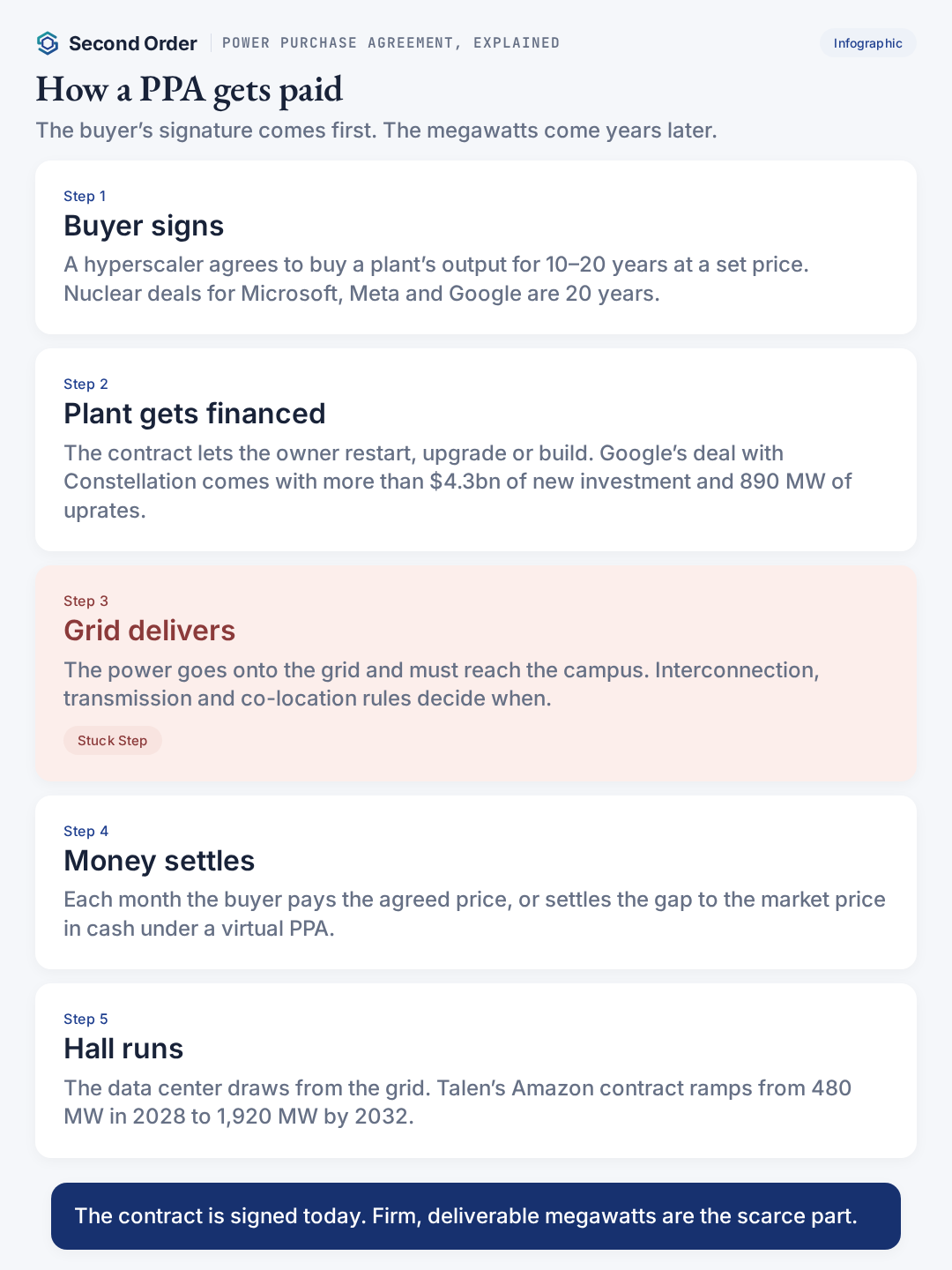
Our read: firm megawatts the grid can deliver. Signing a PPA is fast. Turning it into power at a campus depends on interconnection, transmission and the rules for serving very large loads, and those move on the grid’s clock, not the buyer’s.
Co-location shows the problem. In December 2025 the US energy regulator, FERC, found the tariff of PJM, the grid operator for 13 states and Washington DC, unjust and unreasonable because it lacked clear rules for data centers and other large loads sited next to power plants, and ordered PJM to create new transmission service options. It also asked PJM to report by 19 January 2026 on speeding up connections for shovel-ready projects. Until rules like these settle, a plant next door is not the same as power at the meter.
Talen’s chief executive said on its November 2026 call that 2029 is becoming the new 2028 for data center sites. Our read of that remark: the year by which new sites can realistically be connected keeps moving out. That is the clock that matters for the PPA buyer and seller alike. A 20-year contract signed in 2026 pays nothing until its first megawatt is delivered.
For readers in Singapore and the region, the same logic applies with less room to sign. BloombergNEF put Asia Pacific corporate deals at 6.9 gigawatts in 2025, down from 10.7 gigawatts, a fall of about 36% by our arithmetic, and said growth in markets such as Malaysia still depends on regulatory support. Our Malaysia market door and Singapore market door track the data center campuses that will need those contracts.
What would change the view?
- Grid rules clear quickly. If PJM and other grid operators settle co-location and fast-track connections, the gap between signing and delivery narrows, and the stuck step moves to equipment and construction.
- Restarts or uprates slip. Crane’s restart is targeted for 2027 and still has to happen on schedule. A delay pushes back both the buyer’s supply and the seller’s revenue.
- Hyperscalers slow their buying. Corporate volumes already fell 10% in 2025 as smaller buyers stepped back. If the largest buyers also pause, the market loses its main signer.
- Cheaper firm supply arrives. Storage paired with solar, or demand flexibility at the campus, could compete with nuclear on firmness and pull prices for long-dated firm power down.
Common misconceptions
- People assume a PPA means the data center runs on that plant. Actually most PPAs send power into the grid; the contract matches money and energy, not electrons.
- People assume the price is public. Actually the big nuclear deals do not disclose prices; only offer benchmarks such as LevelTen’s are published.
- People assume the full contract starts on day one. Actually large deals ramp. Talen’s Amazon contract reaches about a quarter of its full size in 2028 and full volume by 2032.
- People assume a PPA always adds new power. Actually many deals buy output from existing plants; only uprates, restarts and new builds add megawatts to the grid.
FAQ
What is a power purchase agreement?
A power purchase agreement (PPA) is a long-term contract in which a buyer agrees to pay for electricity from a specific power plant at an agreed price, usually for 10 to 20 years.
What is the difference between a physical and a virtual PPA?
In a physical PPA the buyer takes delivery of the power through the grid. In a virtual PPA the plant sells into the wholesale market and the buyer settles the difference between the market price and the agreed price in cash.
Why do data centers sign PPAs?
To fix the price of a large, steady load for years and to match their use with clean or firm supply. Hyperscalers also use PPAs to fund new plants or plant upgrades that would not be built otherwise.
How long is a typical PPA?
Ten to twenty years. The recent nuclear deals for Microsoft, Meta and Google are 20-year contracts, and Talen’s Amazon contract runs to 2042.
How much does a PPA cost?
It depends on the technology and the market. LevelTen put the benchmark North American solar offer at $64.23 per megawatt-hour and wind at $68.27 in the third quarter of 2026. Big nuclear deals do not publish prices.
Does a PPA mean the data center is powered by that plant?
Not usually. Most PPAs send the plant’s output into the grid, and the buyer’s campus draws from the same grid. The contract matches money and energy, not electrons.
Is this a list of stocks to buy or sell?
No. This page explains how power purchase agreements work and where the money goes. It does not rank companies or give buy or sell calls. Not investment advice. Do your own research.
Related: contracted power; data center power distribution; take-or-pay contracts; data center financing; where AI data centers are located; who the hyperscalers are.
Stack doors
Layer: AI Data Centers. Also: Hyperscalers. Markets: US. Analysis: where does the stuck step move.
Get the Wire — short daily notes when AI power deals move.
Not investment advice. Do your own research.
How we check this
Corporate deal volumes and buyer shares come from BloombergNEF’s release of 19 February 2026 on its 1H 2026 Corporate Energy Market Outlook. Wind and solar offer prices come from LevelTen Energy’s third-quarter 2026 index of 20 October 2026; they are developer offers, not signed prices. The Amazon contract terms come from Talen’s release of 11 June 2025, and the ramp figures, contracted margin and new-build cost remarks from Talen’s third-quarter call on 3 November 2026, as transcribed. The Crane restart timing comes from Constellation’s update of 23 September 2025. Meta’s contracts come from Vistra’s release of 9 January 2026. Google’s contract comes from Constellation’s release of 6 October 2026. The co-location ruling comes from FERC’s release of 18 December 2025. Shares, ratios, the cost of a year of flat power and the investment per new megawatt are our arithmetic, checked in code and labelled as ours on the page. Who gets paid and the stuck step are our read. Contract prices for the nuclear deals are not public, and we do not estimate them. The featured photograph is credited in its caption. This page explains a mechanism. It does not rank companies or give buy or sell calls. Not investment advice. Do your own research.
Last reviewed: 8 Nov 2026 · Next review: after BloombergNEF’s 2026 corporate energy tally (early 2027) and Constellation’s Crane restart date
Spot an error? Tell us and we will correct it and note the change here.
References
- BloombergNEF — Corporate clean energy buying fell in 2025 after nearly a decade of growth (19 Feb 2026) — 55.9 GW of corporate clean PPAs in 2025, down 10% from the 2024 record; Meta, Amazon, Google and Microsoft 49% of activity; Meta and Amazon 20.4 GW including 4.7 GW nuclear; US record 29.5 GW with 33 unique buyers; Asia Pacific 6.9 GW from 10.7 GW; baseload-like products 5.2 GW
- LevelTen Energy — North American PPA Price Index, Q3 2026 (20 Oct 2026) — Core-Markets P25 solar offer price $64.23/MWh, continental solar index up 4.9% in the quarter on Section 232 tariffs; P25 wind $68.27/MWh, wind index down 0.1%; wind pipeline stalled on permits
- Talen Energy — Talen Energy expands nuclear energy relationship with Amazon (11 Jun 2025) — PPA for 1,920 MW from Susquehanna at full quantity through 2042; ramp to full volume no later than 2032; co-located arrangement moves to front-of-the-meter after transmission work; PPL handles transmission and delivery
- Talen Energy — third-quarter 2026 earnings call transcript (3 Nov 2026) — AWS contract ramp: 480 MW in the 2028 outlook, 840 MW minimum commitment in 2029, ramp steps rising from 120 MW to 360 MW; AWS takes contracted gross margin to about 35%; new combined-cycle power north of $120/MWh all-in; 2029 becoming the main window for new data center connections
- Constellation — One year later: Crane Clean Energy Center ahead of schedule (23 Sep 2025) — Crane restart made possible by a 20-year PPA with Microsoft; PJM interconnection request approved on an accelerated basis; restart accelerated to 2027
- Vistra — Vistra and Meta announce agreements to support nuclear plants in PJM (9 Jan 2026) — 20-year PPAs for 2,176 MW from operating Perry and Davis-Besse plants plus 433 MW of uprates including Beaver Valley; purchases begin late 2026; full 2,609 MW online by 2034; power continues to flow to the grid
- Constellation — Google and Constellation announce agreement to bring 890 MW of new nuclear capacity to PJM (6 Oct 2026) — 20-year PPA funding 890 MW of uprates at 11 nuclear units, first uprate by 2028; more than $4.3 billion of new investment; separate 15-year energy supply agreement for 2,700 MW of existing fleet output
- FERC — FERC directs nation’s largest grid operator to create new rules (18 Dec 2025) — PJM tariff found unjust and unreasonable for co-located large loads; PJM must offer new transmission service options; report due 19 Jan 2026 on expedited interconnection for shovel-ready projects