What Does ASE's Price Assume About the Packaging Stuck Step?
ASE sits at the packaging stuck step as OSAT overflow and LEAP/test behind TSMC CoWoS. At roughly NT$3.10 trillion, the question is what LEAP growth and capacity clocks that price already assumes.
ANALYSIS · MEMBERS CONTINUE · 3 min free / 12 min full · Data as at 24 Sep 2026
ASE Technology Holding sits at the packaging stuck step as the OSAT overflow and LEAP/test capacity behind TSMC CoWoS. At roughly NT$3.10 trillion, the question is not whether advanced packaging matters — it is what LEAP growth and capacity clocks that price already assumes.
In short
- The question: what is today's price for ASE already assuming about the packaging stuck step?
- The answer: Scenario B — LEAP keeps racing (ahead of US$3.5B in 2026; management aiming to double LEAP in 2027) while packaging/test capacity stays the bind through Renwu Phase I (Apr 2027) and SPIL Douliu first phase (2028)
- Why: tools and OSAT overflow get paid while foundry CoWoS lines stay full; ASE is the listed expression of that overflow + LEAP attach
Behind the wall: three scenarios with the arithmetic · what NT$3.10T implies · six practical takeaways · Members' FAQ - What would break it: blended util easing before Renwu/Douliu land — or a CoWoS-L path/validation slowdown that delays OSAT attach
- Nothing here is a recommendation. This is a map of what the price requires, with the working shown
What's in this piece: the numbers that matter · why ASE sits at the stuck step · what the price implies in one line · members from here · who gets paid · three scenarios, arithmetic shown · our read · what would change the view · practical takeaways · FAQ · sources
The numbers that matter
| What | Figure | Date | What it tells us |
|---|---|---|---|
| ASE market cap / price | NT$3.10T / NT$693 | Close 23 Sep 2026 | The number we work backwards from |
| Shares out | ~4.47B | ASE Q2 materials, Jul 2026 | Cap = price × shares |
| Trailing P/E / EPS | ~52.3× / NT$13.25 | FT.com, as of 23 Sep 2026 | Expensive unless LEAP/ATM extends |
| Q2’26 consol revenue | NT$191.1B (+26.7% YoY, +10% QoQ) | ASE PR / SEC 6-K, Jul 2026 | Consol run-rate |
| Q2 ATM revenue | NT$125.1B (+36% YoY); ATM GM 27.3% | SEC 6-K; earnings call 30 Jul 2026 | Packaging/test engine |
| Consol GM / OM | 21.0% / 11.1% | SEC 6-K | Group margins (not ATM GM) |
| 1H’26 consol | NT$364.7B | Same | Half-year base |
| Capex 2026 | Raised to US$10.5B (~US$4B buildings / US$6.5B equipment) | Earnings call 30 Jul 2026 | Capacity clock funded |
| LEAP 2026 → 2027 | Tracking ahead of US$3.5B; aim double LEAP in 2027 | Earnings call / Alpha Spread transcript | Scenario B hinge |
| Blended util | 80–85%; demand limited by ability to add equipment/facilities | Earnings call | Bind is capacity, not demand |
| Renwu testing cluster | >NT$108.3B; proj. annual output ~NT$177.3B; Phase I Apr 2027, Phase II Oct 2027 | ASE press, 10 Apr 2026 | Test capacity clock |
| SPIL Douliu CoWoS | ~NT$100B; first-phase ops 2028 | Taipei Times / Focus Taiwan, 12 Aug 2026 | Packaging overflow clock |
| Panel-level packaging | Volume production Q1 2027 (310×310) | Earnings call | Adjacent capacity option |
| Baipu Mini-Loop (context) | Validation gate; ops expected Q4 2029 | Reuters/CTEE, 21 Sep 2026 | Gate ≠ ASE plant — see yesterday’s Analysis |
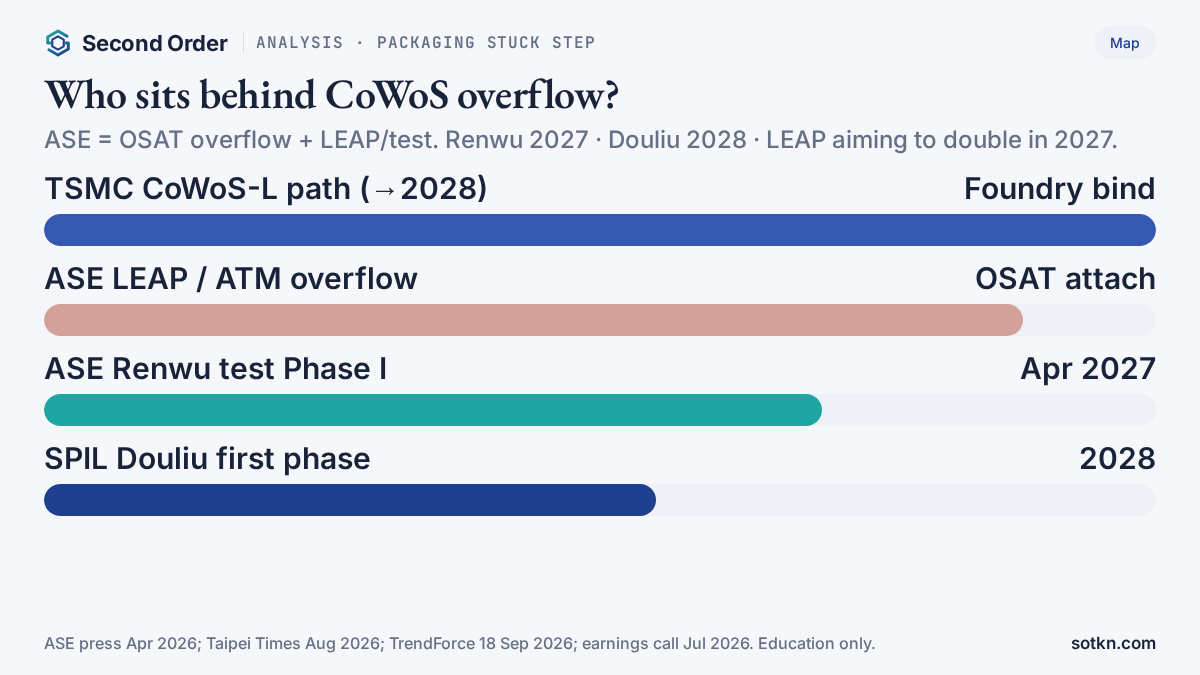
Chart 1 — Who sits behind the packaging stuck step. ASE = OSAT overflow + LEAP/test. Sources: ASE press Apr 2026; Taipei Times Aug 2026; earnings call Jul 2026. Education only.
Why does ASE sit at the packaging stuck step?
The Semiconductors layer still waits on advanced packaging — the short step every finished AI accelerator needs alongside memory. Foundry and advanced packaging is the mechanism; the money question is who gets paid while TSMC CoWoS lines stay full and OSAT overflow stacks behind them.
ASE Technology Holding (TWSE:3711 / NYSE:ASX) is Taiwan’s largest OSAT group. Its Assembly, Testing and Materials (ATM) business — including advanced packaging brands under the LEAP umbrella — is the listed expression of that overflow. Renwu’s testing cluster (groundbreaking April 2026, Phase I ops April 2027) and SPIL’s Douliu CoWoS plant (groundbreaking August 2026, first-phase ops 2028) are the dated capacity clocks. Markets desks already track the foundry side on TSMC CoWoS capacity and the validation gate on Baipu Mini-Loop. Yesterday’s map piece asked capacity or validation inside CoWoS-L; this piece asks what ASE’s price already assumes about the OSAT side of the same stuck step.
Two clocks sit on ASE’s books at once. The revenue clock is LEAP: management said 2026 LEAP service revenue is tracking ahead of the prior US$3.5 billion guide, and they are aiming to double LEAP revenue in 2027 (earnings call, 30 Jul 2026). The capacity clock is physical — Renwu’s >NT$108.3 billion testing cluster and SPIL’s ~NT$100 billion Douliu CoWoS plant — with panel-level packaging volume also targeted for Q1 2027. Blended utilisation in the 80–85% band, with demand limited by the ability to add equipment and facilities, is why this is a stuck-step company piece rather than a results Wire: the order book is not the scarce thing; the floors and tools are.
What does NT$3.10 trillion already assume?
Work backwards from the close. At NT$3.10 trillion on 23 September 2026 (NT$693; FT.com / exchange quote), against a crude Q2×4 consol run-rate of about NT$764 billion, the trailing sales multiple is about 4.1×. Trailing earnings at ~52× (FT.com EPS ~NT$13.25) already price multi-year LEAP and ATM expansion — not a one-quarter beat.
Our read, in one line: the price assumes Scenario B — LEAP keeps racing toward a 2027 double while packaging/test capacity stays the bind through Renwu and Douliu. The three scenarios and the arithmetic are below.
The free preview ends here.
—— Still to read · ~8 of 12 minutes ——
MEMBERS CONTINUE HERE
- Three scenarios with the arithmetic
- What NT$3.10T requires in LEAP and capacity clocks
- Six practical takeaways
- Members' FAQ