If CoWoS-L Stays Mainstream Through 2028, Who Gets Paid — Capacity or Validation?
CoWoS-L is expected to stay the mainstream AI packaging path through 2028. The money question is who clears the tool and material validation gate before those lines can run.
ANALYSIS · MEMBERS CONTINUE · 3 min free / 12 min full · Data as at 23 Sep 2026
CoWoS-L is expected to stay the mainstream AI packaging path through 2028. The money question is not only who owns the next wafer-month of capacity — it is who clears the tool and material validation gate before those lines can run.
In short
- The question: if CoWoS-L stays mainstream through 2028, who gets paid first — capacity or validation?
- The answer: cash sticks at the validation gate before it sticks at volume lines. Baipu’s Mini-Loop is that gate; TSMC owns it
- Why: back-end toolmakers lack front-end scale to self-qualify as AI packages iterate every year — so qualification, not only wafer starts, sets who can ship
Behind the wall: three scenarios with the arithmetic · clock mismatch (CAGR vs Q4 2029 ops) · six practical takeaways · Members' FAQ - What would break it: EMIB-T or CoPoS taking share from CoWoS-L before 2028 — or Mini-Loop slipping so far that volume lines re-absorb validation on the floor
- Nothing here is a recommendation. This is a map of where cash collects along the packaging clock, with the working shown
What's in this piece: the numbers that matter · why CoWoS-L locks the path · capacity vs validation · members from here · who gets paid · three scenarios, arithmetic shown · our read · what would change the view · practical takeaways · FAQ · sources
The numbers that matter
| What | Figure | Date | What it tells us |
|---|---|---|---|
| CoWoS-L as mainstream AI packaging | Through 2028 vs EMIB-T | TrendForce, 18 Sep 2026 | The package architecture clock |
| Baipu Industrial Park groundbreaking | 21 Sep 2026 | TrendForce / CTEE / Reuters | Validation hub goes live as a build |
| Mini-Loop role | Modular tool + process validation — not a volume CoWoS fab | CTEE / TrendForce, 21 Sep 2026 | Gate ≠ capacity |
| Validation efficiency claim | +25% to +50% | Jun He via CTEE/TrendForce, 21 Sep 2026 | How much the gate can compress |
| CoWoS capacity CAGR | >80% through 2027 (growth through 2029) | Jun He via TrendForce/CTEE, 21 Sep 2026 | Volume still races |
| Mini-Loop expected ops | Q4 2029 | Reuters, 21 Sep 2026 | Gate arrives after the near ramp |
| TSMC Baipu footprint | ~3 ha, 2 buildings | CTEE / Reuters, 21 Sep 2026 | Lab + training, not a mega-fab |
| Back-end OEM scale vs front-end | ~6.5% economic scale; R&D ~1/20 | CTEE, 2 Sep 2026 (Jun He) | Why TSMC owns co-dev |
| Baseline validation clock | Often >1 year | CTEE, 2 Sep 2026 | The stuck step inside packaging |
| ASE Renwu testing cluster | >NT$108.3B; Phase I Apr 2027 | ASE press, 10 Apr 2026 | OSAT clustering clock |
| SPIL Douliu CoWoS | NT$100B; first-phase ops 2028 | Taipei Times / Focus Taiwan, Aug 2026 | Overflow capacity clock |
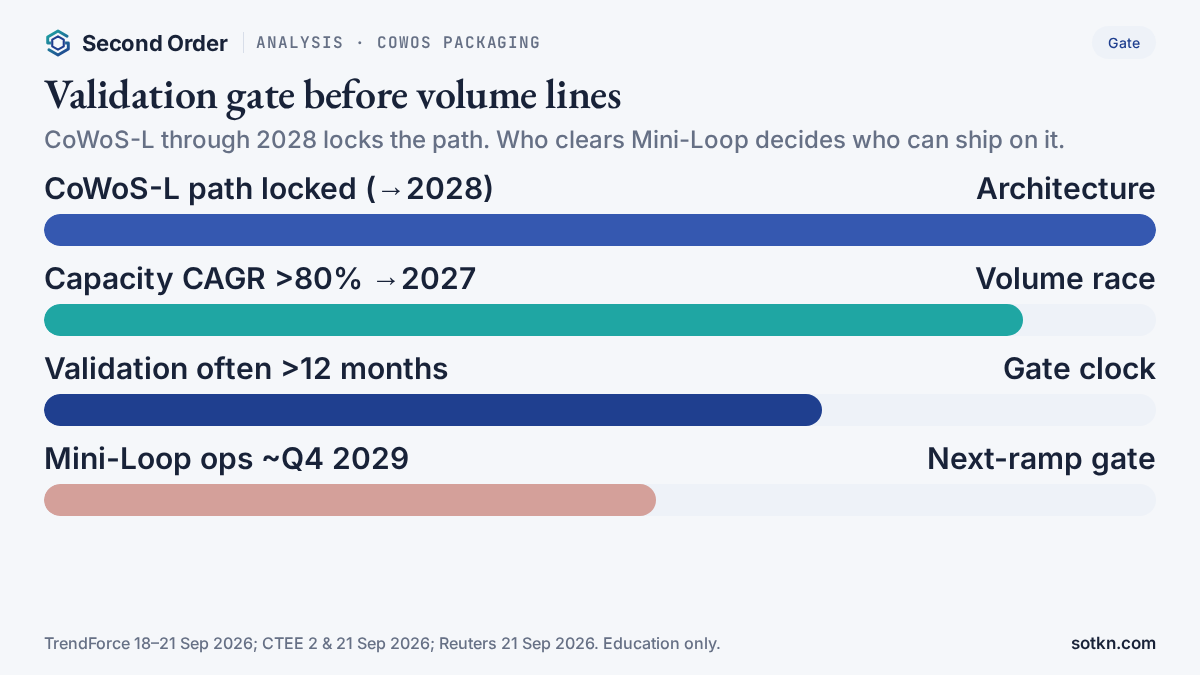
Chart 1 — Capacity races; validation gates who can enter the race. Sources: TrendForce 18–21 Sep 2026; CTEE 2 & 21 Sep 2026; Reuters 21 Sep 2026.
Why does CoWoS-L lock the packaging path through 2028?
The Semiconductors layer still waits on advanced packaging — the short step every finished AI accelerator needs alongside high-bandwidth memory. Foundry and advanced packaging is the mechanism; the money question is which package architecture can actually ship at yield.
TrendForce said on 18 September 2026 that TSMC’s CoWoS-L is expected to remain the mainstream advanced-packaging platform for AI chips through 2028, ahead of Intel’s EMIB-T on technology maturity and yield. Larger GPU and ASIC packages need CoWoS-L’s local silicon bridges once they outgrow a single large interposer; NVIDIA and AMD accelerators have already adopted it, with hyperscaler ASICs expected to move further onto CoWoS-L in 2027 (TrendForce press, 18 Sep 2026 — see also today’s CoWoS-L Wire).
That locks the path. It does not, by itself, say who gets paid along it. Capacity desks already track wafer-month plans on TSMC CoWoS capacity. The new map question is whether the next dollar sticks at those volume lines — or one step earlier, at the gate that decides which tools and materials are allowed onto them.
Capacity or validation — which bind is priced into the packaging clock?
Three days after that CoWoS-L call, Taiwan broke ground on Kaohsiung’s Baipu Industrial Park, with TSMC anchoring a modular Mini-Loop — a tool and process validation hub, not another CoWoS volume fab (TrendForce and Commercial Times, 21 Sep 2026; Reuters, 21 Sep 2026). Jun He (TSMC VP, Advanced Packaging Technology and Service) put the aim at improving validation efficiency by 25% to 50%, while separately estimating CoWoS capacity CAGR above 80% through 2027. Full Markets desk on the groundbreaking: Baipu CoWoS validation Pulse.
Those two numbers sit on different clocks. Capacity is racing now. The dedicated validation campus is expected to reach operations only in Q4 2029 (Reuters, 21 Sep 2026). That mismatch is the thesis: the packaging stuck step is not only wafer-months — it is also who clears qualification before those months can be sold.
Our read, in one line: with CoWoS-L locked through 2028, who gets paid first is the supplier that clears the Mini-Loop validation gate — capacity prints after, not instead. The three scenarios and the arithmetic are below.
The free preview ends here.
—— Still to read · ~8 of 12 minutes ——
MEMBERS CONTINUE HERE
- Three scenarios with the arithmetic
- Clock mismatch: >80% CAGR vs Q4 2029 Mini-Loop ops
- Six practical takeaways
- Members' FAQ