Samsung HBM4 Yield: Who Gets Paid When Korea Wafers Shift
September 2026 in one line: Samsung’s HBM4 yield is near 80%, HBM wafer starts are headed toward ~250k a month, and commodity DRAM plus external foundry buyers compete for what’s left of wafer and SF4 capacity.
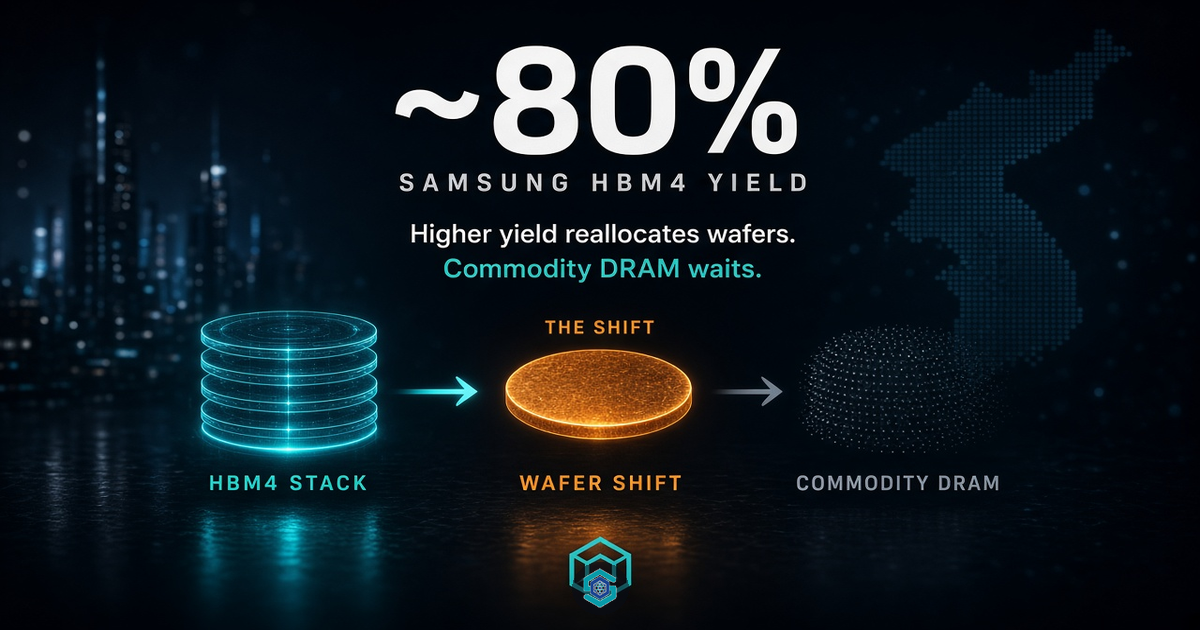
Samsung’s HBM4 yield is near 80%. That unlocks a volume push — and a quieter shift: more Korea wafers and SF4 foundry slots go into high-ASP HBM stacks and base dies. Who gets paid is Samsung memory. The stuck step for commodity DRAM and external foundry buyers is the capacity that left with them.
KOREA PULSE · Data as at 21 Sep 2026 · Next update: after Samsung / SK hynix Q3 2026 results (late Oct)
Affects: Semiconductors · Hyperscalers · Neoclouds — Markets: Korea · Taiwan · China
Education only, not advice to buy or sell any security. Yield and capacity figures from trade press are labelled as reported. Company IR is cited only where dated.
The numbers that matter this month
Samsung HBM4 yield (Sep 2026, reported)
~80%
Up from <60% in early mass production · SED 20 Sep 2026
Yield unlockHBM wafer input (2027 vs 2026, reported)
~250k / ~180k per mo
Our math: +70,000 wafers/month (~+38.9%)
Volume pushDRAM industry revenue (2Q26)
US$154.73B
+59.5% QoQ · Samsung DRAM US$60.98B, 39.4% share
Cash printConventional DRAM contracts (3Q26 forecast)
+13–18% QoQ
TrendForce 7 Sep 2026 — still rising as supply stays tight
Pricing powerSF4 capacity for HBM4 base dies (reported)
~half of 4nm
TechPowerUp citing ZDNet Korea, 7 Sep 2026 — secondary cite
Stuck stepHBM revenue share Q2 2026 (Counterpoint)
Samsung ~33%
SK hynix ~50% · Micron ~18% — research estimate, not a filing
Share shiftSources: Seoul Economic Daily 20 Sep 2026; TrendForce 7 Sep 2026; TechPowerUp/ZDNet Korea 7 Sep 2026 (SF4, reported); Counterpoint Q2 2026 HBM table as cited on Second Order HBM Explained. Status chips are Second Order’s read.
On this page: Why Korea? · What changed on yield? · Where do the wafers go? · Our wafer math · Where money sticks · Is capacity still stuck? · Dates next · Policy · What would change this · FAQ
Why does Korea matter for AI chips?
Korea is still the AI memory door. Most high-bandwidth memory that sits beside an AI GPU is made by SK hynix and Samsung. Without those stacks, a leading-edge die from Taiwan cannot ship as a finished accelerator.
That is the same map we keep on the Korea Markets hub and in HBM, explained. The September Korea HBM Pulse already covered SK hynix allocation and export prints. This Pulse asks a different money question: what happens when Samsung’s HBM4 yield finally lets it pull more wafers and foundry capacity into the same scarce pool.
1 · HBM stacks (Samsung + SK hynix)
Who: Memory makers under long agreements
Paid: High ASP on qualified HBM4 / HBM3E stacks
2 · Wafer + SF4 base dies
Who: Samsung DS memory + Samsung Foundry SF4
Paid: Capacity reallocated toward HBM4; other buyers wait
3 · Commodity DRAM ASP
Who: Server / PC / mobile buyers
Paid: Pay higher contract prices when wafers leave the pool
4 · Package join (mostly Taiwan)
Who: CoWoS-class and peers
Paid: Attach step still gates finished GPUs — see Taiwan door
Chain is Second Order’s map. Neighbours: Semiconductors stack · CoWoS explained · Taiwan TSMC / CoWoS Pulse.
What changed on Samsung’s HBM4 yield?
The yield lock is the fresh September print. Seoul Economic Daily reported on 20 Sep 2026 that Samsung’s HBM4 yield had climbed to around 80% from under 60% in early mass production.
HBM is unforgiving: a defect in one stacked die can scrap the finished product. When yield stabilises near what Korean industry sources call a “golden” range, the same tools and wafer input produce more sellable stacks. That is when a volume push stops being a slogan.
- SED (20 Sep 2026): Q3 HBM4 revenue expected to more than triple QoQ
- SED: HBM4 expected to account for more than 60% of Samsung HBM revenue in H2 2026
- SED: HBM4 about 2 million won per chip — more than double HBM3E
- SED: HBM4E reliability-stage yield reported above 70%; 12-layer samples to major customers including Nvidia in May
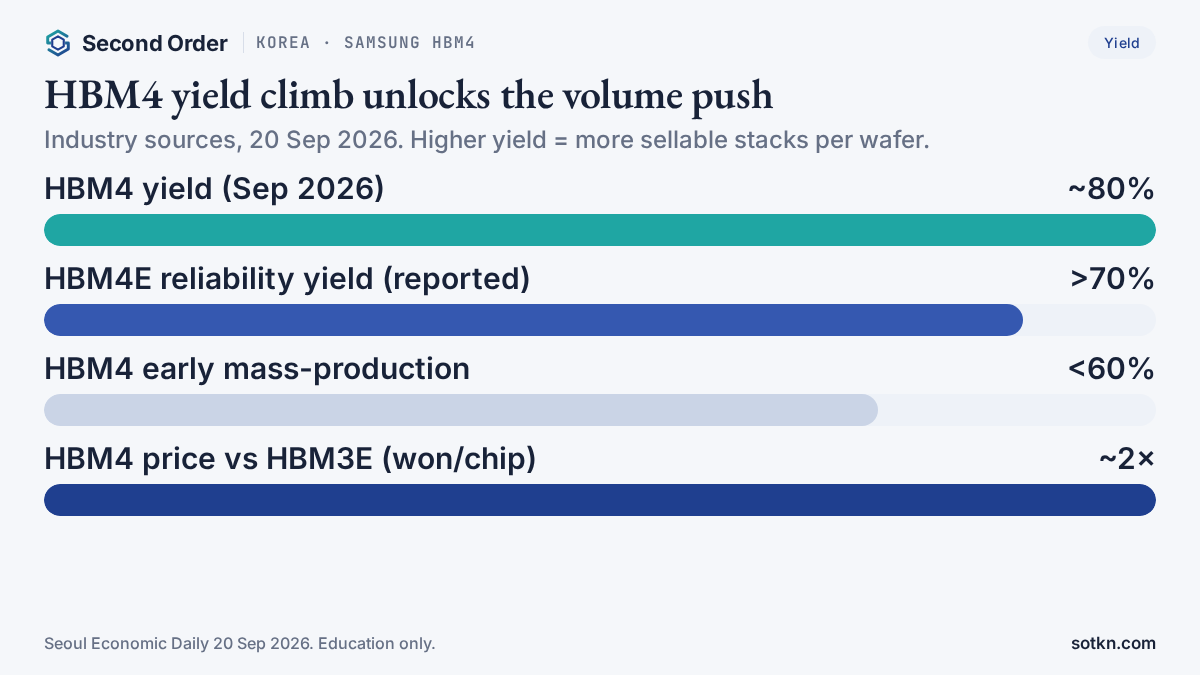
So what: Samsung can now grow high-margin HBM4 bits without waiting for another process miracle. The second-order effect is capacity — every wafer that goes into HBM is a wafer that does not go into commodity DRAM, and every SF4 slot that prints an HBM4 base die is a slot external foundry customers do not get.
Where do the wafers — and SF4 slots — go?
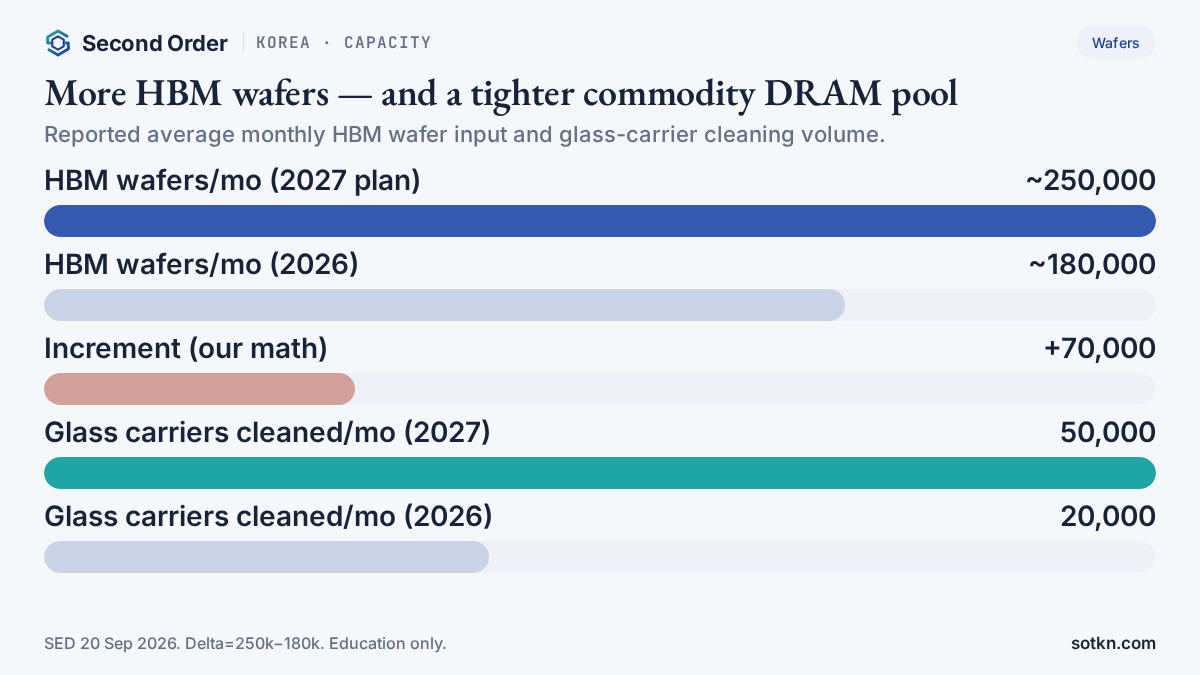
They go into HBM volume. Industry sources via SED on 20 Sep 2026 put Samsung’s average monthly HBM wafer input near 180,000 this year and about 250,000 next year — nearly 40% higher.
The same reporting says the HBM4 family (HBM4 plus HBM4E) could rise from around 40% of Samsung HBM shipments this year to about 80% next year as HBM4E mass production ramps. Glass-carrier cleaning volume — a back-end tell for high-stack thinning — is expected to rise from 20,000 to 50,000 sheets a month (2.5×).
On the foundry side, TechPowerUp on 7 Sep 2026, citing ZDNet Korea, reported that roughly half of Samsung Foundry’s 4nm (SF4) capacity at Pyeongtaek is allocated to HBM4 base dies. Label that as reported secondary Korean media, not a Samsung IR slide — but it matches the integrated story: HBM4 uses 1c DRAM plus a 4nm base die that Samsung can coordinate inside one company.
Share context: Counterpoint’s Q2 2026 HBM revenue table (as cited on our HBM Explained page and in SED) put Samsung near 33%, SK hynix near 50%, and Micron near 18%. SED also notes Samsung’s HBM share rose from 21% in Q1 to 33% in Q2 while SK hynix fell from 58% to 50%. That is a research estimate — useful for direction, not a filing.
Our wafer math — what the +70,000 tells you
Take the two reported monthly wafer figures at face value and subtract. That is the only original arithmetic in this Pulse.
Reported HBM wafer input (SED 20 Sep 2026)
Inputs: Seoul Economic Daily, 20 Sep 2026 (two articles). Arithmetic is Second Order’s. These are industry-source plans, not Samsung formal guidance.
What this tells you: Samsung is preparing a large step-up in HBM wafer starts on top of a richer HBM4 mix. What it does not tell you: exact stack shipments, exact customer mix, or whether every planned wafer start lands on schedule. Treat the 70,000 as a scale marker.
The DRAM cash print already shows the pricing side of a tight pool. TrendForce (7 Sep 2026) put industry DRAM revenue at nearly US$154.73 billion in 2Q26, up 59.5% QoQ. Samsung led with US$60.98 billion (+63.4% QoQ) and 39.4% share. Conventional DRAM contracts are still forecast +13–18% QoQ in 3Q26 — slower than earlier quarters, but not a loose market.
Where does the money stick?
Cash sticks where capacity is scarce relative to demand. In this Korea read, that is not “does HBM4 exist?” — it is which wafers and which SF4 slots feed HBM4 first.
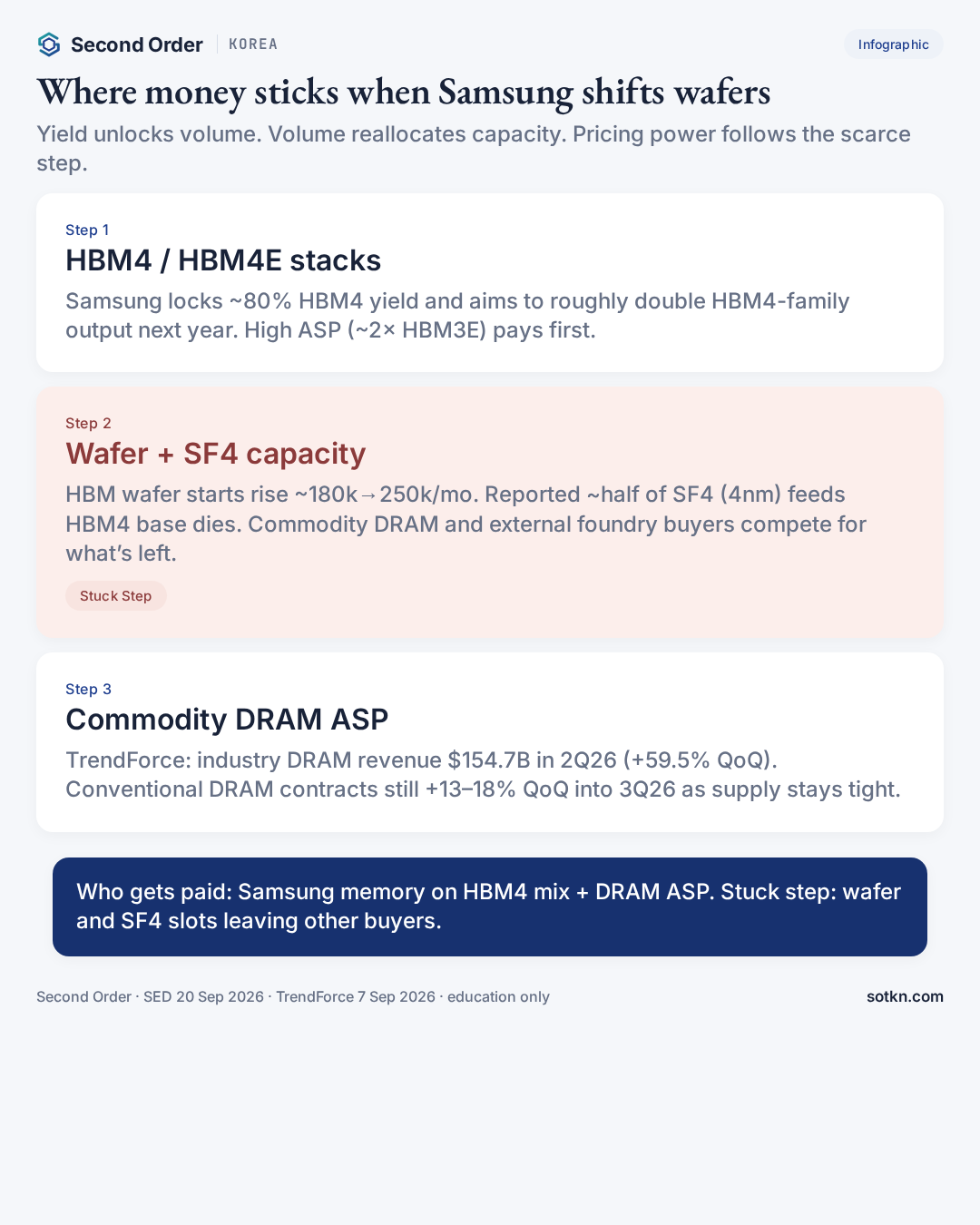
- Step 1 — HBM4 / HBM4E stacks: Samsung invoices high ASP (~2× HBM3E on HBM4 per SED). Yield near 80% turns volume into sellable bits.
- Step 2 — Wafer + SF4 capacity (stuck): HBM wafer starts rise; reported ~half of SF4 feeds base dies. Commodity DRAM and external foundry buyers wait.
- Step 3 — Commodity DRAM ASP: A tighter wafer pool supports contract prices (+13–18% QoQ conventional DRAM into 3Q26, TrendForce).
One-line rule: when yield unlocks HBM volume inside an integrated memory–foundry company, the margin migrates to the memory mix — and the queue migrates to everyone else who needed those wafers or SF4 slots.
Is wafer and SF4 capacity still stuck?
Yes for other buyers — until dated evidence shows HBM wafer starts and SF4 base-die share stop crowding them out. Samsung’s own HBM path looks looser on yield; the scarcity simply moved to the capacity those other buyers share.
Stuck-step scorecard (Sep 2026)
Status is Second Order’s read from SED 20 Sep 2026, TrendForce 7 Sep 2026, and the SF4 secondary cite (7 Sep 2026). Two cautions: (1) yield is reported, not IR-guided; (2) SF4 share is Korean-media reported.
For the allocation-centred Korea story — SK hynix margins, export prints, LTA customer lists — stay on the Korea HBM Pulse. For the packaging neighbour, use Taiwan TSMC revenue / CoWoS and CoWoS explained. China’s parallel stack still hits advanced HBM access first — see China HBM access.
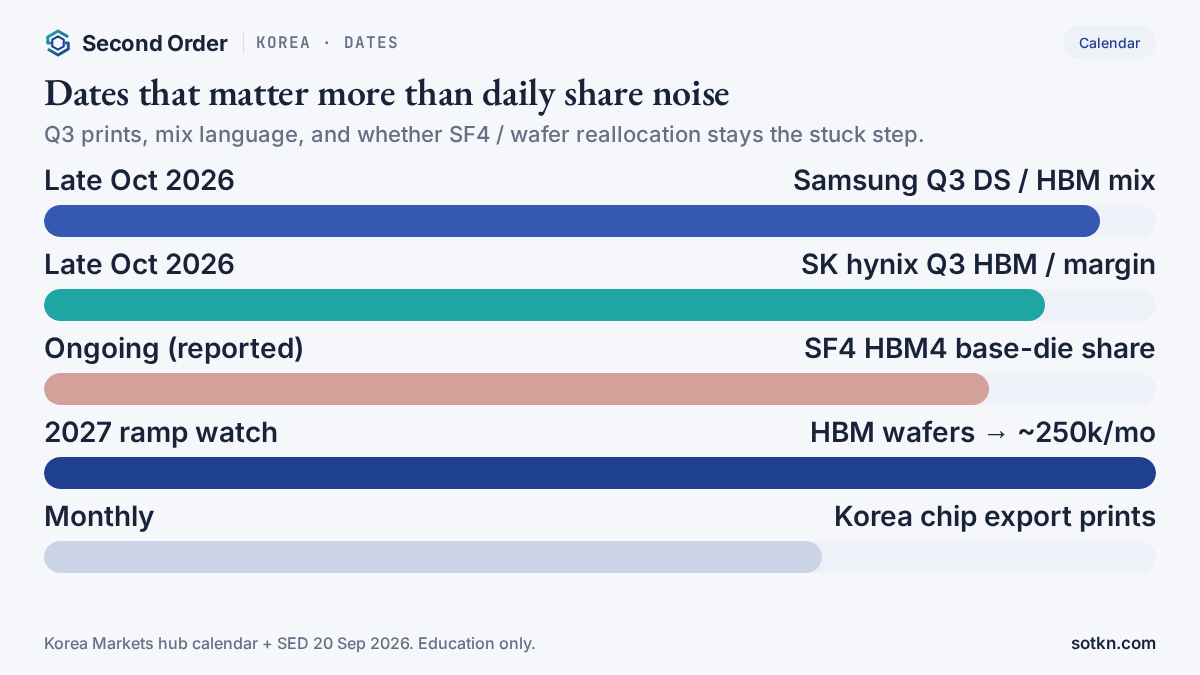
Samsung and SK hynix earnings dates — what comes next
The next hard prints are Q3 results late October 2026. Listen for HBM mix, wafer-start language, and whether foundry commentary mentions base-die load — not for daily share noise.
Calendar
Policy — export rules and tool access
Korea’s HBM leaders still sit inside a global rules set that shapes who may buy advanced stacks and which tools can ship where. This Pulse does not re-litigate every control list. The money point for September is domestic: even without a new rule change, Samsung’s own reallocation of wafers and SF4 capacity changes who gets paid inside Korea.
- Advanced HBM remains strategically allocated to a short customer list globally
- China’s access path is a separate stuck step — see the China Pulse
- Tool and equipment lead times still set how fast new wafer starts can land
- A yield win does not erase export or customer-qualification clocks
So what: policy can tighten or loosen the buyer list. Yield and wafer starts decide how much Samsung can put on that list this year and next.
What would change this view?
- Credible Samsung IR showing HBM wafer starts flat while commodity DRAM supply loosens
- Clear evidence SF4 capacity for external customers rises even as HBM4 ramps
- Conventional DRAM contracts falling QoQ for two quarters while HBM ASP holds
- HBM4 yield reports reversing below ~60% with delayed HBM4E quals
- Hyperscaler / neocloud demand pause that frees HBM without new capacity
- Architecture shift that cuts HBM intensity per unit of useful compute
The view stays intact while reported HBM4 yields hold near the high-70s/80s, wafer-start plans keep rising, and conventional DRAM contracts stay firm on a tight supply read.
Practical takeaways
- Name the stuck step: wafer + SF4 capacity leaving commodity DRAM and external foundry buyers
- Samsung HBM4 yield near 80% (SED 20 Sep 2026, reported) is the unlock — not the end of scarcity
- Our math: +70,000 HBM wafers/month planned (~180k → ~250k) is the scale marker
- TrendForce’s 2Q26 DRAM revenue print (US$154.7B, +59.5% QoQ) shows the pricing side of a tight pool
- Read this beside the SK hynix allocation Pulse — same door, different stuck-step lens
How international readers get exposure (roles only)
Examples of exposure roles only — not recommendations. Samsung Electronics (005930.KS) and SK hynix sit on the Korea memory door; Micron is the third HBM supplier often accessed via US listing. Always verify ticker, ADR, and tax treatment for your jurisdiction. Where a broker account is useful for international access, some readers use Interactive Brokers — soft link only, never a hard sell.
FAQ
What is Samsung’s HBM4 yield in September 2026?
Industry sources cited by Seoul Economic Daily on 20 Sep 2026 put Samsung’s HBM4 yield near 80%, up from under 60% in early mass production. Treat that as a reported industry figure, not a company IR release.
Why does HBM4 yield matter for who gets paid?
Higher yield means more sellable stacks from the same wafer and tool set. Samsung can expand high-ASP HBM4 output and still keep commodity DRAM supply tight — both support memory cash, on different clocks.
What is the stuck step in this Korea read?
Wafer starts and SF4 (4nm) foundry capacity being pulled into HBM4 stacks and base dies. Commodity DRAM buyers and external foundry customers compete for what remains.
How big is the planned HBM wafer increase?
Industry sources via SED (20 Sep 2026) put average monthly HBM wafer input near 180,000 this year and about 250,000 next year. Our math: +70,000 wafers/month, about +38.9%.
Is this a buy list of Samsung or SK hynix shares?
No. This Pulse maps who gets paid and which step is stuck. It is education only, not a recommendation to buy or sell any security.
How does this differ from the earlier Korea HBM Pulse?
The September Korea HBM Pulse centred on SK hynix allocation and export prints. This door centres on Samsung’s HBM4 yield unlock and the wafer / SF4 capacity shift that follows.
Keep reading on the map
- HBM explained · CoWoS explained
- Korea HBM Pulse (SK hynix allocation) · Korea Markets hub
- Taiwan TSMC / CoWoS Pulse · China HBM access Pulse
- Semiconductors stack · Hyperscalers · Analysis · Wire
How we check this
Figures come from company filings and government releases, each dated in the list below. Capacity and timing from press reports are labelled as reported, not guided. Where we work something out ourselves, the arithmetic is shown in full.
Last reviewed: 21 Sep 2026 · Next review: after Samsung / SK hynix Q3 2026 results
Spot an error? Tell us and we will correct it and note the change here.
Sources
- Seoul Economic Daily — Samsung HBM4 yield ~80% / volume push (20 Sep 2026)
- Seoul Economic Daily — HBM4 output / glass carriers / wafer input (20 Sep 2026)
- TrendForce — DRAM industry revenue 2Q26; 3Q26 contract-price outlook (7 Sep 2026)
- TechPowerUp (via ZDNet Korea) — SF4 ~half for HBM4 base dies (7 Sep 2026, reported)
- Counterpoint Research — Global HBM revenue share Q2 2026 table (as cited on Second Order HBM Explained)
- Samsung Electronics — Q2 2026 results / HBM4 scale-up context (30 Jul 2026 newsroom)
- Second Order — Korea HBM Pulse (sibling door)
Education only. Not investment advice. Do your own research. Second Order may correct figures if primary sources revise them — next planned refresh after Samsung / SK hynix Q3 2026 results.