Korea drafts 50 MW grid-review pass for AI data centres outside Seoul
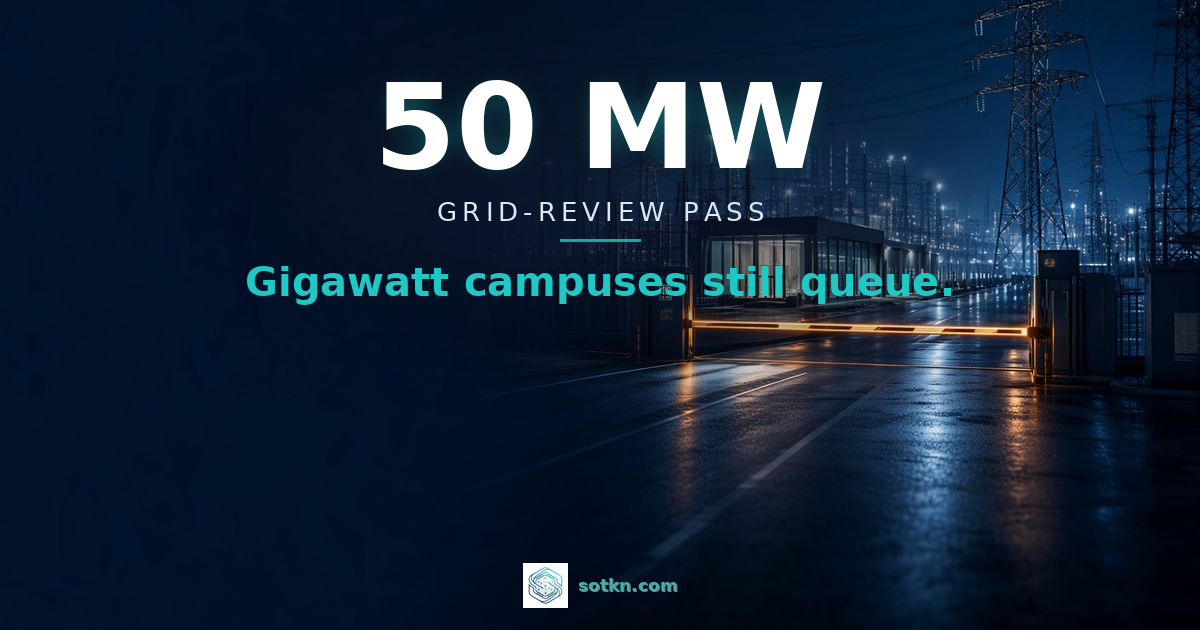
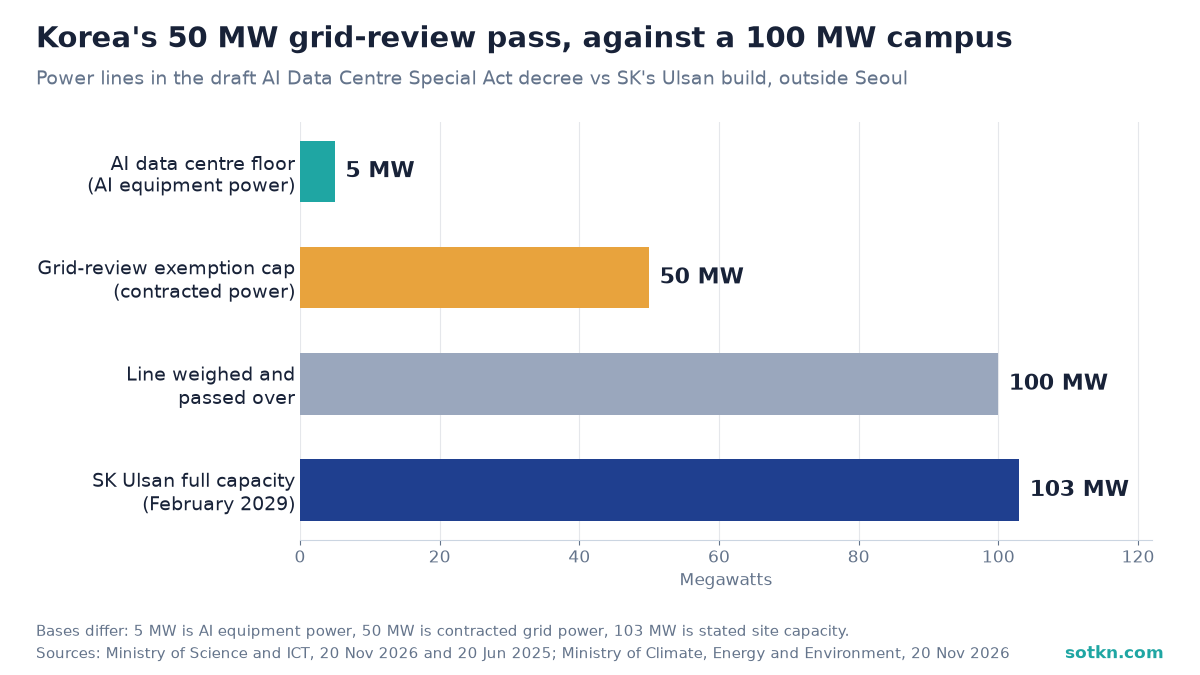
South Korea's draft decree lets AI data centres outside the capital region skip the grid impact review at 50 MW of contracted power or less. Gigawatt campuses only move up the queue, and SK's Ulsan site alone would draw roughly three times the line.
WIRE · AI DATA CENTERS · SOUTH KOREA · Data as at 22 Nov 2026 (draft decree 20 Nov; Ulsan site visit 21 Nov)
South Korea has drafted a rule that lets AI data centres outside the Seoul capital region skip the national grid impact review if they contract 50 MW of power or less. Gigawatt-scale projects still face the review and get only a place at the front of the queue, so the rule clears small regional halls first while the big campuses keep waiting on the grid. Comments close on 30 December, and the rule is meant to start with the AI Data Centre Special Act on 10 March 2027.
What happened
Print: The exemption line
Figure: 50 MW of contracted power or less, for AI data centres built, expanded or converted outside the capital region. An expansion is tested on total contracted power after it is built.
Source: Ministry of Science and ICT, draft Enforcement Decree Article 17, 20 Nov 2026
Print: The line the ministries passed over
Figure: 100 MW. The climate ministry said even that would leave most gigawatt-class megaprojects outside the exemption. Instead, megaprojects and bundled-permit applicants will get priority review at any size, and sites in AI data centre special zones will skip the non-technical part of the review.
Source: Ministry of Climate, Energy and Environment, 20 Nov 2026
Print: Who counts as an AI data centre
Figure: At least 250 kW of AI equipment power making up at least 50% of IT power, or at least 5 MW of it, plus a design power ratio (total facility power divided by IT power) of 1.5 or less. Colocation halls qualify.
Source: Ministry of Science and ICT, draft Enforcement Decree Article 3, 20 Nov 2026
Print: The clocks
Figure: Bundled permits: 7 days to forward the file, 10 days for agencies to reply, 30 days for the ministry to finish. A construction notice must name a start date within one year. Hearing 9 December; planned start 10 March 2027; existing sites then have six months to file.
Source: Ministry of Science and ICT, draft decree Articles 7 and 14 and notice No. 2026-1094, 20 Nov 2026
Print: The first big site
Figure: SK's Ulsan AI data centre is 71% built and due to be the first megaproject AI data centre to open, at the end of 2027, as the start of SK's 5 GW plan.
Source: Office of the President (Cheong Wa Dae), written briefing, 21 Nov 2026
Why cash cares
The grid impact assessment checks whether the local network can carry a large new load before the user signs for power. A data centre owner is paid when a tenant moves into a powered hall, so every month in review is a month of construction interest with no rent.
Aju Press reported on 22 November an industry estimate that delay costs about 300 million won a day on a 1 trillion won build, about 11% of the build cost over a year. It also reported that, among groups planning hyperscale sites, only SK had issued corporate bonds for AI data centres by the third quarter.
The exemption pays by saving time, not by adding power, and it sets the size of hall that benefits. On our arithmetic, a site contracting 50 MW at the maximum design ratio of 1.5 carries at least about 33 MW of IT equipment, or about 36 to 38 MW at the 1.3 to 1.4 operating ratio the science ministry says that corresponds to. That is a solid AI hall, not a campus.
Why 50 MW leaves the big campuses in the queue
Ulsan shows where the line falls. At launch in June 2025, the science ministry said it would open 41 MW in November 2027 and reach 103 MW by February 2029. On 21 November the SK Ecoplant site manager updated the President, in the presidential office's video of the visit: building A takes 154 kV power next month, finishes in May 2027 and passes to AWS in October 2027; building B follows in January 2029.
If that 103 MW is IT load and the hall runs at a ratio of 1.3 to 1.5, Ulsan would draw roughly 134 to 155 MW from the grid, about 2.7 to 3.1 times the line, on our arithmetic. Because expansions are tested on total contracted power, a campus cannot grow past 50 MW in exempt slices. A 5 GW plan sits wholly inside the review, fast track or not.
The deeper bind is geography. Money Today reported in May, citing climate ministry data obtained by a lawmaker, that 736 data centre projects applied for the first technical grid review between August 2024 and March 2026. Of those, 522 were in the capital region, 279 of them were judged impossible to supply, and only 10 cleared the main review. Outside the region, 187 of 214 passed the first review. Aju Press reported on 20 November that capital-region approvals came to about 1 GW of the 33.6 GW sought.
On our arithmetic, about 87% of regional applications cleared the first review, while 53% of capital-region applications were refused outright and about 3% of the capacity sought near Seoul was approved. The exemption helps where the grid already tends to say yes, not where it says no.
The second-order read
Who gets paid first. Regional developers and landlords whose halls fit under 50 MW, including colocation landlords renting space to other firms' AI racks. Local governments in special zones gain too: the draft lets government fund roads, energy storage, waste-heat reuse, telecom, security and resident facilities there.
Who gets paid on the big sites. Builders and power-gear suppliers, before any tenant pays. At Ulsan, SK Broadband is the client, SK Ecoplant the builder, and the site manager said the extra-high-voltage substation equipment comes from LS Electric. AWS, named on site as the lessee, takes the halls in October 2027 and January 2029. Our read: SK's income from the halls follows those handovers, not the building work.
Who pays. Capital-region projects, which keep the full review. Placeholder applicants: the science ministry says the one-year start-date rule targets operators who file only to lock in the exemption. And the grid still has to carry the load. An exemption removes a review, not a substation.
Upstream and downstream. President Lee said demand for AI data centres and memory will keep rising as the technology advances. Our read: accelerators can only be installed as fast as powered halls open. Our Markets note Korea AI Data Centres: Seoul Halls Booked, Regions Wait covers the tenant side of the same split.
Two cautions
This is a draft. The line, the clocks and the definitions can move after comments close and legal review. The climate ministry's notice amendment and priority-review manual are not yet published; the ministries only aim to settle them for the Act's start.
The grid numbers are a snapshot to March 2026, reported from ministry data rather than a published series. The Ulsan schedule comes from a site briefing to the President, not an SK or AWS filing.
What would change the view
A final line nearer 100 MW would bring more regional campuses inside the exemption and pull their rent forward. A priority-review manual with a stated waiting time would put a clock on the megaprojects. More approvals near Seoul would matter more than any exemption. A slip at Ulsan's power hook-up or May 2027 completion would show review time was not the only constraint.
What to watch
- December 2026: Ulsan building A takes 154 kV power.
- 9 December 2026: public hearing at Nuri Dream Square, Seoul.
- 30 December 2026: comments close.
- First half of 2027: science ministry guideline on consulting nearby residents.
- 10 March 2027: Act and decree take effect, if the decree is final.
- May and October 2027: Ulsan building A completion and handover to AWS.
- About 10 September 2027: filing deadline for sites running or under construction at the start, on our arithmetic (10 March plus six months).
Read: the AI Data Centers layer, Contracted Power, Explained and How Long Does It Take to Build an AI Data Center?
Get the Wire. A free brief every day, here and in your inbox.
Not investment advice. Education only; do your own research. Figures marked "our arithmetic" are our own calculations on the sources below.
References
- Ministry of Science and ICT, 20 Nov 2026, press release on the draft Enforcement Decree and Enforcement Rule of the AI Data Centre Special Act — https://www.msit.go.kr/ssm/file/fileDown.do?atchFileNo=55663&fileOrd=2
- Ministry of Science and ICT, 20 Nov 2026, notice No. 2026-1094, draft Enforcement Decree of the AI Data Centre Special Act (full text) — https://www.msit.go.kr/bbs/view.do?bbsSeqNo=84&mId=109&mPid=103&nttSeqNo=3186432&sCode=user
- Ministry of Climate, Energy and Environment, 20 Nov 2026, press release on grid impact assessment changes for AI data centres — https://mcee.go.kr/home/web/board/read.do?boardId=1908920&boardMasterId=939&menuId=10598
- Office of the President (Cheong Wa Dae), 21 Nov 2026, written briefing on the Ulsan SK AI data centre site visit — https://www.president.go.kr/briefings/zXB9A2D7
- Office of the President (Cheong Wa Dae), 21 Nov 2026, video of the Ulsan SK AI data centre site visit — https://www.president.go.kr/videos/shZPSTtz
- Ministry of Science and ICT, 20 Jun 2025, "Ulsan AI Data Center Launch Sparks Dialogue on Advancing Korea into a Top-Three Global AI Power" — https://www.msit.go.kr/eng/bbs/view.do?bbsSeqNo=42&mId=4&mPid=2&nttSeqNo=1130&sCode=eng
- Money Today, 23 May 2026, data centre grid review applications by region (reported, citing climate ministry data) — https://www.mt.co.kr/tech/2026/05/23/2026052210211399740
- Aju Press, 20 Nov 2026, "Korea fast-tracks grid reviews for AI data centers" — https://www.ajupress.com/view/20261120123819750
- Aju Press, 22 Nov 2026, "Investment Clock Stops for AI Data Centers Amid Permit Delays" — https://www.ajupress.com/view/20261122172070182