ChronoScale's $7.5B Odessa deal: power is firm, GPU money is not
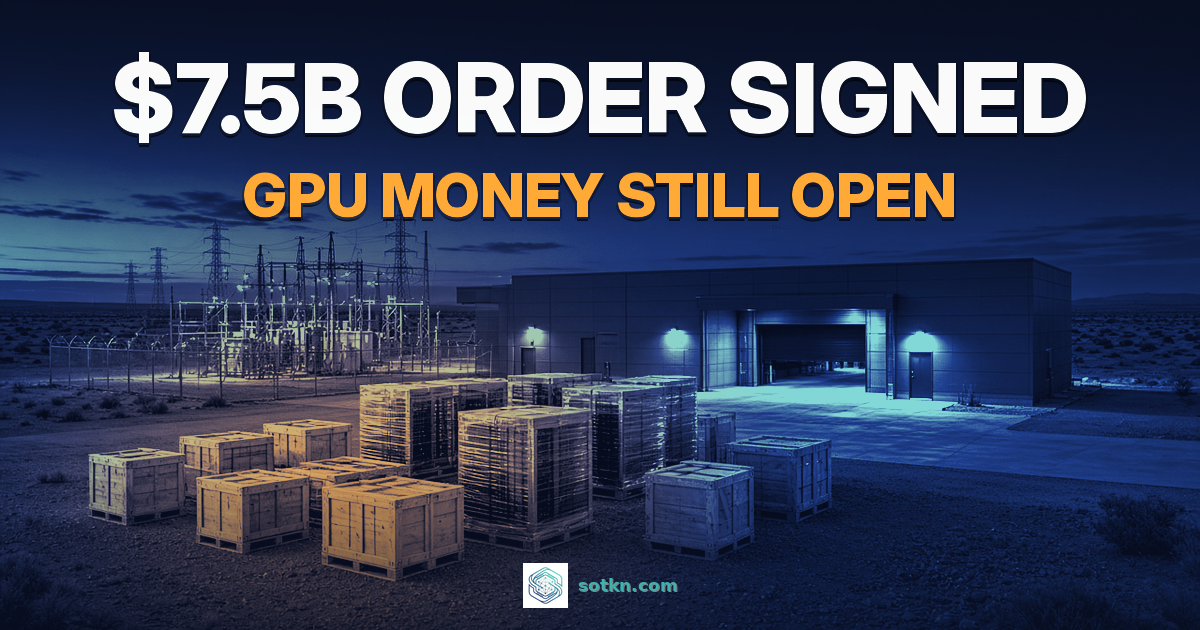
ChronoScale and STN will run an Odessa, Texas AI campus for an unnamed frontier lab: 65 MW ordered, up to US$7.5 billion over six years. The power is firm. Project financing for the GPUs has not closed, and until it does ChronoScale funds the gap.
WIRE · NEOCLOUDS · UNITED STATES · Filed 18 Nov 2026 (ChronoScale Form 8-K)
GPU cloud ChronoScale said on Wednesday it will form a 50/50 partnership with developer STN to run an AI campus in Odessa, Texas, for an unnamed frontier AI lab. The first 65 MW is ordered and worth up to US$7.5 billion over about six years. The power for those 65 MW is already firm. The money for the chips is not: the partnership still needs project financing for at least 75% of the budget. On the Neoclouds layer, a signed order is not cash. Cash comes when a delivered tranche of GPUs is accepted and billed.
What happened
The order
65 MW in four tranches; up to US$7.5 billion over about six years
First tranche due in Q4 2026, the other three in the first half of 2027; a substantial part of phase one is backed by an investment-grade technology company
The campus
350 MW planned in three phases; only the first 65 MW is ordered
ChronoScale has a right of first offer on the other 285 MW; the customer has no commitment to order phases two or three
Who puts in what
US$390 million of value each; ChronoScale lends US$220 million, US$200 million of it straight to Super Micro for GPUs
STN brings the contract, the site lease and project assets valued at US$251.9 million; the rest of its share is cash, due only after project financing closes
The parent's raise
Up to US$750 million: US$250 million of stock at US$8, plus a US$500 million preferred facility
Only US$10 million of the preferred facility is expected to be drawn at closing; investors include a frontier AI lab, Nutanix and Empery Digital
Why cash cares
The headline number is a ceiling, not a bank balance. The filing says the US$7.5 billion assumes "full performance and delivery of the contracted capacity". It excludes extensions and any extra tranches. Nothing is billed until a tranche of GPUs is delivered and accepted.
Spread over six years, US$7.5 billion is about US$1.25 billion a year. On 65 MW, that is roughly US$19 million per megawatt per year, on our arithmetic. ChronoScale quotes a blended US$20.8 million per megawatt across all three phases, but two of those phases have not been ordered. The figure for the part that is signed is the lower one. For scale, the Corvex deal on 16 November priced at about US$21 million per megawatt.
The money going in is small next to the money promised. The two partners put in US$390 million of value each, US$780 million together. That is about 10% of the contract value, on our arithmetic. And not all of it is cash. STN's share is mostly the contract itself, the site lease and assets valued at US$251.9 million. The other US$138.1 million is cash that STN owes only within 90 days after a "Qualified Project Financing" closes. If that financing never closes, STN does not have to pay it.
The customer is paid to show up. It gets a warrant for up to 8,072,152 ChronoScale shares at one cent each. Half of those vest in four equal parts, one as each tranche is delivered and accepted. The lab is rewarded for taking delivery, which tells you delivery is the moment that matters.
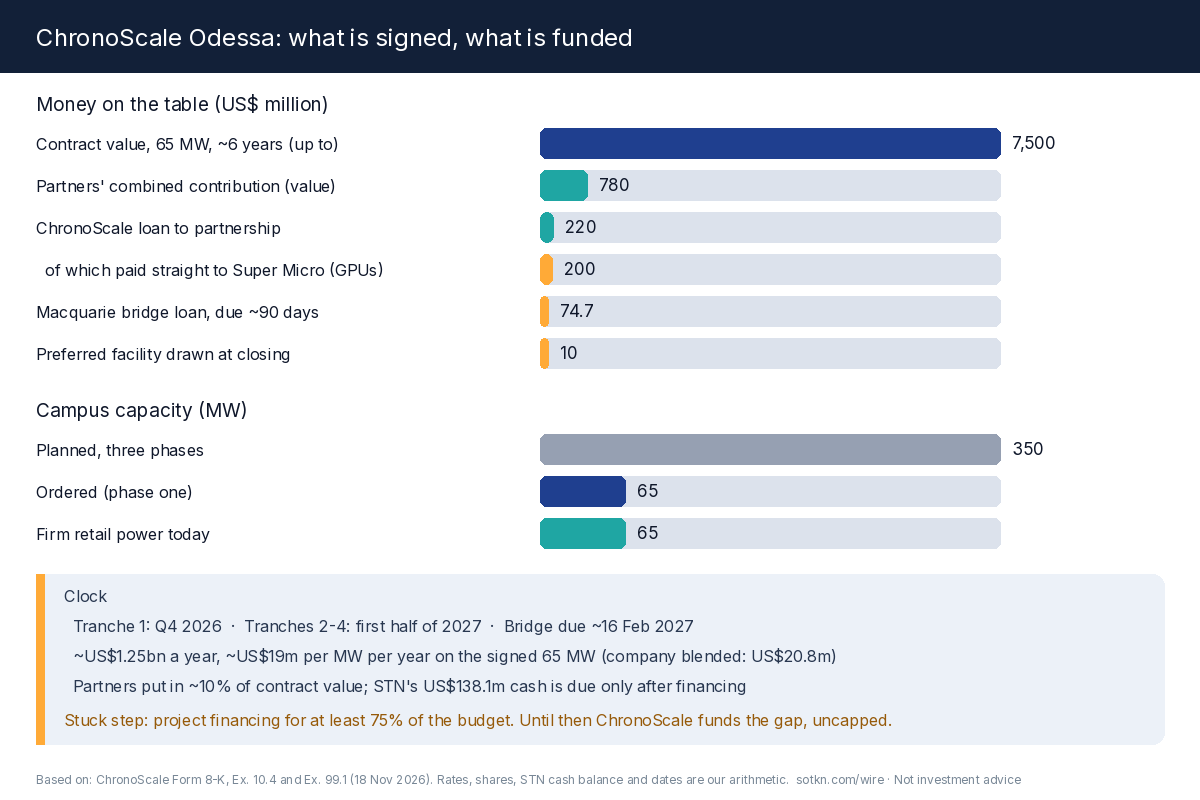
Figure: the order is signed and the power is firm; the GPU money is the open step. Contract value, phases, contributions, loans and the parent's financing from ChronoScale's Form 8-K and Exhibit 99.1 (18 November 2026). Per-megawatt rate, shares of contract value and the loan date are our arithmetic.
The step that is still open
The stuck step is project financing for the GPUs. A "Qualified Project Financing" in the filing means debt for at least 75% of the project budget. That has not closed. Until it does, ChronoScale must fund whatever else the project needs, "without a specified cap". It gets that money back with interest from STN's later cash or, failing that, from the project's cash ahead of other payouts.
Power is not the stuck step for this phase. The contribution agreement says the site has retail electric service for up to 65 MW through Ammper Power, under agreements dated 13 May and 11 August 2026, with no further interconnection studies or approvals needed. Oncor is the wires company. The same section says the site has no wholesale contract for on-site, behind-the-meter power. That matters for the next 285 MW, not the first 65 MW.
The short loans set the clock. Macquarie lends the partnership US$74.7 million at 10%, interest paid in kind, secured on the partnership's assets including its GPUs. The money repays part of STN's existing Macquarie debt, and the loan falls due 90 days after closing. If the deal closed as planned on 18 November, that is about 16 February 2027, on our arithmetic. ChronoScale's own US$220 million note matures 91 days after that loan unless it converts into partnership units once the US antitrust (HSR) waiting period ends.
So the order runs from Q4 2026 into the first half of 2027. The bridge loan runs out in February. The long-term GPU debt has not been named. That gap is where the risk sits.
The second-order read
Who gets paid. Super Micro first: US$200 million of ChronoScale's loan goes straight to it for GPUs, before a single hour is billed. Macquarie next: it is repaid within about 90 days, with 10% interest, and holds the GPUs as security. Ammper and Oncor sell the 65 MW of power. STN turns a site and a signed order into half of a partnership, and its cash share is conditional.
Who funds the wait. ChronoScale and its shareholders. The parent is raising US$250 million of stock at US$8 a share and has a preferred facility of up to US$500 million, but it expects to draw only US$10 million of that at closing, about 2% of the facility, on our arithmetic. Applied Digital, ChronoScale's controlling shareholder, takes part of the stock through a note. If GPU debt is slow, the uncapped funding duty falls on ChronoScale.
Who waits. The frontier lab waits for its capacity, but it carries little cash risk. It can end affected tranches for late delivery or sustained service failures, with cure rights possible. The partnership's own rights to end the deal are more limited. The investment-grade backer stands behind a large part of phase one, which is what lenders will look at first.
If phase two is ordered, the next stuck step moves to power. The other 285 MW needs land, permits, power and interconnection, the filing says. Texas grid operator ERCOT has paused energising new large data centres of 75 MW or more and expects findings by 10 December, American Buildout reports. The first 65 MW sits below that line. The rest of the campus does not.
Cautions
The US$7.5 billion is "up to". It assumes full delivery and full performance for six years, and the customer can cut tranches that arrive late.
The customer and the credit backer are unnamed. "Investment-grade technology company" tells you about credit quality, not who signs the cheque.
The per-megawatt figures are not like-for-like. Our US$19 million is on the signed 65 MW; ChronoScale's US$20.8 million blends phases that are not ordered, and GPU types vary by phase.
What would change the view
A closed project financing for at least 75% of the budget, with the lender named, would move this from "signed" to "funded". A first tranche accepted in Q4 2026, which would also vest the first part of the customer's warrant, would move it to "billed". A slip in tranche dates, or a draw on the uncapped funding duty large enough to need more ChronoScale stock, would point the other way.
What to watch
- 10 December 2026: ERCOT's findings on large data centre connections, which matter for the 285 MW, not the first 65 MW.
- Q4 2026: delivery and acceptance of the first tranche, and any filing on warrant vesting.
- By about 16 February 2027: whether the Macquarie bridge is repaid from new project debt or extended.
- First half of 2027: the other three tranches, and any order for phase two.
Read: the Neoclouds layer, What Does ChronoScale Do?, ChronoScale's US$2.7 billion of contracted revenue, What Does Applied Digital Do?, What Is Vendor Financing? and What Is a Customer Prepayment?
Get the Wire. A free brief every day, here and in your inbox. Subscribe free →
If this Wire saved you a search, tip Second Order → sotkn.com/support
Not investment advice. Do your own research. The annual and per-megawatt contract rates, the share of contract value put in by the partners, STN's cash balance, the share of the preferred facility drawn and the loan due date are our arithmetic on ChronoScale's filing.
References
- ChronoScale Holdings, Form 8-K with Exhibits 10.4 (Contribution Agreement) and 99.1, filed 18 Nov 2026. Partnership terms, GPU Services Agreement, contributions, loans, power, warrant and financing.
- ChronoScale, "ChronoScale Announces New Development Partnership to Accelerate AI Compute Capacity Deployment, Supported by a Significant Capital Raise", 18 Nov 2026. Contract value, phases, US$20.8 million per MW and investors.
- STN, "STN and ChronoScale Form Partnership to Develop Odessa AI Campus", 18 Nov 2026. Campus phases and first-phase timing.
- American Buildout, "ChronoScale and STN: Odessa, Texas data center could bring $7.5B", 19 Nov 2026. ERCOT large-load pause threshold and December findings.