Corvex signs $103M for Blackwell; the customer and lender fund 82%
Corvex signed a three-year, $103 million take-or-pay contract for Nvidia Blackwell capacity. The customer and a lender fund $64 million of the $78 million build, but Corvex earns nothing from it until the GPUs are delivered and accepted, from the end of March 2027.

WIRE · NEOCLOUDS · UNITED STATES · Reported 16 Nov 2026 (company release and 8-K filing)
Corvex, a Nasdaq-listed GPU cloud, said on Monday 16 November that it has signed a three-year, US$103 million take-or-pay contract to rent Nvidia Blackwell capacity to an unnamed AI inference platform. The gear costs about US$78 million, and the customer and a lender put up US$64 million of it, about 82% on our arithmetic. Corvex gets paid only once the capacity is delivered and accepted, from the end of March 2027. On the Neoclouds layer, the chip sellers are paid first and the landlord of the GPUs waits.
What happened
The contract
US$103m over three years, take-or-pay, for more than 1,000 Nvidia HGX B200
The customer pays for the reserved capacity whether it uses it or not; 1.6 MW of IT capacity at Corvex's Mid-Atlantic 1 site
Who funds the build
US$26m customer prepayment + US$38m loan from USD.AI = US$64m of a US$78m cost
Corvex puts in the remaining US$14m; the three-year loan is asset-backed and non-recourse to Corvex
The revenue
About US$21m of annual contract revenue per megawatt
Contracted annual revenue at Mid-Atlantic 1 rises from US$22m today to about US$56m once the deployment is in service
The same day, bigger
TensorWave signs six years and 457 MW of AMD capacity for OpenAI
First capacity in the first half of 2027, full deployment by early 2028; no sites or price disclosed
Why cash cares
A GPU cloud is a landlord for chips. It buys the servers, installs them, and rents the hours back to an AI company. The hard part is the gap between the two: the servers have to be paid for before the first hour is billed. Corvex's deal shows how a small neocloud now closes that gap with other people's money.
The contract is worth US$103 million over three years, or about US$34.3 million a year on our arithmetic. Spread over 1.6 MW of IT capacity, that is about US$21.5 million per megawatt a year, in line with the company's own "approximately US$21 million". Once it is running, contracted annual revenue at Mid-Atlantic 1 goes from US$22 million to about US$56 million, roughly 2.5 times as much.
The build costs about US$78 million for servers, storage, networking and spares, or about US$49 million per megawatt for the gear alone, on our arithmetic. The customer prepays US$26 million, a quarter of the full contract value. The lender, USD.AI, commits US$38 million on a three-year loan secured on the equipment and with no claim on the rest of Corvex. That leaves Corvex with US$14 million, about 18% of the cost. Each dollar of its own money sits behind about US$7.40 of contracted revenue.
The contract brings in about 1.3 times what the gear costs over its term. That is before power, rent, staff and interest, which Corvex did not break out. If the loan were repaid in equal parts, principal alone would take about US$12.7 million a year, roughly 37% of the contract's annual revenue; the repayment schedule was not disclosed.
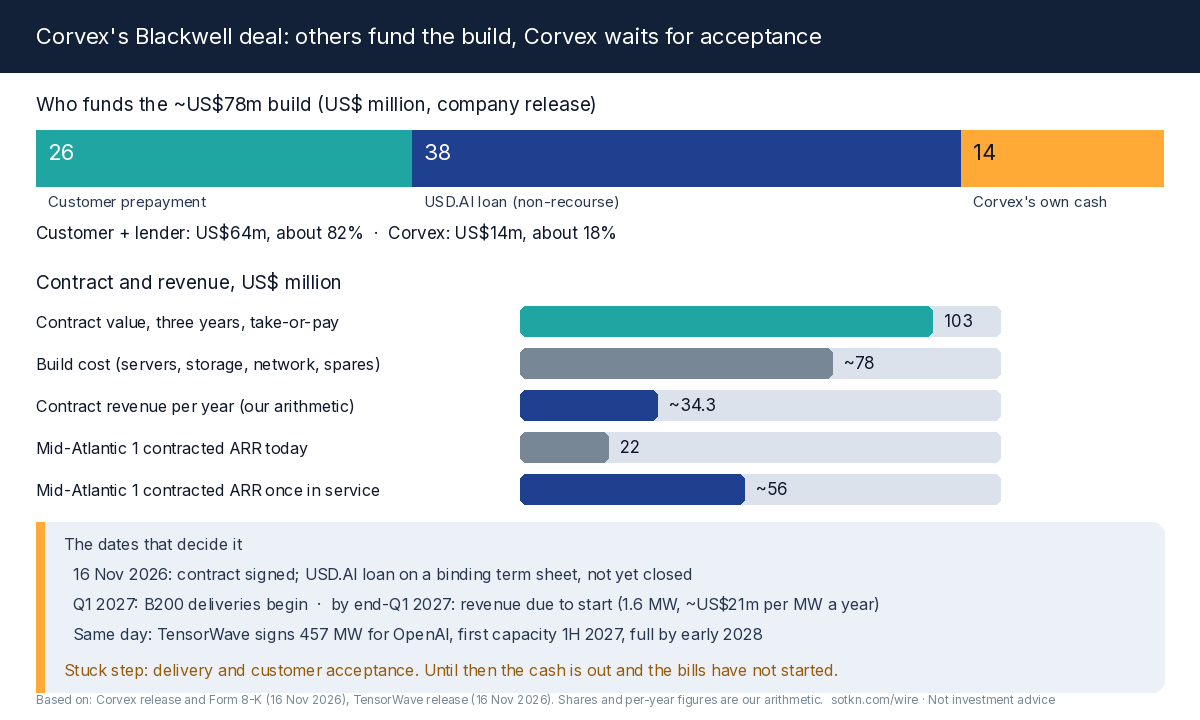
Figure: others fund the build, Corvex waits for acceptance. Contract, cost, funding and revenue figures from Corvex's release and Form 8-K (16 November 2026); TensorWave figures from its release (16 November 2026). Shares, ratios and per-megawatt costs are our arithmetic.
The step that is still open
The stuck step is delivery and acceptance. Corvex expects to start delivering the B200 GPUs in the first quarter of 2027 and to begin earning revenue by the end of that quarter, about four and a half months from the announcement. The contract carries customer acceptance provisions, and Corvex's own risk list names delays in the delivery, commissioning or acceptance of the capacity. Until that is done, the cash has gone out and the take-or-pay bills have not started.
The loan is not closed either. Corvex has a binding term sheet with USD.AI, but its filing says drawing the money still depends on technical due diligence and other closing conditions, and that funding could be delayed, reduced or unavailable. Corvex says power and space at Mid-Atlantic 1 are on track, after an expansion it announced on 31 August.
The second-order read
Who gets paid. Nvidia and the server, storage and networking suppliers, first, out of the US$78 million build. USD.AI gets interest on a loan backed by the chips themselves.
Who funds the wait. The customer, through its US$26 million prepayment, and the lender, through its US$38 million loan. Together they carry about 82% of the cost before a single billable hour.
Who waits. Corvex, with US$14 million of its own money in and no revenue from this deal until the end of the first quarter of 2027 at the earliest.
Stuck step. Delivery, commissioning and customer acceptance of more than 1,000 B200 GPUs at Mid-Atlantic 1.
The same day, TensorWave said it will supply OpenAI with 457 MW of IT capacity on AMD's MI455X chips over six years, about 286 times the size of Corvex's deployment. Its first capacity also lands in the first half of 2027, with full deployment by early 2028. TensorWave named no sites, no utilities and no price, so the funding split behind it is not on the record.
Three cautions
The customer is unnamed. Take-or-pay is only as good as the buyer's ability to pay, and Corvex disclosed neither its identity nor its credit. Either side can end the agreement for a material breach not cured within 30 days.
US$21 million per megawatt is revenue, not profit. Corvex has not published the operating costs, interest rate or residual value of the chips after three years, so the deal's margin is not knowable from the release.
The 82% funding share depends on the loan closing as planned. If it is delayed or cut, Corvex would have to fund more of the US$78 million itself or slow the build. The shares, ratios and per-megawatt figures here are our arithmetic on reported numbers.
What to watch
- 17 November (US time): Nvidia's third-quarter results, its first under interim chief executive Colette Kress, and any comment on Blackwell supply to smaller clouds.
- Coming weeks: whether Corvex reports the USD.AI loan as closed and drawn.
- First quarter of 2027: B200 deliveries at Mid-Atlantic 1, with revenue due to start by the end of March.
- First half of 2027: TensorWave's first OpenAI capacity, and whether the sites and utilities are named.
Read: the Neoclouds layer, What Is a Take-or-Pay GPU Contract?, What Is a Customer Prepayment?, GPU Financing Explained, What Does TensorWave Do? and Lambda's $34.9B Anthropic deal turns terminable after a missed lease
Get the Wire. A free brief every day, here and in your inbox. Subscribe free →
If this Wire saved you a search, tip Second Order → sotkn.com/support
Not investment advice. Do your own research. Corvex's annual contract revenue, revenue per megawatt, revenue multiple, funding shares, gear cost per megawatt, contract-to-cost ratio, illustrative loan principal share and revenue per dollar of its own money, and the TensorWave size ratio, are our arithmetic on reported figures.
References
- Corvex, Inc., "Corvex Signs $103 Million Take-or-Pay Agreement for NVIDIA Blackwell Capacity" (Exhibit 99.1), 16 Nov 2026. Contract value, cost, prepayment, loan, capacity and revenue per megawatt.
- Corvex, Inc., Form 8-K, 16 Nov 2026. Delivery timing, termination terms and financing conditions.
- TensorWave, "TensorWave Announces Agreement with OpenAI to Deliver More Than 450MW of AMD Powered AI Infrastructure", 16 Nov 2026. Capacity, term, chips and timeline.
- NVIDIA, "NVIDIA Sets Conference Call for Third-Quarter Financial Results", 28 Oct 2026. Results date.