What Does TensorWave Do? The All-AMD Cloud With a Borrowed Credit Rating
TensorWave is a GPU cloud that runs only AMD chips. Its $6.5 billion lease at Fermi’s Texas campus leans on AMD’s credit, and the hall still has no construction money, so financing is the step that binds.
STACK · Neoclouds · Status: Tightening · Last reviewed: 30 Oct 2026
TensorWave is a GPU cloud that runs only AMD chips. It buys AMD Instinct GPUs, puts them in leased data halls and rents the computing to AI developers, labs and companies by the hour or on longer contracts.
In short. TensorWave rents out AMD GPUs by the hour and owns no Nvidia chips at all. It has raised about $493 million of equity in three rounds, on our sum, and signed a 15-year lease worth about $6.5 billion for a 222 MW hall in the Texas Panhandle. That gap is why AMD has put its credit behind the rent. Our read: AMD gets paid first, as supplier, investor and backstop. The stuck step is the money to build the hall, which had not been raised a day before the lease’s 31 October closing deadline.
Why an investor cares: TensorWave is the test case for whether AMD can build its own channel of clouds on the Neoclouds layer, the way Nvidia did with CoreWeave. Its biggest lease shows who carries the risk when a young tenant signs for a hall it could never pay for on its own.
Numbers that matter
| Number | What it is | Why it matters |
|---|---|---|
| 8,192 | AMD MI325X GPUs online, June 2026 | Today’s base: tens of thousands of GPUs, not hundreds of thousands |
| $1.55bn | Valuation at the $350m Series B, June 2026 | Small next to the rent it has signed |
| $6.5bn | Fermi lease over 15 years, 222 MW power, 156 MW IT | About $433m a year on average, on our arithmetic |
| A / A1 | AMD’s credit ratings behind the lease | Lenders price the hall off AMD, not TensorWave |
| 31 Oct 2026 | Lease closing deadline, already pushed once | Either side may walk if conditions are not met |
Company and filing figures listed at the end of the page. The yearly average is $6.5 billion divided by 15 and ignores the 2.5% yearly rises.
What does it actually do?
It sells GPU time. Founded in Las Vegas in 2023, TensorWave chose to be all-AMD from the start, when Nvidia chips were scarce and AMD had not yet shipped its first big AI accelerator. Its chief executive, Darrick Horton, has said customers did not care whose logo was on the chip as long as it worked and was available.
By June 2026 it had 8,192 AMD MI325X GPUs online, one of the largest AMD training clusters in North America, and was preparing larger MI355X clusters in new regions. Its pitch is memory: AMD’s chips carry more high-bandwidth memory per GPU, which suits large models and heavy inference. Horton has said TensorWave expects to deploy one to two gigawatts of AMD’s Helios MI455X racks in 2027, a target, not a contract.
It does not own its halls. It leases powered space from landlords, including TecFusions, with which it signed a 1 GW capacity agreement in 2024 and another 20 MW in Pennsylvania and Arizona in January 2026. It says it has more than 2 GW of long-term capacity secured. Our data centre lease explainer covers how those contracts work.
How does it make money?
By renting GPU hours above what the GPUs, the space and the power cost it. TensorWave is private and publishes no revenue, so we do not estimate it. What is public is how it pays for growth: equity, then debt secured on the GPUs and the customer contracts behind them.
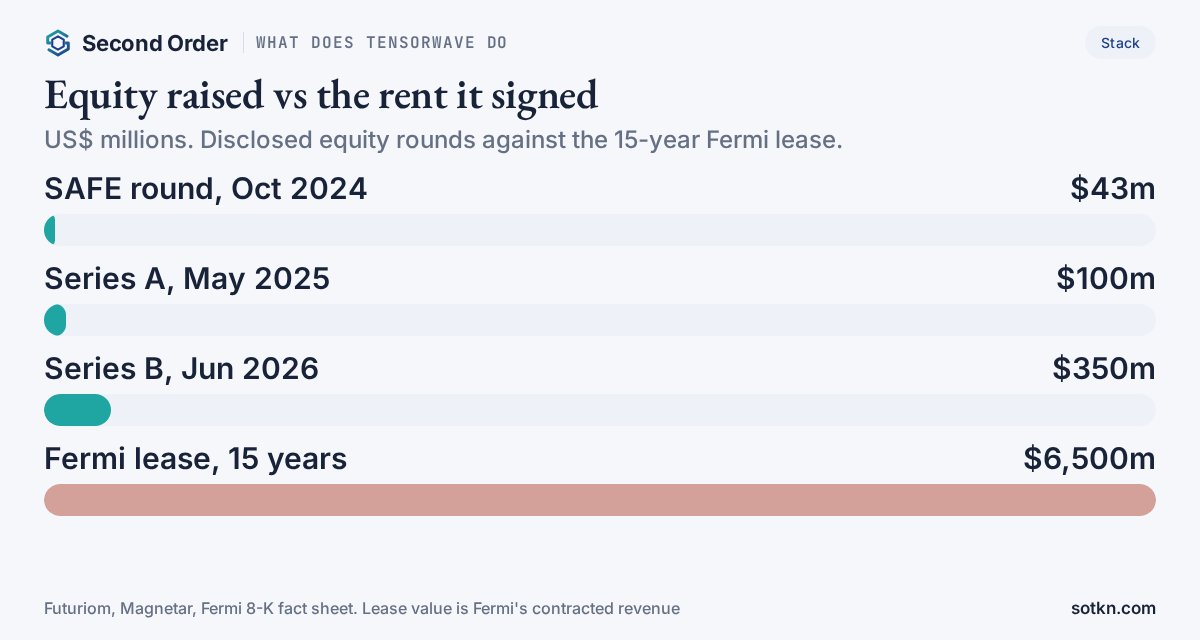
The equity is small. TensorWave raised a $43 million SAFE in October 2024, a $100 million Series A in May 2025 and a $350 million Series B in June 2026, co-led by Magnetar and AMD Ventures, at a $1.55 billion valuation. Our sum: about $493 million. It also drew an $800 million tranche of a delayed-draw term loan, released in steps as GPUs and contracts are added, the structure Magnetar used with CoreWeave.
The lease that tests the model
In August 2026 TensorWave signed to take the first phase of Fermi’s Project Matador campus in Carson County, Texas: 222 MW of power, 156 MW of it for IT, on a 15-year term with rent rising 2.5% a year. Fermi values it at about $6.5 billion. Fermi builds the hall and its own gas-fired power and hands it over in phases from late 2027 into early 2028. Our Wire on AMD backing the lease covered the 13 October announcement.
Our arithmetic shows the strain. $6.5 billion over 15 years is about $433 million a year on average, close to the $493 million of equity TensorWave has raised in its life. And on Fermi’s own cost estimates, $10 million to $12 million per IT megawatt for the hall and $3 million to $4 million per megawatt of power, phase one costs roughly $2.2 billion to $2.8 billion to build before a single GPU goes in.
So AMD signed credit support on 13 October. It is narrower than it sounds. It begins only after construction is finished and rent starts on the final phase, and it ends early if TensorWave earns an investment-grade rating of its own for 12 months. It gives Fermi’s lenders an A-rated name to lend against. It does not pay for construction.
Who gets paid first?
- AMD. It sells the GPUs, owns part of TensorWave through AMD Ventures, and now stands behind part of the rent. Every hall that fills is a reference customer against Nvidia.
- GPU lenders. The term loan is secured on the GPUs and the contracts, and is drawn only as both arrive, so lenders are paid from the hours that bill.
- Landlords and builders. Fermi and its contractors are paid once the hall is financed and built, which is the step still open.
- TensorWave’s shareholders, last. They keep what the hours earn after GPU debt, rent and power, and they carry the hardware if prices for AMD hours fall.
Our analysis of neocloud debt costs shows why a tenant without a rating pays more for every one of those layers.
What limits it?
Financing the hall. The Fermi lease closes only when guaranties and work letters are signed, both boards approve, and project financing big enough to build phase one is in place. The closing was pushed once in September, to 31 October. As of 29 October no closing, no second extension and no construction financing had been announced, and either side may walk away if the conditions are not met.
Fermi is short of room too. Its shares were down about 71% this year by late October, and it was selling $350 million of convertible notes. A landlord that has to raise money for its own power plant and hall makes the tenant’s timeline longer, not shorter.
The second limit is the chip. TensorWave’s plan for 2027 depends on AMD’s Helios racks arriving on time and working at scale. Horton has said production racks for TensorWave were expected around January, with everything before that pre-production testing. An all-AMD cloud has no second supplier to fall back on.
Who else does this?
Other GPU clouds rent AMD chips beside Nvidia’s. Vultr has a 50 MW AMD cluster in Ohio and a $1.2 billion order for AMD Helios racks through HPE, but it also sells Nvidia. Crusoe and Lambda are mostly Nvidia shops. TensorWave is the only large cloud that has bet the whole fleet on one challenger, which makes it AMD’s cleanest scorecard. Our guide to who the neoclouds are maps the rest.
What would change this view?
- Easing: the Fermi lease closes with phase-one construction financing named, or TensorWave’s Series C prices well above $1.55 billion.
- Tightening further: a second extension or termination on 31 October, or a delay to AMD’s Helios racks into the second half of 2027.
- A rating: any credit rating for TensorWave itself, which would show whether lenders will take its name without AMD’s.
Practical takeaways
Read TensorWave as AMD’s balance sheet at one remove. The chips, part of the equity and now part of the rent all trace back to AMD. The next dates are the lease closing deadline on 31 October and Fermi’s results on 12 November, which should say whether the hall has money to be built. Our GPU rental price explainer shows what an hour of GPU time is selling for while the halls wait.
FAQ
What does TensorWave do?
TensorWave is a GPU cloud based in Las Vegas that rents out computing power built only on AMD Instinct GPUs. AI developers, labs and enterprises pay to use its clusters for training and inference. It is one of the largest all-AMD clouds, with 8,192 MI325X GPUs online by June 2026.
Who owns TensorWave?
It is private. Its investors include AMD Ventures, Magnetar, Maverick Silicon and Nexus Venture Partners. Its $350 million Series B in June 2026 valued it at $1.55 billion, and its CEO has said a larger Series C is in progress.
What is the TensorWave and Fermi lease?
A 15-year lease for the first phase of Fermi’s Project Matador campus in Carson County, Texas: 222 MW of power, 156 MW of it for IT, worth about $6.5 billion to Fermi. Delivery is due from late 2027. It had to close by 31 October 2026, and closing needs construction financing that had not been raised by late October.
What does AMD’s credit support do?
It lets Fermi’s lenders lean on AMD’s A-rated balance sheet rather than TensorWave’s. It starts only after construction is finished and rent begins, and ends early if TensorWave earns its own investment-grade rating for 12 months. It supports the financing; it is not the financing.
Why does AMD back TensorWave?
Our read: every TensorWave hall is a showcase for AMD GPUs against Nvidia. AMD is an investor, the only chip supplier, and now stands behind part of the rent, so it is paid three ways if the hall fills.
Is this a recommendation to buy AMD or Fermi?
No. This page explains how TensorWave makes money and where it can get stuck. It gives no buy or sell calls. Not investment advice. Do your own research.
Keep reading on the map
Layer: Neoclouds. Also on the layer: Nebius, Fluidstack and Together AI. Explained: neocloud vs hyperscaler. Next layer down: Semiconductors.
Get the Wire — short daily notes when GPU leases, loans and handovers move.
Not investment advice. Do your own research.
How we check this
Figures come from TensorWave’s and its investors’ releases, Fermi’s SEC filing and press releases, and a public interview with TensorWave’s chief executive, read on 30 October 2026. TensorWave is private and publishes no accounts, so we do not estimate its revenue. The equity total, the yearly rent and the build-cost range are our arithmetic and are labelled as ours. Who gets paid and the stuck step are our read. The featured image is an illustration, not a photograph of a TensorWave site. This page explains a business. It gives no buy or sell calls. Not investment advice. Do your own research.
Last reviewed: 30 Oct 2026 · Next review: after the 31 October lease closing deadline and Fermi’s results on 12 November 2026
Spot an error? Tell us and we will correct it and note the change here.
References
- Magnetar — TensorWave raises $350 million Series B (10 Jun 2026) — co-led by Magnetar and AMD Ventures; 8,192 AMD Instinct MI325X GPUs online; MI355X deployments planned across new North American regions; more than 2 GW of long-term data centre capacity secured
- DCD — TensorWave secures $350m Series B (Jun 2026) — valuation $1.55bn; $100m Series A in May 2025; additional 20 MW with TecFusions in Pennsylvania and Arizona signed January 2026
- Fermi Inc. — TensorWave fact sheet, Form 8-K Exhibit 99.1 (14 Oct 2026) — 15-year phase one lease, $6.5bn contracted revenue, 222 MW total power and 156 MW critical IT, 2.5% escalators, delivery from Q4 2027 to early 2028; capex $3–4m per MW of power and $10–12m per MW of IT; AMD credit support begins once construction is complete and rent starts; ends early if TensorWave holds an investment-grade rating for 12 months
- Fermi — credit support agreement with AMD and partnership (13 Oct 2026) — AMD credit support for phase one; framework for expansion of up to 650 MW; Fermi has invested more than $1.5bn at Project Matador
- Fermi and TensorWave — closing date extended to 31 October 2026 (22 Sep 2026) — closing depends on guaranties, work letters, board approvals and project financing for the leased facility; either party may terminate if conditions are not met
- Futuriom — TensorWave is poised to be AMD’s loudest advocate (Aug 2025) — all-AMD cloud; $43m SAFE in October 2024; $800m tranche of a delayed-draw term loan secured on GPUs and long-term contracts; 1 GW capacity agreement with TecFusions
- theCUBE — interview with TensorWave CEO Darrick Horton, AMD Advancing AI 2026 — Series C in progress; expects to deploy one to two gigawatts of AMD Helios MI455X capacity in 2027; Helios production for TensorWave expected around January
- The Inference — Fermi’s TensorWave lease must close by 31 October (28 Oct 2026) — no closing, second extension or phase-one financing announced three days out; Fermi shares down about 71% this year; $350m convertible notes offered 22 October
- HPE — first AMD Helios order, $1.2 billion from Vultr (30 Sep 2026) — Vultr to deploy AMD Helios racks with 72 MI455X GPUs each at US data centres