Intel's CEO says memory costs 6-7x more; Micron keeps an 87% margin
Intel's chief executive says memory prices have risen six or seven times and buyers may not get supply even at that price. Micron booked $54.23 billion at an 87% gross margin, while its first new Idaho fab only starts wafers around mid-2027.

WIRE · SEMICONDUCTORS · UNITED STATES · Reported 12 Nov 2026 (Yahoo Finance Invest conference interview)
Intel chief executive Lip-Bu Tan said on Thursday 12 November that memory prices have gone up "six, seven times", and that even buyers willing to pay "may not get it". He expects next year to be worse. On the other side of that bill, Micron kept about 87 cents of every revenue dollar as gross margin in its latest quarter. On the Semiconductors layer, the memory maker is paid now and the PC buyer waits.
What happened
The warning
Memory prices up "six, seven times", and supply not assured even at that price
Tan also named packaging substrates, power and the cost of financing as constraints on the AI build
The buyer's bill
Intel's PC chip revenue US$8.1bn, down 5%, guided down more than 20% this quarter
Intel blames high memory prices and expects PC units to fall about 12% in 2026 and about 10% in 2027
The seller's margin
Micron: US$54.23bn of quarterly revenue at an 87.0% gross margin
Up from US$11.32bn a year earlier; it guides US$61.5bn for the quarter to early December
The new supply
First wafers from Micron's new Idaho fab around mid-2027
Its second Idaho fab and the Hiroshima expansion target first output toward the end of 2028
Why cash cares
A memory shortage is a transfer. Every chip that goes into a server or a laptop needs memory beside it, and when there is not enough, the buyer pays more or ships less. Tan's line on 12 November is the buyer's side of that transfer in one sentence: prices up six or seven times, and no guarantee of supply even at that price.
The seller's side is in Micron's numbers. In the quarter to 3 September, Micron booked US$54.23 billion of revenue against US$11.32 billion a year earlier, about 4.8 times as much. Its cost of goods sold was US$7.18 billion, so on our arithmetic only about 13 cents of each revenue dollar went to making the chips. Operating cash flow was US$43.97 billion in the quarter, about 2.7 times Intel's entire third-quarter revenue of US$16.5 billion.
Buyers are also paying before delivery. Micron took in US$12.75 billion of customer deposits in its 2026 fiscal year, and its long-term customer contract liabilities rose from US$568 million at the end of May to US$12.90 billion at the start of September. That is about US$12.3 billion of prepaid supply added in one quarter, on our arithmetic. Micron ended the year with US$73.48 billion of cash and investments.
Intel shows what the same bill does to a chip buyer. Its PC chip revenue was US$8.1 billion in the September quarter, down 5% from a year earlier and 9% from the quarter before, which Intel put down to memory prices and tight IT budgets. It guides that line down more than 20% this quarter, which on our arithmetic means below about US$6.5 billion. Its data center chips went the other way, up 78% to US$7.3 billion, about 90% of the PC line's size.
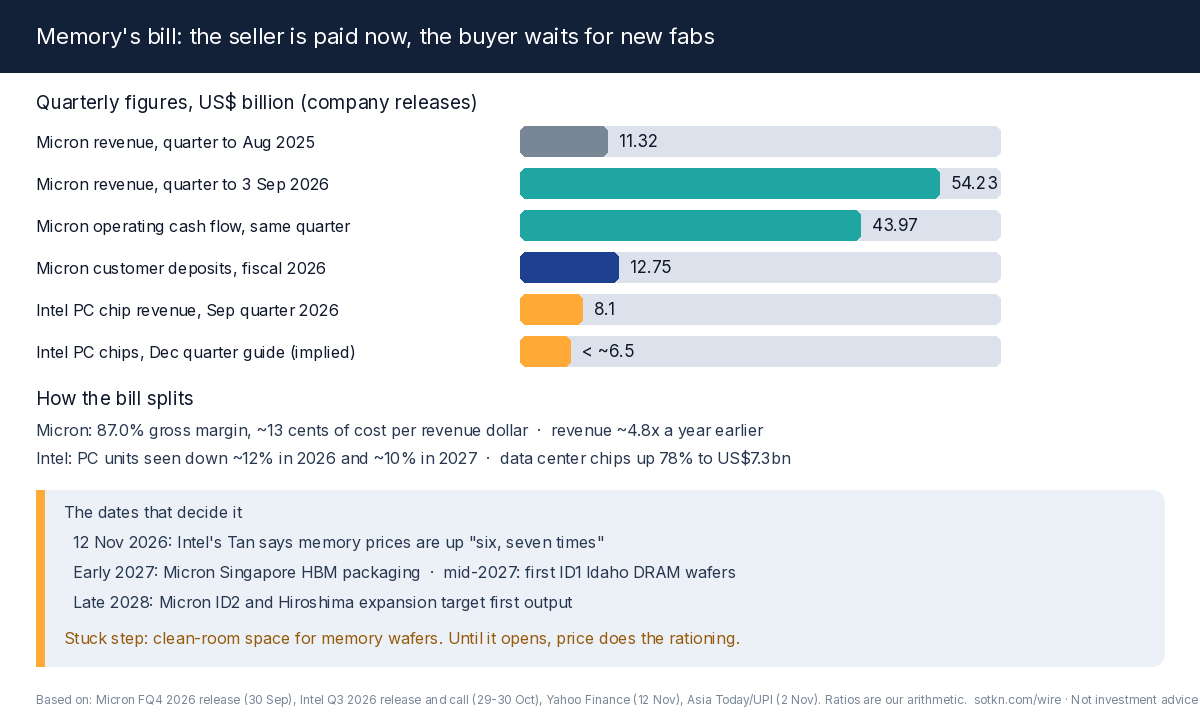
Figure: the seller is paid now, the buyer waits for fabs. Micron figures from its fiscal fourth-quarter release (30 September 2026); Intel figures from its third-quarter release and call (29 October 2026); fab dates from Asia Today via UPI (2 November 2026). Multiples, shares and the implied Intel figure are our arithmetic.
The step that is still open
The stuck step is clean-room space for memory. Micron's first new Idaho fab, ID1, is due to produce its first DRAM wafers around the middle of 2027. Its second Idaho fab and the Hiroshima expansion target first output toward the end of 2028. A Singapore HBM packaging plant is due to start early output in early 2027, but that adds packaging, not wafers.
Micron plans about US$25 billion of capital spending in the first half of its 2027 fiscal year, and it says more of the step-up is going into new clean rooms than into tools. In the September quarter its gross capital spending was US$11.11 billion, about 20% of revenue on our arithmetic. A clean room has to be built, then filled with tools, then qualified by customers before it ships a single extra chip. Until then, the only lever is price.
The second-order read
Who gets paid. The memory makers. Micron at an 87% gross margin, guiding to US$61.5 billion next quarter, about 13% more on our arithmetic. Samsung and SK hynix say their 2027 high-bandwidth memory supply is effectively sold under long-term contracts.
Who funds the wait. The buyers who prepay. Micron's US$12.75 billion of deposits is cash handed over before the chips exist, and it pays for the clean rooms the buyers are waiting on. PC buyers fund it too, through higher prices on every machine.
Who waits. PC makers and the chip suppliers who sell into them. Intel plans for PC units to fall about 12% in 2026, with the second half down more than 20%, and about 10% in 2027. Its finance chief said there will be no sustained recovery until memory supply improves and prices normalise.
Stuck step. New memory wafers. The first meaningful new US output is ID1 from mid-2027; the next wave is late 2028.
Three cautions
"Six, seven times" is Tan's description in an interview, not a published price index. Quarterly contract price forecasts move in much smaller steps; TrendForce in September forecast conventional DRAM contract prices up 10% to 15% for the fourth quarter of 2026.
Micron's deposits are not revenue. Some of its customer agreements carry price floors and ceilings, so it does not capture every dollar of a further price rise.
Shortages also push buyers to redesign. TrendForce said on 6 November that some smartphone makers are using cheaper reworked memory in budget models, and analysts on Micron's last call asked whether big customers might cut memory per server; management called that optimisation, not weaker demand. The multiples, shares and implied figures here are our arithmetic on reported numbers.
What to watch
- 17 November: Nvidia's results, its first under interim chief executive Colette Kress, and any comment on memory supply for its systems.
- Mid-December (expected): Micron's fiscal first-quarter results against its US$61.5 billion and 86.25% gross margin guidance.
- Late January 2027 (expected): Intel's fourth-quarter results, which show how far the PC line fell.
- Mid-2027: first DRAM wafers from Micron's ID1 in Idaho.
Read: the Semiconductors layer, What does Micron do?, Who makes DRAM?, What is a customer prepayment?, Mid-2027 isn't wafers: Micron's Idaho 10-K and Intel sees PC units down 12% as the memory crunch bites
Get the Wire. A free brief every day, here and in your inbox. Subscribe free →
If this Wire saved you a search, tip Second Order → sotkn.com/support
Not investment advice. Do your own research. Micron's revenue multiple, cost share, cash-flow comparison, one-quarter deposit increase, capital-spending share and guided growth, and Intel's implied PC revenue and segment ratio are our arithmetic on reported figures.
References
- Yahoo Finance, "Intel CEO Lip-Bu Tan sees a 'healthy pullback' ahead in the AI boom", 12 Nov 2026. Tan's memory, substrate, power and financing remarks.
- TheStreet via the Bellingham Herald, "Intel CEO warns of a deeper memory squeeze, putting Micron in focus", 13 Nov 2026. TrendForce contract price forecast, price floors and ceilings, reworked memory.
- Intel Corporation, third-quarter 2026 earnings release, 29 Oct 2026. Segment revenue and fourth-quarter guidance.
- The Motley Fool, Intel Q3 2026 earnings call transcript, 30 Oct 2026. PC unit forecasts, client guidance and memory comments.
- Micron Technology, fiscal fourth-quarter and full-year 2026 results, 30 Sep 2026. Revenue, margin, cash flow, deposits, contract liabilities and guidance.
- S&P Global Market Intelligence, "Behind the Earnings Call: Micron Technology Inc. Q4 2026", 27 Oct 2026. Capital spending plan and clean-room mix.
- Asia Today via UPI, "Samsung, SK Hynix and Micron expand AI memory production", 2 Nov 2026. Fab timelines and long-term contracts.