Vendor Financing Explained: Nvidia’s $110B Investment Book
Vendor financing is when a seller helps fund the customers who buy its product. Nvidia now holds about US$110bn of equity and other securities and spent about 47% of nine-month operating cash buying equity. The stuck step is the buyer’s balance sheet.

EXPLAINED · Mechanism · Last reviewed: 19 Nov 2026 · Next review: when Nvidia files its Form 10-Q for the quarter to 25 October 2026, and again after its fourth-quarter results
Vendor financing is when a seller helps pay for its customers’ purchases, by lending to them, guaranteeing their debts, buying shares in them or paying them in advance, so they can afford to buy its product.
In short. Vendor financing is a seller putting its own money or credit behind the customers who buy from it. Nvidia now does this at scale: at 25 October 2026 it held about US$110 billion of equity and other securities, roughly three times January’s level, and over nine months it spent US$58.1 billion buying equity, about 47% of the cash its business generated, by our arithmetic. Our read: the money exists because the buyers of AI computing power, neoclouds and frontier labs, are growing faster than their own balance sheets can carry. The stuck step is the buyer’s balance sheet. Nvidia gets orders and gains on its stakes now; its shareholders carry the risk later, as the US$1.8 billion of third-quarter write-downs shows.
Why an investor cares: when a seller funds its own customers, its sales can grow faster than its customers’ real ability to pay. That is fine while the customers grow into it, and painful if they do not. AI computing is now the biggest test of this in years, because the largest seller in the chain holds stakes in many of its buyers. This page sits in our Neoclouds layer and builds on our GPU financing explainer.
What is vendor financing? The short answer
A company that sells expensive equipment often finds that its best customers cannot pay for everything at once. It can wait, or it can help. Vendor financing is the help: the seller puts its own money or credit behind the buyer so the order happens now. Telecom equipment makers did it heavily around 2000. Aircraft makers and truck makers do it routinely through finance arms. What matters is not whether a seller does it, but how much, to whom, and what happens if the buyer fails.
Is Nvidia doing it? It uses several of the tools. At 25 October 2026 it held about US$110 billion of equity and other securities, by our arithmetic, its chief financial officer’s commentary says its equity investments are focused on frontier labs, infrastructure financiers and other private companies, and it carries guarantees with up to US$118.0 billion of maximum exposure. The table sets out the tools.
| Tool | How it works | Who carries the risk | Nvidia example in its filings |
|---|---|---|---|
| Equity stake | The seller buys shares in the customer, giving it capital it can spend or borrow against | The seller, through the value of the stake | Equity investments focused on frontier labs, infrastructure financiers and other private companies |
| Guarantee | The seller promises to pay a lender or landlord if the customer defaults | The seller, only if the customer fails | Guarantees with US$118.0bn of maximum gross exposure; no payments made so far |
| Capacity commitment | The seller agrees to rent back computing capacity, so the customer can show lenders a paying client | The seller, through future rent | US$32bn of neocloud agreements, effective only if the neocloud secures financing and the capacity is accepted |
| Loan or deferred payment | The seller lends directly or lets the customer pay over time | The seller, as a creditor | Not broken out as a separate line in the Q3 filings |
Tools, not a ranking. A seller can use several at once. Nvidia figures at 25 October 2026.
How vendor financing works, step by step
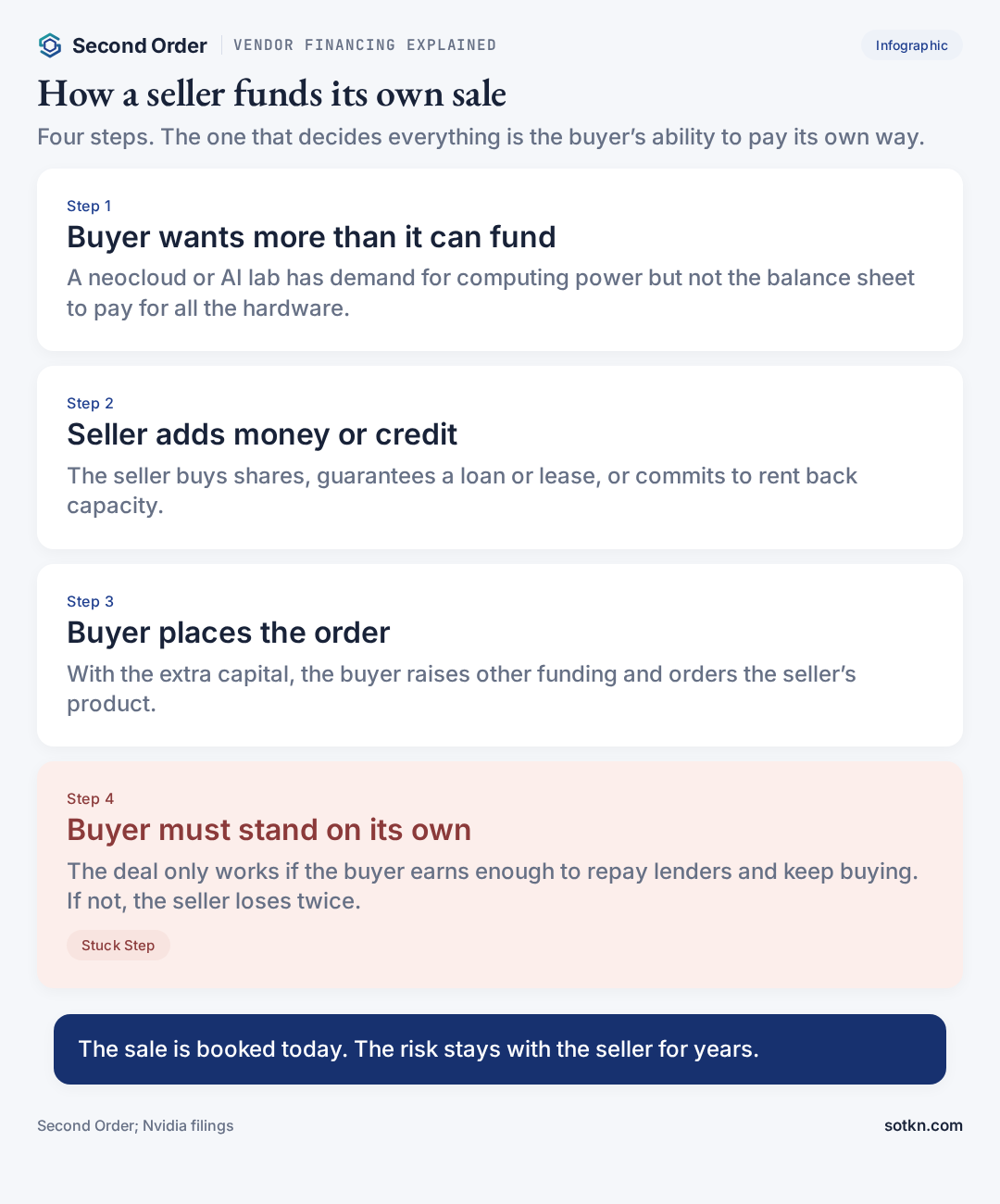
The mechanics are simple. A buyer has more demand than it can fund. The seller adds money or credit: it buys shares, guarantees a loan or a lease, or agrees to rent back some of the capacity. With that support, the buyer can raise more money from banks and investors, because lenders see a strong partner standing behind it. The buyer then places its order with the seller.
The seller books the sale when it ships. The financing stays on its books for years. If the buyer grows into its commitments, the seller has won a customer and often a gain on its stake. If the buyer stumbles, the seller can lose on the stake, pay on the guarantee and lose future orders, all at once. Our who finances GPU clusters page covers the other lenders in the same chain.
Why AI buyers need it now
The buyers of AI computing power are mostly new companies. Neoclouds, specialised clouds that rent out GPUs, and frontier labs, the companies that train the largest AI models, have signed huge customer contracts but carry little history and heavy debts. Our neocloud explainer covers how they make money.
Nvidia says this plainly. Its third-quarter commentary says neoclouds and frontier labs are seeing extraordinary demand, “yet many are growing faster than their balance sheets and long-term credit profiles can support.” In response, it says, it has entered into arrangements that help select customers secure land, power and data-centre capacity. That is a seller describing why its customers need help to buy.
The bottleneck is not chips or demand. It is money that a buyer can raise on its own terms. A neocloud with a signed contract still has to pay for the servers before the contract pays it, and lenders charge more to young companies. Our customer concentration page explains why one large client makes lenders nervous, and our prepayment page covers the opposite case, when the buyer pays early.
Is Nvidia doing vendor financing? What the filings show
Start with the balance sheet. In nine months, Nvidia’s holdings of equity and other securities roughly tripled.
| Line | 25 Jan 2026 | 25 Oct 2026 | What it is |
|---|---|---|---|
| Marketable equity securities | US$12,886m | US$44,219m | Shares in listed companies, marked to market each quarter |
| Non-marketable securities | US$22,251m | US$65,528m | Mostly stakes in private companies; the private equity part alone is US$61,650m |
| Together (our arithmetic) | About US$35.1bn | About US$109.7bn | About 3.1 times January’s level |
| Remaining equity investment commitments | — | US$20bn (US$25bn at 26 Jul) | Money Nvidia has agreed to invest but not yet paid |
Nvidia supplemental financial information and CFO commentary, 17 November 2026; CFO commentary for the second quarter. Totals and ratios are our arithmetic.
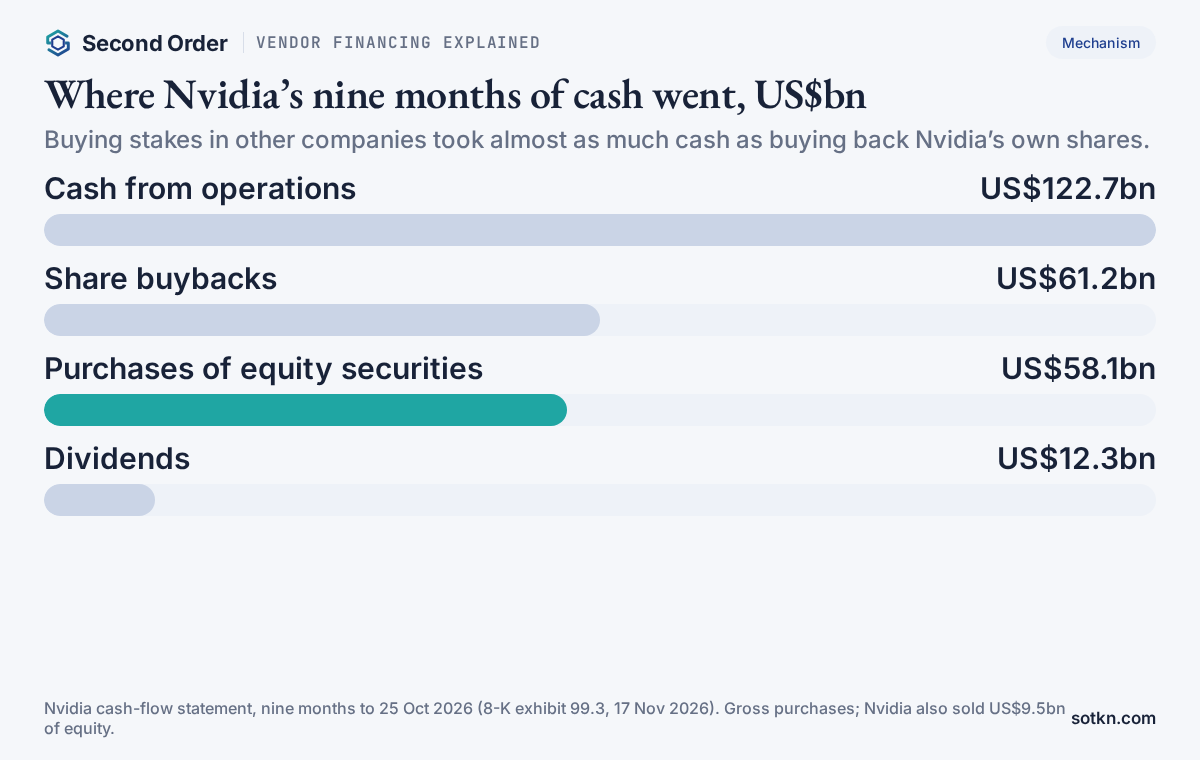
The cash-flow statement shows the scale of the buying. Nvidia spent US$15.7 billion on equity securities in its third quarter and US$58.1 billion over nine months, while selling US$9.5 billion. Over the same nine months its operations produced US$122.7 billion of cash. So about 47% of that cash went into buying stakes, by our arithmetic, almost as much as the US$61.2 billion it spent buying back its own shares.
Not every stake is vendor financing. Some are strategic, some are bets on technology, and some are in companies that buy little or nothing from Nvidia. The filing describes the focus, frontier labs, infrastructure financiers and other private companies, but it does not break the book down by customer. That limit matters, and we come back to it below.
What the stakes are worth, and what they cost
Holdings like these move Nvidia’s profits. Gains and losses on them run through other income. In the nine months, Nvidia recorded US$25.5 billion of net gains from equity securities, about 11.6% of its pre-tax income, by our arithmetic. In the third quarter alone, it recorded US$1.8 billion of net gains: US$2.8 billion on listed holdings, offset by a US$1.0 billion net loss on private holdings that included US$1.8 billion of impairment.
The private book is where the risk sits. The roll-forward in the filing shows private equity holdings rising from US$47.9 billion to US$61.7 billion during the quarter: US$15.4 billion of new money, US$0.8 billion of gains, and US$1.8 billion of impairments and unrealised losses. Since it began holding them, Nvidia has recorded US$9.9 billion of cumulative gains and US$2.2 billion of cumulative losses and impairments on these private stakes.
Some of the listed holdings cannot be sold yet. Nvidia says US$21.0 billion of its investments are under short-term lock-up restrictions, and a further US$4.7 billion of listed shares are locked up through December 2027.
Where the money went: the 13F and the Anthropic placement
Nvidia’s 13F filing for 30 September 2026 shows the listed part of the book. The largest holdings were SpaceX at US$19.68 billion and Intel at US$19.37 billion, then CoreWeave at US$4.11 billion, Coherent at US$2.24 billion, Synopsys at US$1.89 billion, Nokia at US$0.74 billion and Nebius at US$0.28 billion. CoreWeave and Nebius are both neoclouds that rent out Nvidia GPUs; our pages on what CoreWeave does and what Nebius does explain their models. Our SpaceX page covers the largest holding.
A 13F lists only US-listed shares, so the private stakes, including those in frontier labs, are not in it. The newest one is public in another filing. Anthropic’s amended IPO registration of 17 November says Nvidia would buy 135,135,135 shares in a private placement alongside the offering, about US$10.0 billion at the assumed US$74 midpoint. Google would buy the same number. Anthropic is a frontier lab that runs on large amounts of AI computing power.
Guarantees and neocloud agreements: the other tools
Equity is one tool. Guarantees are a second. Nvidia’s commentary lists guarantees with maximum gross exposure of US$118.0 billion: US$105.0 billion of credit support for SB Energy’s Ohio campus, built to host Nvidia infrastructure under 20-year leases to OpenAI; US$9.5 billion of power and systems credit support; and US$3.5 billion of land, power and shell guarantees for neoclouds. The Ohio guarantees take effect building by building, the first expected in fiscal 2029, and Nvidia says it has made no payments on any guarantee so far.
Capacity commitments are a third. Nvidia lists US$32 billion of neocloud agreements, down from US$36 billion of what it called AI cloud agreements in July. They take effect only if the neocloud secures financing to buy the infrastructure and the capacity is deployed and accepted. A neocloud with Nvidia as a paying tenant finds it easier to borrow. Our Nvidia cloud partner explainer covers that relationship, and our Wire on Nvidia’s neocloud commitments covers the earlier figures.
Is it circular financing?
Circular financing is the worry that a supplier invests in a customer and the customer spends the money on the supplier’s products, so some revenue is the supplier’s own cash coming back. It is the right question to ask. It is not yet a proven answer.
To prove it you would have to match a specific investment to a specific purchase. Nvidia’s filings do not do that, and money is fungible: a lab that takes Nvidia’s cash also raises money from many other investors and earns revenue from its own customers. What the filings do show is overlap. Nvidia’s indirect customers include neoclouds and frontier labs, and its investments are focused on frontier labs and infrastructure financiers. Where those two lists meet, a share of demand rests on capital Nvidia helped supply.
A related signal is who owes Nvidia money. Its receivables stood at US$81.0 billion at 25 October, and two direct customers accounted for 18% and 17% of that balance. Our Wire on the US$81 billion customers owe and our analysis of what the price assumes go further.
Who gets paid?
Our read: everyone in the chain is paid up front except the seller’s shareholders, who are paid later, if the buyers grow into their commitments.
- The buyers get capital first. Neoclouds and frontier labs get money and credit on better terms than they could raise alone, and the orders they could not otherwise fund.
- Nvidia gets orders and marks. It books the hardware sale when it ships, and records gains on its stakes when their values rise, as US$25.5 billion of nine-month equity gains show.
- Lenders get a stronger borrower. Banks and private credit funds lend against contracts and guarantees with Nvidia behind them. Our GPU financing page covers how those loans are built.
- Suppliers get more volume. Every funded order becomes chips, memory, packaging and boards further down. Our Kinsus Catalyst shows money flowing to a substrate supplier, the same idea pointed the other way.
- Nvidia shareholders carry the tail. If a funded customer fails, the impairments, guarantee payments and lost orders land on Nvidia’s results together.
Where is the stuck step?
Our read: the buyer’s balance sheet. Chips can be made, power can be contracted, and demand is plentiful. What is short is a buyer’s ability to pay for all of it with its own money. Vendor financing does not remove that limit. It moves part of it onto the seller.
That is why the details matter more than the headline. A stake in a lab with paying customers is different from a guarantee on a building that only earns if one tenant pays rent for 20 years. Each tool sits at a different point on the same question: can the buyer eventually fund itself?
The clocks
- The 10-Q. Nvidia had not filed its quarterly report when we reviewed this page. It will carry the full investment, guarantee and commitment notes, which can add detail the earnings exhibits leave out.
- US$5 billion this fiscal year. Of the US$20 billion of remaining equity commitments, US$5 billion falls in the rest of fiscal 2027, which ends in late January 2027, and US$11 billion in fiscal 2028.
- Lock-ups. US$21.0 billion of holdings are under short-term lock-ups, and US$4.7 billion through December 2027. When they lift, Nvidia can sell; until then, it carries the price swings.
- The Anthropic placement. The roughly US$10.0 billion share purchase is priced at the IPO price, so the final number of shares depends on where the offering prices.
- Ohio, from fiscal 2029. The first of the SB Energy guarantees is expected to take effect when its building is ready, with exposure building as each one comes online.
What would change the view?
- Buyers raise money on their own. If neoclouds and labs start funding themselves through bonds, IPOs and customer cash, Nvidia’s commitments should stop growing. The drop in remaining equity commitments from US$25 billion to US$20 billion is one early sign to watch.
- Write-downs grow. A US$1.8 billion impairment against US$15.4 billion of new private money in a quarter is about 12%, by our arithmetic. If that share rises, the book is turning from support into cost.
- A guarantee is called. Nvidia says it has paid nothing so far. The first payment would show the risk is real, not theoretical.
- The filings tie sales to stakes. If a future filing links specific investments to specific purchases, the circular question gets a real answer, in either direction.
Common misconceptions
- People assume vendor financing means the sales are fake. Actually the hardware ships and gets used. The question is who carries the risk if the buyer cannot pay, not whether the sale happened.
- People assume all of Nvidia’s US$110 billion is in its customers. Actually it includes holdings such as Intel and Synopsys, which are partners, and SpaceX. The filings do not split the book by customer.
- People assume the 13F shows everything. Actually it lists only US-listed shares. The private stakes, about US$61.7 billion of private equity, are not in it.
- People assume a guarantee is money already spent. Actually it is a promise that costs nothing unless a partner defaults. The US$118.0 billion is maximum exposure; Nvidia says it has paid nothing so far.
FAQ
What is vendor financing?
Vendor financing is when a seller helps its customers pay for what they buy from it. It can take the form of a loan, a guarantee on the customer’s debts, a share purchase in the customer, or cash paid in advance. The seller gets the sale; the customer gets money it could not raise as cheaply alone.
Is Nvidia doing vendor financing?
Nvidia uses several of the tools. At 25 October 2026 it held about US$110 billion of equity and other securities, by our arithmetic, mostly in private companies such as frontier labs and infrastructure financiers, and guarantees with up to US$118.0 billion of maximum exposure. Its filings do not tie any particular sale to any particular investment.
What is circular financing in AI?
Circular financing is the worry that a supplier invests in a customer and the customer spends the money on the supplier’s products, so revenue partly comes back from the supplier’s own cash. It is a question to test, not a fact: to prove it you would need to match a specific investment to a specific purchase, and Nvidia’s filings do not do that.
How much has Nvidia invested in other companies?
Nvidia bought US$58.1 billion of equity securities in the nine months to 25 October 2026, and sold US$9.5 billion. Its balance sheet showed US$44.2 billion of marketable equity securities and US$65.5 billion of non-marketable securities, up from about US$35.1 billion combined in January 2026.
What does Nvidia’s 13F show?
Its 13F filing for 30 September 2026 lists only US-listed holdings: SpaceX (US$19.68 billion), Intel (US$19.37 billion), CoreWeave (US$4.11 billion), Coherent, Synopsys, Nokia and Nebius among them. Private stakes, such as those in frontier labs, are not in a 13F.
Is vendor financing risky for the seller?
It can be. The seller takes on some of its customer’s risk. If the customer struggles, the seller can lose on the investment and the future orders at once. Nvidia booked US$1.8 billion of impairments and unrealised losses on private holdings in its third quarter.
How is vendor financing different from a prepayment?
In a prepayment the buyer pays the seller early, usually to secure supply. In vendor financing the money runs the other way: the seller puts money or credit behind the buyer. Our prepayment page covers the other direction in detail.
Is this advice to buy or sell any company?
No. This page explains how vendor financing works and what the filings show. It does not rate companies as investments or give buy or sell calls. Not investment advice. Do your own research.
Related: GPU financing explained; who finances GPU clusters; prepayments; customer concentration; neoclouds; Nvidia cloud partners.
Stack doors
Layer: Neoclouds. Players: CoreWeave, Nebius and SpaceX.
Get the Wire — short daily notes on where AI computing gets built and who pays for it.
Not investment advice. Do your own research.
How we check this
Nvidia’s balance sheet, cash-flow statement, private-equity roll-forward, lock-up notes and receivables concentration come from its supplemental financial information for the quarter to 25 October 2026, filed as exhibit 99.3 to its Form 8-K of 17 November 2026. Its description of its equity investments, its remaining commitments, its guarantees, its neocloud agreements and its third-quarter equity gains and impairment come from its CFO commentary of the same date, exhibit 99.2. The second-quarter comparisons come from its CFO commentary for the quarter to 26 July 2026. Listed holdings come from its Form 13F for 30 September 2026, filed on 16 November 2026, which covers US-listed shares only. The Anthropic share purchase comes from Anthropic’s Form S-1/A Amendment No. 3 of 17 November 2026, at the assumed US$74 midpoint; the final price may differ. Nvidia had not filed its Form 10-Q for the quarter when we reviewed this page; we will update it when the full notes are out. Totals, ratios and growth multiples are our arithmetic, checked in code and labelled as ours on the page. Who gets paid and the stuck step are our read. We do not say any particular Nvidia sale was funded by any particular Nvidia investment, because no filing says so. The featured image is a photoreal illustration generated for this page, not a real site. This page explains a financing mechanism. It does not rate companies as investments or give buy or sell calls. Not investment advice. Do your own research.
Last reviewed: 19 Nov 2026 · Next review: when Nvidia files its Form 10-Q for the quarter to 25 October 2026, and again after its fourth-quarter results
Spot an error? Tell us and we will correct it and note the change here.
References
- Nvidia — CFO Commentary on Third Quarter Fiscal 2027 Results, Form 8-K exhibit 99.2 (17 Nov 2026) — Equity investments focused on frontier labs, infrastructure financiers and other private companies; remaining equity investment commitments US$20bn; guarantees with maximum gross exposure of US$118.0bn and no payments made; neocloud agreements US$32bn; net equity gains US$1.8bn including a US$1.8bn impairment
- Nvidia — Supplemental Financial Information, Quarter Ended 25 Oct 2026, Form 8-K exhibit 99.3 (17 Nov 2026) — Balance sheet (marketable equity securities US$44,219m; non-marketable securities US$65,528m), cash-flow statement (purchases of equity securities US$58,100m over nine months), private-equity roll-forward and lock-up notes
- Nvidia — CFO Commentary on Second Quarter Fiscal 2027 Results (Aug 2026) — Remaining equity investment commitments of US$25bn at 26 Jul 2026; AI cloud agreements of US$36bn
- Nvidia — Form 13F-HR information table, period ended 30 Sep 2026 (filed 16 Nov 2026) — US-listed holdings by value: SpaceX, Intel, CoreWeave, Coherent, Synopsys, Nokia, Nebius
- Anthropic — Form S-1/A Amendment No. 3 (17 Nov 2026) — Concurrent private placement: Nvidia to buy 135,135,135 Class N shares, about US$10.0bn at the assumed US$74 midpoint