TrendForce sees HBM prices up 122% in 2027 as wafers run short
TrendForce told its Seoul roadshow that HBM prices will rise 122% in 2027, from US$1.67 to US$3.70 per gigabit, with HBM4 at US$3 to US$5.50. HBM uses three to four times the wafers of ordinary DRAM, and stacking lines grow far slower than price.
WIRE · SEMICONDUCTORS · SOUTH KOREA · Reported 18 Nov 2026 (TrendForce Roadshow Korea, Seoul)
Market researcher TrendForce told its Seoul roadshow on Wednesday that the average price of high-bandwidth memory (HBM) will rise 122% in 2027, from US$1.67 to US$3.70 per gigabit. The newest generation, HBM4, goes from at least US$2.05 per gigabit this year to US$3 to US$5.50 next year, and it becomes 51% of HBM shipments, up from 31%. On the Semiconductors layer, the memory makers set the price; the limit is how many wafers they can spare.
What happened
The price
HBM average price +122% in 2027; HBM4 at US$3 to US$5.50 per gigabit
Asking price of at least US$5 per gigabit discussed for HBM4E, now in customer testing; TrendForce says it has not yet changed its 2027 memory price outlook
Who buys it
Nvidia 42% of HBM demand in 2027; Google rises to 31% from 22%
Two buyers take about 73% between them on our arithmetic; Google's share grows with its TPU chips
What it costs the rest of memory
HBM uses three to four times the wafers of ordinary DRAM
TrendForce does not expect ordinary DRAM prices to fall in any quarter of 2027
Who pays at the edge
Servers +21% in 2027; smartphones -7.8%; laptops -10.6%
Big cloud capex seen up 60% and AI chip shipments up 54% next year, per TrendForce
Why cash cares
A memory price rise is a transfer. Every extra dollar per gigabit of HBM leaves the chip buyer and lands with the three companies that make it: SK hynix, Samsung and Micron. TrendForce's numbers say that transfer roughly doubles next year.
The blended price goes from US$1.67 to US$3.70 per gigabit, about 2.2 times on our arithmetic. HBM4 alone goes from at least US$2.05 to between US$3 and US$5.50, a rise of roughly 46% at the low end and 168% at the high end. That is before HBM4E, where a starting ask of at least US$5 per gigabit is being discussed. In September, TrendForce had already lifted its 2027 forecast to a 121% blended rise, citing tight supply and a firmer stance from suppliers. Wednesday's figure says nothing has loosened since.
The buyers have already signed up. Nvidia's supply commitments rose to US$390 billion at the end of October from US$279 billion a quarter earlier, and its own CFO commentary says the jump is mainly multi-year memory purchasing. The biggest HBM customer is paying ahead to make sure it gets the wafers.
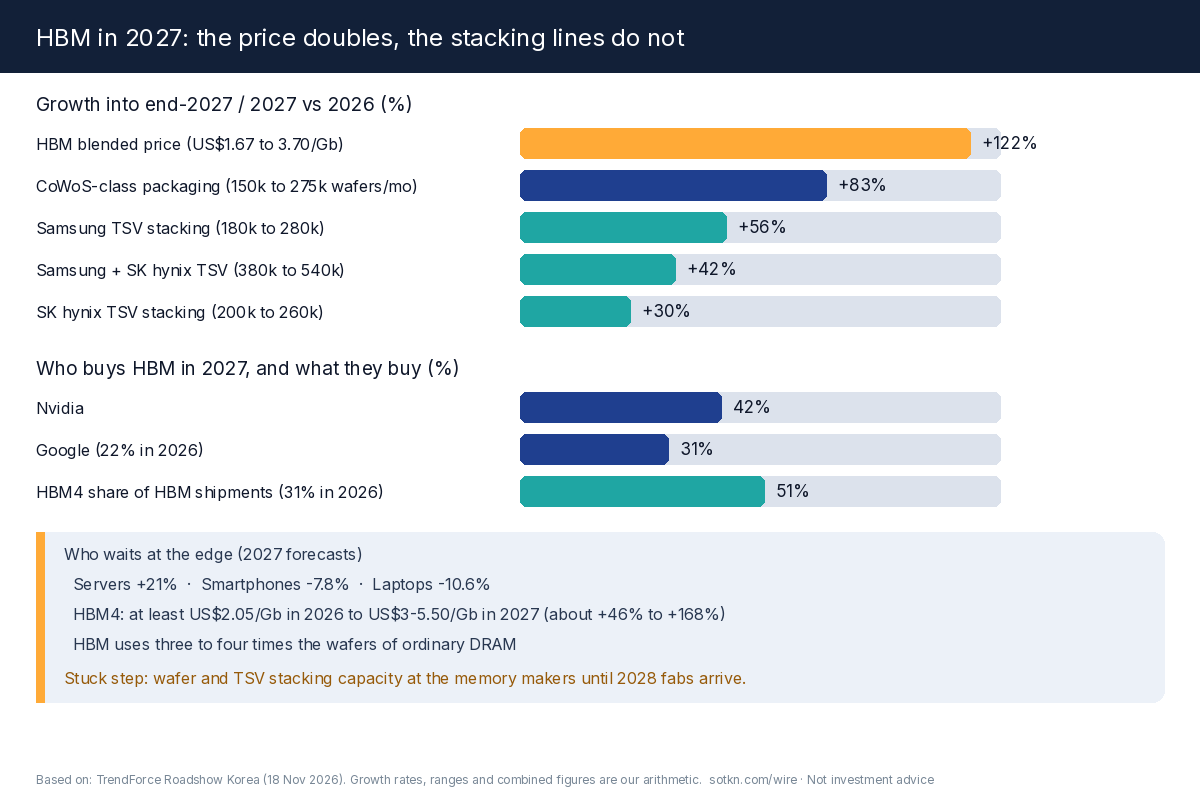
Figure: price rises faster than the stacking lines. HBM prices, HBM4 share, buyer shares, stacking (TSV) capacity, CoWoS capacity and device forecasts from TrendForce's Roadshow Korea (18 November 2026). Multiples and growth rates are our arithmetic.
The step that is still open
The stuck step is wafers. TrendForce says HBM needs three to four times the wafer resources of ordinary DRAM for the same output, so every wafer moved to HBM takes more than one wafer's worth of supply away from servers, PCs and phones. That is why it does not see ordinary DRAM prices falling in any quarter of 2027, even as the pace of rises slows.
Stacking capacity is growing, but not as fast as the price. TrendForce sees Samsung's through-silicon via (TSV) capacity, the step that wires DRAM dies into a stack, rising from 180,000 to 280,000 wafers a month by the end of 2027, and SK hynix's from 200,000 to 260,000. Together that is 380,000 to 540,000, about 42% more, on our arithmetic. Over the same period TrendForce sees CoWoS-class packaging, where HBM meets the GPU, rising from 150,000 to 275,000 wafers a month, about 83% more. The packaging lines are growing about twice as fast as the memory stacking lines, which leaves memory as the narrower gate in 2027.
Buyers are already designing around it. GPU and chip makers are moving to eight-layer HBM4 stacks, which TrendForce expects to overtake 12-layer stacks in the second half of 2027. Fewer dies per stack spreads scarce memory across more chips. It does not make memory cheaper: in September TrendForce said eight-layer stacks carry a 10% to 20% premium per gigabit because each stack still needs its own base die.
The second-order read
Who gets paid. SK hynix, Samsung and Micron, through a price that roughly doubles on volume that grows far more slowly. Packaging houses next: TrendForce sees advanced packaging revenue at foundries rising 118% in 2027, to more than 10% of a foundry market it puts at US$294.4 billion.
Who funds the wait. Nvidia, with US$390 billion of supply commitments, much of it memory bought years ahead. Google, whose share of HBM demand rises to 31% as it builds more TPUs. Behind both, the big clouds, whose capex TrendForce sees rising 60%.
Who waits. Phone and PC makers, who lose memory to servers and are forecast to ship fewer units: smartphones -7.8%, laptops -10.6%.
Stuck step. Wafer and TSV stacking capacity at the memory makers, until new fabs arrive in 2028.
The risk sits in 2028. TrendForce expects new capacity from Samsung's P5 in Pyeongtaek, SK hynix's Yongin site and China's CXMT, and it flagged a risk that data center construction slips after 2028. If both happen at once, the price that doubles in 2027 is the one that turns.
Three cautions
This is a forecast, not a contract price. HBM is sold on negotiated supply deals, and TrendForce's ranges are wide: US$3 to US$5.50 for HBM4 is nearly a two-times spread.
TSV and CoWoS wafers are not the same unit. Our comparison of their growth rates shows direction, not bits; an HBM stack and a CoWoS package use wafers very differently.
A higher blended price partly reflects mix. As HBM4 rises to 51% of shipments, the average rises even if each product's price held still. The multiples, growth rates and buyer total here are our arithmetic on TrendForce's figures.
What to watch
- Coming weeks: Nvidia's 10-Q for how much of the US$390 billion of commitments is memory, and with whom.
- 2027 HBM supply deals: whether SK hynix, Samsung or Micron confirm 2027 HBM4 prices inside TrendForce's US$3 to US$5.50 range.
- Second half of 2027: eight-layer HBM4 overtaking 12-layer stacks, a sign buyers are rationing memory per chip.
- 2028: Samsung P5, SK hynix Yongin and CXMT capacity, against any slip in data center construction.
Read: the Semiconductors layer, What Is HBM?, Who Makes HBM, Who Makes DRAM?, What Is CoWoS?, Intel's CEO says memory costs 6-7x more and Nvidia sells $115.8B in a quarter; customers still owe it $81B
Get the Wire. A free brief every day, here and in your inbox. Subscribe free →
If this Wire saved you a search, tip Second Order → sotkn.com/support
Not investment advice. Do your own research. The price multiple, HBM4 price range in percent, combined buyer share, combined TSV growth, CoWoS growth and packaging-versus-stacking comparison are our arithmetic on TrendForce figures.
References
- ChosunBiz, "AI demand to reshape memory market and drive up chip packaging revenue", 18 Nov 2026. TrendForce Roadshow Korea: HBM and HBM4 prices, shares, TSV and CoWoS capacity, foundry and device forecasts.
- Semi Doped, "Daily Update - November 18th, 2026", 18 Nov 2026. TrendForce DRAM outlook and Nvidia supply commitments.
- TrendForce, "HBM Supply Constraints Persist, 2027 Price Outlook Revised Upward with Blended ASP Forecast to Rise 121% YoY", 29 Sep 2026. Eight-layer stacks and per-gigabit premium.
- NVIDIA, "CFO Commentary on Third Quarter Fiscal 2027 Results" (Exhibit 99.2), 17 Nov 2026. Supply commitments.